CHAPTER 1: The Paper on the Diner Table
Part 1
“Sign the paper, Clara, or you leave Oak Creek with nothing but the clothes on your back.”
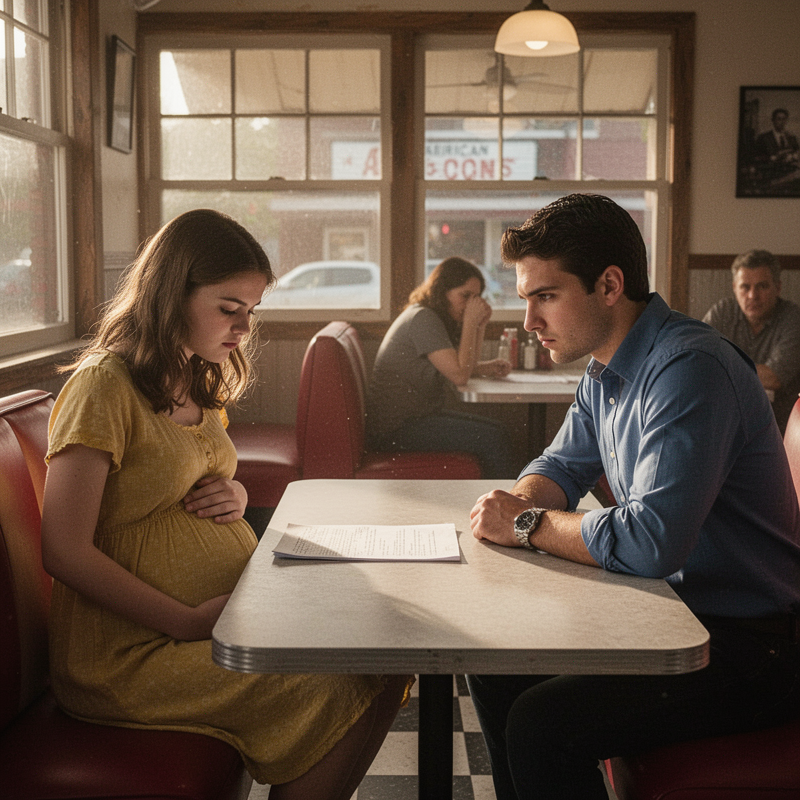
My husband, Derek, slid the divorce agreement across the laminate table of the town diner, knowing I was eighteen years old and eight months pregnant.
He insisted I wouldn’t survive two weeks on my own, claiming the baby wasn’t even his to spare his family’s reputation in our small town.
I took the pen with trembling fingers, completely surrounded by quiet townspeople who looked away rather than meet my eyes.
Then a black luxury sedan pulled up onto the gravel outside, and a woman with my exact pale green eyes walked through the door holding a manila folder.
The pen felt impossibly heavy in my shaking hand. My knuckles were white as I gripped it, the tip hovering just inches above the signature line.
My gaze drifted from the cold, sterile paper to the bustling diner around us. Mrs. Henderson, our next-door neighbor, pretended to be deeply engrossed in her chili bowl.
Across the room, old Mr. Abernathy, who had known me since I was a baby, suddenly found the checkered linoleum floor fascinating.
Not a single person met my eyes, not even the waitress who usually gave me an extra slice of pie. They all just watched, or meticulously avoided watching, the drama unfolding at our table.
The air in the Oak Creek Diner was thick with the smell of fried onions and stale coffee. But all I could taste was the bitter metallic tang of fear.
My stomach, swollen with the life growing inside me, felt like a lead weight. A sharp kick from within reminded me of the stakes. This wasn’t just about me anymore.
Derek Albright, my husband of barely a year, leaned back in his chair, a smug smirk playing on his lips. His expensive watch glinted under the fluorescent lights.
He was twenty-four, the golden boy of Oak Creek, manager of Albright Building Supply—the family business that practically built this town of 3,200 people.
He enjoyed this, the public spectacle of my humiliation.
“Don’t waste my time, Clara,” he drawled, his voice low but carrying just enough to reach the ears of nearby patrons.
“You know you have nothing. No family to run to, no money to your name.”
My throat tightened. It was true. My foster grandmother, who raised me, had passed away six months ago. Derek knew I was completely alone.
“Those non-refundable deposits for the nursery?” he continued, his eyes glinting with cruel satisfaction. “That expensive crib and stroller you picked out?”
He chuckled softly.
“Poof. Gone. You won’t see a dime. The contract is clear.”
A fresh wave of despair washed over me. I’d spent months saving up the meager tips from my part-time job at the general store, pouring every cent into preparing a loving space for my baby.
Now, even those small comforts were being ripped away.
My hand automatically went to my swollen belly, a silent plea, a desperate comfort. My baby. I had to protect my baby.
Just then, a hush fell over the diner. It wasn’t the quiet of people pretending not to listen; it was a sudden, expectant silence.
The clatter of plates stopped. The low hum of conversation vanished.
Every head in the diner, including Derek’s, turned towards the door.
A sleek black luxury sedan, a model I’d only ever seen in magazines, was parked awkwardly on the gravel lot outside.
Its polished surface reflected the late afternoon sun, momentarily blinding me.
Then, a woman emerged from the car. She moved with an undeniable grace, her posture radiating an authority that silenced the casual chatter of Oak Creek.
Her tailored navy suit was impeccably cut. Her dark hair was pulled back into a sophisticated knot.
But it was her eyes that made my breath catch.
They were a pale, striking green, exactly like mine.
She carried a thick, tan manila folder, clutching it purposefully against her side.
Without hesitation, she walked straight into the diner, her gaze sweeping the room until it locked onto our table.
She didn’t smile. Her expression was calm, resolute, and utterly unreadable.
She held the folder in one hand, her knuckles white, and walked directly towards us.
Part 2
She stopped at our table, her pale green eyes, so like mine, assessing everything around her.
“Clara Albright?” she asked, her voice calm and clear, cutting through the diner’s stunned silence.
I could only nod, my voice caught in my throat. Derek, however, managed to find his.
“Who are you?” he demanded, annoyance clear in his tone. “We’re in the middle of something important here.”
She ignored him completely. Her gaze was fixed on me.
“My name is Evelyn Davenport,” she said, her voice carrying a quiet authority. “I’m a regional land investor from the next county over.”
She laid the thick manila folder on the table, right on top of Derek’s divorce papers.
“And I believe you’re my daughter.”
Derek spluttered, his smug expression replaced with a look of stunned disbelief. He looked like he’d been slapped.
“Eighteen years ago,” Evelyn continued, her eyes unwavering, “you were illegally funneled through a corrupt private adoption. I’ve been looking for you ever since.”
She opened the folder. Inside were several documents, neatly organized.
She slid two pieces of paper across the table towards me.
One was a lab report, printed with official letterhead: “DNA Match: 99.99% Maternal.”
The other was a faded, official-looking document, a birth registry. My name, Clara Higgins, was there. My birth date. And next to “Mother,” printed clearly, was “Evelyn Davenport.”
My breath hitched. The entire diner was silent, every eye glued to our table. I stared at the papers, my mind reeling.
Derek finally found his voice again, though it was strained. “What is this nonsense?” he blustered, trying to sound authoritative but his voice cracking. “This is some kind of scam, Clara, is this your doing?”
Evelyn finally turned her piercing green eyes to Derek.
“No, Mr. Albright,” she stated, her voice icy. “This is a rescue. And about your claim that Clara is leaving with ‘nothing’ because you have ‘no assets’…”
She reached back into the folder, pulling out another, much thicker set of documents.
This wasn’t a birth registry. It was a financial ledger, thick with figures and dates.
She slapped it down on the table with a soft thud, right beside the divorce papers and my birth certificate.
“That,” Evelyn declared, pointing to the open ledger, her voice resonating through the silent diner, “is also entirely false.”
CHAPTER 2: The Hidden Accounts of Oak Creek
Evelyn set a crisp white folder on top of the laminate table, right beside my signed divorce decree.
She pulled out three printed financial statements, each bearing the red stamp of First National Bank of Ohio.
“You told my daughter she had no claims to marital property, Derek,” Evelyn said.
Her voice was low and controlled, carrying across the silent diner.
“You claimed your business holdings were worth under fifty thousand dollars total.”
Derek scoffed, leaning back in his booth with his arms crossed over his chest.
“That’s what the town tax filings say,” Derek said. “She gets nothing. She signed the paper.”
“Harlan Finch signed those tax filings for you,” Evelyn replied, sliding a paper toward him. “But these records show an offshore account in Grand Cayman under your personal legal name.”
Derek’s posture went rigid.
“That account holds one million, four hundred and twenty thousand dollars,” Evelyn said.
A loud gasp came from the counter behind us. Mrs. Gable dropped a coffee spoon onto the tile floor.
“That’s impossible,” Derek muttered, his fingers twitching against his knuckles. “That’s private business.”
“It’s undisclosed marital capital,” Evelyn said. “And these records prove you undervalued the commercial storage lots on Highway 35 by eighty percent.”
“Who gave you those documents?” Derek demanded, his jaw tight.
“A formal subpoena will be served to Harlan Finch’s office by eight in the morning,” Evelyn said.
Derek looked around the diner.
Old man Peters was staring directly at him from booth four. Two women from the church committee were whispering behind their paper menus.
Derek stood up so fast his knee slammed the underside of the table, rattling the salt shakers.
“This is garbage,” Derek hissed, snatching his keys off the Formica top. “You think you can come into Oak Creek and pull this stunt?”
“The paper trail is already with the regional tax authority,” Evelyn said without looking up.
Derek pointed a finger directly at my face.
“You’re going to regret this, Clara,” Derek spat out. “By tomorrow morning, everyone in this town will know what kind of snake you really are.”
He shoved past the diner entrance, the screen door slamming violently behind him into the heavy rain.
CHAPTER 3: The Flyers on Main Street
The air smelled like wet asphalt and damp wood when I stepped outside the next morning.
By seven o’clock, Derek had already gone to work on the town.
Printed white paper flyers were stapled to every wooden utility pole along Main Street, right outside the hardware store and the bakery.
A large black headline read: *THE TRUTH ABOUT CLARA HIGGINS.*
The text claimed I had faked my pregnancy timeline to trap the Albright family into a quick marriage. It alleged I was conspiring with out-of-town land speculators to ruin a local family business.
On the “Oak Creek Community Buzz” Facebook page, Derek had posted three separate long messages detailing false claims about my character.
I walked down the gravel shoulder toward the local corner grocery to buy a carton of whole milk.
The bell above the door chimed as I walked inside.
Behind the register sat Sarah Miller, a woman who had known my late foster grandmother for twenty years.
I carried the milk carton to the counter and set down three one-dollar bills.
Sarah scanned the carton without making eye contact.
“That will be two dollars and forty cents,” Sarah said, keeping her head down.
“Good morning, Sarah,” I said gently.
She slid the change across the counter without looking up.
“Have a good day, Clara,” she murmured, turning her back immediately to restock a rack of gum.
I stood there for a moment, feeling the cold weight of the store’s silence.
A customer near the bread aisle turned his shopping cart around and walked down another aisle to avoid passing me.
The Albright family had built the town’s primary building supply store thirty years ago. In Oak Creek, people believed the name on the side of the main warehouse before they believed an eighteen-year-old girl with no family left.
I took my paper bag and stepped back out into the morning breeze.
CHAPTER 4: A Whisper in the Supply Yard
At ten o’clock, I walked down the gravel alley behind Albright Building Supply.
My personal clothes and high school yearbooks were still stored in the back cab of Derek’s work truck, parked near the lumber stacks.
The heavy smell of fresh-cut pine filled the humid air.
As I reached for the truck’s door handle, a hand reached out from between two stacks of drywall and gently tapped my shoulder.
I turned quickly, my hand resting over my bump.
Gabe Carver stood there, wearing his grease-stained yellow work vest and heavy boots. He was twenty-one and had worked as Derek’s yard assistant for two years.
“Clara,” Gabe whispered, looking over his shoulder toward the main office windows. “Get back behind the cedar posts.”
“I just came for my boxes, Gabe,” I said.
“Listen to me,” Gabe said, pulling a small silver USB flash drive from his vest pocket. “Derek is lying to everyone. He had me haul three filing boxes out to his personal shed last month.”
He held out the silver drive toward my hand.
“What is this?” I asked.
“It’s the dual ledgers,” Gabe whispered, his voice trembling slightly. “Derek paid Harlan Finch fifteen thousand dollars in cash off the books last November.”
“Cash?” I asked.
“I saw the withdrawal stub,” Gabe said. “Finch wrote down the low appraisal values on purpose so the business looked broke during your marriage.”
“Why are you giving this to me, Gabe?” I asked. “If Derek finds out, he’ll fire you today.”
“He treated you like trash in front of the whole diner yesterday,” Gabe said, setting the drive in my palm. “My mom saw it. He thinks he owns this town. Take it.”
Footsteps crunched on the gravel near the main driveway.
Gabe stepped back into the shadows of the lumber aisle without another word.
CHAPTER 5: Frozen Out at the Local Bank
I walked straight from the supply yard to Oak Creek Community Bank on Front Street.
The lobby smelled of brass polish and air conditioning.
I approached the teller counter where an older woman named Linda sat behind the glass partition.
“Hi, Linda,” I said. “I need to withdraw four hundred and fifty dollars from my savings account, please.”
That four hundred and fifty dollars was the remaining money from my summer job at the public library.
Linda typed my name into her terminal screen.
Her fingers paused on the keyboard. A dark red blotch rose up her neck.
“Clara,” Linda said, her voice dropping down to a faint whisper. “I can’t process this transaction.”
“Why not?” I asked. “It’s my personal account. It was opened before I got married.”
“Arthur Albright placed an administrative freeze on the account an hour ago,” she said.
Arthur Albright was Derek’s father, and he sat on the bank’s board of directors.
“He isn’t a joint owner on my savings,” I said, leaning closer to the counter.
“He filed a legal notice claiming all marital assets are subject to restraint until the divorce hearing,” Linda said, refusing to meet my eyes.
“It’s four hundred and fifty dollars for baby supplies,” I said clearly.
“I’m sorry, Clara,” Linda said, closing the account file on her screen. “My hands are tied. Management’s orders.”
A man standing behind me in line adjusted his hat and looked down at his boots.
I folded my slip of paper, put it back in my coat pocket, and walked out of the double glass doors into the midday heat.
They wanted to cut off every dollar I had left until I came back to Derek on my knees.
I walked the three blocks back to my small rented cottage on the edge of town, holding my stomach as a sharp kick hit from the inside.
CHAPTER 6: The Secret in the Attic
By four o’clock that afternoon, Evelyn arrived at the rental cottage carrying a paper bag full of yellow cotton onesies and a warm thermos of tea.
We sat on the small laminate table in the tiny kitchen.
“You look exhausted, Clara,” Evelyn said, pouring tea into two porcelain mugs.
“Derek froze my four hundred and fifty dollars at the local bank,” I said. “And the flyers are all over Main Street.”
“The flyers won’t matter by next week,” Evelyn said calmly. “My legal team in Columbus is filing an emergency motion for interim support.”
She took a sip of her tea and looked across the table at me.
“You know,” Evelyn said softly, “when I got that message from the registry four months ago, I couldn’t believe it.”
I looked down at my tea mug, watching the steam rise.
“You thought it was a coincidence that you found me,” I said.
Evelyn paused, setting her mug down on the saucer.
“What do you mean?” she asked.
“I found the adoption papers in my foster grandmother’s attic back in January,” I said. “In an old cedar trunk under three wool blankets.”
Evelyn’s pale green eyes—the exact shade of mine—widened slightly.
“The file had an original clinic receipt from Harrison County,” I said. “It had Harlan Finch’s signature as the legal witness, and your maiden name listed on the intake ledger.”
“You tracked me down first?” Evelyn asked quietly.
“I sent my cheek swab to the regional DNA database three days after I found the box,” I said. “I knew who you were before Derek ever brought up a divorce.”
Evelyn stared at me, her hands resting flat on the wooden tabletop.
“Why didn’t you tell me when the match came back?” she whispered.
“Because I needed to know what Derek was going to do,” I said. “And I needed to make sure he did it where everyone could see.”
CHAPTER 7: The Mastermind Behind the Table
Evelyn sat back in her chair, observing me with a look that shifted from worry to complete stillness.
“You let him push you,” Evelyn said.
“Six months ago, Derek started moving money,” I said. “He stopped putting cash into our shared checking account. He bought two commercial lots using shell company names.”
“You knew he was hiding assets back then?” she asked.
“I found a bank statement in his truck glove box in February,” I said. “I knew if I hired a lawyer in town, his father would hear about it in twenty minutes.”
“So you waited,” Evelyn said.
“I waited until he thought I had no options left,” I said. “When he told me to meet him at the diner yesterday to sign the zero-asset papers, I didn’t refuse.”
“You chose the diner on purpose,” Evelyn said.
“It’s the busiest hour of the day,” I said. “At noon, every business owner in Oak Creek sits at those counter stools. If he had signed those papers in a private lawyer’s office, he could have lied about what happened.”
I took the silver USB drive Gabe had given me out of my pocket and set it on the table between us.
“Derek thought he was marrying an eighteen-year-old girl with no family to protect her,” I said. “He thought I would cry, sign the paper, and vanish.”
Evelyn picked up the USB drive, running her thumb over the metal edge.
“This holds the actual construction yard ledgers,” I told her. “Paid in cash to Harlan Finch.”
A faint smile appeared on Evelyn’s face.
“You aren’t anything like what he thought you were, Clara,” she said.
“I’m protecting my baby,” I said. “I’m not going to let him turn my child into a beggar in this town.”
CHAPTER 8: Burning the Appraisals
At nine o’clock that night, light shone through the small ground-floor window of Harlan Finch’s accounting office on Elm Street.
The office sat in a narrow alley behind the town library.
Inside, Harlan Finch stood over a metal trash bin beside his desk, holding a heavy pair of iron shears and a butane lighter.
Stack after stack of yellow ledger pages and property appraisal sheets lay piled on his desk.
Outside in the dark alley, Gabe Carver stood pressed flat against the damp brick wall of the library.
He held his phone steady in two hands, pointing the camera lens right through the uncurtained glass window.
Inside, Finch struck the lighter flame.
The amber light caught the top page of an appraisal document labeled: *ALBRIGHT COMMERCIAL STORAGE — REVISED TAX EVALUATION.*
Finch dropped the burning corner into the metal bin. Thick gray smoke billowed up toward the ceiling tile.
Gabe zoomed the phone camera in, capturing Finch’s face, the header of the document, and the pile of matching duplicate ledgers sitting on the desk.
“Got you,” Gabe whispered under his breath.
Finch dumped another handful of sliced papers into the flames, fanning the smoke with a cardboard file folder.
Gabe backed down the alley quietly, his rubber-soled boots making no noise on the wet asphalt.
Once he reached the corner under the streetlamp, he tapped his phone screen three times.
He sent the high-definition video file directly to Evelyn’s attorney in Columbus and to the public email address of the State Tax Fraud Investigation Unit.
By nine-fifteen, the file was delivered.
CHAPTER 9: The Wall of Silence
The next afternoon, Derek walked up the wide brick steps of the town square outside the county courthouse.
Around twenty local business owners, including the hardware store manager and the chief of the volunteer fire department, stood near the fountain talking in hushed groups.
Derek carried a thick leather portfolio under his arm. He wore his neat blue collared shirt with the Albright Building Supply logo embroidered on the chest.
“Hey, everyone,” Derek called out, stepping onto the top brick landing. “I want to say a few words about these vicious rumors going around town.”
Nobody answered.
Derek cleared his throat, adjusting his portfolio.
“My family has built this town for thirty years,” Derek said, his voice dropping an octave as he tried to sound confident. “We’ve supported every Little League team and fire house drive in this county.”
Old man Peters turned around slowly from the edge of the fountain.
He didn’t yell. He didn’t wave a hand.
He simply looked Derek up and down, turned his back entirely, and walked across the street toward the hardware shop.
Sarah Miller’s husband followed him without saying a single word.
One by one, the other business owners turned away. They didn’t argue. They didn’t ask questions.
By twelve-thirty, the video of Harlan Finch burning the tax documents had been forwarded across forty local phones. The county auditor’s office had already posted an official notice of emergency tax assessment on Finch’s front door.
Derek stood alone on the wide brick steps.
His hands shook as he gripped his leather portfolio.
“Hey!” Derek shouted toward the emptying square. “I’m talking to you!”
The wind blew a stray white flyer across the red brick floor, brushing against the toe of his leather shoe.
No one looked back.
CHAPTER 10: The Disowning of Derek Albright
By eight o’clock that evening, a formal statement was taped to the glass front doors of Albright Building Supply.
It was signed by Arthur Albright.
The statement announced that Derek Albright had been officially removed from his position as general manager, effective immediately.
The statement claimed the company was cooperating fully with all county tax inquiries and that Arthur Albright had taken over full operational control.
In the back office of the main warehouse, the lights were turned off.
Derek sat alone at his wooden desk, staring at his computer screen. The monitor displayed an empty inbox—no returned calls from his suppliers, no messages from his local friends.
His desk phone rang once.
Derek snatched the receiver up instantly.
“Dad?” Derek said.
“Pack your personal items and leave the keys on the counter,” Arthur Albright’s voice said over the speaker. His tone was cold and dry.
“Dad, we can fight the audit,” Derek said, his voice straining. “Finch said he could handle the county—”
“Finch is meeting with state investigators at nine tomorrow morning,” Arthur interrupted. “You brought this into my business, Derek. You brought this family into the newspapers.”
“She set me up!” Derek shouted into the receiver. “Clara set the whole thing up!”
“You tried to take everything from an eighteen-year-old girl carrying your baby in front of forty people at the diner,” Arthur said. “You made us look like monsters.”
The line went dead.
Derek sat in the dark office for ten minutes, listening to the hum of the overhead refrigerator unit.
No sheriff’s car drove into the parking lot with flashing lights. No handcuffs were clicked shut.
The legal system moved slow, cold, and quiet, leaving him sitting in an empty room with nothing left to manage.
CHAPTER 11: An Unsettled Dusk
By nine o’clock, dusk settled over Oak Creek.
The air was cool and crisp, carrying the scent of damp leaves from the woods behind my rented cottage.
I sat on a wooden rocking chair on the small front porch, wrapped in a thick wool blanket, folding a set of pale blue baby washcloths into neat squares.
Evelyn’s car was parked behind the house, her lawyer still working on papers inside the kitchen.
Down at the end of the long gravel driveway, sixty feet away near the mailbox, a black pickup truck pulled up to the shoulder.
It was Derek’s truck.
The engine remained idling, sending a faint cloud of gray exhaust into the darkening air. The headlights were turned off.
Derek sat inside behind the glass, his silhouette visible against the fading evening sky.
He did not open the truck door. He did not step out onto the gravel.
I didn’t get up from my chair. I didn’t go inside the house.
I kept my hands steady, folding the small baby clothes one after another in the quiet twilight.
The financial lawsuits were still pending in county court. The custody battle would begin the moment my child was born next month.
The town around us remained dead silent, caught between two sides of a fight that was far from finished.
In a town where everyone knows your name, silence speaks louder than any verdict ever could.
Leave a Reply