CHAPTER 1: The Sixth Sunflower Stalk
Part 1
Six years ago, my daughter Maya died in what our landlord, Marcus Gable, called an unpreventable utility room structural accident at our office incubator building.
Every year on October 14th, my son Julian sets out six potted sunflowers on our suite’s balcony to honor his twin sister’s memory.
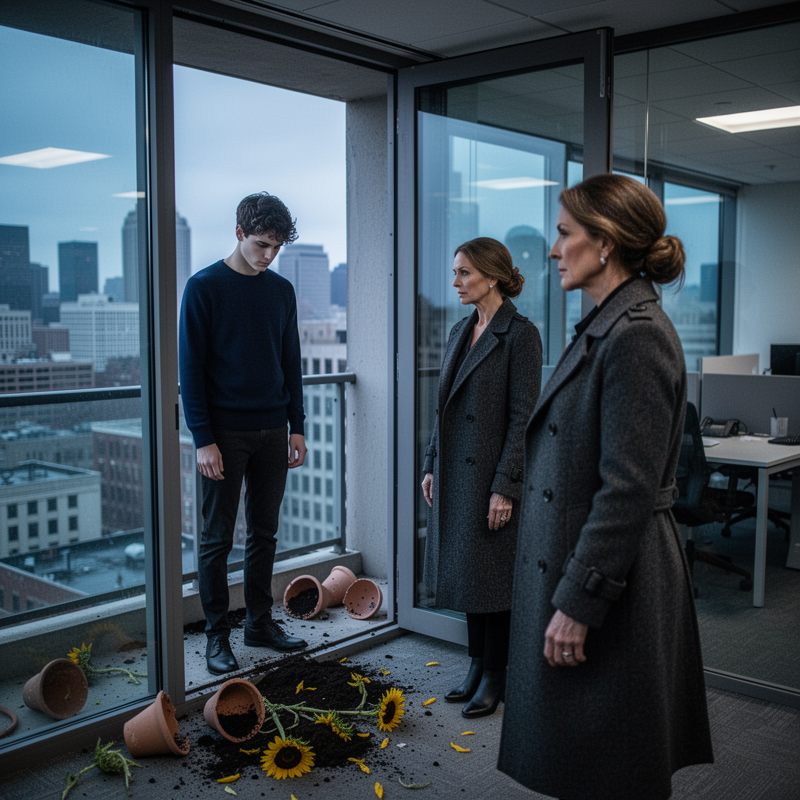
This morning, on the sixth anniversary, we arrived at our office to find every sunflower chopped to pieces, except for one stalk holding a sealed white metal box.
Inside was an original 2018 municipal work order signed by Marcus Gable himself, proving he illegally removed a load-bearing wall to create extra rental space three days before the collapse.
He didn’t just cause the structural failure that took Maya’s life; he spent six years framing my daughter for improper equipment storage to protect his commercial real estate empire.
The fluorescent lights of the fourth-floor hallway hummed, a familiar, sterile drone that usually faded into the background of my day. This morning, it grated. Julian walked ahead of me, his usual brisk pace muted by the somber weight of the date.
October 14th. Six years.
We reached Suite 402. Our firm, Holloway & Associates, occupied the corner space, with its small, private balcony overlooking the city’s quiet downtown. Julian paused at the glass door, his hand hovering over the handle. He always did this on this day. A small, silent moment before facing the memories inside.
I watched him, my chest tight. He was 22 now, tall and slender like Maya had been. The same dark, intense eyes.
He pushed the door open, the soft click echoing in the pre-dawn quiet of the office. Our office was usually the first to arrive.
“I’ll get them set up,” Julian murmured, already heading for the small kitchenette where we stored the pots.
Every year, he bought six potted sunflowers. One for each year since Maya was gone. He’d arrange them carefully on the balcony, a vibrant splash of yellow against the grey urban landscape, a small act of defiance against the silence.
I walked to my desk, the usual clutter a comforting anchor. I started sorting through emails, trying to immerse myself in the familiar rhythm of work. A distraction.
A gasp, sharp and sudden, tore through the quiet.
It wasn’t a sound of surprise, but of pure, raw fury.
I looked up, my heart leaping. Julian stood frozen by the balcony door, his back to me. His shoulders were stiff, coiled.
“Julian?” I called, my voice soft, cautious.
He didn’t answer. He just stood there, staring out at the small concrete slab.
I pushed back my chair, the wheels squeaking softly, and walked towards him. As I approached, the scene on the balcony slowly came into view.
My breath hitched.
The six sunflowers weren’t there. Not whole, anyway.
Instead, the pots were overturned, ceramic shards glinting on the pavement. Rich potting soil was scattered everywhere, mingling with the torn petals and mangled stems of what had once been vibrant blossoms. It looked like a small, violent explosion had occurred.
Julian turned, his face pale, his jaw clenched so tightly I could see the muscle twitching. His eyes burned with an icy rage I rarely saw, a protective fire that flared when Maya was involved.
“They… they destroyed them,” he whispered, his voice raspy with disbelief.
My gaze swept across the devastation. Not a single bloom remained intact. This wasn’t an accident. This was deliberate. A message.
A cold dread coiled in my stomach.
Then, I saw it. Amidst the chaos of shattered pottery and plant matter, one stalk remained upright. It was bare, stripped of its leaves and petals, but still rooted in its small, intact pot.
And attached to it, with a length of thick, silver wire, was a small, white metal box. It was industrial, perhaps a heavy-duty junction box, roughly five inches square, sealed tight.
Julian’s eyes followed mine. He walked to the edge of the balcony, careful not to step on the destroyed flowers. He reached out, his fingers brushing the cool, smooth metal.
“What is that?” he murmured.
My mind raced. Who would do this? Who would be so cruel, so callus, on this specific day? And why leave a box?
I stepped onto the balcony, crunching softly on a ceramic piece. The morning air was crisp, carrying the faint scent of exhaust fumes from the street below.
“Don’t touch it yet,” I said, my voice steady despite the tremor in my hands.
I examined the box. It had no markings, no labels. The silver wire was tightly twisted around the bare stalk, securing the box firmly. It felt heavy.
“It’s sealed,” Julian observed, trying to pry at the edges with his fingernail. “Like it’s welded shut.”
“It’s not welded,” I said, my fingers tracing a faint seam. “There are tiny screws along the side. Probably a Phillips head.”
I went back inside, rummaging through a desk drawer until I found my small, multi-tool. My heart hammered in my chest, a frantic drumbeat. This wasn’t just vandalism. This felt… personal. And calculated.
I returned to the balcony, the multi-tool cool in my palm. Julian stood back, watching me with a mixture of anger and apprehension.
“Be careful, Mom,” he warned, his voice low.
I knelt beside the pot, steadying the stalk with one hand. The screws were small, almost flush with the metal. I engaged the Phillips head and slowly, methodically, began to loosen them. The faint squeak of metal against metal sounded incredibly loud in the silence.
One, two, three, four.
The small lid came free with a soft pop.
A faint, metallic scent, like old paper and machinery, wafted up.
Inside, nestled on a thin layer of foam, was a single, folded sheet of paper. It looked old, yellowed slightly at the edges, but carefully preserved.
My fingers trembled as I reached in and unfolded it. It was a municipal work order, dated October 8th, 2018. My eyes scanned the heading, the project description. “Utility Room Structural Refit – Suite 402, Gable Commercial Center.”
My blood ran cold. October 8th. That was three days before Maya died.
The “structural refit.” Marcus Gable had always insisted it was a minor, unpreventable accident, a failure of old piping that led to the utility room wall giving way. He’d said Maya’s equipment, stored improperly, had exacerbated the collapse.
But this document…
I read it again, my eyes lingering on the specific language: “Authorization for removal of non-load-bearing partition, to be replaced with reinforced access panel.”
And then, the fine print below, almost an afterthought: “Note: Engineer’s assessment indicates adjacent wall may bear partial load. Proceed with caution. Re-evaluation required post-removal.”
My breath hitched. Partial load. Re-evaluation required. He hadn’t just removed a wall; he had done it against a warning.
My gaze snapped to the bottom of the form. A signature, bold and unmistakable. Marcus Gable.
A roar filled my ears, a silent, internal scream of anguish and rage. Not an accident. Not improper storage. It was him. All this time, he knew. He blamed Maya to cover his own crime.
Six years. He let us believe it was an accident. He let me believe a part of it was my fault, for not checking her storage, for not foreseeing a disaster he orchestrated.
My hands clenched around the paper, crinkling the aged municipal form. The world outside the balcony, the city waking up, the gentle breeze, all faded into a meaningless hum. There was only this document, this undeniable proof.
A heavy shadow fell across the balcony.
I looked up, my vision still blurring with unshed tears and burning anger.
Marcus Gable stood in the doorway of Suite 402, flanked by two burly security officers in crisp grey uniforms. He wasn’t smiling. His eyes, usually glinting with a practiced geniality, were hard, cold.
He held a folded piece of paper in his hand.
Part 2
Marcus Gable stepped onto the balcony, his two security officers waiting just inside the suite. The fluorescent hum seemed to press in on us. Julian moved to stand beside me, a silent, protective presence.
Gable’s eyes, usually calculating, now held a cold, unwavering intensity. He looked past the shattered pots and the destroyed sunflowers, past the white metal box, and directly at the work order still clutched in my trembling hand. A flicker of something, perhaps triumph, crossed his face.
“Ms. Holloway,” he said, his voice flat, devoid of his usual pleasantries. “I believe you have something of mine.”
He extended the folded paper in his hand towards me. It was an official document, its stark white surface a sharp contrast to the old, yellowed work order I held. My gaze dropped to the bold, red letterhead: “Gable Commercial Properties – Urgent Lease Action.”
My heart pounded, a frantic drum in my chest. This wasn’t a conversation. It was an execution.
“This is a formal 72-hour commercial eviction notice,” he stated, his words clipped and precise. “Effective immediately. Your firm is in violation of multiple structural code requirements, as verified by municipal inspector Arthur Pendelton.”
He pointed to a stamp near the bottom of the page, a crisp black seal with the city logo and Pendelton’s name.
“You are to vacate Suite 402 and surrender all keycards by Friday at 5:00 PM,” Gable continued, his gaze unwavering. “Failure to comply will result in law enforcement intervention to remove all personnel and property.”
I stared at the document, then back at him. My mind struggled to catch up. He wasn’t addressing the work order, the proof of his guilt. He was attacking us.
The timing wasn’t a coincidence. He had found out about the box somehow, or maybe he knew the evidence was out there and he was just waiting. Now, with the proof of his crime literally in my hand, he was moving to shut us down, to remove us from the building he wanted to tear apart.
He was trying to make sure I couldn’t use the work order against him. He was cutting off our access, our very presence, before I could even begin to fight back.
CHAPTER 2: The Inspector’s Ledger
The fluorescent lights in Room 304 of the Municipal Building buzzed with a low, relentless hum.
Arthur Pendelton sat behind a metal desk stacked with blue zoning maps and yellowed inspection folders. He didn’t look up when the heavy oak door clicked shut.
I walked to the front of his desk and laid the original 2018 municipal work order flat on his desk pad.
The paper was crisp, bearing the official city stamp and Marcus Gable’s dark ink signature authorizing the removal of the utility room load-bearing wall.
Pendelton’s hands froze over a red ink pad. His face turned gray under the glare of the ceiling lights.
“Where did you get this?” he whispered, his voice cracking.
“It was left on my balcony this morning,” I said. “Three days before the collapse, you cleared that utility room for storage. Then yesterday, you signed Gable’s 72-hour emergency eviction notice for my suite.”
Pendelton closed his eyes and leaned back against his vinyl chair. His knuckles were white against the armrests.
“You don’t understand how Marcus works, Evelyn,” he said, staring at the ceiling. “I didn’t have a choice.”
“You had a choice six years ago,” I said. “And you have one now.”
Pendelton pulled a worn leather binder from his bottom drawer and slid it across the desk toward me.
Inside was a single legal document stamped by a private mortgage servicing firm dated three months ago.
“Marcus didn’t bribe me with cash,” Pendelton said softly. “My wife had surgery last year. We fell behind on our house payments. Marcus quietly bought out my defaulted $210,000 mortgage note from First County Bank.”
He pointed a trembling finger at the bottom clause of the mortgage agreement.
“He holds my personal debt, Evelyn,” Pendelton said. “If I don’t sign his emergency structural violation orders when he asks, he initiates immediate foreclosure on my family’s home. He threatened to throw us onto the street by Monday.”
“So you signed an eviction notice claiming my suite is unsafe,” I said, the cold truth settling into my chest.
“He called me at six yesterday morning,” Pendelton admitted, pulling his glass of water closer. “He told me if I didn’t certify Suite 402 as an immediate structural hazard by noon, my house would go to public auction.”
CHAPTER 3: A Shadow on the Balcony
At 1:15 PM, Julian pushed open the heavy steel door to the basement maintenance hub beneath Gable Commercial Center.
The room smelled of motor oil, damp concrete, and rusted iron piping.
Derek Ross stood at a workbench in the back, sorting brass valve fittings into plastic bins. He turned around fast when Julian’s boots slammed against the concrete floor.
Julian grabbed Derek by the shoulder of his blue work shirt, shoving him back against the wooden workbench. A tray of copper screws crashed to the floor.
“You chopped my sister’s flowers,” Julian said through gritted teeth. “Gable paid you to clear that balcony, didn’t he?”
Derek didn’t hit back. He raised both hands, his eyes wide behind his safety glasses.
“I didn’t chop them to hurt you, Julian,” Derek said quietly. “Look at the security camera above the maintenance bay door.”
Julian turned slightly, keeping his hand pressed against Derek’s chest. High on the wall, a small black camera lens pointed directly down the hallway.
“Marcus set up motion-activated recording on your balcony last week,” Derek said, his voice dropping to a low whisper. “He was waiting for you to leave those potted sunflowers so he could send security to confiscate the entire planter.”
“Why?” Julian demanded, his grip tightening.
“Because I put that white metal box in the middle pot at 5:00 AM,” Derek said.
Julian stared at him, slowly loosening his grip on Derek’s shirt.
“I chopped five of the stems to make it look like an act of petty vandalism,” Derek said, smoothing his collar. “If Marcus thought it was just a broken display, he wouldn’t check the high-definition footage before your mother got to the office.”
Derek reached under his workbench and pulled out an old navy blue binder labeled *2018 Facility Logbooks*.
“Why are you doing this now?” Julian asked, his voice shaking.
“Maya was my lab partner in senior year,” Derek said, looking down at the concrete floor. “When the ceiling fell six years ago, Marcus made me lock the utility room door before the city paramedics arrived. I was terrified of losing my job, so I stayed quiet.”
He slid the binder across the bench toward Julian.
“I’ve kept duplicate maintenance logs in my apartment for six years,” Derek whispered. “I couldn’t live with it anymore.”
CHAPTER 4: Clause Fourteen-B
By 9:40 PM, the fourth floor of the commercial center was entirely silent.
The fluorescent corridor lights were dimmed to night settings, casting long geometric shadows across the linoleum floor of Suite 402.
I sat at my drafting desk under the yellow glow of a single desk lamp, surrounded by stack after stack of yellowing paper.
Spread out before me was the original 2012 Gable Commercial Center master lease agreement—a forty-page document drafted back when Marcus Gable first converted the old textile factory into office space.
My fingers tracked across the tiny, eight-point print of the legal covenants in the back appendix.
For twenty-five years, my career had been auditing historical commercial titles and lease riders. I knew every archaic phrasing standard used by municipal legal teams in the late 1990s and early 2000s.
On page thirty-two, hidden under a section titled *Miscellaneous Service Access Charges*, my pencil stopped.
Section 14-B.
It was an unexpired master rider covenant, framed in classic late-nineties commercial property language.
The clause stated clearly that if the landlord performed any unannounced, unpermitted structural modification to the building framework without written tenant consent, two things happened automatically.
First, the tenant’s current lease term was instantly granted an automatic fifteen-year rollover extension at the baseline 2012 rental rate.
Second, all structural maintenance liabilities, code compliance indemnities, and emergency repair costs were assigned entirely and directly to the property owner, completely waiving the tenant’s responsibility for any operational interruption.
I read the three sentences four times to be absolute certain.
Marcus had copied an old boilerplate lease template from his father’s real estate firm in 2012 without reading the fine print.
He had spent six years trying to push us out using intimidation and fake code notices, completely unaware that his own master contract bound him to us for another fifteen years.
I picked up a red highlighter and drew a clean line beneath Section 14-B.
CHAPTER 5: Cold Steel and Fluorescent Lights
At 7:00 AM on Thursday morning, the heavy glass doors of Suite 402 would not open.
Julian pulled on the chrome handle, but the electronic card reader above the lock flashed a solid red light.
The air inside the suite felt freezing. Through the glass, I could see that the overhead emergency lights were dark and the ventilation fans were completely still.
Marcus Gable stepped out of the fourth-floor elevator bay, holding a stainless-steel travel mug and a clipboard. Two private security guards stood behind him.
“Good morning, Evelyn,” Marcus said, stopping ten feet away. “I’m afraid Suite 402 is under an emergency maintenance lockdown.”
“The lease requires forty-eight hours written notice for utility shutoffs,” I said, stepping between Marcus and my son.
“Section 8 of your standard lease allows immediate suspension of electrical power and HVAC services in the event of an unscheduled structural hazard,” Marcus said smoothly. He tapped the clipboard with his pen. “Inspector Pendelton’s code order gave me full authority.”
“We have three client audit presentations due by noon tomorrow,” Julian said, his fists clenching at his sides. “That’s eighty-five thousand dollars in active contract retainers.”
“Then I suggest you hand over your master keycards and sign the voluntary lease surrender form,” Marcus replied, pulling a fresh document from his clipboard. “If you sign now, I’ll restore power for two hours so you can back up your server drives.”
He held out a black ballpoint pen toward me.
“If you don’t sign,” Marcus added, his voice dropping, “the power stays off through the weekend. By Monday at 5:00 PM, your eviction notice expires, and city marshals will clear your furniture onto the curb.”
The hallway was cold. I looked at the red light on the door reader, then at Marcus Gable’s calm, smiling face.
“Keep the power off,” I said.
Marcus’s smile faded slightly. “You won’t survive thirty-six hours without electrical access, Evelyn.”
“We’ll see,” I said.
CHAPTER 6: The Structural Audit
At precisely 12:00 PM, Sarah Chen walked into the narrow alleyway behind the commercial center carrying a brown paper shopping bag from the local bakery.
The wind swept dry leaves along the asphalt, pushing them against the rusted dumpster near the service entrance.
Derek Ross stepped out from behind the building’s emergency generator housing, wearing his high-visibility work vest over a gray fleece.
Sarah didn’t waste time with greetings. She set the bag on a wooden pallet and looked straight at Derek.
“Evelyn showed me Section 14-B last night,” Sarah said. “We have the legal lever, but we need the physical proof before Marcus calls the city marshals.”
Derek reached inside his zip-up fleece and pulled out a thick, water-damaged manila envelope sealed with red industrial tape.
“This is the original structural engineering inspection letter from October 11, 2018,” Derek said, his voice barely audible over the hum of the transformer behind them. “Three days before the accident.”
Sarah took the envelope, her fingers tracing the red tape.
“The structural engineer told Marcus directly that removing that utility beam would cause a total load distribution failure,” Derek explained. “Marcus hid this document in his private home office safe. I found the duplicate copy tucked behind the boiler room blueprint cabinets six years ago.”
“Did Marcus know it was unsafe when he took the wall down?” Sarah asked.
“He knew,” Derek said. “He wanted four hundred extra square feet of rentable floor space for the tech firm on the third floor. He thought the wall would hold long enough to install steel replacement braces month later.”
Sarah opened the envelope and pulled out the top sheet.
At the bottom of the page, in bold red type, the licensed structural engineer had stamped the word **CRITICAL DANGER: DO NOT REMOVE LOAD-BEARING BEAM.**
“This completely destroys his building insurance defense,” Sarah said softly.
“It does more than that,” Derek replied, looking toward the top floor windows. “If that letter reaches his commercial underwriters at Lloyd’s, his entire property insurance policy across all four of his city buildings gets cancelled instantly.”
CHAPTER 7: The Quiet Gathering
At 6:00 PM on Thursday, the fourth floor of Suite 402 was lit only by three small battery-powered LED camping lanterns placed on the central conference table.
The room was chilled, but the heavy blinds were drawn tight against the streetlights below.
One by one, six people walked through the unlocked rear emergency door of our suite.
They were the managing directors, senior partners, and principal owners of the seven other commercial businesses operating on our floor—an architectural firm, a accounting group, two graphic design studios, and an independent legal agency.
Sarah Chen stood at the head of the dark conference table, handing each person a stapled four-page packet.
“Marcus told all of you yesterday that Suite 402 was being closed due to routine electrical upgrades,” Sarah began, her voice steady in the quiet room. “That was a lie.”
David Vance, the head of the accounting firm in Suite 408, adjusted his reading glasses under the lantern light.
“He told us your firm was behind on common area maintenance fees, Evelyn,” David said, looking up from the packet. “He said you were obstructing building repairs.”
“Read page three,” I said quietly from the edge of the room.
The only sound for two minutes was the crisp rustle of paper being turned.
David Vance’s eyes widened as he read through the copy of Section 14-B and Derek Ross’s verified maintenance logs.
“He altered the building frame without municipal permits?” David asked, turning to the other tenant representatives. “If he did that on the fourth floor, our leased spaces are operating under invalid commercial occupancy certificates right now.”
“If my insurance company sees this engineering report,” said Elena Gomez, owner of the design agency in Suite 405, “my business liability policy becomes completely void.”
“Marcus is using a fake code violation to evict Evelyn before she can show this rider to his bank,” Sarah explained, laying a single sheet of paper in the center of the table.
It was a joint commercial tenant agreement.
“If Marcus enforces the 72-hour eviction on Suite 402 tomorrow at 5:00 PM,” Sarah said, “all eight tenants on this floor will execute a collective rent withholding action under Section 14-B.”
David Vance pulled a pen from his coat pocket without hesitation.
“That’s $112,000 in monthly rental income frozen instantly,” David said, signing his name on the line marked Suite 408. “Let’s see him explain that to his mortgage lenders.”
Within five minutes, all seven business owners had signed their names to the document.
CHAPTER 8: The Terms of Stay
At 3:00 PM on Friday—exactly two hours before Marcus Gable’s eviction deadline—the glass doors to his top-floor executive suite swung open.
The office was quiet, lined with polished mahogany panels and floor-to-ceiling windows overlooking the city skyline.
Marcus sat behind his massive oak desk, reviewing a stack of property management reports. He looked up, his expression hardening as I walked in, flanked by Julian and Sarah Chen.
“Evelyn,” Marcus said, laying his pen down on an ink blotter. “You’re early. I didn’t expect you to hand over your keycards until 4:59 PM.”
I stepped up to his desk and set three separate documents on the polished wood.
The first was the original 2018 signed municipal work order proving he authorized the beam removal.
The second was the copy of the October 11, 2018 structural engineer’s critical danger letter.
The third was Section 14-B of the 2012 master lease rider, marked with bright red highlighter.
Marcus didn’t touch the papers at first. He leaned back in his leather chair, crossing his arms over his chest.
“I don’t know where you bought these forged documents, Evelyn,” Marcus said smoothly. “But Inspector Pendelton’s code violation notice is an official city order. You have less than two hours to clear your equipment out of Suite 402.”
“Read page two of the rider, Marcus,” Sarah said quietly.
Marcus glanced down at the paper. His gaze scanned the highlighted lines of Section 14-B.
“This is an obsolete template from twelve years ago,” Marcus scoffed, though his shoulders stiffened slightly. “It holds no standing against a current municipal safety order.”
“It holds full standing under state commercial tenancy law,” I said, my voice quiet and absolute. “Unpermitted structural changes by the landlord instantly trigger an automatic fifteen-year rollover of our original 2012 lease rate.”
I laid a fourth document on top of the stack.
It was the collective tenant pact signed by all eight commercial occupants on the fourth floor.
“If Suite 402 is locked at 5:00 PM,” I said, “every tenant on the fourth floor will cease rent payments effective immediately. And these engineering documents will be delivered directly to your master mortgage holder and your primary insurance underwriter by 5:15 PM.”
CHAPTER 9: The Pressure Point
Marcus Gable’s hand hovered over his desk phone for five seconds before he picked up the receiver.
He dialed a four-digit extension and pressed the speakerphone button.
“Richard,” Marcus said, staring directly at me. “I have Evelyn Holloway in my office. She’s holding a copy of an old 2012 master rider clause—Section 14-B—and claiming it triggers an automatic fifteen-year tenancy extension based on historical structural edits.”
A thick silence stretched through the speaker before a dry, heavy voice replied from the desk speaker.
“Section 14-B?” Richard, his senior corporate legal advisor, asked. “Marcus, did you sign the original 2012 master rider addendum for the fourth-floor commercial space?”
“It was boilerplate paperwork from the building acquisition,” Marcus snapped. “It doesn’t supersede a city inspector’s hazard notice.”
“If she has the original signed 2018 work order or structural audit notes,” Richard’s voice came through cold and flat, “Section 14-B is completely binding under state law.”
Marcus gripped the edge of his desk. “What does that mean for the eviction notice?”
“It means if you enforce that code eviction today, you trigger a material breach of contract,” the lawyer replied. “Under Section 14-B, a tenant can file an emergency stay that freezes your primary mortgage line across the entire property.”
“How much leverage does she have?” Marcus asked, his voice dropping an octave.
“If those engineering letters reach Lloyd’s of London,” Richard said, “your commercial structural insurance policy across your entire $14,000,000 portfolio gets suspended pending a full judicial audit. You won’t be able to collect rent on any floor in any of your four buildings.”
The line went quiet.
Julian stood beside me, his hands resting calmly in his pockets. Sarah didn’t move an inch.
“Disconnect the call, Richard,” Marcus said softly, reaching out to press the red button on his phone.
The office returned to dead silence.
CHAPTER 10: The Unspoken Accord
For four full minutes, Marcus Gable didn’t speak.
He looked down at the highlighted lines of Section 14-B, then at the eight signatures on the tenant association agreement.
He did not apologize. He did not offer an explanation, or express regret for what happened six years ago, or shed a single tear for Maya.
He simply pulled open his top right desk drawer and removed a heavy, brass commercial seal and an ink pad.
He pulled Inspector Pendelton’s red code violation order from his clipboard.
With a heavy, mechanical *thump*, Marcus stamped the word **WITHDRAWN – ADMINISTRATIVE ERROR** across the front of the city document in thick black ink.
He pulled a fresh, pre-printed master lease extension addendum from his side cabinet, inserted the date, and wrote *SUITE 402 – 15 YEAR TERM EXTENSION* in the top margin.
His pen moved across the bottom line with aggressive, sharp strokes.
He picked up the heavy brass seal, aligned it over his signature, and pressed down until the paper embossed with the official crest of Gable Commercial Properties.
Without looking up at me, he slid the signed extension and the stamped code withdrawal across the polished oak desk.
He pulled his pen back, picked up his stainless-steel travel mug, and turned his leather chair slightly toward the window, looking out over the traffic six stories below.
“Power will be fully restored to Suite 402 by 6:00 PM,” Marcus said, his voice flat, monotonous, and completely devoid of emotion.
I reached out, picked up the signed documents, and checked the dates. Everything was signed, sealed, and legally binding.
I didn’t say thank you. I didn’t say goodbye.
I turned around, and Julian, Sarah, and I walked quietly out of his executive suite.
CHAPTER 11: Power Restored
At 6:00 PM on Friday evening, a soft metallic click echoed through the interior walls of Suite 402.
The overhead fluorescent lights flickered twice, then surged into a steady, bright white glow.
The ventilation fans in the ceiling panels began to hum, pushing fresh, warm air through the metal grilles into the chilled office space.
On the card reader outside our main glass door, the red light blinked out, replaced by a solid, reassuring green LED.
Down in the basement maintenance office, Derek Ross sat at his desk under a small desk lamp.
Arthur Pendelton walked into the room wearing his dark municipal coat, holding a gray plastic file folder.
Pendelton set the folder on Derek’s desk. Inside was the official municipal record update, clearing Suite 402 of all structural safety flags and marking the building’s utility records as fully compliant under historical maintenance covenants.
“Marcus called the city clerk ten minutes ago,” Pendelton said softly, pulling his coat tighter around his chest. “He paid off my personal mortgage note in full to close the administrative file. The house is clear.”
Derek didn’t answer. He simply stamped the municipal folder *FILED AND CLOSED* and slid it into the metal archive cabinet behind his chair.
“Are you staying here?” Pendelton asked, looking around the cluttered basement room.
“Yeah,” Derek said, picking up a wrench from his workbench. “I have a lot of maintenance work to catch up on.”
Pendelton nodded once, turned, and walked out into the corridor, his footsteps fading down the concrete hallway.
CHAPTER 12: Morning Light on Glass
At 8:00 AM on Saturday morning, the elevator doors opened onto the fourth floor of the Gable Commercial Center.
The corridor smelled of lemon floor cleaner and warm carpet fibers under the long rows of fluorescent lighting.
Julian and I walked down the hallway toward Suite 402, our shoes making quiet, rhythmic sounds against the linoleum tiles.
Julian carried a small brown paper bag under his arm.
When we unlocked the door to our suite, the room was warm, bright, and familiar. The computer monitors on our drafting tables hummed quietly on standby power.
Julian walked over to his desk by the large window overlooking the street below.
He reached into the brown bag and pulled out a small, heavy ceramic pot containing a single, fully bloomed yellow sunflower.
He set it down carefully on the corner of his desk, right where the morning sunlight hit the glass.
Footsteps sounded in the hallway outside our open door.
Marcus Gable walked past Suite 402 holding a thick stack of routine commercial tenant memos and a ring of master keys.
He wore his usual dark gray suit and silk tie. As he passed our suite, his eyes flicked toward the glass door for a fraction of a second.
He didn’t stop. He didn’t say a word, or raise his head, or acknowledge us in any way.
He kept walking down the corridor, his steps fading toward the far end of the hallway where the utility rooms were located.
Nothing about the building had fundamentally changed. The walls remained old, the elevator still creaked between floors, and the loss of my daughter remained as cold and permanent as it had been six years ago.
Marcus Gable was still our landlord, and we were still his tenants.
We didn’t win a victory that cleared the air or brought back what was taken. We simply earned the right to unlock our door every morning and keep doing our work.
Leave a Reply