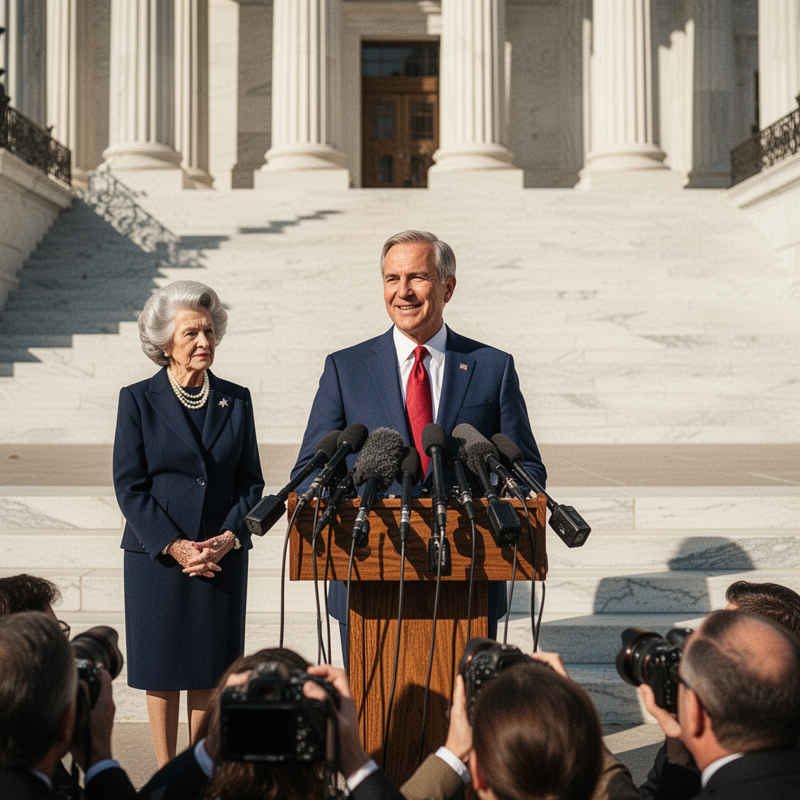
CHAPTER 1: The Locket on the Podium
Part 1
My 82-year-old mother, former Lieutenant Governor Eleanor Halloway, stood beside me on the Capitol steps as I announced my campaign for Governor of Pennsylvania.
A silver-haired, ragged man stepped out of the crowd, pulled down his scarf, and stared directly into my eyes with my own face.
He dropped an old brass locket onto the microphone podium before security tackled him to the marble pavement.
Inside the locket was a 1966 hospital photograph showing two identical newborn boys bearing the official state seal stamp.
My mother glanced at the photo for half a second, adjusted her pearl necklace, and told the gathered press that I was suffering from severe fatigue.
The air on the Capitol steps, moments before a crisp autumn breeze, solidified into a thick, suffocating silence. It was as though every microphone had stopped recording, every camera lens frozen mid-flash.
Then, a ripple of movement.
Two broad-shouldered security guards, their faces grim, dragged the unhoused man from the polished marble. His tattered coat snagged on the corner of the podium, leaving a faint streak of grime.
A collective gasp swept through the assembled crowd.
The man’s eyes, the color of my own, remained fixed on me even as his body scraped along the ground. He made no sound, no struggle, just a silent, unnerving connection that went deeper than logic.
Eleanor, a vision in tailored navy, turned her head slightly. The flash of her pearl necklace caught the sunlight, a small, perfect gleam against the backdrop of chaos.
She leaned into the cluster of microphones that still surrounded her. Her voice, though low, carried with effortless authority, cutting through the murmuring crowd.
“My son, Senator Halloway, has been working tirelessly,” she stated, her gaze sweeping over the journalists. “These campaigns are incredibly demanding, and he’s clearly experiencing severe fatigue.”
A reporter, brave or perhaps foolish, blurted out a question. “What about the man, Governor? What was in the locket?”
Eleanor merely offered a tight, dismissive smile. “A confused individual. Nothing more to discuss.”
She gave my arm a firm, almost imperceptible squeeze, a warning more than a comfort. Her grip was iron, even at 82.
I stood there, feeling the weight of the moment, the surreal encounter burning into my memory. The locket lay on the podium, its brass glinting, a small, dangerous secret exposed under the full glare of the Pennsylvania sun.
My political career, my public image, my very identity—it all felt suddenly fragile.
Later that evening, the city lights of Harrisburg glowed softly outside my Senate apartment window. The day’s events replayed in an endless loop in my mind: the cheering crowd, the abrupt intrusion, the shocking familiarity of that stranger’s face.
The locket was still in my pocket, warm from my hand. I pulled it out, tracing the worn lines of the brass. It was heavy, unexpectedly so.
Flipping it open, I stared again at the faded sepia photograph. Two identical newborn boys, swaddled in hospital blankets, their tiny faces mirroring mine, mirroring his.
And there, stamped clearly in the bottom right corner, was the official seal of the Commonwealth of Pennsylvania. It wasn’t just a random photo; it was an official document.
The image sent a chill down my spine that had nothing to do with the cool evening air. My mother’s quick dismissal, her almost immediate pivot to my “fatigue,” replayed in my ears.
It was too fast. Too controlled.
I thought of the man’s eyes, fixed on mine, a silent accusation. My hands began to tremble. I had to know.
Pushing aside the half-eaten dinner plate, I walked over to my study. The mahogany desk felt solid and reassuring under my fingertips, a stark contrast to the shifting ground beneath my political campaign.
I logged onto the secure state archives network, my Senatorial credentials granting me access to records far beyond the public’s reach. My fingers, surprisingly steady, typed out the search parameters: “Harrisburg General Hospital, 1966, Halloway.”
The screen flickered. A list of digitized records appeared.
I clicked on the first entry: *Halloway, Julian. Birth Record. January 12, 1966.*
A wave of relief washed over me, brief and fleeting. My own birth, confirmed.
But then, my eyes caught a secondary entry, highlighted in a faint red text, barely noticeable. *Halloway, Julian. Birth Certificate Re-issue Request. April 15, 1966.*
My breath hitched.
My official birth certificate, the one I had carried my entire life, had been re-issued three months after my actual birth. Why? And what happened to the original?
The silence in the room pressed in on me, heavy and suffocating. The glowing screen showed the cold, bureaucratic detail of my own existence, hinting at a truth far more complex than any political scandal.
Part 2
The re-issued birth certificate. Three months after my birth, someone had altered my official record. The implications hit me like a physical blow. This wasn’t just a locket; this was a cover-up.
I knew who I had to talk to. The man with my face. Eli.
Finding him wasn’t hard. A quick call to the security team, a subtle inquiry about the man from the Capitol steps. They gave me a general area, a soup kitchen Eli frequented downtown.
I met him the next afternoon in a quiet booth at a diner just off State Street. The smell of stale coffee and frying onions hung heavy in the air. He looked the same, though his face was cleaner, his hair combed. Still, the weariness in his eyes was profound.
He didn’t greet me, just slid a small, silver USB drive across the Formica table. It looked cheap, like something you’d get at a promotional event.
“It’s all on there,” he said, his voice raspy, a mirror to my own. “Everything my mother tried to hide.”
My hands trembled slightly as I picked it up. He watched me, his expression unreadable.
“What is it?” I asked, my voice barely a whisper.
“Archived posts,” he replied. “From a political forum called ‘ArchivedPAnet,’ back in 2004. My mother thought she’d erased it all.”
I plugged the drive into my discreet tablet, my eyes scanning the folders. There it was: ‘Halloway_Birth_Transfer_Logs.pdf’.
I opened the document. Page after page of encrypted forum threads, detailing a wire transfer. A single, staggering sum: $150,000. It listed Halloway family accounts as the origin. The purpose, chillingly clear: to alter hospital adoption registries. To make one person disappear.
My head swam. This was real. My mother, the Iron Matriarch, had systematically erased Eli’s existence.
Before I could even process the full weight of the evidence, the large television mounted in the corner of the diner, usually showing local sports, suddenly flickered. An emergency news bulletin flashed across the screen.
The anchor’s grave voice filled the diner. “We interrupt this program for a special report from the office of former Lieutenant Governor Eleanor Halloway.”
A formal statement appeared on screen, scrollings words beneath Eleanor’s official seal. It wasn’t about the campaign. It was about me.
“Senator Julian Halloway,” the voice continued, “is currently undergoing a severe mental health crisis, questioning his fitness for office.”
CHAPTER 2: The Smear Campaign Begins
The rain tapped hard against the stained-glass windows of Eleanor Halloway’s private study in Chestnut Hill.
My mother sat behind her mahogany desk, her hands folded neatly over a silver pen. She did not stand when I walked in. She did not offer me a chair.
“You should have left the brass locket on the pavement, Julian,” she said, her voice smooth and devoid of tremor.
“The hospital archives from 1966 match the photo,” I said, placing the printed digital registry on her desk. “And the 2004 forum posts on ArchivedPAnet detail a hundred and fifty thousand dollar wire transfer from our family trust to clear hospital records.”
Eleanor did not look down at the papers. She leaned forward, her pearls catching the soft amber light of the desk lamp.
“You are fifty-eight years old, Julian,” she said softly. “And you still do not understand how state power operates.”
“Who is he, Mother?” I stepped closer to the desk. “Who is the man with my face?”
“He is nobody,” she replied. “And by five o’clock tonight, the Commonwealth of Pennsylvania will know that you are currently suffering from severe stress-induced cognitive fatigue.”
Before I could answer, her landline rang once. She did not answer it.
I turned toward the wall-mounted television screen in the corner of her study. The local Harrisburg news anchor was standing before a red banner marked *BREAKING NEWS*.
“We are receiving statements from senior advisors within Senator Julian Halloway’s gubernatorial campaign,” the anchor announced, reading from a tablet. “Confidential internal health memos indicate the Senator has missed three committee votes this month due to acute memory loss and mental exhaustion.”
I turned back to Eleanor. Her face remained set in cold, deliberate stone.
“You cannot bury a living person, Mother,” I whispered.
“I built this state’s political machinery, Julian,” she said, picking up her pen. “Do not force me to use it to erase my own son.”
My phone buzzed in my pocket with six consecutive alerts from my campaign manager. I stepped back into the rain, the digital war for my sanity officially declared.
CHAPTER 3: An Ally in the Shadows
The lower deck of the Harrisburg central parking garage smelled of engine exhaust and damp concrete.
I stood beside a concrete pillar, my coat collar turned up against the cold draft. Headlights cut through the darkness as a dark grey sedan pulled into the space beside mine.
Gareth Croft stepped out. He had served as my mother’s chief political strategist for twenty-two years, his grey suit tailored with quiet precision.
“You shouldn’t have come alone, Senator,” Gareth said, keeping his eyes on the ramp behind us.
“You called me, Gareth,” I said. “You said you had something my mother missed.”
Gareth reached inside his jacket and pulled out a sleek black flash drive. He held it between two fingers, hesitation visible in his tight posture.
“In 2004, when those threads showed up on ArchivedPAnet, Eleanor ordered me to scrub the state archive servers,” Gareth said. “She wanted every digital footprint of the adoption alterations erased.”
“And you did it?”
“I executed the purge,” Gareth replied, dropping the drive into my hand. “But I kept a full, unredacted backup. Eleanor thinks she controls every lever in this state, but the federal prosecutor’s office is already quietly poking around state PAC funds. I’m not going to prison for her.”
I looked down at the metal drive in my palm. “What’s on this?”
“Internal strategy memos from 1982 through 2004,” Gareth said. “It proves Eleanor didn’t just know Eli existed. She had state agents tracking his location for over thirty years.”
“She monitored him?”
“She kept him at arm’s length, and she kept him broken,” Gareth said, stepping back toward his car. “Be careful, Julian. Eleanor is filing an emergency court petition tomorrow to strip your campaign authority. She’s going to claim you’re incapacitated.”
“Why help me now?” I asked.
Gareth paused with his hand on the car door, his profile illuminated by the amber ceiling lights.
“Because I know what happens to people who stay loyal to your mother when the house comes down,” he said.
CHAPTER 4: The Digital Paper Trail
My legal advisor, Diane, leaned over the glass conference table in my private office, her reading glasses pushed up on her forehead.
The unencrypted files from Gareth’s drive covered the monitor in long, glowing columns of text. Archived forum logs from ArchivedPAnet dated November 14, 2004, stretched across the screen.
“It wasn’t a standard adoption, Julian,” Diane said, highlighting a string of redacted transaction handles. “Eli wasn’t put into the public child welfare system.”
“Where did he go?” I asked, staring at the digital birth certificate logs.
“He was routed through three private foster homes in Lancaster County,” Diane said, clicking through the financial attachments. “All three were funded by an anonymous trust account managed by a shell company registered to the State Democratic Committee.”
I pointed to a specific entry dated October 1982. “Look at the payments there. They suddenly spike, and then stop completely.”
“The forum thread shows a final transfer of forty thousand dollars in late October 1982,” Diane said, her fingers tapping the keys. “And then Eli’s name is completely purged from state social service logs.”
“Why October 1982?” I asked. “He was twenty-four years old.”
“There’s a police incident code attached to the final transfer record,” Diane noted, zooming in on a scanned docket thumbnail. “Harrisburg Bureau of Police, Incident Report 82-4410. But the text file is corrupted.”
I stood up and walked to the window overlooking the state capitol dome.
Eli hadn’t just been separated from me at birth. He had been managed, funded, and systematically contained by state machinery until he vanished into the dark in 1982.
“My mother didn’t just give up a child,” I said to the cold glass. “She ran an institutional cover-up using taxpayer resources.”
“If we take this to court,” Diane warned, “it won’t just stop your campaign. It will trigger a state constitutional crisis.”
“Good,” I said. “Print every page.”
CHAPTER 5: Doctored Shadows
At six o’clock the following evening, the local news broadcast dropped a bombshell that cut through my campaign like a glass blade.
I sat in my campaign headquarters as twenty staff members went completely silent, eyes glued to the wall monitors.
The broadcast displayed security camera footage from the Capitol steps event three days prior. The clip had been slowed down and digitally enhanced with bright yellow indicators overlaying the crowd.
“Newly released high-definition security footage obtained by our investigative team raises serious questions about Senator Halloway’s account of the incident,” the reporter announced.
On the screen, my security detail was shown standing back as Eli approached. An edited graphic highlighted my right hand, making a brief, distinct tapping motion against the podium microphone two seconds before Eli stepped out of the crowd.
“Expert analysis suggests Senator Halloway signaled the individual prior to the disruption,” the reporter continued. “Opposing political groups now claim the encounter was a manufactured publicity stunt designed to reverse falling poll numbers.”
“That’s completely doctored,” my press secretary said, her voice shaking. “You didn’t signal anyone. You were reading your speech notes.”
“It doesn’t matter,” I said, watching the footage loop. “It looks real enough on a six-inch phone screen.”
My phone rang instantly. It was my campaign manager.
“Julian,” he said, skipping any greeting. “The broad-market polling just dropped twelve points in Philadelphia and Allegheny County. Three major labor union PACs just froze their donations.”
“Eleanor manufactured that footage,” I said.
“It doesn’t matter who manufactured it,” he replied. “The narrative is that you’re fabricating personal drama to save a dying campaign. If we don’t counter this within twenty-four hours, the party executive committee will vote to remove you from the primary ballot.”
I pulled my coat off the chair. “Get District Attorney Nora Kincaid on the phone. Tell her I’m coming to her office tonight.”
CHAPTER 6: The DNA Confirmation
District Attorney Nora Kincaid’s office smelled of stale coffee and old legal briefs.
She sat behind a desk piled high with case files, her fifty-year-old face stern and unreadable. On the table between us lay a white manila envelope stamped with the emblem of the Pennsylvania State Police Forensic Laboratory.
“I don’t usually expedite private genetic comparisons, Senator,” DA Kincaid said, resting her palms flat on the wood. “But given the state seal stamp on the 1966 hospital photo, this falls under official state record tampering.”
She slid the envelope across the table toward me.
I picked up the seal, tore the edge, and pulled out the single-page summary report. My eyes went straight to the conclusion line at the bottom of the page.
*Probability of Identical Twin Relationship: 99.9%.*
“The DNA swab from Eli Banneker matches your reference sample completely,” DA Kincaid said. “You two share the exact same genetic profile. You are identical twin brothers born on June 12, 1966, at Harrisburg General Hospital.”
I let the paper fall onto the desk. A strange, cold weight settled in my chest.
“My mother swore under oath during her 1994 confirmation hearing that she had only one biological child,” I said quietly.
“She did,” Kincaid replied, opening a yellow folder. “And based on this DNA match, I have ordered the impounding of all 1966 Harrisburg General Hospital birth logbooks. I’ve also issued formal evidence preservation notices to your mother’s political action committee.”
“Does this mean an official criminal inquiry?” I asked.
“It means,” Kincaid said, leaning forward, “that this is no longer a family feud or a political smear campaign. It is an active state criminal investigation into the falsification of official records.”
She looked at me intently. “When this hits the wire tomorrow morning, Senator, your campaign for Governor is effectively over. Are you prepared for that?”
“I’ve spent fifty-eight years living a lie, Nora,” I said, standing up. “I don’t care about the governorship anymore.”
CHAPTER 7: The Leaked Strategy
The front page of the *Philadelphia Inquirer* hit the stands at five in the morning.
*SENATOR HALLOWAY HOLDS SECRET MEETINGS WITH DA IN STATE RECORD PROBE.*
The article, written by investigative journalist Rachel Danforth, contained exact dates, times, and internal campaign memos detailing my secret visits to DA Kincaid’s office and my planned legal strategy against my mother.
My campaign office was in absolute chaos when I walked in at seven. Phones were ringing off the hook, and staff members were packing their personal belongings into cardboard boxes.
“How did Danforth get internal strategy notes?” I demanded, slamming the newspaper onto the center desk. “Only four people in this room had access to those files.”
No one answered.
An hour later, my phone buzzed with an unfamiliar number. I answered it immediately.
“Julian,” Eli’s raspy voice came through the receiver. He sounded out of breath, the background noise filled with passing city traffic.
“Eli, where are you?” I asked. “The papers have our meeting details. Did someone follow you?”
“Nobody followed me, Julian,” Eli said, coughing sharply. “I sold the diner meeting details to the Inquirer reporter.”
I froze, the phone pressed hard against my ear. “You what?”
“She offered me five thousand dollars in cash,” Eli said, his voice flat, completely devoid of shame. “Five grand. Do you know what five grand means when you’re sleeping under a concrete bridge near the river? It means a warm room for two months.”
“Eli, I offered to get you an apartment,” I said, trying to control the anger rising in my chest. “I offered you help.”
“I don’t want your charity, Senator,” Eli spat back. “You’re playing chess with your mother for a governor’s seat. I’m trying to survive the night. Five thousand cash is real. Your promises aren’t.”
The line went dead.
I leaned against my desk, looking out at the city streets below. He was broken, paranoid, and desperate—damaged by decades of living in the shadows while I grew up in wealth and privilege.
I swallowed my anger. I had to fix what my mother had destroyed, no matter what Eli did to protect himself.
CHAPTER 8: The Cold Case Record
The diner on the outskirts of Harrisburg was dark, illuminated only by a humming neon sign in the window.
Retired Police Captain Donald Novak sat in a corner booth, a cup of black coffee cooling in front of him. His sixty-year-old face was deeply lined, his knuckles swollen with arthritis.
“I remembered the face the second I saw the news,” Novak said, not bothering with greetings as I sat down across from him. “1982. I was a young detective back then.”
“In Incident Report 82-4410?” I asked, placing a notepad on the table.
Novak nodded slowly. “October 14, 1982. An seventy-one-year-old shopkeeper named Arthur Vance was beaten to death during a robbery in a corner store on Market Street. Two witnesses identified a twenty-four-year-old kid named Eli Banneker running from the alley with a bloodstained coat.”
My stomach turned over. “Eli was a suspect in a murder?”
“He wasn’t just a suspect, Senator,” Novak said, leaning across the table. “He was *the* suspect. We had the bloodstained jacket. We had two positive identification statements. We were two hours away from signing an arrest warrant.”
“What happened?”
“A sedan pulled up to the precinct at midnight,” Novak said, his voice dropping to a whisper. “Two men from the State Attorney General’s office walked into the Captain’s office. By three in the morning, the physical evidence vault was re-keyed. The bloodstained jacket vanished. The witness statements were shredded.”
“My mother,” I whispered.
“Eleanor Halloway was Lieutenant Governor back then,” Novak said, his eyes filled with decades of old guilt. “The order came from the top floor. Eli Banneker was quietly picked up, put on a bus out of state, and his entire criminal file was completely expunged from the state database.”
Novak stared straight into my eyes.
“Your mother didn’t just hide a twin brother to protect her reputation, Senator,” Novak said. “She quashed a murder investigation and let a killer walk free to keep her family name clean.”
CHAPTER 9: The Legal Offensive
The civil process server stepped up to my podium just as I finished speaking at a small community center in Lancaster.
He handed me a thick legal packet tied with a red ribbon.
“Senator Julian Halloway,” the man said loudly in front of three television cameras. “You are officially served with a petition for Emergency Civil Protection and Conservatorship in Dauphin County Court.”
I opened the cover page. Eleanor had filed a full civil lawsuit against me.
The complaint alleged that I was engaging in systematic elder abuse, exploiting an eighty-two-year-old former state official, and illegally diverting family trust funds to finance a malicious smear campaign against my own mother. Attached were four sworn affidavits from former campaign staffers claiming I had exhibited unprovoked rage and memory lapses during private strategy sessions.
That evening, my estranged wife, Diane, met me in my empty campaign headquarters. She stood near the door, keeping her distance, her tailored coat pristine.
“You need to drop this, Julian,” Diane said, her corporate attorney voice calm and unyielding. “Eleanor is going to file for full conservatorship over your assets. She will freeze your personal bank accounts before the week is out.”
“She quashed a homicide investigation in 1982, Diane,” I said, holding up Novak’s notes. “She used state power to erase a murder.”
“And if you drag that into court, you will drag the entire family into the gutter,” Diane said, stepping closer. “My law firm’s board met this morning. If my name is tied to a criminal grand jury probe involving murder cover-ups and fraudulent trusts, they will force my resignation.”
“I am not letting her win this,” I said.
“She has already won, Julian,” Diane replied softly. “Look around you. Your campaign is empty. Your donors are gone. Settle with her privately. Let her team handle Eli.”
“No,” I said.
I picked up my briefcase, loaded it with the digital forum archives from 2004, and walked out the door toward the District Attorney’s grand jury division.
CHAPTER 10: The Tape in the Vault
Gareth Croft met me inside an empty church sanctuary in downtown Harrisburg at midnight.
The soft light from the stained-glass windows illuminated the rows of dark wooden pews. Gareth stood near the altar, holding a heavy yellow envelope.
“This is the piece that destroys everything,” Gareth said as I approached him. “If I give you this, there is no turning back. I will likely be named an unindicted co-conspirator.”
“What is it, Gareth?”
He pulled out a digital micro-cassette tape and a printout of an audio transcript dated August 12, 2004.
“It’s a recording of a private strategy meeting in Eleanor’s study,” Gareth said. “Just Eleanor, myself, and former Chief of Staff Miller. Listen to track two.”
He pressed play on a handheld digital recorder.
My mother’s crisp, undeniable voice filled the cold sanctuary.
*”The state record clerks in Dauphin County have been paid fifty thousand dollars each from the PAC discretionary fund,”* Eleanor’s recorded voice said clearly. *”Ensure the 1982 expungement order remains locked in the vault. If the press finds out that the subject in Harrisburg is linked to the Vance homicide, it will destroy Julian’s state Senate race before it begins.”*
The recording clicked off.
I stood in silence, the echo of her voice lingering in the high rafters of the church.
“She did it to protect my Senate run in 2004,” I said, the realization hitting me like a physical blow. “She buried Eli’s criminal record to save my career.”
“She did it to save the family dynasty,” Gareth corrected. “Your career was just the vessel for her ambition. This tape proves public corruption, obstruction of justice, and witness tampering.”
“This tape will send my mother to prison,” I said.
“Yes,” Gareth replied. “And it will end your political existence forever. Hand it to DA Kincaid, Julian. Finish it.”
CHAPTER 11: The Double Game
I followed Eli’s rusty sedan through the rain to a low-budget motel on the outskirts of Lancaster.
I parked two rows over, watching through my windshield as Eli stepped out of his car and pulled his scruffy jacket tight against the wind. He walked up the exterior staircase and knocked on the door of Room 114.
The door opened. Standing inside the doorway was Thomas Vance—the senior campaign director for Arthur Albright, my direct rival in the gubernatorial primary.
I pulled my hat low and walked silently up the outdoor walkway, positioning myself behind a ice machine near the window of Room 114. The curtains were partially drawn.
Inside, Thomas Vance placed a thick, sealed Manila envelope on the small table. Eli picked it up immediately, tore the edge, and flipped through stack after stack of hundred-dollar bills.
“That’s twenty-five thousand in cash,” Vance said, his voice easily passing through the thin glass. “Albright wants the full timeline of your meetings with Julian by tomorrow morning. We need sworn statements that Julian offered you money to claim you were his twin brother.”
“I told you,” Eli said, stuffing the cash into his canvas bag. “I’ll sign whatever statement you print out. Just keep the payments coming every two weeks.”
“If you go on television and call him a fraud,” Vance added, “Albright’s PAC will deposit another fifty thousand into an offshore account for you.”
“Deal,” Eli said with a cold laugh. “Julian thinks he’s my savior. He actually thinks I care about his truth.”
My blood ran cold.
I stepped away from the window, walked directly to the door, and pushed it wide open.
Eli whipped around, his hand clutching the canvas bag. Vance jumped back, his face instantly turning pale.
“Julian,” Eli stammered, stepping back toward the bed.
“Twenty-five thousand dollars, Eli?” I said, my voice dangerously low. “You’re taking bribes from Albright’s campaign to frame me?”
Eli’s defensive expression hardened into pure venom. He sneered, his identical face twisting into a bitter mask.
“You grew up in a mansion in Chestnut Hill, Julian!” Eli shouted, taking a step toward me. “You went to legal academy! You had trust funds, private cars, and political favors! The Halloway family owes me millions for the life you stole from me! I’m taking money from anyone who offers it!”
“I fought for you,” I whispered. “I brought federal prosecutors into this to give you justice.”
“I don’t want justice!” Eli screamed. “I want my money!”
CHAPTER 12: Wire Transfer Match
The joint task force meeting room in the Harrisburg Federal Courthouse was packed with federal prosecutors, state investigators, and DA Nora Kincaid.
On the whiteboard at the front of the room, a complex financial chart linked family accounts, state infrastructure funds, and offshore handles.
“We have the complete cross-reference results from the 2004 ArchivedPAnet forum handles,” DA Kincaid announced, pointing her marker at a central box on the board. “Federal investigators traced the handles directly back to a state treasury wire executed in October 1982.”
A federal prosecutor stood up. “Two hundred thousand dollars was illegally diverted from the Pennsylvania Highway Infrastructure Fund into a private escrow account controlled by Eli Banneker’s foster guardians.”
“That was the payoff to keep him quiet after the 1982 shopkeeper homicide,” I said from the back of the room.
“Precisely,” the prosecutor replied. “This establishes a thirty-year pattern of state-funded bribery, money laundering, and grand jury obstruction executed by the Halloway Political Action Committee.”
DA Kincaid turned to face me. “Senator, with the digital logs, the wire records, and Gareth Croft’s audio tape, the United States Attorney’s Office has joined my office in issuing formal federal indictments.”
“Against Eleanor?” I asked.
“Against Eleanor Halloway, three former state treasurers, and two campaign treasurers,” Kincaid said firmly. “Federal marshals are serving the warrants as we speak.”
I sat in silence as the prosecutors gathered their papers.
The political dynasty my mother had built over fifty years—the dynasty I had spent my entire adult life serving—was being dismantled in front of my eyes.
“Julian,” Kincaid said, walking over to my chair. “You need to be ready. When the marshals hit her estate, the media firestorm will be unprecedented.”
“Serve the warrants,” I said flatly. “Let it burn.”
CHAPTER 13: Subpoenas at the Estate
By two o’clock that afternoon, six black SUVs with federal plates lined the winding driveway of Eleanor’s Chestnut Hill estate.
News helicopters hovered high above the property, broadcasting live footage to millions of households across Pennsylvania.
I stood inside the state capitol Senate gallery, watching the live television feed on a wall monitor.
Federal marshals and state police investigators moved back and forth through the front doors of the stone mansion, carrying heavy archive boxes, hard drives, and legal filings out to their vehicles.
Then, my mother stepped onto the front porch.
She wore her signature navy blue suit and her pearl necklace. She refused the assistance of the federal agent beside her, standing completely upright on the stone steps despite her eighty-two years.
Reporters thrust microphones over the iron perimeter gate, shouting questions that echoed through the broadcast speakers.
“Mrs. Halloway! Did you use state funds to suppress birth records?”
“Mrs. Halloway! Is your son Julian telling the truth?”
Eleanor did not look at the cameras. She did not raise a hand to shield her face. She stood silent, composed, and absolutely motionless as federal marshals loaded her personal safe into the back of an armored truck.
She turned her eyes directly into the lens of the primary news camera—looking straight through the screen, straight at me.
In her eyes, there was no fear. There was only absolute, icy contempt.
My phone chimed on the desk. It was a text message from Gareth Croft:
*The federal grand jury has formally convened in Philadelphia. You are scheduled to testify tomorrow morning at nine.*
The dynasty had fallen. The reckoning had begun.
CHAPTER 14: The Blackmail Ultimatum
I was sitting alone in my darkened Senate office at eight o’clock that night when the heavy wooden door clicked open.
Eli walked in without knocking. He wore a heavy leather jacket, his eyes bloodshot, his movements twitchy and tense.
“You need to give me two million dollars, Julian,” Eli said, stepping up to my desk and leaning over the wood.
I looked up at him, my voice completely deadened. “I don’t have two million dollars, Eli. And even if I did, I wouldn’t give you a single cent.”
“You have two point four million remaining in your gubernatorial campaign reserves,” Eli snapped, pointing a trembling finger at my face. “I checked the state campaign finance filings. Wire two million into my offshore account by midnight, or I go to Eleanor’s defense attorneys.”
“And tell them what?” I asked.
“I’ll sign a sworn affidavit stating that you paid me fifty thousand dollars to fake the brass locket photo,” Eli said, a cruel smile spreading across his face. “I’ll tell the grand jury that you paid Gareth Croft to fabricate the 2004 forum logs to frame your mother because you were losing the election.”
I stared at the identical reflection of my face—corrupt, mercenary, and utterly hollowed out by greed.
“I fought my mother to clear your name, Eli,” I said softly. “I ruined my entire life to give you back your identity.”
“I don’t give a damn about my identity!” Eli screamed, slamming his fist onto my desk. “I want the money I’m owed! Two million dollars, Julian! Or I walk into that courthouse tomorrow and destroy you under oath!”
I stood up slowly, stepping around the desk until I was inches from his face.
“Get out of my office, Eli,” I said quietly.
“You think I’m joking?” he hissed.
“Get out,” I repeated.
As he turned and slammed the door behind him, I picked up my desk phone and dialed DA Nora Kincaid’s direct line.
“Nora,” I said when she answered. “Add extortion to the file on Eli Banneker. I’m testifying before the grand jury tomorrow.”
CHAPTER 15: The Oath
The federal grand jury room in Philadelphia was windowless, illuminated by harsh, buzzing fluorescent lights.
Twenty-three grand jurors sat in tiered rows, watching me as I walked to the witness stand in the center of the room. DA Nora Kincaid sat beside the federal prosecutor at the main counsel table.
“State your full name for the record,” the foreperson directed.
“Julian Edward Halloway,” I said clearly.
“Senator Halloway,” the federal prosecutor began, standing up. “Before we begin, I must advise you that you have the right to remain silent under the Fifth Amendment, as some of these events involve your own campaign filings.”
“I waive my Fifth Amendment rights,” I said, placing my hands on the witness stand railing. “I intend to answer every question truthfully.”
For three continuous hours, I laid out fifty years of family history.
I detailed Eleanor’s management of state PAC funds, the 2004 ArchivedPAnet forum logs, Gareth Croft’s audio recordings, the 1982 murder cover-up, and Eli’s recent extortion demands. I concealed nothing. I protected no one—not my mother, not my brother, and not myself.
When I finished my testimony, the grand jury room was completely silent.
“Thank you, Senator,” the prosecutor said quietly. “You are excused.”
I walked out of the federal courthouse into a wall of flashing camera bulbs and screaming reporters. Hundreds of journalists crammed the concrete steps outside.
I stepped up to the wall of microphones set up by the press corps.
“Effective immediately,” I said into the microphone array, “I am withdrawing my candidacy for Governor of Pennsylvania. I am resigning my seat in the Pennsylvania State Senate at the end of this legislative term. May God save this Commonwealth.”
I walked through the sea of cameras without answering a single question, leaving my political life behind on the marble steps.
CHAPTER 16: The Eve of Hearing
On the night before the pre-trial evidentiary hearing in Dauphin County Court, I sat alone in my stripped Harrisburg office.
Boxes filled with thirty years of legislative files lined the walls. My phone rang on the empty desk.
I picked it up. “Hello?”
“Julian,” Gareth Croft’s voice was barely a whisper. “Are you alone?”
“I’m in my office,” I said. “Where are you, Gareth?”
“I’m sitting in my car outside the courthouse,” Gareth said, his breath hitching. “Listen to me very carefully. Eleanor’s defense team just submitted a sealed motion to the presiding judge for tomorrow’s hearing.”
“A motion regarding what?”
“Regarding your father,” Gareth said.
I frowned, holding the receiver tight. “My father died in an auto accident in 1982. What does he have to do with the 1966 adoption records?”
“Your mother didn’t just alter those hospital records to hide an extra child, Julian,” Gareth said, his voice shaking. “There’s a reason she paid off those state clerks in 2004 that wasn’t on the audio tape. The truth about 1966 is far worse than an illegal adoption.”
“Gareth, tell me what’s in the motion!” I demanded, standing up.
“I can’t say it over an unencrypted line,” Gareth said nervously. “Just be ready tomorrow. When those files are opened in court, everything you think you know about your father—and why Eli was hidden—is going to shatter.”
The call disconnected before I could ask another question.
I stood alone in the dark office, watching the rain strike the window, filled with a cold, terrifying dread.
CHAPTER 17: Gathering at the Court
The main courtroom of the Dauphin County Courthouse was packed to maximum capacity by eight o’clock the following morning.
National television correspondents, legal analysts, state senators, and dozens of armed courtroom deputies filled every available seat. The air was thick with the smell of wet wool coats and old floor wax.
I sat at the prosecution table alongside DA Nora Kincaid, my hands resting quietly on the oak wood.
A movement at the side entrance drew everyone’s attention.
Eleanor was wheeled into the courtroom by her private nurse, flanked by three high-priced defense attorneys in dark suits. She was dressed in pristine black, her white hair immaculately styled, her expression unreadable. She did not look in my direction.
In the very back row of the gallery, flanked by two uniformed police officers, sat Eli. He wore a wrinkled prison jumpsuit, his wrists handcuffed to a leather waist belt, staring at me with pure hatred.
Judge Arthur Vance banged his gavel three times, the loud wooden strikes echoing off the high plaster ceiling.
“Dauphin County Court is now in session,” the judge announced. “We are here to hear oral arguments regarding the admissibility of archived digital evidence in the matter of the Commonwealth versus Eleanor Halloway.”
DA Kincaid stood up, smoothing her jacket.
“Your Honor,” Kincaid began, turning toward the bench. “The prosecution is prepared to present undeniable physical, digital, and audio evidence establishing that the defendant systematically used state funds to alter 1966 hospital birth registries and quash a 1982 criminal investigation.”
I leaned forward, my heart pounding against my ribs, waiting for the truth to finally enter the official public record.
CHAPTER 18: The Interrupted Hearing
“The Commonwealth calls Senator Julian Halloway as its primary witness,” DA Kincaid declared, pointing toward me.
I stood up from the prosecution table, adjusting my suit coat, preparing to walk to the witness stand to deliver the final testimony that would seal my mother’s legal fate.
Before I could take a single step, the heavy double oak doors at the back of the courtroom burst open with a loud wooden crack.
Six armed United States Marshals strode down the center aisle, their tactical vests gleaming under the courtroom lights. The lead marshal held a raised document in his right hand.
“All proceedings in this courtroom are halted immediately by order of the United States District Court!” the lead marshal shouted, his voice booming over the gallery murmurs.
Judge Vance slammed his gavel down repeatedly. “Marshal! You are out of order! This is a state judicial proceeding!”
“Your Honor, I am executing an overarching federal arrest warrant,” the marshal yelled back, advancing past the bar enclosure.
The entire courtroom erupted into chaos. Reporters stood on wooden pews, camera shutters clicked frantically, and deputies moved to secure the perimeter.
The marshals passed right by my mother’s wheelchair. They walked directly past the prosecution table, heading straight toward the back gallery where Eli sat under police escort.
“Eli Banneker!” the lead marshal announced loudly. “You are under arrest for federal charges of multi-state extortion, wire fraud, and conspiracy with political operatives!”
Eli surged out of his seat, screaming obscenities as the marshals forced him down onto the wooden bench to double-cuff his wrists.
“Julian!” Eli shrieked, his voice cracking with panic as he was dragged toward the aisle. “You did this to me! You setup me up!”
I stood frozen beside the prosecutor’s table, watching my identical twin brother be dragged away in chains, the entire hearing collapsing into total bedlam around us.
CHAPTER 19: The Shattered Reckoning
“Order in the court!” Judge Vance roared, striking his desk again and again. “Clear the gallery!”
As the deputies scrambled to contain the chaotic room, Eleanor Halloway suddenly pushed her nurse’s hand away and stood up from her wheelchair.
Though eighty-two years old and frail, her presence instantly silenced the immediate area around the defense table.
“You wanted the absolute truth, Julian?” Eleanor’s voice echoed across the quieted courtroom, sharp and cutting through the surrounding noise.
I turned to look at her. “Mother, sit down.”
“You built your whole crusade on the idea that I stole your innocent brother to protect a political dynasty,” Eleanor said, taking a slow step toward me, supported by her lead attorney. “You thought I was hiding a simple adoption.”
“You hid a murder suspect, Mother!” I shouted back over the gallery barrier.
“Eli wasn’t my child, Julian!” Eleanor yelled, her voice trembling with decades of stored rage. “Eli was born from your father’s extramarital affair with an undercover narcotics informant!”
The entire courtroom went dead silent. Even the judge stopped his gavel mid-air.
“Your father was a corrupt state prosecutor who took bribes from syndicate leaders,” Eleanor said, her eyes locked on mine with brutal intensity. “When his informant got pregnant with twins in 1966, your father brought you home to me and left Eli with her. In 1982, Eli found out who his father was and tried to blackmail him. Your father beat that shopkeeper to death during a drop gone wrong, and then he was killed himself three weeks later!”
I felt the room tilt beneath my feet. Cold sweat broke out across my forehead.
“I didn’t pay off those clerks in 2004 to hide a twin, Julian!” Eleanor cried out, her voice breaking. “I paid them off to protect *you* from learning that the father you idolized was an extortionist and a murderer! I spent fifty years protecting your precious moral purity!”
She fell back into her wheelchair, gasping for air, as her defense team rushed to cover her with a blanket.
I stood completely frozen in the center of the courtroom.
My father was a murderer. Eli was an extortionist who carried his father’s violent blood. And my entire crusade to bring “justice” to my family had been built on a complete, catastrophic lie.
Judge Vance adjourned the court indefinitely. The room cleared out around me, leaving me standing alone among empty tables and scattered papers.
CHAPTER 20: The Aftermath of the Empire
In the week that followed the courtroom collapse, the machinery of federal law moved swift and final.
Eli was formally indicted on four counts of federal interstate extortion and wire fraud. Denied bail due to flight risk, he was remanded to a federal detention facility in Philadelphia, facing a mandatory twenty-year sentence. He refused all visits from me.
Eleanor suffered a massive stroke three days after the hearing.
Given her advanced age of eighty-two and severe physical decline, federal prosecutors agreed to a plea arrangement. Her political action committee was dissolved, her financial assets were subjected to seven million dollars in state fines, and she was sentenced to permanent house arrest at her Chestnut Hill estate under medical supervision. She would never step foot inside a courtroom again.
My political career was systematically obliterated.
I resigned my Senate seat, surrendered my law license, and sold my Harrisburg townhouse to pay off accumulated legal fees. The Halloway name—once the proudest political brand in Pennsylvania—became synonymous with institutional corruption, murder cover-ups, and shattered lives.
Diane’s law firm forced her complete departure, and our divorce was finalized six months later in an empty county office.
I moved into a small, rented one-bedroom apartment on the industrial edge of Harrisburg. I cut ties with every campaign staffer, every politician, and every news reporter who called my phone.
I had sought to expose the dark foundation of my mother’s empire to bring light to the truth.
Instead, I had pulled down the entire roof upon my own head, discovering that everyone I fought for was corrupt, and everyone I loved was a lie.
CHAPTER 21: Epilogue
Five years later.
The air in the basement records office of the Harrisburg Municipal Courthouse was thick with the dust of fifty years of decaying paper.
Fluorescent lights buzzed overhead, flickering against the windowless concrete walls. I sat at a small metal desk, wearing a faded wool sweater and simple reading glasses, carefully sorting yellowed property deeds into cardboard archive boxes.
At sixty-three, my hair was entirely white, my hands weathered by quiet, manual labor. I worked three days a week as a low-wage part-time archive clerk, earning just enough to pay my modest rent.
The heavy metal door of the archive room squeaked open.
Gareth Croft walked in. He looked older, his hair thinned, wearing a plain trench coat over a simple suit. He carried a single wooden file box under his arm.
He set the box on my desk without speaking.
“State PAC record disposals from 1990,” Gareth said softly, his voice echoing in the small room. “They asked me to drop them off for shredding.”
I looked up from my desk and gave him a brief, silent nod of recognition. We had not spoken since the trial five years ago.
“How is she?” I asked quietly.
“She passed away peacefully in her sleep last Tuesday,” Gareth replied. “The estate is being liquidated by the federal receiver next month.”
I nodded again, my face showing no emotion. I felt no anger, no grief, no triumph. Only a vast, empty silence.
Gareth stood near the desk for a moment, hesitation lingering in his eyes, before turning and walking back out the heavy door.
I picked up my stamp, inked the pad, and pressed the official seal onto the top document of the pile.
Through the small, dirt-streaked basement transom window near the ceiling, I could see the street level outside. A colorful political campaign bus passed by the Capitol steps above, its bright loudspeakers blaring speeches about honor, legacy, and public trust, rolling forward without ever slowing down.
I tore down my mother’s empire expecting to find justice at the foundation. I only found the rubble of my own making, and a brother who was never looking to be saved.
Leave a Reply