CHAPTER 1: The Florida Sun and the Kitchen Shadow
Part 1
“You haven’t earned a vacation yet,” my husband Julian said as he loaded his weekend bag into his friend’s SUV, leaving me alone in our suburban home with six-week-old triplets after five painful years of fertility treatments.
For four days while he drank cocktails on a Miami beach, his mother, Eleanor, cut off my access to our shared family accounts and told our entire church group that I was having a mental breakdown and neglecting the infants.
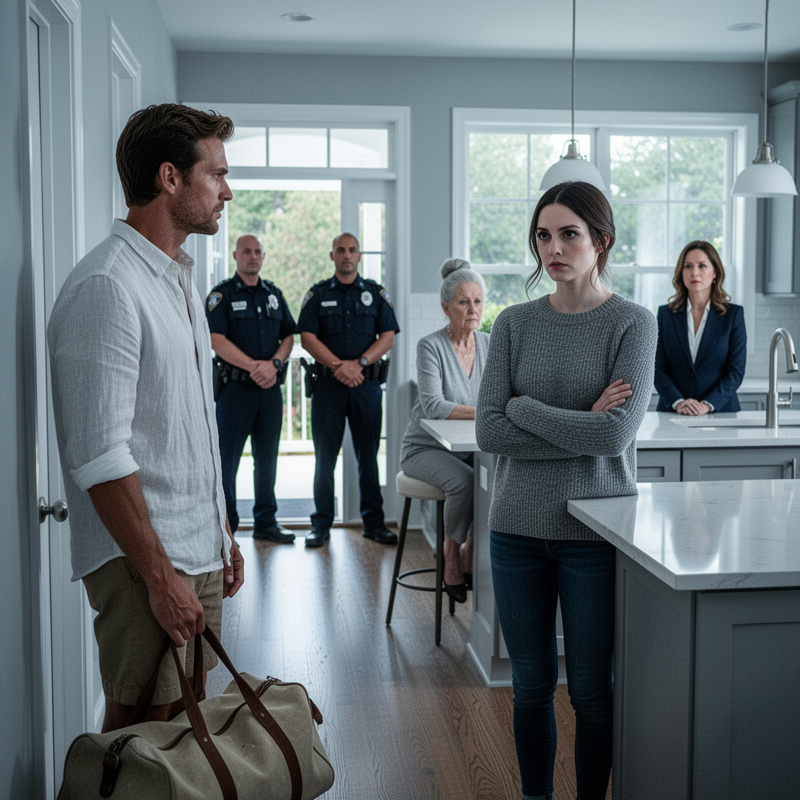
When Julian walked back through the front door with a sun-tanned, self-satisfied grin, expecting to find me broken and weeping, he stopped dead in his tracks at the kitchen counter.
Sitting across from his mother was an estate attorney holding an unsealed trust document, while two police officers waited in the hallway to take Eleanor’s statement.
The Florida sun had left Julian’s skin a golden brown, a stark contrast to my own pale face, etched with lines of sleepless nights. He exuded the carefree ease of someone who had just spent four days without a single responsibility.
His eyes, still reflecting the glint of distant ocean waves, scanned the quiet living room. He seemed to expect the sight of scattered baby bottles and my tear-stained face, perhaps even the quiet, defeated sobs he probably imagined during his luxurious escape.
The house was meticulously clean. Too clean, almost.
The triplets were asleep in their bassinets, the soft hum of the white noise machine the only sound in the nursery. Their small, perfect bodies were swaddled tightly, their breathing light and even.
I stood by the kitchen island, not broken, not weeping, but utterly exhausted, my gaze fixed on the scene unfolding before me.
Eleanor was perched stiffly on one of our kitchen stools, her designer handbag clutched tightly on her lap. Her usually immaculate silver hair seemed a little disheveled, a few strands escaping her perfectly sculpted bun.
Across from her sat Clara Higgins, the family estate attorney, a stern, principled woman I knew only vaguely from holiday gatherings. Clara wore a sharp navy suit, her expression grave as she held a thick stack of papers.
Julian’s self-satisfied grin faltered. It didn’t just fade; it vanished, wiped clean from his face like a chalk drawing in the rain.
His eyes darted from Eleanor to Clara, then to me, a flicker of confusion, then panic, crossing them. He dropped his weekend bag with a thud.
It landed near the front door, right where the two uniformed police officers stood, their presence a silent, imposing weight in our usually peaceful suburban hallway. Their radios crackled with distant, unintelligible voices, a jarring counterpoint to the domestic silence.
“What… what is all this?” Julian stammered, his voice hoarse, as if he’d been shouting over ocean waves for days.
He looked at me, as if expecting an explanation for the surreal tableau. His eyes, just moments ago full of arrogant expectation, now held a dawning dread.
Eleanor turned her head slowly, her eyes narrowed at Julian. Her usual air of composed superiority was replaced by something akin to defensive fury.
“Julian, thank goodness you’re home,” she said, her voice strained, but with an undercurrent of vindication. “Your wife… she’s completely lost it.”
Clara Higgins, without looking up, cleared her throat. The sound was sharp, decisive, cutting through Eleanor’s dramatic declaration.
“Mrs. Bennett, if you please,” Clara said, her tone utterly devoid of warmth. “We are simply waiting for Detective Miller and Officer Rodriguez to finish their initial report. Then we can proceed with your statement.”
Julian took a tentative step into the kitchen, his gaze sweeping over the unsealed document in Clara’s hand. He recognized the official letterhead of the county probate court.
“My statement? What statement?” Julian asked, his voice rising, a frantic edge to it now. He looked at me again, searching my face, perhaps for signs of the breakdown Eleanor had just accused me of. He found none.
I remained silent, my arms crossed, watching the unraveling of his perfect vacation. The silence stretched, heavy and expectant.
“Eleanor,” I said, my voice quiet, but firm, “why don’t you tell Julian why the police are here?”
Eleanor bristled, her jaw tight. “Don’t you dare try to turn this on me, Hannah. You’re the one who needs help. I was trying to protect my grandchildren.”
“Protect them from what?” Julian interjected, his eyes bouncing between us. “What is going on?”
Clara finally looked up, her gaze piercing, first at Eleanor, then at Julian. She took a deep breath, her eyes flicking toward the two officers in the hall, as if ensuring they were listening.
“Mr. Bennett,” Clara began, her voice calm and authoritative, “I have been contacted by Child Protective Services regarding a report filed against your wife, Hannah Bennett.”
Julian blinked, his mouth falling open slightly. “Child Protective Services? What are you talking about?”
He looked at me, bewildered, then at Eleanor, whose face was now a mask of indignation.
“This is outrageous,” Eleanor snapped, attempting to reclaim control. “Hannah has been completely unstable since the triplets were born. She refused all help. She wouldn’t even let me feed them when I came by.”
“Is that so, Mrs. Bennett?” Clara asked, her voice dangerously calm. She shifted the unsealed document slightly, revealing a printed date at the top. “Because the report to CPS was filed by you. Four days ago. On the very first morning of your son’s vacation to Miami.”
Part 2
Julian’s gaze snapped back to Eleanor, his face paling even further. “Mom? Is this true? You called CPS on Hannah?”
Eleanor scoffed, waving a dismissive hand. “Of course I did, Julian! Someone had to look out for my grandchildren. Your wife is clearly unstable. She refused all my help, she looked like she hadn’t slept in days. What else was I supposed to do?”
“Unstable?” I echoed, my voice low. “Or just exhausted from caring for three newborns alone while you cut off my credit cards and stopped answering my calls?”
Clara Higgins held up a hand, silencing us both. Her eyes, cool and direct, fixed on Eleanor. “Mrs. Bennett, your objective was not merely to ‘look out’ for the children, nor was it a simple welfare check.”
She tapped a finger on the document she held. “We have recordings of your calls to the agency. You explicitly stated your intention to use Mr. Bennett’s absence and Mrs. Bennett’s postpartum exhaustion as evidence that Hannah was an unfit mother.”
Julian flinched, turning his head sharply to his mother. “Evidence? Unfit? What are you talking about?”
Eleanor’s composure was beginning to crack, a tremor in her perfectly coiffed silver hair. “It’s a lie! She’s lying, Julian! I was trying to get help for her. She needs psychiatric care!”
Clara ignored her, addressing Julian. “Mrs. Bennett’s stated goal was to establish a case for Hannah’s incapacity, allowing her to petition for emergency temporary guardianship of Beatrice, Leo, and Samuel.”
Julian stared, his mouth agape. “Guardianship? You were trying to take my children, Mom?”
Eleanor’s face contorted, a mixture of outrage and desperation. “They’re *my* grandchildren, Julian! And she isn’t capable! She refused to even let me feed them when I tried to help!”
“And why would you want to take custody of them, Eleanor?” I asked, my voice cutting through her frantic defense. “What exactly would you gain from that?”
Clara Higgins watched Eleanor, a knowing glint in her eyes. “A very good question, Hannah. And one that Julian’s late father, your grandfather, Mr. Bennett, actually anticipated.”
She pushed aside the top few pages of the document, revealing another, older parchment beneath. Its edges were slightly yellowed, the signatures elegant and deliberate.
“This,” Clara said, her voice dropping to a serious, almost somber tone, “is an unsealed codicil to your father’s original trust document.”
CHAPTER 2: The Whispering Circle
Clara Higgins stacked three thick manila folders on the granite island, right next to Julian’s designer sunglasses.
“Three weeks ago,” Clara said, her voice dry as parchment, “Eleanor called the home health agency and canceled Hannah’s certified postpartum nurse.”
Julian blinked, looking from his lawyer to his mother. “What? Hannah told me she didn’t want a stranger in the house.”
“Your mother told the agency that Hannah refused entry,” Clara corrected, sliding a stamped call log across the counter. “Then she told you that your wife was neglecting the babies.”
I stood by the doorway, my knuckles white against the wooden frame.
For four days, I had felt the cold wall of isolation closing in on our suburban cul-de-sac.
Clara pulled out a stack of printed text messages. “Eleanor sent these to forty-two members of the St. Jude Parish emergency chain.”
The messages were clear, crisp, and devastating.
*Hannah is refusing to feed the infants again,* one text read. *Please pray for her fragile mental state, but do not drop off supplies. She becomes hostile when approached.*
I remembered Tuesday afternoon.
I had run out of newborn formula after two cans spoiled in the heat.
I walked across the manicured lawn to Mrs. Gable’s house, holding six-week-old Leo in my arms while Beatrice and Samuel cried in their cribs.
When Mrs. Gable opened her door, her face hardened. She stepped back and shut the heavy oak door in my face without a single word.
“You told the neighbors I was dangerous,” I whispered, my voice trembling in the quiet kitchen.
Eleanor did not look at me. She adjusted the gold chain on her tweed jacket and smoothed her skirt.
“I was protecting this family’s reputation from a woman who clearly cannot handle the responsibilities of motherhood,” Eleanor said calmly.
“You cut off her access to the shared checking account on Thursday morning,” Clara added, pulling up a bank statement. “She had forty-eight dollars in cash to feed three infants.”
Julian shifted his weight, his sun-tanned forehead creasing. “Mom… is that true?”
“It was an administrative precaution,” Eleanor snapped, her eyes narrowing. “She was spending irrationally.”
“I spent forty dollars on liquid formula at the pharmacy,” I said. “And you locked the rest away.”
CHAPTER 3: Locked Doors and Empty Cabinets
The air in the kitchen grew heavy, saturated with the faint smell of Julian’s coconut-scented tanning lotion.
I walked slowly toward the downstairs bathroom, my eyes fixed on the oak medicine cabinet above the sink.
“On Friday night, baby Leo’s forehead felt like hot copper,” I said, my hand resting on the polished chrome knob. “He was running a fever of 102.4 degrees.”
Julian followed me down the hallway, his footsteps heavy against the hardwood. “Why didn’t you give him the infant Tylenol we bought before I left?”
“Ask your mother,” I said, pulling on the cabinet door.
It didn’t budge. A fresh brass padlock glittered in the dim hallway light.
“Eleanor came by on Friday afternoon under the pretext of dropping off canned soup,” Clara said from behind us. “She took the house keys off the hook in the foyer and installed that lock while Hannah was putting Beatrice down.”
Julian stared at the tiny metal lock. “Mom… why would you lock the medical cabinet?”
“Because she was overmedicating them!” Eleanor shouted from the kitchen, her voice sharp and high. “I saw her holding the dropper! She doesn’t know the proper dosages!”
“I called Dr. Callahan’s emergency line six times that night,” I whispered.
My throat felt tight, raw from days of unshed tears.
“Every call was routed to a busy signal,” I said. “Because Eleanor logged into our patient portal on Thursday and changed the primary contact number to her own mobile phone.”
Julian stepped back, his face losing its golden Miami glow. “You blocked her from the pediatrician?”
“I answered the doctor’s callback myself,” Eleanor declared, stepping into the hallway with her chin raised. “I informed Dr. Callahan that Hannah was having an episode and that I was monitoring the children personally.”
“You weren’t here,” I said softly. “You locked the cabinet, took the keys, and drove back to your gated community.”
CHAPTER 4: The Group Chat Evidence
Clara walked into the hallway carrying Julian’s personal iPad, which had been syncing to the home network while he was away.
“Julian,” Clara said, her stern face unreadable. “You spent four days in South Beach while your wife was trapped here without money, medicine, or support.”
“I was on a mandatory corporate retreat,” Julian said defensively, crossing his arms. “I worked hard for five years during those fertility treatments. I deserved a weekend to clear my head.”
Clara opened a blue folder and pulled out twenty pages of printed text logs.
“This is from a group chat titled ‘Miami Boys 2024,’” Clara said, handing the pages directly to Julian.
I watched his eyes dart across the top line.
At 2:14 AM on Saturday night, I had sent Julian seven consecutive messages pleading with him to book a flight home because Leo’s fever was rising and the medicine was locked away.
Julian had forwarded my panicked messages directly to his three college friends.
*She’s losing her mind over a mild sneeze,* Julian had typed in the group chat at 2:18 AM, accompanied by three laughing emojis. *Drama queen needs attention while I’m trying to enjoy the cabana. Mom is handling the home front.*
His friend Mark had replied: *Keep her on a tight leash, man. Don’t let her ruin the trip.*
Julian’s thumb brushed against the paper. The color drained completely from his lips.
“Julian,” I said, my voice barely audible over the hum of the refrigerator. “I spent four hours sitting on the nursery floor holding a washcloth against Leo’s forehead because I couldn’t reach his medicine.”
“Hannah… I didn’t know,” Julian stammered, his confidence collapsing. “Mom told me you were just exaggerating to get me to come home early.”
“You laughed at me,” I said. “While our son was burning up in his crib, you were drinking cocktails by a pool and laughing at me.”
“I thought Mom was in the house with you!” Julian yelled, turning on Eleanor. “You told me you were staying in the guest room!”
“I am not a nanny, Julian!” Eleanor retorted coldly. “I run three charitable foundations. I do not sleep on guest beds to oversee an ungrateful daughter-in-law.”
CHAPTER 5: The Unsealed Codicil
Clara cleared her throat, a sharp sound that cut through the mounting argument.
“We are not here today simply to discuss your marital neglect, Julian,” Clara said, reaching into her leather briefcase. “We are here because of Arthur’s estate.”
Eleanor froze. Her hands, covered in diamond rings, stopped hovering over her purse.
“Arthur’s trust was settled six years ago,” Eleanor said, her voice dropping an octave. “I am the sole executor until Julian turns thirty-five.”
“That was the primary trust,” Clara said calmly. “Your late husband visited my office three weeks before he passed away. He added an unsealed codicil.”
Clara flattened a thick document with a golden state notary seal onto the kitchen counter.
“Clause 4B,” Clara read aloud. “If Eleanor Bennett attempts to alter the legal custody of any future grandchildren, or actively interferes in the marital harmony of Julian and his wife, her monthly stipend of $14,000 from the estate shall be immediately and permanently revoked.”
Julian gasped. “Fourteen thousand a month?”
“Your mother has been living off your father’s secondary bequest,” Clara explained, looking directly at Eleanor. “And the trust explicitly states that full disbursement of the estate’s remaining five million dollars requires Hannah’s explicit written consent.”
“That is a forgery!” Eleanor shrieked, her mask of high-society composure shattering completely. “Arthur would never give that quiet little archivist power over my money!”
“Arthur knew you,” Clara said simply. “He knew exactly what you were capable of.”
I stood in the doorway, realizing for the first time why Eleanor had spent five years treating me like an intruder in my own home.
It wasn’t just snobbery. It was fear.
If I stayed married to Julian, she lost her absolute financial grip over him. If she couldn’t break us quietly, she had to prove I was unfit to take the children—and the estate—for herself.
CHAPTER 6: The Father’s Final Letter
Clara reached into the folder one more time and produced a single sheet of yellowed lined paper, covered in precise, fading cursive script.
“Arthur left this in my custody with strict instructions,” Clara said. “It was to be delivered to Julian only if Eleanor attempted a formal legal intervention against his family.”
Julian took the paper with trembling hands.
“Read it out loud, Julian,” Clara instructed softly.
Julian swallowed hard. His voice cracked as he read his dead father’s words.
*”Julian, my son,”* he read. *”If you are reading this letter, your mother has begun the work of dismantling your household, just as she did to your brother Marcus eight years ago.”*
Julian stopped. He looked up at Eleanor. “Marcus? Marcus left the state because he said his wife cheated on him.”
“Read the rest,” Clara said.
*”Marcus’s wife did not abandon him,”* Julian read, his tears finally breaking through. *”Your mother paid a hired assistant to plant fraudulent hotel receipts in her name, then filed a report with CPS alleging neglect. Marcus realized the truth too late. He lost his wife, his daughter, and his sanity, because he believed his mother over the woman he swore to protect.”*
The kitchen fell dead silent.
The only sound was the faint, rhythmic tick of the grandfather clock in the foyer.
Eleanor stood rigid, her lips pressed into a thin, bloodless line. She did not offer a defense. She did not deny it.
“You destroyed Marcus,” Julian whispered, the paper shaking in his hand. “He lives in a trailer in Oregon because of you.”
“Marcus was weak,” Eleanor said, her voice dripping with ice. “He married a girl from a family of auto mechanics. I saved this family from embarrassment.”
“You didn’t save anyone,” I said, taking a step toward her. “You are a monster.”
“Watch your tongue in my presence!” Eleanor hissed, turning her dark eyes on me. “You are nothing! A penniless clerk who trapped my son with three sickly babies!”
CHAPTER 7: Public Reckoning
Clara did not flinch at Eleanor’s outburst. Instead, she opened a sleek silver laptop sitting on the island.
“Eleanor,” Clara said, “fifteen minutes before I arrived here today, I dispatched an encrypted audio file to all twelve board members of the Bennett Children’s Foundation.”
Eleanor’s head snapped toward the lawyer. “You did what?”
“I am their legal counsel as well,” Clara said smoothly. “And I have a moral obligation to report fraud and criminal intent among board directors.”
Clara pressed the spacebar on her keyboard.
A clear, high-definition audio recording filled the quiet room.
It was Eleanor’s voice, recorded during a phone call three days ago while I was downstairs trying to soothe the crying infants.
*”She is breaking, Dr. Vance,”* Eleanor’s recorded voice purred through the speakers. *”Another forty-eight hours without sleep or help, and she will have a complete nervous breakdown. I will have the police escort her to Saint Jude’s psychiatric wing by Monday morning. Once she is committed, Julian will sign the custody papers over to me. The trust funds will remain entirely under my management.”*
The recording clicked off.
Julian covered his face with both hands, let out a ragged sob, and collapsed against the kitchen counter.
“That call was recorded legally via the home security network Arthur installed before he died,” Clara stated. “The foundation board has already called an emergency vote for five o’clock today to remove you as chairwoman.”
Eleanor’s hand flew to her collar.
For the first time, her immaculate posture failed her. Her shoulders slumped, and her face turned an ash-gray color.
“My foundation…” Eleanor whispered, her eyes wide with terror. “My life’s work…”
“Your reputation is finished, Eleanor,” Clara said coldly. “And the police are already outside.”
CHAPTER 8: The Falling Shadow
Right on cue, two heavy knocks echoed through the front door.
Through the frosted glass panel of the entryway, two uniformed police officers were visible, their squad car headlights flashing silently against the driveway bricks.
“Mrs. Bennett,” Clara said, leaning across the island. “Officers are here to take a statement regarding locked medical supplies, intentional child endangerment, and the falsification of CPS reports.”
Eleanor spun around, looking frantically for an exit, but the narrow kitchen offered nowhere to hide.
“Julian!” Eleanor gasped, grabbing her son’s linen sleeve with frantic fingers. “Tell them it was a misunderstanding! Tell them your wife is sick! Julian, look at me!”
Julian pulled his arm away from her touch as if she were made of fire. He stepped back, staring at her with utter disgust.
“Don’t touch me,” Julian choked out. “Don’t ever touch me again.”
Before the officers could unlock the front door, a faint, metallic sound drifted from the living room down the hallway.
It wasn’t a cry. It wasn’t the healthy, sharp burst of an infant’s lungs.
It was a strange, wet wheeze—a quiet, rattling struggle for air coming from the double bassinet in the shadow of the window curtains.
My heart stopped.
I turned away from the lawyers, the police, and the terrible ruin of my mother-in-law, and sprinted toward the living room.
“Leo?” I screamed.
I dropped to my knees beside the bassinet.
Beatrice and Samuel were sleeping soundly, but in the center, six-week-old Leo lay terribly still.
His skin wasn’t red anymore. It was a pale, mottled gray.
His tiny chest was barely moving, hitching once every few seconds with a dreadful, dry rasp. When I touched his cheek, his skin was scorching hot—far worse than it had been on Friday night.
The untreated fever had lingered, creeping deep into his fragile chest while we argued over legal clauses and money.
“Julian!” I shrieked, my voice tearing in my throat. “Call an ambulance! Call 911! He’s not breathing right!”
CHAPTER 9: The Red Lights
The next ten minutes dissolved into a terrifying, chaotic blur of boots, bright lights, and screaming sirens.
Two paramedics rushed past the police officers in the hallway, shoving their heavy black equipment bags through the living room archway.
Julian was on his knees by the sofa, sobbing hysterically into his hands, while Eleanor stood frozen against the wall like a stone statue, her eyes wide with shock.
“Six-week-old male, high persistent fever, extreme lethargy, shallow respiratory effort!” a female paramedic barked into her shoulder radio as she lifted Leo’s tiny, limp body onto a portable backboard.
“His pulse is thready!” the second paramedic yelled, attaching a minuscule oxygen mask over Leo’s nose and mouth. “We need to move now! County General Pediatric ICU!”
“I’m coming with him!” I screamed, grabbing my purse off the floor.
“Only one parent in the back!” the paramedic shouted over the blare of the approaching second unit.
Julian jumped up, his face covered in tears. “Hannah, let me come! Please, I’m his father!”
I looked back at him as the paramedics pushed past us toward the front door.
Julian looked so small, so pathetic in his wrinkle-free linen shirt, clutching his expensive sunglasses while our son gasped for oxygen.
“Stay away from us,” I said, my voice dead and cold.
I ran out the front door into the bright Florida sunlight.
Red strobe lights washed over the pristine lawns of our suburban street.
Neighbors—the same neighbors who had closed their doors to me two days ago—stood on their porches, watching in stunned silence as the paramedics hoisted Leo into the back of the ambulance.
I climbed inside and slammed the heavy metal doors.
The engine roared, and the sirens began their piercing, rhythmic wail, cutting through the quiet afternoon as we sped toward the hospital.
I sat on the narrow bench, holding Leo’s icy, blue-tinted fingers in mine, listening to the agonizing beep of the heart monitor hanging above his head.
“Stay with me, Leo,” I sobbed, pressing my forehead against the steel edge of the gurney. “Please, baby. Mommy is right here.”
CHAPTER 10: The Broken Thread
The pediatric emergency room at County General smelled of harsh antiseptic and cold air.
Doctors and nurses surrounded Leo’s tiny gurney the moment the doors burst open, wheeling him instantly into Resuscitation Bay 3 behind blue privacy curtains.
I was pushed back into the hallway by a gentle, firm nurse who held my shoulders.
“You have to let them work, Mrs. Bennett,” she whispered softly. “Dr. Callahan is the best pediatric specialist in the state. Sit down, please.”
I couldn’t sit. I paced the linoleum floor, my hands sticky with cold sweat, staring at the closed sliding glass door of Bay 3.
Through the glass, I saw tiny wires, IV bags, and the rhythmic pumping of a manual respirator bulb.
Twenty minutes felt like twenty years.
Then, the noise inside the bay suddenly stopped.
The frantic shouting of dosages ceased. The rhythmic metallic beep of the monitor flattened into a long, continuous, terrifying tone.
The sliding glass door creaked open.
Dr. Robert Callahan stepped out into the hallway.
He pulled off his surgical mask, letting it hang loosely around his throat. His face was pale, his eyes heavy with an unimaginable weight.
“Mrs. Bennett…” Dr. Callahan began, his voice barely above a whisper.
“No,” I said, stepping back. “No, don’t say it. Please don’t say it.”
“The prolonged, untreated fever led to severe infant sepsis,” Dr. Callahan said, his voice choking with genuine grief. “It spread into his lungs and bloodstream over the last forty-eight hours. By the time he arrived, his organs were already failing.”
He took a slow breath, his eyes filling with tears.
“We tried every intervention we had,” Dr. Callahan whispered. “I am so, so sorry. Baby Leo is gone.”
The world around me didn’t crash; it simply stopped turning.
The bright hallway lights faded into a dull gray haze.
I didn’t scream. I didn’t cry.
A cold, bottomless void opened inside my chest, swallowing every trace of warmth, every memory of love, every prayer I had ever whispered over my children’s cribs.
They brought me into the room, and I sat in a hard plastic chair, holding my tiny, still son wrapped in a white blanket, pressing my lips against his cold, quiet forehead.
CHAPTER 11: The Ruined Corridor
An hour later, the heavy double doors of the pediatric ward swung open.
Julian stumbled down the hall, his eyes bloodshot, his clothes disheveled, followed closely by Clara Higgins.
Eleanor was nowhere to be seen—she had been taken to the central precinct in a squad car for formal questioning.
Julian stopped outside the door of Resuscitation Bay 3.
He looked through the glass and saw me sitting in the dim light, holding the motionless white bundle against my chest.
He dropped to his knees right there on the hospital floor.
“Hannah…” Julian sobbed, burying his face against the cold linoleum. “Oh God, Hannah… please…”
He crawled toward the open doorway on his hands and knees, clutching at the hem of my jeans.
“I’ll sell the house,” Julian wept uncontrollably, his voice raw and broken. “I’ll cut my mother off forever. I’ll sign over everything to you and the remaining babies. I’ll spend the rest of my life making this right, Hannah! Just please… please don’t look at me like that!”
I looked down at him.
Five years ago, I had married this man because I believed his gentle smile could protect me from the world.
I had endured five years of painful hormone shots, countless doctor visits, and endless family dinners where his mother mocked my background, all because I loved him.
Now, looking at his wet, trembling face, I felt absolutely nothing.
No anger. No hatred. Just a vast, empty wasteland where a marriage used to be.
“You left me alone with three infants to go to Miami, Julian,” I said. My voice was level, completely devoid of emotion.
“I know! I was a fool! I was weak!” he wailed, reaching out to touch my boot.
“Your mother locked his medicine away,” I said, staring into his red, terrified eyes. “And you laughed at my texts in a group chat.”
Julian pulled his hands back as if he had been struck by lightning.
“There is nothing to fix,” I whispered, holding Leo tighter against my heart. “You didn’t just break our family, Julian. You helped kill our son.”
He curled up on the tile floor, shaking violently as he wept, but I turned my back on him and looked back down at Leo’s quiet face.
CHAPTER 12: The Midnight Waiting Room
It was nearly midnight when the hospital social worker ushered me into the private family waiting room down the corridor.
The room was dimly lit, illuminated only by a single floor lamp and the soft, steady hum of a pediatric monitor in the corner.
Clara Higgins sat quietly in a armchair near the window, holding two car seats.
Inside them, six-week-old Beatrice and Samuel were sleeping peacefully, oblivious to the storm that had consumed their world.
“Eleanor was formally booked an hour ago,” Clara said softly, her voice low so as not to wake the babies. “Child endangerment, gross negligence, and obstruction of medical care. The board of the foundation has officially stripped her of her title and issued a public statement.”
I sat on the vinyl couch, pulling both car seats close to my knees.
“Julian’s father left everything to you and the surviving children,” Clara continued, placing a quiet hand on my shoulder. “The trust is entirely yours. Eleanor will never see a single dollar, and she will likely face federal prison time.”
I looked out the high hospital window at the sprawling city lights of the suburban valley below.
The news outlets were already broadcasting the scandal.
The wealthy Bennett family had been dismantled in a single afternoon.
The church group was sending hundreds of apologetic text messages to my phone.
The social standing Eleanor had spent forty years building was reduced to ash and shame.
Justice had been delivered, swift and absolute.
Yet, inside the cold, dimly lit room, the silence was deafening.
I looked down at Beatrice and Samuel, then reached out to touch the empty space between their car seats where Leo’s bassinet should have been.
No legal settlement could fill that empty space.
No public humiliation could bring back the sound of his tiny breath in the dark.
They gave me back my name and laid bare every lie, but no court on earth can hand me back the quiet breath of my youngest son.
Leave a Reply