CHAPTER 1: The Dawn Regimen
Part 1
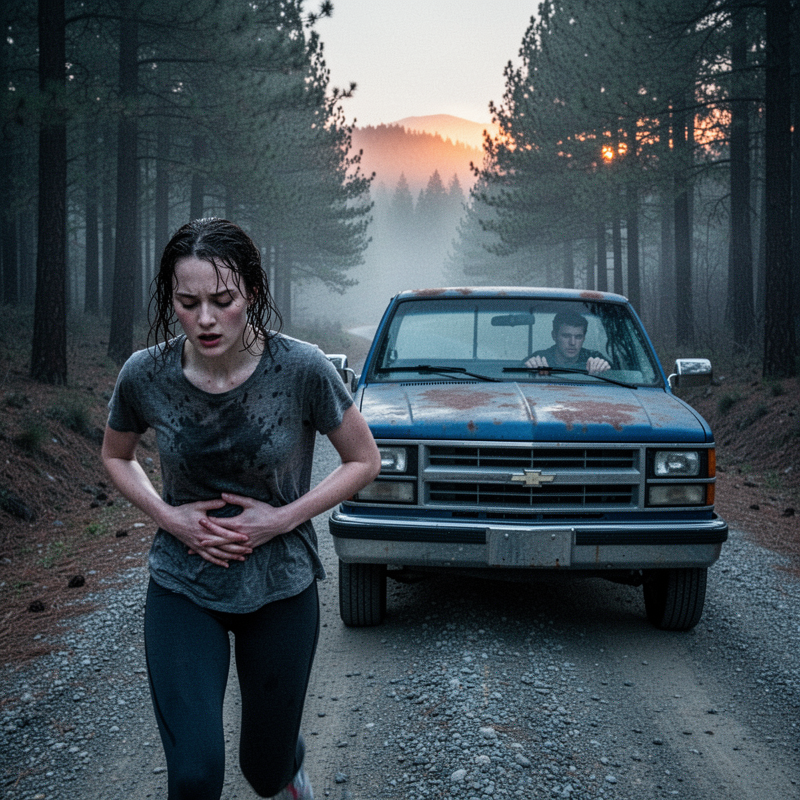
Six weeks after undergoing an emergency C-section, my stepfather Silas ordered my husband Caleb to force me onto the gravel roads of our religious compound every morning at dawn.
“She must burn the weakness from her flesh,” my stepfather declared, citing our community’s doctrine of physical purity.
Caleb drove a beat-up pickup truck two paces behind me, revving the engine and playing recorded sermons through the speakers while my surgical incision tore beneath my clothes.
I had lost 18 pounds in twenty days, but every step felt like a blade twisting inside my abdomen.
On the sixteenth morning, an elderly woman stepped out from the pine trees and blocked the truck’s path.
What she handed my husband in that quiet valley changed everything.
The sun was a pale orange smear over the eastern ridge, struggling to break through the thick, damp air. My lungs burned with each ragged breath, but it wasn’t the cold that chilled me. It was the constant, gnawing pain.
Six weeks. It had been exactly six weeks since Ruth was born, six weeks since Dr. Albright had sewn me up with neat, precise stitches. Now, those stitches felt like they were unravelling thread by agonizing thread.
Every stride sent a jolt of agony through my lower abdomen. The gravel, sharp and unyielding, dug into the thin soles of my worn running shoes.
My vision blurred, not just from the sweat stinging my eyes, but from the exhaustion that had become my constant companion.
Behind me, the growl of Caleb’s truck was relentless. It was a familiar, oppressive sound, a metal beast herding me forward.
He kept the engine just loud enough to drown out my gasps, just loud enough to ensure there was no reprieve from the sermon blaring through the old truck’s speakers.
“The flesh is a veil, sisters! A weak, porous veil between our spirit and the Divine Light!” Silas Kidd’s voice boomed, amplified and distorted, echoing off the silent pine trees.
His words were a constant reminder of my supposed failure, my softness, my inability to conform to the compound’s rigid expectations.
My soaked shirt clung to my skin, chafing against the tender skin above my incision. A dull, wet warmth had started to spread there, a familiar sensation I tried desperately to ignore.
It was blood, I knew. Not much, not yet, but enough to mark another failure.
I focused on the faint trail ahead, a barely visible track winding between the tall, shadowed pines. Five miles. Five miles before I could collapse, before I could numb the pain with a scalding bath and pretend everything was normal for my infant daughter.
My legs felt like lead, each muscle screaming in protest. I could feel a tremor starting in my knees.
I stumbled, catching myself before I fell. The sudden jolt sent a sharp, tearing pain through my core. I gasped, a small, choked sound.
“Faster, Hannah!” Caleb’s voice cut through the sermon, sharp with his own anxiety. He wasn’t yelling, not really, but the urgency was clear. “Silas will want to see you push through!”
He knew. He knew the pain I was in. He saw the streaks of sweat, the way I hugged my arms around my middle. But the fear of his father, Silas, was a far more potent force than any concern for his wife.
The truck’s engine revved again, a louder snarl this time, closer. It nudged me forward with its sheer sonic force.
My head swam. I could taste iron in my mouth. I wanted to stop, to sink to the ground, to just stop moving.
But the fear of Silas, the fear of what he might do to Ruth if I disobeyed, pushed me on.
Then, just as the path narrowed, a figure emerged from the dense undergrowth of the pines.
It was Ester Kidd, Silas’s own mother, the matriarch I rarely saw outside of Sunday service. Her 82 years sat heavily on her, her back stooped, her movements slow and deliberate.
She wore a faded calico dress and a knitted shawl, looking out of place in the damp dawn.
She stepped directly into the center of the narrow road, her frail body a defiant barrier.
Caleb slammed on the brakes. The pickup truck skidded on the loose gravel, kicking up a cloud of dust. The recorded sermon abruptly cut off with a screech of static.
The sudden silence was deafening after the incessant noise.
I stumbled to a halt a few yards in front of Ester, my chest heaving, my legs shaking uncontrollably. The pain in my incision flared, a fire spreading beneath my skin.
Ester stood perfectly still, her eyes fixed on Caleb. She didn’t look at me, not directly.
Her face, usually placid and resigned, was etched with a grim determination I had never seen before.
Caleb rolled down his window, his face a mixture of irritation and surprise.
“Grandmother? What are you doing out here?” he asked, his voice strained. He glanced nervously at me, then back at his grandmother.
“I need a moment with you, boy,” Ester said, her voice surprisingly firm despite its age. She held up a thick, worn envelope, its edges softened with time.
It looked like something that had been stored away for years, perhaps decades.
Caleb’s eyes widened, recognizing the envelope instantly. He hesitated, his gaze darting to the still-idling truck and then to the silent forest.
He knew. There was a flicker of something in his eyes—panic, confusion, a deep-seated fear.
Ester took a slow, deliberate step towards the truck. The morning air was suddenly still, heavy with unspoken tension.
She reached the driver’s side window and, without a word, pushed the envelope into Caleb’s trembling hand.
Her fingers were gnarled with age, but they held the paper with a surprising grip, pressing it firmly into his palm.
“This,” she whispered, her voice barely audible, “is what your father never wanted you to see.”
Caleb’s fingers closed around the envelope, the paper feeling heavy, substantial. He glanced at the faded, handwritten label on the front: “Compound Land Covenant – 1998.”
His face went pale as he understood, even before opening it, what his grandmother had just given him.
Part 2
Caleb’s hand trembled so violently the envelope almost slipped from his grasp. His face, already pale from the cold morning, drained of all color. He let out a low, strangled sound, a mix of fear and disbelief.
Then, as if his legs had simply given out, he dropped to his knees on the gravel. The envelope lay open in his hand, the 1998 document inside clearly visible.
“No,” he mumbled, his voice barely a whisper, eyes wide and fixed on the paper. “Father wouldn’t…”
Ester leaned closer, her frail frame surprisingly sturdy as she looked down at her grandson. Her voice was a low, urgent murmur, meant only for Caleb, but the sudden quiet of the valley carried it straight to me.
“He’s been working with Gideon Croft for years,” she said, her gaze darting towards the administration building in the distance, where Silas held his office. “Falsifying everything. The old land deeds. Even the papers for the… for the children.”
The words hung in the still air, each one a hammer blow.
*The papers for the children.*
My breath hitched in my throat. I stood there, rooted to the spot, the throbbing pain in my incision suddenly secondary to a cold, horrifying dread that spread through my entire being.
Gideon Croft. The community notary and land adjuster, a man whose quiet, precise work went unnoticed by most. But I had seen him often enough, always with a stack of documents, always deferential to Silas.
*Falsifying everything.*
A sudden, sharp clarity pierced through the fog of exhaustion and pain that had defined my life for weeks. My daily runs, the agonizing five miles, the forced weakness. It wasn’t just about “burning the weakness from my flesh.” It wasn’t just about spiritual purity.
It was about keeping me broken.
Keeping me too tired to think, too sore to move, too distracted by physical agony to notice anything beyond my own survival.
Silas had orchestrated my daily torment, not for my soul, but to ensure I would be too incapacitated to question his authority, too weak to inspect any dusty archives, any ledgers, any legal documents that might expose his lies.
CHAPTER 2: The Chemist’s Eye
The pine floors of my small cabin creaked under the weight of my own cautious steps.
Outside, the compound was silent, save for the wind pushing through the red pines and the faint, rhythmic idling of Caleb’s pickup truck down near the motor pool.
My surgical incision throbbed in sharp, hot pulses beneath my blood-stained cotton dress.
I set baby Ruth into her wooden bassinet near the stove, her tiny hands reaching blindly into the cool air.
From beneath the bottom drawer of my cedar chest, I pulled out my old leather travel kit—the only item Silas had permitted me to keep from my life before the Sanctum of Light.
Inside sat a handheld 365-nanometer ultraviolet light probe, no larger than a fountain pen.
Before Silas married my late mother and swept us into this valley, I had spent six years in a state forensic laboratory analyzing questioned documents, ink chromatography, and paper fiber degradation.
I laid the yellowed 1998 land covenant document across the coarse oak table.
I turned on the UV light.
The narrow blue beam washed across the brittle paper.
Under standard light, the signature at the bottom read *Ester Kidd* in fading brown ink, ceding the entire 420-acre trust to Silas upon the community’s founding.
But beneath the UV light, the chemical truth revealed itself instantly.
A pale, ghostly halo haloed every loop of the script—the distinct fluorescent signature of sodium hypochlorite, plain household bleach, used to dissolve an original signature.
And directly over those erased fibers sat a secondary ink layer.
The ink was not from 1998.
It was a modern iron-gall synthetic mix manufactured after 2010, which leaves distinct, harsh metallic feathering when applied over bleached cotton-rag paper.
Someone had taken a document pencil-signed by Ester in 1998 and chemically overwritten it in 2011.
My chest tightened as the timeline slotted together.
In the spring of 2011, my mother had owned the deed rights to the eastern 60 acres of the valley—the fertile pasture land near the creek.
Silas had married her six months before she died of sudden liver failure.
He had not taken my mother out of spiritual love.
He had taken her so that notary Gideon Croft could falsify her land title and attach those 60 acres directly to his newly rewritten master covenant.
The sound of boots crunched on the gravel outside my front door.
I clicked the UV light off and shoved the paper beneath my mattress just as the latch lifted.
Caleb stood in the doorway, his eyes red-rimmed and his hands trembling against his canvas work jacket.
“Father wants to see you at the assembly hall,” Caleb said, his voice flat and strained. “Now.”
“Ruth is resting, Caleb,” I said, stepping between him and the bassinet.
“He knows what grandmother gave you,” Caleb whispered, refusing to make eye contact. “He knows.”
CHAPTER 3: The Radio Sermon
I walked across the center quad with Caleb two paces behind me.
The morning air smelled of wet wood chips and diesel fuel.
Before we reached the steps of the timber assembly hall, a sharp, metallic screech split the valley air.
The high-power public address speakers, mounted on twenty-foot poles at every corner of the compound, hummed to life.
Silas’s voice boomed across the dirt roads, amplified through the heavy metal cones.
“Brethren of the Sanctum,” Silas’s voice echoed off the ridge, smooth and unhurried. “We must lift our prayers for the house of Caleb.”
I stopped on the gravel path.
Several women hanging wash near the communal laundry line paused, their eyes locking onto me.
“Our sister Hannah has fallen into profound spiritual affliction following the birth of her child,” the speaker crackled overhead. “The enemy has seized her mind with postpartum demonic psychosis.”
My stomach dropped into a cold, hollow void.
“She sees phantom contracts where there is only covenant,” Silas continued, his voice dripping with false sorrow. “She wanders the roads making wild, ungodly accusations against the elders.”
Down near the barn, two senior guards stepped into the road, their heavy leather belts holding key rings and radios.
“For her safety and the safety of infant Ruth,” Silas declared over the speaker, “Hannah is hereby restricted to her quarters. No member of the fold shall speak to her, feed her, or validate her delusions. Brother Gideon Croft is currently preparing temporary guardianship papers to relieve her of maternal duties until her spirit is cleansed.”
I turned to Caleb. “He is laying the paper trail to take my daughter.”
Caleb stared at the gravel, his knuckles white in his jacket pockets.
“Father knows best what is clean, Hannah,” he muttered, though his lip trembled.
“Look at me, Caleb!” I stepped into his path, forcing him to halt. “He is using Gideon Croft to write me off as insane so I cannot challenge the land title!”
“You don’t understand the law!” Caleb snapped, his voice cracking as he looked around nervously. “If Father says you’re sick, the elders sign the papers! The county judge in town accepts whatever notary seal Gideon puts on the affidavit!”
He reached out and shoved me roughly back toward our cabin, playing his part for the watching guards.
“Get back inside,” Caleb shouted, his voice shaking with a terror that was not meant for me, but for the speakers above us. “Get back inside before he takes her today!”
CHAPTER 4: The Ledger in the Bible
Night fell heavy over the valley, bringing a thick river fog that rolled across the pine ridge.
At 9:00 PM, the compound lights were cut, leaving only the dull orange glow of the perimeter security lamps.
My incision throbbed like an open flame, but I wrapped a wool shawl tightly around my waist to bind the torn muscle beneath my dress.
I left baby Ruth asleep under the watchful eye of a young girl Caleb had bribed with a jar of wild honey, and slid out the back window of the cabin.
I moved through the tall grass behind the equipment sheds, avoiding the gravel roads where the night watch patrolled.
Ester’s cottage sat three hundred yards into the timber line, isolated from the rest of the commune.
I pushed through her unlocked back door and slipped inside.
The room smelled of dried lavender, kerosene, and damp wood.
Ester sat in a rocking chair near her small woodstove, a hand lantern burning low beside her knees.
“You shouldn’t have come, child,” Ester said, her voice thin and rasping. “Silas has guards posted on the main road.”
“He’s taking Ruth, Ester,” I whispered, kneeling beside her chair. “He’s using Gideon Croft to file an emergency guardianship affidavit tomorrow.”
Ester stared into the dim flame of the lantern for a long moment, her old hands knotting in her apron.
She stood up slowly, her knee joints popping in the silence.
She walked to the corner of the small room, bent down, and pulled back a strip of worn braided rug.
With a rusty butter knife, she pried up a single short floorboard.
She reached into the dark void and pulled out an ancient, leather-bound family Bible wrapped in oilcloth.
“Silas took everything my husband built,” Ester whispered, setting the heavy book on her knees. “He told the fold it was for God. But God doesn’t buy commercial real estate.”
She opened the cover.
Past the hand-written birth records from the 1940s, pulled tight against the back spine, was a folded document bearing a blue state seal.
I pulled it out and unfolded it under the lantern light.
It was a pre-signed, unrecorded commercial purchase agreement dated four months ago.
It detailed the outright sale of 140 acres of the compound’s western timberland to an outside logging corporation based in Syracuse for $2.8 million.
At the bottom sat Gideon Croft’s official notary stamp, raised in embossed foil, along with Silas’s sole signature as executive trustee.
“He isn’t building a sanctuary,” I said, my voice barely audible. “He’s liquidating the valley.”
“He’s leaving,” Ester said cold and flat. “He’s selling the land out from under the two hundred families living here, and once the money clears the Albany bank, he’ll disappear to a non-extradition district in South America.”
“And he’s locking me in an institution,” I realized, “because my mother’s original deed proves he doesn’t own the 140 acres he just contracted to sell.”
CHAPTER 5: Ashes at Midnight
I crept back toward the center quad at midnight, keeping to the shadows of the timber mill.
A sharp smell hit the night air—not the damp odor of burning pine from the heating stoves, but the acrid chemical stink of burning paper and leather.
Plumes of black smoke rose from behind the small brick administration building where Gideon Croft kept the community’s legal records.
I rounded the corner of the tool shed and froze.
A heavy 55-gallon iron drum stood in the narrow alley between the administrative building and the generator shed.
Flames leaped three feet out of the top.
Gideon Croft stood beside the drum, his sleeves rolled up, clutching a thick leather-bound master ledger.
He was tearing out bundles of land registration receipts and tossing them directly into the fire.
His face was slick with sweat, his eyes wide and panicked as he poked a long steel rod into the coals to force the papers under.
If those land ledgers burned, every trace of original property transfers, payment histories, and notary logs from 1995 to 2015 would be gone forever.
I waited until Gideon turned his back to haul another box out of the side door.
I sprinted across the open dirt lane.
I grabbed a long iron scraper sitting against the generator wall and slammed it into the side of the drum, tipping the heavy iron barrel onto its side.
A shower of burning embers and white hot ash exploded across the damp gravel.
“What are you doing!” Gideon screamed, dropping a cardboard box as he lunged around the corner.
I ignored him, raking the burning, scattered papers into the mud with the iron tool.
I stomped frantically on the smoldering edges, cold rain beginning to mix with the hot ash.
“You crazy, hysterical woman!” Gideon yelled, grabbing my wool shawl and pulling me backward.
I swung the flat edge of the scraper back, catching him across the shins.
He fell into the gravel with a high-pitched yelp.
I dropped to my knees in the hot mud, my hands scorching as I grabbed three partially charred sheets from the pile.
They were official bank receipt duplicates from the Commercial Trust Bank in Albany.
They showed six separate wire transfers totaling $410,000 from Silas Kidd’s private trust directly into Gideon Croft’s personal account over the last eighteen months.
“Get away from those!” Gideon scrambled back to his feet, clutching his knee.
“These are kickbacks, Gideon,” I yelled, shoving the hot, scorched papers into my apron pocket. “This is federal bank fraud!”
Footsteps pounded on the gravel down the alleyway.
I shoved past Gideon and vanished into the dark pine forest before the night watch arrived.
CHAPTER 6: A Key in the Dark
I hid behind the timber shed, pressing my back against the damp cedar siding as my breath came in ragged, wheezing gasps.
My C-section stitches felt like they had completely split beneath my dress, a cold sticky wetness spreading down my hip.
A shadow moved around the corner of the shed.
I pressed my back against the wall, pulling a heavy steel wrench off a lower tool shelf.
“Hannah,” a quiet voice called out.
Caleb stepped out of the fog, holding a dim flash lantern pointed down at the mud.
He looked at my ash-stained hands and the smoke rising from my apron.
“Gideon is raising the alarm,” Caleb said softly. His voice lacked any anger. It was completely hollow. “He told Father you set fire to the archives.”
“Gideon was burning the proof that your father is selling this valley out from under you, Caleb,” I said, my voice cutting through the dark. “Look at this.”
I pulled one of the scorched bank receipts from my apron and jammed it against his chest.
Caleb pulled his lantern up, his eyes scanning the blurred ink on the charred paper.
He read the dollar amounts.
He read his father’s signature next to Gideon Croft’s personal account number.
“No,” Caleb whispered. “This… this is for the regional missionary fund. Father said…”
“It’s an Albany private account, Caleb!” I stepped closer, grabbing his jacket lapels. “There is no missionary fund! He sold 140 acres of your grandmother’s land to outside developers! He is taking $2.8 million and leaving you to take the fall with the county authorities!”
Caleb dropped his lantern into the mud.
He slid down the side of the shed, his hands covering his face as silent, body-racking sobs shook his frame.
“He made me enforce those runs,” Caleb wept into his palms. “He told me you were trying to break our family apart… he told me you were sick…”
“He wanted me too exhausted to look at the books, Caleb,” I said gently, crouching down beside him despite the tearing pain in my abdomen. “He needed me weak so Gideon could seal the guardianship papers without a fight.”
Caleb sat in the wet dirt for a long minute, listening to the alarm bells beginning to toll weakly across the compound quad.
He reached deep into his inner coat pocket.
He pulled out a heavy, double-bitted brass key attached to a leather strap.
“This opens his private study in the main house,” Caleb whispered, his voice trembling as he pressed the cool brass into my ash-covered palm. “The deadbolt key he keeps on his desk clock. I took it while he was at evening prayer.”
“Caleb…”
“The original 1998 county deed is in his iron box behind the oak bookcase,” Caleb said, looking up at me with tears cutting lines through the coal dust on his cheeks. “Get your mother’s real paper, Hannah. Get it and get Ruth out of here.”
CHAPTER 7: Shadows in the Study
A torrential rainstorm broke over the valley by 1:00 AM, thunder rattling the tin roofs of the compound buildings.
Sheets of rain slammed against the high stained-glass windows of the patriarch’s main residence.
The entire commune was gathered in the central assembly hall three hundred yards away, where Silas had called an emergency midnight prayer circle to deal with the “spirit of rebellion” in our house.
I unlocked the side entrance of the main house with Caleb’s brass key, slipping inside as lightning illuminated the polished hardwood floor.
The house was dead silent, smelling of lemon wax, old leather, and oil lamps.
I hurried down the wide hallway to Silas’s private study at the rear of the building.
I inserted the key into the heavy brass deadbolt.
It turned with a sharp, heavy *click*.
I stepped inside and closed the door behind me, leaving it unlatched just an inch to hear the hallway.
I pulled out my penlight, sweeping the narrow beam across the massive oak desk, the framed scriptures on the wall, and the heavy brass floor clock.
Behind the floor-to-ceiling oak bookcase on the north wall, I found the small wall safe Caleb had described.
The door was unlatched—Silas had been filling it with cash and records earlier that evening.
I pulled open the iron door.
Inside sat three thick Manila folders.
I pulled the first one out and opened it under my penlight beam.
There it was.
The original 1998 land deed bearing my late mother’s real, un-bleached signature, complete with the original blue county clerk’s intake stamp from upstate New York.
Attached to it was a private letter from a legal firm in Rochester, warning Silas that any transfer of the eastern 60 acres without my written consent as her sole heir would constitute felony real estate fraud.
He had known for twelve years that he had no legal right to that land.
I pulled the document out and slid it into my inner coat pocket.
A soft, sudden creak sounded in the hallway outside.
I froze.
The narrow strip of light beneath the door was blocked by a dark shadow.
The door swung open slowly on its brass hinges.
Silas stood in the doorway, holding an unlit kerosene lantern in one hand and a heavy oak walking stick in the other.
His eyes were cold, sharp, and entirely devoid of the spiritual benevolence he projected over the loudspeakers.
“You always were too smart for your own good, Hannah,” Silas said softly, stepping into the room and closing the door behind him.
CHAPTER 8: The Cold War
The thunderstorm slammed against the study’s heavy glass window, lighting up Silas’s dark silhouette with brief flashes of white light.
I did not scream. I did not back away.
I stood beside the open safe, holding my penlight firmly in my right hand, my left arm pressed tight against my bleeding surgical dress.
“Put the stick down, Silas,” I said, my voice steady, clear, and quiet.
“You’re standing in my home, stealing my private property while suffering from documented mental distress,” Silas said, stepping closer, his voice low and calculating. “Do you think a single county deputy will listen to a word you say when Gideon hands them your medical hold papers tomorrow?”
“Gideon won’t be handing anyone papers tomorrow,” I said.
Silas stopped, his brow furrowing slightly.
“I pulled three bank transfer receipts out of Gideon’s fire drum an hour ago,” I continued, taking a step toward the desk. “Direct wire payments from your Commercial Trust account in Albany to Gideon Croft’s private account.”
Silas didn’t move, but his hand tightened slightly on the wood stick.
“I am a certified forensic document examiner, Silas,” I said, speaking with rigid precision. “I spent six years presenting ink analysis in federal courtrooms before I ever met you.”
I pulled the 1998 document from my pocket and laid it flat under the desk lamp.
“Under 365-nanometer ultraviolet reflection, the sodium hypochlorite erasure on Ester’s covenant shows distinct chemical halos,” I said. “The iron-gall ink used to write your name over her signature was manufactured in 2011. Iron-gall degrades at a rate of 0.4 percent per year in humid environments. I can date that forgery to within six weeks of its creation in an outside state lab.”
Silas stared at me, his breathing shallow.
“Combine that chemical proof with the charred bank receipts showing corporate kickbacks for the 140-acre commercial sale,” I added, “and you aren’t looking at a quiet custody dispute in a small town probate court. You’re looking at federal mail fraud, bank fraud, and forged land titles carrying a mandatory twenty-year sentence in a state penitentiary.”
Silence stretched between us in the dark study, punctuated only by the heavy pounding of rain against the roof.
The grand patriarch, the man who had ordered two hundred people’s daily lives for two decades, looked at me and realized he was not looking at an obedient fold member.
He was looking at an expert witness who could destroy his life in four hours.
“What do you want?” Silas asked, his voice dropping all spiritual inflection, sounding like a tired, transactional businessman.
“A signed release,” I said. “Immediate physical and legal release for me and Ruth. And an unfettered exit from this valley tonight.”
Silas glared at me, calculating the odds, weighing the loss of his absolute authority against twenty years in an upstate prison.
“Gideon prepares the papers,” Silas said coldly. “You leave the compound. But you stay in New York State where I can keep eyes on you.”
“Why would I agree to that?”
“Because if you try to take this to a grand jury,” Silas smiled thinly, his dark eyes gleamin, “I will file the uncompleted mental health petitions instantly. You might beat the land fraud in two years, Hannah. But you will spend those two years in a court custody battle while Ruth sits in state foster care.”
He pulled a blank release form from his desk drawer.
“You get physical safety tonight,” Silas said, holding his pen over the page. “Or we both burn. Choose.”
CHAPTER 9: The Paper Shackles
At 4:30 AM, as the rain turned into a cold, grey morning drizzle, Gideon Croft was summoned to the main study.
His hands shook so violently he could barely hold his official notary seal.
Under my direct supervision, Silas signed a conditional physical custody release and residential permission agreement.
It granted me permission to take six-week-old Ruth and reside in a small, two-room apartment in a satellite industrial township twenty-two miles south of the compound ridge.
It granted me a small monthly stipend drawn from the compound’s basic welfare trust—just enough for rent and milk.
But at the bottom, embedded in dense, bureaucratic legal boilerplate written by Gideon, sat the conditional clawback clause.
Silas retained active joint legal guardianship status through unfiled, pre-stamped court petitions held in Gideon Croft’s office.
If I ever contacted a state law enforcement agency, a journalist, or an outside land surveyor, those petitions would be dropped into the county court hopper instantly, citing my recorded “postpartum instability.”
I was not being freed.
I was being transferred to a longer leash.
Caleb brought his pickup truck around to the front of the cabin at 5:15 AM.
He carried my single duffel bag and set Ruth’s car seat into the passenger side.
He refused to look me in the eye as he handed me the keys to his old sedan, which stood idling near the gate.
“Don’t come back, Hannah,” Caleb whispered, his voice dry and hollow as he looked up at the main house where Silas stood watching from the second-floor window. “If you come back, he won’t use paper next time.”
“Come with us, Caleb,” I said, holding Ruth close against my chest. “You know what he is now.”
Caleb looked at the dirt road, at the grey pine trees, at the only world he had ever known since he was four years old.
“I can’t live out there,” Caleb said softly, shaking his head. “I don’t know how.”
I got into the car, strapped my baby into the backseat, and drove past the wooden security gates of the Sanctum of Light without looking back in the rearview mirror.
CHAPTER 10: Two Years Later
The cheap fluorescent light overhead flickered with a dull, buzzing hum.
It was 5:00 AM.
Inside the cramped, narrow living room of my two-room apartment in an industrial suburb of Utica, the air smelled of stale radiator heating and faint exhaust from the highway two blocks over.
The apartment had no pine trees, no dirt roads, and no high-power radio speakers mounted on poles.
I stood on the black rubber belt of a secondhand mechanical treadmill I had bought off an online marketplace six months ago.
*Thump. Thump. Thump.*
My running shoes hit the belt in a rigid, unwavering cadence.
I ran five miles every morning.
Not because Silas was driving a truck behind me, but because if I stopped moving, the panic creeping around the edges of my mind would catch up to me.
My C-section scar was a thick, pale white line now, numb to the touch, but the memory of the pulling flesh still burned whenever my heart rate climbed.
In the corner of the room, two-year-old Ruth slept soundly under a yellow blanket in her toddler bed.
On the laminate kitchen counter sat my phone.
At exactly 5:15 AM, the screen lit up with a harsh, sharp chime.
An automated text message appeared from an encrypted regional phone service registered to Gideon Croft’s legal assistant.
*WEEKLY LOCATION VERIFICATION REQUIRED. CONFIRM RESIDENTIAL PRESENCE WITHIN 15 MINUTES.*
I did not stop the treadmill.
I reached out with a sweaty hand, tapped the screen, and sent the pre-formatted automated GPS ping back to the compound’s administrative server.
Every seven days, for two years, the ping was required.
If I missed the fifteen-minute window, the unfiled guardianship petitions sitting on Gideon Croft’s desk would be couriered to the county courthouse by noon.
I put my hands back on the treadmill handlebars and increased the belt speed by two notches.
The physical gravel roads were twenty miles behind me.
The valley was gone.
But as the rubber belt turned beneath my feet, pushing me nowhere inside the small, fluorescent-lit room, I looked at the dark window reflecting my own tired face.
They think freedom is crossing a physical border, but when you were raised under the watch of saints and enforcers, you learn that safety is just a temporary silence between commands.
Leave a Reply