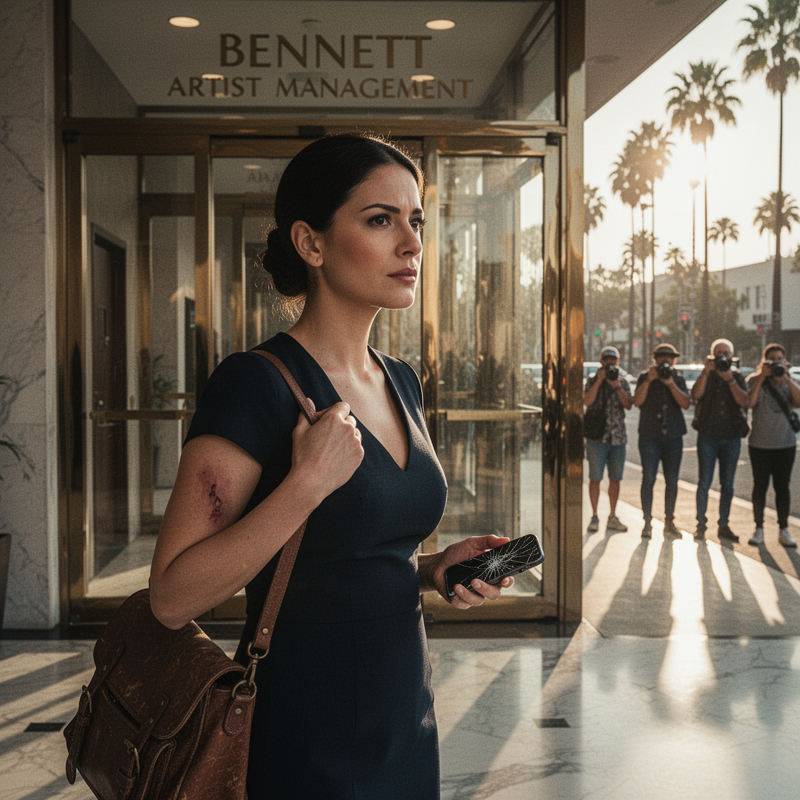
CHAPTER 1: The Threshold on Sunset
Part 1
“You don’t belong in this family, and you certainly don’t own a single frame of this studio,” my stepmother, Eleanor Bennett, said as she shoved me out of the executive suite on Sunset Boulevard.
Her adult son, Julian, threw my personal belongings into the hallway while laughing about how my late father had left everything to them.
I left the building with bruised ribs and a cracked smartphone, but I didn’t head to the hospital or call a tabloid reporter.
I walked straight to my car, pulled out my encrypted laptop, and logged into the federal oversight portal where I had been secretly tracking their financial fraud for eight months.
They thought I was just a quiet, helpless assistant, but they were about to learn what a certified forensic accountant actually does when her family legacy is stolen.
The heavy glass door of Bennett Artist Management slammed shut behind me, the sound echoing hollowly across the polished marble lobby. My ribs ached with a dull throb, a souvenir from Eleanor’s unexpected shove. The corner of my smartphone screen spiderwebbed from where Julian had intentionally dropped it onto the floor.
Outside, the late afternoon sun of Los Angeles cast long shadows down Sunset Boulevard. Tourists, oblivious to the drama unfolding just moments ago, laughed as they snapped photos of iconic landmarks, their cheerful chatter a stark contrast to the burning humiliation in my chest.
I pulled myself upright, adjusting the strap of my bag, and walked purposefully toward the parking garage. Each step was deliberate, a silent defiance against the chaos I had just endured. My adoptive father, Marcus Bennett, had built this studio from nothing. He would have been heartbroken to see his legacy treated like a pawn in Eleanor’s desperate game.
Finding my older model sedan in its usual spot, I slid into the driver’s seat. The worn leather offered a familiar comfort. I didn’t immediately start the engine. Instead, I took a deep breath, letting the quiet interior of the car become a temporary sanctuary.
My fingers, still trembling slightly, reached for the hidden compartment beneath the passenger seat. I retrieved a sleek, matte-black laptop, far more advanced than the basic model Julian had sneered at earlier. This one was my real toolkit.
I powered it on. The screen glowed to life, displaying a complex, custom-coded login interface. This was not the standard company laptop they saw me use for scheduling and expense reports. This was the encrypted portal for my actual work.
Under an alias, a name from my early foster care days, I typed in my credentials. The system granted access with a soft chime. My professional identity as Maya Ruiz, Certified Forensic Accountant, was a secret I had meticulously guarded for years.
Eleanor and Julian had no idea that their unassuming “assistant” had spent the last eight months quietly dissecting their financial records. Every questionable transaction, every offshore transfer, every inflated invoice — all meticulously documented.
The federal oversight portal loaded, presenting a dashboard of complex data. My gaze immediately found the running total. $2,437,812. That was the exact amount I had traced, piece by painful piece, from the studio’s legitimate accounts into various shell corporations and personal expenditures.
The money wasn’t just missing; it had been systematically siphoned from Marcus’s carefully curated catalog of master recordings, the very heart of Bennett Artist Management.
A vibration in my pocket startled me. My cracked smartphone, barely functional, buzzed with an incoming text message. It was from Eleanor.
“Enjoy your freedom, darling. Don’t bother coming back. We’re happy to handle Marcus’s legacy without your interference.”
A cold, dismissive laugh emoji followed the message.
I stared at the screen, a flicker of something close to pity in my gut. They truly believed I was out of options, that their petty cruelty had won. They thought this was the end.
Just as I lowered the phone, a new notification flashed across my laptop screen. It wasn’t a standard system alert. This was an automated trigger, specifically programmed to activate under certain conditions.
The text was stark, immediate.
ALERT: Unauthorized Asset Transfer Attempt Detected. Bennett Artist Management — Primary Master Recordings. Initiating Legal Hold.
Part 2
My heart pounded, a strange mix of dread and vindication. The alert wasn’t just a warning; it was a command. A new window popped up on my laptop, detailing the automated response. The transfer of the master recordings had been blocked, not by me directly, but by a pre-existing legal mechanism I hadn’t fully understood until now.
I scrolled through the system logs, my fingers flying across the keyboard. This wasn’t part of my initial fraud investigation. This was something else, deeper, a layer of protection Marcus must have put in place. The system highlighted a specific clause, an obscure line from Marcus’s original 2012 foundation trust.
It was an “option clause,” set to expire, but its expiration triggered an automatic legal hold. It locked all asset sales and transfers unless an annual audit clearance, signed by a certified forensic accountant, was logged into the system. Without that signature, no major assets could move. And Eleanor, in her rush to cash out, had just hit that exact tripwire.
A triumphant, almost dizzying wave washed over me. Marcus, ever the strategist, had built a silent guardian into his legacy. He hadn’t just loved music; he’d loved protection, especially for the things he truly valued. This wasn’t just about money; it was about his art, his life’s work.
My phone, the same cracked device Eleanor had just texted me on, began to ring. It was her. The caller ID glowed ominously against the cracked screen. She usually left a string of voicemails before calling directly if something was truly wrong. This was immediate.
I let it ring once, twice, then answered, keeping my voice neutral, almost bored.
“Maya! What in God’s name is going on?” Eleanor’s voice was sharp, laced with panic, a stark contrast to her smug text just minutes earlier. “The system is frozen! I’m trying to finalize a transfer, and it says ‘pending audit clearance’! What kind of nonsense is this? Get back here *right now* and fix this!”
She rattled on, her words a torrent of frustration and fury. She had no idea. Not a single clue that the person she had just physically thrown out, the “unimportant assistant” she had mocked, was the only one who could unlock the system. The audit key was in my hands. And Eleanor, frantic and oblivious, was demanding I use it for her.
Chapter 2: Shadows of the Studio
The back alley of Bennett Artist Management smelled faintly of stale coffee and exhaust fumes. It was well past nine, the kind of quiet that settled over Sunset Boulevard once the industry lights dimmed. I walked through the service entrance, the automatic lock clicking shut behind me with a soft thud. My goal was simple: retrieve Marcus’s old desk logs from his former executive office.
I moved through the empty, echoing hallways, my footsteps hushed on the polished concrete. The building felt different tonight, no longer a place of veiled threats but a repository of secrets I was about to expose.
Suddenly, a figure stepped out from behind a stack of shipping crates near the recording studio entrance. It was Julian. He looked disheveled, a dark stubble shadowing his jaw.
“What are you doing here?” he snapped, his voice sharp in the silence.
He blocked my path, arms crossed. “Looking for company files to steal, Maya? Is that it?”
“I’m here for my father’s personal items,” I said, keeping my voice even.
“Your father left nothing to you,” Julian sneered. “And I’ll make sure everyone in this town knows you’re a thief. Your reputation will be in tatters.”
He took a step closer, his eyes narrowed, remembering the shove from earlier that day.
I paused, then slowly lifted my gaze to a small, dome-shaped camera mounted discreetly in the corner of the hallway ceiling. Its red light blinked steadily.
“Every physical threat,” I stated, my voice calm. “Every missing financial dollar.”
Julian scoffed. “What are you talking about?”
“It’s all recorded,” I continued, gesturing vaguely upwards. “Cloud storage has a remarkable memory, Julian. For everything.”
His eyes flickered to the camera, then back to me, a flash of uncertainty in their depths. The memory of him shoving me out of the office earlier, the way I’d hit the wall, must have played through his mind.
He started to speak again, but his words caught in his throat. He understood. I wasn’t just talking about financial documents. I was talking about him.
I wasn’t going to release that footage. Not yet. But the look on his face told me he knew I had it.
He took a hesitant step back, his bravado deflating. The hallway remained silent except for the faint hum of the building’s ventilation.
Chapter 3: The Architecture of Lies
The coffee shop in Studio City was bustling, but Eleanor had chosen a secluded corner booth. She sat opposite me, meticulously stirring a latte, her expression a careful blend of concern and condescension.
“Maya, we need to talk about your father,” she began, not meeting my gaze.
I nodded, taking a sip of my own black coffee.
“He loved you, in his way,” she said, finally looking up. Her eyes were sharp, calculating. “But you know, he often expressed regret about the adoption.”
My grip tightened on my mug. This was the first round of gaslighting.
“He worried about the cost, the… disruption,” Eleanor continued, her voice softening falsely. “Especially with the business. That’s why he made sure Julian, his true son, would inherit the corporate stock.”
She leaned forward, her voice dropping to a conspiratorial whisper. “He wanted to protect you from the burden. Said he’d left you nothing because he wanted you to be free. Isn’t that what he would have wanted?”
I met her gaze, keeping my face expressionless. She was building a narrative, piece by carefully placed piece. A narrative of my father regretting me, of deliberately cutting me out.
A heavy, cream-colored envelope rested in my bag, just out of sight. Inside were the letters Marcus had written to me over the years. Letters full of love, pride, and detailed plans for my future within the company.
He had enclosed sketches of the new studio wing, asking for my input on the soundproofing and layout. He even once sent me a copy of a finance textbook, a note scribbled inside: “For my favorite future auditor.”
Eleanor watched me, waiting for a crack in my composure, for me to argue. I just sat there, listening to her lies.
Her story was crafted, a cruel fiction to justify her actions. I knew it wasn’t true. Marcus would never have left me nothing. His letters, written in his familiar, sprawling hand, were my proof.
Chapter 4: Unraveling the Ledger
The glow of my laptop screen illuminated my West Hollywood apartment, casting long shadows across the walls. It was past three in the morning, but I couldn’t stop. Coffee cooled in a mug beside me.
My fingers flew across the keyboard, cross-referencing transaction IDs, IP addresses, and bank statements. The Los Angeles Financial Crimes Unit report was almost complete.
I pulled up Eleanor’s personal credit card statements. They showed lavish spending: designer clothes, expensive vacations, a new luxury car every two years. Her monthly payments alone were staggering.
Then, I overlaid them with the studio’s offshore talent escrow accounts. The pattern jumped out at me. Large, irregular transfers. Not direct siphoning, but rather a complex system of inflating artist advances, channeling portions to shell companies, and then diverting those funds back into accounts I now traced to Eleanor’s personal debt management.
It wasn’t simple greed. Not entirely.
Hidden deep within one of the digital ledgers, encrypted and buried under layers of dummy invoices, I found a series of loan agreements. They weren’t for Eleanor. They were in the name of a man I barely remembered: her previous husband, Julian’s biological father. He had vanished from her life years ago, leaving her with a mountain of legal and financial obligations.
One particularly damning document detailed a settlement for a failed investment scheme, totaling nearly $1.8 million. The date on the settlement was three years after Marcus had adopted me.
Eleanor hadn’t embezzled the $2.4 million purely out of malice or disdain for Marcus’s legacy. She was desperate. She was covering her ex-husband’s crippling debts, fearing exposure and the loss of her carefully constructed Hollywood façade. Her desperation fueled her cruelty.
It didn’t excuse her actions, but it painted a clearer, more complex picture of her motives. The report was almost ready.
Chapter 5: The Shell Game
Nora Albright’s office at the Los Angeles Financial Crimes Unit was sparse and functional. She sat across from me, her expression professional as she reviewed my forensic audit report. Stacks of case files were neatly arranged on her desk.
“This is comprehensive, Ms. Bennett,” Nora said, her voice clipped. “The pattern of embezzlement, the specific transfers—it’s all here.”
She tapped a page in the report. “The attempted sale of the studio’s primary master recordings, funneled through ‘Pacific Coast Royalty Acquisitions’—that alone is a clear case of wire fraud. With the added layer of the $2.4 million in diverted funds, Eleanor Bennett could face up to eight years in federal prison.”
I felt a tremor in my hand, but kept my voice steady. “I understand the gravity, Deputy Prosecutor.”
“Given the evidence,” Nora continued, “we’re prepared to move forward with a formal indictment.”
I took a breath. “I would ask that you hold that in reserve, if possible.”
Nora’s eyebrows lifted slightly. “You’re asking for leniency after all this?”
“No,” I replied, shaking my head. “I’m requesting a court-sanctioned civil diversion agreement. One that allows for full restitution and accountability, without the immediate criminal prosecution.”
“That’s unusual,” Nora said, her pen tapping rhythmically on her desk. “Especially with such a clear-cut case of fraud. Why?”
“Because Pacific Coast Royalty Acquisitions isn’t a legitimate buyer,” I explained, leaning forward. “My father’s catalog is still valuable. But this company? It’s an insolvent shell, set up to launder their own royalty debts.”
Nora paused, her pen still.
“They’re not trying to buy the catalog, Deputy Prosecutor,” I said. “They’re trying to hide it. If Eleanor sells to them, the entire catalog disappears into a legal black hole, along with the millions they owe other artists.”
“And if we pursue criminal charges immediately,” I added, “Eleanor could go to prison, but the catalog, the true legacy, would be lost in the bankruptcy proceedings of that shell company. It would never be recovered.”
Nora looked from me to the report, then back. A single, sharp nod was her only response.
Chapter 6: The Ghost Clause
The air in the county records office vault was cool and smelled of aged paper. I wore white gloves as I carefully unrolled the original physical copy of Marcus’s 2012 trust document. Arthur Pendelton, the senior estate attorney, watched me from a respectful distance.
“Your father was a stickler for detail, Maya,” Arthur murmured. “Even in his later years, he checked every line.”
I focused on the section concerning asset sales and the now-expired option clause. It was the clause that had frozen Eleanor’s attempted transfer. Beside the typed text, Marcus’s familiar handwriting filled the margins. His notes were small, precise, almost hidden.
“This clause,” I pointed, tracing his script with my finger. “It required an annual audit clearance to unfreeze any major asset sales.”
Arthur nodded. “Standard practice for a trust of this size, though the ‘annual’ part made it quite strict. I recall discussing it with him.”
“But look here,” I said, pointing to a specific marginal note. Marcus had written: “To be cleared by a *certified* auditor, ensuring due diligence, protecting future assets.”
And then, underneath that, almost an afterthought, a single, underlined phrase: “_My Maya_.”
A wave of emotion washed over me. Marcus hadn’t just encouraged my accounting career. He hadn’t just hoped I would find my path. He had seen. He had known.
He knew Eleanor’s tendencies towards financial recklessness. He had deliberately structured the studio’s foundational contract to include that specific, annually renewing audit clause. A protective trap. A failsafe.
And the only person who could truly unlock the assets, who held the power to sign off on that clearance, was a certified auditor. A career he had actively, proudly encouraged me to pursue, almost as if he knew this day would come.
He hadn’t been over-forgiving. He had been planning. This clause wasn’t an oversight. It was his final, brilliant act of protection. My father had trusted me implicitly, from beyond the grave.
Chapter 7: Gaslight at Twilight
A crisp, official-looking envelope arrived at my accounting firm. Inside was a cease-and-desist letter from Eleanor’s legal team. It was a vicious piece of work, accusing me of professional misconduct, fabricating evidence, and threatening to report me to the Certified Public Accountant Board for “unethical interference.” The penalties, it stated, could include the revocation of my license.
This was Eleanor’s third and final round of gaslighting, an attempt to use my professional credentials against me, to force my submission through fear. She still believed I was after money, or revenge.
I read the letter once, then crumpled it. I didn’t call my own attorney. I didn’t send a response.
Instead, I opened my calendar application. I created a new event.
Recipient: Eleanor Bennett.
Subject: Meeting.
Date: Tonight.
Time: Midnight.
Location: Bennett Artist Management – Executive Office, Sunset Boulevard.
I attached no message, no explanation. Just the stark, silent invitation. She would know what it meant. She would know it was time.
The thought of facing her alone, in the empty studio, sent a shiver down my spine. But I knew this was the only way to break through her carefully constructed reality. The truth had to be delivered, face-to-face, without an audience.
I sent the invite. Then I packed my briefcase, making sure the manila folder with the diversion agreement and the core audit report was neatly tucked inside.
Chapter 8: The Silent Corridor
The iridescent glow of the Sunset Boulevard billboards painted the glass facade of Bennett Artist Management in shifting hues of neon and electric blue. It was just shy of midnight. The street was quiet now, the late-night traffic a distant murmur.
I pulled into the empty parking garage, the crunch of my tires echoing in the silence. The air was cool, carrying the faint scent of jasmine from a nearby planter.
The lobby was dark, save for the emergency lights. My footsteps were the only sound as I walked towards the elevator bank. No security guards. No police. No lawyers.
This was my decision. To face Eleanor alone. To strip away all the public performance, all the legal posturing, and get to the core of it.
The elevator doors opened with a soft chime. I stepped inside, the polished steel reflecting my calm, determined face. As the doors closed, I watched my reflection rise, floor by silent floor.
The executive floor was even darker. Only the sliver of light from under Marcus’s office door indicated any presence. My heart thrummed a steady beat in my chest. This wasn’t about vengeance. It was about exposing truth and demanding accountability for Marcus’s legacy.
I walked down the quiet corridor, the carpet muffling my steps. The glittering city lights from the large windows offered a stark contrast to the impending confrontation inside that dimly lit office.
I reached the door. My hand hovered over the cool metal of the doorknob.
Chapter 9: The Anatomy of Fear
The office was dimly lit, a single desk lamp casting an intimate circle of light on Marcus’s old mahogany desk. Eleanor sat behind it, her back ramrod straight. The air was thick with tension, smelling faintly of old paper and anxiety.
She held a pen, twisting it nervously between her fingers. Around her, on shelves and credenzas, Marcus’s celebrity awards gleamed in the low light: Gold records, industry plaques, a Grammy nomination certificate from 2008. Symbols of a legacy she had tried to dismantle.
I pushed the door open, the soft click echoing in the stillness. Eleanor’s head snapped up, her eyes wide, like a trapped animal. Her polished façade had cracked, revealing a raw edge of fear.
I walked in, my steps measured and deliberate. I carried a thin manila folder, its contents a silent promise. I placed it gently on the corner of the desk, just outside the circle of lamplight.
Then, I turned and quietly, firmly, locked the door.
The click resonated like a final gavel. Eleanor flinched, her eyes darting from the folder to the locked door, then to me. Her breath hitched.
The privacy was absolute. There would be no witnesses, no interruptions. Just the two of us, and the truth.
Chapter 10: Private Reckoning
“Eleanor,” I began, my voice steady in the quiet room. “The financial crimes unit has already verified it all.”
Her eyes widened, fixing on mine. She stopped twisting the pen.
“The $2.4 million embezzlement scheme,” I continued. “The offshore accounts. The forged codicil you created three years ago to cut me out of the will. And the expired 2012 trust clause. Every detail has been confirmed.”
A small, choked sound escaped her throat. She looked utterly defeated, the color draining from her face. Her shoulders slumped.
“Based on the evidence, Deputy Prosecutor Albright was prepared to move forward with a full criminal indictment,” I said. “You’re looking at eight years in federal prison.”
Eleanor pressed her lips together, trembling. She started to reach for the pen again, then her hand dropped to the desk.
“But that’s not what I want,” I stated, pushing the manila folder across the desk towards her.
She looked at the folder, then back at me, confusion mixing with her fear.
“Inside is a civil diversion agreement,” I explained. “It’s prosecutor-sanctioned. It protects you from prison, Eleanor, if you restore the stolen catalog and surrender controlling equity back to the company.”
Her gaze snapped to the folder, then to the lock on the door. “What… what kind of trick is this?”
“No trick,” I said softly. “It means you acknowledge your wrongdoing, complete financial counseling, and pay back the missing studio funds over five years. Without a public arrest. Without prison time.”
Eleanor stared at the folder, then at me. Her carefully constructed world was crumbling. The prospect of prison, then the unexpected reprieve, seemed to shatter something inside her.
Slowly, her composure completely crumbled. Her eyes welled up, and a sob tore from her throat. She buried her face in her hands, her shoulders shaking violently.
“He always loved you more,” she choked out, her voice muffled. “Marcus always loved you more than me. I… I was never enough. I just wanted to be enough.”
The words hung in the air, thick with decades of insecurity and resentment. All the cruelty, the gaslighting, the theft – it was all a desperate, misguided attempt to secure a love she felt she hadn’t earned.
Chapter 11: The Signed Covenant
The following morning, the atmosphere in Deputy Prosecutor Nora Albright’s office was formal and hushed. Sunlight streamed through the tall windows, illuminating dust motes dancing in the air.
Eleanor sat stiffly beside me at the conference table. Her face was pale, devoid of makeup, her usual glamour stripped away. She clutched a small handbag in her lap.
Nora Albright, efficient and composed, slid the finalized civil diversion agreement across the table. “This document outlines the terms we discussed, Ms. Bennett.”
“Your agreement to return controlling stock to Maya Bennett is explicit,” Nora continued. “Along with the five years of structured financial restitution and mandatory therapy. Failure to comply will result in the immediate reinstatement of criminal charges.”
Eleanor nodded, her eyes fixed on the document. She picked up the pen Nora offered her. Her hand trembled visibly.
Through the glass wall of Nora’s office, Julian stood in the hallway. He leaned against the wall, arms crossed, a scowl etched on his face. He watched us, his expression unreadable, a blend of anger and confusion. He hadn’t expected this outcome. No public spectacle, no dramatic arrest. Just a quiet, formal surrender.
Eleanor lifted the pen, paused, then with a deep, shaky breath, she signed her name. The scratching sound was loud in the quiet room.
Nora Albright retrieved the document, scanning the signature. “Good. This will be filed immediately.”
Eleanor looked at me, a flicker of something unidentifiable in her eyes—relief, perhaps, or a nascent understanding. It wasn’t forgiveness yet, not by a long shot. But it was a start. The toxic dynamic had shifted, irrevocably.
Chapter 12: A Year of Quiet Dust
One year later, almost to the hour, I sat in a dimly lit diner just off Sunset Boulevard. The air hummed with the quiet clatter of dishes and the low murmur of conversation. It was the anniversary of the day Julian had thrown my belongings into the hallway.
The booth was secluded, away from the main rush. I stirred my coffee, watching the cream swirl.
A shadow fell across my table. Eleanor.
She was dressed simply tonight, a dark sweater and jeans, a stark contrast to the designer outfits she once favored. Her hair was pulled back in a neat ponytail, and she looked… tired. But also, strangely, lighter.
“Maya,” she said, her voice softer than I remembered.
“Eleanor,” I replied, gesturing to the seat opposite me.
She sat down, her movements less theatrical than before. The waitress approached, and Eleanor ordered a plain black tea.
The silence that settled between us was not comfortable. It was thick with the weight of everything that had happened. The betrayal, the lies, the unexpected confession in the dark office.
“The first year of restitution is done,” Eleanor said, finally breaking the quiet. “And the therapy. It’s… harder than I thought.”
I nodded. “Change always is.”
She picked at a loose thread on her sleeve. “Julian still thinks you engineered this for money. He still doesn’t understand.”
“Some things,” I said, “are not about money.”
She finally looked at me, really looked at me, for the first time in years. There was no pretense, no artifice in her gaze. Just a weary honesty. It wasn’t warmth, not friendship. But it was truth. A raw, unvarnished truth that had finally replaced the years of performance.
The studio was thriving now. The catalog was secure, and new artists were signing. It was Marcus’s legacy, preserved.
Eleanor took a slow sip of her tea when it arrived. The quiet between us stretched, no longer hostile, but simply… present. It was an awkward, tenuous peace, built on a foundation of hard-won accountability. There would be no easy smiles, no sudden embraces.
But there was a path forward.
Forgiveness isn’t pretending the hurt never happened; it’s choosing not to let another person’s darkness write the rest of your story.
Leave a Reply