CHAPTER 1: The Leftover Child
Part 1
My ten-year-old grandson, Leo, was left sitting alone on a cold metal bench at Indianapolis International Airport.
His father, Richard Benson, who also happens to be my boss at Benson Realty, had flown to Florida with his new wife and her two teenage sons for a two-week luxury vacation.
His wife sent me a single text message: “Leo’s flight didn’t pan out. He’s at Terminal B, Gate 4. Pick him up and don’t overreact.”
I am a quiet woman who has never raised her voice in thirty years of office work, but as I drove those forty-five miles to the airport, something in me finally broke.
The rain hammered against the windshield of my old sedan, a steady, rhythmic assault that mirrored the frantic beat of my heart. Each swipe of the wipers across the glass did little to clear the blur of the highway, much like the text message blurred the edges of my usual calm.
“Leo’s flight didn’t pan out.”
The words echoed, cold and dismissive, from Evelyn. *Didn’t pan out?* It was a phrase for a dropped coffee order, not a ten-year-old child abandoned forty-five miles from home.
My knuckles were white on the steering wheel. I kept my eyes on the road, but my mind was a whirlwind of images: Leo’s small, pale face, the way his shoulders slumped after his mother, Sarah, died.
Richard Benson, my son-in-law and employer, had promised me. He had looked me straight in the eye in his opulent office just last week, saying, “Martha, you know I’d never let anything happen to Leo. He’s my son. He’ll be fine with Evelyn and the boys.”
The smooth, reassuring words had felt like oil then. Now they felt like venom.
I gripped the wheel tighter, a low, guttural sound escaping my throat. It was not a scream. It was something deeper, a feeling I hadn’t known I possessed, coiling in my gut.
The Indianapolis International Airport loomed ahead, a colossal structure of glass and steel cutting through the grey afternoon. It was a place of departures and reunions, of hurried goodbyes and joyful embraces.
Today, for Leo, it was a place of abandonment.
I navigated the maze of ramps and signs, pulling into the short-term parking. The automatic ticket dispenser spat out a small white card. One hour limit. It felt like an eternity.
Terminal B. Gate 4.
The directions from Evelyn had been chillingly precise, like an address for a forgotten package.
Inside, the airport was a cacophony of sound. Announcements crackled over loudspeakers, luggage wheels rattled across polished floors, and a thousand conversations hummed around me. Families laughed, children pointed at planes, and the scent of airport coffee mingled with a faint, stale aroma of recycled air.
It was too much.
My eyes scanned the sea of faces, searching for a familiar shock of brown hair, a small figure. My quiet demeanor, usually a shield, now felt like a burden. I wanted to push, to yell, to demand answers, but my feet moved with the same measured pace they always did.
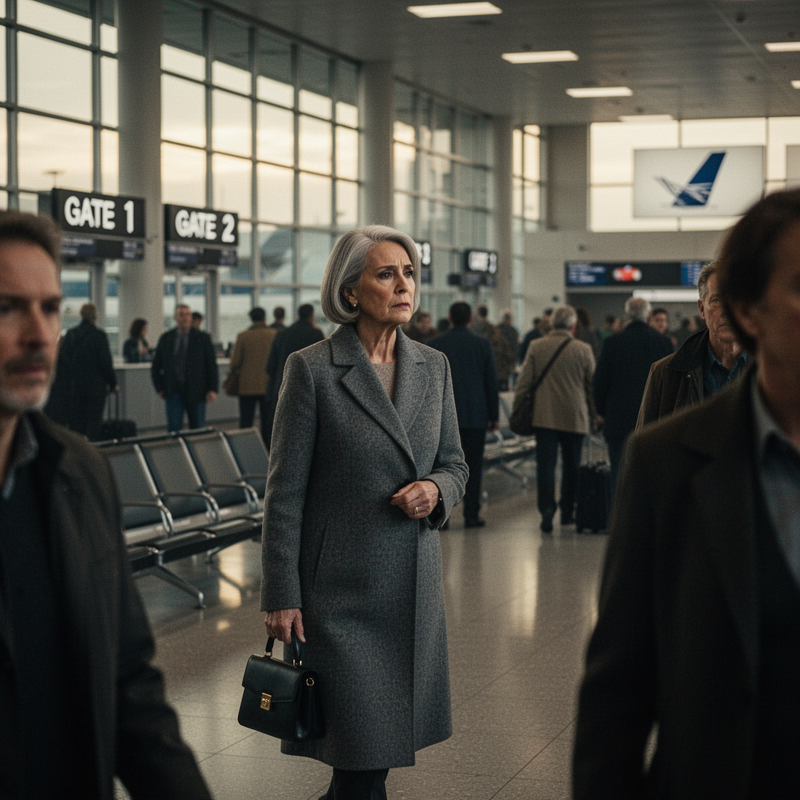
I walked past Gate 1, then Gate 2. Every bench I passed was occupied by travelers glued to their phones or dozing.
Then, at Gate 4, I saw him.
He was tiny, almost swallowed by the long, cold metal bench. His knees were drawn up to his chest, and his arms were wrapped tightly around himself, as if trying to shrink into invisibility.
His head was bowed, revealing the soft crown of his hair. In one small hand, he clutched the silver locket Sarah had worn every day, the one with my daughter’s smiling face inside.
He shivered, despite the controlled temperature of the terminal.
My breath hitched. The anger, the fear, it all coalesced into a sharp ache in my chest. I felt like I was watching him from underwater, the sounds of the airport fading into a distant hum.
I took a slow, deliberate step forward.
“Leo?”
His head snapped up. His eyes, usually bright with curiosity, were wide and rimmed with red. They were the eyes of a child who had cried himself dry.
He didn’t speak, but his small body unfolded from the bench. He launched himself at me, burying his face in my coat. I wrapped my arms around him, pulling him close, feeling the fragile tremor that ran through him.
His silence was a punch to the gut. Leo always talked. He always had a hundred questions, a million observations. Now, he was just a small, shaking weight in my arms.
After a long moment, I gently loosened my hold, keeping one arm around his shoulder.
“Let’s go find out what happened, sweet pea,” I murmured, my voice rougher than I intended.
Leo nodded, still clinging to me. He wouldn’t look at the gate area.
I walked toward the airline counter, Leo pressed against my hip, his grip tight on my coat. The gate agent, a young man with a name tag that read ‘Mark’, was chatting animatedly with a colleague.
He didn’t notice us immediately.
I waited, my usual quiet patience stretched thin. Leo’s trembling against me fueled a new kind of resolve.
“Excuse me,” I said, my voice low but firm.
Mark turned, his smile faltering slightly as he took in Leo’s tear-stained face and my own stern expression.
“Can I help you, ma’am?” he asked, his tone shifting to polite indifference.
“Yes, my grandson, Leo Benson, was supposed to be on flight 117 to Orlando,” I explained, trying to keep my voice even. “His father, Richard Benson, was on the same flight. We were told there was an issue with his ticket.”
Mark typed a few keys on his computer. His brow furrowed.
“Benson… Leo Benson… flight 117… Hmm. I’m not seeing any technical issues, ma’am. No system errors, no overbooking. The flight departed on time, with full passenger manifest.”
My heart sank. “Are you sure? Perhaps a booking error? A glitch in the system?” I pushed, grasping at any explanation that wasn’t a calculated cruelty.
Mark tapped a few more keys, his eyes scanning the screen. “Wait a moment. Here it is. It wasn’t a system issue.”
He looked up at me, his expression softening with a hint of confusion, then concern.
“Ma’am, Mr. Richard Benson himself manually cancelled Leo’s ticket. Right here, at a self-service kiosk near check-in. This was twenty minutes before boarding.”
My blood ran cold. The noise of the airport seemed to rush back in, louder than before.
“Canceled?” I whispered, the word tasting like ash. “Why?”
Mark shook his head, looking uncomfortable. He printed a slip of paper from a small machine beside his keyboard.
“I can’t tell you why, ma’am. But it’s clearly documented. Here’s the transaction slip.”
He slid the receipt across the counter. My hand trembled as I picked it up. It was a standard airline printout, thin and flimsy. My eyes darted to the bolded lines.
Leo Benson. Flight 117. CANCELED.
Date. Time. Richard Benson’s name, clearly printed. The amount: $420.
My gaze dropped to the bottom of the slip, where a smaller line of text stood out like a festering wound: “Refund credit applied to upgrade existing tickets: Elijah Benson, Noah Benson, First Class.”
Richard hadn’t forgotten Leo. He hadn’t made a mistake. He had traded his own son’s seat for an upgrade for his new wife’s two teenage boys.
Part 2
I stared at the slip of paper, the flimsy receipt feeling heavy in my hand. Richard, my son-in-law, my boss, the man who had sat across from me at Sarah’s funeral and promised to care for Leo, had deliberately, callously, traded his own son for a first-class upgrade.
The airport, so loud moments before, fell silent around me. All I could hear was the frantic beat of my own heart, a drum against my ribs.
I crumpled the receipt in my hand. “Come on, Leo,” I said, my voice barely a whisper. I led him through the throng of travelers, past the bright screens announcing departures, out into the still-falling rain. He clung to my hand, his small body a silent testament to betrayal.
The forty-five-mile drive back to my small cottage in Oakhaven was even quieter than the drive to the airport. Leo sat in the passenger seat, his gaze fixed on the rain-streaked window, clutching his mother’s locket. He didn’t speak, didn’t hum, didn’t ask for the radio. The silence was absolute, chilling.
The moment we were home, I tucked Leo into bed with a warm cup of cocoa, then immediately called Douglas Crane, a local family lawyer I knew from church. After that, my trembling fingers dialed Child Protective Services. I relayed the story, every painful detail, my voice cracking only once when I described Leo’s shivering form on that cold bench.
Within seventy-two hours, the authorities had contacted Richard in his Florida hotel. He was forced to cut his luxury vacation short, leaving Evelyn and her sons behind, and return to Indiana.
Monday morning arrived like a dark cloud. I walked into the Benson Realty office, expecting a screaming match, a desperate plea for silence, or perhaps even a furious denial. My stomach was a knot of dread and righteous anger.
Instead, I found Richard sitting calmly behind his mahogany desk, a faint, cold smile playing on his lips. The office was quiet, the air unnaturally still. He looked perfectly at ease, as if the last few days had been nothing more than a minor inconvenience.
“Martha,” he said, his voice smooth and untroubled. “Glad you’re here. The local police are on their way.”
My breath caught in my throat. I braced myself for an accusation about Leo, a threat about my job.
“It seems,” he continued, still smiling, “that $8,500 in cash is missing from the office safe.”
My mind reeled. I hadn’t even known that much cash was kept on the premises.
Richard leaned back in his chair, his eyes fixed on mine, the smile never leaving his face. “And your personal desk drawer, Martha, is the only one with the matching key.”
CHAPTER 2: The Weight of the Keys
I stood frozen in the doorway of Benson Realty, my hands still smelling faintly of airport coffee. The overhead lights in the office hummed with their usual indifferent drone.
Two sheriff’s deputies walked past me, their uniforms a stark blue against the pale yellow walls. Deputy Collins, a man whose children I’d watched grow up, offered a brief, unreadable nod.
Richard Benson sat behind his mahogany desk, a calm smile fixed on his face.
“Martha, thank goodness you’re here,” Richard said, his voice dripping with practiced concern. “These fine officers are just helping us sort out a small misunderstanding.”
He gestured toward my neat desk, piled high with ledgers.
Deputy Collins moved to my workspace. He flipped through the familiar green books, then reached behind them. His fingers closed around something thick and white.
He pulled out a plain white envelope. Inside, a stack of crisp hundred-dollar bills gleamed.
Eighty-five of them. Exactly $8,500.
My breath hitched. “What is that? I don’t—”
“Now, Martha, don’t worry,” Richard interrupted, his voice soothing. “We all know you’ve been under a lot of stress lately.”
He looked at the deputies, shaking his head with a rehearsed pity.
“Ever since Sarah passed, she’s been a bit…erratic,” Richard explained, lowering his voice conspiratorially. “I’m sure she just took the money from the safe to help with Leo’s custody battle. It’s a sad situation.”
I stared at him, the accusation hanging in the air like a heavy curtain. The safe’s secondary combination was only known to Richard and Evelyn. I’d never even touched it.
“Richard, I don’t know the safe combination,” I said, my voice barely a whisper. “I wouldn’t take a dime.”
Deputy Collins ignored me. He counted the cash, then looked at the envelope. “This was in your drawer, Ms. Garrison. Behind your personal ledger.”
He handed me a formal summons, the paper crinkling in my trembling fingers.
“No handcuffs today, Martha,” Deputy Ramirez said, his voice flat. “But you’ll need to report to the station Tuesday morning.”
Richard watched me, his smile never wavering. “Martha, this active investigation… it will complicate things with Leo, I’m afraid. You can’t expect the state to overlook this.”
Outside the office, through the glass front, I could see a few neighbors, drawn by the sheriff’s car. Mrs. Henderson, from the bakery, stood with her hand over her mouth. My ruin was already Oakhaven’s lunchtime gossip.
CHAPTER 3: A Town’s Cold Shoulder
The news traveled faster than any emergency vehicle. Before the sun even dipped below the cornfields, Oakhaven buzzed with whispers.
Martha Garrison, the quiet secretary, embezzled from Benson Realty.
I walked into Henderson’s Market, the same grocery store I’d frequented for twenty years, to buy milk for Leo. Kathy, the cashier, suddenly found the price scanner fascinating.
She avoided my gaze, her lips pressed into a tight line. She scanned the milk, her hands moving quickly, then slid the bag across the counter without a word.
The silence was louder than any accusation.
Later that afternoon, Douglas Crane’s name flashed on my phone. His voice, usually tired but steady, carried a new note of frustration.
“Martha,” he said, without preamble. “I just got off the phone with CPS. Due to the active criminal investigation regarding the embezzlement charges, they’ve paused your emergency guardianship petition for Leo.”
My heart hammered against my ribs. Richard’s words from the office echoed in my mind. He knew this would happen.
“Paused?” I managed to ask.
“Indefinitely, until this is resolved,” Douglas confirmed. “They won’t place Leo with someone facing felony charges.”
As if that weren’t enough, an hour later, a certified letter arrived. The return address was Benson Realty. My hands shook as I tore it open.
It was an eviction notice. Thirty days.
The cottage I lived in, the only home Leo had known since Sarah’s death, belonged to Benson Realty. Richard wasn’t just destroying my reputation; he was stripping away every foundation I had left.
CHAPTER 4: The Adjuster’s Pen
Richard wasn’t done. His campaign against me escalated with cold, precise calculation.
Two days later, a shiny black sedan pulled into the Benson Realty parking lot. Out stepped Gary Fletcher, a local commercial insurance adjuster. Everyone in Oakhaven knew Gary. He owed his entire appraisal business to Richard’s stream of real estate referrals.
Fletcher spent three hours inside the gutted office, a professional smirk plastered on his face. He walked past the still-smoking remains of what had been Richard’s desk, but spent most of his time in the back server room.
I saw him emerge, holding a clipboard, a pen already clicking in his hand.
That evening, a thick envelope arrived via express courier. Inside was an official-looking document. It was a fraudulent insurance report, drafted and signed by Gary Fletcher.
The report claimed Martha Garrison had deliberately poured an entire pitcher of water into the server stacks, causing precisely $12,000 in physical damage. The report even cited a non-existent security camera timestamp.
Armed with this fabricated document, Richard filed for an emergency restraining order.
The papers arrived the next morning. It stated I was a danger to his property and his household. It barred me from the Benson Realty office, and from coming within five hundred feet of his personal home.
I sat on my porch swing, clutching the physical paper, the late afternoon sun doing little to warm me. Richard wasn’t just trying to win; he was systematically dismantling every piece of my quiet life.
CHAPTER 5: The Woman in the Shadow
The sun had long set, leaving Oakhaven steeped in inky black. I was staring at the restraining order, its legalese a blur, when a pair of headlights cut through the gravel of my driveway.
A car door creaked open. A woman stepped out, her silhouette tall and slender against the moonlit sky.
It was Clara Danvers. Richard’s first wife, who had left town ten years ago, a silent ghost from a forgotten past. Her face was etched with a decade of unspoken burdens.
She carried a worn leather folder, the edges softened with age.
Clara sat at my kitchen table, her hands trembling as she placed the folder between us. The fluorescent light above cast harsh shadows on her face.
“I know this is late, Martha,” she began, her voice hoarse, “too late, probably. But I couldn’t stay silent anymore.”
She explained how she had watched Richard for years, how his financial and emotional abuse had driven her away. She had kept quiet, fearing his power, fearing what he would do to her.
“He did this to us, too,” Clara said, her voice barely above a whisper. “He did the exact same thing.”
She slid a yellowed piece of paper across the table. It was a flight itinerary from twelve years ago. The faded ink clearly showed Richard had canceled their own daughter’s return flight from a summer camp.
The reason listed: to avoid paying an extra baggage and reservation fee.
My daughter-in-law, Sarah, had been a childhood friend of Richard and Clara’s daughter. The memory hit me like a physical blow. Richard had stranded his own child to save a few dollars. Just like Leo.
Clara’s eyes, full of a deep, sorrowful regret, met mine. “He doesn’t change, Martha. He never will.”
CHAPTER 6: The Unwitting Tool
The next morning, the thought of Richard doing this to his own child gnawed at me. I needed to know more, needed some leverage.
I found Billy Fowler, the nineteen-year-old summer intern at Benson Realty, behind the local diner. He was hunched over, nervously fumbling with his car keys, trying to avoid eye contact. He looked as though he hadn’t slept in days.
His face was pale, his eyes red-rimmed with guilt. He started to walk away when he saw me.
“Billy,” I said, my voice quiet but steady. “We need to talk about that envelope. The one in my desk.”
He froze, his shoulders tensing. He wouldn’t turn around.
“Richard told me it was back-pay,” Billy mumbled, his voice thick with shame. “For you. He said it was a surprise and I had to hide it.”
He finally turned, his eyes darting around the empty diner parking lot.
“He promised me a recommendation letter for college,” Billy pleaded, tears welling in his eyes. “My scholarship depends on it, Ms. Garrison. Please, don’t tell anyone.”
He looked so young, so lost. A child caught in Richard’s web.
I stood there, torn. My own survival, Leo’s future, depended on exposing Richard. But involving Billy would destroy his future, too. He was just a naive boy, eager to please, easily manipulated.
His desperation hung in the air, a heavy weight. I knew, looking at him, that he would never speak up in court. He was too scared.
CHAPTER 7: The Threat in the Parlor
Two days later, the air in my small cottage felt heavy and cold.
Richard Benson himself appeared at my door, unannounced. He wasn’t alone. Gary Fletcher, the insurance adjuster, stood a few feet behind him, holding his clipboard like a weapon.
Richard surveyed my living room, his eyes lingering on Leo’s colorful drawing of a sailboat taped to the refrigerator.
“Martha, we need to be practical,” Richard said, his voice smooth, devoid of any genuine emotion. “This is all getting very messy.”
He laid a document on my kitchen table. Its title, in bold black letters, read: “Voluntary Relinquishment of Guardianship.”
“Here’s the deal,” Richard continued, gesturing to the paper. “Sign this. Relinquish all future custody claims over Leo. Agree to move out of the county. And I’ll drop the embezzlement charges and the server damage claim.”
He leaned in slightly, his eyes holding a cold glint. “An old woman in a state penitentiary cannot look after a traumatized child, Martha. Think about Leo.”
He gave me exactly forty-eight hours to sign it. Fletcher shifted his weight, the clipboard rustling.
I looked down at the document, then at Leo’s bright sailboat. A simple, childlike dream.
My gaze met Richard’s. “Get out of my house,” I said, my voice quiet but firm. “And take your papers with you.”
Richard’s face tightened. He grabbed the document, a flicker of something dark crossing his features. Without another word, he and Fletcher turned and walked out, leaving the cold silence in their wake.
CHAPTER 8: The Gathering Sky
The local weather station issued a severe thunderstorm warning for southern Indiana. But in Oakhaven, the air remained strangely hot, perfectly still, as if holding its breath.
I spent the afternoon in Douglas Crane’s office. I showed him Clara Danvers’ yellowed flight receipt, the proof of Richard’s cruelty twelve years prior.
Douglas studied it, his brow furrowed. “This is damning, Martha,” he admitted. “It shows a pattern. But it’s a past civil dispute. It doesn’t clear you of the current criminal embezzlement charges.”
He pushed his glasses up his nose. “We need something more direct. Something irrefutable about this $8,500.”
As we spoke, the sky outside transformed. It turned an ominous shade of bruised purple, a heavy, bruised color I had never seen before. A low rumble echoed in the distance.
Then, the wail started. The town square’s sirens, a piercing, mournful sound, began to scream.
“You need to get home, Martha,” Douglas said, gathering his papers. “Now.”
My heart pounded against my ribs. I scrambled into my old sedan, the wind already starting to howl through the ancient oaks lining the streets. I had to get to Leo.
CHAPTER 9: The Fate of Oakhaven
The storm hit Oakhaven with sudden, catastrophic violence. It wasn’t just a thunderstorm. A localized EF-2 tornado, a monstrous funnel of churning cloud, touched down near the western edge of town.
I had barely made it back to the cottage. Leo and I huddled in the small, musty fruit cellar beneath my house. The roar of the wind was terrifying, a primal scream as it ripped the shingles from my roof.
Above us, the very earth shook. We could hear the terrifying crunch of trees snapping, the shatter of glass, the groaning of structures tearing apart. The tornado was tearing through the commercial district.
Its path of destruction, according to the radio broadcast Douglas had managed to catch before the power died, was heading directly toward the brick building of Benson Realty.
In the dark, Leo clung to my neck so tightly I could barely breathe. His small body shook uncontrollably. It wasn’t just the terror of the storm. This was a fear that went far deeper, a cold tremor born from abandonment.
I held him, my own fear swallowed by the desperate need to protect him.
CHAPTER 10: The Rain of Truth
When the sirens finally went silent, a heavy, unsettling quiet settled over Oakhaven. I pushed open the cellar door, blinking at the grey, rain-soaked daylight.
My neighborhood was a landscape of broken branches, shattered glass, and twisted metal. But miraculously, my cottage still stood, albeit missing most of its roof.
I walked toward the town square, Leo’s hand clutched in mine. The sight that greeted us was surreal.
The Benson Realty office was a ghost of its former self. Its roof was gone, the brick walls gaping open like a broken mouth. Its heavy metal filing cabinets, usually bolted to the floor, had been tossed into the street like discarded toys.
The fierce winds had torn open Richard’s private floor safe. Its contents, hundreds of confidential documents, were scattered across the muddy lawns of the sheriff’s office and the local church.
Townspeople, covered in mud and dust, were already clearing debris. Their heads turned. They began picking up the rain-soaked papers, trying to return them.
Then, they started reading.
I watched as Mr. Peterson, who owned the hardware store, unfolded a soggy sheet of paper. It was an original airport cancellation receipt, clearly signed by Richard. Another neighbor found Billy Fowler’s written instructions from Richard, detailing where to hide the “back-pay.”
And then, Gary Fletcher’s fraudulent insurance drafts, thick with his official-looking stamps, lay open in the mud for all to see.
The truth, literally, rained down on Oakhaven.
CHAPTER 11: The Silent Departure
There was no dramatic trial. No public confrontation in the town square. No tearful apology from the man who had ruled Oakhaven for two decades with an iron fist disguised by a charming smile.
The townspeople read the scattered papers in silence. Their eyes, once full of suspicion toward me, now turned toward Richard, who stood amidst the ruins of his office. His tailored suit was now mud-splattered, his usual swagger replaced by a stiff, vacant stare.
Within forty-eight hours, the sheriff’s department dropped all charges against me. Gary Fletcher’s insurance license was swiftly suspended under suspicion of rampant fraud.
Richard quietly packed his remaining belongings into the back of his luxury SUV. He avoided the gazes of his former neighbors, his head bowed, his face a mask of defeat. He didn’t say a single word to his son, Leo, who stood beside me. He didn’t say a single word to me, his former mother-in-law.
He simply got into his vehicle and drove out of Oakhaven forever. He vanished from our lives as silently as the storm had come.
CHAPTER 12: The Permanent Quiet
Though the immediate threat was gone, and Richard had vanished from our lives, the victory felt utterly hollow in the quiet of my repaired cottage. The air, once filled with tension, now hummed with a different kind of silence.
The pediatrician and a kind child psychologist sat with me in the small living room. Their faces were grave as they looked toward the hallway, where Leo sat on the floor, meticulously arranging his collection of smooth river stones.
“Martha,” the pediatrician began gently, “Leo isn’t speaking.”
The psychologist nodded. “The trauma of the abandonment, compounded by the terror of the tornado… it’s triggered something. Selective mutism.”
He explained that Leo had retreated into a state of permanent psychological mutism. He no longer spoke, no longer laughed out loud. He only communicated through tiny, almost imperceptible nods of his head.
He clutched his mother’s silver locket, his fingers constantly tracing its cold metal. It was his only constant.
My grandson, the boy who used to fill my home with his soft chatter, was now wrapped in a silence that felt heavier than any storm. The truth had come out, Richard was gone, but some things, once broken, could not be fixed.
CHAPTER 13: One Year Later
Exactly one year after that terrible night, I drove Leo back to the Indianapolis International Airport. The anniversary was a quiet ache in my chest.
We walked slowly through the bustling terminal, past the security checkpoints, the cheerful chatter of travelers a stark contrast to the quiet boy beside me. We reached the cold metal benches near Terminal B, Gate 4.
The very spot where Richard had left him.
I sat down, the cold metal seeping through my jeans. I wrapped my arm around Leo’s shoulders. He leaned his head against me, his small hand finding mine.
Outside the panoramic windows, planes took off into the grey Indiana sky, their engines roaring, carrying people to distant places, to new beginnings. Leo did not speak. He just watched, his grip on my hand never loosening.
He was a year older, a year taller, but the silence remained. It was a part of him now, as constant as the locket he still held.
CHAPTER 14: The Echo of Gate 4
I looked down at the airport parking ticket in my lap, its numbers a stark reminder of the passage of time. Leo’s head remained resting on my shoulder, his quiet presence a testament to what we had endured. We were the only ones left from the family that once was.
The town of Oakhaven, true to its nature, had mostly forgotten the scandal. The Benson Realty sign had long been painted over, a new business taking its place. Richard was just a name, occasionally whispered in hushed tones over coffee at the diner, a cautionary tale.
But as the boarding announcement crackled over the loudspeaker, its cheerful tone jarring, I knew that some losses were never repaired by time or justice. Some scars ran too deep.
I squeezed Leo’s hand, a silent promise. We would navigate this quiet life together, in the permanent shadow of what was taken. The town rebuilt its roofs and paved its streets, but the quiet in our house remains. Some things, once broken by the coldness of men, cannot be mended by the passage of time.
Leave a Reply