CHAPTER 1: The View From Below
Part 1
“Your housekeeper is corrupting your daughters and skimming from the ministry funds, Caleb,” my boss, Elder Silas Kincaid, told me outside the sanctuary office.
He insisted I take a mandatory ten-day archive delegation trip to Zurich, leaving my two young daughters under the care of his chosen prospective fiancée, Tabitha.
I pretended to board the transatlantic flight at JFK Airport, but instead I rented an off-grid vehicle and checked into a motel three miles from our closed fellowship compound.
When I opened the hidden monitoring app linked to our living room cameras that night, I did not see my housekeeper stealing anything.
I saw my boss and Tabitha locking my seven-year-old daughter into a windowless pantry while my housekeeper risked her job to stand in their way.
The words from Elder Kincaid still echoed in my ears, sharp and unwavering.
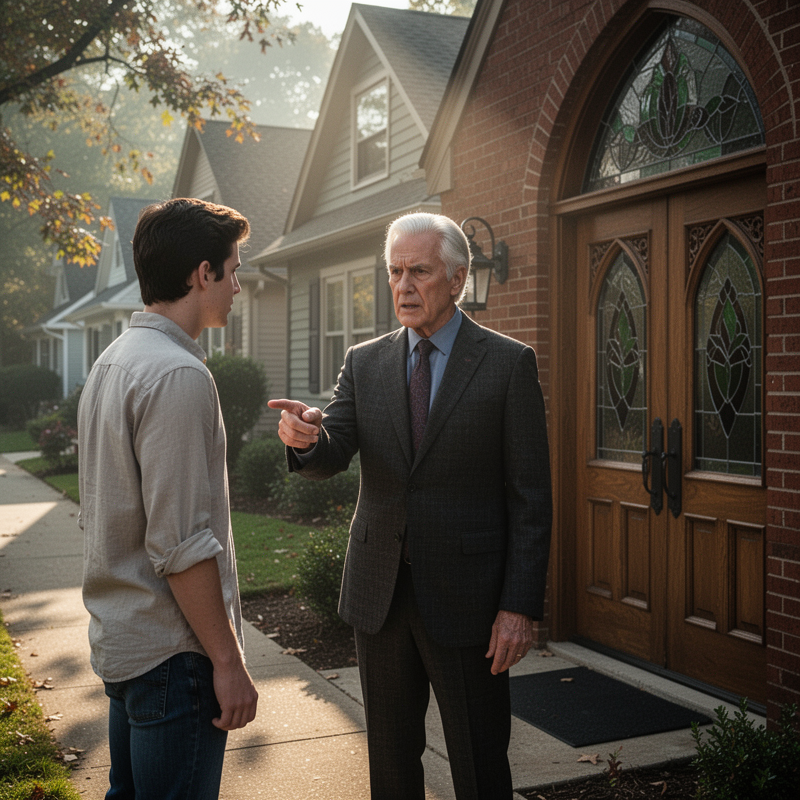
He had stood under the vast, solemn archway of the sanctuary, the morning sun glinting off his silver hair, and fixed me with a stare that brooked no argument.
“A ten-day delegation to Zurich, Caleb. It’s vital work for the historical archives. You leave tomorrow morning.”
My mind reeled. Tomorrow morning. Just four months after Hannah’s death, and he wanted me gone for ten days.
My daughters, Ruth and Grace, were still reeling from the loss of their mother. They needed me.
“Elder, the girls—” I started, but he cut me off with a wave of his hand.
“Tabitha will oversee their care. She has a wonderful spiritual influence. It’s time for a stricter hand, especially with Nora O’Connor’s lax example.”
The accusation against Nora, our housekeeper, stung. She had been a godsend since Hannah passed, a calm, steady presence in the house.
Silas’s gaze hardened. “We have observed concerning patterns, Caleb. Loose change from the offering plates. Secular songs being taught. She is not upholding fellowship values.”
I felt a cold knot in my stomach. The thought of Tabitha, Silas’s stern prospective fiancée, in charge of my sensitive seven-year-old, Grace, filled me with dread.
But I knew better than to argue with Silas. To refuse an elder’s directive was to invite public censure, even expulsion from the New Canaan Fellowship.
So I nodded, swallowed, and promised to prepare for the trip.
That evening, I went through the motions. I packed a small suitcase, called my brother David to cancel a long-planned weekend visit, and told Ruth and Grace about the exciting adventure their father was taking. Their small faces looked crushed.
Grace, my youngest, clung to my leg, her eyes wet. “Don’t go, Daddy.”
I knelt and hugged her tight, murmuring reassurances I didn’t feel. “It’s for the fellowship, sweet pea. Important work.”
“Tabitha says we have to pray extra hard for you to be safe,” Ruth chimed in, her nine-year-old voice already laced with the fellowship’s peculiar language.
I forced a smile, then slipped away to the attic. Earlier that week, after Silas had first mentioned his “concerns” about Nora, I had discreetly installed a few miniature Wi-Fi cameras in our living room and kitchen.
They linked to a hidden app on an old burner phone, a relic from my days before joining the fellowship.
I tested the feed. Crisp, clear images of my living room appeared on the screen. The familiar antique rug, the worn armchair where Hannah used to read to the girls.
Satisfied, I tucked the phone deep into my travel bag.
The next morning, I drove the familiar route to JFK Airport, a large duffel bag on the passenger seat. The sun was barely up, casting long shadows across the empty highway.
I carried my luggage into Terminal 4, navigating the maze of check-in counters. I found the Swiss International Air Lines desk, presented my e-ticket, and got my boarding pass.
I even checked my main bag, watched it disappear down the conveyor belt. The feeling of separation was surprisingly freeing, yet terrifying.
Then, instead of heading towards security, I found a quiet corner near the departures board. I watched the clock. My flight, LX17, was due to depart in two hours.
I waited until I saw the “Go to Gate” notification flash for my flight. Then, I walked back outside, blending into the stream of arriving passengers.
I made my way to a rental car agency a few blocks from the airport perimeter. It was a smaller, local outfit, not one of the big chains, with a gravel lot and a faded sign. Perfect.
I rented a battered, unassuming sedan, paid cash, and kept my identity vague. The car looked like it had seen a few thousand miles too many, invisible in a parking lot.
With the windows down, letting the cool autumn air wash over me, I drove north, away from the city. I bypassed the main routes, sticking to back roads, a sensation I hadn’t experienced in years.
I booked a room at a small, independently-owned motel three miles from the New Canaan Fellowship compound. It was rustic, far from the polished cleanliness of our fellowship homes, but it had good Wi-Fi.
The room smelled faintly of pine cleaner and stale coffee. I placed my burner phone on the nightstand, powered it up, and connected to the motel’s network.
The screen flickered.
It was just past eight in the evening. The girls would be getting ready for bed.
I opened the hidden monitoring app. The connection lagged for a moment, the screen a pixelated mess.
Then, it cleared.
My living room. Exactly as I had left it. Ruth was on the couch, reading a book. Grace sat on the floor, coloring.
Nora, our housekeeper, was tidying up some toys, her back to the camera.
A sense of relief washed over me. Everything seemed normal. Silas’s accusations felt absurd now, the product of his control and suspicion.
I watched for a full hour. Nora finished her tasks, wished the girls goodnight, and went to her separate quarters. The girls moved towards their bedrooms.
Then, the living room door opened again.
Silas Kincaid stepped into view, his imposing figure filling the doorway. Behind him, Tabitha.
They were both wearing their formal evening attire, as if returning from a meeting.
Silas scanned the empty living room, his gaze resting on the pile of crayons Grace had left on the coffee table.
Tabitha, her face set in a severe expression, spotted something on the floor near the armchair. She bent down, picking up a small, folded piece of paper.
It was one of Grace’s drawings. A brightly colored, slightly messy depiction of a unicorn, glitter glued to its horn.
Silas’s eyes narrowed. “What is this?”
Tabitha unfolded the drawing slowly, her lips pressed into a thin line. She held it up. The unicorn looked innocent enough, but its colors were vibrant, almost rebellious.
“Grace,” Tabitha called out, her voice tight with disapproval.
My heart began to pound. Something was wrong. This wasn’t about Nora.
Grace, still in her pajamas, padded back into the living room, her small face looking sleepy and confused.
“Yes, Aunt Tabitha?” she whispered, clutching a worn teddy bear.
Tabitha held up the drawing. “Where did this come from, Grace? You know we are not to draw fantastical creatures. They promote worldly fancies, not fellowship virtues.”
Grace’s eyes widened, her lower lip trembling. She looked from the drawing to Tabitha, then to Silas, who stood silent and formidable behind his fiancée.
“Mommy liked unicorns,” Grace whispered, her voice barely audible.
Silas stepped forward, his shadow falling over my daughter. “Your mother cherished the *truth*, Grace. Not fantasies.”
He took the drawing from Tabitha’s hand, his fingers tearing it in half with a crisp, brutal sound. Grace flinched as if struck.
“Now, tell us, Grace,” Silas continued, his voice low and firm. “Why would you choose to create such a thing? Are you trying to defy our guidance?”
Tears welled in Grace’s eyes. She shook her head, unable to speak.
“She’s lying, Elder,” Tabitha said, her voice sharp. “She’s always been a willful child.”
Silas turned to Grace, his eyes cold. “Perhaps a moment of quiet reflection would help you consider your choices, daughter.”
He pointed towards a small door near the kitchen, a pantry door I knew well. It was narrow, windowless, and often used for storing canned goods and cleaning supplies.
“Go inside. Think about how you might better honor your mother’s memory.”
Grace stood frozen, a silent gasp escaping her lips.
Tabitha took her arm, not gently. “Now, Grace. Before you make the Elder truly displeased.”
Grace resisted for a second, then her small, pajama-clad form was guided towards the pantry. She glanced back at the camera, her eyes wide with a terror I could almost feel through the screen.
Then, the door closed. A click echoed through the living room.
Part 2
Grace was locked in the pantry. I stared at the screen, my breath hitched in my throat. I could almost hear the click of that deadbolt, the terrified silence that followed. My little girl, alone in the dark, because of a drawing. Because she missed her mother.
I clenched my fists, a surge of helpless rage washing over me. On the screen, Silas and Tabitha stood there for a moment, their faces grim but unyielding. They exchanged a look, a silent agreement passing between them.
“This is for her own good, Elder,” Tabitha said, her voice softer now, almost placid. “She needs to learn. She’s been singing those worldly tunes Nora taught her, too. I heard her this afternoon.”
My jaw tightened. The secular songs. Silas’s earlier accusation against Nora, now turned against my daughter. They were systematically trying to break her spirit, trying to erase Hannah’s memory from her.
Just then, a door at the side of the living room, near the kitchen, swung open. It was the entrance to Nora’s quarters.
Nora O’Connor stepped into the room. She was still in her work clothes, a simple apron tied over her dress, but her posture was stiff, her eyes blazing.
“Elder Silas!” she exclaimed, her voice sharp, cutting through the quiet. “What are you doing? You cannot lock that child in there!”
Silas turned, clearly surprised by her sudden appearance. Tabitha’s eyes narrowed.
“This is none of your concern, Nora,” Silas said, his voice regaining its authority. “Grace is being disciplined. A private family matter.”
“Private?” Nora scoffed, moving with purpose towards the pantry door. “I heard her crying! You tore her drawing, a picture of a unicorn! Her mother loved unicorns!”
She planted herself directly in front of the pantry door, her arms crossed, blocking access to it. Her back was to the camera, but I could see the tension in her shoulders. She was small, but she looked utterly immovable.
“You will move, Nora,” Tabitha warned, taking a step forward. “This is a direct command from the Elder.”
“And I directly refuse,” Nora shot back, her voice unwavering. “This isn’t discipline. This is cruelty. You are terrifying that child.”
Silas’s face contorted, a vein throbbing in his temple. He moved towards Nora, his large frame towering over her. Ruth, who had reappeared silently from her bedroom door, froze at the sight, her eyes wide with fear as she watched the confrontation unfold.
It was all so clear now. Silas hadn’t sent me to Zurich for some archive delegation. He’d sent me away to give Tabitha free rein. To cleanse my household of any lingering trace of Hannah, to break my daughters into absolute conformity. And Nora, my housekeeper, the one Silas had accused of corruption, was the only one standing in their way.
Chapter 2: Shadows in the Study
The night air was cold, biting at my exposed skin as I slipped through the woods at the edge of our fellowship compound. Every rustle of leaves felt too loud.
I made my way to the garden shed, the small, familiar structure a strange anchor in the churning anxiety within me.
Nora was already there, a faint flashlight beam cutting through the gloom. Her shoulders were hunched.
“Thank God you’re here, Caleb,” she whispered, her voice tight with relief. “I didn’t know how much longer I could protect them.”
I nodded, the sight of her brave defiance on the camera feed still burning in my mind. “What has Tabitha been doing?”
Nora pulled a loose gardening trowel from a shelf. “She started the burnings the moment you supposedly left.”
“Burnings?” I felt a cold dread spread through me.
“She called them ‘purification rites’,” Nora said, her voice laced with disgust. “Anything connected to Hannah’s ‘worldly attachments’ had to go.”
She knelt, prying at a floorboard near the back wall of the shed. The wood groaned softly.
“I tried to save what I could,” Nora continued, lifting the plank. “From the house. From the girls’ rooms.”
Below the floorboard, a shallow cavity was revealed. Inside, carefully wrapped in old linens, sat a stack of Hannah’s worn cookbooks, Grace’s favorite stuffed rabbit, and a small, framed photo of the four of us at a state fair. My late wife’s bright, unguarded smile looked up at me from the shadows.
Nora looked at me, her eyes pleading. “It wasn’t enough, Caleb. They’re erasing her.”
Chapter 3: The Highway Diner
The next morning, I drove to the dusty highway diner just beyond the fellowship’s perimeter. The smell of stale coffee and frying bacon hung heavy in the air. I needed to blend in, to think, and maybe pick up some supplies I couldn’t get on the compound.
I took a booth in the corner, nursing a lukewarm cup of coffee. A woman with kind, tired eyes sat a few tables over, scribbling notes in a ledger. She caught my glance and offered a small, hesitant smile.
“Rough morning?” she asked, her voice quiet.
I managed a tight nod. “Just figuring things out.”
She closed her ledger. “Miriam Albright. I used to do some bookkeeping for…a local organization.” She paused, her gaze flicking towards the direction of the compound.
A cold certainty settled over me. “The New Canaan Fellowship?”
Miriam’s smile faded. “Elder Silas Kincaid. He still runs a tight ship, I hear.”
“He does,” I said, a bitter taste in my mouth. I decided to gamble. “He’s trying to take my daughters.”
Miriam’s eyes narrowed. “Widower, are you? Lost your wife recently?”
I confirmed it. “Four months ago.”
She nodded slowly. “Silas has a pattern. He targets grieving men, especially those with property or inheritance.” She tapped her pen on the table. “He maneuvers himself into a position to take over, using forced engagements, ‘spiritual guidance,’ anything to get control of assets through a trust.”
“A trust?” I asked, my blood running cold.
“He calls it ‘protecting the ministry’s legacy,’” Miriam explained, leaning in. “But what he really does is absorb the widow’s estate into church control, often into his personal accounts. Had a few nasty run-ins with him over irregular notarizations.”
Chapter 4: Paperwork and Threats
I returned to the motel room, Miriam’s words echoing in my head. I had to get back to the compound. To Nora, to my daughters. But the gates would be locked now.
That afternoon, a fellowship courier, a younger man named Timothy, appeared at the front door of my house on the compound. Nora opened it, her face a mask of practiced neutrality. My hidden camera feed was still active.
Timothy held a large, official-looking envelope. “These are for Caleb Finch, from Elder Kincaid’s office.”
Nora took the envelope, her hand trembling slightly. “He’s… away. I can pass them along.”
Timothy shifted awkwardly. “Elder Kincaid insisted they be delivered directly. He said there are… pressing matters. Regarding spiritual drift and grief instability.”
Nora’s grip on the envelope tightened. “I understand.”
After Timothy left, Nora hurried to the living room, her eyes darting nervously towards the ceiling where she knew the camera lens was hidden. She held up the envelope so I could see the contents through the feed.
Inside were formal disciplinary documents. They cited my “lack of commitment” to the fellowship and my “unstable emotional state” since Hannah’s passing. The main document was a demand for the immediate transfer of temporary parental guardianship of Ruth and Grace to Tabitha Kincaid.
Failure to comply, the papers stated, would result in immediate employment termination and eviction from the fellowship compound. A chilling ultimatum, delivered with chilling efficiency.
Chapter 5: Behind the Closet Panel
I watched the live feed from the motel room, my hands shaking. They were moving faster than I anticipated. I had to find something concrete, something undeniable, before Silas made his next move.
I called Nora, her phone a burner I’d given her weeks ago.
“Nora,” I said, keeping my voice low. “Did Hannah ever mention anything about a safe? Or hidden papers?”
There was a pause. “She kept secrets, Caleb. Especially towards the end. She was scared.”
“Scared of what?”
“Of Silas,” Nora said without hesitation. “And Tabitha. She tried to tell me things, little bits here and there. She worried about what would happen to her belongings, to the girls.”
“Think, Nora,” I urged. “Anything unusual? A loose brick? A book with a false bottom?”
Nora was silent for a long moment. Then, “The master bedroom closet. She spent hours in there, reorganizing. Complained about a loose panel, said she needed to fix it.”
I told her to check it. Minutes later, on the feed, I watched Nora enter the master bedroom. She moved to the large, built-in closet, her fingers tracing along the intricate wood paneling. Near the back corner, behind a stack of old blankets, her hand found a faint give.
With a soft click, a small section of the paneling swung inward. Tucked into the dark cavity, an old, yellowed envelope lay hidden.
Nora retrieved it, holding it gently. On the front, in Hannah’s familiar, elegant script, were two words: *For Caleb.*
Chapter 6: The Notarized Betrayal
My heart hammered against my ribs as I watched Nora carefully extract the single, folded letter from the envelope. It was Hannah’s handwriting, unmistakably hers.
Nora held it up to the camera, slowly unfolding it for me to read. Each word was a punch to the gut.
Hannah had written it weeks before her passing, during a period when she was confined to home care, already weakened. The first paragraph spoke of her love for us, her fear for the girls.
Then, the true horror began to unfold.
Hannah detailed how Silas Kincaid had pressured her to “secure the girls’ future” by transferring a significant portion of her personal family inheritance – a staggering **$185,000** – into a trust. Not a trust for her daughters, but one under his direct control.
The letter explicitly stated that the trust documents had been prepared by Arthur Pendelton, the fellowship’s notary and bookkeeper. Hannah wrote, her hand visibly shaky in the letter, that she had been too ill, too confused by medication, to fully understand what she was signing. She remembered Arthur rushing her, telling her it was “routine.”
The final sentence on that page, stark and chilling, confirmed it: *The funds were not for the girls. They went directly to Silas’s personal accounts.* My own wife, exploited in her final moments.
Chapter 7: The Unraveling Memory
I clenched my jaw, the motel room suddenly feeling too small. The initial shock of Silas’s financial betrayal gave way to a deeper, more personal ache.
Nora, her face grim, slowly turned to the final page of Hannah’s letter for the camera. My vision blurred as I read the words.
Hannah wrote of her history within the New Canaan Fellowship. She confessed that years ago, when the fellowship was first establishing its legal framework, she had been an active participant. She had helped draft the very policies designed to protect “ministry assets.”
And within those policies, she admitted, was a strict property-forfeiture clause. A clause that allowed the fellowship to claim the assets of any member deemed “unfit” or “spiritually adrift,” particularly in cases of widowed spouses or minor children.
*I believed it was for the greater good, Caleb,* Hannah had written, her desperation clear on the page. *I thought it would strengthen our community. But Silas twisted it. He used it to control.*
She had tried to withdraw her name from the policy, to fight against its increasingly punitive application. But by then, it was too late. Her own work had become the cage. The idealized memory of my late wife, the unwavering pillar of faith and love, shattered into a complex, devastating truth.
Chapter 8: The Compound Gate
The revelation from Hannah’s letter left me reeling. But there was no time for grief, only action. Silas knew I hadn’t boarded that flight. He must have figured it out from the silence on the other end of his expected calls.
Suddenly, the live feed from my home cut out. Blackness.
Panic seized me. I immediately tried Nora’s burner phone. It rang unanswered.
Then, a text came through on my personal phone, from an unknown number. Just three words: *Gates are locked.*
Silas was making his move. He wouldn’t just evict me; he’d seize everything, including my daughters. He would use the rules Hannah helped create.
I dialed my estranged brother, David, the only person I could think of outside the fellowship’s suffocating reach. He was a carpenter, lived a few towns over, and had always been wary of the compound.
“David, it’s Caleb,” I blurted, my voice raw. “They’re locking down the compound. Silas knows. He’s trying to take Ruth and Grace. I need your help. Now.”
There was a moment of stunned silence on the other end. “He’s doing what?” David’s voice was instantly sharper, laced with a familiar protectiveness. “Which gate? I’m on my way.”
Chapter 9: Sunday Morning Coffee Hour
The next morning, the fellowship hall buzzed with the usual post-service coffee hour chatter. The smell of cheap coffee mingled with the faint scent of old hymnals. Silas Kincaid stood near the refreshment table, holding court with a small group of elders, his face placid.
Then, the main hall doors groaned open with a loud thud, startling everyone.
My brother, David, stood in the doorway, his broad shoulders filling the frame. Behind him, several local families, long-standing members of the broader community who attended occasional fellowship services, gathered, their faces etched with concern. They didn’t push forward, but their presence was a silent, unignorable challenge.
David’s gaze swept the room, landing on Silas. He didn’t say a word.
I walked in behind him, holding a folder containing Hannah’s original notarized letter and Miriam Albright’s notes on Silas’s financial schemes. My pulse hammered, but a strange calm settled over me.
I moved directly towards Silas, every eye in the room now fixed on us. The chatter died down. The clink of ceramic cups against saucers ceased.
Silas’s smile faltered as he saw me. His eyes darted from my face to David, then to the folder in my hand. His lips parted, but no sound came out.
Chapter 10: The Quiet Confrontation
I stopped just inches from Silas, the folder held openly in my hand. He looked like a deer caught in headlights, his face paling under the fluorescent lights of the fellowship hall. The elders around him shifted uncomfortably.
I didn’t raise my voice. I didn’t make an accusation.
I simply opened the folder and placed the two crucial documents onto the small, Formica coffee table in front of him: Hannah’s original letter, detailing the fraudulent transfer, and Miriam Albright’s meticulously compiled notes on Arthur Pendelton’s notarized signatures on the falsified trust forms.
The paper, slightly yellowed, was proof. The numbers, the dates, the signatures. Undeniable.
Silas’s eyes darted down to the documents, then back up to mine. He opened his mouth, a series of garbled sounds escaping. “Caleb, what… I can explain… this is a misunderstanding…”
Elder Thompson, a stern-faced man who had been with the fellowship for decades, picked up Hannah’s letter. He read a few lines, his brow furrowing deeper with each word. He looked at Silas, a silent question in his gaze.
Silas stammered, his usual authoritative posture crumbling. He refused to meet anyone’s eyes, his authority evaporating with each unspoken word. The silence in the room grew heavy, condemning.
Chapter 11: The Signed Release
Elder Thompson and Elder Davies led Silas away from the murmuring congregation, into the fellowship lobby. The air was thick with the weight of unspoken accusations. My brother David stood by my side, a silent, comforting presence.
“Silas,” Elder Thompson said, his voice low but firm, “this letter, these financial irregularities… we cannot have this. For the good of the fellowship.”
Silas kept his eyes on the scuffed linoleum floor. “It was… a regrettable administrative oversight. Protecting ministry funds. Misguided, perhaps.”
“Misguided?” Elder Davies scoffed. “Fraudulent, Silas. And Caleb’s daughters are not assets to be absorbed.”
The elders made it clear they wanted no public scandal, no police involvement. But they wanted Silas out. They pushed a stack of papers across the reception desk, already prepared. Parental release forms, explicitly relinquishing any claim over Ruth and Grace. And employment termination waivers.
Silas hesitated, his hand hovering over the pen. He looked up, his eyes meeting mine for a fleeting moment. A flicker of something – defeat? Shame? – crossed his face.
Then, with a sigh that seemed to deflate him entirely, he signed each document. His signature, once so bold and commanding, was now a shaky scrawl. He pushed the papers back across the desk. Without another word, Silas Kincaid turned, slipped out the side door, and disappeared into the parking lot.
Chapter 12: The Price of Unity
The next day, I stood before the remaining elder board. The small room felt cold, formal. They affirmed Silas Kincaid’s immediate removal from all leadership positions. It was a victory, but a hollow one.
“Caleb,” Elder Thompson began, his voice devoid of warmth, “the board has deliberated. While we acknowledge the serious transgressions of Elder Kincaid, your actions have created significant public division.”
My heart sank. I knew where this was going.
“Exposing internal matters in such a manner,” Elder Davies added, “especially involving outside parties, destroys the sanctity of our community. It undermines our trust. Our unity.”
“But I protected my daughters,” I argued, the words catching in my throat. “And I exposed a crime.”
Elder Thompson shook his head slowly. “The means do not justify the fracture to the body of Christ. Therefore, it is the board’s decision that you and your daughters, Ruth and Grace Finch, are permanently banished from the New Canaan Fellowship.”
The words hung in the air, a final, unyielding judgment. No more Sunday services, no more fellowship gatherings, no more shared compound life. Exile. The community I had called home my entire life, the one I had just fought to cleanse, was now closed to me forever. I accepted it, a strange sense of clarity washing over me. They were willing to sacrifice truth for the illusion of peace, still bound by the toxic structures Hannah had helped create.
Chapter 13: Nine Days Across the Line
Nine days later, the morning sun glinted off the chrome bumper of a large rental moving truck. It was packed tight with the essentials, mostly the keepsakes Nora had saved from the shed, and the few items Tabitha hadn’t managed to confiscate.
Ruth sat beside me in the cab, Grace asleep against her shoulder. Nora sat in the passenger seat, her gaze steady on the road ahead. We crossed the state line, the “Welcome to Vermont” sign a new promise.
My phone vibrated. It was David.
“Hey,” he said, his voice gruff. “Just checking in. Everything okay?”
“As okay as it can be,” I replied, glancing at Ruth. She was humming a soft, secular tune under her breath. “The compound doors are still closed, I take it?”
“Tight shut,” David confirmed. “Not that you’d want to go back anyway.”
I looked in the rearview mirror, at the long, empty road stretching behind us. The old life, the old rules, the old sanctuary, were all fading away.
“No,” I said, a faint smile touching my lips. “Not anymore.”
We spent years looking for sanctuary behind closed gates, only to learn that freedom is the only shelter that truly holds.
Leave a Reply