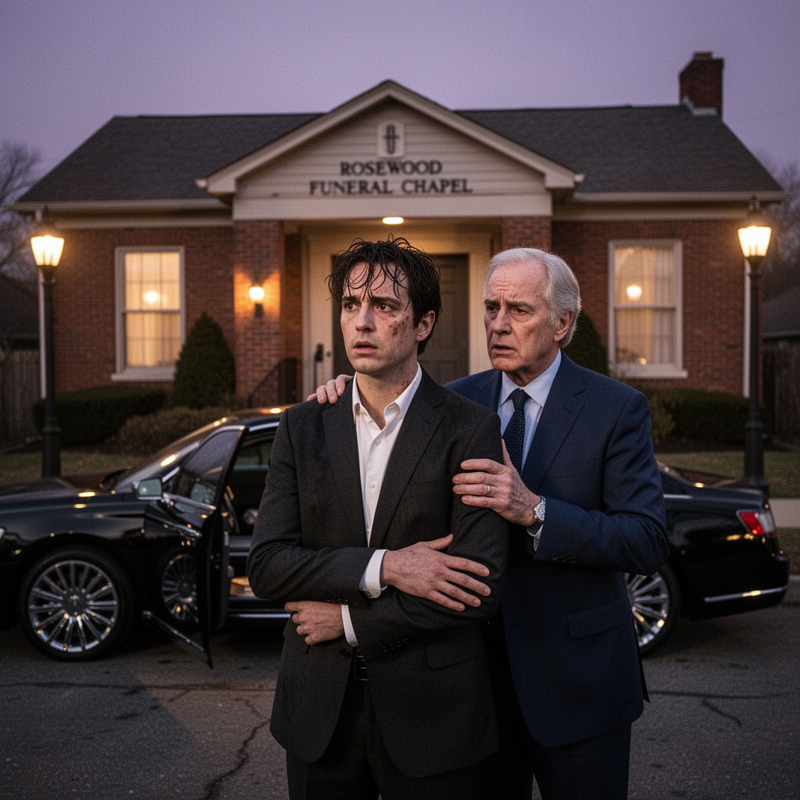
CHAPTER 1: The Pulse in the Casket
Part 1
“Your wife suffered fatal labor complications while you were airborne over the Atlantic, David,” State Senator Arthur Pendelton said, placing a hand on my shoulder beside the polished mahogany casket.
I had just landed in Harrisburg after a twelve-day official trade summit in Dubai, returning home to my nine-month pregnant wife, Sarah.
Instead of a hospital nursery, my boss brought me straight to a private funeral home where my wife lay motionless in burial gown, declared dead three hours prior.
When I leaned down to kiss her forehead, my combat medic instincts kicked in: I saw a faint twitch in her abdominal muscle and felt a thready, masked pulse against her jaw.
My boss was trying to bury my pregnant wife alive before sundown.
The private jet’s wheels had barely touched the tarmac at Harrisburg International when Senator Pendelton’s black Lincoln Continental was already waiting.
His driver held the door open, a grim, professional courtesy that immediately prickled my senses. This wasn’t the usual cheerful welcome home from a successful trade summit.
Pendelton, a man whose smile could charm a room full of critics, wore a solemn, almost pained expression. His usually immaculate suit seemed a shade darker, his tie cinched a little tighter.
“David,” he’d said, his voice unusually soft, “I need you to brace yourself. There’s been an accident.”
My heart hammered against my ribs, a cold dread seizing me. An accident? Sarah? Pregnant with our first child, due any day now.
“What happened?” I managed, my voice a raw whisper. “Is Sarah okay? Is the baby—”
He cut me off with a gentle but firm grip on my arm, guiding me into the back of the Lincoln. The plush leather seats felt alien, suffocating.
“We need to go,” was all he offered, his gaze fixed straight ahead. The driver, a large man named Frank, pulled away from the private hangar with unusual speed.
The city lights of Harrisburg blurred past the tinted windows. My mind raced, picturing Sarah in a hospital gown, maybe an emergency C-section, but always alive, always with our baby.
Pendelton kept his hand on my shoulder, a gesture meant to be comforting, but it felt heavy, a weight I couldn’t shake. He began to speak, his words measured, practiced.
“Sarah… she was admitted this morning. Sudden complications. The doctors did everything they could, David. They truly did.”
My breath hitched. Admitted? Why wasn’t I called? Why wasn’t I there?
“Complications with what?” I demanded, my voice rising. “The baby? Labor? Just tell me!”
Pendelton’s eyes met mine in the rearview mirror, full of a manufactured sympathy that made my stomach churn.
“Labor, David. Sudden cardiac arrest during advanced labor. It was very quick. Three hours ago, to be exact.”
Three hours ago. While I was still over the Atlantic, oblivious, scrolling through trade reports and dreaming of holding our son.
The Lincoln pulled up to a discreet building on the quieter side of town, not the familiar red brick of Allegheny General Hospital. The sign, subtly lit, read: “Rosewood Funeral Chapel.”
No. It couldn’t be.
“No,” I repeated aloud, stumbling out of the car, my legs suddenly weak. “This isn’t—”
Pendelton was right beside me, his hand still on my back, ushering me through the ornate doors. The air inside was thick with the scent of lilies and sterile cleaning solution, a sickening combination.
A young man in a dark suit, the funeral director, met us with a somber nod. He led us down a hushed corridor, past closed doors, the silence punctuated only by the soft pad of our shoes on the thick carpet.
My mind refused to process what my eyes were seeing, what my ears were hearing. This was a nightmare. A cruel, elaborate joke.
Then we entered the viewing room.
It was bathed in soft, amber light. In the center, a polished mahogany casket stood open, framed by an arrangement of white roses and baby’s breath.
And there she was.
Sarah. My Sarah.
She lay still, dressed in a delicate, cream-colored burial gown that smoothed over her swollen belly. Her usually vibrant auburn hair was meticulously arranged, framing a face devoid of color.
A gasp, raw and involuntary, tore from my throat. It felt like every cell in my body screamed.
Pendelton’s hand tightened on my shoulder. “I’m so sorry, David. Truly.”
The world tilted. The floor felt unsteady beneath my feet. I stumbled forward, drawn by an unstoppable force toward her.
I knelt beside the casket, the scent of her perfume, faint but unmistakable, making my eyes sting. Her hands, usually so warm and lively, were clasped serenely over her abdomen, cold and still.
“Sarah,” I whispered, reaching out a trembling hand.
My combat medic training, honed over years in the deadliest corners of the globe, was a reflex, an instinct. It kicked in, bypassing the crushing grief, the disbelief. It was a practiced, methodical response to a body, to a patient.
My fingers brushed her forehead, cool and smooth. I leaned down, intending to press my lips to hers one last time.
As my face hovered inches from hers, I noticed it.
A faint, almost imperceptible tremor. A tiny ripple of muscle beneath the fabric of her gown, right where her diaphragm would be.
My eyes narrowed, scanning her face. No obvious signs of trauma. Her skin, pale though it was, had a subtle sheen, not the waxy dullness of true rigor mortis.
Then, without conscious thought, my thumb found the hollow beneath her jaw, pressing gently against her carotid artery.
My breath hitched again, this time not from grief, but from pure, unadulterated shock.
A faint, thready pulse fluttered beneath my fingertip. Masked, weak, but undeniably there.
It was the pulse of a living person.
Part 2
My heart, which moments ago had been a leaden weight, now surged with a terrifying, desperate hope. She was alive. Sarah was alive.
I recoiled from the casket, my gaze snapping up to Pendelton, who stood a few feet away, watching me with that same manufactured sympathy.
“She’s alive,” I choked out, my voice raw with a mixture of disbelief and burgeoning fury. “She’s not dead, Arthur. I felt her pulse.”
Pendelton didn’t flinch. His expression remained unreadable, almost patronizing. He stepped closer, his voice dropping to a low, comforting tone that only chilled me further.
“David,” he said gently, placing a hand on my arm. “I know this is incredibly difficult. The grief… it can play tricks on us. Especially with everything you’ve been through. Losing your mother just eight months ago…”
He paused, letting the implication hang in the air. He was trying to gaslight me, use my recent grief against me. He was suggesting I was having a psychotic break, hallucinating.
“This is not grief,” I hissed, shaking off his hand. “This is real. She has a pulse. A faint one, but it’s there. She’s been drugged.”
The funeral director, who had been hovering nervously, looked from me to Pendelton.
Pendelton sighed, a theatrical display of patience. “David, please. You’re a decorated combat medic, I know, but you’re under immense stress. You’re seeing things that aren’t there.” He turned to the funeral director. “Mr. Davies, I believe it’s time. Let’s proceed with the transport. David, you can join us for a quiet cremation at the facility. It’s what Sarah would have wanted.”
Cremation. My pregnant wife, still alive, burned. The horror of it clawed at my throat.
I realized then, with a sickening clarity, that the system was compromised. Pendelton wasn’t just my boss; he was trying to bury my wife alive. And he intended to finish the job.
As Mr. Davies moved to close the casket, I knew I had no choice. I couldn’t let them take her. I had to get her out of here, no matter what.
I burst out of the viewing room, ignoring Pendelton’s shouts, rushing through the hushed corridors. I heard footsteps behind me, Pendelton’s voice calling for security.
I found the transport team in the dimly lit alleyway behind the chapel, two men in black uniforms preparing a black hearse-style van. They were about to load Sarah’s casket.
“Stop!” I yelled, my voice ragged.
They turned, surprised. Before they could react, my combat training took over. One man lunged, but I sidestepped, striking his jaw. He crumpled. The other, startled, reached for his radio. I hit him with a quick jab to the solar plexus, knocking the wind out of him, then delivered a swift kick that sent him sprawling.
I tore open the back doors of the van. The casket, with Sarah inside, was already partially loaded. With a desperate surge of adrenaline, I shoved it fully inside, slammed the doors shut, and leaped into the driver’s seat. The keys were in the ignition.
The engine roared to life. I threw the van into reverse, then slammed it into drive, tires squealing as I careened out of the alley and onto the street, leaving the stunned funeral home and Pendelton’s betrayal behind me in the dark.
Chapter 2: Shadows of the Capitol
The hijacked funeral van careened through the empty streets of downtown Harrisburg. The city lights blurred into streaks, but I saw only Sarah.
She lay beside me on the passenger seat, the burial gown rustling with every turn. I pressed two fingers to her neck, feeling the faint, thready pulse.
It was barely there.
“Hang on, Sarah,” I whispered, my voice raw. “Just a little longer.”
I fumbled for my phone, my other hand clamped on the steering wheel. Dialing Dr. Chloe Bennett’s direct line at Allegheny General, my heart hammered against my ribs.
“Dr. Bennett, this is David O’Connor,” I said the moment she answered, my words tight and fast. “I’m bringing in a patient, Sarah O’Connor. Nine months pregnant. Critical neurotoxin exposure, presenting as cardiac arrest.”
A beat of silence. “David? What are you talking about? I thought you were in Dubai.”
“No time,” I cut her off. “She’s been paralyzed. They tried to bury her alive. Get a trauma team ready, toxicology panel, stat.”
The van hit a pothole. Sarah’s head lolled slightly. I gripped the wheel tighter.
“They’ll try to stop me,” I added. “Senator Pendelton will call it a psychotic break. You have to believe me.”
Meanwhile, less than a mile away, Senator Arthur Pendelton leaned over his polished mahogany desk. His phone was pressed to his ear, his voice calm, measured.
“Chief Miller,” he said, “I have a serious situation. My legislative director, David O’Connor, has stolen a funeral transport van containing his late wife’s body.”
He paused, letting the words sink in.
“He’s been suffering from severe PTSD since his mother’s passing eight months ago,” Pendelton continued, his tone sympathetic. “He’s clearly having a psychotic episode. We need to secure him for his own safety and ensure the deceased receives proper interment.”
He requested a statewide emergency bulletin, painting me as a dangerous veteran in acute delusion. The senator’s voice carried no trace of his earlier shock, only a practiced concern that sent a cold shiver down my spine, even from a distance.
Chapter 3: The ER Miracle
Screeching tires announced my arrival at Allegheny General Hospital. The funeral van slid to a halt under the emergency bay canopy.
Uniformed security guards, alerted by Dr. Bennett, moved quickly. They yanked open the rear doors, ready for what I’d described.
“Trauma Bay 1!” a nurse yelled, already wheeling a gurney towards us.
I carried Sarah inside, her lifeless weight heavy in my arms. The ER buzzed with controlled chaos, but Dr. Bennett’s presence was a steady anchor in the storm.
Her eyes, sharp and analytical, met mine. “David, what exactly did you say she was exposed to?”
“Synthetic neurotoxin,” I gasped, laying Sarah gently onto the gurney. “Tetrodotoxin, if my combat medic training is still worth anything.”
A medical team swarmed Sarah, cutting away the burial gown. Dr. Bennett ordered a full toxicology screen, her voice calm but firm.
Minutes later, a resident burst back into the bay, a stunned look on his face. “Dr. Bennett, the tox screen is back. Positive for tetrodotoxin. A lethal dose.”
“Lethal, but she’s alive,” Dr. Bennett murmured, her gaze fixed on Sarah’s distended abdomen. The baby’s heart rate monitor beeped frantically.
“The baby,” I choked out, a sudden fear gripping me.
“We need an emergency C-section, now!” Dr. Bennett commanded. “Prep for delivery.”
As they wheeled Sarah towards the operating room, the distinct wail of police sirens grew louder, converging on the hospital perimeter. I stood at the surgical doors, my hand on the cold steel frame, listening to the approaching threat.
A few agonizing minutes later, a tiny, piercing cry echoed from the operating room.
Dr. Bennett emerged, her face streaked with sweat but a small smile gracing her lips. “You have a healthy baby boy, David. Eight pounds, two ounces. He’s perfect.”
Tears blurred my vision. My son. He was alive.
Just then, the double doors of the ER burst open, and two Capitol Police officers rushed in, their hands on their holsters. “We have a report of a kidnapping,” one officer announced. “Where is David O’Connor?”
Chapter 4: The Injunction
The calm after the storm in the ER was short-lived. I held my newborn son, a tiny, perfect bundle wrapped in a hospital blanket.
His small fingers curled around mine, a fragile lifeline to hope.
Suddenly, the doors to the recovery ward swung open. Senator Pendelton strode in, his face a mask of concern.
Behind him were two uniformed security officers. Marcus Fane, his chief campaign treasurer, trailed nervously, clutching a thick legal document.
“David, thank goodness you’re safe,” Pendelton said, his voice dripping with false relief. He didn’t even glance at my son.
“Where’s Sarah?” I demanded, stepping protectively in front of my baby.
“Still recovering, I hear,” Pendelton replied smoothly. “But we have a serious matter to discuss regarding the child and the estate.”
Marcus Fane stepped forward, his eyes darting between me and the baby. “This is an emergency probate court injunction, Mr. O’Connor.”
He handed me the document. My eyes scanned the legal jargon, but the core message was clear: Pendelton was asserting legal guardianship over my newborn son. He also demanded Sarah’s immediate transfer to a “private state facility” for mental health evaluation.
“You’re an unstable military veteran, David,” Pendelton stated, his voice now colder. “The court agrees your recent trauma has compromised your judgment. This child needs a stable guardian.”
Before I could respond, a new voice cut through the tension. “Senator Pendelton, I believe we have a few things to clear up first.”
Detective Ray Callahan, from the State Police Public Corruption Unit, stepped into the ward. He was flanked by two state troopers.
“This patient’s toxicology report confirms synthetic tetrodotoxin,” Callahan stated, holding up a file. “We’re launching a full investigation. There will be no transfers until we’ve completed our forensic analysis.”
Pendelton’s jaw tightened, but he managed a tight smile. “Of course, Detective. Anything to assist law enforcement.”
He shot me a look, a subtle, chilling promise of future pain, before turning to leave. Marcus Fane scurried after him, clutching his briefcase.
Chapter 5: The Paper Trail Begins
I found refuge in an empty hospital basement office, the scent of antiseptic and old paper filling the air. My son, still nameless, slept peacefully in a portable bassinet beside me.
His quiet breathing was a balm against the storm brewing outside.
Dr. Bennett had managed to smuggle a small duffel bag to me, filled with some of Sarah’s personal belongings recovered from our home. She said it might contain clues.
I started sifting through it. A crumpled receipt from a flower shop. A worn copy of her favorite novel. Then, a crisp, official-looking envelope from the Dauphin County Registrar’s Office.
My hands trembled as I pulled out the notice. It was a formal acknowledgment of a property transfer.
Sarah’s inherited riverfront development property—the $8.2 million parcel that had been in her family for generations—had been signed over.
To Senator Arthur Pendelton’s campaign trust.
My breath hitched. The date on the document… it was four hours *before* Sarah’s engineered collapse.
Four hours.
I flipped the paper over, looking for any detail, any explanation. The notary seal stood out, stark and black against the white page.
Marcus Fane.
The campaign treasurer. The nervous man who had just delivered the probate injunction.
A cold, hard knot formed in my stomach. It wasn’t about my alleged PTSD. It wasn’t about Sarah’s supposed labor complications.
It was about the land. And the money.
Pendelton hadn’t just tried to bury Sarah. He’d stolen her entire legacy, and he’d used Fane to do it.
The realization hit me with the force of a physical blow. This wasn’t just a medical emergency anymore. It was a calculated, ruthless act of theft and attempted murder.
My son stirred, making a soft cooing sound. I looked down at him, his innocent face oblivious to the dark web of corruption we were now entangled in.
This wasn’t just about saving Sarah anymore. It was about protecting him, and reclaiming what was rightfully ours.
Chapter 6: Blackmail at the Bedside
The fluorescent hum of the hospital corridor felt oppressive. I stood guard outside Sarah’s hidden recovery room, my newborn son sleeping soundly in a bassinet beside me.
Suddenly, Pendelton was there, his silhouette filling the doorway, blocking my exit. He moved with a practiced ease, closing the door behind him.
“David,” he began, his voice low, almost a purr. “We need to talk. Man to man.”
He gestured to the empty visitor chairs. I kept my stance, my hand instinctively resting on the bassinet.
“What do you want, Arthur?” I asked, my voice flat.
“A quiet settlement,” he replied, a thin smile on his lips. “It’s all quite simple, really. You sign over parental custody of the child. We arrange for Sarah’s quiet, respectful transfer to a long-term care facility, out of the public eye.”
He watched my face for a reaction.
“And you sign a non-disclosure agreement regarding her… delicate medical state.”
The implication was clear: Sarah would disappear. My son would be his.
“In return,” Pendelton continued, “we make all this unpleasantness go away. No federal charges for military drug theft. No kidnapping charges for the funeral van. Your top-secret security clearance remains intact, your veteran pension, your entire future.”
His words hung in the air, cold and heavy. Military drug theft. Kidnapping. My pension, my clearance—the bedrock of my post-military life, gone in an instant.
“Think about it, David,” he pressed, seeing my hesitation. “The public believes you’re unstable. The police have reports. Your word against mine, and I’m a State Senator. Who do you think they’ll believe?”
My mind raced. I couldn’t fight him head-on, not yet. I needed time. Information.
“I need to consider this,” I said, forcing the words out, trying to sound defeated. “Twenty-four hours.”
Pendelton’s smile widened, a predator seeing its prey yield. “Twelve hours, David. I’ll be back then. Make the right choice.”
He turned and left, leaving a chilling emptiness in his wake. My knuckles were white, clutching the handle of the bassinet. I hated every word I’d said, but I had bought myself a precious twelve hours.
Twelve hours to find a way out.
Chapter 7: The Ledger Clerk’s Memory
The suburban Harrisburg house of my Great-Aunt Evelyn O’Connor was a sanctuary, smelling of lavender and old books. Her eyes, though framed by wrinkles, were sharp and observant.
“Senator Pendelton?” she repeated, her voice frail but firm, as I recounted the unfolding nightmare. “Arthur Pendelton tried to bury Sarah and steal the riverfront land?”
She tapped her fingers on her orthopedic cane. “That man… always had a way with papers, a way with secrets.”
I explained the forged deed and Marcus Fane’s notary seal. Evelyn’s expression shifted.
“Marcus Fane,” she mused. “Skinny boy, always nervously adjusting his tie. He was my junior clerk at the Dauphin County recorder of deeds office, back in ’05. Knew his way around a ledger, even then.”
Her eyes narrowed. “I remember a similar incident, many years ago. A county commissioner, a political rival of Pendelton’s. Died suddenly, ‘stroke’ they called it. Opened the path for Pendelton to move up to the Senate.”
Evelyn shuffled over to a massive, dust-covered cabinet in her living room. It was crammed with binders and archival boxes. The faint scent of aged paper filled the room.
“Never trusted the official story,” she muttered, pulling out a heavy, leather-bound register. “I kept my own copies. My own records.”
She flipped through pages, her finger tracing lines of faded ink. “There it is. The ’08 scandal. Pendelton cleared a municipal title for a major developer, just after Commissioner Davies’ sudden death.”
“But how does that connect to Fane and the paralysis?” I asked.
“There was an online forum,” Evelyn said, her memory sparking. “A local political whistleblowing site. ‘Keystone Exposed,’ it was called. Someone leaked details about the commissioner’s death, said it wasn’t natural.”
She pulled out a yellowed printout, its text small and faded. “They said it was a paralytic agent, meant to look like a stroke. And the land deal… it involved a forged deed, too. Sound familiar?”
My blood ran cold. The exact same scheme. Sixteen years ago.
Evelyn pointed to a specific post on the printout. “This one, here. Anonymous insider. Always bothered me that it vanished from the internet after a few days.”
“Do you still have the original forum name?” I asked, my voice barely a whisper. “The website?”
Evelyn smiled, a shrewd glint in her eyes. “Always kept my records, David. Always.”
Chapter 8: Keystone Exposed
Great-Aunt Evelyn’s memory was a treasure trove. She found a dusty floppy disk, labeled “Keystone Archives.”
“Couldn’t let history be rewritten, dear,” she said, carefully inserting it into her ancient desktop computer. “Not when politicians have such short memories.”
The screen flickered, revealing the long-defunct “Keystone Exposed” political forum. David navigated through the archived posts, the dates scrolling back to 2008.
“There,” Evelyn said, pointing with a gnarled finger. “The Commissioner Davies thread.”
I clicked it open. The posts detailed how a county commissioner had suffered a “sudden stroke” that mimicked natural causes, just weeks before a crucial land vote. Anonymous users discussed rumors of “synthetic paralytics” and “forged signatures” on property deeds.
“This is it,” I breathed, reading a particularly damning post. “An insider wrote this. Claims Pendelton arranged for Davies’ incapacitation to push through a land deal.”
The post described the use of a neurotoxin to simulate brain death, mirroring Sarah’s condition exactly. It even mentioned a specific type of land trust, identical to the one Pendelton was trying to seize from Sarah.
“Who would have known all these details?” I wondered aloud.
“Someone very close to Pendelton’s operation,” Evelyn murmured, leaning closer to the screen. “Someone with access to his finances and his dirty deeds.”
My combat medic training had taught me how to trace a wound to its source. Now, I needed to trace a digital breadcrumb.
“Aunt Evelyn, do you have any old network logs or IP records from that time?” I asked. “Anything that might link to who posted this?”
She chuckled softly. “Dear boy, I was the county clerk. I kept *everything*.”
She rummaged through another binder, pulling out a printout of an old ISP subscriber list. After several tense minutes of cross-referencing, my finger landed on a name.
“Marcus Fane,” I said, the name a chilling whisper. “The IP address for the ‘Keystone Exposed’ insider post… it matches Marcus Fane’s family home network from 2008.”
Evelyn’s face hardened. “That little snake. Always nervous. Always greedy. He wasn’t just Pendelton’s notary; he was his accomplice all along.”
The truth solidified. This wasn’t a sudden crime. It was a long-standing criminal conspiracy, spanning over a decade, and Marcus Fane was at its core.
Chapter 9: The Decoy Ward
The hospital corridors were hushed at 1:45 AM, bathed in the dim glow of emergency lights. I watched the security monitors from a hidden room, a knot of anticipation tightening in my stomach.
My son was safe with Dr. Bennett in a secure, undisclosed location. Sarah, thanks to Dr. Bennett’s quick thinking, was in a hidden burn unit ward, recovering slowly.
At 2:00 AM precisely, two men in medical transport uniforms pushed a gurney down the ICU corridor. They wore ID badges, but their movements were too stiff, too practiced.
They approached Sarah’s previous ICU bed. One man pulled out a keycard, swiped it, and the door hissed open.
“This is it,” I whispered, my eyes glued to the screen.
They entered the room. A moment later, they emerged, pushing the gurney with a body shrouded under a sheet. Their faces were grim, focused.
They didn’t realize they were wheeling out an anatomical mannequin, carefully dressed in Sarah’s hospital gown.
“They took the bait,” Dr. Bennett said from beside me, her voice tight with relief.
The operatives moved with chilling efficiency, loading the mannequin into a waiting, unmarked medical transport van. The van then sped out of the hospital parking lot, into the predawn darkness.
“Got them,” Detective Callahan’s voice crackled over my earpiece. “Our surveillance team is on their tail. They just walked into a felony kidnapping attempt, right on camera.”
The hospital’s sophisticated surveillance system had captured every single detail: the men’s faces, their fake IDs, the van’s license plate, and the precise moment they attempted to abduct Sarah.
It was concrete evidence, undeniable proof of Pendelton’s ruthlessness. He wasn’t just trying to steal. He was willing to kill, or make a pregnant woman disappear.
“Now we have them,” I said, a grim satisfaction spreading through me. “Now we make them pay.”
Chapter 10: The Wiretap in the Campaign Office
The ICU abduction footage was all Detective Callahan needed. It provided the probable cause for an expedited federal wiretap warrant.
Less than six hours later, Marcus Fane’s campaign finance office in downtown Harrisburg was humming with activity, unknown to him. Every phone call, every hushed conversation, every clatter of a coffee cup was being recorded.
I sat with Detective Callahan and a team of FBI agents in a cramped surveillance van parked discretely a block away. We listened, patiently, as the mundane sounds of a political office played out.
Then, the line went live. Pendelton’s voice, sharp and commanding, filled our headphones.
“Marcus, what the hell happened last night?” Pendelton roared, his usual calm completely gone. “Those idiots just abducted a plastic doll! This is a disaster!”
Fane’s voice was a nervous squeak. “Senator, I don’t know what went wrong. They said the room was empty, then a decoy was there. Someone tipped them off.”
“No one was tipped off, Fane!” Pendelton snapped. “Someone is playing us. We need that land trust finalized. The $8.2 million. Where are the funds right now?”
Fane stammered, “The initial tranche… it’s been transferred, Senator. Three point five million of the $8.2 million is already wired. It’s in the offshore PAC for the US Senate primary. Just like you instructed.”
A cold wave washed over me. Pendelton wasn’t just trying to get the land. He was actively using the stolen money to fund his US Senate primary campaign.
“Good,” Pendelton said, his voice regaining some of its composure. “Make sure the rest of it goes through. We need it to bury this whole mess, and O’Connor along with it.”
Callahan exchanged a look with the FBI agent beside him. A nod passed between them.
“That’s enough,” Callahan said, pulling off his headphones. “Attempted murder, wire fraud, conspiracy. And now, clear evidence of illegal campaign finance. Pendelton just sealed his own fate.”
The recorded conversation was damning. It wasn’t just about Sarah anymore. It was about public corruption at the highest levels of the state government, using stolen funds to manipulate the very democratic process.
Chapter 11: The Florida Connection
With the wiretap evidence securing Pendelton’s motive, the federal investigation shifted to the source of the synthetic tetrodotoxin. Detective Callahan put a team on it.
“This isn’t an everyday street drug,” Callahan explained to me, tracing a map on a whiteboard. “It’s highly specialized, difficult to obtain. We’re talking pharmaceutical-grade.”
Federal investigators fanned out, focusing on chemical suppliers and compounding pharmacies across the country. The break came from an unexpected place: Miami, Florida.
“We found it,” an FBI agent reported, on a secure line to Callahan. “A private compounding pharmacy in Miami. High-end, caters to very specific, often obscure, medical needs.”
My blood ran cold. “And the purchaser?”
“The purchase was made three weeks ago,” the agent continued. “Ordered under the guise of marine biology research equipment, for an offshore aquatic studies project.”
My mind raced. Marine biology. Pendelton’s son, Sean. He’d always been obsessed with the ocean, even though his career was in politics.
Callahan already knew what I was thinking. “Subpoenaed the credit card receipts from the pharmacy,” he confirmed, his voice tight.
The receipts arrived a few hours later. The name on the credit card account was stark, undeniable.
Sean Pendelton.
Senator Arthur Pendelton’s son.
Sean, the arrogant, careless son who managed his father’s advance team, had personally purchased the lethal neurotoxin. He hadn’t just been an accessory to his father’s political aspirations; he was an active participant in the attempted murder.
“This is it, David,” Callahan said, showing me a copy of the receipt. “This links the chemical directly to the Senator’s family. No more plausible deniability.”
The realization sent a chill down my spine. The entire Pendelton family, involved in a twisted web of greed and violence.
“We’re moving fast now,” Callahan added. “This changes everything. We’re going to put out an alert for Sean Pendelton immediately.”
The net was tightening, and the threads were all leading back to the Pendelton dynasty.
Chapter 12: The Media Blitz
Pendelton was cornered, and like any cornered animal, he lashed out. Desperate to control the narrative before his US Senate primary press conference, he bought full airtime on local television news.
I watched it from Aunt Evelyn’s quiet living room, the TV’s glow illuminating her concerned face.
The screen showed a slick, professionally produced segment. Pendelton, looking somber and statesmanlike, stood against a backdrop of the Pennsylvania Capitol building.
“My heart goes out to the O’Connor family during this difficult time,” Pendelton began, his voice dripping with false sympathy. “But David O’Connor, a veteran I once respected, has clearly succumbed to severe trauma.”
He painted me as a violent, PTSD-stricken veteran, prone to delusions, who had held medical staff hostage and stolen his own child from the hospital.
“He is a danger to himself and others,” Pendelton declared, looking directly into the camera. “We must protect the public from individuals who let their grief turn to madness.”
He announced a $100,000 reward for my arrest. The phone lines flashed on the screen, urging citizens to report any sightings.
The phone rang at Aunt Evelyn’s. It was a concerned neighbor, asking if she was safe, if she had seen “that man.”
“It’s working, David,” Evelyn said, her voice strained. “He’s turning the city against you.”
My face, my name, my military service, all twisted into a weapon against me. They wanted me to be a monster.
“He wants me isolated,” I said, watching my own image on the screen, distorted into a villain. “He wants me hunted.”
The doorbell rang. A hesitant knock followed. Evelyn peered through the peephole. A delivery person, holding a package.
“Stay hidden,” she whispered, her eyes wide. “They’re watching. They’re listening.”
I retreated further into the shadows of her hallway, clutching my son to my chest. The city, once my home, now felt like a hunting ground.
Chapter 13: The Unrecorded Deposition
“He thinks he’s untouchable,” I said, recounting Pendelton’s media blitz to Aunt Evelyn. “He’s telling everyone I’m delusional.”
Evelyn, undeterred, just nodded. “Arrogance always leaves a trail, dear. Always.”
She disappeared into her study, returning moments later with a dusty VHS cassette. Its label was handwritten in her neat cursive: “Pendelton Boundary Dispute – 2012.”
“This isn’t official,” she explained, blowing dust off the tape. “A private deposition, back when I was helping a neighbor with a property line issue. Pendelton was trying to seize their land, too. I brought my own recorder.”
She slid the cassette into an old VCR. The grainy image flickered to life: a younger, more confident Pendelton, sitting across from an attorney.
His voice, clearer than I remembered, filled the room. He was boasting, off-camera, about his influence.
“County deed seals?” Pendelton chuckled on the tape. “Just bureaucratic rubber stamps. I have people who can make a signature appear on any document, any time. Judicial oversight? Please. It’s all about knowing the right people, and ensuring the paper trail works *for* you, not against you.”
His words were casual, confident, a private admission of systemic property fraud, spoken without concern for who might be listening.
My jaw tightened. This wasn’t just circumstantial. It was Pendelton, in his own words, admitting to the very crimes he was now committing against Sarah.
“This is the piece,” I said, pulling out my phone. “This, with the 2008 forum digital hash traces from Fane’s IP address. It connects everything.”
I immediately contacted Detective Callahan. A few hours later, I delivered the physical VHS cassette and the digital evidence package directly to him at FBI regional headquarters in Harrisburg.
Callahan watched the deposition, his expression grim. “He really thought he was above it all, didn’t he?” he murmured, rewinding the tape.
“He does,” I replied. “But the paper trail, Aunt Evelyn’s vigilance, and his own arrogance, are about to catch up to him.”
The pieces were finally in place. All that was left was to spring the trap.
Chapter 14: The Capitol Siege
The morning of Senator Arthur Pendelton’s US Senate candidacy announcement dawned bright and clear, a stark contrast to the storm brewing beneath the surface. The Pennsylvania State Capitol rotunda buzzed with activity.
A crowd of five hundred supporters, many bussed in from across the state, filled the marble halls. Dozens of news cameras were set up, their lenses glinting under the vaulted dome.
Pendelton, impeccably dressed and radiating confidence, worked the crowd, shaking hands, flashing his charismatic smile. He was ready to ascend to the next level of power.
But unbeknownst to him, a silent siege was already underway. FBI Public Corruption agents and Pennsylvania State Troopers were discreetly surrounding every exit of the Capitol building. Their movements were subtle, blending into the crowd, but their presence was undeniable.
Their radios were silent, waiting for the signal.
Just a few miles away, in a quiet suburban parking lot, Marcus Fane was arrested in his car. He’d been tracked by a federal surveillance team, intercepted on his way to the Capitol.
Under intense, but swift, interrogation, Marcus Fane broke. The weight of his long-standing conspiracy, the wiretap recordings, the 2008 forum evidence, and the prospect of a lengthy federal sentence, proved too much.
He agreed to state’s evidence.
He turned over his encrypted ledger.
The ledger, meticulously kept over the years, detailed every illegal land transfer, every kickback, every untraceable payment, and every neurotoxin procurement Pendelton had orchestrated. It was the final, irrefutable proof.
Back at the Capitol, Pendelton stepped onto the podium, the roar of the crowd momentarily drowning out the whispers of justice closing in. He adjusted the microphone, his eyes scanning the adoring faces.
He raised his hand, ready to begin his speech, completely unaware that his political career, his freedom, and his carefully constructed lies were about to shatter, live on statewide television.
Chapter 15: The Live Broadcast Arrest
Senator Pendelton gripped the podium, a confident smile plastered across his face. The cameras rolled, capturing his every move.
“My fellow Pennsylvanians,” he boomed, his voice echoing through the Capitol rotunda. “Today marks a new chapter for our great state, a chapter of integrity and…”
Suddenly, Federal Agent Callahan marched onto the stage, a phalanx of State Troopers behind him. He didn’t hesitate. He reached out and cut Pendelton’s microphone, plunging the rotunda into an abrupt, stunned silence.
Pendelton’s face contorted, a flicker of outrage, then dawning horror.
“Senator Arthur Pendelton,” Callahan’s voice cut through the silence, amplified by an FBI-controlled PA system. “You are under arrest for attempted murder, wire fraud, and public corruption.”
He held up a sheaf of federal arrest warrants. The crowd erupted into confused murmurs.
“You are also charged with conspiring to commit grand larceny, including the attempted theft of an $8.2 million land trust.”
Just then, the giant public screens mounted around the rotunda, which had been displaying Pendelton’s campaign logo, flickered. They switched to a pre-recorded video.
It was Marcus Fane. His face was pale, his voice trembling but clear. “Senator Pendelton forced me to forge Sarah O’Connor’s signature… just like he did in 2008 for Commissioner Davies… He used a paralyzing drug to make it look like a stroke…”
Fane’s taped confession played, detailing the entire 16-year conspiracy, the neurotoxin purchases by Sean, the illegal campaign finance.
A collective gasp swept through the crowd. Pendelton stood frozen, his face ashen, his world collapsing around him.
Then, from a side balcony overlooking the rotunda, a hush fell. The cameras swiveled.
Sarah O’Connor walked out, flanked by federal marshals. She was pale, but upright, awake, and very much alive. In her arms, she held our healthy newborn son, carefully wrapped in a blue blanket.
Her eyes met mine across the stunned hall. A small, resolute smile.
She raised a hand, gently swaying our son, and faced the stunned press corps, the bewildered crowd, and the cameras. The truth, living and breathing, was revealed to the nation.
Chapter 16: The Aftermath in Court
The Federal District Court in Harrisburg was packed. Every seat was taken, the air thick with tension.
Senator Pendelton, his son Sean, and Marcus Fane stood before the federal judge, their faces grim. The judge swiftly denied bail for all three, citing flight risk and the egregious nature of their crimes.
State prosecutors presented their case with ruthless efficiency. The 2008 “Keystone Exposed” forum trail, linked directly to Fane’s IP address, established the pattern of corruption.
The toxicology reports, detailing the synthetic tetrodotoxin found in Sarah’s blood, laid bare the attempted murder.
The forged trust deeds, bearing Fane’s notary seal and Pendelton’s name, solidified the grand larceny. The wiretap recordings of Pendelton’s own words confirmed the illegal campaign finance.
The prosecution even played the grainy VHS deposition from Aunt Evelyn, Pendelton’s casual boast about forging deeds echoing through the quiet courtroom.
Pendelton, stripped of his power and charisma, broke down in tears as his carefully constructed political network disintegrated before his eyes. Sean Pendelton stared blankly ahead, his arrogance replaced by fear. Fane, smaller than ever, simply wept.
The federal judge didn’t waste words. He ordered the immediate restoration of the $8.2 million land trust to Sarah and David O’Connor. He set a trial date that promised a swift, uncompromising path to justice.
Outside the courthouse, Sarah and I stood with Detective Callahan, shielded by federal marshals. The cameras flashed, but this time, they captured truth, not lies.
“It’s over,” Sarah whispered, clutching our son close. “It’s really over.”
The stolen legacy was returned. The criminals were in custody. Justice, slow but inevitable, had finally arrived.
Chapter 17: A Year Under the Sun
Exactly one year later, the scent of blooming honeysuckle drifted on the warm breeze. I sat on the sunlit porch of our suburban home, overlooking the serene Susquehanna River.
The river, a symbol of everything Pendelton tried to steal, flowed peacefully, mirroring the quiet calm in our lives.
Sarah sat beside me, her hair catching the sun. Our healthy, robust one-year-old son, Arthur-free and thriving, babbled happily in her arms. We’d named him Elias, after my grandfather.
Elias giggled, reaching out to touch a butterfly fluttering by.
On the television inside, a news anchor reported on the latest developments. Senator Pendelton, the once-powerful politician, had begun his 28-year sentence at USP Lewisburg, without parole. Sean Pendelton received 8 years for chemical trafficking, and Marcus Fane was serving 12 years after asset forfeiture wiped out his ill-gotten holdings.
The world had righted itself.
Sarah leaned her head on my shoulder. “Remember when they thought you were hallucinating?” she asked softly.
I smiled, holding her hand. “They thought grief made me weak enough to accept their lies, but love taught me how to read the faint pulse beneath the surface of their corruption.”
We had decided to dedicate the disputed riverfront property, now fully restored to Sarah, to a public trust. It would become a beautiful park, a place for families, dedicated to healthcare fraud survivors. A place where the truth could always breathe free.
Our son cooed, pulling at Sarah’s hair. We had survived. We had fought. And we had won, not with power or deception, but with vigilance, love, and the unyielding pursuit of justice.
Leave a Reply