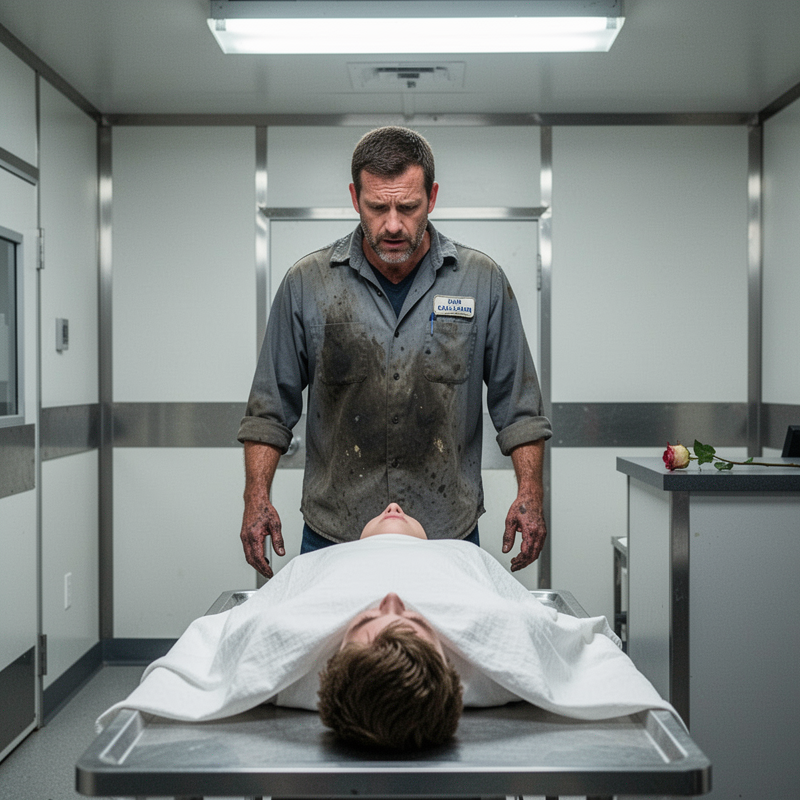
CHAPTER 1: The Mark on His Wrists
Part 1
“Your son collapsed during night maneuvers, Dan. The coroner signed off on natural heatstroke,” Colonel Richard Solloway said over the receiver.
Eighteen-year-old Toby Callahan was dead, barely twelve hours after entering the private military prep academy managed by his stepfather.
When Dan Callahan arrived at the county morgue in his stained mechanic work-shirt, he found fresh defensive bruising on his wrists and an unmailed letter stuffed into Toby’s boot.
The local Sheriff’s office closed the file before sunset, citing a pre-existing medical condition.
Dan Callahan had lost his business, his marriage, and served eighteen months in prison for a DUI—but he knew his son had not died of natural causes.
He resolved to trace the truth, oblivious that his son’s stepfather was already assembling the rest of the family to crush him.
The sterile air of the county morgue bit at Dan’s lungs, sharper than any winter wind. Fluorescent lights hummed overhead, casting a harsh, unforgiving glare on everything, even the single wilting rose left on the reception desk.
He wore his grease-stained mechanic’s shirt, the one with the ripped sleeve from a stubborn transmission job last week. He hadn’t bothered to change. There wasn’t time.
He followed the attendant, a woman with tired eyes, down a silent corridor. Each step echoed too loudly.
Then he saw him. Toby.
His son lay on a stainless steel table, covered by a white sheet up to his chest. He looked impossibly still, too peaceful, not like the vibrant, athletic boy Dan had just seen off yesterday morning.
A wave of nausea hit Dan. He braced himself against the cold tile wall.
“We finished the preliminary examination,” the attendant murmured, almost apologetically. “Coroner Kincaid signed off.”
She gestured vaguely towards a form clipped to a board at the foot of the table. Dan didn’t look at it. He couldn’t.
He reached for Toby’s hand, his own calloused fingers trembling. The skin felt cool, distant.
That’s when he saw them. Faint, purple-blue marks just above Toby’s wrists, like someone had gripped him hard. Defensive bruises.
Not heatstroke. Never heatstroke.
A small, crinkled envelope, barely visible, protruded from the top of Toby’s combat boot, which had been placed neatly beside the table. Dan carefully pulled it out. It was addressed to his mother, Martha. Unmailed.
He pocketed the letter, his heart pounding a frantic rhythm against his ribs. This was wrong. All of it.
He drove straight to the Solloway family home, a sprawling brick mansion on the edge of the academy grounds. The manicured lawn, the perfect rose bushes—everything screamed control and order.
Richard Solloway, Toby’s stepfather, met him at the imposing oak front door. The Colonel, still in his crisp academy uniform, looked down his nose at Dan’s work shirt.
“Dan. A tragedy. Martha is beside herself.” His voice was devoid of warmth, clipped, professional.
Dan gripped the doorframe, trying to steady his voice. “Richard, I just came from the morgue. Toby had bruises on his wrists. And a letter in his boot.”
Richard didn’t flinch. He simply raised an eyebrow, a practiced look of weary disdain.
“Heatstroke, Dan. A pre-existing condition, regrettable as it is. Dr. Kincaid confirmed it.”
He stepped aside just enough to reveal a framed certificate hanging in the entryway: a commendation for academy service. The house smelled faintly of Martha’s pot roast, a stark contrast to the grim conversation.
“I need to talk to Martha,” Dan insisted, trying to push past him. “She needs to know what I saw.”
Richard blocked his path smoothly, his stance unyielding. He held up a single sheet of paper.
“No need, Dan. She’s resting. I’ve already handled everything.”
The paper was a medical release form, signed and dated just hours earlier. It authorized the immediate release of Toby’s body to the academy for burial arrangements. Dan’s name wasn’t on it. Martha’s signature, however, was clearly visible.
He felt a cold dread creep through him. Richard had moved fast. Too fast.
“I need to see Toby’s room,” Dan said, his voice flat. He needed to find something, anything.
Richard hesitated, then nodded curtly. “Briefly. Then you should leave.”
He led Dan down a long hallway, past framed photos of Toby in his pristine academy uniform, smiling with other cadets. The air here was heavy with a false sense of peace.
Toby’s bedroom was surprisingly neat, the bed made, clothes folded. It was a cadet’s room, not an eighteen-year-old’s.
On the small desk in the corner, an old desktop computer hummed softly. The screen glowed with a faded blue light. It was on, left running.
Dan walked over, his eyes scanning the display. A web browser was open, displaying a primitive-looking webpage with blocky text. The title at the top of the browser read: `alt.military.cadets`.
A hand clamped down on Dan’s shoulder, firm and unyielding.
“That’s quite enough, Dan.”
It was a security guard, a hulking man in an academy uniform, his face grim. He smelled of Old Spice and determination.
“Colonel Solloway asked us to escort you out. Immediately.”
Part 2
The security guard’s hand was like iron. Dan didn’t resist. He was ejected from the manicured grounds, the heavy oak door clicking shut behind him. He stood there for a moment, the taste of ashes in his mouth. He had the letter, the images of Toby’s bruised wrists, and the strange Usenet address. He had to show Martha.
He drove to her home, a smaller cottage on the other side of the academy lake, part of the Solloway estate but separate. He knocked, waited, then knocked again. The door creaked open. Martha, her eyes red and puffy, her face streaked with tears, looked utterly broken.
“Dan? What are you doing here?” Her voice was raw, thin.
“Martha, I need to talk to you about Toby. What I saw at the morgue. This letter.” He held out the crumpled envelope from Toby’s boot and pulled out his phone, ready to show her the photos he’d discreetly taken of the bruises.
She flinched back, shaking her head. “No. Get away from here, Dan.”
Her grief was a palpable thing, heavy in the air. “Martha, please. Richard is lying to you.”
Her eyes flashed with sudden, fierce anger. “You’re lying! You always were. Colonel Solloway warned me you’d try this. He told me you’d relapsed, that you were delusional.”
“Relapsed? Martha, I’m two years sober. You know that.”
“Do I?” she spat, tears still streaming. She reached behind the doorframe and pulled out a stack of papers. Her hand trembled as she thrust them at him. “He also told me you stole from Toby! His college fund. Twelve thousand dollars, Dan. All of it gone, just weeks ago.”
Dan took the papers, his mind reeling. Bank withdrawal receipts. Dated perfectly, forged flawlessly. His own name. His own signature, expertly faked. Richard had created a phantom theft, tying it to his past to paint him as an unstable, dangerous alcoholic.
It was a cold, calculated strike, designed to ensure Martha would never believe him, never even listen. Richard wasn’t just controlling the narrative; he was isolating Dan completely.
He looked at Martha, her face etched with pain and accusation, and knew he couldn’t reach her. Not now. Not like this. He turned, the forged papers heavy in his hand, and walked numbly back towards his beat-up pickup truck.
Before he even reached the driver’s side door, his phone buzzed in his pocket. It was a number he knew by heart. Marcus. His brother.
“Dan? Don’t ask any more questions,” Marcus said, his voice tight with an urgency Dan hadn’t heard in years.
Chapter 2: The Price of Loyalty
The fluorescent hum of Marcus’s auto supply shop felt particularly loud. I pushed through the swinging doors, past stacks of tires and racks of oil filters. My brother was at the counter, hunched over a manifest, his shoulders stiff.
He didn’t look up when I stepped into the aisle beside him.
“Marcus.” My voice sounded rough even to me.
He flinched, then slowly lifted his head. His eyes, usually quick and sharp, were dull, avoiding mine.
“Dan. What are you doing here?” He wiped his hands on a greasy rag, though they already looked clean.
I pulled the creased photos from my pocket – the defensive bruises on Toby’s wrists. “I need your help. Something’s wrong with Toby’s death.”
Marcus took a step back, bumping into a display of spark plugs. They rattled.
“The colonel said it was heatstroke,” he muttered, finally looking at the wall behind me. “The doctor signed off.”
“Richard dictated that report,” I said, my voice low. “Before the body was even examined.”
A muscle in Marcus’s jaw twitched. He leaned over the counter, his voice dropping to a near whisper. “Richard is… he’s just trying to protect the family, Dan.”
Then came the twist. “He offered my firm a quarter-million-dollar distribution contract.”
The words hung in the air, thick with the smell of rubber and motor oil. A quarter-million dollars. My brother’s eyes finally met mine, and I saw the desperate glint of opportunity there.
“Military supply,” he clarified, as if that made it better. “Logistics for the academy, the whole region. It’s a game-changer, Dan.”
My stomach clenched. “So, that’s it? You’re just going to turn your back on Toby?”
“I’m looking out for my family,” he shot back, his voice rising now. “And yours. You’re unravelling, Dan. Richard’s right.”
He took another shaky breath, then delivered the final blow. “If you keep pushing this, if you go near that academy, I’ll testify. I’ll tell the court you were hallucinating during your DUI arrest. That you’ve been unstable since your business went under.”
The shop door chimed as a customer entered, but I barely registered it. The smell of victory was already in Marcus’s eyes, mixing with the shame.
I looked at my brother, the last piece of family I thought I had, and saw only a stranger bought and sold. I left without another word, the quarter-million-dollar contract a heavy weight in the silence behind me.
Chapter 3: Pixels in the Dark
My truck sputtered its protest, but kept running. I drove straight to the small, brick building of the *County Herald*. Sarah Holbrook, the junior reporter, looked up from her cluttered desk, her brow furrowed. She had been the only one who didn’t dismiss my calls.
“Mr. Callahan,” she said, her voice surprisingly firm for someone so young. “The editor said not to pursue this. ‘No new news.’”
I slid Toby’s unmailed letter across her desk, then the photos of his bruised wrists. “Toby wrote this. He was scared. And the local sheriff’s office closed his file in hours.”
Sarah picked up the letter, her eyes scanning the familiar handwriting. She frowned, then looked at the photos. Her mouth tightened into a thin line.
“Okay,” she said, a new resolve in her voice. “What do you need?”
“Toby’s old desktop,” I told her. “The one in his room. It was left running.”
Two days later, she showed up at my garage. “The family let me ‘borrow’ it for a story on digital archiving,” she said with a wry smile. “Took some convincing.”
We set it up in the newspaper backroom that night. The hum of the old machine was familiar, almost comforting. The screen flickered to life, showing the same bookmarked page I’d seen that first day.
“Usenet,” Sarah murmured, leaning closer. “Early internet forums. Before everything was polished.”
She navigated through the archives of `alt.military.cadets`, a specific newsgroup from 1998. The posts scrolled by, a digital time capsule. Then, a screen name caught my eye: “Cadet_Tango.”
My heart pounded. Toby always called himself Tango on the basketball court.
We found his posts. He’d described “conditioning drills” ordered by “the Colonel.” Grueling 3:00 AM forced runs across the drill field, wearing heavy iron backpacks. He spoke of fatigue, nausea, and the fear of “disappointing his stepfather.”
“He was trying to get help,” Sarah whispered, her finger tracing the screen.
Then, we saw them. Multiple replies from a user named “Watcher_91.” Each one more urgent than the last.
“Cadet_Tango, you need to leave that camp. Now.”
“This isn’t standard training. Get out.”
“They will not listen to reason. Do not trust them.”
The words, blinking on the old monitor, were a ghost speaking from the past. A chill ran through me. Someone had seen this coming. Someone had tried to warn Toby.
And Toby, confused and fearing disappointment, had stayed.
Chapter 4: The Circle Closes
The stack of printed Usenet pages felt flimsy in my hand, but the words on them were solid as concrete. Sarah had helped me collate them, adding timelines and cross-referencing names. This was it. Real proof.
I walked towards the county courthouse, the afternoon sun glinting off its white columns. I pictured the prosecutor’s face as he read about the 3:00 AM runs and the iron backpacks. He’d have to act.
Just as I reached the broad steps, a man in a crisp suit stepped in front of me. He held out a folded document. His face was unreadable.
“Mr. Daniel Callahan?” he asked. His voice was flat.
“Yes,” I said, my gut clenching.
He handed me the papers. “You are hereby served with an Emergency Temporary Restraining Order.”
I stared at the official seal, then at the list of plaintiffs. Martha Solloway. Marcus Callahan. My own brother. And then, Toby’s half-siblings, Richard’s children, young adults barely out of college.
My hands began to tremble. I was legally forbidden from coming within five hundred feet of the prep school grounds. Five hundred feet of Martha’s residence.
Across the street, standing next to a sleek black sedan, was Colonel Richard Solloway. He wasn’t smiling. He wasn’t sneering. He simply watched, his arms crossed over his chest, his legal representative beside him. He looked like a statue, carved from granite.
He had closed the circle. Every single person in my family, except Toby, had been turned against me. Martha believed I was a thief and an alcoholic. Marcus was bought. Now, even Richard’s children, Toby’s own half-siblings, had signed on. They believed I was harassing them, grieving irrationally.
The papers rustled in my hands. I was an outsider, legally isolated. My own family had built a wall around me, and Richard Solloway stood on the other side, silent and victorious. The air in front of the courthouse felt suddenly thin, hard to breathe.
Chapter 5: The Voice from North Carolina
The restraining order felt like a physical barrier, not just a legal one. I couldn’t go near the academy, couldn’t talk to Martha. But Richard hadn’t anticipated Sarah.
She worked late nights, fueled by stale coffee and a journalist’s stubbornness. A week later, I found her slumped at her desk, a small notepad open in front of her.
“Mr. Callahan,” she said, her voice hoarse. “Watcher_91.”
My chest tightened. “You found them?”
“IP address traced to a residential landline in Wilmington, North Carolina,” she confirmed, pushing the notepad across the desk. “It’s a long shot, but it’s all we have.”
The next morning, I drove to the public phone booth outside my garage. The payphone felt alien, its surface grimy. I dropped in a quarter, then dialed the number Sarah had given me. It rang four times, five.
Just as I was about to hang up, a woman’s voice answered. It sounded fragile, hushed. “Hello?”
“I’m looking for Watcher_91,” I said, my voice barely steady. “My name is Dan Callahan. My son was Cadet_Tango.”
A sharp intake of breath on the other end. A long silence. Then, a choked sob.
“Oh, God,” the voice whispered. “Tango. I tried. I really tried to warn him.”
“Who is this?” I asked, my heart hammering against my ribs.
“Evelyn,” she managed, her voice breaking. “Evelyn Solloway.”
The name hit me like a physical blow. Richard’s first wife. The woman he’d divorced twelve years ago.
“You’re Richard’s ex-wife?” I gripped the receiver, my knuckles white.
“Yes,” she confirmed, a fresh wave of tears in her voice. “He was my husband. I knew what he was capable of.”
She then delivered the shock. “My nephew. He was at the academy in 1988. Ten years ago. Richard put him through the exact same ‘conditioning discipline.’ Forced runs, heavy packs.”
Her voice grew distant, filled with old pain. “He ended up in the hospital. Severe kidney damage. The family hushed it up. Said it was a ‘pre-existing condition.’ Richard threatened us.”
A cold wave washed over me. This wasn’t the first time. Richard had done this before. And Evelyn, silent for a decade, had been watching, waiting, protecting. My son’s death wasn’t an isolated incident. It was a pattern, hidden in plain sight.
Chapter 6: The Weight of Silence
Evelyn arrived two days later, stepping off a Greyhound bus that hissed to a stop at the town depot. She was thinner than the old wedding photos, her hair a faded blonde, but her eyes held a steady fire. Under her arm, she clutched a worn leather binder.
“Thank you for coming,” I said, meeting her by the luggage bay.
“I should have come sooner,” she replied, her voice strained. “For all of them.”
We drove directly to a roadside diner, a place with chipped Formica tables and the smell of old coffee. Before she even ordered, her phone buzzed in her purse. She glanced at the caller ID, then visibly recoiled.
“It’s Richard,” she said, her voice shaking. “He knows I’m here.”
She answered, holding the phone away from her ear. I couldn’t hear Richard’s words, but his tone was a low, menacing rumble. Evelyn’s face went pale. Her hand tightened on the binder.
She hung up, her chest rising and falling rapidly. “He called my care facility,” she whispered, her eyes wide with a mix of fear and rage. “He knows about my daughter. He’s threatening to cut off the supplemental trust payments.”
Her daughter. I remembered Sarah mentioning Evelyn’s disabled child. Richard knew exactly where to strike.
“He said if I testify, if I even *talk* to you, he’ll make sure she loses her care.” A single tear tracked a path down her cheek. “He said he’d blame her financial issues on ‘unforeseen family legal costs.’”
The coffee arrived, untouched. Evelyn sat for a long moment, staring out the greasy window, her jaw working. The weight of her silence, the decade of it, pressed down on her.
Then, she pushed the binder across the table. It was thick, stuffed with yellowed documents. “These are copies of military correspondence from the 80s,” she said, her voice clear now, resolute. “Formal complaints. And these,” she tapped a section, “are old forum logs. From the early 90s, when he was still at the military base, before he started the private academy. They detail the exact same ‘conditioning’ drills, the same injuries.”
Her eyes met mine, unwavering. “He can’t silence me anymore. Not if it means protecting others.”
Richard’s financial pressure, his cruel threat, had failed. It had only solidified Evelyn’s resolve. The binder was heavy, filled with a truth that had been hidden for far too long.
Chapter 7: Ink on Paper
Sarah moved like a whirlwind. Evelyn’s binder was a treasure trove. It contained hand-typed letters, internal memos, and even scanned news clippings from regional papers decades ago, all hinting at “unorthodox disciplinary methods” at Richard’s previous posts.
Combine that with Toby’s chilling Usenet posts and Evelyn’s personal testimony, and it wasn’t just a story. It was an institutional failure spanning decades.
The regional Sunday newspaper hit the stands with a banner headline: “Cadet Death: A Pattern of Abuse?” Sarah’s comprehensive two-page investigative piece dominated the front section. My hands shook as I unfolded it in my garage, the smell of newsprint mingling with oil.
Her article didn’t just focus on Toby. It wove together Evelyn’s historical accounts of her nephew’s kidney damage in 1988, connecting it directly to Richard’s “conditioning.” It juxtaposed those events with Toby’s `alt.military.cadets` posts, creating an undeniable narrative of systemic abuse.
By Monday morning, the phones at the *County Herald* were ringing off the hook. The local veteran coalition, usually stoic, issued a public statement demanding answers. The state military board, previously dismissive, announced an emergency session.
Then, the protestors arrived. They gathered outside the prep academy gates, a small but growing crowd. Signs bobbed above their heads: “Justice for Toby!” “Protect Our Cadets!” “Solloway: Resign Now!”
The tranquil, manicured lawns of the academy, once a symbol of prestige, were now surrounded by reporters and angry citizens. Camera crews jostled for position. The sound of their chants echoed, stark against the quiet hum of the Georgia summer air.
Richard Solloway’s carefully constructed world, built on silence and manipulation, was crumbling. The ink on Sarah’s paper had done what my pleas and legal papers could not. It had ignited a fire that would be impossible to extinguish quietly. The truth, once confined to pixels in the dark, was now shouting from every newsstand.
Chapter 8: The Shadow over the Academy
The Georgia State Military Inquiry Panel convened at the county courthouse on a Tuesday morning. The air outside was thick with anticipation, but inside, the hearing room was hushed, almost solemn. Colonel Solloway sat at the defense table, his posture ramrod straight, his face a mask of practiced calm. He looked directly ahead, acknowledging no one.
Earlier that morning, I’d seen him on a grainy local news report, stepping into his car. He had been issuing terse instructions into a hidden microphone, his voice low. “Stay inside. Avoid the press. No comments.” His family, presumably, was following his orders.
But not Martha.
Back at the academy residence, a sprawling house usually filled with Richard’s carefully curated decor, Martha moved through the silent rooms. The house felt too big, too empty. The echoes of Toby, of their life before Richard, seemed to press in on her.
Richard had left strict instructions: his private desk office was off-limits. *Especially* during the inquiry. But Martha couldn’t shake a feeling. A small, persistent itch at the back of her mind. Toby’s missing personal effects. His old baseball glove. A watch. Things that just weren’t where they should be.
She slowly pushed open the door to Richard’s office. The scent of polished wood and old cigars hung heavy in the air. His desk, usually immaculate, had a few scattered papers. She saw his campaign badges, still gleaming, lying on a corner.
Her gaze fell on a small, locked drawer. A sudden, cold certainty washed over her. Richard had always been meticulous. Everything had its place. Why this drawer, hidden, yet not quite secret?
She pulled at it. It didn’t budge. Panic, cold and sharp, began to prick at her. What if… what if there was something in there related to Toby? Something Richard didn’t want anyone to find? Her hands shook as she searched the desk for a key, the silence of the empty house pressing in, holding its breath with her.
Chapter 9: The Silence of the Colonel
The courthouse hearing room was packed, hushed. The state medical examiner, a stern-faced woman in a no-nonsense suit, stood before the panel. My hands were clenched under the table. Evelyn sat beside me, her expression grim.
“Our independent toxicological findings confirm,” the medical examiner stated, her voice clear, “that Toby Callahan suffered from severe exertion-induced rhabdomyolysis.”
A murmur rippled through the room. She explained the term: muscle tissue breakdown, kidney damage, a direct result of extreme physical overexertion and forced dehydration.
“Furthermore,” she continued, pointing to a projected image, “we found evidence of multiple blunt force traumas consistent with repeated physical impact, particularly on the lower back and legs. These injuries are not indicative of a fall, nor are they typical of heatstroke.”
She looked directly at the panel. “The cause of death was not natural heatstroke. It was systemic organ failure brought on by forced physical trauma and extreme, non-consensual exertion.”
Richard Solloway didn’t move a muscle. His face remained impassive, betraying nothing.
Minutes later, during a short recess, the courtroom doors burst open. Martha Solloway stood there, her hair disheveled, her eyes red-rimmed. In her hand, she clutched a small, silver micro-cassette player.
She walked directly towards Richard, ignoring the reporters, ignoring the bailiffs. She stopped directly in front of him, her chest heaving.
“I found this,” she said, her voice raw, thrusting the player forward. “In your desk.”
She pressed play. The tinny, desperate voice of Toby Callahan filled the courthouse hallway. “Please, Colonel. I can’t. My legs… I’m sick. Just let me come home.” A pause. A ragged gasp for air. “Mom… Mom will understand. Please, let me come home.”
The recording clicked off. The hallway was utterly silent. Martha’s gaze was searing, filled with a decade of unspoken accusations.
Richard looked at the micro-cassette player. He looked at Martha. He looked at me, then at Evelyn. He offered no grand speech. No angry defense. No desperate plea. He simply stared, his face finally devoid of all expression.
Then, with a slow, deliberate movement, he unpinned the gleaming campaign badges from his lapel. He handed them to his bewildered aide. Without another word, without a glance back, Richard Solloway turned and walked out the back door, alone, into the swirling crowd of reporters.
The colonel’s silence was his confession.
Chapter 10: After the Storm
The fallout was swift and absolute. Within days, the Georgia State Military Inquiry Panel issued its final ruling. Richard Solloway’s conduct was deemed “grossly negligent” and “criminally culpable.”
The prep academy’s military certification was immediately revoked. Its gates, once a symbol of ambition, were padlocked by state authorities, draped with official seals. The once-proud institution stood empty, a hollow monument to a terrible secret.
Martha Solloway vanished from public view. I heard through Sarah that she’d sold the family house within weeks, the deed signed quietly. She moved north, to live near her sister, severing all contact. No calls. No letters. Her marriage to Richard had ended not with a bang, but with a silent, devastating retreat. She cut me off too.
Richard himself became a ghost. He quietly liquidated his assets, paying out the remaining contract liabilities to Marcus’s firm – a final, bitter transactional exchange. The local political nomination he’d been chasing for years simply vanished from the news. No grand announcement. No public apology.
He relocated to an isolated cabin in rural Alabama, a place so remote even his former peers couldn’t find him. He was disgraced, shunned, forced into a solitary retirement, avoided by everyone he’d ever known. His silence remained unbroken. The world just moved on without him, as if he’d never been a colonel, never run an academy. The silence was his consequence.
For me, the immediate storm had passed, but the air still felt heavy with grief. Toby was heard, finally. But the victory felt hollow, a quiet ache that would never fully heal.
Chapter 11: The Rusted Bleachers
A long time later, I found myself back at the abandoned prep academy grounds. The padlocks on the main gates were rusted, the paint peeling. Weeds grew tall through cracks in the asphalt. The meticulously manicured lawns were overgrown, reclaiming the earth.
I walked the perimeter, past empty dormitories with boarded-up windows, the silence echoing in the afternoon air. The faint smell of damp earth and decaying leaves replaced the sharp scent of polish and discipline.
My steps led me to the drill field, now just a stretch of untended grass. I found the bleachers, where Toby used to train. They were rain-slicked, the metal seating streaked with rust, the wood rotting. I sat down on the cold, damp bench, the only sound the distant chirping of crickets.
I pictured him here. Eighteen years old. Strong. Full of dreams. His laugh, the way he’d wipe sweat from his brow after a hard practice. I sat there for a long time, just breathing, just remembering. The anger was still there, a low ember, but the raw, frantic desperation had faded.
Eventually, the chill in the air drove me away. I drove back to the small roadside diner near the bus station, the same one where I’d started so many mornings, sober, after so many dark nights.
Inside, I ordered black coffee. Through the streaked window, I watched a commercial transport bus pull up. A new cohort of young men, fresh-faced and eager, boarded it, their duffel bags slung over their shoulders. They were heading south, for basic training. The cycle, I knew, would continue. Institutions, for better or worse, always found a way.
I took a slow sip of my coffee, its bitter warmth spreading through me. The world doesn’t fix itself just because you brought the dark into the light. It just keeps turning, and all you can do is stay sober enough to watch the sunrise.
My toolbox waited in the truck. I picked it up, the familiar weight a comfort. Then I went back to work.
Leave a Reply