CHAPTER 1: The Whisper in Ward 4.
Part 1
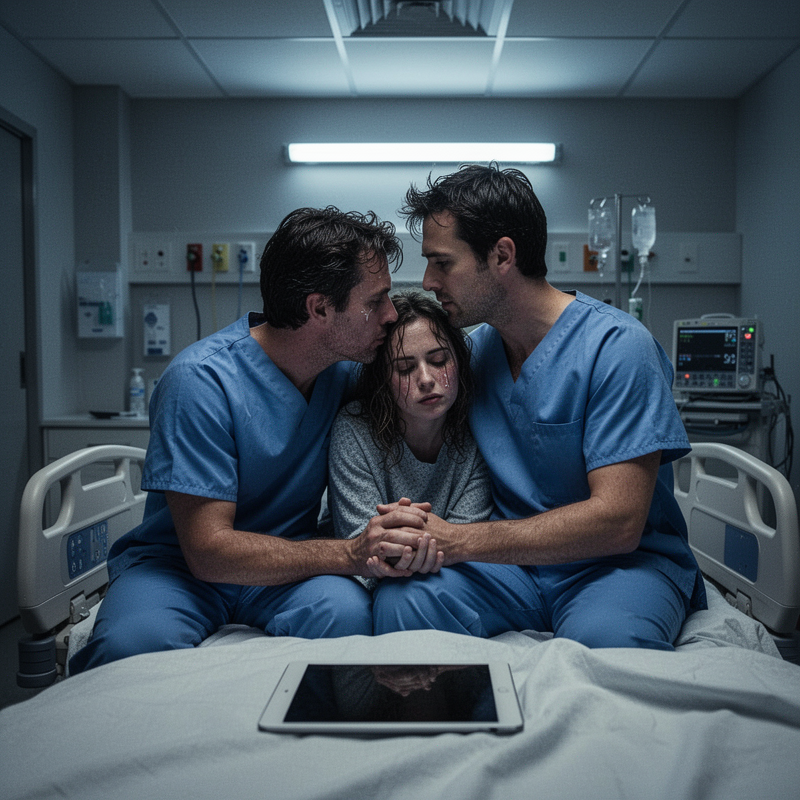
“We lost the first boy, Eleanor, there was nothing the doctors could do,” my husband Julian whispered in the dimly lit Canberra Hospital room, holding my hand with tears in his eyes. I collapsed into his shoulder, consumed by grief over losing one of our twin sons delivered via surrogate, believing his every word as he spent the next six hours endlessly comforting me. Right before the attending midwife brought in our surviving baby, she slipped an encrypted micro-SD card into my palm and whispered, “Watch this before you sign his medical consent form—do not trust your husband.” When Julian stepped out to answer a call from my parliamentary chief of staff, I inserted the card into my tablet and pressed play. The video showed Julian standing outside the delivery room ten minutes before the emergency delivery, quietly instructing the doctor to delay resuscitation on Twin A to ensure only one child survived.
The screen flickered to life in the dim hospital room, casting a stark blue light across my tear-stained face.
My hand, still trembling from grief and the cold, smooth plastic of the micro-SD card, clutched the tablet tight.
Julian’s footsteps had just faded down the corridor, his voice, rich and reassuring just moments before, now replaced by the muted hum of the hospital and the distant chatter of staff.
On the screen, there he was.
Julian Bennett, my husband of five years, stood in a sterile corridor, just outside the double doors of what I knew had been the delivery room.
His usually immaculate hair was slightly ruffled, a subtle performance of stress, I now saw. He wore the blue hospital scrubs that had seemed so ordinary at the time, indicating his presence during the emergency.
He looked calm, too calm, considering the chaotic, life-or-death situation unfolding just metres away.
Dr. Anya Sharma, the obstetrician, a woman whose face was usually a mask of professional composure, appeared strained. Her glasses sat slightly askew on her nose. She clutched a chart to her chest.
The timestamp in the corner of the video read 10:47 AM.
Our surrogate, Chloe Sanders, had gone into emergency labour at 10:55 AM.
“Dr. Sharma,” Julian began, his voice surprisingly clear on the tablet’s small speakers, cutting through the hospital’s ambient noise. He glanced around the empty corridor before leaning in closer to the doctor.
“Julian,” Dr. Sharma replied, her voice tight, “We’re losing Twin A. We need to move immediately. The heart rate is plummeting.”
My breath hitched in my throat. Losing Twin A. Leo. My little Leo.
Julian placed a hand gently, almost paternally, on Dr. Sharma’s shoulder. His touch, which I had once found so comforting, now seemed utterly sinister.
“Anya, we discussed this,” he said, his tone low but firm. “The genetic screening showed anomalies, didn’t it? A high probability of severe, irreversible complications.”
Dr. Sharma’s eyes darted around, betraying a flicker of unease.
“There were markers, yes,” she conceded, her voice barely a whisper, “but nothing conclusive. And now… now it’s about active intervention. Every second counts for Twin A.”
Julian shook his head slowly, a picture of measured regret.
“No, Anya. We made a decision. Given Eleanor’s age, her position… we need to ensure the best possible outcome for *one* healthy child.”
My heart hammered against my ribs, a frantic drumbeat in the sudden, terrifying silence of the room. The air felt thin, metallic.
“Delay resuscitation on Twin A,” Julian instructed, his gaze unwavering, fixed directly on Dr. Sharma. “Focus all resources on Twin B. Ensure Twin A’s passing is… peaceful. Untraceable.”
The word “untraceable” echoed in my head, a chilling pronouncement.
Dr. Sharma’s mouth opened slightly, as if to protest, but no sound came out. She visibly swallowed, her eyes wide behind her crooked glasses. She slowly nodded, a faint, almost imperceptible dip of her head.
A cold, icy dread began to spread through me, chilling me to my very core. My grief, a familiar, heavy blanket, was instantly ripped away, replaced by a searing, white-hot fury.
The video continued for another few seconds. Julian offered Dr. Sharma a small, sympathetic smile, a gesture of faux compassion.
“Thank you, Anya,” he said, patting her shoulder once more. “You understand.”
Then, he turned and walked away, disappearing around the corner of the corridor, leaving Dr. Sharma standing there, alone, looking utterly defeated.
The screen went black, returning to the tablet’s home screen. The silence in the hospital room was deafening.
My vision blurred.
The man who had held me for six hours, whispering platitudes about fate and tragedy, had just calmly orchestrated the death of our son.
He hadn’t been comforting me in my grief. He had been covering his tracks.
My hands flew to my mouth, stifling a cry that threatened to rip through the sterile quiet.
Leo. My beautiful, lost Leo. He hadn’t been taken by an act of God.
He had been taken by Julian.
Part 2
The screen flickered to life in the dim hospital room, casting a stark blue light across my tear-stained face. My hand, still trembling from grief and the cold, smooth plastic of the micro-SD card, clutched the tablet tight. Julian’s footsteps had just faded down the corridor, his voice, rich and reassuring just moments before, now replaced by the muted hum of the hospital and the distant chatter of staff. On the screen, there he was. Julian Bennett, my husband of five years, stood in a sterile corridor, just outside the double doors of what I knew had been the delivery room. His usually immaculate hair was slightly ruffled, a subtle performance of stress, I now saw. He wore the blue hospital scrubs that had seemed so ordinary at the time, indicating his presence during the emergency. He looked calm, too calm, considering the chaotic, life-or-death situation unfolding just metres away. Dr. Anya Sharma, the obstetrician, a woman whose face was usually a mask of professional composure, appeared strained. Her glasses sat slightly askew on her nose. She clutched a chart to her chest. The timestamp in the corner of the video read 10:47 AM. Our surrogate, Chloe Sanders, had gone into emergency labour at 10:55 AM. “Dr. Sharma,” Julian began, his voice surprisingly clear on the tablet’s small speakers, cutting through the hospital’s ambient noise. He glanced around the empty corridor before leaning in closer to the doctor. “Julian,” Dr. Sharma replied, her voice tight, “We’re losing Twin A. We need to move immediately. The heart rate is plummeting.” My breath hitched in my throat. Losing Twin A. Leo. My little Leo. Julian placed a hand gently, almost paternally, on Dr. Sharma’s shoulder. His touch, which I had once found so comforting, now seemed utterly sinister. “Anya, we discussed this,” he said, his tone low but firm. “The genetic screening showed anomalies, didn’t it? A high probability of severe, irreversible complications.” Dr. Sharma’s eyes darted around, betraying a flicker of unease. “There were markers, yes,” she conceded, her voice barely a whisper, “but nothing conclusive. And now… now it’s about active intervention. Every second counts for Twin A.” Julian shook his head slowly, a picture of measured regret. “No, Anya. We made a decision. Given Eleanor’s age, her position… we need to ensure the best possible outcome for *one* healthy child.” My heart hammered against my ribs, a frantic drumbeat in the sudden, terrifying silence of the room. The air felt thin, metallic. “Delay resuscitation on Twin A,” Julian instructed, his gaze unwavering, fixed directly on Dr. Sharma. “Focus all resources on Twin B. Ensure Twin A’s passing is… peaceful. Untraceable.” The word “untraceable” echoed in my head, a chilling pronouncement. Dr. Sharma’s mouth opened slightly, as if to protest, but no sound came out. She visibly swallowed, her eyes wide behind her crooked glasses. She slowly nodded, a faint, almost imperceptible dip of her head. A cold, icy dread began to spread through me, chilling me to my very core. My grief, a familiar, heavy blanket, was instantly ripped away, replaced by a searing, white-hot fury. The video continued for another few seconds. Julian offered Dr. Sharma a small, sympathetic smile, a gesture of faux compassion. “Thank you, Anya,” he said, patting her shoulder once more. “You understand.” Then, he turned and walked away, disappearing around the corner of the corridor, leaving Dr. Sharma standing there, alone, looking utterly defeated. The screen went black, returning to the tablet’s home screen. The silence in the hospital room was deafening. My vision blurred. The man who had held me for six hours, whispering platitudes about fate and tragedy, had just calmly orchestrated the death of our son. He hadn’t been comforting me in my grief. He had been covering his tracks. My hands flew to my mouth, stifling a cry that threatened to rip through the sterile quiet. Leo. My beautiful, lost Leo. He hadn’t been taken by an act of God. He had been taken by Julian.
The video had ended, but the images of Julian, so calm and commanding, were seared into my mind. My hands were shaking uncontrollably, the tablet a foreign object. The man I loved, the father of my children, had murdered our son. The raw, gut-wrenching grief was still there, but now it was laced with a venomous disbelief and a terrifying clarity.
I stared at the black screen, trying to breathe, trying to process. Moira’s warning echoed: *do not trust your husband.* She hadn’t just meant his words of comfort. She meant everything.
My thumb instinctively brushed the screen, a desperate need for answers overriding the shock. The tablet responded, showing a file directory. The video I’d just watched was labelled “DELIVERY ROOM_01.mp4.” But beneath it, there were other files. Several, in fact. All encrypted, but the tablet had apparently decrypted them when I first inserted the card.
There was “SURROGATE_HEALTH_REPORTS_FULL.pdf,” “KEATING_TRUST_AMENDMENTS_2022.pdf,” and another one that screamed at me: “ELEC_FUND_TRANSFER_AUTH_URGENT.pdf.”
My eyes darted to the last file. Electoral Fund Transfer. Urgent.
My stomach clenched. What electoral fund? The one I had set aside for my next campaign? The $3.8 million reserve fund, painstakingly built over years, meant for critical infrastructure projects and community engagement, not personal use.
I tapped the PDF, and it opened instantly.
It was a form, dated just yesterday, the same day Leo died. An Emergency Financial Authorization form. My name, Eleanor Keating, was printed clearly at the top as the grantor.
But the signature at the bottom, scrawled quickly over the dotted line, wasn’t mine. It was a crude, rushed imitation of my signature. It looked like mine at first glance, but the angle was off, the flourish at the end completely wrong. It was a forgery.
Beneath the forged signature, Julian Bennett’s name was typed, designated as the ‘authorised signatory’ for the immediate transfer of funds.
The sum was specified in bold, undeniable figures: **$3,800,000.00 AUD**.
And the recipient account? Not the campaign’s secure holding account. It was a private entity, an investment company I’d never heard of, registered offshore.
My campaign reserve fund. Drained.
He hadn’t just murdered our son. While I lay weeping, believing his every lie, he had been dismantling my entire life, piece by sickening piece.
Chapter 2: The Surrogate’s Confession
The metallic tang of hospital disinfectant clung to my clothes as I walked down a quiet corridor, away from the NICU where Arthur lay, his tiny chest still rising and falling with help from machines. The image of Julian’s face on the tablet, cold and calculating, was burned behind my eyes. I needed answers beyond that video.
I found Chloe Sanders, our surrogate, in a small, sterile waiting room, fiddling with a button on her blouse. Her face was pale, her eyes red-rimmed and distant. She looked exhausted, haunted.
“Chloe,” I said softly, my voice raspy. I sat opposite her, the plastic chair cold against my back.
She flinched, pulling her hands into her lap. “Mrs. Keating. How’s… how’s Arthur?”
“He’s stable,” I replied, choosing my words carefully. My gaze fixed on her. “Chloe, about Leo. Julian said it was an untreatable anomaly.”
She swallowed hard, her eyes darting to the closed door, then back to me. A tremor ran through her hands.
“He told you that?” she whispered, her voice barely audible.
“Yes. That’s what he told me, what he told the doctors.”
Chloe’s lower lip began to tremble. Her shoulders slumped. The sterile room suddenly felt suffocating.
“It wasn’t… it wasn’t true,” she finally choked out, tears welling in her eyes. “Oh, God, Mrs. Keating, I’m so sorry.”
My heart hammered against my ribs. “What wasn’t true, Chloe?”
She buried her face in her hands, her voice muffled. “The scans. The early ones. They were fine. Both of them. Perfect.”
I leaned forward, a cold dread spreading through my chest. “Perfect? Julian said the first few weeks showed significant developmental issues for Twin A.”
Chloe shook her head violently, lifting her tear-streaked face. “He knew. He saw the reports.”
“How?” I pressed, my voice tight. “How could he know?”
“He paid me,” she confessed, her words rushing out in a desperate flood. “Fifty thousand dollars cash. To keep quiet about those early results. To say nothing about how healthy they both were.”
Fifty thousand dollars. Cash. To conceal the truth about my sons. My mind reeled, Julian’s carefully constructed lie shattering into a million pieces.
“He threatened my family,” Chloe continued, her voice raw. “Said he’d ruin my life, accuse me of fraud. Said I’d never see my own kids again.”
The air left my lungs. The man who had held my hand, who had cried with me over Leo’s death, had engineered it all. He had paid to silence the truth that Leo was perfectly healthy.
Chapter 3: Echoes from Perth
Just as Chloe finished her painful confession, the door to the waiting room swung open. Aunt Beatrice stood there, her frail frame surprisingly determined, a worn leather carry-all slung over her shoulder. Her eighty-two years weighed visibly on her, but her eyes were as sharp as ever.
“Eleanor,” she said, her voice raspy from the flight. She gave Chloe a brief, sympathetic nod before her gaze fixed on me. “I came as soon as I heard.”
“Aunt Bea,” I managed, still reeling from Chloe’s words. “How… how did you know to come now?”
She settled onto a nearby chair, placing her bag carefully beside her. “I’ve had a bad feeling about Julian since the day you married him, dear. And when your chief of staff called with news of the ‘tragedy,’ it only confirmed my suspicions.”
“Suspicions?” My brow furrowed. I looked from Chloe, who was quietly wiping her eyes, to my aunt.
“Yes. Eleanor, I’m afraid this isn’t his first time.”
A cold knot tightened in my stomach. “First time for what?”
“A scheme like this. A financial drain,” Aunt Beatrice clarified, her voice low but firm. “Fifteen years ago, in Perth.”
I stared at her, disbelieving. “Perth? What are you talking about?”
“Julian Bennett was known as Julian Hayes then,” she revealed, pulling a folded, aged newspaper clipping from her purse. “Married to a wealthy mining heiress, Margaret Thorne. He convinced her to invest heavily in a ‘revolutionary’ diamond exploration project.”
She unfolded the yellowed clipping. The headline was small, faded: “Heiress’s Fortune Vanishes in Investment Scandal.”
“Margaret lost everything. Every last cent of her family’s trust fund,” Aunt Beatrice said, her finger tracing a blurry photo of a younger, smirking Julian. “And Julian, well, he disappeared right after the assets were liquidated. Left her with nothing but debts.”
My mind raced, connecting the dots. The charm, the political ambition, the constant questions about my finances. It wasn’t love. It was a pattern.
“He used the same playbook,” Aunt Beatrice continued, her voice heavy. “Isolated her from her family, presented himself as her sole support, then systematically drained her accounts. Blamed a ‘botched investment’ and a ‘sudden market crash’.”
The room felt like it was spinning. Julian hadn’t just betrayed me with Leo’s death; he had planned this entire marriage as an elaborate, predatory heist. My entire life with him was a lie built on a foundation of greed and calculated malice.
Chapter 4: The Four Million Dollar Clause
The next morning, the sterile hospital room felt like a cage. Arthur’s ventilator hummed softly beside me, a constant reminder of the life Julian had almost extinguished. My family solicitor, Graham Caldwell, a man who had handled Keating family affairs for decades, sat opposite me, his face grim.
“Eleanor, I’ve reviewed the Keating Estate trust documents,” Graham began, clearing his throat. “I’m afraid I have some deeply concerning news.”
I braced myself, clutching the armrest of my chair. “More than I already know, Graham?”
He pushed a thick legal document across the table. “Julian requested an amendment to the trust two years ago. Said it was a ‘modernization’ for future heirs.”
“I signed off on general updates,” I said, a flicker of suspicion igniting. “But nothing specific about the line of succession.”
Graham pointed to a specific paragraph, highlighted in stark yellow. “This clause, Eleanor. It states: ‘Should any direct heir born of the primary beneficiary’s marriage via gestational surrogacy fail to survive childbirth, full management and discretionary control of the Keating Family Trust, valued at 4.2 million Australian dollars, shall immediately revert to the primary beneficiary’s spouse as sole trustee.’”
My eyes widened, scanning the horrifying words. The clause was a dagger, precise and deadly. “Only one heir survived childbirth.”
“Exactly,” Graham confirmed, his voice heavy. “With Leo’s passing, Julian would become the sole trustee. He would gain complete control over the entire 4.2 million dollar fund.”
A gasp caught in my throat. It wasn’t just a general financial drain like with Margaret Thorne; this was a targeted, premeditated murder designed to unlock a specific, massive inheritance. He hadn’t just taken Leo’s life; he had done it to gain control of my family’s legacy.
“He added this clause two years ago,” I repeated, the horror sinking in. “Before we even considered surrogacy.”
“That’s right, Eleanor,” Graham said, his gaze firm. “It suggests a deeply disturbing foresight. A long-term plan.”
I pressed my hands against my temples. The audacity, the cold-blooded calculation. My husband, the man who had pledged his life to me, had plotted Leo’s death for two years, anticipating our desperate desire for children. He hadn’t just intended to steal my money; he had been willing to kill for it.
Chapter 5: The Oxygen Monitor Swap
The next evening, under the cloak of darkness, I met Nurse Moira Devlin in the hospital basement archive. The air was cool and smelled of old paper and dust. Fluorescent lights flickered overhead, casting long, dancing shadows. Moira clutched a tablet, her face pale but resolute.
“I pulled the telemetry logs, Minister,” Moira whispered, her eyes darting around the deserted room. “For the specific timeframe leading up to the emergency C-section.”
“What did you find?” I asked, my voice tight with anticipation.
She turned the tablet towards me, displaying a complex graph of fluctuating vital signs. “This is Twin A’s distress monitor output. Notice the flatlining here, forty-five minutes before surgery. A sudden, drastic drop in oxygen saturation.”
My breath hitched. “Julian claimed Twin A was failing, that it was a spontaneous event.”
“That’s what it looked like on paper, and in the delivery room,” Moira confirmed. “But then I cross-referenced it with Twin B’s telemetry.”
She swiped the screen. Another graph appeared, showing a corresponding, mirror-image spike in Twin B’s oxygen levels at the *exact same moment* Twin A’s dropped.
“This is impossible,” I murmured, my mind struggling to process. “They weren’t connected like that.”
“They weren’t,” Moira agreed, her voice grim. “Unless someone physically swapped the monitors.”
My head snapped up. “Swapped them?”
“Yes. Julian did it,” she stated, her eyes locking onto mine. “Forty-five minutes before the emergency C-section. He asked to ‘check on the babies’ one last time before I prepped you. He was alone with the monitors for less than two minutes.”
The image of Julian, feigning concern, leaning over the incubators, flashed through my mind. He hadn’t been checking on them. He had been ensuring Twin A appeared to be in distress, to create a false emergency, to mislead the obstetrician. He’d orchestrated the narrative of a failing baby.
“He wanted Twin A to be perceived as compromised,” Moira explained. “So that any delayed intervention would seem like a tragic inevitability, not a deliberate act.”
The pieces clicked into place with sickening clarity. The video of Julian telling the doctor to delay resuscitation, combined with this fabricated distress signal. He hadn’t just asked for delay; he had manufactured the medical justification for it, ensuring there would be no genuine attempt to save Leo.
Chapter 6: The Public Execution of Character
The following morning, before I could even contact Detective Walsh, the headlines screamed at me from every newsstand in the hospital gift shop. “Minister Keating Suffers Psychotic Episode: Source Claims Unfit for Cabinet.”
My hands shook, the coffee cup rattling in its saucer. The Australian Financial Review, a respected national newspaper, ran a front-page story. It cited “anonymous but highly placed sources” within my inner circle, claiming I was suffering from “severe late-life maternal psychosis,” unable to distinguish reality from delusion, and that my recent behavior was “erratic and concerning.”
“This is Julian,” I whispered, the words tasting like ash. He hadn’t waited for my move. He’d launched his own preemptive, devastating attack.
My phone rang incessantly. My chief of staff, Peter, was on the other end, his voice tight with panic.
“Eleanor, this is a disaster,” Peter said, his usual calm demeanor gone. “The PM’s office is already calling for a statement. They’re suggesting you take immediate leave for ‘health reasons’.”
“Health reasons?” I snapped, my voice rising. “This is a fabrication, Peter! Julian is trying to strip me of my authority, to silence me before I can expose him.”
“I know, Eleanor, but the story is already out,” Peter countered, his frustration evident. “They’ve even attached ‘leaked’ medical notes, supposedly from your GP, detailing anxiety and ‘irrational thought patterns’ after the birth.”
My blood ran cold. My own GP? Julian must have forged those, too, or somehow coerced my medical team. He was systematically dismantling my credibility, my reputation, before I could utter a single word of truth.
“He’s trying to make me look insane,” I realized aloud. “So no one will believe me when I tell them he killed our son.”
The phone went silent for a moment. “Eleanor, people are saying you’re struggling with the tragedy,” Peter finally said, his voice softer, laced with genuine concern. “That the grief has broken you.”
It was a brilliant, cruel move. Julian had turned my deepest pain, my grief over Leo, into a weapon against me, painting me as a madwoman. He was not only escaping justice but aiming to destroy every vestige of my public life.
Chapter 7: Federal Warrants and Drained Accounts
The day after Julian’s public attack, Detective Sergeant Marcus Walsh of the Australian Federal Police finally arrived at my hospital room. He was a tall man with an air of quiet determination, his gaze direct and unblinking. I had lodged a formal criminal complaint, and he was here to follow up.
“Minister Keating,” Walsh began, his voice calm, “I understand you’ve made some very serious allegations against your husband, Julian Bennett.”
I laid out everything: the video, Chloe’s confession, Aunt Beatrice’s revelation, Graham’s discovery of the trust clause, Moira’s monitor swap. I watched his face carefully, searching for doubt, but his expression remained impassive, methodical.
“We’ve been quietly investigating Mr. Bennett since your initial complaint,” Walsh said, pulling out a small notebook. “His financial activities, in particular, raised some red flags.”
“What red flags?” I asked, my heart pounding.
“Shortly after your son’s death, Mr. Bennett initiated a series of large wire transfers,” Walsh stated, without looking up from his notes. “Under the guise of ’emergency medical expenses’ and ‘campaign debt consolidation’.”
“I know he drained $1.2 million from my campaign account,” I said, remembering Part 2 of the story.
“More than that, Minister,” Walsh corrected, finally looking up. “Our financial intelligence unit traced an additional $600,000. He’s already transferred a total of 1.8 million Australian dollars from your reserve accounts.”
My breath hitched. “An additional $600,000? Where?”
“To an offshore account,” Walsh replied, his voice devoid of emotion. “In Vanuatu.”
Vanuatu. A tax haven. A place where money disappeared without a trace. Julian wasn’t just draining my political funds; he was systematically liquidating my entire financial foundation, moving the assets beyond the reach of Australian law.
“We also uncovered encrypted emails,” Walsh continued, his gaze narrowing slightly. “Between Mr. Bennett and a known disreputable offshore financial consultant. The communications detail explicit instructions for the rapid liquidation of all your accessible assets.”
My mind flashed back to the $4.2 million Keating trust. He wasn’t just planning to manage it; he was planning to siphon it all away, leaving me with nothing. The full scope of his financial predation was staggering.
“We are preparing federal warrants,” Walsh concluded, snapping his notebook shut. “For fraud and money laundering. And given the information you’ve provided, Minister, we will be escalating our investigation into the circumstances of your son, Leo’s, death.”
Chapter 8: Weaponizing the Surviving Child
The news of Julian’s financial manoeuvres and the impending federal warrants didn’t slow his attack. Instead, it escalated into something far more vicious. The hospital ward manager approached me, her face apologetic, a stack of papers in her hand.
“Minister Keating,” she began, “I’m so sorry, but your husband, Mr. Bennett, has officially revoked the private health insurance coverage for Arthur’s specialized NICU ventilator support.”
My jaw dropped. “Revoked it? He can’t do that! Arthur needs that ventilator to breathe.”
“Unfortunately, as the legal next-of-kin for financial decisions, his signature is valid,” she explained, her voice softening with regret. “Without that coverage, the daily cost of Arthur’s specialized equipment and care is… considerable.”
She handed me a detailed invoice. The numbers blurred, but I caught the daily rate: 4,500 Australian dollars. A week would be $31,500. A month, over $135,000. It was an impossible sum without my access to funds.
Minutes later, my phone buzzed. It was Julian, his name flashing ominously on the screen. I answered, my hand trembling with rage.
“Eleanor,” his voice was smooth, devoid of his usual political charm, laced instead with a chilling undertone. “I understand there’s a small administrative issue with Arthur’s medical care.”
“You monster,” I hissed. “You can’t do this. Arthur is your son!”
“Our son,” he corrected, a cold laugh escaping him. “And his health is quite expensive, wouldn’t you agree? Especially without access to your… considerable fortune.”
“What do you want, Julian?” I asked, my voice tight. “Don’t play games with our child’s life.”
“Simple. I want you to sign a non-disclosure agreement,” he stated, his voice turning hard. “Acknowledge that Leo’s death was a tragic accident. And then, you will release the remaining trust funds to me, fully and without reservation.”
He was using Arthur, my surviving, vulnerable son, as a pawn. He was holding his breath, his fragile life, hostage for money. It was a vile, inhumane ultimatum, designed to force me into silence and financial ruin.
“Sign the NDA, transfer the funds, and Arthur’s insurance will be reinstated within the hour,” Julian continued, as if discussing a business deal. “Refuse, and well… I imagine the hospital will require payment up front.”
The line clicked dead. He had severed Arthur’s medical lifeline, demanding my complicity in his crimes, threatening my baby’s life to secure my silence and the remaining millions.
Chapter 9: The Ledger from 2008
I spent a desperate night trying to arrange emergency medical coverage for Arthur, but Julian had frozen my personal accounts and flagged me for investigation by the Australian Financial Review. My credit was shredded. Just as despair began to set in, Aunt Beatrice arrived, carrying a dusty, old leather-bound ledger.
“I knew it,” she said, her voice filled with a grim satisfaction as she placed the ledger on the small table next to Arthur’s incubator. “I remembered my late husband, Arthur Senior, handled some unusual corporate insolvencies around 2008.”
“What is it, Aunt Bea?” I asked, looking at the faded cover.
“It’s a client ledger from his old law firm vault,” she explained, her fingers tracing the neat cursive handwriting. “He kept meticulous records. He was always wary of men like Julian.”
She flipped open the book to a marked page, revealing an entry from “2008 – Fraudulent Corporate Practices – Queensland.” Beside it, were two distinct names: Julian Hayes and Julian Evans.
“He operated under two alias names, Eleanor,” Aunt Beatrice revealed, her eyes gleaming with triumph. “To evade previous corporate fraud convictions in Queensland.”
She then produced a crisp, yellowed bank statement, dated 2008, showing large sums transferred between accounts under “Julian Hayes” and “Julian Evans” before both accounts were emptied and closed.
“Your Julian Bennett,” she stated, tapping the ledger, “is the very same man who fled Queensland a decade and a half ago, leaving a trail of bankrupt businesses and defrauded investors behind him.”
My head swam. He hadn’t just drained Margaret Thorne’s fortune; he had a long, established history of corporate fraud, using aliases to escape justice. His entire adult life was a carefully constructed deception, a predator constantly reinventing himself.
“This proves his pattern, Eleanor,” Aunt Beatrice said, her voice firm. “His identity is fraudulent. His intentions, criminal. This isn’t just about your money or your son’s death anymore. It’s about systemic, premeditated fraud.”
The ledger was a physical piece of history, undeniable proof of Julian’s criminal past. It wasn’t just my word against his anymore. It was hard evidence that Julian Bennett, my husband, was a lifelong con artist and a cold-blooded killer.
Chapter 10: The Climax Build-Up — The Corridor Security Feed
The evidence from Aunt Beatrice, combined with Moira’s testimony and Chloe’s confession, galvanized Detective Walsh. The AFP moved swiftly. I sat with Walsh and two hospital technicians in a small, windowless security office, watching the raw, unedited footage from the surgical hallway outside Ward 4. The room was tense, the only sound the low whir of the monitors.
The timestamp on the screen rolled back to the night of the delivery. We watched a blurred figure, unmistakably Julian, walk down the corridor. He paused near the neonatal transport incubator, where Leo, still connected to his auxiliary oxygen supply, lay waiting for transfer to the NICU after the emergency C-section.
The camera, positioned high on the wall, offered a wide, albeit slightly grainy, shot. Doctors and nurses moved in and out of the adjacent rooms, their backs often to the incubator.
Julian glanced around, a quick, furtive scan. He then reached out, his hand disappearing from view for a critical few seconds.
“Enhance the feed, zoom in on the incubator’s side panel,” Walsh ordered, his voice low and urgent.
The image pixelated, then sharpened slightly. Julian’s hand was visible again, rotating a small, metallic knob on the side of the incubator. A crucial knob.
“That’s the auxiliary oxygen valve,” one of the technicians murmured, his voice hushed.
We watched, horrified, as Julian’s fingers twisted the valve, deliberately turning it counter-clockwise. A small, almost imperceptible turn, but enough.
“He’s shutting it off,” I whispered, my voice choked with despair.
The timestamp continued to tick. Julian straightened up, smoothed his clothes, and walked casually back down the corridor, disappearing from view. A mere ten minutes later, a nurse rushed to the incubator, frantically signaling for help.
“That’s the ten-minute window,” Walsh stated, his voice flat. “The crucial time where Twin A experienced severe oxygen deprivation before doctors could re-intervene.”
The footage was irrefutable. It wasn’t just a delay in resuscitation. It wasn’t just a monitor swap. Julian had manually, physically, shut off Leo’s oxygen supply, ensuring his death. The man I married, the father of my children, had murdered his own son with his bare hands.
Chapter 11: The Climax — Arrest at Parliament House
The day of the arrest was a media circus. Julian, oblivious to the net tightening around him, had called an emergency press conference at Parliament House. He stood at the podium, a picture of carefully crafted grief, announcing he was taking immediate leave from his duties as my chief of staff to “care for his incapacitated wife, Eleanor, during her difficult battle with maternal psychosis.”
The cameras flashed, microphones bristled. He spun a narrative of a devoted husband, a victim of tragedy and a wife’s mental breakdown. The lies poured from him, sickeningly familiar.
Suddenly, the side doors of the press room burst open. Detective Walsh, flanked by a dozen AFP officers, strode purposefully towards the podium. The murmuring crowd went silent.
“Julian Bennett,” Walsh’s voice boomed, cutting through the stunned silence. “You are under arrest by the Australian Federal Police.”
Julian’s smirk faltered, his eyes widening in disbelief. “Arrest? What is this? A political stunt?”
“On charges of neonate manslaughter, commercial fraud, and forgery,” Walsh continued, his voice clear and unwavering. “Anything you say may be used against you.”
As Walsh read Julian his rights, a flurry of activity erupted. Nurses Moira Devlin, her face pale but determined, stepped forward, handing a secure data drive to a representative from the Director of Public Prosecutions who had just entered the room. “The raw, unaltered server footage,” she stated, her voice trembling but firm.
Simultaneously, a medical examiner’s report was being distributed to the press. The headline flashed onto the live news screens: “Medical Examiner Confirms Twin A Died of Oxygen Deprivation Due to Manual Valve Shutoff.”
Julian’s face crumpled. The carefully constructed façade shattered, revealing the desperate, cornered man beneath. As the officers cuffed him, another news alert pinged across every journalist’s phone: “Keating Trust Forgery Invalidated: Million-Dollar Clauses Exposed.”
The camera zoomed in on Julian’s face as he was led away, his carefully tailored suit now seemed to hang limply. The “devoted husband” arrested live on national television, his crimes laid bare. But even as justice unfolded, I watched from my hospital room, feeling a profound, aching emptiness. My political career, the work of thirty years, collapsed in the scandal’s wake, replaced by a devastating, permanent grief.
Chapter 12: Immediate Aftermath — The Shattered Career
In the days that followed Julian’s dramatic arrest, a storm of media attention engulfed Parliament House and my personal life. The headlines were relentless, dissecting every detail of the scandal: “Minister’s Husband Charged with Manslaughter,” “Political Scandal Rocks Canberra,” “Keating’s Career in Ruins.”
My office was a revolving door of worried colleagues and increasingly distant political advisors. The Prime Minister’s chief of staff, typically a man of calm diplomacy, visited me in my hospital room, his face etched with strain.
“Eleanor,” he began, his voice flat, “The Prime Minister has asked for your resignation from Cabinet.”
I stared at him, my throat tight. “My resignation? After everything?”
“The optics are… devastating, Minister,” he explained, avoiding my gaze. “A Cabinet Minister’s husband charged with such heinous crimes, the questions about your judgment, your awareness of his past. It’s too much. The government needs to distance itself.”
There was no sympathy, only political calculus. My years of public service, my reputation built on integrity, all shattered by Julian’s monstrous betrayal. Exposing him had brought him to justice, but it hadn’t saved my career. It had destroyed it.
I spent the next week packing my office, each box a testament to a life I was now forced to abandon. The awards, the framed photos with world leaders, the legislative drafts — they all felt hollow, meaningless. My desk, once piled high with policy papers, was now bare.
Walking through the deserted corridors of Parliament House for the last time, the silence was deafening. The once-vibrant halls, where I had dedicated my life to public service, now felt cold and indifferent. My security pass no longer worked at the main entrance. My name, once synonymous with strength and resilience, was now just another casualty of the scandal.
I left the building, the Canberra sun doing little to warm the chill in my bones. Julian was in a cell, facing charges for his crimes, but Leo was still gone. Arthur still struggled for breath. And I was left, utterly alone, with nothing but the echoes of a political life I had lost and a personal life Julian had systematically, cruelly, dismantled.
Chapter 13: Epilogue — A Silent Birthday in Canberra
One year later, the Canberra winter had settled in, cold and damp. It was my 61st birthday. I sat in the darkened living room of my house, the only light emanating from the soft glow of Arthur’s continuous breathing monitor beside his crib. He was sleeping, his tiny chest rising and falling to the rhythm of the machine.
Julian’s trial was still ongoing, bogged down in appeals and legal maneuvering, but he remained in custody. The Keating Trust had been unfrozen, but the bulk of my personal funds were still tied up in legal battles, trying to recover the millions Julian had siphoned offshore. My political career was a distant memory, a public obituary in a world that had moved on.
I gently rocked Arthur, his small hand clutched in mine. He was a fighter, but the mild cerebral hypoxia from the delayed delivery had left him with lifelong respiratory struggles. Every breath was a small victory, every night a silent vigil.
My gaze drifted to the empty space beside his crib. We had bought two identical cribs, two sets of tiny clothes, two teddy bears. Now, one crib was gone, packed away in the attic, too painful to look at. The empty space was a constant, searing reminder of Leo, of the future that had been stolen.
No calls came for my birthday. No colleagues, no friends from my old life. The silence was absolute, save for the gentle hum of Arthur’s monitor. The grand house, once filled with the energy of political gatherings and family life, now felt vast and empty.
I looked down at Arthur, his innocent face illuminated by the soft blue light. Justice could lock a criminal away in a cell, but it cannot put breath back into a silent crib.
Leave a Reply