CHAPTER 1: The Final Stitch
Part 1
My grandfather spent three weeks hand-stitching my Year 12 formal dress out of a roll of emerald silk he kept locked in his workshop for thirty years.
Five days after he put the final stitch in the hem, he passed away suddenly in his sleep at age seventy-six.
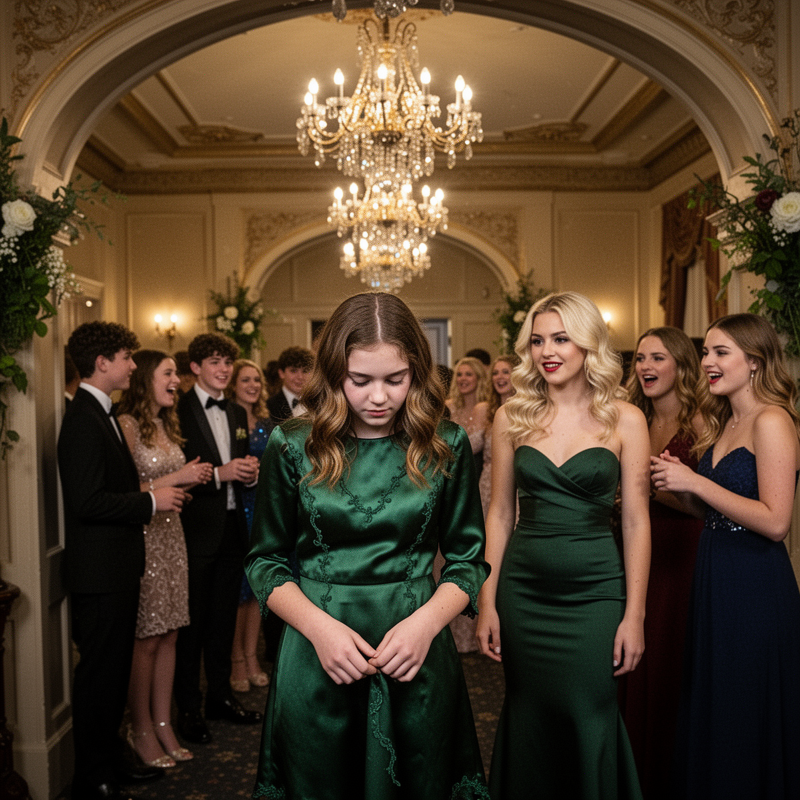
When I walked into the Geelong function center wearing his final masterpiece, my classmates openly laughed and called it a cheap homemade rag.
Before I could run out the back doors, the most popular boy in my year stepped through the crowd, took my hand, and walked me straight onto the dance floor.
He didn’t know that inside the dress lining, I was holding a secret that a total stranger had spent weeks trying to destroy.
The vibrant emerald silk shimmered under the chandeliers of the Geelong function center, catching every angle of light as I moved. Each stitch, I knew, was placed with Arthur’s careful hands. Each thread represented three weeks of his devoted work.
I could still feel the phantom weight of his hand on my shoulder, steadying me as he’d smoothed the fabric just five days before his death.
Tonight, the dress was meant to be my tribute, my way of carrying him with me.
Instead, it felt like a spotlight on my grief, highlighting every raw edge of my recent loss. The heavy, sweet scent of lilies and cheap perfume in the air was cloying, making my head spin.
The entrance hall buzzed with the excited chatter of my classmates. Girls in sparkling store-bought gowns clutched designer bags. Boys in sharp suits adjusted their ties. They looked like they’d stepped off the pages of a magazine.
I felt like an alien, a flicker of green in a sea of manufactured glitter.
A small cluster of girls near the decorative archway, their backs initially turned, slowly swivelled their heads. Bianca Wright, her blonde hair sculpted into perfect waves, was at the center of their group. She wore a strapless gown that hugged her curves, looking every bit the queen of the formal.
Her eyes, usually dismissive, locked onto me. A small, knowing smile played on her lips.
Then she whispered something to the girl next to her.
The girl giggled, covering her mouth with a manicured hand. Her gaze flickered over my dress, then back to Bianca.
Another whisper. Another suppressed laugh.
My stomach clenched. I felt the heat rising in my cheeks, a familiar flush of humiliation. I tried to focus on the soft, cool silk against my skin, grounding myself in Arthur’s legacy.
But their whispers grew louder, bolder.
“Is that… homemade?” Bianca’s voice, though hushed, carried across the polished floors. It wasn’t a question, but a pronouncement.
A ripple of snickers spread through the immediate vicinity. More heads turned.
My carefully constructed composure began to crack. Each laugh was a tiny shard of glass, digging into the wound of my recent grief.
“It looks like something from a dress-up box,” someone else chimed in, louder this time.
The murmurs swelled. “Did she sew it herself?” “It’s so… green.” “Bit cheap, isn’t it?”
My vision blurred, the sparkling lights of the hall melting into watery streaks. I felt a desperate, primal urge to disappear, to vanish into the shadows.
Just then, Mrs. Fiona Walsh, the formal committee organizer and a mother from our school, bustled towards me. Her usual air of flustered goodwill had been replaced by a tight, uncomfortable frown. She held a clipboard to her chest like a shield.
Her gaze avoided my eyes, fixing instead on the hem of my dress.
“Chloe, darling,” she began, her voice strained, a sickly sweet tone that did nothing to hide the tension in her jaw. “There seems to be a… a small issue.”
My heart pounded against my ribs. “An issue?”
She nodded, not quite looking at me. “Yes, dear. A technicality, really. We have a very strict dress code this year, you see. For… uniformity.”
Uniformity. The word hung in the air, absurd in a room full of individual expressions of style. The implication was clear: my dress, Arthur’s dress, was not uniform enough. It was an outsider.
“I’m so terribly sorry,” Mrs. Walsh continued, fiddling with the papers on her clipboard. “But I’m afraid, due to the… uniqueness of your attire, we might not be able to permit you entry tonight.”
Her words were a physical blow. The laughter of my classmates, which had momentarily quieted, seemed to crescendo in my ears. The world tilted.
Permit me entry. They were turning me away. Arthur’s final gift, his last act of love, was being rejected.
Tears, hot and undeniable, welled in my eyes. They spilled over, tracing warm paths down my cold cheeks. I squeezed my eyes shut, wishing the floor would swallow me whole. The urge to bolt, to escape through the nearest fire exit and never look back, was overwhelming.
My hand instinctively went to the inner lining of the dress, clutching the hidden secret there. It was a small, hard object, a reassurance that only I knew about.
But even that comfort couldn’t stem the tide of humiliation. I started to turn, my feet heavy, ready to make my desperate retreat.
Just then, a presence materialized beside me. A tall figure, solid and unyielding, stepped between me and Mrs. Walsh.
A hush fell over the crowd.
“There’s no technicality here,” a calm voice stated, deep and clear, cutting through the strained silence.
It was Liam Henderson. The captain of the footy team, the one everyone looked up to, the effortlessly popular boy who never seemed to say a wrong word. He stood next to me, his presence a sudden, unexpected wall against the world.
He turned to me, his eyes, usually full of an easygoing charm, now held a quiet, steady resolve.
He didn’t ask if I was okay. He didn’t make a big speech.
He simply reached out.
His fingers, surprisingly gentle, closed around mine. His grip was firm, a silent anchor in the swirling chaos.
Then, without another word, Liam Henderson took my hand and led me straight onto the dance floor.
Part 2
Liam’s hand was warm, steadying. He didn’t try to dance, just guided me to a quieter spot near the edge of the polished floor, a haven away from the judging eyes. The music, a thumping pop song, was suddenly background noise.
The initial shock of being led in, of not being rejected, slowly gave way to a wave of dizzying relief. I could still feel the whispers, the stares, but Liam was a shield.
My fingers, still clutching the fabric of the dress, traced the inner lining near my hip. It was there again. That strange, hard lump I’d felt earlier. But now, without the urgency of escaping Mrs. Walsh, my curiosity sharpened.
It wasn’t just a lump. It was a firm, flat rectangle, sewn tightly into the thick hem of the silk, much too deliberate to be a flaw.
Liam squeezed my hand gently. “You okay?” he asked, his voice low.
I nodded, not quite meeting his gaze. My mind was already elsewhere, fixated on the unexpected object. The dance floor felt too public, too exposed for whatever this was. I needed a moment, a quiet corner to myself.
“I just… I need a minute,” I mumbled, pulling my hand from his, feeling a sudden need for privacy. “I’ll be right back.”
He simply nodded, his eyes kind. “Take your time, Chloe.”
I turned, quickly navigating through the throng of dancers, seeking refuge in the nearest hallway. The corridor was blessedly empty, lined with potted plants and muted artwork, a stark contrast to the thrumming main hall.
Leaning against the cool plaster wall, I lifted the hem of the dress. My fingers carefully explored the thick inner lining, searching for the source of the rigidity. My grandfather was meticulous; if he’d sewn something in, it was for a reason.
Then I found it. A tiny, almost invisible seam, stitched expertly into the fold. It took a moment, but I managed to prise open the delicate stitching with my fingernail, revealing a small, hidden pocket.
Inside, nestled in the emerald silk, were two objects.
One was a small, rectangular SIM card, the kind used in old mobile phones. The other was a folded piece of paper, thin and brittle, with Arthur’s familiar, elegant handwriting scrawled across it.
My hands trembled as I carefully unfolded the note. The words blurred for a second, then sharpened into focus, each letter a punch to my gut.
*Chloe,* it read, *If you find this, things have gotten difficult. Do not trust anyone who asks about the emerald fabric. They are not what they seem.*
Chapter 2: The Unseen Hand
My hand still trembled as I pulled the old SIM card from the hidden pocket of the dress lining. The formal music was a dull throb beyond the closed hallway door.
Arthur’s scribbled note still felt warm from my touch. “Don’t trust anyone asking about the emerald fabric.”
I found my old burner phone in my small clutch, the one I used for gaming. The SIM card clicked into place.
The phone whirred, then the screen flickered to life. An archive of messages started populating.
Not from friends or family. These were messages from a name I didn’t recognise: “Marcus Crane.”
The first few were polite, even formal. He expressed interest in “acquiring” my grandfather’s emerald silk roll. He offered “a fair price.”
Then the tone shifted, turning colder, more demanding. My eyes scanned the dates. They stretched back weeks, right up until the day before Arthur died.
“I am prepared to offer you AUD $20,000 for the fabric,” one message read. “This is my final offer, Arthur. Do not delay.”
Another, more recent one, sent just two days before Arthur passed, made my stomach clench.
“If you refuse to cooperate, I will have no choice but to initiate public claims against your business, damaging your reputation.”
My grandfather, who had never hurt a fly, threatened by a stranger for a piece of fabric. The silence in the hallway felt suddenly deafening.
Arthur’s sudden heart attack had been five days ago. This man had been hounding him for weeks.
I looked down at the dress, the shimmering emerald silk. It wasn’t just a dress. It was a target.
Chapter 3: A Debt In The Dark
I found Mrs. Walsh in the side office, fussing with a stack of name tags. Her face was pale beneath her expertly applied makeup.
She looked up, her hands freezing on the tags. “Chloe. What can I do for you, dear?”
Her voice was tight, too strained.
“Mrs. Walsh,” I said, my voice steadier than I expected. “The man who pressured you to keep me out tonight. Marcus Crane.”
Her eyes darted to the closed office door. Her throat bobbed as she swallowed.
“I don’t know what you’re talking about, Chloe.” She tried to smile, but it looked like a grimace.
I held up my old phone, the screen still glowing with Marcus Crane’s messages. “He told you to stop me. Why?”
She wrung her hands. A single tear escaped the corner of her eye, tracing a path through her foundation.
“My husband,” she whispered, her voice barely audible. “He borrowed money. From Mr. Crane.”
A private loan. AUD $14,000. For her husband’s struggling business, I vaguely remembered hearing.
“Marcus Crane threatened to call it in,” she confessed, her voice cracking. “Immediately. If I didn’t… if I didn’t make sure you weren’t allowed inside with the dress.”
She wrung her hands again. “My family would be ruined, Chloe. We can’t afford that.”
The desperation in her eyes was real. She wasn’t just being mean. She was trapped.
Chapter 4: Poisoned Whispers
I left Mrs. Walsh, feeling a knot of cold understanding in my chest. Marcus Crane wasn’t just a collector; he was a manipulator.
The formal hall was loud with music again, but I needed a moment to process. I moved past the main dance floor, heading towards the less crowded area near the photo booth.
“Honestly, it was so easy,” a voice chirped.
It was Bianca Wright, my classmate, her back to me as she adjusted her hair in the reflective surface of the photo booth wall. She was talking to another girl.
“I just said, ‘Look at Chloe’s dress, it looks like something a grandmother made.’ And everyone laughed.”
My steps faltered. The girl with Bianca giggled.
“And you got paid for that?” the other girl asked, her voice hushed.
Bianca flicked her hair. “AUD $1,500 cash. Just to make her feel like a total dag.”
“The guy in the dark suit? He actually paid you?”
“Yep. Said he needed her ‘softened up’ or something,” Bianca said, completely oblivious to my presence behind her. “Weird, right? Just for a bit of a laugh.”
A laugh. My classmates’ scorn wasn’t just random cruelty. It was bought. Every snicker, every whispered comment, had been orchestrated by Marcus Crane.
Chapter 5: The Thread Of Truth
I retreated to a quiet bench near the entrance, away from the music and the whispers. My fingers flew across the burner phone’s screen, scrolling back through Marcus Crane’s messages.
I needed to understand what he wanted, why this particular silk. He insisted it was “stolen property,” an “old family heirloom.”
But Arthur had kept it locked away for thirty years. He wouldn’t have kept something stolen.
I scrolled past more threats, more offers, then hit pay dirt. Among the older messages, I found a small, pixelated image attached.
It was a photograph of a yellowed piece of paper. The corners were dog-eared, the ink faded, but still legible.
“Melbourne Textile Liquidators,” read the heading. The date below it was clear: “14th March, 1978.”
And then, in faded handwriting: “One (1) roll, 20 metres, finest emerald Italian silk. Purchased by Arthur Callaghan.”
My grandfather’s signature was scrawled at the bottom, firm and unmistakable.
A legitimate receipt. Proof. This wasn’t stolen. It was bought, fair and square, decades ago.
Marcus Crane was lying. The silk had never been his, or his family’s. It was Arthur’s, legally.
My stomach twisted. This changed everything.
Chapter 6: Shadow In The Corridor
The proof of Arthur’s ownership burned in my mind. I needed air, needed a moment away from the suffocating noise of the formal.
I pushed open a heavy fire exit door at the back of the auditorium, stepping into a short, empty corridor. It smelled faintly of cleaning solution and damp concrete.
The quiet was a relief. I leaned against the cool wall, trying to piece together this puzzle.
Suddenly, the fire exit door at the *other* end of the corridor swung inward. My breath caught.
Marcus Crane stepped into the hallway. He was wearing a dark, expensive suit, just as Bianca had described. His eyes, cold and sharp, immediately locked onto me.
He walked toward me, slowly, deliberately. The corridor felt impossibly small.
“Chloe, isn’t it?” His voice was low, almost a whisper, but it carried an undeniable edge.
He stopped a few feet away, effectively blocking my path to the exit. My heart began to pound, a frantic rhythm against my ribs.
“I believe you’re wearing something that belongs to me,” he said, his gaze fixed on the emerald silk of my dress. “It’s time to settle an old family account.”
Chapter 7: The Silent Standoff (Build-up)
Marcus Crane took another step, his presence dominating the narrow corridor. He was too close.
“Don’t worry,” he said, a condescending smile touching his lips. “I’m not interested in making a scene. Just the dress.”
He held out a hand, palm up. “Hand it over, and all claims against Arthur’s estate disappear. No public humiliation. No messy legal battles for you to deal with.”
He paused, letting his words hang in the air, a silent threat. He believed he had all the power.
My mind raced. He thought I was a scared teenager, easily intimidated. He thought I had nothing.
But I had Arthur’s note. I had his phone, buzzing with secrets.
I didn’t scream. I didn’t shout for help, even though the noise of the formal was a distant comfort.
My hand slid into my small clutch bag, my fingers closing around the old burner phone.
I pulled it out, bringing the screen up to eye level, bright with the recovered messages.
Marcus’s smile faltered, replaced by a flicker of confusion.
Chapter 8: Unspoken Defiance (Climax)
I didn’t utter a single word. I simply held the phone out, turning the screen slightly so Marcus Crane could clearly see the messages.
His eyes scanned the display. He saw his own name. He saw his own words.
I paused on the earliest messages, where he had demanded the silk. Then, I scrolled slowly, deliberately, to the digitised image of Arthur’s 1978 receipt.
His jaw tightened. He saw the date, the name, the proof. He saw that Arthur had legally bought the silk, completely disproving his “stolen property” claim.
Then, I scrolled further, to a more recent exchange. A message where Marcus, frustrated, had admitted in writing: “I acknowledge Arthur, the purchase in ’78 was legitimate. But the historical context remains. You *will* surrender the fabric.”
He had known. He had always known. But he had threatened Arthur anyway, threatened to ruin his reputation.
My finger moved, tapping the screen to bring up a share log. Without a sound, without a hint of panic in my eyes, I let him see the details.
“Sent to Arthur Callaghan Probate Attorney.”
“Sent to Crane Holdings, Senior Legal Counsel.”
“Sent to Marcus Crane, Private Business Associates.”
The colour drained from his face. His lips parted, but no sound came out. He stared at the screen, then at me.
His leverage was gone. Neutralised. No public scene, no screaming, just the quiet, undeniable truth.
He stood there for a long moment, frozen. Then, without a word, he turned on his heel and walked out the fire exit door, leaving me alone in the silent corridor.
Chapter 9: The Residual Quiet
I smoothed the emerald silk of my dress, feeling a strange mix of exhaustion and quiet victory. The corridor remained empty.
Marcus Crane was gone.
I pushed open the heavy door and stepped back into the main ballroom. The music swelled, laughter drifted from tables, and the colourful lights still pulsed across the dance floor.
Everything looked the same. But it wasn’t.
Mrs. Walsh was standing by the entrance, greeting late arrivals. Her eyes flickered to me, then quickly away, avoiding my gaze. She offered no more technicalities, no more challenges.
Bianca Wright was huddled in a corner with a few other girls, sipping a soft drink. She looked up, saw me, and quickly turned her back, her face flushed with embarrassment. Her whispers had dried up.
Then, Liam Henderson, the one who had led me onto the dance floor earlier, walked over. He carried two glasses of water.
He handed one to me.
“You okay?” he asked, his voice low, respectful.
I nodded, taking a sip of the cool water. The room hummed around us, but the earlier tension that had surrounded me felt gone, replaced by an awkward, subdued silence from those who had witnessed or participated in the initial cruelty.
The show hadn’t stopped. But the play had changed. I sat calmly, bathed in the soft glow of the formal lights, wearing Arthur’s final masterpiece.
Chapter 10: The Unanswered Stitch
Nine days later, the Geelong formal was a distant memory. I sat in the plain, unadorned kitchen behind Arthur’s old tailoring shop. The scent of aged fabric and faint lavender still lingered from the workshop next door.
The shop was quiet now, save for the gentle hum of the old fridge. I was having tea for my lunch break, sorting through Arthur’s mail.
Among the bills and flyers, a plain white envelope appeared. It had no return address, just my name handwritten in neat, unfamiliar script.
I tore it open. Inside, there was no letter, no message.
Only Arthur’s original brass tailor’s chalk. It was worn smooth from years of use, the brass dulled but still warm in my palm. He’d lost it years ago, or so I’d thought.
I traced the edges of the chalk. Marcus Crane had vanished, his threats crumbling to dust. Arthur’s memory was protected. But the full, intricate history between my grandfather and that man, the true origin of Marcus’s obsession with the emerald silk—that remained a secret.
It was a thread that would forever be buried in the past.
Some threads are meant to hold a garment together, and some are meant to hold a life together. My grandfather made sure mine would never tear.
Leave a Reply