CHAPTER 1: Scalded in the Scullery.
Part 1
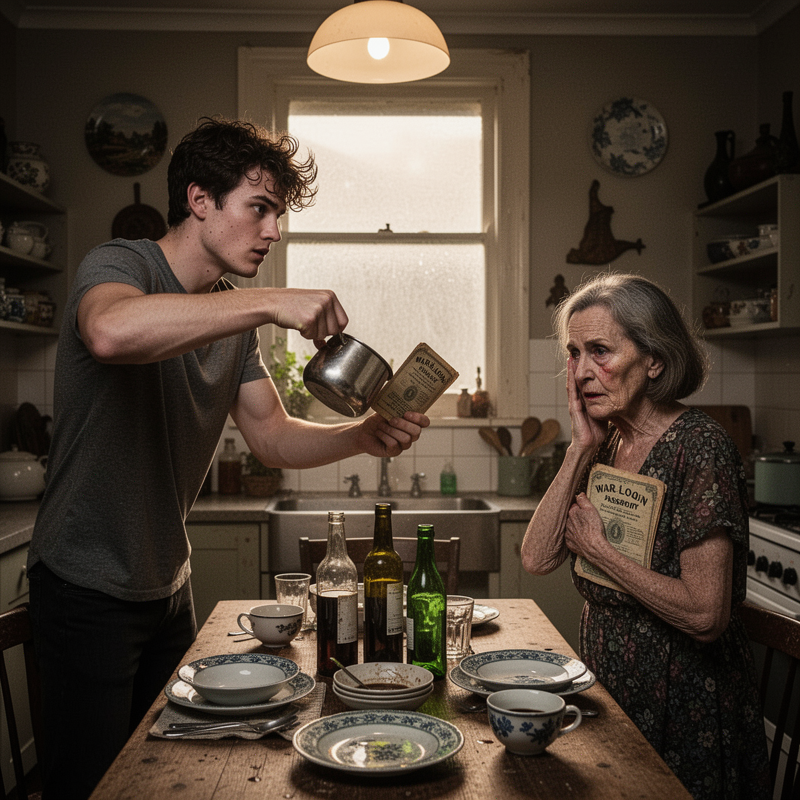
“Give me your dead father’s bank ledger now, Mother, or you won’t survive this winter,” my twenty-four-year-old son Julian barked across the kitchen table.
When I refused to surrender the war-loan passbook, he hurled a pot of scalding chicory coffee straight into my face.
As severe burns bubbled across my cheek and neck, Julian ran into the street screaming that I had suffered a hysterical breakdown and scalded myself.
He locked me inside our Paddington terrace home while he went to claim total legal authority over my late husband’s estate.
I knew I had only hours to escape through the scullery window before he had me committed to an asylum.
The searing heat had been instantaneous, a shocking liquid fire that painted my vision red. My hands flew to my face, but the damage was already done. The metallic scent of chicory coffee, dark and bitter, filled my nostrils.
A gasp tore from my throat, raw and involuntary. It was a sound I barely recognized as my own.
A thick stream of coffee, still smoking, ran down my dress, soaking the front of the worn fabric. It clung to the thin cotton like a hot, hateful second skin.
Beneath my hands, my skin felt taut and bubbling. A raw, blistering pain seized my left cheek and the side of my neck, making my head throb.
My fingers, however, still clutched the precious war-loan passbook. The thick paper of the ledger was now stained a deep, muddy brown, soft and pulp-like from the scalding liquid.
Julian stood frozen for a split second, his eyes wide and wild. He stared not at my agony, but at the ruined ledger clutched to my chest.
A flicker of something dark, a cold satisfaction, crossed his face. It was gone as quickly as it came, replaced by a theatrical terror.
“Mother! What have you done?” he shrieked. His voice was laced with a false horror, loud enough to carry through the open kitchen window to the neighbours.
He pointed a trembling finger at me.
“You’ve gone mad with grief, Mother! You’ve scalded yourself!”
He wrenched the back door open, the old timber groaning on its hinges. He burst out into the narrow lane behind our terrace, his voice rising to a frantic pitch.
“Help! My mother! She’s hysterical! She’s burnt herself!”
A terrible clarity cut through the haze of pain. It wasn’t just a fit of rage. He had aimed the coffee. Not just at me, but at the passbook, tucked deliberately against my chest for safekeeping. He had wanted to destroy the evidence.
My son, Julian, had tried to erase my husband Edward’s legacy along with my face.
The back door slammed shut with a sickening thud. The distinct click of the heavy brass bolt sliding home echoed through the sudden silence of the house. I was locked in.
A wave of nausea washed over me. I pressed my back against the cool plaster of the scullery wall, my legs threatening to give way. The pain was excruciating, a constant, fiery throb.
But the fear was worse.
Julian’s words, screamed to the street, replayed in my mind: “She’s hysterical! She’s burnt herself!” He was painting me as delusional, as a danger to myself. The path to an asylum, to Callan Park, was terrifyingly clear.
I had only hours before he returned, probably with someone from the magistrate’s court, to declare me mentally unfit. Edward’s entire estate, the £3,400 meant for war orphans, would be in his ruthless hands.
My gaze fell on the scullery window. It was small, dusty, rarely opened. It overlooked the narrow, overgrown service lane between our home and Mrs. Henderson’s.
It was my only way out.
My hands trembled as I fumbled with the rusted latch, the pain radiating from my face, making my fingers clumsy. The window groaned, stiff from years of disuse, resisting my efforts.
Rain, an unexpected downpour, lashed against the glass, blurring the world outside into a grey smear. Each drop seemed to mock my desperation.
I pushed harder, gritting my teeth against a cry. The latch finally gave way with a screech of tortured metal.
The frame was old, wooden, swollen with damp. I had to force it upwards, using my shoulder, the raw skin on my neck burning with every flex.
It was a tight squeeze. I was a small woman, but the opening seemed impossibly narrow. I had to turn sideways, pushing with my good shoulder first.
A shard of glass, loosened by the struggle, tinkled onto the paving stones outside. I froze, listening. Only the drumming rain answered.
I hauled myself through, scraping my hip on the sill, the cold rain a shocking balm against my inflamed skin. My feet landed awkwardly in a puddle, my worn shoes instantly soaking through.
The air was thick with the scent of wet earth and winter rain. The cold stung my burns, but it also numbed them, a strange, unwelcome relief.
I stumbled out into the narrow laneway, pulling the window shut behind me with a final, desperate heave. I didn’t dare look back at the house, at the place that had been my home, now a prison.
My head pounded. Each breath was shallow, tasting of fear and the lingering bitterness of chicory. The rain plastered my hair to my face, mixing with tears that were already streaming down my cheeks.
I moved with a sudden, desperate urgency. Concord Repatriation Hospital was miles away, but it was my only sanctuary. Dr. Patrick Callaghan, Edward’s army friend, would be there. He would help me.
My legs ached with every step, the cold seeping into my bones. The rain hammered down, turning the unpaved back lanes of Paddington into muddy streams.
I clutched the ruined passbook tighter, pressing it against the throbbing pain in my chest. Each hurried step was a silent prayer, a desperate plea for justice.
The world blurred around me – the dark silhouettes of terrace houses, the distant rumble of a wartime lorry, the faint, wailing sound of an air raid siren in the distance.
I pushed forward, the pain in my face a constant, searing reminder of Julian’s betrayal, of the fight I now faced alone. I had to reach the hospital. I had to expose him.
But first, I simply had to survive the journey through the cold, relentless rain. My vision swam, each streetlamp a hazy halo through the downpour.
I knew Julian would act fast. He would already be at the magistrate’s office, twisting the truth, poisoning my name.
My only hope lay in reaching Dr. Callaghan before it was too late. I just had to keep walking, one agonizing step after another.
The rain was relentless, washing over my scalded skin, each drop a tiny, sharp needle. I kept my head down, my breath coming in ragged gasps, as I limped through the darkened, rain-slicked streets of Paddington, a war widow fleeing her own son.
Part 2
The hospital came into view, a vast, imposing structure through the relentless rain. My legs were screaming, my lungs burning, but the sight of its entrance gave me a final surge of adrenaline. I stumbled through the automatic doors, the sudden warmth a shock after the cold.
A nurse, her face kind but weary, saw me sway. “Goodness, dear, what happened?”
I tried to speak, but only a choked sob escaped. My hand went to my face, then to the sodden passbook clutched to my chest.
Within minutes, I was on a stretcher, being wheeled down a long corridor. The pain in my face was a raw, insistent throb. My vision blurred again, but this time from exhaustion, not just tears.
Then, a familiar face hovered over me. Dr. Patrick Callaghan. Edward’s friend. Relief, so potent it made me dizzy, washed through me.
“Clara? My God, what has Julian done?” His voice was a low, angry murmur.
He gently examined my face, his touch careful, professional. I flinched, but his grip was steady. He dabbed away the clinging chicory residue. His brow furrowed as he leaned closer, his eyes sharp.
“This isn’t an accident, Clara,” he said, his voice flat. He looked at the pattern of the burns, the way the scalding liquid had spread. “It’s… deliberate.”
I nodded, unable to speak, the truth a bitter taste in my mouth.
“He tried to get the ledger,” I finally managed, my voice raspy. I pushed the ruined passbook into his hand. “He threw the coffee at me. To destroy it.”
Patrick opened the soggy book to the page I indicated. His eyes scanned the entries, then stopped. A sharp intake of breath. “£450 gone? From Edward’s trust?”
My pain was momentarily forgotten, replaced by a desperate urgency. “He took it. For himself. He wants the whole estate.”
Patrick’s face was grim, a muscle twitching in his jaw. He looked from the ledger to my burned face, then back again. His grip tightened on the passbook.
“Clara,” he said, his voice dropping, “there’s something you need to know.”
My heart pounded. I braced myself.
“Julian was at the magistrate’s court this morning. He’s filed an emergency petition.”
My breath hitched.
“He’s declared you mentally incompetent. He’s trying to have you committed.”
Chapter 2: The Magistrate’s Petition
Dr. Callaghan led me down the polished hospital corridor, the antiseptic smell a stark contrast to the burning ache in my cheek. We reached his private study, a small room filled with medical journals and the faint scent of pipe tobacco.
He gestured to a worn leather chair.
“Clara,” he said, his voice quiet, “there’s something you need to see.”
He slid a document across his desk. My eyes struggled to focus through the pain, but the words swam into view: “Emergency Petition for Mental Incompetence.”
My son Julian’s name was etched below it.
The paper claimed my overwhelming grief for Edward, killed at El Alamein, had driven me to a hysterical breakdown. It detailed how I had “self-mutilated” with scalding chicory coffee.
My hands trembled as I gripped the armrests. He was twisting everything.
“He’s moved quickly,” Dr. Callaghan observed, watching me carefully. “This was served to the magistrate’s court this morning.”
The door creaked open. Sister Evelyn stood there, still in her crisp army nurse uniform, her face pale. She carried a tray with a cup of tea.
Her eyes fell on the document on the desk.
“Mother, what is this?” she whispered, her voice cracking.
She rushed to my side, her gaze flicking between my bandaged face and the petition. “He told me you had an accident. That you were unwell.”
I shook my head slowly, the movement sending fresh stabs of pain.
“Julian is trying to have me committed, Evelyn,” I managed to say. “He wants to control everything.”
Evelyn stared at the paper, then at her brother’s name. A tremor ran through her.
“He’s using Father’s death against you,” she said, a raw edge to her voice. “He’s weaponizing it.”
Chapter 3: The Lockbox and the Forgery
Evelyn slipped back into the Paddington house later that afternoon, under the guise of collecting some of my clothes and personal effects. The front door groaned shut behind her, echoing in the sudden quiet. Julian was out, she’d confirmed.
A knot tightened in her stomach. It felt wrong, sneaking around in her own home.
She walked straight to Julian’s small study, its door slightly ajar. His desk was usually a mess of papers and half-finished crosswords. Today, it was neater than usual, a thin layer of dust on the mahogany.
Her fingers brushed against a stack of official-looking envelopes tucked beneath a heavy brass letter opener. She pulled them out, her heart thudding.
Most were routine correspondence. But near the bottom, a folded sheet caught her eye. It was cream-coloured, official-looking, stamped with the distinctive AIF officer’s insignia.
Her breath hitched. The stamp was identical to the one their father, Captain Edward Higgins, used for his military documents.
She unfolded the paper. It was a letter, addressed to the Bank of New South Wales, authorizing access to a “secured personal deposit box.” The signature at the bottom was a careful, almost perfect, imitation of Edward’s hand.
Julian had forged their father’s official military authorization code.
He had been using this fake document to access the bank’s private deposit vaults in Martin Place, a place reserved for high-value military assets or personal trusts. Her brother wasn’t just stealing; he was committing fraud of the worst kind, dishonouring their father’s name.
She quickly refolded the letter, her hands clammy, and tucked it back into the pile. She had to tell Mother and Dr. Callaghan.
Chapter 4: Martin Place Transactions
The Bank of New South Wales in Martin Place felt like a mausoleum of quiet wealth and hushed transactions. I sat beside Dr. Callaghan in a small, well-appointed private office, the leather chairs smelling faintly of beeswax.
Arthur Bennett, the bank manager, sat stiffly behind his desk. He was a man of precise movements, his spectacles perched on his nose.
“Mrs. Higgins,” he began, clearing his throat, “this is an… unusual situation.”
He opened a ledger. “Your late husband, Captain Edward Higgins, established a trust. The ‘Widow Relief Fund,’ he called it.”
A lump formed in my throat. Edward, always thinking of others.
“Yesterday afternoon,” Bennett continued, “your son, Mr. Julian Higgins, presented documentation requesting a substantial withdrawal.”
My hands clenched in my lap. “How much?”
Bennett hesitated, adjusting his glasses. “He attempted to liquidate… two thousand, nine hundred and fifty pounds (£2,950).”
My blood ran cold. Nearly the entire remaining estate.
“Did he succeed?” Dr. Callaghan asked, his voice sharp.
“Fortunately, no,” Bennett replied, exhaling slowly. “The trust deed explicitly requires your physical signature for any sum exceeding fifty pounds. Mr. Julian Higgins assured me he would provide it ‘once his mother rested.’”
He peered over his spectacles at me. “He implied you were unwell, recuperating after a… domestic incident.”
A sudden wave of nausea washed over me. Julian’s plan was clear: declare me unfit, then empty the trust entirely.
“He wanted to transfer the funds to a foreign merchant shipping account,” Bennett added quietly. “A very unusual destination for a widow’s relief fund.”
The air in the room grew heavy with the weight of Julian’s deception. He wasn’t just taking money; he was trying to disappear with it.
Chapter 5: The Attic Trunk
Dr. Callaghan drove me back to the Paddington house. Julian, we knew, was away at the docks, a fact confirmed by Evelyn. The thought of re-entering the house where he’d hurt me made my stomach churn.
The key felt heavy in my hand.
Inside, the house was silent and still, dust motes dancing in the afternoon light. It felt both familiar and menacing.
“The attic,” I said, my voice barely a whisper. “Edward’s trunk is up there.”
We climbed the narrow, creaking stairs. The attic was dim, smelling of camphor and old wood. Beneath the sloping eaves sat Edward’s heavy, iron-bound military trunk, a sturdy relic of his service.
I knelt, fumbling with the brass clasp. It took a moment, but the lock finally yielded with a rusty click.
Inside, nestled beneath his perfectly folded dress uniform, were layers of old letters and photographs. But then, my fingers brushed against something stiff, not fabric.
I pulled out a thick stack of small, brightly coloured booklets. Not ration books, not exactly. These were… different. They looked like ration tickets, but the printing was subtly off, the paper just a fraction too thin.
Hundreds of them. Fuel rations. Sugar. Butter.
My breath caught in my throat. Counterfeit.
Julian wasn’t simply paying off gambling debts as I’d suspected. He was deeply involved in supplying Sydney’s black-market petrol ring. Edward’s uniform, carefully preserved, now concealed his son’s crime.
The £450 from the ledger, the funds he’d tried to access from the bank—it all made a terrible, sickening sense. He was selling them. He was a black marketeer.
Chapter 6: Constables at the Door
The sound of a key turning in the lock downstairs jolted me and Dr. Callaghan. We froze, huddled in the attic. Footsteps echoed below, then voices. Julian had returned.
Quickly, I shoved the fake ration books back under the uniform. We crept to the attic door, listening.
“She’s clearly unwell, Constable,” Julian’s voice, smooth and concerned, floated up the stairwell. “Distraught by Father’s death. She’s broken into her own home.”
My blood ran cold. He had brought the constables.
We heard Grandmother Martha’s agitated voice. “Julian, please, your mother has been through enough.”
“She’s trespassing on estate property, Grandmother,” Julian insisted, his tone hardening. “And I believe she’s stolen important military documents from my father’s study. Discharge papers, crucial for my own administrative process.”
Dr. Callaghan exchanged a quick, grim look with me.
We descended the stairs to find Julian, looking impeccably dressed, standing with his arm around a tearful Grandmother Martha. Two civil constables, their uniforms starched and severe, stood by the entrance.
Julian’s eyes widened when he saw me. “There she is! My poor mother. Her mind has completely unspooled since the casualty telegram arrived.” He squeezed Martha’s shoulder, whispering loudly, “She’s become quite delusional, hasn’t she, Grandmother?”
Martha looked at me, her eyes clouded with concern and confusion. She still loved Julian, wanted to believe the best.
“Mrs. Higgins,” one of the constables said, stepping forward. “Are you aware you are on private property?”
Dr. Callaghan immediately stepped between me and the constables. He looked them squarely in the eye. “Gentlemen, Mrs. Higgins is my patient. She is not trespassing. This is her home, and she is under my medical care.”
He risked everything, putting his own reputation on the line, to halt Julian’s cruel eviction.
Chapter 7: The Hospital Shipping Logs
The confrontation with the constables left a bitter taste. Julian had nearly succeeded. Dr. Callaghan’s quick thinking saved me, but the threat of institutionalization still loomed.
Dr. Callaghan couldn’t shake Julian’s mention of “discharge papers.” It struck him as odd, considering Julian’s story of combat fatigue.
The next morning, driven by a growing suspicion, Dr. Callaghan used his military rank. He pulled strings, circumvented protocol, and gained access to confidential administrative files at Victoria Barracks.
The air in the records office was thick with the smell of old paper and stale coffee. He worked methodically, cross-referencing Julian Higgins’s name against the Ordnance Corps’ official discharge papers.
He expected to find a medical discharge, perhaps with a notation about “battle-induced neurosis.” That’s what Julian had told his mother and grandmother.
But the ledger pages told a different story.
Julian Higgins. Date of entry. Date of departure. And in the ‘Reason for Discharge’ column, a chilling code: ‘D.D.’
Dr. Callaghan’s gaze lingered on the two letters. Dishonourable Discharge.
Below it, a brief, stark note: “Court-martialled for grand theft of military supplies from the Quartermaster Corps.”
Julian had never been discharged due to combat fatigue. He wasn’t a war hero suffering from the horrors of the front. He had been quietly drummed out for common theft.
The lie was immense, a betrayal not just of his family, but of every soldier serving overseas. This changed everything.
Chapter 8: The Contract on the Terrace
A few days later, while Dr. Callaghan was arranging for an official inquiry into Julian’s military record, Evelyn returned to the house. She was meant to pick up more of Mother’s personal items, but her true purpose was surveillance.
She moved quietly through the hallway, making her way towards the kitchen. A low murmur of voices drifted from the telephone nook. Julian was on the line.
Her steps slowed. She could make out snippets of his conversation.
“Eighteen hundred pounds, cash,” Julian was saying, his voice hushed and urgent. “Immediate settlement. The house is mine, legally. My mother is… incapacitated.”
Evelyn’s breath caught. She pressed herself against the wall, listening intently.
“Yes, Mr. Davies,” Julian continued. “A swift exchange. Old Mrs. Higgins can be comfortably housed in Callan Park, of course. My grandmother… well, a small aged care facility in Campsie would be suitable.”
Evelyn’s heart pounded against her ribs. He wasn’t just trying to get the trust money. He was selling their home.
He was arranging the immediate sale of the family’s Paddington terrace house for £1,800 cash. His plan was to keep Grandmother Martha in an aged care facility and have Mother institutionalized at Callan Park, a place known for its long-term mental health commitments.
Her brother was planning to strip them of their home, their dignity, and their freedom. He intended to walk away with everything, leaving them with nothing.
Evelyn quietly retreated, her mind reeling. The phone clicked as Julian hung up. She had to tell Dr. Callaghan. And Mother. Now.
Chapter 9: The Gathering in the Parlor
The parlor in the Paddington house was arranged with an unusual formality. The heavy velvet curtains were drawn, casting the room in a dim, serious light. A scent of old roses from a vase on the mantelpiece mixed with the nervous tension in the air.
Dr. Callaghan and Evelyn had worked quickly, quietly. They had coordinated with Grandmother Martha, who, though still heartbroken, was beginning to see the cracks in Julian’s story.
Arthur Bennett, the bank manager, sat stiffly on one of the settees, clutching his briefcase. Father O’Donnell, our parish priest, sat opposite him, his hands clasped, a look of somber concern on his face.
I sat beside Martha, my bandaged face partially hidden by a silk scarf Evelyn had given me. My heart hammered, a frantic drum against my ribs.
Julian strode in, radiating a deceptive confidence. He wore his best suit, a smirk playing on his lips. He glanced around the room, a flicker of triumph in his eyes.
“Ah, the family council,” he said, taking the armchair by the fireplace. He nodded to Bennett and Father O’Donnell. “All here to sign the final estate papers, I presume?”
He believed he was about to receive full legal authority over his father’s trust, ready to liquidate everything. He was completely unaware of the true contents of the leather-bound ledger lying open on the center table.
He smoothed his tie, a picture of self-satisfaction. The air crackled with unspoken truths, ready to ignite.
Chapter 10: The Unspoken Reckoning
Dr. Callaghan stood before the gathered family, his face grave. He held the Bank of New South Wales ledger, its pages crisp. The silence in the parlor was suffocating.
“Julian,” he began, his voice clear and resonant, “this ledger details Captain Higgins’s trust. And your transactions.”
Julian shifted, a nervous tremor in his composure. “My transactions were for the good of the estate, Doctor.”
“Indeed?” Dr. Callaghan opened the ledger to a specific page. “On July 14th, a withdrawal of four hundred and fifty pounds. Signed with a forged AIF stamp.”
Arthur Bennett nodded slowly from his seat, his gaze fixed on Julian.
“This sum,” Callaghan continued, “was routed to a known black-market syndicate operating out of the Sydney docks. The same syndicate involved in the theft of military kits, including Edward’s, en route from North Africa.”
Julian’s face went white. He opened his mouth, but no sound came out.
“Furthermore,” Callaghan pressed on, “your claims of a medical discharge are false.” He produced a document, its official stamp stark against the paper. “This is from Victoria Barracks. It confirms a dishonorable discharge. For grand theft from the Quartermaster Corps.”
A gasp escaped Martha’s lips. Her eyes, filled with dawning horror, fixed on her grandson.
Finally, Dr. Callaghan laid a series of photographs onto the table. Close-ups of my scalded face, taken at Concord Hospital. “My forensic report,” he said, his voice hard, “shows the deliberate angle of the coffee scalds. The spatter pattern is inconsistent with self-inflicted injury. It is consistent with a purposeful, downward throw.”
Julian froze. His eyes darted from the photos to Martha, then to me. His grandmother, her face etched with utter revulsion, turned her head away.
The silence that followed was deafening, broken only by Martha’s soft, heartbroken sob. Julian was exposed, stripped bare of his lies.
Chapter 11: The Docks at Midnight
The military police arrived shortly after. They stood at the parlor entrance, their uniforms a stark reminder of Julian’s crimes. The room felt cold, hollow.
Stripped of his authority, his lies exposed, Julian stared at the floor. His grandmother wouldn’t even look at him.
“You’ve ruined everything, Mother!” he snarled, his voice cracking with a mixture of rage and fear. “All of it!”
He grabbed his coat from the hall stand, his movements jerky and panicked. He didn’t look back, didn’t offer a single word of apology or regret. He just fled.
We heard the front door slam shut, echoing through the silent house. Julian ran into the dark Sydney streets, swallowed by the wartime night.
Six months later, the telegram arrived. A thin, official envelope from the Department of the Navy. It came on a Tuesday, a grey, drizzly morning.
It stated that the merchant supply vessel, the SS *Kookaburra*, had been struck by a Japanese submarine torpedo in the Coral Sea. No survivors.
Julian was gone. He had died isolated, unrepentant, swallowed by the vast, indifferent ocean.
The news hit me with a strange, numb emptiness. No closure, no chance for forgiveness, no final word. Just a cold, unhealable void where my son used to be.
The war had taken Edward. Now, Julian’s own darkness had taken him, leaving me with only the phantom pain of a lost child.
Chapter 12: Rain on the Scullery Wall
Thirty-one years later, in October 1974, the old Paddington terrace house stood quiet, preserved in time, weathering the passing decades. Rain slicked the cobblestone path, glistening on the overgrown jasmine vines.
Clara-Rose, my granddaughter, now twenty-eight, stood in the overgrown garden. She traced a finger along the aged scullery window frame, the wood softened by years of rain and sun. This was the window. The one Grandmother Clara had escaped through.
The garden felt mournful, damp, yet strangely peaceful.
She held my worn leather-bound diary in her hands, its pages brittle with age. My final entry, penned years ago, was open.
Clara-Rose read it aloud, her voice soft against the steady drum of rain.
“The burns on my face faded to grey parchment over thirty years,” she read, her finger following the familiar script, “but the cold void where my son used to be never warmed again.”
She closed the diary, holding it to her chest. The house, the garden, the scars – physical and emotional – were all remnants of a story she now understood. A story of war, betrayal, and the deep, permanent marks left behind.
Leave a Reply