CHAPTER 1: The Cost of Nine Years
Part 1
For nine years, I paid $4,500 every month toward my boyfriend Julian’s luxury apartment in Vaucluse while he built his reputation as Sydney’s next star classical composer.
When I asked him to put away his own dry cleaning on a Tuesday evening, he stared at me with cold contempt and said, “You’re just my girlfriend, Chloe. You’re not my wife, so stop expecting me to act like your husband.”
The next morning, I packed nine years of my life into two suitcases and revoked my financial guarantee on his $350,000 opera premiere lease.
When Julian returned home that evening, he stood frozen at the bare threshold of an empty apartment, unable to comprehend that everything inside—down to the grand piano—was rented under my name.
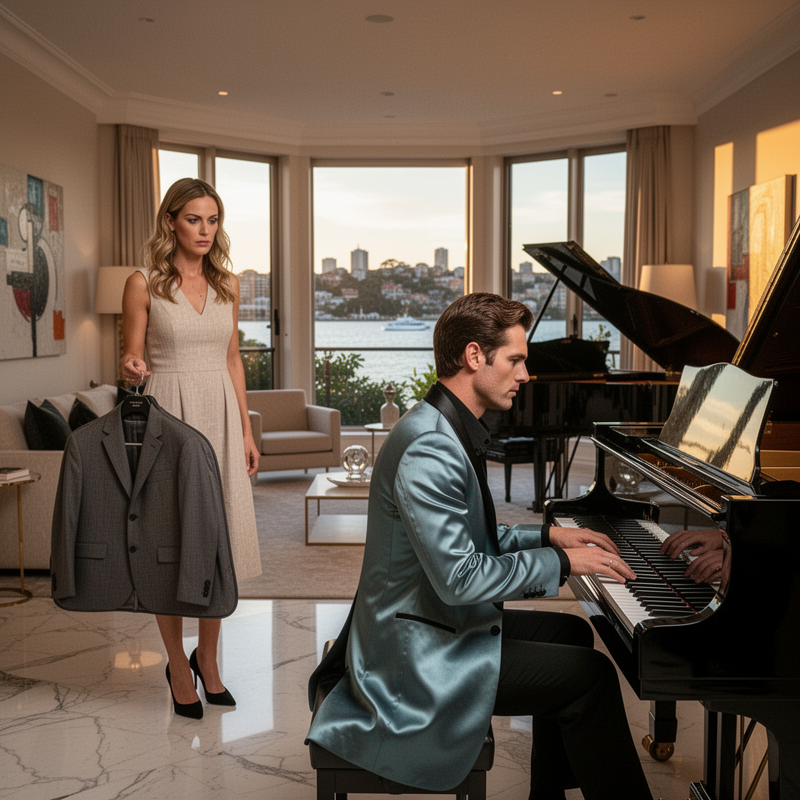
The humid Sydney air hung heavy and still, trapping the scent of expensive dry-cleaning solution in the air. Chloe Carmichael stood by the entrance of their Vaucluse apartment, a neatly pressed suit bag hanging from her outstretched hand. Its delicate silk lining, still crisp from the cleaners, grazed the polished Italian marble floor.
Julian Montgomery, draped in a silk smoking jacket, sat at the custom Steinway grand piano, his fingers hovering over the keys. The afternoon light, filtered through the immense bay windows overlooking Sydney Harbour, cast a golden glow across his perfect profile.
He was lost in thought, or at least, that was how he presented it.
“Julian?” Chloe’s voice was soft, barely a whisper against the gentle lapping of waves from the harbour below.
He didn’t acknowledge her. His gaze remained fixed on the middle C, as if the answer to some profound musical mystery lay embedded in its ivory.
She took a small step closer, the suit bag still extended. “Could you just take these in? The cleaner dropped them off while you were composing.”
It was a simple request. A small, domestic task in a home Chloe paid almost entirely for, month after month.
Julian’s fingers dropped from the keys with a dramatic flourish. The silence that followed was heavy, thick with unspoken judgment. He turned slowly on the velvet piano stool, his eyes, usually so expressive and full of a composer’s passion, now flat and devoid of warmth.
His gaze swept over her, from her sensible linen dress to the offending dry-cleaning bag.
“Are you quite finished?” he asked, his voice smooth, laced with a familiar patronizing tone she had learned to dread.
Chloe swallowed, her hand lowering slightly. She felt the usual prickle of shame, the unspoken accusation that she was interrupting his genius.
“It’s just… they’re yours. I thought you might want them put away.”
A slow, deliberate smile spread across Julian’s face, not one of amusement, but of cutting condescension. He leaned back against the piano, crossing his arms.
“You’re just my girlfriend, Chloe. You’re not my wife, so stop expecting me to act like your husband.”
The words, though she’d heard variations of them countless times over their nine years together, still struck her with the force of a physical blow. The simple request, the very fabric of their shared life, had been twisted into an expectation he found beneath him.
He turned back to the piano, dismissing her with the sweep of his hand.
“Now, if you don’t mind, I was rather in the middle of a rather crucial passage for the gala. You can see yourself out, can’t you?”
Chloe stood there for a long moment, the suit bag forgotten, a cold knot tightening in her stomach. Her world, which had been gently swaying for so long on the currents of his artistic temperament, suddenly snapped into stark, unyielding focus.
She didn’t reply. She simply turned and walked away, the scent of the dry cleaning fading behind her.
The next morning, before the first golden rays of sunrise had even begun to touch the Opera House sails across the harbour, Chloe was already moving. Julian was long gone, off to his early rehearsal for the Sydney Philharmonic, completely unaware of the precise, methodical plan now unfolding in the apartment he considered his own.
She moved through the opulent rooms not with anger, but with a quiet, almost surgical efficiency. The two suitcases, packed the night before, sat by the door. Nine years of her life, compressed into a manageable, movable form.
Her first call was to her solicitor, the one who handled the intricate financial agreements for Julian’s various artistic endeavors. The conversation was brief, professional.
“I need to revoke the financial guarantee on the Opera House gala booking, effective immediately,” Chloe stated, her voice steady.
A moment of silence on the line, then a sigh. “Ms. Carmichael, that’s a $350,000 bond. Are you absolutely certain?”
“Absolutely,” she affirmed, her gaze sweeping across the living room, taking in the designer furniture, the custom pieces. All leased under her private credit facility, not Julian’s, a detail he had conveniently forgotten.
She confirmed the necessary paperwork would be couriered to her, to be signed and submitted before midday. The gears of a formal financial withdrawal, slow but unstoppable, had begun to turn.
Next, a team of professional removalists arrived, quiet and efficient. They wore dark uniforms, their movements practiced as they systematically began to dismantle and remove the furniture. The antique Persian rugs rolled up, the bespoke chaise lounge carefully wrapped, the Italian marble coffee table lifted onto a dolly. Each item was cataloged, signed out under Chloe’s name.
The grand piano was the last to go. It required a specialized crew, meticulously careful as they maneuvered the massive, polished instrument out of the apartment. Its absence left a gaping, echoing silence in the living room, a literal void where Julian’s perceived genius had always resided.
By the time the last truck pulled away from the kerb in Vaucluse, leaving behind nothing but dust motes dancing in the morning sun, the apartment was a hollow shell. No art, no furniture, no sense of home. Just empty walls and the ghosts of nine years of unappreciated sacrifice.
Chloe stood at the bare threshold, the silence profound. She had packed her own life into two suitcases, but she had stripped Julian’s entire high-society existence down to nothing.
Part 2
Julian Montgomery arrived home to the Vaucluse apartment a few hours later, the twilight painting the harbour in shades of bruised purple and orange. He expected the usual quiet luxury, perhaps a glass of chilled champagne waiting, or Chloe in the kitchen preparing dinner. He fumbled with his keys, a faint smile playing on his lips from a successful rehearsal.
The door swung inward, revealing an unfamiliar coldness. The scent of ozone, not expensive air freshener, filled the air. His smile vanished.
He stepped inside, his designer loafers clicking on the bare marble floor. His eyes darted to where the bespoke Italian sofa usually sat, then to the antique Persian rug. Empty. A gaping, echoing void.
Panic, cold and sharp, seized him. His breath hitched as his gaze locked onto the most glaring absence: the space where his custom Steinway grand piano, the supposed centrepiece of his artistic sanctuary, had always stood. It was gone. Not even a mark on the polished floor remained.
His phone buzzed in his pocket, a jarring intrusion into the growing horror. It was his manager, his voice tinny with a barely concealed panic.
“Julian? Julian, what’s happened? The Opera House just called. They’ve revoked the venue lease for the gala. They said your financial guarantee… Chloe’s guarantee… it’s been withdrawn.”
Julian stared at the phone, the words barely registering through the haze of disbelief. “Withdrawn? What are you talking about? It’s all arranged!”
He was shouting now, the empty rooms amplifying his fury. “She can’t do that! The piano… where is my piano?!”
As if on cue, a formal-looking envelope lay on the single, untouched marble console in the entranceway. Julian ripped it open with trembling hands. It was from Chloe’s solicitor, a brief, coldly worded document stating that all financial support, present and future, was permanently terminated.
The paper crumpled in his fist. Chloe. His quiet, overlooked Chloe. She hadn’t just left. She had stripped him bare. The rage that simmered beneath his composure finally boiled over. His entire career, his reputation, his entry into Sydney’s old-money elite, all hinged on that gala.
He gripped his phone, his knuckles white. “She thinks she can ruin me?” he snarled, staring into the silent, hollow expanse of what had once been his opulent home. “She has no idea who she’s dealing with. I will ruin her in this city before she ever gets a chance to speak.”
Chapter 2: A Campaign of Whispers
The silence of my new rental in Surry Hills was a stark contrast to the grand Vaucluse apartment. I sat at the small kitchen table, a half-empty mug of tea growing cold. My phone buzzed, a familiar number flashing across the screen: Marcus Ellison. My boss at the arts consulting firm.
“Chloe, can you meet me in Martin Place?” Marcus asked, his voice tight, avoiding his usual friendly banter. “Soon as you can.”
My stomach tightened. Julian was moving fast.
An hour later, I was sitting opposite Marcus in his glass-walled office, the Sydney CBD skyline gleaming indifferently outside. He didn’t offer me coffee, just pushed a memo across the polished desk.
“This is difficult, Chloe,” he started, without meeting my eyes. “We’ve received some serious allegations.”
I looked at the memo. It outlined a temporary suspension, without pay, effective immediately. The reason cited “financial impropriety and reputational risk” to the firm.
“Julian Montgomery has formally accused you,” Marcus continued, his voice softer now, “of embezzling $200,000 from his non-profit foundation accounts.”
My breath caught. It was a lie, a blatant, sickening fabrication.
“He’s been very… persuasive,” Marcus added, gesturing vaguely. “Victoria Lansdowne herself called the board this morning. She’s extremely concerned.”
My mind raced. Victoria Lansdowne, Point Piper arts patron, Julian’s biggest supporter. He had gone straight to the top.
“This is Julian retaliating,” I stated, my voice steady despite the tremor in my hands. “He’s making it up.”
Marcus sighed, rubbing his temples. “I’m sure there’s a lot of emotional fallout. But the board’s position is clear. We need to investigate. Until then, you can’t access company systems or clients.”
He paused, then looked up at me, a flicker of something almost like pity in his eyes. “Chloe, he painted you as unstable. A bitter ex-girlfriend who couldn’t handle his success. And frankly, the $200,000 figure… it’s a big number. It has legs.”
The implication hung in the air: everyone believed him. As I walked out, the polished hallways felt like a tunnel closing in. Julian wasn’t just abandoning me; he was methodically isolating me, severing every professional tie, silencing me before I could even begin to speak.
Chapter 3: The Forged Deed
The drive to my grandmother Evelyn’s cottage in Hunters Hill was my escape, a familiar route filled with winding roads and sandstone walls. The cottage, my last tangible link to family, sat quietly amidst overgrown jasmine. But as I pulled up, a figure in a dark suit stood at the gate, holding a manila envelope. A process server.
He handed me the documents without a word. My hands trembled as I opened them, the legal jargon swimming before my eyes. A private loan agreement. For $150,000. Secured against *this property*.
And there, at the bottom, was my signature. Bold, looping. Utterly fake.
Julian had forged my name. He had used my grandmother’s home as collateral. My mind reeled, a cold wave washing over me. This wasn’t just vindictiveness; it was outright criminal.
The lending institution was listed as ‘Lansdowne Private Capital’. Victoria Lansdowne again. It wasn’t just her foundation; her bank was involved.
I dialled the number, my finger shaking as I traced the digits. After navigating an automated menu, I finally reached a loan manager.
“My name is Chloe Carmichael,” I explained, trying to keep my voice even. “I’ve just received documents for a loan against 12 Rose Street, Hunters Hill. My signature on this document is forged.”
There was a long silence on the other end, punctuated by the clack of a keyboard.
“Ms. Carmichael,” the manager finally said, her tone clipped, “we have a legally executed, notarised agreement here. All due diligence was performed.”
“It’s a forgery,” I insisted, my voice rising slightly. “I never signed it. Julian Montgomery forged it.”
“With all due respect,” she snapped, “we have no reason to believe that. Mr. Montgomery has been a valued client with a flawless repayment history through our institution. We consider this a vexatious claim.”
“You need to investigate this,” I pressed, clutching the papers. “This is fraud!”
“Ms. Carmichael,” she said, her voice dropping to an icy calm, “if you continue to dispute this without legal proof within the next seven days, we will initiate immediate foreclosure proceedings. Your payment is already overdue.”
The line went dead. I stood there, phone pressed to my ear, the paper rustling in my hand. He hadn’t just attacked my career; he was coming for my family legacy.
Chapter 4: The Closed Doors of Bellevue Hill
The invitation had arrived weeks ago, before everything crumbled: a small, exclusive gathering of Sydney’s emerging arts professionals at a patron’s home in Bellevue Hill. I used to look forward to these events, the quiet satisfaction of seeing my work—Julian’s work, I now realised—performed and celebrated.
Now, it felt like my last chance. A desperate attempt to speak to people I’d known for years, to explain what Julian was doing.
I arrived in a simple black dress, feeling acutely out of place among the sparkling cars and designer outfits pulling into the long driveway. The soft glow of chandeliers spilled from the windows, strains of a string quartet drifting into the cool night air.
As I approached the ornate iron gates, a private security guard stepped forward, blocking my path. He was a mountain of a man, polite but firm.
“I’m sorry, madam,” he said, his eyes scanning a tablet. “Your name isn’t on the guest list.”
“Chloe Carmichael,” I clarified, a knot forming in my throat. “I received an invitation.”
He looked at his screen again, then back at me, a subtle shift in his expression. “Ah, yes, Ms. Carmichael. My apologies. There was an update this afternoon. You’ve been… uninvited, for tonight.”
My face burned. My social isolation was complete.
“Is there a reason?” I asked, my voice barely a whisper.
He hesitated, then cleared his throat. “I’m not privy to the specifics, madam. Only that the host requested your presence be withheld.”
But I knew the reason. Julian had been busy. I pictured him, smooth and charming, weaving his fabricated tale of my supposed mental fragility.
As if on cue, a group of familiar faces laughed loudly inside, their voices carrying through the open doors. One of them, a gallery owner I’d worked with for years, glanced out and quickly looked away.
I could almost hear the whispers: *unstable, bitter, stalking*. Julian wasn’t just uninviting me from events; he was actively poisoning my reputation, turning every contact against me with doctored emails and convenient lies. He’d made sure no one would listen.
Standing alone on the wet pavement, the distant music feeling like a cruel mockery, I realised the full extent of his cruelty. Every high-society ally I had quietly cultivated over nine years, every connection I’d helped Julian forge, had instantly dissolved. They had all chosen to believe the narrative he constructed.
Chapter 5: Frozen Out
The small law office in the CBD felt like a refuge, albeit an expensive one. After explaining Julian’s accusations, the forged loan, and my suspension from work, the solicitor nodded grimly.
“This is complex,” she said, reviewing my documents. “Fraud, defamation, intellectual property theft. We’ll need to move quickly, especially regarding that loan on your cottage.”
“I understand,” I replied, pulling out my debit card. “Can we start with a retainer today?”
She slid the card into the machine. It beeped, then displayed a familiar red message: ‘Transaction Declined’.
A cold dread spread through me. I tried again, my hands clammy. Declined.
“I’m sorry, Ms. Carmichael,” the solicitor said, her brow furrowed. “Do you have another card?”
I shook my head, my mind racing. I had a secondary savings account at Martin Place Bank. It wasn’t a fortune, but it held enough for an initial retainer.
“Let me just call my bank,” I said, excusing myself to the waiting area.
I dialled the customer service line, my heart pounding in my chest. After a few transfers, I finally got through to an accounts manager.
“I’m trying to access my savings,” I explained, giving my details. “My debit card was declined.”
There was a pause, a few clicks. “Ms. Carmichael, your accounts—all of them—have been administratively frozen.”
My breath hitched. “Frozen? What do you mean?”
“Due to an active financial dispute claim,” she stated, her voice flat. “Lodged by Lansdowne Private Capital.”
Victoria Lansdowne. Again. She wasn’t just dismissing my forgery claim; she was actively using her bank’s power to cut off my access to funds. This was a deliberate attempt to cripple me, to make me unable to fight back.
“This is retaliation!” I exclaimed, my voice tight with disbelief. “They’re doing this because I reported a forged document!”
“I’m sorry, Ms. Carmichael, but until the dispute is resolved, your funds are unavailable,” the manager replied, unwavering. “You’ll need a court order to unfreeze them.”
I hung up, staring blankly at the bustling street outside the law firm window. No job, no social support, and now, no money. I couldn’t even afford the legal help I desperately needed. My options had shrunk to almost nothing.
That night, instead of my grandmother’s cottage, or my empty Surry Hills apartment, I checked into a small, plain motel in Surry Hills. The room smelled of stale disinfectant. I lay on the thin bed, staring at the peeling paint on the ceiling, utterly isolated and stripped of everything.
Chapter 6: An Encounter in Paddington
The next morning, determined not to be entirely defeated, I found a quiet café in Paddington. Surrounded by the gentle clatter of ceramic cups and hushed conversations, I spread out the few remaining financial documents I had: old bank statements, my grandmother’s property deed, and, of course, the forged loan agreement. I needed to find a loophole, a weakness in their legal assault.
Lost in thought, I reached for my coffee, and my elbow connected sharply with someone else’s mug. A splash of lukewarm latte landed squarely on a man’s trench coat.
“Oh, I am so sorry!” I exclaimed, jumping up.
The man, older with a shock of white hair and kind eyes, chuckled softly. “No harm done, love. Just a little pick-me-up.”
He pulled out a handkerchief, dabbing at the stain. As he did, a small, worn leatherbound journal tumbled from his pocket, landing open on the checkered floor. My eyes fell on the scribbled musical notation inside.
“Are you a musician?” I asked, a strange connection forming.
He looked up, a wistful smile on his face. “Retired sound engineer, actually. Arthur Pendelton. Used to be quite the wizard in the studio, back in the day.”
His name hit me like a jolt of electricity. Arthur Pendelton. I knew that name. From years ago. He was the engineer on Julian’s early recording sessions, the ones where Julian’s ‘genius’ first began to bloom.
“I’m Chloe Carmichael,” I said, a sudden spark of hope igniting. “I used to work with Julian Montgomery.”
Arthur’s smile faded slightly. He folded his hands on the table, a flicker of something unreadable in his gaze.
“Ah, Julian,” he murmured, his voice laced with a strange melancholy. “Yes, I remember you, Chloe. Quiet one, always in the background, making magic happen.”
My chest tightened. He saw it. He *knew*.
“You know, it always bothered me,” Arthur continued, leaning in slightly. “That 2017 Sydney Philharmonic Symphony. Julian took all the credit, but I remember a lot of late nights. You were the one slaving over those scores.”
My eyes widened. “He claimed every single note.”
“Well,” Arthur said, a glint appearing in his eye, “not in my book. I kept private backup hard drives, you know. Old habit. Original raw session master tapes. From those late nights. You were distinctly arranging and composing, giving directions. Your voice, clear as a bell, on the vocal slate markers.”
My mind reeled. Tapes. Recordings. Proof. Julian’s carefully constructed lie, captured on magnetic tape. My heart hammered against my ribs. This wasn’t just a chance encounter; it was a lifeline.
Chapter 7: Tapes from the Vault
Arthur led me away from the bustling Paddington streets, down a narrow alley, and into a nondescript building near the railyards. Inside, his modest workshop was a jumble of wires, dusty mixing boards, and stacks of old hard drives. The air smelled of solder and aging electronics.
“Welcome to the vault,” Arthur said, with a wry grin. He powered up an ancient computer, its fans whirring to life. “It’s all here, Chloe. Every single session, every take. Unedited.”
He clicked through folders, his fingers surprisingly nimble. “Here we go. 2017. Sydney Philharmonic Symphony. Track seven, second movement.”
He pressed play. The familiar, soaring melody filled the small room, raw and unpolished. My heart pounded. Then, a voice. My voice.
“Slate one, take three,” I heard myself say. “Julian, remember the oboe counter-melody needs to climb more here, not just echo. Let’s try it from bar twenty-four. I’ve written an alternative phrasing.”
Another voice, Julian’s, followed. “Right, right, Chloe. Brilliant. God, I’d be completely lost without your genius writing these movements.”
The words hung in the air, a damning admission, recorded for all time. Julian’s own voice, acknowledging my authorship, my “genius.” The irony was a bitter taste in my mouth, yet it brought with it a surge of righteous vindication.
Arthur paused the recording. “He said that every second session, love. Complained he couldn’t hit the right emotional cadence. You were the one translating his vague ideas into actual music.”
He then rummaged through a box of papers, pulling out a slim, spiral-bound ledger. “And these. My old music logs. From 2018. Julian’s hand, clear as day.”
He opened it to a specific page. Underneath a neatly scribed musical phrase, Julian’s messy signature was scrawled. Next to it, a note in his own handwriting: “Core melody by C. Carmichael. Arrangement by J. Montgomery.”
Another clear acknowledgment. It wasn’t just the recordings; he had admitted it in writing. Two pieces of irrefutable evidence, contradicting every lie he had spread.
“He tried to hide it, didn’t he?” Arthur said, his eyes on the ledger. “But some things, like true music, have a way of finding their way out.”
I stared at the ledger, then at the muted speakers. My hands trembled not from fear, but from a growing sense of power. Julian had systematically tried to erase me, but Arthur had preserved the truth in his “vault.”
Chapter 8: The Restraining Order
With Arthur’s studio evidence in hand – the raw audio files and Julian’s signed ledgers – a new lawyer, a sole practitioner recommended by Arthur, moved quickly. She drafted a comprehensive legal demand letter, detailing Julian’s fraud and demanding acknowledgment of my authorship and an immediate halt to the fraudulent loan.
I felt a surge of hope. This was it. Concrete proof. Julian couldn’t talk his way out of this.
A process server was dispatched to the Sydney Opera House, where Julian was rehearsing for his now-uncertain gala. I imagined the look on his face as he read the demands, saw the undeniable evidence.
But Julian, it seemed, was always one step ahead in his malicious game.
Later that afternoon, a fresh set of legal documents landed on my doorstep. This time, it wasn’t a foreclosure notice. It was an emergency civil restraint application. An AVO, effectively.
My hands shook as I read through the allegations. Julian Montgomery had filed a report with the Sydney Registrar, claiming I had shown up at his private residence, threatened his life, and caused him severe emotional distress. He attached falsified police reports, filled with fabricated dates and events.
My lawyer, on the phone, sounded exasperated. “He’s weaponising the legal system against you, Chloe. This order means you are legally restricted from approaching Julian Montgomery. Or any venue where his works are performed.”
“But this is a lie!” I protested, staring at the paper. “I haven’t been near his apartment! I haven’t threatened him!”
“It’s a temporary order, granted ex parte,” she explained, “meaning Julian made his case without you present. We’ll challenge it, of course, but for now, it’s legally binding. You violate it, and you’re in contempt of court.”
The irony was crushing. I had proof of his fraud, but I was now legally barred from presenting it to him, or even attending the public venues where he performed *my* music. He had effectively muzzled me, making it impossible to confront him, while he continued to spread his lies and profit from my work.
Julian hadn’t just escalated; he had built a legal cage around me. He wanted me silenced, isolated, and powerless, and this order was designed to do exactly that. The weight of his relentless manipulation pressed down on me, but now, I had something he didn’t: undeniable truth.
Chapter 9: The International Deal
The temporary restraining order meant I couldn’t approach Julian, but it couldn’t stop my lawyer from digging. Through standard court document filings made by Julian’s legal team for his various foundations, a new, horrifying detail emerged.
My lawyer called me, her voice grim. “Chloe, Julian is selling your grandmother’s musical scores.”
A chill ran down my spine. “What? Evelyn’s unpublished works?”
“Yes,” she confirmed. “He’s finalising a $1.2 million copyright transfer deal with a foreign media conglomerate. It’s listed in a private contract discovery request. The deal closes in forty-eight hours.”
My grandmother’s music. Evelyn Carmichael, a talented composer who had chosen a quiet life over the cutthroat world of high society, leaving behind a treasure trove of unreleased compositions. Julian had stolen them from my storage unit during the breakup, along with other personal effects I hadn’t yet recovered.
He wasn’t just taking my music; he was pillaging my family legacy.
“If this deal goes through,” my lawyer explained, “the copyright will be transferred offshore. Beyond the immediate jurisdiction of Australian courts. It will be incredibly difficult, if not impossible, to reclaim.”
A cold, knotting fear gripped me. This was a direct strike at the heart of my heritage. Evelyn’s music was sacred. It represented everything pure and honest about composition, a stark contrast to Julian’s manufactured celebrity.
“We need to stop it,” I stated, my voice firm. “Whatever it takes.”
“It means an urgent injunction in the Supreme Court of NSW,” she replied. “But it’s going to be expensive. Very expensive.”
Julian wasn’t just financially bankrupting me; he was culturally ransoming my past, attempting to sell off my grandmother’s artistic soul for $1.2 million. The thought of Evelyn’s beautiful, heartfelt compositions becoming just another commercial asset in some faceless conglomerate’s portfolio, all to fuel Julian’s greed, was unbearable. I had to stop him.
Chapter 10: The High Cost of Justice
My lawyer laid out the grim reality. “To halt that international transaction, and to challenge the forged loan on your cottage, we absolutely need to file an urgent injunction in the Supreme Court of NSW. It’s the only way to get a stay on the sale and freeze the cottage asset.”
I nodded, bracing myself. “What’s the cost?”
“The court demands a mandatory security bond,” she explained, pushing a paper across the desk. “To protect the other parties from losses if your injunction is later overturned. For a contract of this size, and the property asset, it’s $250,000.”
My breath hitched. $250,000. My accounts were frozen. My job suspended. My liquid assets, virtually non-existent.
“I don’t have that kind of money,” I whispered, the words catching in my throat.
She looked at me, a deep frown etched on her face. “Chloe, your only significant asset is the Hunters Hill cottage. You could leverage that for a bridging loan, perhaps.”
But I already had a fraudulent loan on it. And leveraging it further would only deepen the hole. My mind flashed back to Evelyn, playing her piano in the sun-drenched living room, the scent of jasmine drifting in through the open windows. This cottage was more than bricks and mortar; it was my lineage, my family’s story.
“There’s no other way?” I asked, my voice barely audible.
She shook her head. “Not to act with this speed, against a $1.2 million deal and a major bank. The bond is non-negotiable.”
The choice was stark, brutal. Let Julian steal my grandmother’s music and my home, or sacrifice my home to save my grandmother’s music. The cottage was my last tie to Evelyn, my last connection to a simpler, purer life. Selling it would sever that tie forever.
I closed my eyes, a wave of profound sorrow washing over me. “Put the cottage on the market,” I said, the words feeling heavy on my tongue. “For an immediate cash sale. Below market value, if necessary. I need that bond.”
The solicitor’s expression softened. “Chloe, are you sure? This is a huge sacrifice.”
“I’m sure,” I replied, opening my eyes. There was no going back. True dignity, Evelyn always said, lay in standing for what was right, no matter the cost. My ancestral home, the very ground beneath my feet, was now the price of justice.
Chapter 11: The Subpoena and Search Execution
The days that followed were a blur of real estate agents, urgent paperwork, and the crushing finality of signing away my grandmother’s cottage. The funds, once deposited into the Supreme Court for the mandatory $250,000 security bond, felt like blood money. But with the bond secured, my lawyer wasted no time.
We filed the urgent Supreme Court action, securing the injunction that halted Julian’s international deal and froze the fraudulent loan. More importantly, we lodged a formal criminal complaint with the NSW Police Fraud Squad, detailing the forged signatures, the stolen music, and Arthur Pendelton’s irrefutable audio and written evidence.
The police acted swiftly.
Two days later, Detective Inspector Harding from the NSW Police Fraud Squad called me. “Ms. Carmichael, we’ve secured search warrants. We’re moving.”
My stomach clenched. This was it. The official reckoning.
That afternoon, I received another call, this time from the detectives on site. They had executed search warrants simultaneously at Julian’s lavish office space in the CBD and, crucially, at Victoria Lansdowne’s private board office at Lansdowne Private Capital.
“We’ve seized computers, hard drives, and several physical file safes,” the detective informed me, his voice calm and professional. “We’re looking for anything corroborating your claims. Specifically, any communication between Montgomery and Lansdowne regarding the loan, or the music rights.”
A sense of nervous anticipation settled over me. Julian’s lies, his web of deceit, was finally being unravelled by professionals. The quiet, relentless work of the police, meticulously sifting through his digital and physical life, felt like a powerful, cleansing force after months of his social machinations.
They were looking in the right places. The legal system, slow and costly, was finally grinding into action, forcing Julian and Victoria to face consequences beyond their high-society whispers and veiled threats. The cottage was gone, but the truth was finally coming to light.
Chapter 12: The Uncovered Confession
The waiting was excruciating. Every hour felt like a day. Then, the call came. Detective Inspector Harding. His voice was laced with a quiet satisfaction.
“Ms. Carmichael,” he began, “we have something significant.”
My heart hammered against my ribs. “What is it?”
“Inside a locked safe in Victoria Lansdowne’s private office,” he explained, “our officers recovered a confidential written letter. Sent by Julian Montgomery, dated three months ago.”
Three months ago. Just before everything began to unravel.
“What did it say?” I urged, leaning forward, my knuckles white as I gripped the phone.
“It’s a signed confession, Ms. Carmichael,” Harding stated, his voice devoid of emotion, yet the weight of his words was immense. “Julian explicitly confesses to Victoria Lansdowne that you wrote his major works. He also admits he forged your signature on the $150,000 loan for the Hunters Hill cottage.”
A gasp escaped my lips. He had confessed. In writing. To Victoria Lansdowne.
“He begged her,” Harding continued, “to use her bank influence to protect him. His reasoning was that if his fraud was exposed, their state arts grants would be revoked, damaging Lansdowne Private Capital’s reputation and financial interests.”
The audacity. The calculated manipulation. Victoria Lansdowne hadn’t just dismissed my claims; she had knowingly hidden Julian’s criminal acts to protect her own financial interests and the foundation’s grants. This wasn’t just complicity; it was active cover-up.
My entire body trembled with a mix of shock and profound relief. The truth, meticulously buried beneath layers of high-society pretense, had been unearthed. It wasn’t just Arthur’s tapes anymore; it was Julian’s own hand, his own words, condemning him. And condemning Victoria with him.
The pieces snapped into place. The smear campaign, the frozen accounts, the threats of foreclosure – all orchestrated by Julian and knowingly facilitated by Victoria, to silence me and protect their carefully constructed facade of artistic integrity and financial probity. But now, it was all laid bare.
Chapter 13: The Press Conference Crash
Unaware that his carefully crafted world was crumbling beneath the weight of his own confession, Julian Montgomery forged ahead. He scheduled a lavish press conference at a high-end gallery in Point Piper, surrounded by exquisite art and glittering chandeliers. The invitation, leaked to the media, promised a major announcement about his “creative future” and a chance to “clear his name.”
The venue was packed. High-society media figures mingled, cameras flashed, and the air buzzed with anticipation. Victoria Lansdowne, immaculate in a bespoke suit, sat prominently in the front row, a picture of serene confidence. She smiled thinly at the cameras, completely oblivious to the police evidence now in my lawyer’s possession.
I walked into the gallery quietly by myself. No fanfare, no dramatic entrance. Just a plain black dress, my face composed. I took a seat at the very back of the room, near an emergency exit, holding nothing but a slim folder containing a copy of the Supreme Court injunction. I didn’t utter a word, a silent observer in the theatre of his downfall.
Julian, looking radiant in a custom-tailored suit, approached the podium. He took a deep breath, a confident smile playing on his lips. He was about to declare his $1.2 million deal, his triumph over adversity, his final victory against the “bitter ex-girlfriend.”
The spotlights illuminated him, a performer basking in his moment. The music began to swell softly from unseen speakers – one of *my* compositions, of course. He lifted his hand to begin his speech, the picture of Sydney’s next classical star.
But then, a subtle shift rippled through the room. Heads began to turn.
Chapter 14: The Build-Up
Julian cleared his throat, ready to launch into his triumphant speech on creative brilliance. His hand rested on the microphone, his eyes scanning the adoring faces in the front rows. The soft strains of the string quartet, a piece he had so often attributed to his own genius, swelled in the background.
Then, I saw them. Two plainclothes detectives from the NSW Police Fraud Squad. They entered through the side doors of the gallery, quiet and methodical, their presence a stark contrast to the opulent setting.
A ripple of unease spread through the room. A few murmurs. Julian stammered, his confident smile faltering as his gaze fixed on the officers. They weren’t looking at him, not yet. They were moving, slowly but deliberately, down the central aisle.
Victoria Lansdowne, ever the astute observer, stiffened. I watched her from my seat at the back, her eyes darting towards the side exit. She attempted to discreetly slip out, rising from her chair with a forced smile, pretending to answer a call.
But as she reached the side door, two more plainclothes officers, who had been stationed there unnoticed, stepped forward, politely blocking her path. Their expressions were calm, unyielding. Victoria froze, her face draining of colour.
Julian, still at the podium, seemed to shrink. The music faded, replaced by the murmuring tension in the room. His eyes, wide with a dawning horror, swept across the crowd, desperate for an answer, a friendly face.
His gaze landed on me, sitting quietly at the back. For a brief, terrifying moment, our eyes met. He saw no triumph in my expression, no satisfaction, just a quiet, unwavering resolve. He didn’t understand what was happening, but he knew, somehow, that this was the end.
The lead detective reached the podium, his presence dominating the space. He carried a folder, its contents now more powerful than any music.
Chapter 15: The Climax
The lead detective, a man with a steady gaze and an air of quiet authority, stepped up to the podium. He did not ask for silence; the room had already fallen into a stunned, absolute quiet. Julian Montgomery stood frozen, his eyes darting between the detective and Victoria Lansdowne, who was now being gently, but firmly, directed back to her seat by the other officers.
“Julian Arthur Montgomery,” the detective’s voice resonated, clear and unhurried. “I am Detective Inspector Harding from the NSW Police Fraud Squad.”
He then proceeded to formally read Julian his rights, his words echoing through the cavernous gallery. “You are under arrest for grand fraud, forgery, and criminal intellectual property theft.”
A collective gasp rippled through the high-society crowd. Flashbulbs exploded, the sound like distant thunder. Julian’s face contorted in disbelief, then horror.
“What are you talking about?” he stammered, his voice cracking. “This is a misunderstanding!”
The detective calmly reached into his folder. He produced several sheets of paper, holding them up for the cameras to see. “We have obtained conclusive evidence, including but not limited to, this written confession, signed by you, Julian Montgomery, and sent to Ms. Victoria Lansdowne three months ago.”
He read snippets aloud: “I confess Chloe wrote my major works… I forged Chloe’s signature on the $150,000 loan…”
Julian broke down. His carefully constructed facade shattered, replaced by desperate pleas. “No! Victoria! Tell them! This is a setup! You promised!”
Victoria Lansdowne, pale and rigid in her seat, refused to meet his frantic gaze. She was implicated, publicly, undeniably.
Two uniformed officers moved swiftly to Julian, taking his arms. He thrashed, his elegant suit now appearing dishevelled. He looked toward me at the back of the room, his eyes wide, pleading, but I remained completely calm and silent. There was no joy in watching his public humiliation, only the cold, hard weight of justice finally arriving.
As the officers applied hand restraints, the metallic click echoed through the stunned silence. Julian Montgomery, Sydney’s supposed next classical star, was led away, his grand press conference reduced to a criminal arrest. The performance was over.
Chapter 16: Immediate Aftermath
Outside the Point Piper gallery, a frenzy erupted. News cameras converged, their bright lights blinding, their microphones thrust forward as Julian Montgomery was escorted into a waiting police vehicle. He was no longer the charming, confident composer; he was a man dishevelled, defeated, his face a mask of shame and disbelief. His reputation, carefully built over nine years on a foundation of lies, was irrevocably shattered.
His high-society standing, his access to exclusive circles, all evaporated in the harsh glare of public scrutiny. The headlines would be devastating.
Within minutes, Victoria Lansdowne issued an immediate public statement. Her PR team worked furiously, but it was too late. She announced her resignation from all arts boards and positions of influence, citing “personal reasons” but clearly a move to avoid criminal indictment for her complicity. The grants, the prestige, her carefully curated image – all of it had come crashing down.
I stepped away from the gathering media, unnoticed in the chaos. There were no questions for me. My story, my sacrifice, was not yet headline news. But my grandmother’s original ledger, containing Julian’s damning admission, was tucked safely inside my bag, a tangible victory.
I walked alone, through the dispersing crowds, down to the nearest train station. The cool evening air felt strangely clean after the suffocating atmosphere of the gallery. The city lights twinkled, indifferent to the personal drama that had just unfolded.
On the train, watching the city lights blur past, I felt no exhilaration. Only a profound sense of emptiness, and the heavy weight of what I had lost. The cottage, my last connection to Evelyn, was gone. The peace of mind I sought had come at a brutal, tangible cost. But Julian was exposed. The truth was out. And for the first time in a very long time, I had retrieved something truly mine.
Chapter 17: Epilogue (The Following Month)
The following month, my world had shrunk to a single, small 1-bedroom rental apartment in Ultimo. It overlooked an industrial alleyway, far from the gleaming waters of Vaucluse or the manicured gardens of Hunters Hill. I spent my days unpacking the few remaining boxes of my life, fitting them into the modest space. My ancestral home was gone, sold to pay the legal bonds, leaving me with no lingering wealth or high-society status.
Julian Montgomery awaited criminal trial in remand, his name a byword for fraud. His music, once celebrated, had been pulled from every platform nationwide, his compositions now tainted with the shame of their true authorship. Victoria Lansdowne faded from public life, a cautionary tale of hubris and complicity.
I sat at a modest electric keyboard, a stark contrast to Julian’s Steinway. My fingers hovered over the keys, then slowly began to play.
I opened my grandmother Evelyn’s final, unreleased composition. The notes flowed from the page, a delicate, haunting melody, full of the quiet dignity that had defined her. It was a piece I knew, deep down, I would never publish or share with the world. Its beauty was too pure, too personal, to be tainted by the machinations of the high-society elite I had just fought to escape. I would keep its beauty entirely for myself.
They thought they could buy my silence with their prestige. In the end, I traded my legacy to break their illusion, and I have never heard music so clear.
Leave a Reply