CHAPTER 1: The Veil and the Deed
Part 1
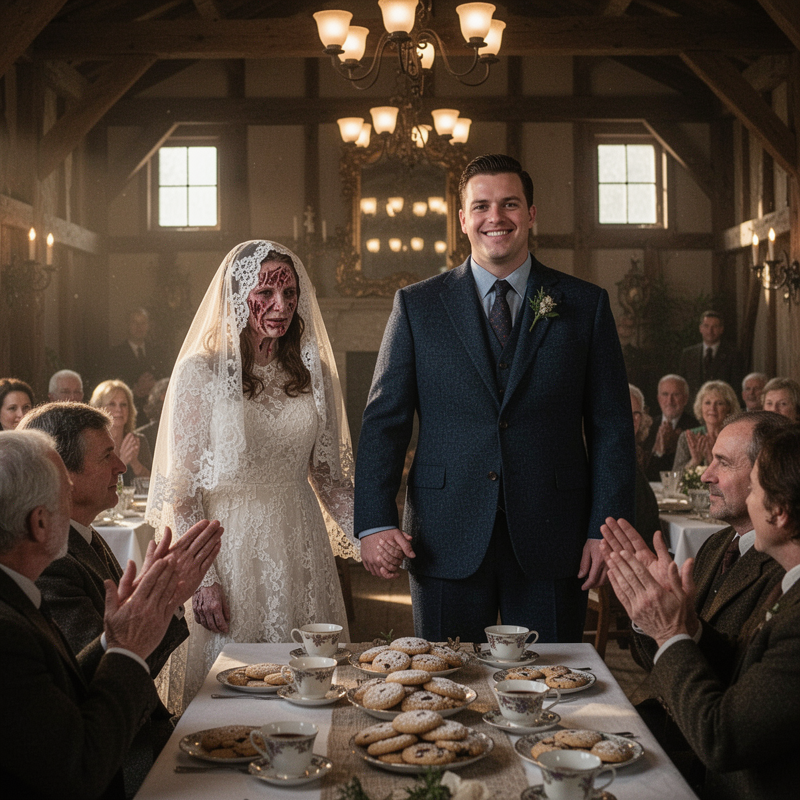
“Look at her face—she looks like a monster in a veil,” my mother-in-law whispered across the crowded fellowship hall, while forty members of the Covenant of Hope chuckled into their tea.
My new husband, Silas Krenshaw, took the microphone, held my hand, and told the entire congregation how I had saved his brother from a burning barn six years ago, leaving me with permanent facial scars.
Then he announced that because of my sacred sacrifice, he was taking full legal management of my $185,000 inherited farmland to “protect my delicate soul from worldly greed.”
The room applauded his saintly patience, but as he squeezed my wrist until my fingers went numb, I realized the horrifying truth.
He hadn’t married me to heal my shame—he had married me to steal the only thing I had left.
The heavy lace veil felt like a suffocating shroud, clinging to my scarred skin. It did little to hide the disfigurement, merely softening the sharp edges of my burn marks. Through the thin fabric, I could see the blurry outlines of the forty faces in the Covenant of Hope fellowship hall, their eyes boring into me.
They had been whispering, of course. For seven years, since I arrived at the compound from the outside world, I had felt their judgment. My appearance was a constant topic of their hushed conversations, a testament to my perceived unworthiness in their pure, agrarian enclave in rural Ohio.
The air hung thick with the scent of stale chamomile tea and the cloying sweetness of sugar cookies. A child’s laugh, shrill and innocent, echoed from a corner, starkly out of place against the quiet tension of the room.
Beside me, Silas Krenshaw, my new husband, stood tall and imposing. His hand, warm and firm, enveloped mine, a stark contrast to the chill that always seemed to settle around my heart when I was among these people. He wore his finest wool suit, a rich, dark blue that made his broad shoulders seem even wider. A slight sheen of sweat had begun to gather on his forehead, catching the dim light.
He stepped forward, pulling me gently with him towards the small, raised platform at the front of the hall. The murmuring died down, replaced by a reverent hush. This was the moment. The “blessing of the union,” as Elder Silas had called it.
He took the microphone from its stand, his movements practiced and smooth. A warm, paternal smile spread across his face, instantly disarming.
“Brothers and sisters,” his voice boomed, rich and resonant, filling every corner of the room. It was the voice of a man accustomed to being heard, to being obeyed.
“Today, we celebrate not just a marriage,” he continued, his gaze sweeping over the congregation, “but a testament to sacrifice.”
He turned his head slowly towards me, his eyes softening, a tear welling in the corner of his left eye. He squeezed my hand, a gesture that looked tender to the onlookers.
“Six years ago, a terrible fire nearly took my dear brother Gideon from us,” he recounted, his voice catching with emotion. “And it was Clara Albright, our newest sister, who rushed into those flames, disregarding her own safety, to pull him out.”
A collective gasp rippled through the hall. Some faces looked genuinely moved. Others, like Aunt Tabitha Krenshaw, Silas’s bitter aunt, merely nodded, their expressions unreadable beneath a thin veneer of piety.
“Her scars,” Silas continued, gesturing lightly towards my veiled face, “are not a mark of shame, but a holy testament. A physical reminder of a sacred act of selfless love.”
He paused, letting his words sink in, allowing the weight of his performance to settle upon the listeners. I could feel the heat rising in my cheeks, a mixture of embarrassment and a faint, unfamiliar flicker of hope. Had he truly accepted me? Was this an end to the years of quiet disdain?
Then, the applause began, a slow, gentle clapping that grew into a robust thrum. Men clapped with open palms, women with daintier, more restrained gestures. They nodded approvingly at Silas, their expressions beaming with respect for his magnanimity, for his saintly patience in taking on such a “burden.”
A young boy, Micah Krenshaw, no older than seven, smiled up at me from his mother’s lap, his eyes wide and innocent. For a fleeting second, I almost believed Silas.
Silas beamed, acknowledging the adoration. He tightened his grip on my hand, pulling me slightly closer, his thumb tracing a slow circle on my skin. The gesture seemed intimate, loving.
“And it is precisely because of this profound sacrifice,” he announced, his voice regaining its authority, shedding the tearful veneer, “and to further protect Clara’s delicate soul from the worldly temptations of greed and attachment, that I have taken a solemn vow.”
The clapping died down, replaced by an expectant silence. Every eye in the room was fixed on him.
“This morning,” he declared, his gaze unwavering, “before our blessed union, I officially signed papers confirming my full legal management of Clara Albright’s inherited farmland and all its assets. The $185,000 trust will now be under the sacred guardianship of the Covenant, and thus, under my humble direction.”
My breath hitched in my throat. The words hit me like a physical blow, cold and sharp. The fellowship hall, the applause, the tender speech – it all warped into a grotesque mockery.
His fingers, which moments ago felt tender, now squeezed my wrist with an excruciating pressure. My fingers tingled, then went numb. The smile on his face was no longer soft; it was a triumphant, predatory grin, barely visible to the congregation, but starkly clear to me.
The room erupted in another wave of applause, even louder this time. Murmurs of “What a righteous man!” and “A true shepherd!” filled the air. They saw a saint; I saw a thief.
The warmth of the hall vanished, replaced by a sudden, icy dread that seeped into my bones. My entire inheritance, the one thing that connected me to my life before, the $185,000 trust from my grandfather, was gone.
And I had just married the man who stole it.
Part 2
The applause rang in my ears, a deafening sound of my own undoing. I couldn’t move, couldn’t speak. The knot of dread in my stomach tightened, cold and hard. Silas smiled, a private, cruel twist of his lips meant only for me, before releasing my hand and turning back to accept the congratulations of his flock. I was trapped.
The rest of the wedding day passed in a blur of forced smiles and meaningless platitudes. I floated through it, numb, my mind racing. I had to get out. But how? Silas had my land, my money. He had isolated me completely.
That evening, the compound was quiet. Silas was still downstairs, receiving more praise, more well wishes. I needed my personal identification papers, my passport, anything that could prove who I was beyond this place. I knew they were in a small box I’d brought with me, tucked away in what was now *our* desk in the Elder’s study.
My hands trembled as I opened the heavy oak drawers, one after another. I found old sermon notes, receipts for farm equipment, a collection of worn leather-bound Bibles. Then, in the bottom drawer, beneath a stack of dusty ledgers, I found a thin, official-looking envelope. It was marked “CONFIDENTIAL – Barn Fire Investigation Report – Krenshaw Property.” Six years ago. The year of the fire.
My heart hammered against my ribs. I pulled out the papers, unfolding them carefully. The official seal of the local fire marshal was stamped at the top. I scanned the lines, my eyes darting over legal jargon until a single phrase jumped out at me, stark and damning.
“Cause of ignition: Accelerant used (Kerosene), intentionally applied from interior.”
It wasn’t an accident. The fire that had ripped through the barn, the fire that had almost killed Gideon, the fire that had left my face a roadmap of scars, had been set on purpose. Not an electrical fault, not some random spark. Someone had lit it. From the *inside*.
My gaze fell on the date of the report. A week after the fire. And then, a memory surfaced: Gideon, in the hospital, mumbling about “papers” and “Silas” before he was sedated.
A cold, horrifying clarity washed over me. Silas had started that fire. He’d locked Gideon in there, not out of malice, but to destroy something else – financial receipts, maybe, records of stolen communal money, conveniently blaming an accident. My supposed “heroic sacrifice” wasn’t divine; it was a cover-up. And my scars were a testament not to my bravery, but to his calculated, murderous greed.
Chapter 2: The Notary’s Ledger
The main farmhouse pantry was a cool, dim space, smelling faintly of dried apples and stored winter squash.
I stood there, the weight of Silas’s recent announcement still pressing down on me, my hands trembling as I thought about the forged papers.
My wedding veil felt heavy, suffocating. I needed answers, and I knew exactly who held them.
I found Barnaby Finch in the compound’s storehouse office, hunched over ledgers that smelled of dust and stale ink. He was a small man, his glasses perched on his nose, looking more like a frightened mouse than a legal official.
“Barnaby,” I said, my voice barely a whisper.
He startled, nearly knocking over a stack of invoices. He knew why I was there. His eyes flickered nervously to the door.
“Clara. You shouldn’t be here.” He smoothed his graying hair, avoiding my gaze.
“My property deed,” I said, stepping closer. “The one Silas signed over. You notarized it.”
Barnaby wrung his hands. “It’s… it’s all in order, Clara. Standard procedure.”
“Standard procedure to sign my name when I wasn’t even there?” I could feel the heat rising in my face, a familiar flush that often came with anger or shame.
His shoulders slumped. “Silas… Silas said it was urgent. For the community’s good. He said you understood.”
“Three days before my wedding?” The date slammed into me. Silas had moved to steal my inheritance before he even said ‘I do.’
My stomach churned. The $185,000 farmland, the last connection to my family, gone. Forged.
“He told me it was a blessing, a protection for my soul,” I said, the words bitter in my mouth. “He signed over my entire property, my entire inheritance, with a fake signature. Didn’t you see it wasn’t mine?”
Barnaby swallowed hard. “I… I was under Elder Silas’s instruction. He presented the documents. He said you were a willing participant.”
“Willing?” I laughed, a sharp, humorless sound. “I had no idea until he announced it to the whole Covenant.”
I took a step back, the truth cold and hard. “This is fraud, Barnaby. This is illegal. I will call the authorities. I will expose him.”
His face went pale. “No! Please, Clara, don’t.”
He glanced past me, his eyes wide with fear. “You don’t understand the reach of Elder Silas.”
Before I could react, Barnaby darted to the small, dusty window overlooking the yard. He saw Silas, just then, crossing the path.
“Elder Silas!” Barnaby practically shrieked, waving frantically. “She’s threatening to call the outside!”
My blood ran cold. The window was open a crack, carrying his frantic words across the quiet compound.
Silas looked up, his face hardening instantly. He began to stride toward the office.
I fumbled for my phone, my fingers clumsy with panic. My only link to the outside world.
But Silas was faster. He burst through the door, his charismatic smile replaced by a mask of cold fury.
“My dear Clara,” he said, his voice deceptively soft. He snatched my phone from my hand before I could even dial. “You’re clearly unwell.”
He gripped my arm, his fingers digging into the recent bruises from his earlier squeeze.
“Barnaby, escort our troubled sister to the pantry,” Silas commanded, his voice now loud enough for anyone passing to hear. “She needs quiet reflection, away from worldly distractions.”
Barnaby, trembling, took my other arm. “This way, Clara.”
They steered me from the office, past the silent stares of a few passing members. I struggled, but Silas’s grip was like iron.
He shoved me into the dark pantry, the air immediately heavy with the smell of preserved food. The door slammed shut, the heavy wooden beam sliding into place with a sickening thud.
The only sound was the distant murmur of the compound, and the frantic pounding of my own heart.
Chapter 3: The Circle of Silence
The pantry was a dark, cramped cell, smelling of dust and forgotten spices. I pounded on the door, then listened for footsteps, for any sign of help. There was nothing. Just the silence.
Hours later, the lock finally slid back. Not Silas, but Evelyn, my younger sister. Her eyes were red, swollen from crying.
She held a bowl of thin broth, her hand shaking. “Silas said you could have this. You must repent, Clara.”
“Repent for what, Evie?” I asked, my voice raw. “For being robbed?”
She flinched at my tone. “He says you’re letting worldly greed tempt you away from the Covenant. From God.”
I tried to reach for her hand, but she pulled away as if my touch might burn her.
“Evie, he stole my land. He forged my name.”
She shook her head, tears spilling down her cheeks. “Elder Silas wouldn’t lie. He’s God’s shepherd.”
Then, Silas’s booming voice echoed from the fellowship hall. “A mandatory community gathering, now! All members present!”
Evelyn dropped the bowl, the ceramic shattering at my feet. She looked terrified.
“He’s calling us to chapel,” she whispered, her gaze fixed on the broken pieces. “He said you must come too.”
We walked into the chapel, the air thick with anticipation. Forty pairs of eyes turned towards me, then quickly away. The whispers began immediately.
Silas stood at the altar, his face a mask of saintly sorrow. He gestured for me to stand before the congregation.
“Brothers and sisters,” he began, his voice resonating with false compassion. “Our dear Clara, though beloved, has allowed the temptations of the outside world to cloud her spirit.”
He paused, letting his words hang heavy in the silent room.
“She questions the holy guidance given to her for her own salvation. She has threatened to bring worldly judgment upon our sacred Covenant.”
A collective gasp went through the room. My heart hammered against my ribs.
“Therefore,” Silas declared, his voice rising, “until Clara truly repents, we must institute the Circle of Silence.”
He looked directly at me, his eyes cold and unwavering.
“No member of the Covenant of Hope shall speak to Clara Albright. No member shall look upon her. No member shall offer her aid or comfort, not even a simple cooked meal, lest their own spirit be contaminated.”
Aunt Tabitha, Silas’s bitter aunt, nodded vigorously from the front row. Her eyes were sharp, triumphant.
I searched the faces around me, desperate for a familiar glance, a flicker of kindness. My gaze finally landed on Evelyn. She was standing with the other young women, her shoulders shaking.
Our eyes met for a fleeting second. Her face crumpled.
Then, slowly, deliberately, Evelyn turned her head away. A single tear tracked down her cheek.
The message was clear. I was an outcast. Alone.
Chapter 4: Whispers in the Furnace
The Circle of Silence was absolute. Each meal, I sat at the far end of the fellowship hall, a ghost among the living. Plates of steaming food passed me by. No one met my eye. No one spoke my name. My own sister, Evelyn, walked past me daily as if I were thin air.
Silas had assigned me the dirtiest jobs, “penance for my pride.” My latest task: scrubbing the chapel floors after evening prayers.
The chapel was empty and echoing in the twilight, a stark contrast to the lively gatherings I’d once attended. I was scrubbing near the altar when I heard a small sound. A child’s hum.
Seven-year-old Micah, one of Silas’s many nephews, was playing beneath the altar steps, oblivious to my presence. He was drawing pictures in the dust with a twig, his small face lit by the last rays of sunset filtering through the high windows.
He looked up at me, a quick, innocent glance. For a moment, I braced for him to turn away, but he didn’t. He just watched my rag move over the floorboards.
“Mama says you’re not supposed to talk to me,” he said, his voice barely a whisper. “But you’re really good at cleaning.”
I stopped scrubbing. “Thank you, Micah.” My voice felt rusty from disuse.
He pointed to a loose floorboard near where he was sitting. “Elder Silas gets mad when I play here. He says it’s for grown-up secrets.”
I knelt closer, pretending to examine the wood grain. “Secrets, Micah? Like what?”
“Like the books,” he whispered, leaning in conspiratorially. “He woke me up the other night. When he lifted the floorboards.”
My heart gave a jolt. I kept my face neutral. “What kind of books?”
“Thick blue ones,” Micah said, drawing a rectangle in the dust. “He puts them in the furnace air shaft.”
He mimed pushing something into a narrow space. “Under there. He seals them up.”
My gaze immediately went to the old iron furnace grate set into the wall, partially obscured by the altar’s wooden base. It had been decorative for years, long replaced by a modern heating system.
“Why would he do that?” I asked, forcing curiosity into my tone.
Micah shrugged, entirely innocent. “I don’t know. Mama says sometimes grown-ups hide things.”
He went back to his drawing, his small secret delivered without a second thought.
I worked until well past midnight, waiting for the compound to fall completely silent. The moon was a sliver outside the chapel windows.
With a deep breath, I pried up the loose floorboard where Micah had pointed. It came up easily. I peered into the dark cavity beneath the altar.
The air shaft, narrow and cold, led down to the old furnace. I reached inside, my fingers brushing against cobwebs and grit. Deeper, I felt something solid.
My hand closed around the cool, leathery spine of a book. Then another.
I pulled them out, two heavy ledgers bound in faded blue leather. They were locked with small brass clasps, but the locks were flimsy.
I remembered a small, sturdy hairpin I kept tucked into my scarf. With trembling fingers, I worked it into the first lock. A soft click.
I flipped open the cover. The pages were filled with neat, precise handwriting, rows and columns of numbers. Not the official, bland reports Silas showed the community. These were different.
These were secret off-grid bank accounts. Years and years of them.
My blood ran cold. Micah’s childish chatter had just handed me Silas’s deepest, darkest secret.
Chapter 5: A Sister’s Betrayal
Back in my small bedroom, the moon streamed through the window, illuminating the blue ledgers. I quickly picked one of the loose floorboards in my room and slid them beneath. My heart hammered, a frantic drumbeat against my ribs.
I had to tell Evelyn. She had to see this.
I found her in her room, quietly mending a tunic. Her face was still drawn, the silence having taken its toll on her too.
“Evie,” I whispered, closing the door softly. “You have to listen to me.”
She looked up, her eyes wide, then immediately looked away, her hands still. “I can’t, Clara. Elder Silas forbids it.”
“This isn’t about Silas,” I insisted, my voice urgent. “This is about us. About the truth.”
I pulled out the ledgers from under my mattress, the heavy books thudding softly as I laid them on her bed. “Look at these, Evie. These are Silas’s real books. Not the ones he shows everyone.”
I flipped open a page, pointing to columns of numbers, coded names. “He’s been stealing from the Covenant for years. Millions. He used my inheritance to cover his own debts.”
Evelyn stared at the pages, her brow furrowed in confusion, then alarm. A flicker of doubt, of fear, crossed her face.
“He promised us eternal salvation,” I pleaded, my voice cracking. “He promised us safety. He’s a liar, Evie. A thief.”
I grabbed her hand. “We can leave tonight. Together. We can get out of here. Before he takes everything from everyone.”
She pulled her hand back, her face suddenly hardening. The flicker of doubt was gone, replaced by something cold and rigid.
“You speak blasphemy, Clara,” she said, her voice shaking but firm. “You are sowing discord. This is the devil’s work.”
My mouth fell open. “Evie, no—”
She stood up abruptly, her gaze fixed over my shoulder. Her eyes were wide with a different kind of fear now, not for me, but for herself.
“Elder Silas must know of this deception,” she declared, her voice rising. “He must purify you.”
Before I could stop her, before I could even understand what was happening, Evelyn turned and ran from the room. Her footsteps echoed down the hallway, quick and determined.
My blood ran cold. She wasn’t going to help me. She was going to report me.
Seconds later, Silas burst into the room, his eyes blazing. Evelyn stood behind him, trembling, but resolute.
“What is this wickedness?” he thundered, his gaze sweeping the room, landing on the slightly raised mattress.
He strode to the bed, tearing the quilt back with one swift motion. He ripped the mattress open, stuffing flying everywhere.
The blue ledgers were exposed.
Silas picked them up, his face a mask of rage. “You vile serpent! You undermine the very foundation of our faith!”
He grabbed my arm, his grip crushing. “You will be purged of this pride! You will reflect on your sins in darkness and cold!”
He dragged me from the room, past Evelyn’s averted gaze, down the narrow stairs, and out into the biting night air.
The heavy iron door of the underground root cellar creaked open. The smell of damp earth and rot filled my nostrils.
He shoved me inside, the door slamming shut, plunging me into absolute darkness.
Chapter 6: The Matriarch’s Key
The root cellar was colder than I expected, the air thick with the smell of potatoes and a faint, cloying sweetness of decay. I huddled on the dirt floor, my hands wrapped around my knees, listening to the drip, drip, drip of moisture from the stone walls. My winter coat was still back in my room.
Hours passed. I shivered, my teeth chattering. Just when I thought I couldn’t take the cold anymore, I heard a soft click.
The heavy iron door swung inward a crack, revealing a sliver of candlelight.
“Clara?” a voice whispered, thin and reedy.
It was Aunt Hattie Krenshaw, Silas’s 82-year-old aunt. She stood framed in the flickering light, a shawl pulled tight around her shoulders, an ancient ring of keys clutched in her hand.
“Aunt Hattie?” I whispered back, disbelief warring with a rush of hope. “How…?”
She pushed the door open just enough for me to slip out, then relocked it immediately, her movements surprisingly swift for someone her age.
“I have my ways,” she said, a faint, knowing smile on her lips. “This old house has many secrets, and so do I. Silas is not the first Krenshaw to believe he is above the rules.”
She led me quickly through the dark, silent house to a small, dusty sitting room I rarely saw used. She lit a single oil lamp on a side table.
“Silas took your money, child,” she said, her voice low. “Your $185,000. He didn’t use it for the community, as he claimed.”
My breath hitched. “What did he use it for?”
Aunt Hattie’s gaze was direct, unwavering. “Gambling debts. In Columbus. He has a weakness for the tables. Has for years. He owed thousands.”
My stomach clenched. He hadn’t just stolen my inheritance; he’d squandered it on personal vice. The saintly Elder, a gambler.
“I tried to warn Gideon,” she continued, her voice heavy with regret. “About Silas. About the fire.”
She reached into the pocket of her shawl and pulled out a small, ornate brass key. “This is for my personal lockbox. Hidden in the old attic chest.”
She pressed the key into my hand. It was cold against my palm.
“Inside, you will find a letter,” she said, her eyes sad. “A confession. From Silas’s own father. Written in 1994.”
“A confession?” I asked, my voice barely audible.
“Thirty years of systematic tax fraud. Property theft against every outsider convert who joined the Covenant,” Aunt Hattie explained. “Just like you, Clara. My family has been doing this for generations. And I let them. For too long.”
She looked at me, her eyes filled with a lifetime of guilt. “This letter, along with those ledgers you found? They will bring him down. For good.”
“But why now?” I asked, confused. “Why are you helping me?”
She sighed, a fragile sound. “Because I’m old, Clara. And I can’t die with this sin on my soul. My bloodline may be poisoned, but my spirit doesn’t have to be.”
Her gaze hardened. “Go now. Before anyone wakes. Go get what you need.”
Chapter 7: The Brother’s Confession
Armed with Aunt Hattie’s key and a desperate surge of hope, I crept through the silent farmhouse. The attic was a labyrinth of forgotten furniture and dusty boxes. I found the old chest, unlocked Aunt Hattie’s hidden box, and inside, tucked beneath yellowed linens, was a thick envelope. I slipped it into my pocket, its weight a promise.
My next stop was the carpentry shop. Gideon Krenshaw, Silas’s younger brother, was often there, working on repairs. He was a quiet man, his limp a permanent reminder of the barn fire.
I found him hunched over a workbench, meticulously sanding a chair leg. The shop was cold, filled with the comforting smell of sawdust and fresh wood.
He looked up, his eyes widening in alarm when he saw me. He immediately looked away, following Silas’s shunning orders.
“Gideon,” I said, my voice soft. “I need to talk to you. About the fire.”
He flinched, his sanding suddenly still. He kept his head down, refusing to meet my gaze. “I can’t. Elder Silas—”
“Silas locked you in that barn, didn’t he?” I cut him off, my voice gaining strength. “He started that fire. To destroy his dirty papers. And you were in there.”
Gideon’s hand stopped. A single tear traced a path through the sawdust on his cheek. He stayed silent for a long moment, then slowly, he lifted his head. His eyes were filled with an old, deep pain.
“He threatened to excommunicate me,” Gideon finally whispered, his voice hoarse, barely audible. “To cast me out, to tell everyone I was a cursed, worldly fool. I wouldn’t be allowed to see my family. Not even my children.”
He paused, a shudder running through him. “I helped him. I helped him set the fire. He wanted to burn the old ledgers. The ones his father used, too.”
My stomach lurched. The man I had saved, had helped hurt me.
“He didn’t know you were still inside, did he?” I asked, a fresh wave of horror washing over me.
Gideon shook his head, a single, violent motion. “No. He thought I’d left. But I went back for my tool belt. Then the door was chained.”
His gaze dropped to my scarred face. He couldn’t look me in the eye. “I owe you my life, Clara. And you got this because of my cowardice.”
He hobbled over to a dusty chest in the corner, rummaging inside. He pulled out a rolled-up parchment, brittle with age.
“Silas thought this burned,” Gideon said, pressing it into my hand. “It’s the original master deed for your farmland. The real one.”
He looked at me, a flicker of defiance in his eyes, a desperate plea for redemption. “He changed the locks on my office door. My winter shoes are in there. Please, Clara. You saved me. I want to save you.”
I stared at the deed, then at Gideon. The weight of his confession, the physical proof of Silas’s lies, felt heavy in my hand. It was another piece of the puzzle, a crucial one.
But the night was growing late, and Silas was still out there.
Chapter 8: The Cold Room
I gripped the master deed and the confession letter tightly, my mind racing. Gideon’s confession had given me a strange strength, a resolve I hadn’t felt in years.
I had the evidence. I had to get it out.
I made my way stealthily towards the compound perimeter, heading for the main gate. The moon was high now, casting long, eerie shadows. The air bit at my exposed skin. I’d forgotten my coat.
I was almost there, just twenty yards from the gate, when a figure emerged from the shadows of the large oak tree.
Silas.
He stood blocking my path, his silhouette huge and menacing against the stark moonlight. He’d known. He’d been waiting.
“Running away from your penance, Clara?” he asked, his voice low, filled with a chilling menace. “Trying to escape God’s judgment?”
My heart pounded. There was no way around him.
“You’re a thief, Silas,” I said, my voice surprisingly steady. “And a liar. Your father was too.”
His face contorted in a sneer. “Such worldly defiance. Such arrogance.”
He strode towards me, his eyes fixed on my hands. He must have seen the slight bulge of the papers.
“Give me those!” he commanded, lunging for me.
I pulled back, trying to evade him, but he was too quick. His hand clamped around my wrist, hard. He yanked the master deed from my grasp, then pulled the confession letter from my pocket.
“More lies?” he scoffed, glancing at the old parchment, then at the envelope. “You think these flimsy scribbles will save you?”
He crumpled both papers into a ball and shoved them into his own pocket. “Foolish girl.”
He looked me up and down, a cruel smile on his lips. “You will learn humility. Tonight.”
He ripped the shawl from my shoulders, then roughly pulled off my worn boots. The freezing mud immediately seeped between my toes.
“You will spend the night in the tractor shed,” he announced, his voice carrying in the still night. “Barefoot, and without comfort. To purge your pride.”
He called out, his voice echoing across the silent compound. “Brothers! Sisters! The serpent attempts to flee! Guard the perimeter! Let no one leave!”
Lights flickered on in several of the houses. Figures emerged, armed with lanterns, fanning out around the fences.
I saw Evelyn’s shadow, near the Krenshaw house, her head bowed. She didn’t look up.
Silas pushed me roughly towards the unheated tractor shed. The metal door groaned open, revealing a cavernous, dark space filled with the ghostly shapes of farm machinery.
“Tomorrow morning,” Silas said, his voice cold and final, as he shoved me inside, “your land transfer will be finalized at the county office. Beyond repair. Then you will truly be humble.”
The metal door slammed shut, the heavy bolt scraping home. I was alone in the bitter cold, my feet already numb, the finality of his words echoing in the darkness.
Chapter 9: The Written Testimony
The tractor shed was an icebox, metal walls radiating the sub-zero chill. My breath plumed in the air. I could feel the cold seeping into my bones, a slow, steady numbness. Silas’s words, “beyond repair,” echoed in my mind.
I had to act now.
I stumbled in the darkness, my bare feet stinging on the frozen dirt floor. My fingers fumbled along the rough metal walls, searching for anything, a sliver of hope.
My hand brushed against something familiar. A box mounted on the wall. An old land-line telephone connection, used for farm emergencies. It was dusty, archaic, but it was there.
I pulled the phone off the hook. Silence. No dial tone. My heart sank.
Then I remembered the Krenshaw family’s odd habit of sometimes forgetting to pay the “outside” phone bills for this particular emergency line, letting it get disconnected. But Aunt Hattie had said they always reinstated it by the first week of winter, for any potential blizzard emergencies. It was the first week of winter.
I tried again. A faint, static-laced dial tone. It was working.
My fingers, stiff with cold, struggled to dial. I knew the general number for the overnight courier service in the nearby town, having seen its advertisements on a church bulletin board months ago. I’d never imagined needing it myself.
The phone rang several times, then a gruff voice answered.
“Overnight Express. What can I do for ya?”
“I need a pickup,” I said, my voice a shaky whisper. “Registered mail. Before dawn.”
“Lady, we don’t do pickups from private residences out that far at this hour,” the man said, sounding annoyed. “Our route starts at 6 AM from the office.”
“This is urgent,” I pleaded, my teeth chattering. “Federal. Tax. Fraud.”
The line went silent for a moment. “Alright, registered parcel only. Where’s the drop-off?”
“The mailbox,” I said, my voice gaining a desperate clarity. “The mailbox at the Covenant of Hope compound gate. You know it? The one shaped like a cross.”
“Yeah, I know the crazy church. What’s the package?”
“Documents,” I said, my eyes darting to the entrance of the shed. “Financial ledgers and a signed confession. From Silas Krenshaw’s family. Thirty years of tax fraud. To the IRS criminal investigation division.”
“Whoa, lady,” the man said, his tone shifting. “That’s heavy. You got a return address?”
“No,” I said, “Just the pickup. Before dawn. It’s life or death.”
“Alright,” he finally said, a note of unease in his voice. “I’ll dispatch a runner. Earliest I can get there is 5 AM. Gotta be out at the mailbox. Sealed package. You got a name for the sender?”
“Clara Albright,” I said. “Just Clara Albright.”
I hung up, my hands trembling. The ledgers. The confession. They were with Silas.
My gaze fell on the heavy, dormant tractor in the corner. Its fuel tank.
I took Aunt Hattie’s small key from my pocket. It was meant for her lockbox, but she’d mentioned it was an old master key for certain household cabinets as well.
I tried the key on the padlock of the shed’s built-in toolbox. It clicked open. Inside, amid wrenches and grease, I found a small, rusted tin.
My heart leaped. The tin held my small, personal sewing kit. And inside the kit, carefully folded, was a set of copies I had made of the ledgers months ago, just a few pages, before I understood what they meant. And I still had the confession letter Gideon gave me.
I also found a roll of heavy-duty tape and a thick, padded envelope.
With numb fingers, I taped the copies of the ledgers and the confession letter from Silas’s father into the envelope. I wrote “IRS Criminal Investigation Division” in bold, shaky letters.
Then, I thought of Gideon’s confession. And Aunt Hattie’s testimony. They were pieces, but the IRS would need more.
I scrawled a short, urgent note, detailing Silas’s personal gambling debts, his forged signature, the barn fire, Gideon’s coerced involvement, and Barnaby Finch’s complicity. I signed my name.
I sealed the envelope, securing it with extra tape. This was it. Everything I had. My only shot.
The courier would come for the sealed package before dawn.
Chapter 10: The Covenant Feast
The cold had settled deep in my bones by the time the first rays of dawn touched the eastern sky. My feet were numb, my hands stiff. I had wrapped the envelope in a piece of old canvas and secured it with twine, leaving it tucked safely inside the mailbox at the compound gate, praying the courier would find it.
Hours later, guards led me, shivering and still barefoot, back into the fellowship hall. The room, usually subdued, buzzed with an unusual excitement. It was the annual Covenant Feast, a day of pomp and celebration for Silas Krenshaw.
The air was thick with the rich scent of roasted meats and sweet pies. Forty members of the Covenant of Hope, dressed in their finest, gathered around long tables laden with food. They were laughing, talking, celebrating. They pointedly ignored me, as per the Circle of Silence.
Silas stood at the head of the main table, a triumphant smile on his face. He looked resplendent in his best suit, a picture of divine blessing.
“Brothers and sisters,” he boomed, raising a goblet of cider. “Another year of divine favor has been bestowed upon our Covenant! The Lord’s bounty flows, and our prosperity is assured!”
He looked directly at me, a smirk playing on his lips. “And as a testament to our steadfast faith, the final acquisition of Sister Clara’s property will be formalized today. Her worldly possessions now truly belong to the Covenant, for the greater glory of God!”
A round of applause filled the hall. Aunt Tabitha beamed at Silas, a look of pure adoration on her face. Evelyn, sitting near the altar, kept her eyes fixed on her plate, her face pale and drawn.
Barnaby Finch, looking unusually slick in a clean suit, sat beside Silas. A stack of official-looking papers lay before him, including the final municipal tax exemption forms for my land. He had a pen in hand, ready to sign.
Silas gestured to Barnaby. “Our faithful Barnaby Finch, steward of our earthly affairs, will now complete the final blessing of these deeds. Ensuring our co-op’s continued prosperity for generations.”
Barnaby adjusted his glasses, picked up the pen, and leaned over the documents. The silence in the room was palpable, everyone watching this final ritual of Silas’s power.
The smell of roasted lamb filled the air, the sound of crackling fire in the hearth. Everything seemed perfect, a picture of prosperity and divine order.
But I knew the truth. And somewhere out there, a courier package was making its way to federal regulators.
My bare feet were cold on the polished wood floor. My stomach rumbled with hunger, but I felt a strange calm. This was the moment. The final act of his deception.
Barnaby poised his pen over the forms, ready to sign.
Chapter 11: The Frozen Wire
Barnaby Finch’s pen hovered an inch above the crisp municipal tax exemption forms. A hush fell over the fellowship hall, forty pairs of eyes fixed on the signing of my stolen land.
Just as Barnaby began to lower his pen, a sharp, insistent ring pierced the celebratory silence.
Barnaby’s cell phone, lying on the table beside him, vibrated violently. It was a shrill, outside sound, clashing with the quiet order of the feast. He ignored it.
But the phone continued to ring, then Silas’s own phone, tucked into his jacket pocket, began to buzz with a frantic intensity. Then Barnaby’s phone rang again. And again.
Barnaby, flustered, finally snatched his phone. “Excuse me, Elder Silas.”
He answered, bringing it to his ear. His eyes, initially annoyed, grew wide. His face went ashen, all the color draining from it.
“IRS?” he whispered, his voice barely audible. “Criminal Investigation Division?”
The murmur in the hall intensified. Silas, sensing the shift, snatched his own phone. His face, moments ago radiating triumph, now contorted in confusion. He answered, his brow furrowed.
“What do you mean ‘asset freeze’?” Silas barked into the phone, his voice losing its customary calm. “This is Elder Krenshaw of the Covenant of Hope! Our accounts are sacred!”
A collective gasp swept through the hall.
Barnaby dropped his phone, the plastic clattering on the table. “They know,” he choked out, his eyes darting frantically around the room. “They have everything. The ledgers. The confessions.”
Silas’s face went purple with rage. “No!” he roared, slamming his phone onto the table. “It’s impossible!”
He scrambled from the table, overturning his chair in his haste. He sprinted towards his office, a small room off the fellowship hall, where his computer and the compound’s financial terminals were kept.
“He’s trying to transfer emergency cash!” I heard Aunt Hattie mutter from her seat, a grim satisfaction on her face.
Every eye in the hall was now on Silas, watching him burst into his office. We could hear the frantic click-clack of his keyboard.
Then, a guttural cry of despair ripped from his throat.
“No! NO!”
Silas stumbled back into the fellowship hall, his face truly terrifying now, devoid of all pretense.
“It’s all frozen!” he shrieked, his hands tearing at his hair. “Every account! Every penny! The co-op… it’s gone! The entire $1.2 million operating treasury… gone! Instantly!”
The silence that followed was deafening, broken only by the crackle of the hearth fire.
Then, a woman at one of the tables shrieked. “My children’s savings! Is it gone too?”
Another man stood up, his face livid. “The winter fuel shipment! It was due today! Is that frozen?”
Barnaby Finch, sweating profusely, tried to make a run for the back exit. He didn’t make it two steps before two burly farmers, their faces contorted with rage, tackled him to the ground.
The festive feast, the celebration of divine blessing, imploded.
Panic erupted. The loyalty of forty people, built on lies and stolen wealth, shattered in an instant.
Chapter 12: The Empty Kingdom
Panic ripped through the fellowship hall like wildfire. The festive atmosphere evaporated, replaced by raw, desperate fear. The news of the frozen funds, the entire $1.2 million operating treasury, sent shockwaves through the congregation.
“My debit card!” A young man cried out, fumbling in his wallet. “It’s declined!”
“The winter food shipment from town!” another shouted. “It’s canceled! They just called the kitchen!”
The communal illusion of Silas’s divine blessing shattered instantly. Decades of indoctrination, years of unquestioning loyalty, evaporated as quickly as the funds. These people weren’t loyal to Silas; they were loyal to the safety and comfort his stolen wealth had provided.
The roaring fire in the hearth, meant to symbolize warmth and plenty, seemed to mock them now.
Aunt Tabitha, Silas’s bitter aunt, who had so eagerly enforced the Circle of Silence against me, pointed a trembling finger at Silas. “He lied to us! He stole from us!”
Her words, once reserved for gossip and shaming, turned on her own kin.
No one looked at me now. Their fury was focused entirely on Silas. The betrayal was too immense, the consequences too immediate. Their survival depended on money and supplies, not spiritual purity.
“The silos!” someone screamed. “Get to the grain silos! Before it’s all gone!”
The feast, barely touched, was abandoned. A stampede of desperate cult members rushed from the hall, not to pray or repent, but to salvage what they could.
Pots and pans clanged in the kitchen as people ransacked the pantry shelves. The sound of truck engines sputtering to life filled the crisp winter air.
I watched, numb with shock, as families packed their belongings, piling them into old pickup trucks. Children cried, confused by the sudden chaos. Wives screamed at their husbands to hurry.
Evelyn, my sister, stood frozen in the middle of the hall, her face streaked with tears, a look of utter desolation in her eyes. The prophet she worshipped was a bankrupt liar. The future she had believed in, gone.
But instead of turning to me, instead of running to me, she grabbed a small satchel from a chair and rushed out with a small group of younger families, their faces grim. They were heading not back into the compound, but out, towards the main road.
Silas, stripped of his authority, stood alone in the center of the muddy yard. His face was contorted, his hair disheveled. He screamed into the cold wind, his voice hoarse, “Return! You unfaithful fools! Return to your Elder! This is a test of faith!”
But no one listened. They simply drove past him, their tires splashing mud, their faces set. The once-bustling compound was emptying out, hour by hour.
In a matter of minutes, the loyal congregation, the forty members he had ruled with an iron fist, had vanished. The buildings that housed them, the fields they worked, the community they had built around his lies—all of it stood silent, abandoned.
Silas Krenshaw, the charismatic Elder, was left completely bankrupt and utterly alone, standing in the cold, muddy yard of his empty kingdom. Not a single officer had made an arrest. The system had simply collapsed under its own weight of deceit.
Chapter 13: The Highway Diner
Just three hours later, the afternoon sun was already sinking low, casting long shadows across the barren Ohio landscape. I sat in a booth at a plain highway diner two miles outside the now abandoned Covenant of Hope compound. The fluorescent lights overhead hummed, casting a harsh, unrelenting glow on the plastic tablecloth.
A plate of plain white toast sat before me, untouched. The warmth of the coffee mug in my hands was a comfort. I held a stack of papers: my official land title release, dated just this morning, fully restoring my $185,000 inheritance. Barnaby Finch had been very cooperative once the IRS agents arrived.
My phone, retrieved from Silas’s office, sat silently on the table. No one had called. No one from the compound.
The bell above the diner door jingled.
I looked up, and my breath caught in my throat.
Evelyn.
She walked in, her eyes scanning the booths, then landing on me. Her face was smudged with dirt, her clothes disheveled. She carried the small satchel I’d seen her grab from the fellowship hall.
Hope, fragile and desperate, surged through me. “Evie!” I called out, my voice breaking.
She walked towards my booth, but her steps were stiff, her expression unreadable. She didn’t sit down. She just stood there, looking down at me, her face pale.
“I’m joining a splinter group,” she said, her voice flat, devoid of emotion. “They’re going to Kentucky. A true Covenant. Untainted by worldly greed.”
My heart plummeted. “Evie, no,” I pleaded, reaching for her hand. “It’s another lie. Silas was a fraud. They’re all frauds. Come home with me. Please. We can start over. We can be free.”
She pulled her hand back, shaking her head. Her eyes, once full of youthful light, were now clouded with a zealous, unyielding conviction.
“You don’t understand, Clara,” she said, her voice laced with the same certainty I’d heard in Silas’s sermons. “You’re still blinded by the world. I must seek true purity. The true path.”
She turned to leave, her back ramrod straight.
“Evelyn!” I called out, my voice cracking, a desperate plea for the only family I had left.
She paused at the door, her back to me. She didn’t turn around.
“May God be with you, Clara,” she said, her voice barely a whisper, then she pushed open the door and stepped out into the twilight, disappearing into the vast, indifferent world.
I sat there, watching the door swing shut, the jingle of the bell echoing in the quiet diner. My inheritance was restored. Silas was ruined, his empire crumbled. I was free.
But the silence in the booth was deafening, a hollow space where my sister used to be. The freedom I had fought for felt suddenly cold, heavy with a loss that financial victory couldn’t mend.
I left the fire with scars on my skin, but I left the Covenant knowing some wounds never heal—they just teach you how to walk away.
Leave a Reply