CHAPTER 1: The Cost of Silence
Part 1
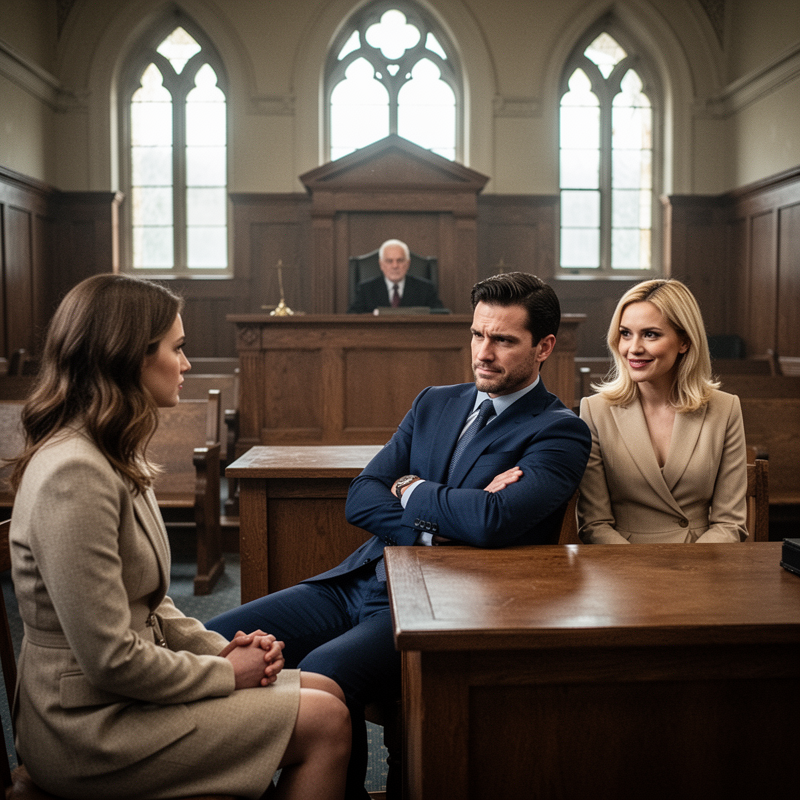
“Get out of my firm, Clara, you don’t own a single nail in this building anymore,” my brother Mark said, sliding the legal papers across the counsel table while his fiancée Chloe smirked beside him.
After my six-year-old daughter Maya died six months ago, Mark took total control of our small-town timber design firm and transferred every corporate asset into his personal holding account.
He brought me into the Oakhaven County courthouse today to strip away my remaining partnership equity and leave me penniless.
He didn’t know I had brought a sealed envelope containing Maya’s official medical records from the state capital.
And he didn’t know what a visiting doctor had found in her blood.
The Oakhaven County courthouse stood as an anchor in the heart of town, its red brick façade weathered by a century of Maine winters. Inside, the courtroom was a somber space, smelling faintly of old wood and dust, with tall, arched windows that let in a thin, watery light.
Every creak of the polished oak chairs seemed amplified in the quiet.
Judge Harold Sallow, a man whose face carried the weariness of decades of small-town disputes, sat on the bench. His gaze swept over the small assembly with practiced disinterest.
Brenda Kincaid, my attorney and a pragmatic local advocate, sat beside me. She tapped a pen against her legal pad, a small, rhythmic sound.
I sat very still, my hands clasped tightly in my lap, feeling the chill of the counsel table through my fingertips. The silence was a heavy shroud, but beneath it, a storm brewed within me.
Across the aisle, Mark leaned back in his chair, a confident smirk playing on his lips. His expensive suit seemed to bristle with his self-satisfaction.
Chloe, his fiancée, sat primly beside him. She wore a tailored beige dress and a carefully neutral expression, though her eyes glinted with an eager anticipation that mirrored Mark’s.
Mark’s lawyer, Mr. Davies, a slick attorney from Portland, stood before the judge. He spoke with a smooth, unhurried cadence, detailing the motion to terminate my equity in O’Connell Design & Timber.
“Ms. O’Connell, your Honor,” Mr. Davies began, “has regrettably abandoned her duties to the firm for the past six months, following a personal tragedy.”
He paused, a calculated beat of false sympathy.
“This prolonged absence has demonstrably impacted the firm’s operations and financial stability. Mr. Mark O’Connell, as the acting managing partner, has been forced to assume full responsibility, covering her dereliction.”
Mark nodded slowly, as if agreeing with every word, reinforcing the narrative. He shot a quick glance at me, a flicker of triumph in his eyes.
My jaw tightened, but I held my tongue. The words “personal tragedy” felt like a cheap euphemism, an insult layered on top of the gaping wound of Maya’s loss.
“The evidence before the court,” Mr. Davies continued, “clearly shows that Clara O’Connell has neglected her partnership responsibilities, leaving her brother with no recourse but to seek a full termination of her remaining shares.”
He presented a stack of documents, each representing another alleged missed meeting, another unsigned project form. Each one a tiny knife twist.
I knew the papers weren’t lies, not exactly. After Maya died, a part of me had died too. The blueprints on my desk blurred. The timber calculations made no sense. My world had narrowed to the unbearable ache of absence.
Mark had capitalized on my grief with a speed that still shocked me. Within weeks, he’d locked me out of the main office, citing “operational restructuring.”
He leaned over and whispered to Chloe, loud enough for me to hear.
“She thought she could just disappear,” he murmured, “and everything would stand still.”
Chloe offered a small, knowing smile in response, her gaze flitting to my face, then quickly away.
Judge Sallow listened, occasionally interjecting with a question about specific dates or financial implications. He seemed impatient, clearly viewing this as another tedious family squabble over money in a town full of them.
Finally, Mr. Davies concluded his arguments. “We respectfully request, your Honor, that the court grant this motion in full, allowing O’Connell Design & Timber to move forward unencumbered.”
Judge Sallow turned his attention to Brenda Kincaid. “Ms. Kincaid, does the defense have a counter-motion?”
Brenda stood slowly, her movements deliberate. Her eyes met mine for a brief, steady moment, a silent message passing between us.
Then, without speaking, she reached into her worn leather briefcase.
She pulled out a large, manila envelope. It was thick, heavier than it looked, and sealed with an official red wax stamp, bearing the insignia of the Maine Department of Health and Human Services.
Brenda held it up, showing both the judge and Mark’s side of the table.
“Your Honor,” she said, her voice clear and even, “the defense has a submission for the court’s immediate review.”
Mark scoffed, a short, dismissive sound that cut through the quiet. He leaned forward, eyes narrowing at the envelope.
“What is that, Clara?” he drawled, his voice dripping with condescension. “A demand for spousal support? Too little, too late, sister.”
Chloe let out a small, almost imperceptible chuckle.
Brenda ignored them. She walked calmly towards the bench and presented the envelope to Judge Sallow, her posture radiating an understated dignity.
The judge accepted it, his brow furrowing slightly at the unexpected formality of the state seal. He weighed it in his hand for a moment, then looked at Brenda.
“And the nature of this submission, Ms. Kincaid?” he asked, his voice now tinged with genuine curiosity.
“It is a sealed toxicology report, your Honor,” Brenda stated, her voice unwavering. “Regarding the official cause of death of Maya O’Connell.”
Part 2
Judge Sallow nodded slowly, his gaze still fixed on Brenda. Then, with a decisive motion, he broke the red wax seal on the envelope. The sound of the paper tearing was sharp in the quiet courtroom.
He pulled out several pages, all neatly stapled together, and began to read. His expression, initially neutral, slowly shifted. His eyebrows drew together, then he frowned, a deeper line forming between his eyes. He took off his reading glasses, polished them briefly with a handkerchief, and put them back on, leaning closer to the document.
The air in the room grew heavy with anticipation. Even Chloe seemed to hold her breath for a moment, though Mark remained dismissive. He leaned over to Mr. Davies, his voice a low, confident murmur.
“Don’t worry about whatever nonsense she’s cooked up,” Mark whispered, loud enough for me to catch snippets. “She signed off on everything. And old Dan, bless his trusting heart, put his name on all those warehouse receipts. There’s no way she has any financial leverage left for some dramatic buyout.”
He clearly believed the sealed envelope was some desperate, last-ditch attempt at a monetary claim. His eyes darted to me, a flash of contempt in their depths.
Judge Sallow continued to read, taking his time, his eyes moving methodically across the lines of text. The silence stretched, punctuated only by the rustle of papers as he turned a page. The judge’s face became unreadable, a mask of judicial gravity that seemed to harden with each word he absorbed.
Finally, he reached the end. He lowered the report to the bench, his hand resting on it. He paused, a long, deliberate beat, as if weighing not just the document, but the very fabric of the room.
Then, slowly, he looked up. His eyes, usually weary, found Mark O’Connell across the aisle. A cold, ironic smirk played on the judge’s lips. He leaned back slightly in his chair, a faint, almost imperceptible sound escaping him.
He chuckled under his breath.
Chapter 2: The Diner Encounter
Three days before the hearing, the Oakhaven Diner buzzed with the usual morning chatter. I sat in a back booth, the worn laminate cool under my forearms. Around me, forks scraped plates and coffee cups clinked, but all I could hear was the frantic beat of my own heart.
I spread Maya’s death certificate across the table, tracing the official seal with a trembling finger.
My eyes snagged on the fine print, a jumble of medical jargon I couldn’t quite decipher. A man in a crisp, unfamiliar shirt slid into the opposite booth, eyeing my papers.
“Excuse me,” he said, his voice calm and even. “That chemical notation there—is that a specific industrial solvent?”
I looked up, startled. This was Dr. Nathan Cross, a visiting environmental analyst I’d met briefly at the town’s small library a week ago.
“I don’t know,” I admitted, pulling the certificate closer. “It’s from my daughter’s hospital chart.”
He nodded slowly, pulling a small tablet from his bag. “I’m in Oakhaven for river testing samples. We’ve found some unusual concentrations upstream, near the industrial basin.”
His gaze dropped back to Maya’s certificate.
“This compound,” he continued, pointing to a string of letters and numbers on the page, “it matches a substance sometimes used in wood preservatives. A highly toxic one.”
My breath hitched. “Near the basin?”
“Specifically, within the Oakhaven lumber yard’s runoff area,” he confirmed, his brow furrowed. “The levels we’re seeing could cause severe acute organ failure in prolonged exposure.”
The diner noise faded. My hands clenched around the flimsy paper. Mark had sworn Maya’s death was an undetected heart defect.
Chapter 3: Unwitting Accomplice
I found Uncle Dan at the family workshop, methodically sanding a timber beam. The familiar scent of sawdust and wood stain usually brought comfort, but today it felt heavy, suffocating. He looked older, his shoulders stooped under the weight of something I couldn’t name.
“Uncle Dan,” I said, my voice barely a whisper above the whirring machinery.
He turned, his eyes wide. “Clara. What brings you out here, dear?”
I held out a copy of the chemical disposal logs, the ones Dr. Cross had helped me track down. They bore his shaky signature.
“These,” I said, pointing to the dates from six months ago. “Why did you sign off on these chemicals? They’re not standard for our operation.”
His face crumpled. He grabbed a rag and wiped his hands, but his movements were frantic.
“Mark… Mark told me they were routine fire-safety compliance sheets,” he stammered, his eyes darting around the workshop as if seeking an escape. “Said he needed my signature to speed things up with the county.”
He sat heavily on a stack of timber.
“He said it would keep the business running smoothly,” Uncle Dan whispered, tears welling in his eyes. “He said it was important for the family name. I didn’t read them closely, Clara. I just trusted him.”
My stomach churned. Mark hadn’t just brought in dangerous chemicals; he’d used Uncle Dan’s trusted reputation in Oakhaven to bypass every local environmental inspection. His own uncle, a loyal fixture in this town for fifty years, had been unknowingly made an accomplice.
Chapter 4: The False Narrative
Back in the hushed courtroom, my lawyer, Brenda Kincaid, stood before Judge Sallow, her voice clear and unwavering. Mark watched from his table, a faint smirk still playing on his lips, oblivious to the coming storm. Chloe sat beside him, head held high.
“Your Honor,” Brenda began, “the defense has maintained that Ms. O’Connell’s daughter, Maya, passed away due to an undetected congenital heart condition.”
She paused, letting the words hang in the air.
“This was the narrative Mr. O’Connell shared with the entire community of Oakhaven.”
Mark leaned forward, ready to object, but Brenda held up a hand.
“However, the state toxicology report, now unsealed, confirms a different truth.”
She picked up the document Dr. Cross had helped me secure.
“Acute chemical exposure,” Brenda stated, her voice echoing in the sudden silence, “was the direct cause of Maya O’Connell’s organ failure.”
A collective gasp rippled through the spectators. Chloe’s smirk vanished, replaced by a pale shock. Her perfectly made-up face drained of color as she stared at Mark, then at me.
Whispers erupted, growing louder, indignant. The lie, so carefully constructed by Mark, shattered in a single sentence.
Chapter 5: Paper Trails and Receipts
Brenda didn’t wait for the murmuring to die down. She moved swiftly, projecting a series of digital documents onto the courtroom screen. These weren’t medical records, but financial ledgers and shipping manifests.
“Your Honor, these are purchase orders.” Brenda pointed to a highlighted line item. “For an unapproved industrial solvent sealant, costing forty-two thousand dollars.”
The screen displayed an out-of-state vendor’s logo. Mark’s face went from pale to a mottled red.
“These purchases,” Brenda continued, “were made by Mr. O’Connell directly, completely bypassing O’Connell Design & Timber’s standard safety protocols, which require two management signatures, including the senior workshop manager – Uncle Dan.”
Mark shot up, knocking his chair slightly. “Objection! Clara approved those purchases! She oversaw the inventory!”
Judge Sallow held up a hand, silencing him. “Proceed, Ms. Kincaid.”
Brenda scrolled down, highlighting another section. “Furthermore, the electronic signatures on these orders belong solely to Mr. Mark O’Connell’s personal account, not to any company-shared account, nor do they bear Ms. O’Connell’s approval.”
The finality in her voice left no room for doubt. Mark sank back into his chair, his jaw clenched, every word a nail in his self-made coffin.
Chapter 6: Systemic Collapse Begins
A short recess was called, a chaotic scramble of hushed conversations and urgent phone calls. The news, it seemed, traveled faster than even I anticipated. Whispers about the chemical exposure, the unapproved sealants, and Maya’s true cause of death spilled from the courtroom doors.
Outside, the Oakhaven municipal council had convened an emergency meeting. Their largest civic project, a new community center, was due to begin construction with O’Connell Design & Timber.
During the recess, Mark’s phone vibrated violently on the counsel table. His attorney picked it up, listened intently, and then his eyes widened.
He turned to Mark, his face grim. “It’s the Oakhaven municipal contractor. They’re pulling the two-point-four million dollar community center contract. Effective immediately.”
Mark’s mouth fell open, a silent gasp. The large, prestigious contract was the lifeblood of his plans for the firm.
“And,” the attorney added, his voice low but audible, “that cancellation triggers the cross-default clause on your one-point-one million dollar commercial loan. The bank knows about the environmental liability exposure.”
The air in the courtroom, still buzzing with recess activity, suddenly seemed to thicken. The foundation of Mark’s empire had just crumbled.
Chapter 7: Bank Frozen
The judge’s gavel was about to fall, signaling the resumption of the session, when Mark’s phone, which he’d left lying on the table, began a frantic series of vibrations. Emergency alerts. The screen flashed bright red.
He snatched it up, his face a mask of confusion, then panic.
His eyes darted from the phone to his attorney, then to me.
“First Oakhaven Bank,” he stammered, his voice tight. “They’ve… they’ve frozen everything.”
His attorney leaned in, quickly reading over Mark’s shoulder. His own face hardened.
“The environmental liability covenants,” the attorney explained, his voice low and strained. “Attached to the company’s mortgage. With the contract cancellation and the exposure allegations, the bank has automatically frozen all operational and personal accounts tied to O’Connell Design & Timber.”
Mark stared at the phone, then at his hands, as if they no longer belonged to him. His entire financial base, the fortune he had so ruthlessly seized, had collapsed. It happened not with a judge’s decree, but with an automated digital command, while he sat helpless at the defense table.
Chapter 8: The Interrupted Climax
Judge Sallow resumed his bench, the weariness in his face replaced by a strange, almost dark amusement. He looked directly at Mark, who still stared blankly at his phone.
“Mr. O’Connell,” the judge said, a slight shake in his voice. “Oh… this is good.”
I took a deep breath, preparing to finally take the stand. This was my moment. My chance to speak for Maya, to lay bare the truth I had painstakingly uncovered. I imagined her face, her bright eyes.
But before I could even push my chair back, the courtroom doors swung open with a resounding th thud.
Two individuals in state marshal uniforms strode in, their faces stern. They bypassed the counsel tables, walking directly to Judge Sallow. One of them handed him a document with an official state seal.
“Your Honor,” the marshal stated, his voice ringing through the silent room. “Emergency administrative order. Halt all proceedings.”
The judge quickly scanned the papers, his brow furrowing. “A hazardous site seizure,” he murmured, looking at Mark. “At O’Connell Design & Timber yard. Effective one hour ago.”
My testimony, my truth, hung unspoken. The trial, the very reason I was here, was about to be snatched away.
Chapter 9: The Truncated Reckoning
The judge slammed his gavel down, the sound sharp and final.
“Court is adjourned!” he declared, his voice firm. “All civil proceedings regarding O’Connell Design & Timber are suspended indefinitely, pending state environmental review and criminal investigation.”
Mark sprang to his feet, a wild, disbelieving look in his eyes. He pointed an accusing finger at the marshals.
“Criminal investigation?” he shrieked. “You can’t do this! I need to speak to my bankers! This is a mistake!”
He turned to Chloe, his hand outstretched, but she was already rising. She glanced at him, a flicker of disgust on her face, then silently gathered her purse. Without a single word, without a backward glance, Chloe walked out of the courtroom, leaving Mark to shout at empty air.
I stood motionless, the weight of everything still unspoken pressing down on me. My moment, the chance to articulate my pain, my anger, my truth about Maya’s death, was gone. The justice Mark faced was systemic, legal, financial—but it wasn’t the catharsis I had yearned for.
Chapter 10: Cold Concrete
The damp, chilly air of the Oakhaven courthouse parking lot hit me like a physical blow. The afternoon sun was already sinking, casting long, bruised shadows.
A flatbed tow truck was backing up to Mark’s gleaming luxury truck, its engine rumbling. Repossession agents from First Oakhaven Bank moved quickly, efficiently. The truck, once a symbol of Mark’s ambition, was now just another asset seized.
Mark sat on the cold concrete steps outside the courthouse entrance, head buried in his hands. He was utterly alone, his expensive suit now seemed ill-fitting, a costume for a life that had just evaporated.
He looked up as I passed, his eyes red-rimmed and desperate.
“Clara!” he called out, his voice hoarse. “Please, tell them it was a mistake! Tell the bank!”
I didn’t break my stride. I kept walking, one foot in front of the other, the sound of his pleas fading behind me. My silence was not an act of triumph, but simply… emptiness.
Chapter 11: Empty Arms
Two hours later, the afternoon light was almost gone, leaving the world a stark, unforgiving gray. I sat in my quiet car, parked across the street from Maya’s elementary school. The playground was deserted, the swings still.
My phone buzzed on the passenger seat.
It was a text from Uncle Dan. A short message.
*Do you want to salvage Maya’s old wooden playground set from the yard? Before the state fence goes up.*
I looked at the cold steering wheel, my fingers tracing the worn plastic. Mark had lost everything he built. His company, his money, his fiancée. The town had seen his true colors. He faced financial ruin and social ostracization.
But when I stepped into the cold afternoon air, my arms were still empty.
Leave a Reply