CHAPTER 1: The Eighteenth Birthday Reckoning
Part 1
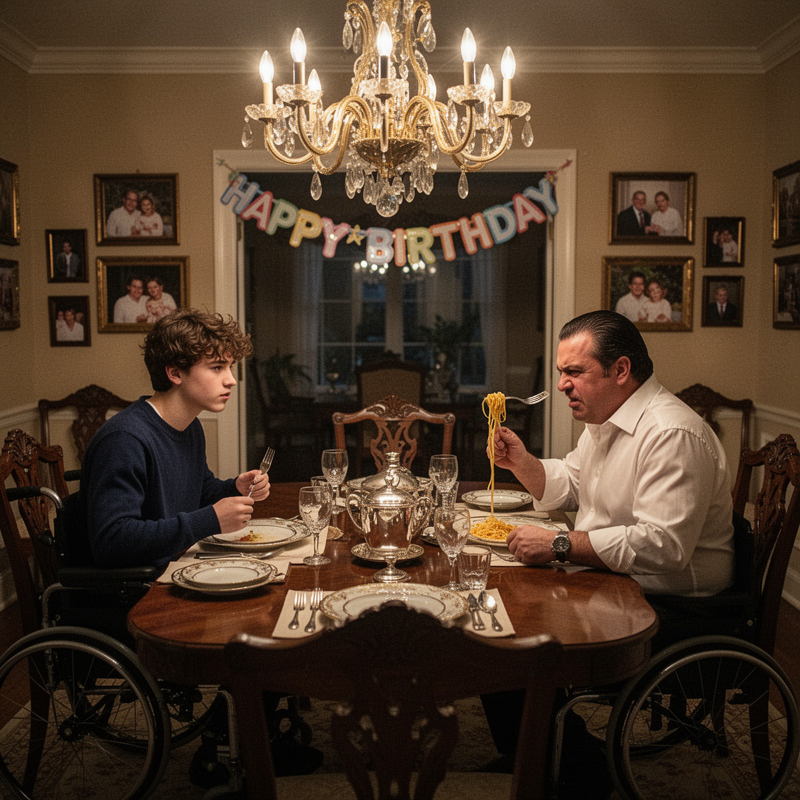
“If your mother hadn’t insisted on taking you to that stupid youth soccer tournament seven years ago, you’d be playing Division I right now instead of sitting in that chair,” my husband Marco sneered across the dinner table.
He spat the words directly at my eighteen-year-old son, Leo, just as he had done every single week since the accident.
I lowered my eyes, swallowing the familiar guilt that had suffocated me ever since my sister passed away six months ago, leaving me entirely isolated in Marco’s mob-controlled household.
Then Leo slowly put down his fork, reached under his napkin, and pulled out a thick Manila envelope.
“You can stop blaming Mom now, Marco,” Leo said quietly, his voice unnaturally calm. “Because I know exactly what happened to the brakes that night, and I know what you’ve been hiding in your safe.”
The silence that followed was thick, heavy, and immediate. It pressed down on the ornate dining room, muffling the distant city sounds. My heart hammered against my ribs, a frantic bird trapped in a cage.
Marco, usually so quick to retort, froze with his fork halfway to his mouth. A piece of pasta, glistening with sauce, dangled precariously from the tines. His dark eyes, normally gleaming with cruel amusement, narrowed to slits.
I dared to look up, my gaze darting from Leo’s unnervingly placid face to Marco’s sudden, unsettling stillness. The air in the room seemed to crackle with an unspoken charge, a dangerous energy that had been simmering beneath the surface for years.
This was Leo’s eighteenth birthday. We had a cake with candles waiting in the kitchen, a vibrant “Happy Birthday” banner strung haphazardly above the doorway, almost mocking the tension that now choked the room.
Just moments before, Marco had been in full tirade, his voice dripping with venom. He had been recounting, for the hundredth time, the story of Leo’s accident seven years ago.
“A promising career,” he had declared, slamming a fist lightly on the polished mahogany table, making the silverware jump. “All gone. A waste.”
He always framed it as my fault, a reckless decision to take Leo to that “stupid” soccer tournament. The tournament that had ended with our car careening off Roosevelt Boulevard, leaving Leo paralyzed from the waist down.
My hands, hidden in my lap, clenched into fists, my fingernails biting into my palms. The guilt was a constant companion, a suffocating blanket woven from Marco’s accusations and my own enduring grief. It had been six months since my younger sister, Sofia, had passed away. Six months of feeling even more isolated, more vulnerable, under Marco’s increasingly oppressive thumb.
He controlled everything now. My ancestral bakery, the house we lived in, even the clothes I wore seemed to bear the invisible stamp of his ownership. But my son, Leo, had always been my unwavering focus, my reason to endure.
Leo, in his wheelchair at the end of the long table, had seemed to shrink into himself for years under Marco’s relentless psychological attacks. He rarely spoke up, just absorbed the barbs, a quiet strength radiating from him despite his physical limitations.
But not tonight. Tonight, something was different. The calm in his voice was unnerving, an icy counterpoint to Marco’s usual fiery outbursts.
Marco slowly lowered his fork, placing it with meticulous care beside his plate. The clink of metal against ceramic echoed in the sudden, profound silence. He wiped his mouth with his napkin, his movements slow and deliberate, almost theatrical.
“What is that, Leo?” Marco asked, his voice low, a dangerous rumble beneath the forced calm. “Some kind of birthday joke?”
Leo didn’t flinch. He pushed the thick Manila envelope further across the table, sliding it gently until it stopped just inches from Marco’s hand. The paper was worn at the edges, slightly crinkled, as if it had been handled many times.
“It’s not a joke, Marco,” Leo replied, his gaze unwavering, meeting Marco’s cold stare head-on. “It’s the truth.”
My breath hitched in my throat. What truth? What could Leo possibly know? The accident had been seven years ago. He was only eleven then, a child.
Marco picked up the envelope, turning it over in his hands. His brows furrowed slightly as he felt the thickness of the paper, the weight of whatever secrets it contained. His eyes scanned the blank exterior, searching for a clue.
“Truth about what, exactly?” Marco asked, a hint of a sneer returning to his lips, though it felt less convincing this time. “That your mother is a terrible driver?”
My face burned with renewed shame and anger, but Leo cut him off before I could even formulate a response.
“The truth about the car, Marco,” Leo said, his voice gaining a quiet intensity. “The mechanic’s report from the impound lot after the crash. It says the brake lines were cut.”
A gasp escaped my lips, a sharp, involuntary sound. It was a secret I had buried deep, a fleeting thought I had immediately dismissed as trauma-induced paranoia. *Cut?* No, it couldn’t be. The police report had been clear: a simple mechanical failure.
Marco’s carefully constructed composure shattered. His eyes widened imperceptibly, a flicker of raw, unadulterated shock crossing his features before he could mask it. The color drained from his face, leaving a pale, almost sickly pallor.
He dropped the envelope onto the table with a sharp slap. The sound seemed to reverberate, a gunshot in the dining room.
“What… what are you talking about?” Marco stammered, his voice losing its smooth menace, replaced by a rough, agitated tone. He looked at me, then back at Leo, his gaze desperate, searching for a lie, an explanation.
Leo leaned forward slightly, his hands resting on the wheels of his chair. He didn’t raise his voice, but every word resonated with chilling clarity.
“I’ve also been seeing a physical therapist in secret, Marco,” Leo continued, ignoring his stepfather’s flustered questions. “A specialist. He says the nerve damage isn’t irreversible like you always told Mom. He says with consistent therapy, I could regain sensation. Maybe even walk again.”
My head snapped towards Leo, my eyes wide with disbelief and a sudden, overwhelming surge of hope I hadn’t dared to feel in years. *Walk again?* He had been doing this in secret?
“He also mentioned something else,” Leo added, his voice dropping to a near whisper, but piercing the silence like a shard of ice. “He mentioned that the old medical records show a sudden cancellation of a specialized nerve treatment program… signed by you, Marco. Four years ago.”
Marco stared at Leo, his face a mask of furious, disbelieving horror. His lips moved, but no sound came out. He opened his mouth again, a guttural sound finally escaping.
“You… you little—”
Leo held up a hand, silencing him. The gesture was so confident, so unexpected, that Marco actually stopped speaking.
“And,” Leo finished, his eyes burning with a cold fire, “I know what you’ve been hiding in your safe, Marco. All the papers about the syndicate. Everything.”
My gaze snapped to the small, discreet safe embedded in the wall behind Marco’s desk in his study, a place I had never been allowed to touch. A cold dread, far deeper than any guilt I’d ever felt, settled in my stomach. Syndicate papers?
Marco lunged across the table, his hand shooting out to grab the envelope. His chair scraped back with a violent shriek against the polished floor.
“Give me that!” he roared, his face contorted with rage, the veneer of calm completely gone.
But Leo was faster. He pulled the envelope back, clutching it to his chest, his eyes never leaving Marco’s. His composure was unnerving, a stark contrast to Marco’s explosive fury.
“You’re not getting this back,” Leo said, his voice still low, but unwavering. “Not until Mom knows everything.”
Marco’s breath hitched. He stood frozen, his hand still outstretched across the table, inches from Leo. His chest heaved with suppressed violence. His eyes, now truly terrifying, fixed on Leo with murderous intent.
A wave of icy fear washed over me, stronger than anything I had ever felt before. It wasn’t just about the car accident anymore, or Leo’s legs. This was about something far more dangerous, something that had been hidden in plain sight all these years. And Leo, my brave, quiet son, had just walked right into the heart of it.
Part 2
The moment hung, thick and suffocating. Marco finally dropped his outstretched hand, his chest still heaving. He merely stared at Leo, then slowly pushed his chair back. “We’re done here,” he snarled, before stomping from the room, the heavy oak door slamming shut upstairs moments later.
Leo still held the Manila envelope, his gaze fixed on the empty doorway Marco had vanished through. My own heart still pounded, but the immediate, explosive threat had passed. My son, my quiet, resilient Leo, had just faced down his stepfather, and for the first time in years, he hadn’t backed down.
Hours later, long after Leo had retreated to his room, the house felt eerily quiet. I was clearing the last dishes, the silence a stark contrast to the earlier chaos. A soft, insistent rap came from the back door. I froze, my hand still on a plate. Marco never used the back door.
I wiped my hands on my apron and tiptoed to the door, peering through the small frosted window. It was Ray, my older brother. His face was grim, his shoulders hunched against the night air.
I quickly unlatched the door and pulled him inside, closing it softly behind him. “Ray, what are you doing here? Is everything okay?” I whispered, my voice laced with a fresh wave of anxiety. He rarely visited, knowing Marco’s dislike for my family.
He shook his head, running a hand through his already disheveled hair. “No, Nora, it’s not okay. I just got off the phone with Tony from the bank. Something’s happened with the bakery accounts.”
My stomach clenched. The bakery, “Rossi’s Legacy,” was my family’s heart and soul, passed down through generations. It was the last thing I had left that truly felt like mine.
“What about them?” I asked, my voice barely audible.
Ray pulled a folded printout from his jacket pocket, handing it to me. The numbers swam before my eyes, but one line stood out, stark and horrifying: a transfer out.
“Forty-five thousand dollars,” Ray said, his voice flat. “Gone. Transferred out of the commercial operating account this morning. Marco’s name is on the transaction approval.”
A cold dread seeped into my bones, chilling me far deeper than any of Marco’s cruel words ever had. The money wasn’t just gone; it had been taken by *him*.
“But… why?” I whispered, my voice trembling. “We need that for suppliers, for payroll next week.”
Ray took my hands, his grip firm. His eyes met mine, full of a fierce, protective anger I hadn’t seen in years. “He’s making sure you can’t leave, Nora. He’s systematically emptying out your finances. He’s not just emotionally abusing you anymore. He’s destroying your independence, piece by piece, so you’ll have no choice but to stay.”
Chapter 2: The Specialist’s Slip
The air in Dr. Kincaid’s private orthopedic office smelled like antiseptic and something vaguely sweet, like old candy. I pushed Leo’s wheelchair through the waiting room, past a faded poster of a smiling runner.
“It’s good to see you again, Leo,” Dr. Kincaid said, his voice a little too loud, a little too cheerful. He avoided my eyes.
Leo managed a tight smile. He’d seen Dr. Kincaid off and on for years, though the visits felt more like bureaucratic checkpoints than actual treatment.
Dr. Kincaid moved around Leo, checking his leg braces, his movements quick and professional. He didn’t make small talk.
“Alright, let’s see these nerve pathways,” he muttered, adjusting a small monitor. “Still no change, correct?”
“No,” Leo said, his voice flat. “Still no sensation below the knee.”
I watched Dr. Kincaid’s face. He seemed distracted, his brow furrowed as he typed something into a tablet.
“It’s a real shame,” he began, almost to himself. “Such promising initial signs for regeneration. I remember the orders came through to stop the advanced therapy, oh, must be four years ago now. Marco signed off on it, said it was too expensive.”
My breath hitched.
The antiseptic scent in the room turned acrid.
“Marco signed what?” I asked, my voice barely a whisper. My hands went cold.
Dr. Kincaid’s head snapped up. His eyes, dark and wide, met mine, and a flicker of pure panic crossed his face. He looked like a deer caught in headlights.
“The… the forms,” he stammered, fumbling with the tablet. “For the cessation of the advanced neural stimulator therapy. Your husband, Mr. Moretti. He stated it wasn’t providing results and wanted to conserve funds.”
A wave of nausea washed over me. Marco. Not me.
It wasn’t my decision to stop Leo’s most hopeful treatment. Marco had done this, deliberately, to keep my son bound to that chair. To keep him dependent.
My vision blurred, the cheerful running poster suddenly a cruel mockery.
Chapter 3: Squeezing the Business
The moment Marco walked through the door that evening, I met him in the hallway. The shock from Dr. Kincaid’s words had hardened into a cold, furious resolve.
“The bakery accounts,” I said, my voice shaking despite my best efforts. “They’re frozen. And now Dr. Kincaid tells me you stopped Leo’s nerve therapy.”
Marco didn’t even flinch. He walked past me into the living room, loosening his tie.
“The bakery needs management, Nora,” he said, turning to face me with a sneer. “And you’re too emotional to provide it.”
He tossed a thick stack of papers onto the coffee table.
“As for your little business,” he continued, gesturing at the documents, “it seems there are some outstanding debts. Property leases you never renewed properly.”
My heart pounded. I picked up the top document. It was a lease agreement for the bakery, but the figures were wrong, inflated.
“This is forged,” I said, my voice cracking. “The lease isn’t up for another three years.”
Marco shrugged, a casual movement that sent a chill down my spine.
“Not according to my lawyers. You owe $120,000 in arrears, effective immediately. The property is being repossessed.”
Before I could respond, my phone buzzed. It was a text from one of my bakers.
*They’re chaining the doors, Nora. Men in suits.*
I looked up at Marco, my entire world spinning. His eyes held no warmth, only a chilling triumph.
“It’s simple, Nora,” he said, walking to the bar cart. “You sign over the full power of attorney, and I’ll see what I can do to ‘reschedule’ your payments.”
He poured himself a generous measure of whiskey, watching me over the rim of the glass. He believed he had won.
Chapter 4: Brakes and Lies
Ray found me huddled on a milk crate in the alley behind what used to be my bakery. The heavy chains on the doors glinted under the single, flickering streetlight.
“Nora,” he said, his voice quiet, his face grim. He held a large, weathered envelope.
I looked up, tears blurring my vision. “He’s taking everything, Ray. He even stopped Leo’s treatment four years ago.”
Ray knelt beside me, placing a hand on my shoulder.
“I know,” he said. “I’ve been digging deeper than just the bakery books. I went back to the original accident reports.”
He pulled out a stack of documents, official-looking, with a mechanic’s shop logo at the top.
“I had a contact at the precinct,” Ray explained, his eyes scanning the papers. “Someone who owed me a favor. These are sealed. Seven years ago.”
He pointed to a specific paragraph. My eyes struggled to focus in the dim light.
*…”deliberate severing of brake lines, consistent with criminal tampering.”*
My vision cleared with sickening clarity. The words burned into my brain.
“The car,” I whispered, my voice hollow. “Seven years ago. My husband’s car. Before it crashed.”
Ray nodded, his jaw tight. “The reports show the lines were cut. Not just faulty.”
The alley air, thick with the smell of dumpster and damp concrete, suddenly felt impossibly heavy.
Marco hadn’t just sabotaged Leo’s future. He hadn’t just crippled my son.
He had orchestrated the crash. He had murdered my first husband.
The realization hit me like a physical blow, stealing the air from my lungs. Every act of cruelty, every sneer, every calculated move, suddenly made horrifying, absolute sense.
Chapter 5: Closing the Net
The next morning, Marco’s casual cruelty continued its relentless march. He sat at the dining table, sipping coffee, while I tried to coax Leo into eating.
“I’ve also terminated Leo’s medical trust fund,” Marco announced, not looking up from his newspaper. “Eighty thousand dollars wasted on treatments that clearly don’t work.”
My fork clattered onto my plate. “You can’t do that! That’s for his future!”
“It was a discretionary fund,” Marco said, folding the paper. “And I’m exercising my discretion. I’m trying to teach you financial responsibility, Nora.”
Leo slowly pushed his plate away, his knuckles white against the tray.
That afternoon, desperate, I gathered my mother’s small jewelry box. A sapphire pendant, an engraved bracelet. They weren’t worth much, but they were all I had left.
The pawn shop was a short walk from the house. I clutched the box in my hand, walking quickly, trying to avoid any of Marco’s associates.
But as I stepped out, turning onto the quiet side street, a dark sedan pulled up beside me. Gino Salzar, Marco’s bulky lieutenant, leaned out the passenger window, a grim smile on his face.
“Going somewhere, Nora?” Gino’s voice was low, menacing. “Marco thinks you’re getting ideas.”
I stopped dead, my heart pounding against my ribs.
“He also asked me to remind you that Leo is a vulnerable young man,” Gino continued, his eyes flicking to the house. “Accidents happen, especially when people don’t cooperate.”
My hand tightened around the jewelry box, my knuckles aching. He was threatening Leo. Directly.
Marco had isolated me, financially ruined me, and now he was threatening my child. I could no longer fight him on his own terms, in the shadows of his world.
There was only one path left. The law.
Chapter 6: The Trophy Ledger
The house felt like a cage. After Gino’s threat, I avoided even the garden, my eyes constantly scanning the windows. Leo was confined to his room, his keys and phone gone.
“Mom,” Leo whispered from his doorway late that night, after Marco had finally gone to bed.
I turned, my heart leaping. He had managed to get his door open.
“What is it, sweetie?” I asked, pulling him further into the dim hallway.
He gestled something in his lap, a small, dark object.
“I have something important,” he said, his voice low and urgent. “Something for Ray. For the FBI.”
My breath hitched. “The FBI? Leo, what are you talking about?”
He looked up at me, his eyes wide and determined.
“Four years ago,” he began, “when I was laid up in bed, Marco came into my old room. He didn’t know I was watching him from under the covers.”
He paused, a flicker of old fear in his eyes.
“He took my old soccer trophy,” Leo continued. “The one for the State Finals. He twisted the base off. There was a hollow compartment inside.”
He held out the object in his hand. It was a micro-SD card.
“It was full of papers,” Leo said. “Handwritten ledgers. Names, dates, numbers. All his dirty business. Loansharking, extortion. I knew it was important.”
He swallowed hard. “I started photographing everything. Every page. Then I put it back and hid this card where he’d never look.”
My fingers trembled as I took the tiny card. Marco’s entire criminal empire, tucked inside a child’s soccer trophy. His arrogance was breathtaking.
“Thank you, Leo,” I whispered, pulling him into a tight embrace. “You saved us.”
Chapter 7: Debt Assignment
The next afternoon, Marco called a “family meeting” in the living room. Leo and I sat stiffly on the sofa, while Marco stood by the fireplace, a stack of legal papers in his hand.
“Since you’re so irresponsible with your finances, Nora,” he began, his voice dripping with false concern, “I’ve taken the liberty of consolidating some… outstanding debts.”
He laid the papers on the coffee table. These documents were heavier, more official-looking than the bakery lease. They bore the letterhead of various shell corporations.
“These are syndicate liabilities,” he explained, tapping the top page. “Three hundred and fifty thousand dollars, to be exact.”
My eyes darted across the page. Names I recognized from the periphery of Marco’s world—loan sharks, enforcers. And then, my name. Nora Rossi.
“You can’t be serious,” I choked out. “I have nothing to do with this.”
Marco smiled, a cold, predatory flash of teeth.
“You’re my wife, Nora. In the eyes of the syndicate, that makes you a guarantor. Unless you’d prefer I explain to these gentlemen that you’re refusing to cooperate?”
He gestured to the phone on the side table. The implication was clear: a call to one of these ruthless creditors would mean not just financial ruin, but physical danger.
“Sign here,” he ordered, pushing a pen across the table. “Or you face the consequences alone.”
The weight of $350,000 in mob debt, fraudulently transferred, pressed down on me. It was a suffocating, inescapable burden.
Chapter 8: The Underworld Crack
Ray met me in a secluded corner of the library, away from Marco’s prying eyes. The grand old room, usually quiet, felt full of unspoken tension.
“I found something else,” Ray said, his voice hushed. He didn’t look up from the tablet in his hands.
I looked around nervously. “What is it?”
“Gino Salzar,” he muttered. “Marco’s lieutenant. He’s been… providing information.”
My blood ran cold. “Gino? But he threatened Leo.”
“He’s playing both sides,” Ray explained, finally looking up, his eyes hard. “He wants Marco out of the picture. Gino thinks if Marco goes down, he can claim his territory.”
Ray showed me a series of encrypted messages, anonymized but clear in their content: tips about money transfers, meeting locations, names of Marco’s dirty contacts.
“He’s been feeding me crumbs for weeks,” Ray said. “Small, untraceable things that led me to bigger trails. He knows I’ve been auditing Marco’s books.”
The twist was unsettling. Gino, who had threatened my son, was also providing the very leverage we needed.
“He’s desperate to replace Marco,” Ray continued. “And he’s willing to use us to do it. But it also means he’s a ticking time bomb. We need to move fast, Nora, before he makes his move and things get violent.”
The situation felt like walking on a razor’s edge.
Chapter 9: The Federal Pact
Two days later, under the cloak of a moonless night, Ray and I met Detective Frank Delgado of the FBI Organized Crime Task Force. The detective’s unmarked vehicle was parked in a deserted lot near the Philadelphia docks, the air smelling of brine and diesel.
Detective Delgado was a stern, imposing figure, even in the close confines of the car. He listened without interruption as Ray laid out everything.
“We have this,” I said, handing over the micro-SD card Leo had given me. “Photos of Marco’s hidden ledger. Years of his illegal operations.”
Then I produced the copies of Dr. Kincaid’s signed orders, the ones Marco had used to cancel Leo’s therapy.
Delgado reviewed them, his face unreadable. “This is significant,” he finally stated, his gaze sweeping over us. “Enough to build a strong RICO case against Moretti.”
He paused, then looked directly at me. “But to secure a conviction, we need more. We need his primary encryption key. The one that links all his digital accounts, offshore transfers, everything.”
A cold knot formed in my stomach. “His master key? It’s in his office, on his computer.”
“Exactly,” Delgado affirmed. “And we can’t get a warrant to search his home without a higher level of probable cause. You’ll have to get it, Mrs. Rossi.”
My hands tightened on my knees. Returning to that house, to face Marco, knowing what I now knew—it was terrifying.
“You’d be acting as an insider informant,” Delgado warned, his voice grave. “It’s extremely dangerous. But it’s the only way to get him.”
I looked at Ray, then back at the detective. There was no other choice.
“I’ll do it,” I said, my voice steady, though my heart pounded a frantic rhythm.
Chapter 10: The Threat to the Legacy
Marco’s paranoia sharpened as the days passed. He noticed Ray driving past the syndicate’s local properties, too frequently for coincidence.
One evening, he cornered me in the kitchen, his eyes narrowed. “Your brother is getting too curious, Nora. It’s becoming a liability.”
My stomach clenched. “Ray is just worried about me.”
Marco scoffed. “He’s worried about your late sister’s estate. And speaking of which…”
He tossed a thick envelope onto the counter. Inside were official court documents.
“I’ve filed a claim against Sofia’s estate,” Marco announced, his voice flat. “It appears she owed me a substantial sum in gambling debts. Unpaid, of course.”
My hands trembled as I picked up the papers. Sofia. My beloved younger sister, gone six months ago, taken too soon. Now Marco was desecrating her memory, fabricating debts to seize what little she had left.
“This is a lie,” I whispered, my voice raw with anguish. “Sofia never gambled.”
“The courts will decide that,” Marco said, turning to leave the kitchen. “Unless, of course, you finally decide to be a cooperative wife.”
The audacity, the sheer depravity of it, stole my breath. He was systematically dismantling every piece of my past, every memory of my family. The bakery, my home, Leo’s future, and now Sofia’s legacy.
He wasn’t just destroying me; he was erasing us. My lineage, my history, everything that mattered. I had to destroy him first.
Chapter 11: The Doctor’s Confession
The discreet black sedan pulled up to Dr. Kincaid’s private practice just as he was leaving for the day. Two agents, efficient and unsmiling, blocked his path.
“Dr. Kincaid? Federal agents. We need to ask you some questions about Marco Moretti.”
Panic immediately flashed across Dr. Kincaid’s face. He visibly paled, his hand going to his tie.
“Mr. Moretti?” he stammered. “I… I don’t know anything.”
One of the agents held up a subpoena. “We have reason to believe you were involved in a conspiracy to falsify medical records and obstruct patient treatment.”
The words hung in the air. Dr. Kincaid’s composure shattered.
Within hours, in a sterile interrogation room, Dr. Kincaid was giving his sworn testimony on video. His voice was hoarse, his eyes darting nervously.
“He… he paid me,” Dr. Kincaid confessed, wiping sweat from his brow. “He threatened my family. He said if I didn’t sign the orders to stop Leo’s advanced nerve therapy, and if I didn’t keep him out of legitimate rehab centers, there would be consequences.”
He detailed how Marco had specifically ordered him to ensure Leo’s medical diagnosis reflected a permanent, untreatable disability, even when there was still hope.
“He wanted him confined,” Dr. Kincaid said, his voice cracking. “He wanted him… immobile. He called it ‘management’.”
He implicated Marco in a scheme spanning four years, detailing specific payments and threats, providing the federal agents with the concrete evidence they needed to prove Marco’s deliberate medical neglect and manipulation.
Chapter 12: Confiscated Freedom
The tension in the house was a living, breathing thing. Leo, restless and determined, saw his chance. Marco had left the front gate unlocked, a rare oversight.
“I’m going to meet Ray,” Leo whispered to me, his voice tight. “He said he found something else important.”
My heart hammered against my ribs. “No, Leo, it’s too risky. Marco is on edge.”
But Leo was already moving, slowly propelling his chair toward the front door. “I need to do something, Mom. I can’t just sit here.”
He made it out the front door, the afternoon sun warm on his face. He was halfway down the short path to the gate when Marco’s black sedan screeched to a halt in front of the house.
Marco stepped out, his face a mask of rage. He stalked toward Leo.
“Where do you think you’re going?” Marco snarled, his eyes blazing.
Leo froze. “Just… for a ride.”
Marco lunged, yanking the key out of Leo’s wheelchair ramp access panel. He snatched Leo’s phone from his lap, then reached into his jacket pocket and pulled out Leo’s wallet, extracting his driver’s license and ID card.
“You’re not going anywhere,” Marco hissed, his grip tight on the items. “You’ll stay in your room, where you belong.”
He turned back to the house, kicking Leo’s wheelchair back towards the front door. He then shoved Leo into his bedroom, slamming and locking the door from the outside, the heavy click echoing through the silent house.
He had isolated us completely.
Chapter 13: The Mask of Surrender
The next morning, the silence in the house was suffocating. Leo was locked in his room, and Marco moved through the house with an air of smug victory.
I approached him in the living room, my hands clasped tightly together, my shoulders slumped. I forced tears to my eyes, letting them track down my cheeks.
“Marco,” I sobbed, my voice choked with what I hoped sounded like despair. “Please. I can’t. I can’t fight you anymore.”
He paused, a flicker of suspicion in his eyes, then replaced by satisfaction. He leaned back in his armchair, a slow smile spreading across his face.
“Smart woman, Nora,” he purred. “You’re finally seeing reason.”
I continued to weep, pulling out the debt assumption papers he had given me days ago. “I’ll sign them. All of them. Just… just tell me what to do.”
He watched me for a moment, savoring my apparent defeat.
“Good,” he said, rising from his chair. “I’ll get a celebratory drink. Then we can make this official.”
He walked to the bar cart, his back to me, clearly believing his victory was complete. He had left his home office desk unlocked, just as Delgado had predicted. My chance.
My hands flew to my collar, undoing the tiny clasp of a necklace I hadn’t worn in years. Attached to it was a microscopic flash drive.
I moved like a phantom, my movements silent and swift. Four minutes. That was all I had.
My fingers flew across the keyboard, navigating his messy desktop, finding the encrypted financial files. I inserted the flash drive, my heart pounding a frantic rhythm against my ribs. The data transfer bar crawled across the screen.
Every second felt like an hour. I heard the clink of ice from the living room.
Then, a triumphant *ping*. The transfer was complete.
I pulled out the flash drive, re-attached it to my necklace, and slipped it back under my shirt, taking a deep, shuddering breath just as Marco returned, a glass of amber liquid in his hand.
Chapter 14: The Evidence Chain
The moment Marco turned his back to retrieve another cigar from his humidor, I moved. I grabbed a small duffel bag I’d stashed behind the sofa days ago, containing only essentials.
I slipped out the back window, pushing it open just enough to squeeze through. The cool night air hit my face, invigorating me. I landed softly on the dewy grass.
Ray was waiting just beyond the fence, hidden in the shadows of a large oak tree. He stepped forward as I approached, his face etched with worry.
“Did you get it?” he whispered, his eyes scanning the house.
I pulled out the flash drive from beneath my shirt, my hand shaking slightly. “Everything. His master encryption key. All his financial data.”
Ray took it, his fingers brushing mine. His expression was grim but determined.
“Delgado’s waiting,” he said.
He led me to his car, parked a few blocks away, and sped off. We drove directly to a secure, unmarked building downtown.
Inside, Detective Delgado sat at a computer, his expression tense. Ray immediately plugged in the flash drive.
Lines of code and encrypted files filled the screen, then began to decrypt, information spilling out like a broken dam.
Delgado watched, his jaw tight. “Wire fraud, extortion, money laundering… it’s all here.”
Then, he looked at Ray, then at me. “And with Dr. Kincaid’s testimony, and those original mechanics’ reports, we have attempted murder and child medical neglect.”
He leaned back in his chair, a rare flicker of satisfaction in his stern eyes. “It’s complete. We have everything we need to bring him down.”
A wave of exhaustion, profound and bone-deep, washed over me. It was done.
Chapter 15: Setting the Trap
Detective Delgado’s voice was firm, leaving no room for argument. “We have the evidence, Mrs. Rossi. Now we need to spring the trap.”
We were back in his office, the glow of the computer screens reflecting in his glasses.
“Tactical units are mobilizing,” he explained, pointing to a map of Marco’s estate on a large monitor. “We need him in his private office, isolated. No chance for him to escape or destroy more evidence.”
I swallowed hard. “You want me to go back in?”
“Yes,” Delgado confirmed, his gaze unwavering. “One last time. Ensure he’s in place. You’re the only one who can get close enough without arousing suspicion.”
My hands trembled. The thought of stepping back into that house, knowing Marco believed he had utterly broken me, was chilling. He would be celebrating, arrogant in his supposed victory.
“If he suspects anything, Mrs. Rossi,” Delgado warned, his voice low, “he’s a dangerous man. He won’t hesitate to use force.”
I imagined Marco’s face, contorted with rage, if he knew. The terror was palpable.
But then I thought of Leo, locked in his room, his future stolen. I thought of my first husband, murdered. My bakery, gone. Sofia, slandered.
This was for them.
“I understand,” I said, my voice steadying. “I’ll do it.”
Chapter 16: The Silent House
The house loomed, a dark, imposing silhouette against the midnight sky. I slid out of Ray’s car a few blocks away, the cool night air prickling my skin.
Every shadow seemed to stretch, to whisper Marco’s name. My heart hammered against my ribs, a frantic drumbeat in the oppressive silence.
I used my old key, turning it carefully in the lock. The click echoed loudly in the stillness.
Inside, the house was utterly silent, every room dark. It was a silence that felt heavy, pregnant with expectation. My footsteps on the polished wood floors sounded like gunshots.
I crept past Leo’s room. A sliver of light escaped from under his door, and he must have heard me. A quick, almost imperceptible tap-tap on the wood.
My son. Still locked inside, waiting.
I gave a tiny, reassuring nod at the door, hoping he felt it.
I then heard the low murmur of Marco’s voice, muffled but distinct, coming from his private study at the far end of the house. He was still there, just as Delgado wanted. Drinking, I imagined, and gloating over his stolen deeds.
I walked to the front door, my hand shaking slightly, and twisted the deadbolt. The click was loud and final.
The trap was set. Now, I just had to face him.
Chapter 17: The Locked Room
I climbed the grand staircase, each step a deliberate, defiant act. The house remained utterly silent around me, amplifying the sound of my own breath.
Marco’s office door was slightly ajar, a sliver of warm, yellow light spilling into the dark hallway. I could hear the clink of ice in a glass, followed by a low, self-satisfied chuckle.
I pushed the heavy oak door open completely, stepping into the room. It smelled of expensive whiskey, old leather, and stale cigar smoke.
Marco sat at his massive mahogany desk, bathed in the dim glow of a single desk lamp. He looked up, a triumphant smirk on his face.
He held up a thick, embossed document—the deed to my ancestral bakery. My family’s legacy, now reduced to a piece of paper in his hands.
“Nora,” he purred, his eyes gleaming with arrogance. “Come in. We have much to celebrate.”
I walked further into the room, my spine rigid. Then, with a slow, deliberate movement, I reached behind me and pulled the heavy door shut. The click of the lock echoed in the quiet room.
Marco’s smile wavered for a fraction of a second, just enough for me to see a flash of surprise.
He had no idea that federal agents surrounded the house. He had no idea the game was finally over.
Chapter 18: The Unraveling
Marco’s eyes narrowed slightly as the lock clicked. “What are you doing?” he asked, his voice losing its playful edge.
I walked toward his desk, my gaze steady, refusing to break eye contact.
“I’m here to finish this, Marco,” I said, my voice clear and unwavering. “No more games. No more lies.”
His smirk returned, harder now. “You have nothing, Nora. You’re ruined. Your pathetic bakery is mine, your house is mine, and your son is a cripple who can never leave his room.”
I stood directly across from him, the desk between us. “You cut my husband’s brake lines, didn’t you, Marco?”
His casual laugh was a chilling sound. “That old accident? Poor unfortunate soul. Bad driving, Nora. Happens.”
“And you ordered Dr. Kincaid to stop Leo’s nerve treatment,” I continued, pushing past the shock of his callousness. “You wanted him immobile. Dependent. You wanted to punish me.”
Marco leaned back, a triumphant gleam in his eyes. “So what if I did? You can’t prove a thing. All the ‘physical records’ were destroyed years ago. You think your little brother’s digging means anything? My connections run deep, Nora. I’m untouchable.”
I reached into my collar, my fingers finding the tiny, cold metal of the wire transmitter. I pulled it out slowly, letting it dangle in front of him.
“You’re not untouchable, Marco,” I said, my voice cutting through the thick air. “And every word you’ve just said has been recorded.”
His face, which had been so arrogant just seconds before, went absolutely still. Then, a primal roar erupted from him. He lunged across the desk, grabbing for the small device.
“You bitch!” he screamed.
But I was faster. I stepped back, and he stumbled. He then scrambled toward the wall safe hidden behind a framed picture, his eyes wide with frantic desperation. He knew his digital backup drives were inside.
“It’s too late, Marco,” I said, a grim satisfaction rising within me. “Two hours ago, Gino Salzar gave the FBI your master decryption keys. He cut a deal to save his own skin.”
Marco froze, his hand inches from the safe dial. His face contorted with a mixture of disbelief, betrayal, and pure, unadulterated terror.
At that exact moment, the heavy oak door to his office exploded inward with a deafening crash. Federal agents, weapons drawn, swarmed the room.
“FBI!” one agent yelled. “Moretti! Hands where I can see them!”
Marco let out a guttural cry, more animal than man, as they threw him to the floor, snapping handcuffs around his wrists.
Chapter 19: The Price of Justice
Marco Moretti, his face crimson with fury and spittle, was dragged out of the house. He screamed threats, his voice raw and hoarse, echoing through the night as he was shoved into an unmarked federal vehicle.
“You’ll regret this, Nora! I’ll be back! You’ll pay for this!”
His words were hollow, powerless. The street was alive with federal agents, uniformed police, and forensic teams. Lights flashed, illuminating the grim reality of his downfall.
But the victory was sharp, edged with a bitter truth.
Detective Delgado approached me, his expression grave. “Mrs. Rossi, because Mr. Moretti commingled his illegal proceeds with the deeds to your family bakery and this residential property, federal asset forfeiture laws take immediate effect.”
My stomach dropped. I knew what that meant.
“The properties will be seized,” he continued, his voice softer, apologetic. “They are considered instruments of his criminal enterprise.”
My home. My mother’s home. The bakery, built by my grandparents. Gone.
Leo sat in his wheelchair by the now-open front door, watching the chaos, his face pale but calm.
There was no time for goodbyes. No time for sentiment. We had to pack what we could, fast. I grabbed garbage bags, stuffing Leo’s clothes, mine, a few cherished photos. Anything small enough to carry.
The house, once a symbol of both comfort and terror, was no longer ours. We were being evicted by the very system that had just saved us.
As the first rays of dawn touched the horizon, Leo and I walked out the door for the last time, carrying our meager possessions in plastic bags, leaving behind everything we had ever known.
Chapter 20: A Long Time Later
A long time later, the scent of fresh coffee filled our small, functional kitchen. The unglamorous two-bedroom apartment in South Philadelphia was cramped, but it was ours. Truly ours.
Marco Moretti was serving a 35-year federal prison sentence without possibility of parole. His syndicate was dismantled, his assets seized. Justice had been delivered, stark and uncompromising.
Leo sat across from me at the small, laminate table, slowly stirring sugar into his coffee. He could stand for short periods now, with the aid of braces, thanks to a small, private charity fund Ray had quietly set up. But seven years of lost medical care had left an indelible mark. His movements were careful, deliberate.
The historic Rossi family bakery was gone, absorbed into federal coffers, then sold off to a chain. My financial standing was reduced to basic survival. I worked as an hourly clerk at a local grocery store, scanning items, bagging groceries.
But as I handed Leo his coffee, our eyes met. He offered a small, genuine smile. The brick alleyway outside our window was nothing special, just concrete and trash cans, but there was no lurking sedan, no shadowy figures.
There was no fear.
“We lost our home and our legacy to the flames of his greed,” I said softly, looking at my son’s steady hands, “but standing in this tiny room today, my son and I finally breathe air that belongs entirely to us.”
Leave a Reply