CHAPTER 1: Sacrifices on the River
Part 1
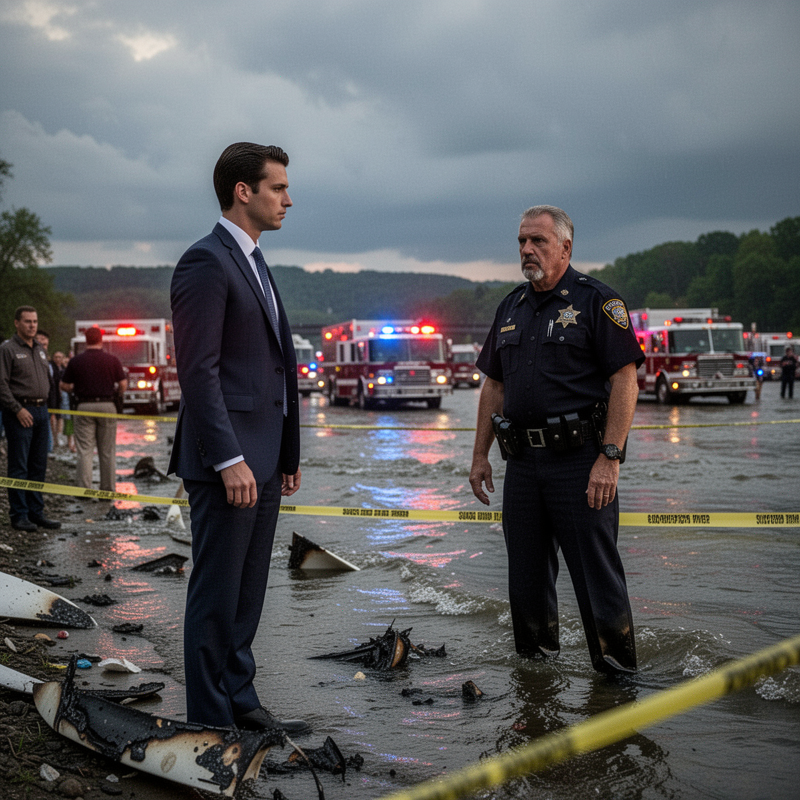
On July 3, 2025, my husband of four months, State Senator Julian Danforth, and his younger brother Leo were declared dead after their boat exploded on the Susquehanna River.
Three hours before the explosion, Julian sent me a single text message: “If the water takes us today, remember that power requires sacrifices you haven’t seen yet.”
By the next morning, the local sheriff closed the case as a tragic mechanical failure, refusing to examine the wreckage or interview the dock workers.
When I demanded a second look at the forensic reports, Julian’s political machine didn’t comfort me—they stripped my access to our home and warned me to stay quiet.
I thought I was mourning a heroic husband, but I was actually standing in the way of a fourteen-million-dollar ghost.
The air hung heavy and humid over the Susquehanna River, thick with the smell of scorched fiberglass and river water. Not even a full day had passed since the blast.
Emergency lights pulsed red and blue against the darkening July sky, reflecting off the oily sheen on the water. A crowd of onlookers, hushed but insistent, pressed against the police tape.
The television news vans, their satellite dishes gleaming, cast a harsh, artificial glow on the grim scene. Reporters spoke in hushed tones into microphones, their faces serious, yet eager.
I stood numbly by the water’s edge, the damp chill from the river seeping through my thin dress. My mind kept replaying Julian’s text message, the words echoing with an unsettling, hollow resonance.
“If the water takes us today, remember that power requires sacrifices you haven’t seen yet.”
Sacrifices. What sacrifices? The message had been so unlike him, so cryptic. I had dismissed it as dramatic flourish at the time, a senator’s flair for the theatrical. Now, it felt like a cold premonition.
Sheriff Donald Kester, a man whose career owed everything to Julian’s political pull, approached me. His uniform, still crisp, seemed untouched by the chaos.
“Nora,” he said, his voice a low rumble, barely audible over the distant hum of the news helicopters. He placed a hand on my shoulder, a gesture that felt more performative than comforting.
“We’ve completed our initial assessment,” Kester continued, his gaze sweeping over the wreckage bobbing in the murky water. “Tragic mechanical failure, plain and simple.”
He looked directly at me then, his eyes weary, almost pitying. “The engine malfunctioned. Happens more often than you’d think with these older models. A fuel line probably ruptured.”
“An engine malfunction?” I heard my own voice, thin and reedy, a stranger’s voice. “Julian just had that boat serviced last month. Leo was meticulous about maintenance.”
Kester sighed, his hand still on my shoulder, a subtle pressure trying to guide me away from the scene. “Sometimes these things just… fail, Nora. It was quick. They wouldn’t have felt a thing.”
A knot tightened in my stomach. Quick. Sacrifices. The words tumbled through my thoughts, intertwining.
“Have you examined the wreckage thoroughly?” I asked, pulling slightly away from his touch. “Spoken to the dock workers? There must be more…”
Kester shook his head, a finality in the gesture. “We’ve done our due diligence. It’s an open-and-shut case. My deepest condolences, Nora.”
He turned to address a scrum of reporters, already moving past me, leaving me standing alone, the smell of burning plastic still heavy in the air. The crowd began to disperse, the news vans packing up, a narrative already sealed and delivered.
I watched him walk away, feeling a chill that had nothing to do with the evening air. The quickness of his decision, the dismissive tone, it all felt wrong. Julian’s political machine, so powerful and efficient, was already spinning, burying the facts under a blanket of tragic convenience.
A few hours later, the silence of our sprawling estate on the hill felt oppressive. The house, usually bustling with campaign staff and aides, was eerily quiet. Julian’s presence was everywhere and nowhere.
I wandered through the empty rooms, the grand foyer, the formal dining room, the heavy curtains drawn against the outside world. Each step echoed in the stillness, amplifying the hollowness in my chest.
My eyes fell upon Julian’s study, a room usually filled with the scent of old books and ambition. I pushed the heavy oak door open.
It was immaculate, too immaculate. Every paper was stacked precisely, every pen aligned. It didn’t look like a room that had been left in a hurry by a man about to embark on a routine afternoon boat ride.
I walked to his mahogany desk, where his silver-framed photo of us from our wedding sat perfectly centered. My gaze drifted to the credenza, a place where he always kept his small, familiar stack of personal items.
His worn leather wallet. The antique silver watch, a gift from his grandfather. His favorite, slightly scuffed travel briefcase he used for weekend trips, always standing by the corner, ready to go.
My breath hitched.
The credenza was bare. Nothing. Not a single item remained. It was as if he had never left them there.
A cold dread seeped into my bones, chilling me far more than the river’s damp air had. My hands began to tremble.
He always kept those things there. Always.
He always kept them there, unless someone had deliberately removed them. And not just after his death. The police had been here, yes, but they hadn’t touched anything inside the house yet.
Unless they were taken *before* the explosion.
Unless someone had cleared out his personal effects this very morning.
Part 2
The realization hit me like a physical blow. The missing items from his credenza weren’t an oversight. They were part of a deliberate, calculated act. Julian hadn’t died; he had vanished.
The next day, a formal memorial service was held by the river, a somber affair orchestrated by Julian’s campaign staff. Hundreds of local dignitaries, party officials, and tearful constituents gathered under a large tent.
The air was thick with the scent of lilies and the hushed murmurs of condolences. Claire Holloway, Julian’s campaign manager, moved through the crowd with a practiced grace, her eyes red-rimmed but determined. Sheriff Kester stood by her side, a silent, imposing figure.
I stood apart, a widow in black, feeling like an imposter. The grief I displayed was real, but now it was laced with a chilling suspicion. I felt their gazes, a mixture of sympathy and political calculation.
As I watched the river flow past, reflecting the gray sky, a man broke away from the edges of the crowd. He was lean, with sharp, observant eyes, and carried himself with a quiet intensity that distinguished him from the political hangers-on.
He approached me cautiously. “Nora Danforth?” he asked, his voice low, almost a murmur against the ambient noise. “My name is Marcus Reed. I’m an investigative reporter for the *Harrisburg Herald*.”
I nodded, my eyes scanning his face, trying to place him. “Yes?”
“I know this isn’t the time,” he said, glancing around, “but I’ve been tracking some irregularities with port authority land appraisals for months. Julian’s name kept coming up.”
He paused, then leaned in slightly. “I’ve stumbled across something you need to see. Bank filings. Offshore accounts.”
He pulled a folded printout from his inner jacket pocket, discreetly pushing it into my hand. My fingers brushed against the cool paper, still slightly warm from his body.
The document was dense with banking jargon, but one line screamed out at me. A wire transfer. A large sum.
“$4.2 million,” Marcus whispered, pointing to a highlighted entry. “Transferred to a shell company in the Cayman Islands. Forty-eight hours before the explosion.”
My breath caught in my throat. Forty-eight hours. The missing wallet, the watch, the briefcase. The cryptic text.
It wasn’t an accident. Julian had planned this.
Chapter 2: The Discrepancy in the Ledger
The Harrisburg Hospital reception buzzed with the low hum of fluorescent lights. My hands felt cold, even wrapped around the lukewarm coffee cup. Getting Julian’s old medical records wasn’t easy.
“Ms. Danforth,” the clerk said, her voice flat. “We’ve located the ER visit from March 2023. Head trauma, concussion protocol.”
She slid a printout across the counter. My eyes scanned the page, past the dates and doctor’s notes. There it was, stark and undeniable under “Blood Type”: O-negative.
A wave of dizziness hit me. Julian was O-negative. I knew it. He’d always joked about being a universal donor.
Back in my car, parked under a drooping oak tree, I pulled out the county autopsy report Sheriff Kester had signed. The official document, cold and bureaucratic, listed the recovered body’s blood type.
“AB-positive,” I whispered, the words tasting like ash.
It couldn’t be. AB-positive. My stomach twisted into a knot.
The body they found, charred beyond recognition on that boat, wasn’t Julian. The man I’d married, the man I’d mourned, was not the man the river had claimed.
A sharp, shocking realization hit me: the entire official story was a lie. Julian had faked his own death.
But then, who was in that boat?
Chapter 3: A Name for the Nameless
Marcus Reed met me at a diner on the outskirts of Harrisburg. The greasy smell of fries hung heavy in the air. I pushed the hospital report and the autopsy results across the sticky table.
He didn’t speak, just took in the documents. His gaze sharpened on the blood types.
“O-negative and AB-positive,” Marcus said, his voice low. “That’s a hell of a discrepancy.”
“It means the body isn’t Julian,” I told him, trying to keep my voice steady. “He’s alive.”
Marcus nodded slowly, a deep line appearing between his brows. “Sheriff Kester closed this case too fast. We need to know whose body it was.”
He pulled out his laptop, opening a local news site. “Missing persons reports,” he murmured, typing furiously. “Around the docks, in the last few days.”
He scrolled through blurry photos, mugshots, brief descriptions. I leaned closer, my heart pounding.
“Here,” Marcus said, pointing. “Thomas Vance. Port worker. Reported missing two days before the explosion.”
The photo showed a man with kind eyes and a worn cap. Thomas Vance. He worked down at the docks.
“Last seen near the private slips,” Marcus read aloud from the report, his voice grim. “Where Julian kept his boat.”
A cold, hard knot formed in my chest. Julian hadn’t just faked his death. He’d used someone else. He’d killed Thomas Vance.
The thought was horrifying. It changed everything. My husband was not just a deceiver, but a murderer.
Chapter 4: The Smear Begins
The news broke like a dam. Just two days after I’d spoken with Marcus, a press conference was called by Julian’s campaign manager, Claire Holloway.
I watched it unfold on my small apartment television, the screen flickering. Claire stood at a podium, her face carefully composed, a black dress hugging her figure. Sheriff Kester was beside her, looking solemn.
“We understand Ms. Danforth’s grief,” Claire began, her voice dripping with practiced sympathy. “Senator Danforth’s passing has been a profound shock to us all.”
Then her tone shifted, hardening slightly. “However, it has become apparent that Nora is struggling significantly.”
Sheriff Kester stepped forward, holding up a file. My stomach dropped.
“We have received concerning reports regarding Ms. Danforth’s mental well-being,” he announced, his voice grave. “Her recent statements and erratic behavior indicate a need for professional evaluation.”
He cited “fabricated psychiatric therapy bills,” painting a picture of a woman spiraling into “grief-induced paranoia.” They implied I was delusional, imagining conspiracies where there were none.
Within hours, my face was plastered across every local news channel. “Senator’s Widow Suffers Breakdown,” the headlines screamed. “Nora Danforth’s Delusions Spark Concern.”
My phone rang off the hook with calls from concerned friends and baffled relatives. They sounded bewildered, unsure how to respond.
The Danforth political machine was moving. They weren’t just trying to silence me. They were trying to erase my credibility entirely.
Chapter 5: The Appraiser’s Stamp
The public smear campaign hit hard. I stopped answering my phone. But I refused to back down.
Marcus had given me a name: Gavin Croft, a land appraiser and notary known for his questionable ethics around port deals. “If Julian was funneling money, Croft likely knew about it,” Marcus had said.
I found Croft’s office listed downtown, in a nondescript building. Instead of confronting him directly, I decided to observe.
I parked my car across the street from a small coffee shop he frequented. I watched him through the window, a man in a rumpled suit, his face lined with stress.
He sat at a small table, pushing documents across to a sleek-looking woman I didn’t recognize. His hand, shaking slightly, pressed a rubber stamp onto several pages. The notary’s seal.
From my vantage point, I could make out a few words on the documents as the woman slid them into her briefcase. “Danforth Estate… property transfer… offshore trust… infrastructure development.”
My breath hitched. Danforth estate properties. Offshore trusts.
Julian’s family assets were being moved. Not just Julian’s, but the entire Danforth estate. To an “anonymous corporate entity” linked to port infrastructure.
It was a carefully orchestrated liquidation, happening right under everyone’s noses. Julian wasn’t just hiding money; he was dissolving his entire financial footprint, probably even the family’s.
And Gavin Croft was the one making it legal. He wasn’t just corrupt; he was actively enabling Julian’s grand escape plan.
Chapter 6: Autopsy of a Brother
Marcus called me late that night. His voice was tight, strained.
“I got something,” he said. “Preliminary coroner notes on Leo Danforth.”
My heart pounded. Leo. Julian’s younger brother. The idealistic one.
“They just finished processing the wreckage this morning,” Marcus explained. “The official report says ‘fire-related injuries’.”
“But?” I prompted, knowing there was a ‘but’.
“But the notes,” he continued, “they mention fatal skull fractures. Before the fire. The boat explosion wasn’t what killed him.”
A chill ran down my spine. “How long before?”
“Estimates say six hours,” Marcus replied. “Six hours before the boat even left the dock.”
I pictured Leo, always looking up to Julian, wanting to believe the best in him. He had been a good kid, earnest and kind.
Julian didn’t just abandon Leo. He murdered him. On land. Six hours before the staged explosion.
Leo was dead long before the fire. He never even made it onto the river alive.
This wasn’t just a political escape anymore. It was cold-blooded fratricide, calculated and cruel. The monster was even darker than I imagined.
Chapter 7: Money from the Shadows
“We need to follow that $4.2 million,” Marcus said, tracing lines on a whiteboard in his cramped apartment. His space was a maze of stacked newspapers and coffee cups.
He’d spent days digging into the shell company Julian used. “It’s a ghost corporation, incorporated in the Caymans. No real assets, just a funnel.”
“Where did the money go after that?” I asked, my voice barely a whisper.
Marcus circled a name on the board: Frank Moretti. “This is where it gets ugly, Nora. Moretti isn’t just a port syndicate leader. He’s mob. Old money, new muscle.”
He showed me a complex diagram of offshore accounts and numbered companies. “The $4.2 million wasn’t just random funds. It was a chunk of something much bigger.”
“How much bigger?”
“Moretti runs protection rackets, illegal gambling, all through the port. His operations generate a lot of cash flow. Julian was skimming.”
Marcus pointed to a figure on the board. “$14 million. That’s the amount Julian stole from Moretti’s syndicate.”
I stared at the number. Fourteen million dollars. Stolen from a mob boss.
“He wasn’t just escaping political debt,” Marcus explained, grim-faced. “He was buying off party leadership, financing his federal campaign, and then planning to disappear with the rest. All of it Moretti’s money.”
Julian had played a deadly game. He hadn’t just faked his death; he’d embezzled from the mob. That explained why he needed to disappear so completely.
He wasn’t running from the law. He was running from Frank Moretti.
Chapter 8: Signal from the Foothills
I couldn’t shake the image of Leo, murdered hours before the explosion. Julian had betrayed his own blood.
Driven by a desperate need for answers, I returned to the house Julian and I had shared. Claire Holloway had stripped my access, but I still had my key. The place felt empty, haunted.
I went straight to Julian’s home office, a room I’d always found intimidating. His mahogany desk was still there, polished and imposing.
I ran my hand along the underside of the desk drawer, remembering a small hidden compartment he sometimes used for spare keys. My fingers brushed against something.
It was a small, black charger, unlike any of our household electronics. Too sleek, too anonymous. A burner phone charger.
I took it to Marcus. He immediately recognized it. “This is for a throwaway. Encrypted.”
He plugged it into his computer. After a few tense minutes, a map appeared on his screen.
“I’ve got IMEI data,” Marcus explained, pointing. “Cell tower pings. They’re active.”
My eyes fixed on the glowing dots on the map. They weren’t in Harrisburg. They weren’t overseas.
“Appalachian foothills,” Marcus said, his voice quiet. “A secluded cabin, looks like. Deep in the woods.”
Julian was alive. He was hiding, not thousands of miles away, but just a few hours’ drive from us. He was alive, and he was close.
Chapter 9: The Manager’s Betrayal
The realization that Julian was in the Appalachian foothills, not some distant country, spurred me into action. He was close enough to still pull strings, still inflict damage.
My mind went back to Claire Holloway, his campaign manager, always so loyal. Too loyal. Her composure at the press conference, the way she spun the narrative.
I remembered a small, discreet keycard tucked into her wallet one day. It wasn’t for the campaign office.
Late that night, I drove to the campaign headquarters, using the spare key I’d found months ago. The building was dark, the only sound the hum of the fluorescent lights.
I found Claire’s private suite. The keycard I’d remembered worked. Inside, the room was neat, almost clinical, but a small overnight bag sat by her desk.
My hands trembled as I searched. Inside the bag, beneath a folded silk scarf, I found them.
Two passports. Not Julian’s official ones, but plain, generic designs. Underneath, flight tickets to Zurich.
My eyes darted to the names on the passports. One was “Mark Thorne.” The other, “Eleanor Thorne.”
A photo of “Mark Thorne” was clipped to the inside. It was Julian, but with a different haircut, glasses, a subtle alteration to his facial hair. And “Eleanor Thorne” was a photo of Claire.
My stomach churned. Zurich. They had planned to run away together. Claire wasn’t just his loyal campaign manager; she was his lover. His accomplice.
The betrayal cut deeper than I thought possible. She had helped him murder his brother, fake his death, and disappear. All while publicly discrediting me.
Chapter 10: Cornered at the Registry
Marcus was furious about Claire. “This explains everything,” he seethed. “She was cleaning up his messes, helping him prep the escape route.”
We needed to prove the financial fraud. Gavin Croft, the land appraiser, was our weak link.
“He’s a coward,” Marcus stated. “He’ll crack if we put enough pressure on him.”
Marcus had a contact at the county records office. He learned Croft often went in after hours to “adjust” old files.
One night, we staked out the building. Hours passed in silent vigil. Finally, a figure emerged from the shadows, fumbling with keys. It was Croft.
He slipped inside. Marcus gave me a look. “Stay here. I’ll go in through the back.”
Minutes later, I heard a muffled shout from inside. Then silence.
I waited, my heart hammering against my ribs. Finally, Marcus emerged, his camera phone still recording.
“Got him,” he whispered, a grim satisfaction in his voice. “Caught him trying to shred documents.”
The video footage showed Croft frantically feeding bundles of certificates into an old, industrial shredder. Marcus’s voice cut through the whirring.
“Fraudulent property assessment certificates, aren’t they, Mr. Croft?”
Croft, pale and sweating, stammered a confession. “Julian… he forced me. Threatened to ruin my family. He wanted the port land values inflated. For the transfers.”
He detailed how Julian had coerced him, inflating appraisal values to manipulate a massive $14 million cash flow into an offshore account. It was the proof we needed.
Chapter 11: Freezing the Whistleblower
The next morning, the consequences of my actions hit me like a physical blow. A legal document arrived at my apartment door, delivered by a grim-faced process server.
It was an emergency court order. Signed by a judge, at the request of Claire Holloway and Sheriff Kester.
The order declared me “mentally incapacitated.” A conservatorship was established.
I stared at the words, unable to fully process them. My state analyst position was terminated. Effective immediately.
Then came the phone calls. My bank informed me my accounts had been frozen. Every dollar, inaccessible.
Minutes later, a tow truck appeared outside my apartment building. Two uniformed officers stood by as my small sedan, my only real asset, was impounded.
“Due to a court order, Ms. Danforth,” one officer explained, his face expressionless. “Your assets are being seized.”
I stood there, watching my car being winched onto the truck, feeling a profound sense of helplessness. Claire and Kester weren’t just discrediting me anymore. They were systematically dismantling my life.
I was broke, unemployed, and legally declared unstable. All channels of official recourse were now closed to me. I had nowhere left to turn.
Chapter 12: The Headlines Drop
With official channels closed to me, Marcus became my last resort. We couldn’t go to the police. We couldn’t go to the courts.
“They’ve blocked every avenue,” I told him, pacing his apartment. “They’ve made sure I can’t move, can’t speak.”
Marcus’s jaw was set. “Then we go public. We force their hand.”
He spent two sleepless days and nights hunched over his laptop, fueled by coffee and sheer determination. He meticulously compiled every piece of evidence: the blood type discrepancy, Thomas Vance’s identity, Croft’s confession, the offshore transfers, the $14 million.
He titled it: “The Senator’s Ghost: Murder, Millions, and the Mob.”
Then, he hit send.
The Harrisburg Herald, Marcus’s newspaper, ran the story as its lead investigative piece the following morning. It was a digital bombshell.
The article detailed Julian Danforth’s staged death, his brother’s murder, the embezzlement of $14 million from Frank Moretti’s port syndicate, and the complicity of Claire Holloway and Gavin Croft.
The city woke up to the truth. The entire narrative Julian’s machine had carefully crafted began to crumble.
But the biggest impact wasn’t in Harrisburg. It was in the underworld.
My phone rang, a number I didn’t recognize. “Nora Danforth?” a gruff voice asked. “Frank Moretti wants a word.”
Marcus’s expose had cut through the political noise and landed squarely on the radar of the man Julian had stolen from. The mob boss now knew Julian was alive, and he knew Julian had his money.
Chapter 13: Key to the Vault
A small, nondescript envelope arrived in my mailbox, tucked between junk mail and bills addressed to “Occupant.” No return address. Just my name, handwritten.
Inside was a single, tarnished brass key. It looked old, heavy, with a small number stamped on its side: “312.”
Then I remembered. Leo.
Before his “death,” Leo had mentioned getting a new safe deposit box. He’d seemed troubled, hinting that he was trying to “protect something important” from Julian.
He must have mailed this key before he confronted Julian. Before Julian murdered him.
I showed the key to Marcus. “It’s Leo’s,” I said, a strange mix of hope and dread filling me.
We went to the bank listed on the key fob. Box 312. The bank manager, a polite but cautious woman, verified my identity and Leo’s instructions on file.
She led us to a small, private room. The click of the vault door echoed in the silence.
Inside, the box contained only two items. A leather-bound ledger, thick with handwritten entries. And a folded letter, also handwritten.
My hands trembled as I unfolded the letter. Julian’s looping script filled the page. It wasn’t just a letter; it was a manifesto.
He detailed everything. His plan to fake his death, his contempt for Leo’s “moralizing,” the exact calculations of Moretti’s $14 million, his intention to use it to buy political influence. He even confessed to murdering Leo, calling it a “necessary sacrifice.”
The ledger was a chillingly precise account of the embezzled funds, the offshore transfers, and the bribes paid. It was all there. Julian’s entire, monstrous scheme, laid bare by his own hand.
Chapter 14: The Mob Moves First
The weight of Julian’s confession felt like a physical burden. This was it. Irrefutable proof.
“We take this straight to federal prosecutors,” I told Marcus, clutching the ledger and manifesto. “There’s no denying this.”
Marcus nodded, his face grim. “The Feds will have to act. This is too big.”
I tried to call the U.S. Attorney’s office, but my phone service had been spotty since the conservatorship. I sent an email, attaching scans of the documents.
Before I could get a reply, before I could even make it physically to their offices, Marcus’s phone rang. It was an anonymous tip.
“Moretti’s people,” Marcus said, hanging up, his eyes wide. “They tracked Julian.”
My blood ran cold. “How?”
“My article. It was the match. And Moretti’s got eyes everywhere. He knows Croft confessed. He knows the account codes.”
The informant had confirmed it. Moretti’s enforcers, not law enforcement, were already on their way. They had located Julian’s Appalachian cabin.
“They’re moving now,” Marcus stated, grabbing his camera. “Before anyone else can.”
We raced out of the city, driving east, towards the foothills. The setting sun cast long, ominous shadows.
Federal agents would be too slow. The legal system, bogged down by procedure, was already behind. Frank Moretti’s justice was faster, more brutal. And it was coming for Julian.
Chapter 15: Night at the Cabin
The narrow, winding road to the Appalachian cabin was barely more than a deer trail. Marcus parked his car half a mile away, tucked behind a thick grove of pines.
“We have to be careful,” he whispered, adjusting his camera lens. “Moretti’s men won’t tolerate witnesses.”
We crept through the dense woods, the air growing colder as night fell. Eventually, through a break in the trees, we saw it. A small, secluded cabin, a wisp of smoke curling from its chimney.
And then, the figures. Dark silhouettes moving stealthily through the clearing. At least five men, heavily armed, surrounding the cabin. Frank Moretti was among them, unmistakable.
“They’re here,” I breathed, pulling Marcus back behind a large rock.
A few tense minutes passed. Then, the cabin door creaked open. Moretti himself stepped inside, followed by two of his men. The other three remained outside, covering the perimeter.
We watched through Marcus’s camera lens, the zoom bringing the scene chillingly close. Inside, Julian stood in the living room, a stack of cash on a rustic coffee table. He looked different, thinner, his face showing the strain of hiding.
He was talking, gesticulating, trying to negotiate. He was offering the $14 million. Trying to buy his life.
But Marcus and I knew what Julian didn’t: Moretti already had the account codes. Croft had given them up. Julian’s last bargaining chip was worthless.
Moretti simply shook his head, a cold, unyielding expression on his face. He said something Julian couldn’t hear. Then, he gestured to his men.
Chapter 16: Silent Retribution
Inside the cabin, Julian’s pleas died in his throat. Moretti looked at him with an icy disdain, the kind of contempt reserved for traitors and fools.
“You stole from me, Julian,” Moretti’s voice was a low growl, audible even from our distance through the quiet night. “You made a mockery of my trust.”
Julian stammered, pointing at the cash. “But the money! It’s all here. You can have it!”
Moretti let out a short, humorless laugh. “Gavin Croft told us everything. We already have the access codes. The money is recovered.”
Julian’s face went white. The realization of his complete failure, of being outmaneuvered, was clear.
“You are not a politician to me, Julian,” Moretti continued, his voice devoid of emotion. “You are a rat who stole from my family.”
He walked over to a small table and picked up a piece of paper. It was Julian’s handwritten confession, which had somehow ended up there. Moretti held it up.
“And you murdered your own brother.” He dropped the paper back onto the table. “The mob does not allow political puppets to steal from us. Nor do we forgive a man who betrays his own blood.”
Moretti simply nodded to his two men. They moved with silent, practiced efficiency. There was no struggle, no shout.
A muffled thud. Then, silence. Julian Danforth, the charismatic State Senator, simply ceased to be.
Moretti and his men exited the cabin, their faces impassive. One of them carried a can of gasoline. Moments later, flames erupted, orange and violent, consuming the small hideout. No police. No arrests. Just smoke, fire, and the silent, brutal justice of the syndicate.
Chapter 17: The Ashes Cleaned
The blaze at the cabin raged for hours, painting the night sky a sinister orange. Marcus and I watched from our hidden vantage point until the first hint of dawn.
By morning, the local emergency services were called. Sheriff Kester was among the first on the scene, his face a mask of concern for the “forest brush accident.”
No mention of a body. No mention of Julian Danforth. Just a “tragic, accidental fire.”
Frank Moretti had ensured a clean sweep. The fire consumed all evidence, burning away Julian’s final resting place and the method of his death.
Sheriff Kester, ever loyal to the Danforth machine, reported that a “derelict hunting cabin” had caught fire. No foul play was suspected.
The federal agencies, who were just beginning to review my emailed evidence, now found themselves with no body, no crime scene, and no suspect. Moretti had moved faster and more thoroughly than any official investigation ever could.
The news cycle, after Marcus’s exposé, had been explosive. But without a new body, without an arrest, the story of Julian Danforth faded into the background.
Frank Moretti, meanwhile, quietly reclaimed his $14 million. The missing funds were restored, his underworld honor upheld. The official files on Julian Danforth were all closed, neatly, permanently.
The world would never know Julian had survived the boat explosion. And it would never know how he truly died. His ghost was laid to rest, not by justice, but by a chillingly efficient retribution.
Chapter 18: The Party’s Offer
Three days after the cabin fire, an urgent meeting was convened. Not at the U.S. Attorney’s office, but in a private, oak-paneled room at the State Capitol.
Senate party leaders, their faces grim and strained, sat around a long table. Claire Holloway was conspicuously absent. My presence was requested, not demanded.
“Ms. Danforth,” the senior Senator began, his voice smooth but firm. “The revelations in Mr. Reed’s article, while… sensational, have caused considerable damage.”
He gestured to a stack of poll numbers. Julian’s district seat was in jeopardy. The party’s reputation, tarnished.
“We need stability,” another leader stated. “We need to control this narrative.”
They didn’t mention Julian’s crimes, Leo’s murder, or the mob’s involvement. Just “narrative” and “control.”
Then came the offer. A choice.
“We have decided,” the senior Senator continued, “that the best course of action is for you to accept Julian’s vacant ballot nomination.”
My breath caught. Me? Julian’s Senate seat?
“You are, after all, his widow,” he added, a calculating gleam in his eye. “It would be seen as a courageous act. A way to heal the district.”
He laid out the terms: “Accept the nomination, and the conservatorship on your assets will be lifted. Your job, your reputation, will be restored. You will be supported by the party machine.”
The unspoken alternative hung in the air: refuse, and remain broke, ruined, and branded as mentally unstable. Trapped and silenced.
The choice wasn’t about justice. It was about survival. A chillingly pragmatic exchange. Accept the monster’s title, or be crushed by the machine.
Chapter 19: Back at the Desk
It was August 2025. One month later.
My old desk in the Capitol campaign office was exactly as I remembered it: cluttered with donor call sheets, stacks of policy memos, and cold coffee in a chipped mug. The relentless hum of the office was a familiar drone.
Only now, the nameplate on the desk read “Nora Danforth.”
My fingers instinctively went to the small, circular pin fastened to the lapel of my jacket. It was Julian’s campaign pin, bearing his name. Now, it was mine.
“Another donor on line three, Nora,” my assistant called out, her voice cheerful, oblivious.
“Coming,” I replied, forcing a smile.
The conservatorship had been lifted. My bank accounts were unfrozen. My job was not only restored but elevated. I was the candidate.
I answered the call, my voice steady, practiced. I spoke about community, about service, about carrying on Julian’s legacy. It was all a performance, a carefully constructed lie.
I looked out the window at the distant dome of the Capitol. I had uncovered the truth. I had exposed the monster, the corruption, the murder.
But the machine hadn’t broken. It had simply absorbed the blow, adapted. It had put me in Julian’s place, making me another cog, another face to maintain the illusion of order.
I thought exposing the monster would break the cage. Instead, they just pinned his title on my chest and closed the door.
Leave a Reply