CHAPTER 1: The Unopened Velvet Box
Part 1
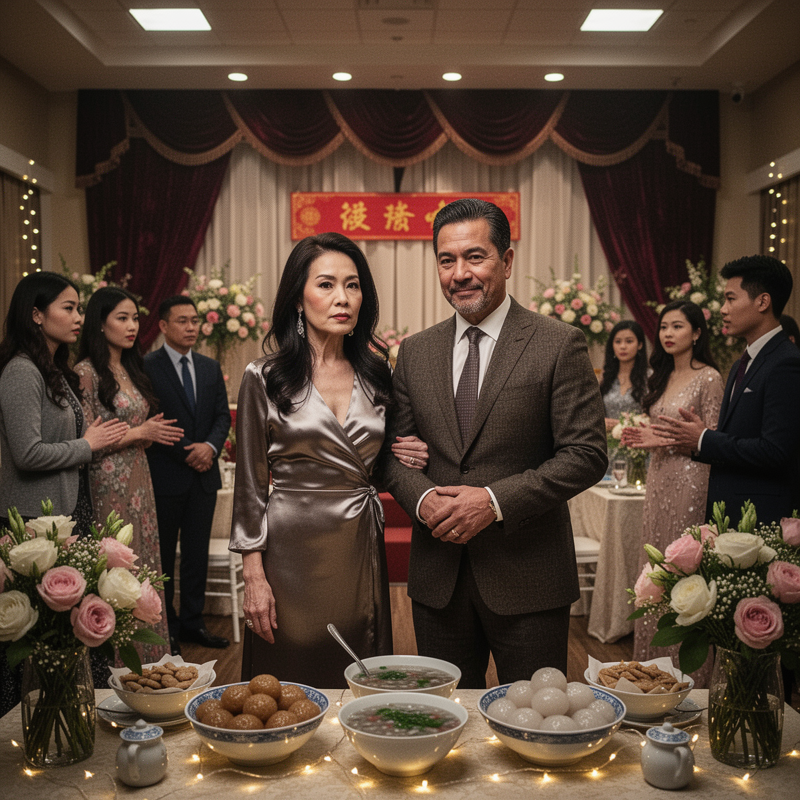
“Your father trapped me in a life of poverty, so I had no choice but to leave all six of you behind fifteen years ago,” my mother announced, walking uninvited into my eldest sister’s pre-wedding dinner in Houston.
My father sat silently in his worn suit, refusing to raise his voice while my mother stood beside the wealthy real estate mogul boss she had abandoned us for.
My sister smiled warmly, stepped forward, and handed our mother a heavy velvet box in front of the gathered guests.
When my mother opened it, her face turned pale, and she screamed in sudden, terrified anger.
The pre-wedding dinner for Tram had been a symphony of soft chatter and quiet joy.
The air in the community hall, rented for the occasion, hummed with the delicate scent of lemongrass and fresh jasmine from the decorations Tram had personally arranged.
Little bowls of chè and bánh bò were arranged meticulously on linen-draped tables, catching the warm glow of fairy lights.
I, Linh, the youngest at seventeen, had been helping Aunt Mai light the last of the floating candles when the front doors swung open.
A sudden draft swept through the room, making a few candles flicker.
All heads turned.
There she stood, my mother, Helen.
Fifteen years.
Fifteen years since she had walked out, leaving my father, Dat, to raise six daughters alone.
She wasn’t alone now.
Beside her, a hulking figure in a bespoke suit stood, radiating an aura of impenetrable wealth: Charles Harrison, the real estate developer whose company she now worked for, the man everyone whispered she had left us for.
Helen wore a silk dress that shimmered under the hall’s soft lighting, a stark contrast to the modest áo dài my sisters and I had chosen, or the worn, but meticulously clean, suit my father always donned for special occasions.
A faint, sickly sweet perfume wafted from her, overpowering the delicate aroma of the food.
A hush fell over the room, heavier than the velvet curtains on the stage.
My father, who had been chatting quietly with Uncle Duc near the head table, froze mid-sentence.
His back stiffened, but he didn’t turn.
He simply lowered his head a fraction, his hands resting on the edge of the table.
Then came her voice, clear and cutting, amplified by the sudden silence.
“Your father trapped me in a life of poverty, so I had no choice but to leave all six of you behind fifteen years ago,” my mother announced, walking uninvited into my eldest sister’s pre-wedding dinner in Houston.
The words hung in the air, acidic and sharp.
A deafening gasp swept across the yard.
Someone dropped a glass.
It shattered violently.
My father sat silently in his worn suit, refusing to raise his voice while my mother stood beside the wealthy real estate mogul boss she had abandoned us for.
His silence was a familiar shield, a testament to his ingrained Vietnamese stoicism, a quiet dignity that had always frustrated me in moments of confrontation.
Charles Harrison, meanwhile, offered a patronizing, almost imperceptible smirk.
He didn’t move, merely observed the unfolding drama with the detached air of a connoisseur watching a play.
His hand rested lightly on Helen’s arm, a possessive gesture that made my stomach churn.
My eldest sister, Tram, was the first to move.
Her face, usually so warm and open, held a calm I could only describe as unnerving.
She had been discussing flower arrangements with her fiancé moments before, her smile bright with wedding anticipation.
Now, that smile remained, unwavering, though it seemed to contain an ocean of suppressed emotion.
She took a deep, measured breath.
Tram walked directly toward Helen and Charles, her movements slow and deliberate, a bridal warrior.
She didn’t rush, didn’t falter.
The guests watched, mesmerized, utterly silent.
Reaching Helen, Tram extended her hand, not in greeting, but in offering.
In it, rested a heavy velvet box.
It was dark blue, almost black, and felt substantial, important.
“Mother,” Tram said, her voice soft, devoid of tremor, “Father wanted you to have this.”
The words hung in the air, a stark contrast to the accusations Helen had just hurled.
Helen’s gaze flickered from Tram’s steady eyes to the box.
A flicker of confusion, then, a dawning expression of expectation crossed her face.
Perhaps it was a peace offering.
Perhaps a belated gift for her return.
Perhaps, even, a token of wealth.
She snatched the box from Tram’s hand, her fingers gripping the velvet.
Charles Harrison leaned in slightly, a speculative gleam in his eyes, clearly expecting some form of monetary gift.
Helen’s long, manicured nails fumbled with the clasp, her eagerness palpable.
The click of the latch was surprisingly loud in the hushed hall.
She flung open the lid.
The contents of the box were not what she, or anyone, expected.
Instead of glittering jewelry, instead of crisp bills, there were stacks of paper.
Neatly bundled, tied with faded ribbons.
They weren’t just papers; they were checks.
Hundreds of them.
Each one bearing the same amount, written out to “Helen Nguyen.”
Each one signed by Dat Nguyen.
Each one dated, meticulously, month after month, year after year.
Fifteen years of them.
Uncashed.
Fifteen years of alimony, sent diligently by the man she had just accused of trapping her in poverty.
The sight seemed to drain the color from her face, leaving her skin ashen beneath her perfectly applied makeup.
Her mouth opened, but no sound came out for a beat.
Her eyes, wide and horrified, darted from the checks to my father’s unmoving back.
Then, a sound ripped from her throat.
A primal, guttural shriek that seemed to vibrate through the very foundations of the hall.
She screamed in sudden, terrified anger.
The velvet box, along with its damning contents, slipped from her trembling fingers and clattered to the floor, scattering a cascade of faded, yellowing checks across the polished wooden boards.
Part 2
The checks lay scattered like fallen leaves, each a silent witness to my father’s unwavering responsibility. Helen stared at them, her face contorted in a mask of pure disbelief and fury. Her scream echoed in the stunned silence, a raw, exposed wound.
Then, Charles Harrison moved. He stepped away from my mother, his expensive suit seemingly impervious to the chaos around him. His smirk, which had been subtle, now broadened into a cold, triumphant smile. He clapped his hands together once, a sharp, decisive sound that cut through the lingering tension.
“Enough of this family drama,” he announced, his voice deep and resonant, designed to command. He surveyed the room, his gaze sweeping over the horrified faces of our guests, then settling, with chilling intent, on my father.
My father, Dat, still hadn’t turned around, but I could see the slight tremor in his shoulders.
“Dat,” Charles said, his tone dripping with false cordiality, “it’s been a long time. Fifteen years, to be precise, since we last discussed your… arrangements.”
My mind raced. Arrangements? What arrangements? My father was a tailor, a caterer. He owned his shop. What could Charles Harrison, a huge real estate developer, possibly have to do with him?
“You see, everyone,” Charles continued, his voice rising, addressing the entire room now, “Dat here is a valued tenant of mine.” He paused for effect, letting the words sink in. “My company owns the commercial property where his tailoring and catering business operates. The very building that houses the kitchen providing all this lovely food for the wedding.”
A wave of murmurs rippled through the guests. Their shock was palpable, mirroring my own. This was a connection no one had ever suspected, a hidden thread that had bound my father to this man for a decade and a half.
“And it seems,” Charles added, his smile twisting into something predatory, “that Mr. Nguyen has a rather significant outstanding balance on his commercial equipment lease. A $120,000 debt note, to be exact, on that catering kitchen. Fully signed, fully enforceable.”
My heart pounded against my ribs. $120,000? My father? This was impossible. He was meticulous with his finances.
Charles then looked directly at my father’s back. “Consider this your formal notice, Dat. I’m demanding full payment of that $120,000, in certified funds, within the next forty-eight hours.”
He paused again, letting the enormity of the demand hang in the air. The wedding reception was just days away. Forty-eight hours.
“Failure to comply,” Charles declared, his voice hard as steel, “and I will personally ensure that the doors of your shop are locked by Friday morning. Which, of course, would mean no catering. No kitchen. No wedding reception for your eldest daughter, Tram.”
The threat was clear, brutal, and aimed directly at the heart of our family. Tram gasped, her earlier calm shattered. My father slowly turned, his face etched with a familiar, weary resignation.
As the room erupted in a fresh wave of horrified whispers, I saw my third-oldest sister, Bao, move silently. Her eyes, usually calm, were narrowed with a fierce concentration. She clutched a worn, accordion-style folder, filled with what looked like old financial documents. Without a word, she slipped out of a side door, her movements quick and deliberate, disappearing into the night.
CHAPTER 2: The Landlord’s Ultimatum
The warm Houston night air still held the scent of jasmine from the restaurant, but inside our family kitchen, it felt cold. Dad had gathered all six of us. The fluorescent lights hummed over the worn countertops.
“He doubled the rent,” Dad said, his voice flat. He looked at the floor, not at our faces.
Tram was still gripping the empty velvet box. Bao, usually so quiet, had a tight line to her mouth.
“Fifteen years ago,” Dad continued, “after your Grandpa passed, Charles Harrison bought the building. He hiked the shop’s commercial rent by over 100%.”
My stomach clenched. I had always pictured Mom just… leaving. Choosing a new life.
“Your mother was scared,” Dad said, his gaze finally lifting to meet ours. His eyes were shadowed with an old pain. “Scared we would lose everything. She felt she had no choice but to take a job at his corporate office to help pay.”
He never told us any of this. Not a single word, not for fifteen years.
“He used it,” Dad whispered. “Used our debt to lure her away. I didn’t want you to hate her. I wanted you to remember only good things.”
The air felt thick with unsaid words. It wasn’t just about Mom’s choice anymore. It was about Charles.
Just then, a sharp knock echoed from the back door. A man in a crisp suit, holding a large envelope, stood framed in the doorway. Behind him, another man held a heavy lockbox.
“Mr. Nguyen?” the man asked, his voice formal. “We are here to serve notice from Harrison Commercial Holdings.”
He extended the envelope. Dad took it, his hand trembling slightly.
“An immediate balloon payment of one hundred and twenty thousand US dollars,” the man recited, consulting a tablet. “Due in full within forty-eight hours.”
He pointed to the lockbox. “Otherwise, per the terms of your commercial equipment lease, we will be forced to seize all assets on Saturday morning. Including the catering kitchen equipment.”
Saturday morning. The morning of Tram’s wedding. The man’s words hung in the air, cold and hard as the metal box he held.
CHAPTER 3: The Price of Silence
The clock on the kitchen wall ticked loudly. Forty-eight hours.
“We can’t let him do this,” Tram said, her voice tight with panic. She was usually so steady, so organized. Now, she paced the small space between the stainless-steel prep tables.
My other sisters started making calls, trying to figure out payment options, but it was too much, too fast. We needed to pack hundreds of spring rolls and stir-fry dishes for a pre-wedding event that night. The absurdity of it all felt like a punch to the gut.
Dad quietly pulled out a small, ornate wooden box from a cupboard. Inside lay his most prized possession: a thick gold ring, etched with an intricate dragon, a gift from his own father.
“I will sell this,” he murmured, his fingers tracing the cold metal. “And I will take out personal loans. Whatever it takes for Tram’s wedding.”
He didn’t mention the shop, or his future, only the wedding. His silence on his own sacrifice was a familiar ache in my chest.
Meanwhile, Bao was already gone. She had slipped away from the pre-wedding dinner, carrying a worn leather folder. I knew where she was headed. The university library, with its rows of dusty microfilmed records.
I pictured her hunched over a flickering screen, sifting through decades of Houston’s commercial land acquisitions. She was looking for anything, any small detail from fifteen years ago that might explain Charles Harrison’s sudden, cruel demands.
“It’s my fault,” Tram whispered, watching Dad prepare to leave for the pawn shop. Her eyes welled up. “If I hadn’t wanted this wedding so badly, none of this would be happening.”
“No,” I said, putting a hand on her arm. “This isn’t about you, Tram. This is about him. Always has been.”
CHAPTER 4: Cracks in the Empire
The next morning, the smell of ginger and fish sauce filled the kitchen as we prepped for another round of catering, but the atmosphere was heavy. Dad was out, trying to secure a loan.
My phone vibrated. It was Bao. Her voice was raspy, like she hadn’t slept.
“Linh, get over here,” she said. “Now. My dorm room.”
I dropped what I was doing, grabbing my keys. Bao never called for anything less than an emergency.
When I arrived, her small desk was buried under printouts. Graphs, legal documents, bank statements. A half-eaten instant noodle cup sat next to a stack of papers.
“Look at this,” she said, pushing a thick binder towards me. The cover read: “Harrison Commercial Holdings: Annual Financial Report.”
My eyes scanned the first few pages. What I saw made my breath catch.
“He’s not rich,” Bao said, pointing a finger at a column of figures. “Not anymore. Look at his debt-to-equity ratio.”
She flipped to another page, showing a list of properties Charles owned. “All of them are leveraged to the hilt. These Houston banks are about to pull the plug.”
She tapped a specific section. “It says here, ‘Initiation of automatic foreclosure proceedings on primary office towers: within 7 days.’”
The truth hit me with a jolt. Charles wasn’t trying to destroy us out of pure malice, at least not entirely. He was desperate.
“He needs that $120,000,” Bao murmured, her eyes still glued to the pages. “Not because he wants Dad’s equipment. Because he needs to make payroll. He’s broke.”
The image of Charles Harrison, so arrogant and composed at the dinner, shattered in my mind. He was a cornered animal.
CHAPTER 5: Escalating Pressure
The next morning, the tension was palpable. Less than 24 hours until the wedding rehearsal, and Charles hadn’t backed down. Dad’s attempts to get a quick loan had been met with polite but firm rejections.
I was trying to pay for the last-minute wedding flowers with our business debit card. The florist, Mrs. Choi, looked at me with a worried expression.
“It’s not going through, Linh,” she said, tapping her payment terminal. “Says ‘Account Frozen.’”
My heart sank. I tried a different card, a different vendor for the seafood delivery. Same message.
“Account Frozen.”
Charles wasn’t just demanding money anymore. He was actively choking our business. No client payments, no vendor payments. He was trying to bring us to our knees before the wedding.
I knew who to find. I raced to the fancy downtown office building where Helen now worked, pulling into the visitor parking lot just as she was leaving for lunch. She wore an expensive suit, her hair perfectly styled.
“Mom!” I called out, my voice raw.
She turned, her smile faltering when she saw my face.
“Please,” I begged, stepping in front of her. “You have to stop Charles. He’s frozen our accounts. We can’t pay for the wedding. Tram’s wedding.”
Helen’s face stiffened. Her eyes, usually so calculating, now held a defensive sheen.
“Charles is merely protecting his business interests, Linh,” she said, her voice distant. “Your father accumulated a debt. These are legitimate business rights.”
“Legitimate? He’s trying to ruin Tram’s wedding!”
She pulled her hand away from mine. “I’m sure your father will find a way. He always does.”
She walked past me, leaving me standing alone in the parking lot, the roar of downtown traffic echoing her indifference.
CHAPTER 6: The Forgotten Clause
I relayed Helen’s cold words to my sisters, feeling a fresh wave of despair. The wedding was hours away, and we were running out of time, money, and options.
Bao, however, was still hunched over her laptop, her brow furrowed in concentration. She had the original 15-year commercial lease and equipment loan agreement from 2009 open on her screen.
“I’ve been reading every single page,” she mumbled, pushing her glasses up her nose. “Every paragraph, every footnote. There has to be something.”
We watched, silent, as her fingers flew across the keyboard, scrolling. She muttered to herself, cross-referencing clauses, her focus absolute.
Then, she stopped. Her eyes widened.
“Found it,” she breathed. Her finger pointed to a small, densely packed section on page twenty-two.
The paragraph was almost hidden, a standard boilerplate clause most people would skip. It was a non-forfeiture clause.
“It says,” Bao read aloud, her voice gaining strength, “that if the lender fails to perform mandatory annual physical maintenance audits on the leased equipment, all financial liens and balloon balance obligations automatically expire after exactly fifteen years to the calendar date.”
My jaw dropped. “Fifteen years?”
Bao nodded furiously, her eyes shining. “The contract was signed on October 12, 2009. That means it expired two days ago, on October 12, 2024.”
Charles Harrison’s $120,000 demand, his threats, his frozen accounts—they were all based on a debt that no longer existed. He had missed the fine print. He had missed his own deadline. The truth was there, staring at us from a forgotten clause on page twenty-two.
CHAPTER 7: Unraveling Truths
The discovery of the expired clause gave us a sliver of hope, a fragile shield against Charles’s attack. But as we were about to call Dad, a new development unfolded across town.
Helen was in her opulent mansion, trying to focus on her appearance for Tram’s wedding rehearsal. Her reflection stared back from the ornate mirror.
From the next room, Charles’s voice ripped through the quiet house. It was loud, panicked, and venomous.
“How could you let this happen?” he roared into the phone. “The bank is calling in the notes! Everything is leveraged!”
Helen froze. She heard specific numbers, names of properties she recognized as being part of Charles’s portfolio. She heard her name, too.
“Her savings… used as unhedged collateral? Are you insane?” Charles’s voice lowered to a frantic whisper. “Do you know what this means for *my* firm?”
Helen’s hands flew to her mouth. *Her* savings? The money she had accumulated over fifteen years, the security she had built with Charles? He had used it. Without her knowledge, without her permission, as a last-ditch effort to prop up his failing empire.
She stumbled to her purse, her fingers fumbling for her wallet. Inside, tucked behind her driver’s license, were a few faded photographs. One was of a younger Dat, holding a tiny Tram. Another, a blurry shot of all six of us, still so small, laughing in our old backyard.
The man she had left for, the man who promised her a life of luxury and security, had quietly stolen her future. He had also twisted her memories of Dat, painting him as the villain, keeping her trapped in a narrative of his making. The photos felt like a betrayal.
CHAPTER 8: The Solitary Ambush
The wedding venue buzzed with activity. Guests would start arriving soon for the rehearsal and dinner. The floral arrangements were perfect, the tablecloths crisp white. It was all a beautiful illusion, hiding the financial storm brewing beneath.
I saw him first. Charles Harrison, in a dark suit, his face grim. He wasn’t a guest. He was carrying a small, heavy toolbox. He headed straight for the double doors of the main banquet room.
My heart hammered against my ribs. He intended to lock it. To cut off the wedding, right before it began.
“No,” I whispered. I started walking, fast, towards him.
There was a small, windowless office near the back hallway, used for storage. It was empty, dark. I knew it.
I sped up, cutting him off just as he reached the banquet hall doors. He looked up, startled, his hand already on the doorknob.
“Mr. Harrison,” I said, my voice surprisingly steady.
He frowned, clearly annoyed. “Linh. I’m busy. This doesn’t concern you.”
He tried to step around me, towards the main hall. But I was quicker. I stepped in front of him, blocking his path, then pushed open the door to the small, dark office.
“Let’s talk,” I said, my voice low.
He scoffed, but before he could protest, I grabbed his arm firmly. It was surprisingly easy to guide him into the cramped room.
As he stumbled inside, I quickly pulled the door shut behind us. The click of the lock echoed in the silence. The small office was completely dark.
I stood between him and the door, clutching a single sheet of paper in my hand. It was Bao’s printout, the certified copy of page twenty-two from the original contract.
CHAPTER 9: The Private Confrontation
The small office was silent, suffocatingly dark. Charles tried the door handle, then whirled on me.
“What is the meaning of this, girl?” he demanded, his voice tight with fury. “Open this door immediately!”
I didn’t move. My hand remained on the doorknob.
“You can’t lock the banquet hall, Mr. Harrison,” I said, my voice clear. “Your claim is invalid.”
He stared at me, his face turning an angry red. “What are you talking about? That equipment loan is fully enforceable. I have the papers right here.” He patted his jacket pocket.
I held up my single sheet of paper. “This is page twenty-two of the original commercial equipment lease, signed October 12, 2009.”
He squinted, trying to make out the text in the dim light filtering under the door.
“It clearly states that if Harrison Commercial Holdings fails to perform mandatory annual physical maintenance audits for fifteen years, all liens and balloon payments automatically expire,” I continued. “As of October 12, two days ago.”
His face went pale. He scoffed, a weak, guttural sound. “That’s a boilerplate clause. It’s unenforceable. I’m a lawyer, girl. You can’t trick me with some college student’s legal theory.”
“My sister is an accounting student,” I corrected him. “And she also found your company’s public financial filings. The ones detailing your impending bank foreclosures, set to begin by Friday.”
He flinched. The bluster drained from him like water from a sieve. He stared at me, a seventeen-year-old girl, for a long moment. Then, with a defeated sigh, he slowly sank into the rickety chair behind the desk.
“You don’t understand,” he muttered, running a hand through his thinning hair. “You couldn’t possibly understand.”
He paused, then looked up, his eyes bleak. “Your father… Dat. Fifteen years ago, he bid against me for the catering contract for the city’s annual Spring Festival. I was supposed to get it. I was the biggest name in commercial real estate. But he won.”
He choked back a laugh that held no humor. “Him. A tailor with a small kitchen. He had nothing. But he had respect. He had integrity. And I lost. I couldn’t stand it. So I took the only thing I knew would hurt him. His wife. And then I tried to break his business.”
The silence in the room stretched, heavy with the weight of a fifteen-year-old vendetta. The man who had almost destroyed my family confessed his deep, bitter jealousy, not to a judge or a crowd, but to a teenage girl in a darkened room.
CHAPTER 10: The Unearned Feast
I stepped out of the small office, leaving Charles alone in the quiet darkness. The confession hung in the air, a bitter truth.
Dad was waiting in the hallway. I told him everything, keeping my voice low. The expired clause. Charles’s bankruptcy. His confession of jealousy.
Dad listened, his face showing no surprise, no anger. Just a quiet understanding.
He turned and went into the kitchen. He returned a few minutes later, holding a pristine white plate. On it, a small portion of traditional Vietnamese wedding food: sticky rice, savory chicken, a delicate spring roll. Food from the very catering business Charles had tried to destroy.
Dad walked into the small office, closing the door softly behind him. I stood outside, straining to hear.
“Charles,” Dad’s voice was calm, gentle. “The debt you claimed… it was cleared years ago. With hard work. Every day.”
A long silence.
“I hold no hatred for you,” Dad continued. “There is no bitterness in my heart.”
I imagined Charles, sitting in the dark, staring at the plate of food. The man who had tried to ruin us, offered a meal.
After another long moment, I heard a ragged sigh from inside. A small, broken sound.
“I… I don’t deserve this, Dat,” Charles’s voice was hoarse, thick with shame. “After everything.”
“Everyone deserves peace,” Dad replied. “And a full stomach.”
The quiet conversation continued for a few more minutes, too low for me to make out the words. But I didn’t need to. The silence that followed, broken only by the soft clinking of a fork against porcelain, spoke volumes. My father wasn’t seeking revenge. He was offering grace.
CHAPTER 11: Words of Redemption
The wedding rehearsal dinner passed in a blur of nervous excitement. Dad kept Charles’s secret, and so did we. The crisis remained hidden from the guests.
Just before the main wedding reception, as the last of the guests found their seats, Dat gathered all six of us in a private family holding room. The scent of orchids filled the air.
The door creaked open. Helen walked in, followed by Charles. Their faces were drawn, their eyes red-rimmed. They didn’t look like the confident, opulent couple from two nights ago. They looked… lost.
Helen stepped forward, her expensive dress seeming to hang oddly on her now. Tears welled in her eyes, spilling freely down her cheeks.
“My daughters,” she choked out, her voice trembling. “I… I am so sorry.”
She looked at each of us, her gaze lingering on Tram, then on me. “I was a fool. I let him fill my head with lies. I believed him when he said your father kept me in poverty. I believed him because I wanted to believe it.”
Her shoulders shook. “I abandoned you. I chose wealth over my children. There is no excuse.”
Charles stepped forward, his head bowed. He looked at Dad, then at us. His usual arrogance was gone, replaced by a profound humility.
“Dat,” he began, his voice barely a whisper. “And all of you, his daughters. I deeply apologize for my actions.”
He raised his head slightly. “My business has failed. Everything I built is gone. But that is my own doing. My manipulation, my jealousy, my vindictiveness towards Dat… it was wrong. All of it.”
He looked directly at Tram, who stood wide-eyed next to Dad. “I tried to destroy your wedding. To hurt your father. I am truly sorry for the pain I caused this family.”
The silence in the room was absolute. This wasn’t a calculated apology. It was broken, raw, and sincere. The man who had embodied greed and malice for fifteen years stood before us, stripped bare, offering genuine remorse.
CHAPTER 12: A Covenant Restored
The wedding ceremony unfolded with a joy that felt almost miraculous. Tram walked down the aisle, radiant, towards her beaming groom. Dad, in his carefully pressed suit, watched with quiet pride.
Helen sat in a back pew, a quiet observer. She didn’t seek attention or a place of honor. She was simply a guest, a mother seeking forgiveness, melting into the crowd.
During the reception, as the traditional music played and toasts flowed, Charles quietly approached Dad near the buffet table. He held a legal document in his hand.
“This is a formal release of all claims against your shop,” Charles said, his voice subdued. He handed the paper to Dad. “It’s all cleared. Legally. My lawyers finalized it this morning.”
Dad took the paper, his fingers brushing Charles’s. Their eyes met, and in that brief exchange, I saw not a victor and a vanquished, but two men who had shared a long, painful history, now finding a path to peace.
Charles left the venue shortly after, slipping away unnoticed amidst the dancing and laughter. He walked into his inevitable corporate bankruptcy not with a fight, but with a newfound, quiet resignation. Stripped of his material empire, perhaps he had finally found something akin to dignity. The wedding continued, a testament not just to love, but to endurance and a profound, unexpected grace.
CHAPTER 13: The Aftermath of Grace
The morning after the wedding, Houston news channels buzzed with the story. Harrison Commercial Holdings had officially filed for bankruptcy liquidation. The banks were seizing his commercial towers. It was a clean, systemic collapse, just as Bao had predicted, without any criminal charges or public lawsuits.
We gathered at the shop, picking up stray flower petals and folding tablecloths. The air smelled of stale wedding cake and coffee. It felt like the end of an era, but also a quiet beginning.
Dad sat at his tailoring table, examining the release Charles had signed. He tapped the paper thoughtfully.
“Helen needs to rebuild,” he said, looking up at us. “She has nothing now.”
My sisters exchanged glances. We all knew what he meant. Helen had lost everything with Charles.
“I will help her find a modest apartment,” Dad continued. “And a job, perhaps at a fabric store. Somewhere she can begin again, on her own terms.”
He paused, then looked at me, at all of us. “True strength,” he said, his voice soft but firm, “is not in holding onto anger. It is in allowing for restorative mercy. For everyone.”
It wasn’t just about Helen. It was about us. He was teaching us that forgiveness wasn’t just for the wronged, but also for the one doing the forgiving. It was a lesson in moving forward, not just financially, but spiritually.
CHAPTER 14: Quiet Porch at Dusk
Three days after the wedding, the last of the celebratory chaos had faded. The shop was quiet, swept clean. My sisters had all returned to their own lives, their own routines.
I sat alone on the worn wooden back steps of Dad’s tailor shop. The sun was setting over the Houston skyline, painting the clouds in shades of orange and purple.
I held a small photograph. It was taken during the wedding dinner, a spontaneous shot. All six of us, my sisters and I, were standing proudly around Dad. His smile was wide and genuine, his eyes crinkling at the corners. Helen wasn’t in the picture. Charles wasn’t either.
In the photograph, Dad’s hand rested on my shoulder, solid and comforting. He never built an empire out of concrete or contracts, but sitting on these wooden steps, I knew he had built something far more permanent—a home where no debt could ever tear us apart.
Leave a Reply