CHAPTER 1: Whispers Beyond the ICU Glass
Part 1
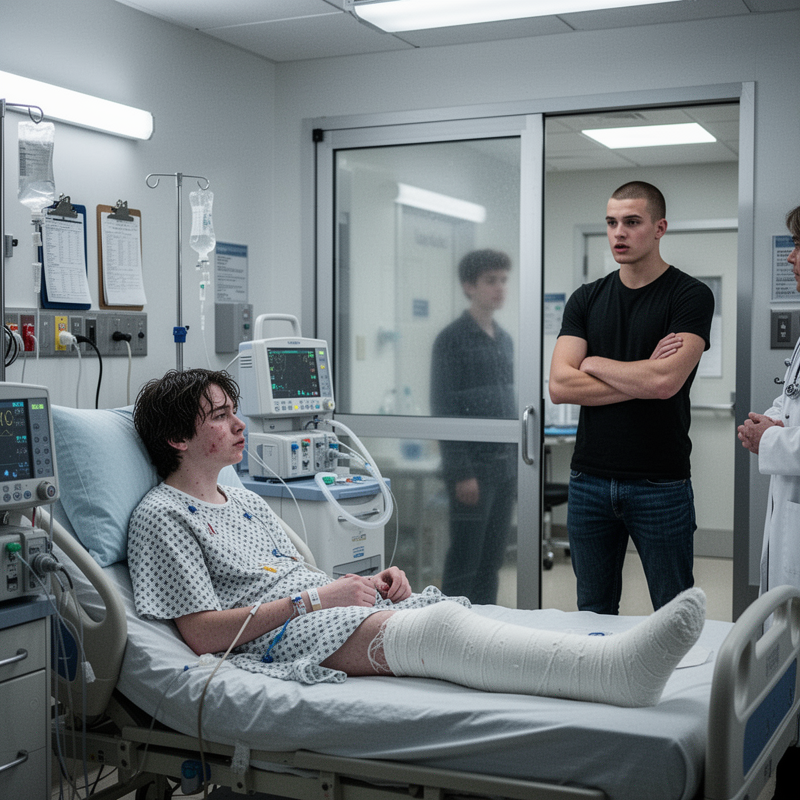
Seventeen-year-old Leo Hensley woke up in the intensive care unit of St. Jude’s Hospital with a shattered leg and two broken ribs after his dirt bike crashed off the coastal highway.
Through the heavy glass door of his room, he heard his twenty-two-year-old brother, Julian, speaking in a flat, emotionless voice to the trauma physician.
“Don’t bother rushing with any updates,” Julian told the doctor coldly. “Only call me back if he doesn’t make it.”
That was the moment Leo realized his crash on the sharp turn above Pacific Cove was no accident.
The fluorescent lights of the ICU hummed, a persistent, clinical drone that vibrated behind Leo’s eyes. Each breath was a shallow, guarded attempt, sending a fresh spike of pain through his broken ribs.
He was tethered to a dozen tubes and wires, a prisoner of beeping machines and the sterile scent of antiseptic. His right leg, encased in a massive plaster cast, felt like a lead weight.
A soft, rhythmic hiss from a nearby ventilator was the only other sound, a constant reminder of the fragile line between life and something else.
Leo shifted slightly, wincing as a sharp twinge shot through his chest. He tried to focus on the ceiling tiles, but his gaze kept drifting back to the glass door.
He had heard Julian’s words. Every chilling syllable.
They echoed in his mind, clear as a bell, cutting through the haze of pain medication and the thick glass.
Through the transparent barrier, he saw Julian’s silhouette, tall and unyielding, talking to a short, harried-looking woman in blue scrubs. The trauma physician.
Her face was a mask of professional concern, her hands gesturing slightly as she spoke. She seemed to be trying to explain something, her mouth moving earnestly.
Julian, however, stood with his arms crossed, his posture rigid. His gaze was fixed somewhere beyond the doctor, detached and cold.
He barely nodded as she spoke, his expression unreadable even from this distance.
Leo’s throat felt dry, sandpaper against his tongue. He wanted water, but the effort to reach for the call button on his hospital bed felt monumental.
He just lay there, watching the silent exchange, replaying the words that had pierced the wall of his pain.
“Don’t bother rushing with any updates… Only call me back if he doesn’t make it.”
It wasn’t just the words. It was the way Julian had said them. No anger, no sadness, no inflection at all. Just a flat, almost casual directive. As if discussing a minor inconvenience, not a brother’s life.
A cold dread began to spread through Leo’s chest, colder than the sterile air conditioning. It wasn’t just the physical pain that gripped him now. It was something far worse.
He remembered Marcus Callahan’s words. Marcus, his late father’s old business partner, a man with calloused hands and a perpetually worried frown.
It had been three weeks ago, in the dusty, oil-scented office at the back of their father’s boat shop. The place still smelled faintly of salt and wood varnish, a comfort Leo always associated with his dad.
Marcus had been hunched over the old oak desk, poring over ledgers, his brow furrowed deeper than usual.
“Julian’s got himself into some real trouble, Leo,” Marcus had said, his voice low and raspy. He hadn’t met Leo’s eyes, instead tracing a line of figures with a stubby finger.
“Gambling debts. Big ones.”
Leo had shrugged it off then. Julian always found a way out of his scrapes. He was charismatic, persuasive.
“He’ll sort it out, Marcus,” Leo had replied, confident. He’d been polishing a carburetor for his dirt bike, oblivious. “He always does.”
Marcus had sighed, pushing his glasses up his nose.
“Not this time. It’s too much. The numbers… they don’t add up.”
“He’s been asking questions about your father’s estate, Leo,” Marcus had continued, his voice barely a whisper. “And your trust fund. All the details.”
Leo had laughed.
“Julian? Worrying about money? He just wants to make sure I’m not spending it all on dirt bike parts.”
But Marcus hadn’t laughed. His eyes, when they finally met Leo’s, were grave.
“He’s desperate, Leo. And desperate men… they do desperate things.”
At the time, Leo had dismissed it as Marcus’s usual worrywart nature. Now, lying broken in this hospital bed, those words took on a terrifying new weight.
The coastal highway turn, sharp and winding, was one he knew like the back of his hand. He’d ridden it hundreds of times.
But that day, the brakes had failed. Not gradually, not fading. They had just… given out.
He’d pumped the lever, stomped the pedal, but there was nothing. Just a sickening lurch and the screech of tires on asphalt, then the dizzying fall over the guardrail.
He remembered the sickening crunch as he hit the rocks below, the waves still crashing nearby.
Julian’s flat voice through the glass, Marcus’s warning about desperation, the sudden, total failure of his brakes on a familiar turn.
The pieces clicked into place, cold and sharp, like shards of ice in his mind.
It was no accident.
Julian wanted him dead.
Part 2
The realization hit me with the force of a physical blow, even worse than the pain of my injuries. Julian. My brother. He wanted me dead.
A soft knock on the glass door made me flinch. Marcus Callahan, his face etched with worry, eased into the room. He walked slowly, his eyes scanning me from head to toe, a somber expression on his usually kind features.
“Leo,” he said, his voice quiet, his gaze heavy. He pulled a chair closer to the bed, the plastic scraping softly on the linoleum floor. “Heard what happened. They said you were lucky.”
I just stared at him, the buzzing in my ears making it hard to focus. Lucky? Lucky to be alive when my own brother tried to kill me?
Marcus shifted in his seat, his hands clasped over his knees. “Look, Leo, I came as soon as I could. There’s something you need to know.” He leaned in, his voice dropping to a near whisper. “It’s about Julian. And your father’s insurance.”
My heart hammered against my ribs, a painful throb. I braced myself.
“Just a few weeks ago,” Marcus continued, his eyes darting to the door, then back to me. “Julian… he added something to your life insurance policy. A rider. For accidental death.”
I blinked, trying to make sense of his words. “A rider? For what?”
“It’s for two hundred and fifty thousand dollars, Leo,” Marcus said, his voice barely audible. “And he took it out less than a month before your crash.”
The air in the room suddenly felt thin. Two hundred and fifty thousand dollars. For my accidental death. It was like a cold, venomous hand reaching out from the shadows. The pieces of Marcus’s previous warning, Julian’s debts, the failed brakes, and now this… it clicked into a terrifying, undeniable picture. Julian hadn’t just *wished* me dead; he had planned for it.
Before I could even find my voice, before I could ask Marcus another question, the door creaked open again. My best friend, Toby Morales, stood in the doorway, his face pale with concern. He clutched a stack of papers in his hand, looking anxious.
“Leo!” Toby rushed to my bedside, not even noticing Marcus. “Julian sent me. He said these are super important. Something about insurance forms so the hospital won’t discharge you too early.” He held out the documents, a folder with a hospital logo on it, stamped with “LEGAL GUARDIANSHIP” in bold, red letters.
Chapter 2: The Unwitting Messenger
The fluorescent lights of the ICU room hummed, a constant, low thrum against my raw nerves. My right leg, a heavy cast extending from my hip to my ankle, felt like a foreign object.
My best friend, Toby Morales, stood awkwardly by the bed. His usual easy grin was gone, replaced by a worried frown that bunched his freckled forehead.
He held a stack of papers, crisp and official-looking.
“Julian said these were super urgent, man,” Toby mumbled, shifting his weight. “Something about insurance. He said the hospital won’t discharge you properly without them.”
He offered me a pen.
My good hand, the left one, reached for the documents. They felt cold and slick.
I scanned the first page, ignoring the bold “Insurance Release” heading Julian had mentioned. My gaze darted to the smaller print, the dense paragraphs that always hid the real intent.
There, tucked away in the third section, were the words: “Surrender of Financial and Medical Guardianship to Julian Hensley.”
A cold dread spread through me, colder than the hospital air. Julian wasn’t just after the insurance; he was after total control.
Toby, oblivious, tapped the pen against the top sheet.
“Just initial here, I guess,” he said, pointing to a line. “And sign on the bottom.”
I gripped the pen, my fingers suddenly weak. The small text blurred before my eyes. Toby had no idea what he was asking me to do. He was just trying to help, manipulated like a puppet.
My hand started to shake. I coughed, a dry, rattling sound that hurt my ribs.
“Man, I feel… woozy,” I gasped, letting the pen slip from my fingers. It clattered against the plastic tray table.
Toby flinched, his eyes wide with concern.
“Whoa, easy, Leo. You okay?”
“Just… too much,” I whispered, closing my eyes. “Can you… just leave them on the tray? I’ll get to it when I’m less… out of it.”
Toby hesitated for a second, then nodded. He placed the papers neatly on the table, along with the pen.
“Sure, man. No problem. Get some rest.”
He backed away, still looking worried, and then slipped out of the room. The heavy glass door swung shut with a quiet whoosh, leaving me alone with the silent, insidious papers.
Chapter 3: The Envelope in the Overcoat
Julian’s visits were brief, almost clinical. He strode in, his tailored winter coat draped over his arm, a forced smile playing on his lips.
He didn’t ask how I felt. His eyes always flickered to the tray table.
“Did Toby get those forms to you?” he asked, his voice smooth. “Need to get those sent in. Hospital’s being a real pain about the paperwork.”
I nodded slowly, feigning lethargy. “Yeah. Just haven’t had the energy to read through them properly.”
He gave a slight, impatient sigh, almost imperceptible. “Alright. Well, don’t rush it. Just get it done.”
He draped his heavy navy wool coat over the back of the visitor’s chair, the fabric rustling softly. “I’m going to grab a coffee. Be right back.”
The moment the door clicked shut, my eyes locked onto the coat. It hung there, thick and dark, a heavy secret.
My heart hammered against my ribs, each beat a painful thud. Getting out of bed was impossible, but the chair was just within reach if I stretched.
Pain shot through my leg as I eased my upper body off the pillow, straining my left arm. My fingers brushed the cool wool of the coat. Slowly, carefully, I slid my hand into the inner breast pocket.
My fingers brushed against something stiff, folded. I hooked it with my thumb and pulled it out.
It was a standard hospital envelope, but the markings were anything but standard. “St. Jude’s Genetic Diagnostics,” it read, stamped boldly across the top. Below that, in urgent red ink, was “CONFIDENTIAL PATERNITY/DNA EVALUATION.”
My breath hitched. Julian had ordered a DNA test? Why?
I unfolded the paper inside with trembling fingers. The name at the top was mine: Leo Hensley.
Then, I saw the conclusion. It was stark, merciless.
“Conclusion: Subject Leo Hensley shares no biological relation to the deceased, Mr. Arthur Hensley.”
A wave of nausea washed over me. My late father. The man who raised me, taught me everything. It claimed I wasn’t his son.
If this was true, I had no claim to the family estate, no rights to the boat shop, no inheritance. Nothing.
Julian was coming back. I frantically refolded the paper, my fingers fumbling, and shoved it back into the coat pocket just as I heard the distinct sound of a coffee cup tapping against the glass door.
Chapter 4: The Chance Meeting at Midnight
Sleep was an impossible luxury. The numbers on the DNA report, the stark words declaring me a stranger to my own father, burned behind my eyelids. The idea of Julian manipulating Toby, then staging this entire charade, made my blood run cold.
The pain from my leg throbbed, a dull, relentless ache.
Around midnight, unable to stand the confinement, I found a wheelchair. Maneuvering it slowly, carefully, I navigated the quiet hospital corridors. The air smelled of antiseptic and stale coffee.
I rolled past nurses’ stations, their screens glowing softly in the dim light, past empty waiting rooms. Eventually, I found myself in a small chapel, tucked away near what I knew was the lab wing.
It was empty, save for one figure.
A woman sat in a pew, her head bowed, her dark hair pulled back in a neat bun. Her blue scrubs, though rumpled, looked familiar.
I recognized the St. Jude’s Genetic Diagnostics logo on her sleeve.
She looked up, startled, as my wheelchair squeaked slightly. Her eyes, tired but kind, met mine. She had a badge clipped to her scrubs: “Dr. Elena Gomez, Clinical Genetics.”
I held the folded envelope in my hand, unable to stop myself. My thumb was tracing the faint red stamp.
Dr. Gomez’s gaze fell to the envelope. Her brow furrowed slightly.
“You’re in the right place for quiet reflection, young man,” she said softly, her voice carrying a faint, warm accent. “But you seem preoccupied with that.”
She gestured to the envelope.
“This is… from your lab,” I managed to say, my voice hoarse.
She nodded. “I work there. What’s the matter?”
I unfolded the document, my hands trembling slightly, and pushed it toward her. “It says… it says I’m not my father’s son.”
Dr. Gomez took the paper gently. Her eyes quickly scanned the header, then flickered down to the identification number. A small gasp escaped her.
“The Hensley file,” she murmured, almost to herself. She ran a finger along a line of text, then tilted her head. “I remember processing this one, about two weeks ago.”
Her gaze sharpened, moving from the printed conclusion back to the top of the page. Then she pointed.
“This font,” she said, her voice hushed with concern. “And the alignment. This last paragraph… it’s been altered. This is not the original conclusion.”
My blood ran cold. My suspicions were confirmed. Julian hadn’t just *found* a document. He had created it.
Chapter 5: The Digital Archive
Dr. Gomez’s face was a mixture of professional shock and growing alarm. She looked from the altered document to me, then back to the paper.
“This is serious, Leo,” she said, her voice firm now. “Medical records, especially genetic ones, cannot be tampered with. This is fraud.”
She rose from the pew. “Come with me.”
I followed her, my wheelchair creaking softly, down a brightly lit corridor to a section of the lab I hadn’t seen before. She led me into a small, sterile office filled with humming computers and blinking lights.
“This is my private terminal,” she explained, gesturing to a monitor. “It’s encrypted and secured. All original lab results are stored here.”
She sat down, her fingers flying across the keyboard, typing a complex series of commands and passwords. The screen glowed with lines of code.
“The paper you have,” she continued, “it matches the original file number, but the physical document has clearly been changed. Someone printed out an official header, but edited the data.”
A new window opened, displaying a secure database. She typed in the Hensley case number.
“Here it is,” she said, her voice quiet. “The central database record. Unaltered.”
She clicked on a file, and a new report filled the screen. It was identical to the one Julian had, except for one crucial section.
“Read this, Leo,” Dr. Gomez instructed, pointing a steady finger at the screen.
My eyes darted to the bolded conclusion.
“Conclusion: Subject Leo Hensley shares a 99.99% biological relation to the deceased, Mr. Arthur Hensley.”
I was my father’s son. A wave of profound relief washed over me, quickly followed by a fresh surge of anger at Julian’s deception.
But Dr. Gomez wasn’t done. She scrolled down, her finger moving to a different name, a different analysis.
“And this,” she said, her voice hushed, “this is where the true story lies.”
My gaze dropped to the next section. It was Julian’s name.
“Conclusion: Subject Julian Hensley shares a 0% biological relation to the deceased, Mr. Arthur Hensley.”
My breath hitched. I stared at the screen, then at Dr. Gomez, my mind reeling.
“Julian… he’s not Dad’s son?” I stammered, the words barely audible.
Dr. Gomez nodded slowly. “The records show Julian was born prior to Mr. Arthur Hensley marrying your mother. This suggests… a different biological father. Your parents kept this secret.”
The shock hit me with the force of a physical blow. Julian had tried to disinherit me with a fake DNA test, but it was *he* who had no legal standing to the single-line paternal trust fund. He had exposed himself.
Chapter 6: The Transfer Mandate
The next morning, the hospital room felt colder. A sense of urgency, of being watched, prickled at my skin.
Julian arrived, radiating a false cheer. He wasn’t alone. A burly man in a clean, grey uniform stood by the door, holding a clipboard. Outside, I could glimpse a private transport van, its tinted windows dark and anonymous.
“Good news, Leo!” Julian announced, holding up a sheet of paper. “I’ve arranged for your specialized trauma therapy. The doctors here agree you need a more focused, quieter environment for recovery.”
He handed a crumpled doctor’s note to the nurse, who scanned it quickly. The note looked legitimate, but something about Julian’s confident smile didn’t sit right. It felt too practiced.
“Six hours away, huh?” I said, my voice flat. “That’s quite the ride.”
Julian waved a dismissive hand. “It’s a top-tier facility. Only the best for family. Plus, the coastal air will do wonders.”
Then, Toby appeared in the doorway, looking sheepish. He carried a duffel bag, my duffel bag, filled with clothes.
“Hey, man,” Toby said, avoiding my gaze. “Julian asked me to follow the van with your stuff. Make sure you have everything.”
My heart sank. Julian had roped Toby into this again, using his loyalty against me. Toby genuinely believed he was helping, that I was fragile and needed this “specialized therapy.”
“Toby, I—” I started, but Julian cut me off smoothly.
“Leo’s a bit disoriented from the medication, Toby,” Julian interjected, putting a hand on Toby’s shoulder. “He just needs to rest. This facility is going to be perfect for him.”
The burly man from the van stepped forward. “Time to go, Mr. Hensley.”
Before I could protest further, or even attempt to explain, the man gently but firmly helped me transfer from my hospital bed to a rolling stretcher. My injured leg was carefully supported, but I was still mostly immobile, unable to put up any real resistance.
The van doors hissed open, and I was slid inside, the world outside becoming a blur of receding white corridors. I caught a glimpse of Toby, looking genuinely concerned, giving a small, helpless wave before the doors closed, plunging me into the confined, unsettling darkness of the transport van.
Chapter 7: Escape on Route 101
The van was stifling, the air thick with the smell of old upholstery and something vaguely metallic. Every bump on the highway sent a jolt of pain through my shattered leg. I tried to mentally map our progress, but the tinted windows offered no landmarks.
Hours dragged by. The driver remained silent, focused on the road.
Suddenly, the van slowed. I felt the familiar pull of a vehicle turning off a highway. We rolled to a stop.
I heard the hiss of air brakes, then the distant murmur of voices. We must be at a fuel station. My chance.
Desperation surged through me. I slammed my good hand against the reinforced window behind the driver’s seat. It made a muffled thud. Nothing.
I tried again, harder, ignoring the pain in my ribs.
A shadow passed the window. Toby.
I hammered again, calling his name, my voice hoarse. “Toby! Help!”
He stopped, his head tilting. He peered at the window, then his eyes widened as he recognized me inside. He rushed to the rear doors, his face etched with confusion.
“Leo? What’s going on?” he yelled through the metal.
“Toby, Julian’s lying to you!” I yelled back, my voice cracking. “He’s not taking me to therapy! He’s trying to get rid of me!”
Toby fumbled with the locks. With a click, the heavy doors swung open. He peered inside, his face pale.
“What are you talking about?” he whispered, his eyes darting to the driver’s side where the driver was still speaking on his phone.
“He tried to kill me, Toby!” I hissed, pulling out the folded insurance rider from my pocket, the one Marcus had told me about. “And he forged this!”
I thrust the altered DNA report into his hand.
Toby stared at the papers, his brow furrowed in confusion, then horror. He saw the insurance policy, the staggering $250,000 rider. Then his eyes fell on the DNA report, seeing the “no biological relation” line.
“He told me it was an accident,” Toby breathed, his face draining of color. “He said you were just… confused.”
“It wasn’t an accident,” I insisted. “And *this*,” I pointed to the DNA report, “is a lie. He’s using you, Toby. He’s trying to take everything from me, and Clara!”
Toby looked at the driver’s side, then back at me, a dawning realization in his eyes. He saw the genuine fear in mine, not the “trauma-induced paranoia” Julian had described.
“Get out!” Toby urged, his voice urgent. “Come on, Leo, we’re getting out of here!”
With Toby’s help, I awkwardly slid off the stretcher, my leg screaming in protest. I leaned heavily on him, hobbling toward his waiting sedan.
The driver was still on his phone, oblivious.
Toby practically shoved me into the passenger seat, then sprinted around to the driver’s side. The engine roared to life. He peeled out of the gas station, tires squealing, speeding back down Route 101 toward Pacific Cove.
Chapter 8: Evidence in the Workshop
Toby drove like a man possessed, his knuckles white on the steering wheel. The silence in the car was broken only by the rush of wind and my ragged breathing.
“Where are we going?” he finally asked, his voice strained.
“The boat shop,” I replied, the words a painful effort. “Dad’s workshop. That’s where I serviced my dirt bike.”
He nodded, pressing the accelerator. The familiar coastal road blurred past, the scent of salt and gasoline growing stronger.
Minutes later, we pulled into the gravel lot of Hensley Marine. The old boat repair shop stood silhouetted against the fading afternoon light, a beacon of my father’s legacy.
Toby helped me out of the car. I leaned heavily on him as we entered the main bay, the air thick with the smell of oil, sawdust, and sea salt. Tools hung neatly on pegboards, a testament to Dad’s meticulous nature.
“The tool shed,” I gasped, pointing to a smaller, enclosed area at the back. “That’s where I kept my spare parts.”
Inside the cramped, shadowy shed, my eyes immediately went to a rusty metal toolbox on a dusty workbench. Julian had used this workshop after Dad died.
I fumbled through a pile of grease-stained rags. My fingers brushed against something cold, metallic, and distinctly out of place. I pulled it out.
It was a section of brake line, severed cleanly. The rubber was torn, frayed at the edges. My dirt bike’s brake line. A sickening lurch hit my stomach.
“He cut it,” I whispered, holding up the damning evidence. “He actually cut my brakes.”
Toby stared at it, his face aghast. “But… why?”
My gaze landed on a laptop, still open on a workbench nearby, an audio recording program displayed on the screen. Julian’s laptop.
“His gambling,” I said, my voice cold. “He’s always been in deep.”
I clicked on a saved audio file. A tinny voice filled the small shed. It was Julian.
“—I assure you, Mr. Ricci, the payment will be made within forty-eight hours,” Julian’s voice echoed, tinged with desperation. “As soon as the estate is settled, my $180,000 debt will be cleared. You have my word.”
The voice on the other end was rough, demanding, but Julian’s tone was sickeningly clear. He was cornered, deep in debt, and he saw my death as his escape.
Toby gasped, stepping back as if burned. “Eighteen… $180,000? He owes that much?”
I shut the laptop with a definitive click. We had the evidence. All of it.
Chapter 9: The Ultimatum at Home
The sun had dipped below the horizon, painting the sky in fiery oranges and deep purples by the time Toby drove us towards our family home. The lights were on, casting a warm, inviting glow that felt like a cruel deception.
We pulled up a block away, Toby cutting the engine. My leg throbbed, but adrenaline kept me alert.
Through the living room window, I saw Clara, my fourteen-year-old sister, perched on the edge of the sofa. Her shoulders were hunched, her head bowed. Julian stood over her, his silhouette sharp and menacing.
I couldn’t hear the words, but his posture, the aggressive gestures of his hands, spoke volumes. He was furious. He was interrogating her.
Then, Clara looked up, her face streaked with tears. She shook her head, a small, desperate movement.
Julian leaned closer, his voice dropping, but I could still hear the harsh edge of it even through the glass. He pointed a finger at her.
“If Leo doesn’t turn himself in by tomorrow morning,” Julian’s voice was clear, cutting through the night air, “I will sign papers surrendering you to state foster care. I cannot afford you alone, Clara.”
Clara recoiled, her hands flying to her mouth, stifling a sob. Her small frame trembled. Julian’s threat hung in the air, cold and cruel.
My blood ran cold. He was threatening to send Clara to foster care. My little sister, innocent in all of this, used as a pawn.
Toby gasped beside me. “He wouldn’t dare.”
But I knew he would. Julian was desperate, cornered. He needed me out of the picture, and Clara was just another obstacle, another piece in his scheme.
A sickening realization washed over me. If I called the police, if I exposed Julian for attempted murder and fraud, the legal battle would be brutal. It would drag our family name through the mud, destroy any chance of keeping the boat shop afloat.
The estate would be tied up in court for years, Clara would almost certainly be plunged into the foster system, losing both of us. My own future, my dream of Stanford, would be shattered, but more importantly, Clara would lose everything.
Julian knew this. He was counting on it.
Chapter 10: The Burden of Choice
The night deepened around us, Toby’s parked car a silent, cramped capsule in the darkness. The streetlights cast long, shifting shadows through the trees.
I held the cut brake line in my hand, its sharp edges digging into my palm. On the seat beside me, the stack of papers lay: the falsified guardianship agreement, the altered DNA report, the real DNA report, the accidental death insurance policy, and the printout of Julian’s desperate voicemail to the loan shark.
Evidence. Enough to send Julian to prison for a very long time. Attempted murder, fraud, coercion.
But at what cost?
I pictured the headlines, the grim faces of police officers, the endless court dates. The family name, Hensley Marine, plastered across every local newspaper, synonymous with scandal.
The boat shop, my father’s legacy, would surely go into bankruptcy foreclosure, tied up in legal proceedings, bleeding money. Marcus, Dad’s partner, would lose everything too.
And Clara. My sweet, quiet Clara. She would be ripped from her home, from everything she knew, tossed into the impersonal system of state foster care. She’d lose me, too, consumed by the legal battle and the fallout.
My dream of Stanford, of a future far away from this small coastal town, shimmered then faded. It felt selfish, trivial, against the weight of Clara’s innocent face.
I could expose Julian, punish him, ensure justice was served. But that justice would shatter Clara’s life, demolish our family’s last shred of dignity, and obliterate the only legacy my father left us.
Or I could find another way. A way to protect Clara, to save the shop, even if it meant sacrificing everything else.
The air in the car grew cold. I shivered, but it wasn’t from the night air. It was the chill of an impossible choice, a burden too heavy for seventeen-year-old shoulders.
The long, silent night stretched before me, demanding an answer.
Chapter 11: The Dark Boat Shop
“Go home, Toby,” I said, my voice a quiet whisper in the predawn gloom. “I need to do this alone.”
Toby hesitated, his face a mixture of fear and defiance. “I should be there, Leo. He’s dangerous.”
“I know,” I replied, pressing the cold brake line into his hand. “But this is between us. Protect Clara. Make sure she’s safe, no matter what.”
He nodded, a grim resolve settling on his face. He drove off, leaving me standing in the silent, gravel lot.
I waited until midnight, alone in the dim light of the family boat shop. The air smelled of grease and old wood, comforting and suffocating at the same time. The single hanging bulb above the workbench cast a stark circle of light, leaving the rest of the vast space in deep shadow.
My leg throbbed, a dull, constant reminder of what Julian had done.
The crunch of tires on gravel announced his arrival. Julian walked in, his expensive dress shoes clicking against the concrete floor. He held a small, powerful flashlight, its beam dancing across the tools. He looked composed, confident, ready to assert his dominance.
He didn’t see me at first, hidden in the shadows.
“Leo?” he called out, his voice echoing slightly in the vast space. “Are you in here? You’re making this much harder than it needs to be.”
I stepped into the circle of light. My shadow stretched long and distorted behind me.
Julian froze. His flashlight beam steadied on my face, then dropped to my injured leg. A flicker of surprise, then irritation, crossed his features.
“You shouldn’t be here,” he said, his voice hard. “You belong in the facility.”
I didn’t reply. Instead, I calmly placed the neatly folded original DNA report on the workbench. Its stark white stood out against the dark, oil-stained wood.
Then, I laid down the cut brake line, positioning it carefully beside the report, its frayed edges clearly visible under the bulb.
Finally, I placed the printout of his recorded voicemail, the one confirming his $180,000 debt.
Julian’s eyes widened. He stared at the documents, then at the brake line, then back at me. His controlled composure began to crack. His jaw tightened.
He opened his mouth to speak, but no words came out. He was completely, utterly isolated, exposed. The silent evidence spoke for itself.
Chapter 12: The Unilateral Terms
The silence in the boat shop stretched, thick and heavy, broken only by the distant lapping of waves against the shore. Julian’s flashlight beam wavered slightly. He looked from the DNA report to the severed brake line, his face pale in the harsh light. All his carefully constructed lies, his elaborate scheme, lay shattered before him.
He swallowed hard. “What is this, Leo? Some kind of stunt?”
My voice was steady, calm, betraying none of the turmoil inside me. “No stunt, Julian. This is the truth.”
I pointed to the DNA report. “You’re not Dad’s son. You have no legal claim to the trust, the shop, anything. You forged that document to disinherit me.”
Then I gestured to the brake line. “You tried to kill me. For the insurance money. For your gambling debts.”
Julian flinched, his eyes darting around the empty workshop, as if searching for an escape, an audience to play to. There was none.
“And I have the recording,” I continued, pointing to the printed transcript of his voicemail. “$180,000 in debt. Within forty-eight hours.”
He sagged slightly, the arrogance draining from him. His shoulders slumped. He was beaten, utterly exposed.
“Here’s the deal,” I said, stepping closer, my voice low and firm. “You walk away from this, Julian. Now. And you walk away with nothing.”
He looked up, a flicker of defiance in his eyes. “What are you talking about?”
“I won’t call the police,” I explained, each word carefully chosen. “I won’t release the brake sabotage evidence. I won’t expose the DNA fraud.”
Julian stared at me, calculating, desperate.
“In return,” I continued, “you sign full legal custody of Clara over to Uncle David. You renounce all claims to Hensley Marine. And you sign over any and all rights to the family estate.”
He opened his mouth to protest, but I cut him off.
“And I will transfer my entire $450,000 trust fund,” I said, the words catching in my throat. “Every dollar of my college savings. It will be used to pay off your $180,000 debt and settle the shop’s back taxes. Tonight.”
His eyes widened, calculating the numbers. My entire inheritance, gone. My Stanford dream, erased.
“You leave California forever,” I concluded, my voice unwavering. “Tonight. And you never come back. If you do, or if you ever try to contact Clara, the police will receive everything.”
He stood there for a long moment, the weight of his choices, his greed, crushing him. He looked at the evidence again, then at my face. He knew I meant every word.
He slowly nodded. In the dim light, he found a pen and signed the prepared legal documents I had brought. With a stroke of a pen, he relinquished his entire life, leaving me with zero dollars, no college fund for Stanford, but full safety for Clara.
Chapter 13: One Year on the Cliff
Exactly one year after the dirt bike wreck, I stood at the windy cliffside overlook on Route 101. The same treacherous curve, the same crashing waves far below. The scar from my leg surgery ached faintly in the cold coastal air, a ghost limb of memory.
I ran a hand over my jaw, feeling the stubble. Eighteen now. A year older, a lifetime wiser.
The wind whipped my hair, carrying the scent of salt and pine. I wasn’t at Stanford, walking manicured lawns, discussing literature. I was a junior mechanic at a local garage, my hands calloused, my clothes smelling of oil and gasoline. Ten-hour shifts, six days a week. Enough to support Clara, to keep a roof over her head, to keep her in school.
Clara. She was thriving. She’d made the honor roll, joined the debate team. Her laughter, free and unrestrained, echoed in the small house we shared. She was safe. She was happy.
Hensley Marine, Dad’s shop, was still open. Marcus, true to his word, had kept it running, now under local management I helped oversee in my few off-hours. It was a lifeline, a testament to what we hadn’t lost.
Julian was gone. Vanished. The agreement had held. He was a ghost, a name never spoken aloud.
My bank account was close to empty, living paycheck to paycheck. The future I’d envisioned for myself, the one paved with degrees and ambition, had been sacrificed on this very cliff.
But as I watched the waves crash against the rocks below, the raw power of the ocean mirroring the raw power of my choice, I felt something deeper than regret.
I lost my inheritance, my college dream, and the brother I thought I knew on that cliffside road. But standing in the wind today, I know that keeping Clara safe was the only real victory worth paying for.
Leave a Reply