CHAPTER 1: The Breakroom Incident
Part 1
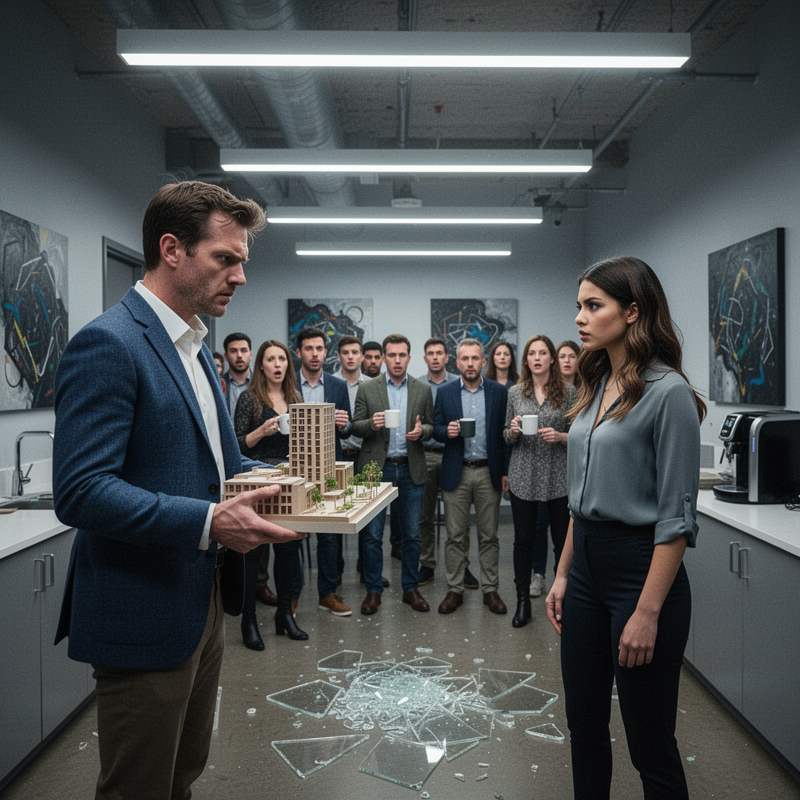
“Everything in this studio, from the designs on that screen to the chair you’re sitting in, belongs to my team’s division,” Julian shouted, grabbing my hand-built physical site model off the breakroom counter and violently slamming it into the recycling bin, shattering two months of precision acrylic work.
He stood over the mess in front of twelve silent colleagues, declaring that I was removed from the $40 million tech-campus project and ordering me to pack my desk immediately.
My co-lead and business partner, Arthur Pendelton, stood three feet away, staring down at his coffee mug without saying a single word of defense.
I picked up a stray piece of broken acrylic from the floor, looked Julian directly in the eyes, and quietly said, “You might want to check who actually owns the master lease on this building and the patent rights to this firm’s name before you make speeches.”
The sharp crack of the acrylic model hitting the bottom of the recycling bin echoed through the suddenly quiet breakroom. It was the only sound after Julian’s booming declaration. Bits of white and clear plastic scattered across the gleaming floor tiles, reflecting the fluorescent lights overhead.
Rachel Brooks, a junior associate, instinctively flinched, her eyes wide as she clutched a half-eaten bagel. No one else moved. They all stood frozen, a tableau of shock and uncomfortable silence.
Julian Croft, a man whose charisma was usually a carefully maintained facade, now looked unhinged. His face was flushed, veins prominent on his neck. He stood with his chest puffed out, directly over the splintered remains of my work.
“Consider yourself off the $40 million tech-campus project,” he announced again, his voice lower now, but laced with a cutting edge. “Effective immediately, Maya.”
My name felt like a curse word on his tongue.
“You are no longer a principal architect on anything but your personal projects,” Julian continued. His gaze swept over the twelve colleagues, daring anyone to contradict him. “Arthur and I will be taking over the full project management.”
No one met his eyes. Their gazes skittered around the room, landing on the coffee maker, the empty snack dispenser, anywhere but on Julian or me.
Then his eyes narrowed on me.
“Go back to your desk. Pack it up. Clear out by lunch.”
I could feel the heat rising in my own cheeks, but I focused on keeping my breathing even. My hands, surprisingly, did not tremble. They remained still as I slowly lowered myself, bending at the knees.
I reached for a shard of the broken model. It was a piece of the cantilevered roof section, perfectly cut, now jagged and useless.
The silence stretched, thick and suffocating. It was so quiet I could hear the hum of the old refrigerator in the corner.
I glanced up. Julian watched me, a cruel, triumphant smirk playing on his lips. He thought I was picking up the pieces in defeat.
My gaze drifted past him, landing on Arthur Pendelton. Arthur, my co-founder and partner for nearly a decade, was still staring intently at the rim of his ceramic mug. He slowly rotated it in his hands. He didn’t look up, didn’t offer a single word, didn’t even shift his weight. His usual placid expression was replaced by a rigid blankness.
The betrayal felt like a cold stone in my stomach.
I stood up, holding the small, sharp piece of acrylic in my palm. It glinted under the harsh lights.
My voice was soft, barely a whisper in the stunned room. But it carried.
“Julian,” I said.
He actually chuckled. A harsh, humorless sound.
“What is it, Maya? Are you going to cry?” he sneered. “Finally admitting you’re out of your depth?”
I didn’t answer that. I just held his gaze, which was now clouded with a hint of annoyance rather than triumph.
My voice remained level. “You might want to check who actually owns the master lease on this building and the patent rights to this firm’s name before you make speeches.”
The smirk vanished from Julian’s face. His brow furrowed in confusion, then anger. He opened his mouth, but no sound came out.
He simply stood there, frozen, his eyes trying to decipher the meaning behind my quiet words, while the broken pieces of my $40 million project lay at his feet.
Part 2
The sharp crack of the acrylic model hitting the bottom of the recycling bin still echoed in my ears as I left the studio that evening. Julian’s face, frozen in a mix of confusion and dawning horror, was the last image I carried out the door. The tension in the air had been thick enough to cut, and no one had dared to speak as I walked past them.
The next morning, the usual office buzz was muted, replaced by a strange undercurrent of apprehension. I arrived early, settling into my quiet corner office, the broken model a distant memory, replaced by a singular focus. Just before nine, a discreet knock on my door announced the studio’s receptionist, holding a thick, cream-colored envelope. She placed it on my desk, her eyes avoiding mine. “For you, Maya. And similar ones for Mr. Croft and Mr. Pendelton.”
I watched her go, then slowly opened mine. Inside, meticulously organized, were copies of corporate legal filings. The kind no one ever paid attention to, buried deep in quarterly reports and property deeds. But these weren’t just copies; they were *confirmations*.
The papers stated, in dry, legal language, that five years prior, a private holding company, “Lin Innovations LLC,” had acquired the master lease for the entire studio building. Further documents detailed the assignment of all core structural and design patents, including the intellectual property for our proprietary “Arc-Flex” bracing system, to the same entity. My entity. I had quietly spent years ensuring my life’s work, and the foundation of the firm, was secure.
I could only imagine the same documents landing on Julian’s polished mahogany desk. And Arthur’s, still likely nursing his coffee, hoping for peace. I pictured Julian, the triumphant smirk wiped clean, replaced by sheer disbelief. He must have scoffed at my words yesterday, thinking it an empty threat from a ‘back-room’ architect.
A few minutes later, the low rumble of a raised voice started to emanate from Julian’s office. It wasn’t the loud, performative shouting from the breakroom, but a deeper, more dangerous growl. I heard the distinct sound of a chair scraping back violently, followed by a series of sharp, angry words directed at a stunned-sounding Arthur. Julian’s ambition was built on an illusion of control, and now that illusion was shattering. He couldn’t dismiss me. He couldn’t fire me. He couldn’t even really take the project, not without my patents. The realization must have hit him like a physical blow: his entire professional status, the very credit he craved, was directly threatened by *my* quiet ownership.
He slammed his office door shut with a resounding thud. But even through the thick wood, I could feel his palpable rage. Julian was not going to back down. He was going to fight.
Chapter 2: The Whispering Campaign
The corporate legal documents landed on desks, confirming my quiet ownership. Julian Croft did not back down.
Instead, his strategy shifted. It was subtler, far more insidious.
He started a campaign, a low hum of whispers that snaked through the studio’s open-plan layout. I heard it first from Rachel Brooks, a junior associate who usually greeted me with a bright smile.
She passed my desk without making eye contact, her shoulders hunched.
Later that morning, an email appeared in my inbox. It was an invitation to a project planning meeting, only to disappear from my calendar five minutes later.
Then another, from Julian, cc’d to the entire junior team: “Due to recent… internal instability, all project communications will be routed through Julian Croft directly.”
The next day, it was the lunchroom. I carried my small salad bowl to the usual communal table. Rachel Brooks and two other junior designers were already there, laughing over a shared screen.
As I approached, their laughter died. Rachel cleared her throat, then gathered her bag.
“Oh, we’re just heading out,” she mumbled, not quite looking at me.
The others quickly followed, leaving behind half-eaten sandwiches. The metal chairs scraped loudly as they moved away.
Within forty-eight hours, I was a ghost in my own studio. My name was scrubbed from group chats. Colleagues deflected my questions with tight smiles and vague answers about “new protocols.”
They believed Julian’s story: that I was an unhinged rogue, a bitter associate trying to sabotage a lucrative client merger. I sat in my corner office, listening to the muted hum of an office actively working around me.
It felt colder than any shouted accusation.
Chapter 3: The Coward’s Confession
The studio emptied out slowly that evening. I waited until the only sound was the distant city traffic.
Arthur Pendelton, the co-founder, usually darted out first. Tonight, he lingered, shuffling papers at his desk, avoiding my gaze.
I walked toward the stairwell, the emergency exit door hissing open.
“Arthur.”
He flinched, dropping a sheaf of blueprints. They fanned across the concrete floor.
“Maya,” he said, his voice a strained whisper. His face was pale, sweat beading on his forehead despite the cool air.
I leaned against the railing, the metal cool beneath my hand. “Why, Arthur?”
He bent to collect the papers, his movements jerky. “Julian… he’s impossible.”
“Impossible enough to watch me get publicly humiliated?” I asked, my voice even. “To allow a lie to spread through the whole office?”
Arthur stood, clutching the blueprints to his chest like a shield. His gaze darted to the empty hallway.
“He found out about the medical leave,” Arthur finally blurted, the words tumbling out. “My wife’s fund. He somehow discovered the debt.”
My stomach tightened. Arthur’s wife had battled a rare illness for years. The medical bills were astronomical.
“Julian threatened to pull his investor network,” Arthur continued, his voice cracking. “He said if I didn’t back him, the entire funding for her ongoing care would vanish.”
Arthur’s eyes glistened. “He would have left us completely ruined. I had no choice, Maya. I couldn’t.”
The explanation hung in the stale stairwell air. Julian’s control wasn’t about ownership or skill; it was about fear, applied with surgical precision to those he perceived as weak.
Arthur leaned against the wall, utterly defeated. “He has everyone terrified, Maya.”
Chapter 4: Digging Through the Archives
I called my brother, Leo, that night. He was the only person I trusted completely, my younger brother but always my protector.
“He threatened Arthur’s family,” I told him, the words tasting bitter. “The medical fund.”
Leo, an IT systems analyst with a quiet intensity, simply listened. He’d helped set up the firm’s backup servers a decade ago, leaving him with emergency administrative recovery access.
“I need you to look,” I said. “Anything. Old files, deleted metadata. Anything with my name.”
Two days later, Leo was in my office, after hours. His laptop glowed on my desk. He wore his glasses low on his nose, his fingers flying across the keyboard.
He mumbled to himself, a low, focused stream of code and file paths. “Okay, legacy server… pre-migration backups… ‘Project Aurora’ folder, 2017…”
Then he paused. His fingers stopped.
“Maya,” he said, his voice flat. He turned the laptop screen toward me.
It displayed a detailed blueprint from a project I’d led years ago. My name was clearly listed as the lead architect in the properties tab, next to the “Author” field.
Then he clicked another file, the same project, but a later revision. The “Author” field read: Julian Croft.
“He didn’t just copy the files,” Leo said, his jaw tight. “He systematically opened each one. Erased your author metadata.”
He scrolled through dozens of files, showing me the same pattern. “Then he replaced it with his own name. Over and over. Six years’ worth of submissions.”
The evidence was sickeningly concrete. Not a mistake, not a misunderstanding. A meticulous, deliberate erasure. Julian hadn’t just stolen credit; he’d stolen authorship itself, file by file, over half a decade.
Chapter 5: The Child’s Observation
Leo and his seven-year-old daughter, Chloe, came to my apartment a few days later for dinner. Chloe, bright-eyed and perpetually curious, was playing on my living room floor.
She built a sprawling city out of blocks, complete with a tiny toy bulldozer.
A printout from Julian, the one he’d dropped during his breakroom tirade, lay curled on my coffee table. It was a preliminary design draft for the tech campus. I’d kept it, almost unconsciously.
Chloe crawled closer, her small finger pointing at the corner of the crumpled paper.
“Auntie Maya,” she asked, tilting her head. “Why does the loud man’s paper have your rainbow grid pattern in the corner?”
I frowned, leaning closer. “My what, sweetie?”
“Your secret grid,” she insisted, tapping the corner. “The one you used to show me when I was little. The tiny colors.”
I remembered. Years ago, while teaching her about design software, I’d shown her a custom vector template I’d built for my personal projects. It had an almost invisible, multi-colored grid pattern in the corner – a unique identifier, a subtle signature only visible under certain conditions.
I picked up the printout. Julian’s messy lines, his rushed annotations. I walked over to my desk and pulled out a magnifying desk lamp.
Flipping on the light, I held the paper directly underneath the lens.
And there it was. Faint, almost imperceptible, hidden within the printer’s resolution. A tiny, iridescent, four-color grid of pixels in the lower right corner. My custom security code.
Julian hadn’t just copied my files; he had printed his stolen submission directly on an old vector template of mine. He was presenting my work, on my own paper.
The proof was undeniable, staring up at me, revealed by the innocent eyes of a child.
Chapter 6: The Client’s Real Position
Armed with the proof, I decided to go directly to David O’Rourke, the lead client representative. We met at a quiet coffee shop, the scent of espresso masking the tension in the air.
David, a stoic man in his fifties, nodded politely as I laid out the situation. I showed him the legal documents of my studio ownership, the patents.
Then I showed him Leo’s findings: the metadata changes, the systematic erasure of my authorship.
Finally, I presented Julian’s printout, pointing out the faint rainbow grid under the portable UV light I’d brought. “This is my custom security code. He printed his ‘final’ submission on my template.”
David’s expression remained unreadable. He took a slow sip of his black coffee.
“Maya,” he said, his voice calm. “We always suspected.”
My breath hitched. “Suspected what?”
“That Julian was… well, let’s just say he was a master at presenting other people’s brilliance,” David continued. “Your engineering precision, your structural integrity – it was always a cut above anything Julian produced on his own.”
He leaned forward, setting his mug down. “The board noted the discrepancy years ago. His public presentations were always big on flash, but thin on technical depth. Your early reports, however, were meticulous.”
“But you still kept working with him,” I said, a tremor in my voice.
“We needed a project delivered on time,” David explained. “And Julian held the public face of the firm. But we also knew the true genius was elsewhere.”
He looked directly at me. “To be frank, Maya, the board was simply waiting. Waiting for you to assert your standing. To step into the leadership role directly. We always knew it was your firm, effectively, and your design.”
My misunderstanding of the client’s silence shattered. They weren’t fooled. They were waiting. The $40 million contract was effectively mine to claim.
Chapter 7: An Awkward Departure
The next morning, the studio was a hive of activity. Coffee machines hissed, keyboards clicked. Three junior associates, including Rachel Brooks, were gathered by the main hallway’s coffee station, chatting loudly.
Julian Croft emerged from his office, his chest puffed out, heading toward the coffee station. He carried his tablet, already dictating into it, rehearsing what sounded like a project update.
I stepped into his path, holding a single, simple manila folder.
“Julian,” I said, my voice barely above a whisper.
He stopped, his eyes flicking to the folder, then to my face. The color drained from his cheeks.
“Maya. What… what is it now?” he stammered, his usual booming voice reduced to a thin reedy sound. He looked past me at the junior associates, who had gone silent, their coffee mugs frozen mid-air.
I opened the folder just enough for him to glimpse the printout inside, the one with the subtle rainbow grid. The same printout Chloe had identified.
Julian’s eyes widened. His tablet slipped from his grasp, clattering onto the polished concrete floor, its screen cracking with a spiderweb fracture. He made no move to pick it up.
He opened his mouth, then closed it. “I… I can explain. There was a… a mix-up with the files. It was an oversight. A legacy template.”
His gaze darted frantically between me and his junior team, who now stared, openly confused and uncomfortable. Rachel Brooks’s mouth was slightly open.
The elevator doors behind him chimed, opening with a soft sigh.
Without another word, Julian Croft turned and practically stumbled into the waiting elevator, his face pale and slick with sweat. The doors closed, leaving a profound, awkward silence in the main hallway. The junior associates slowly looked at each other, then back at me, still holding the folder.
Chapter 8: Late Night Truths
The studio was quiet again, the city lights painting long shadows through the windows. I sat at my desk, the incident from the hallway replaying in my mind.
A soft knock sounded at my open door. Julian Croft stood there, alone.
He looked utterly unlike the man who’d shouted in the breakroom, or the one who’d stammered in the hallway. His shoulders slumped. His usually pristine suit jacket was wrinkled.
He walked slowly, heavily, into my office and sank into the visitor’s chair across from my desk. The fluorescent light from the corridor cast a harsh glow on his face, revealing the network of fine lines I hadn’t noticed before.
He cleared his throat, but no words came out. His hands, usually so expressive, rested motionless on his knees.
Then, a tear tracked down his cheek. Followed by another.
“I’m so sorry, Maya,” he choked out, his voice raw.
I said nothing, simply watched him.
“It’s… it’s never been about the money,” he confessed, his gaze fixed on the floor. “Not really. It’s about… this.” He gestured vaguely at the office, the city outside. “Being here. Being relevant.”
He finally looked up, his eyes bloodshot. “I built my career on bluster. On convincing people I was the visionary. But I always knew, deep down, I was an imposter.”
“Your designs, your calculations,” he continued, the words tumbling out. “They were always so precise. So… solid. I was terrified someone would notice I was just rearranging your work, adding a bit of flash, and claiming it as my own.”
He wiped his eyes with the back of his hand. “I was terrified of being found out. Of being irrelevant. That project… the tech campus… I thought if I could just make it mine, completely, I’d finally prove myself.”
He leaned forward, his voice a desperate plea. “I’ve been a coward, Maya. A complete, utter fraud.”
“Can you… can you ever forgive me?” he asked, his voice barely a whisper. “Is there any way we can salvage this? The firm… us?”
Chapter 9: A Fragile Truce
The silence stretched, broken only by the hum of the city. Julian sat, raw and exposed, waiting for my judgment.
I thought of the shattered model, the public humiliation, the quiet betrayal of Arthur, the years of stolen credit. I had every right to ruin him, to strip him of his partnership, to bury his career.
But I also thought of his pathetic confession, the genuine terror in his eyes. And the firm, the legacy I had quietly built.
“A lawsuit,” I said, my voice measured, “would destroy the firm. It would shatter our reputation, scare off clients, and cost millions.”
Julian swallowed hard, nodding.
“It would also tie us up in court for years,” I continued. “Leaving no one to actually build anything.”
I walked to my filing cabinet and pulled out a blank partnership agreement. I slid it across the desk to him.
“This is what we will do,” I stated. “You retain your equity. You will handle all client public relations, all external presentations, all networking.”
Julian looked up, hope flickering in his eyes.
“But,” I added, holding his gaze, “I will have absolute, binding creative and structural authority over every single project. Every design decision, every structural calculation, every final blueprint will pass through me for approval. Without exception.”
He stared at the document, then back at me. “And if I don’t agree?”
“Then I walk,” I said simply. “I take my patents, my lease, and my reputation. And you will be left with nothing but a shell, and the truth of what you did exposed to the industry.”
He picked up the pen, his hand trembling slightly. His eyes searched mine, looking for a trap, a hidden clause. There was none. It was a clear, stark choice.
“Agreed,” Julian whispered, and with a shaky hand, he signed.
It was a fragile truce, built not on forgiveness, but on a clear division of power and a mutual, if unequal, need to keep the studio operational. The active sabotage would end. The building would stand.
Chapter 10: The Changing Guard
Twenty-four years unfolded, each one adding another layer of quiet growth to the firm. The studio, once dominated by Julian’s loud pronouncements, hummed with a different energy.
Under the restructured management, Julian became a surprisingly effective public face, his charisma now channeled into client relations rather than self-aggrandizement. My own name, once erased from files, now graced the lead architect line of every significant project.
The firm flourished, building a reputation for groundbreaking, structurally sound designs.
I watched as my daughter, Elena, grew up, her childhood spent surrounded by architectural models and blueprint tubes. She chose the same path, her passion for design undeniable.
She graduated from architecture school with honors, her youthful idealism shining bright.
One crisp autumn morning, Elena Lin walked into the studio as a junior designer. Her eyes sparkled with excitement as she looked around the bustling office, completely unaware of the intense breakroom conflict that had nearly destroyed her mother’s career decades earlier.
She greeted Julian respectfully, calling him “Mr. Croft,” a testament to his long-standing, if now carefully delineated, role in the firm. He smiled back, a softer, less arrogant smile than the one I remembered from a lifetime ago.
Elena saw a successful, established firm. She saw a quiet, respected mother and a charming, esteemed senior partner. She saw a future.
She didn’t see the rebar, the quiet strength that had held it all together.
Chapter 11: The Handover in the Archives
The studio building, nestled in the heart of downtown, had aged, its brick facade mellowed by decades of city life. The basement archive room, however, remained stubbornly unglamorous. Fluorescent lights hummed, casting a sterile glow on rows of metal filing cabinets.
Dust motes danced in the stale air.
An aging, retired Julian Croft, his once-powerful frame now frail, his hair thin and white, carefully helped 26-year-old Elena pull historical project blueprints. Her bright, eager face contrasted sharply with his worn, wise features.
A small team of incoming junior designers stood by, observing the handover ritual.
“This one,” Julian said, his voice raspy with age, his finger tracing a faded line on a massive blueprint. It was the original $40 million tech-campus project. “This was the cornerstone. What built this studio, really.”
Elena leaned closer, her eyes scanning the intricate details. “It’s incredible. So complex.”
Julian paused, his gaze meeting mine across the room. I stood quietly, watching.
He turned back to Elena, a small smile playing on his lips. “It’s all in the details, isn’t it? The quiet ones.”
He tapped a specific, almost invisible point in the lower corner of the blueprint. “See this? Just a faint line, right here. A tiny, almost imperceptible code.”
Elena squinted. “Is that… a signature?”
Julian nodded, his eyes warm. “That’s your mother’s, Elena. Her genius. Her hidden mark. It was her vision, her calculations, her structural integrity that made this entire project possible.”
He straightened up, his gaze sweeping over the young, attentive faces of the new design team. “Don’t ever forget,” he said, his voice carrying surprising authority, “that the real strength, the true foundation of everything we build here, came from Maya Lin.”
In that cramped, fluorescent-lit basement, after twenty-five years, Julian Croft publicly gave full credit where it was due, laying bare the quiet truth to the next generation.
Chapter 12: A Quiet Walk Home
The archive session concluded, the young design team buzzing with new insights. As they spilled out of the aging downtown office building, the sky opened with a soft drizzle.
Julian and I stood together under the small awning, watching them scatter, laughing, for a celebratory dinner.
“They’re a good group,” Julian observed, his voice soft.
“They are,” I agreed, pulling my coat tighter against the damp air.
He turned to me, his eyes gentle. “Thank you, Maya.”
The words hung in the air, weighted with decades of shared history.
“For what, Julian?” I asked, though I knew.
“For giving me twenty-five years,” he said, a quiet sincerity in his voice. “To grow. To be… better. Instead of destroying me when you had every right to do so.”
He shifted his weight, looking out at the rain-slicked street. “You built something real, Maya. And you let me be a part of it, even after everything.”
I simply smiled, a small, knowing upturn of my lips. There was no need for grand pronouncements, no dramatic speeches. The long, complex journey was unspoken between us.
The last of the young team disappeared around the corner, their excited chatter fading into the city sounds. Julian gave a small nod, then began his slow, deliberate walk towards a waiting taxi.
The drizzle continued, washing the street clean.
Chapter 13: The Unbroken Foundation
A full generation had passed since the breakroom incident, since Julian had smashed my model into pieces. Now, I sat at my original modest wooden desk, tucked into the corner of the crowded, thriving office.
The familiar hum of activity filled the space. Laughter, the click of keyboards, the rustle of blueprints. It was the music of a life’s work.
Across the room, in the main presentation area, my daughter, Elena, stood confidently. Her posture was strong, her voice clear and articulate as she presented a new master plan to a group of client representatives. Her hand swept across a large digital display, showcasing the meticulous details of her vision.
The same physical walls that had silently witnessed Julian’s public outburst, Arthur’s quiet betrayal, and my own moments of doubt now contained Elena’s confident stride. These were the walls I had quietly saved decades ago, not with shouts or threats, but with quiet competence and a steadfast belief in the truth.
Elena concluded her presentation, a round of polite applause filling the room. She was leading the studio’s next era, built on a foundation secured not just by concrete and steel, but by a quiet strength that had weathered the storm.
I watched her, a sense of profound peace settling over me.
Buildings aren’t held together by the loud paint on the facade, but by the quiet rebar buried deep inside the concrete where nobody thinks to look.
Leave a Reply