CHAPTER 1: The Price of Silence
Part 1
“If you don’t sign these loan papers, Martha, we lose the venue and everything we’ve built in this town,” my husband Howard said, pressing the $2,000,000 bank guarantee onto the kitchen table.
When I pushed the document away and refused to mortgage my late father’s historic Oakhaven estate, his daughter Evelyn shattered a heavy ceramic serving platter over my head.
Bleeding and disoriented, I was locked inside my own upstairs bedroom while Howard changed the front door deadbolts and dismissed our housekeeper of twelve years.
By morning, Howard had called our neighbors and local council members to report that my mind was deteriorating and that I required urgent legal conservatorship.
They thought a isolated 71-year-old woman in a small town had no options left.
They didn’t know I had already uncovered the paper trail of their fraudulent shell accounts.
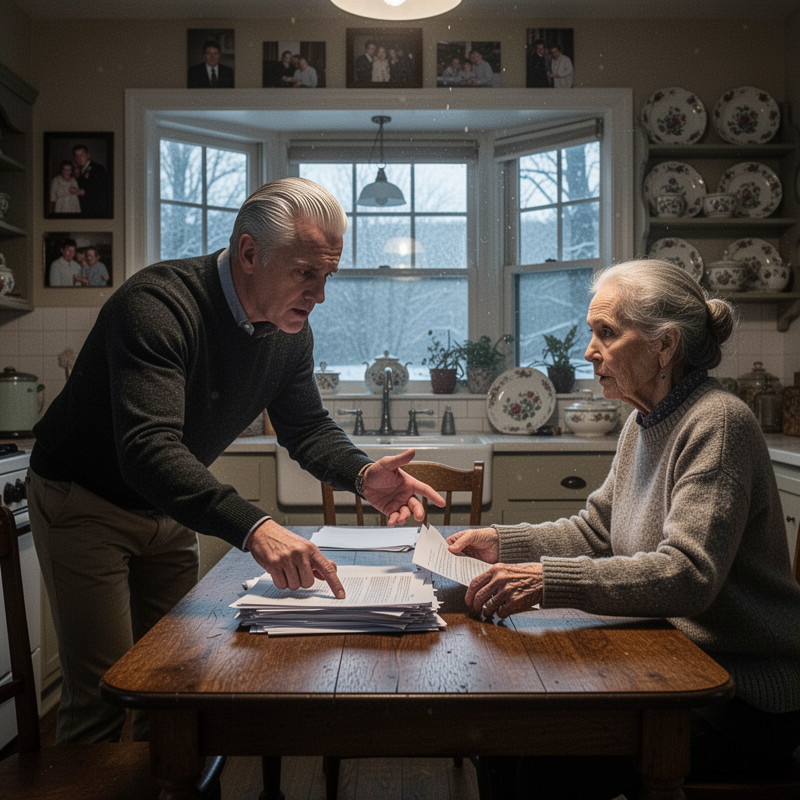
The Oakhaven kitchen, usually a sanctuary of sunlight and simmering pots, felt colder than the January morning outside. A thin, wintery light filtered through the bay window, illuminating dust motes dancing in the air above Howard’s carefully spread documents.
Howard Albright, my husband of eighteen years, leaned across the antique oak table. His usually charming smile was replaced by a tight, desperate line. He tapped a manicured finger on the stack of papers he’d just pushed toward me.
The top document, bold and official, screamed “BANK GUARANTEE.” Below it, a figure: “$2,000,000.”
My breath hitched. Two million dollars. Against Oakhaven, my ancestral home, the Croft Estate. The house my father had built with his own hands, the grounds he’d nurtured for seventy years.
“Martha, you’re not listening,” Howard said, his voice dropping to a theatrical whisper, the kind he used when trying to persuade the local zoning board. “This isn’t just about us. It’s about ‘The Grand Oakhaven Event Hall.’ Our dream.”
I looked from the papers to him, then to Evelyn, his daughter, who stood by the counter. Her arms were crossed, her eyes narrowed to slits. She hadn’t said a word since she arrived an hour ago, but her presence was a heavy, silent judgment.
“Your dream, Howard,” I corrected, my voice steadier than I felt. “Not mine. I warned you about over-extending, about those lavish renovations. You sank every cent into that place.”
“And now it’s about to pay off!” he countered, his voice rising, a vein throbbing faintly in his temple. “Just one more push. One more commitment. This estate is just sitting here, Martha, appreciating. It’s an asset.”
“It’s my home,” I said, my hand instinctively going to the cool, polished wood of the table, a connection to generations past. “My father’s legacy. It’s not a bank vault, Howard.”
I slid the documents back toward him, careful not to wrinkle the crisp paper. The refusal was quiet, but firm. Unmistakable.
Evelyn’s eyes widened. She slowly uncrossed her arms. A low growl rumbled in her throat.
“You can’t be serious,” she seethed, stepping away from the counter. Her movements were sharp, predatory. “You’d let everything collapse? Let Dad lose everything, just to cling to this dusty old relic?”
“It is not a relic, Evelyn,” I responded, turning to face her fully. “And I will not mortgage it for your father’s latest folly.”
“Folly?” Howard echoed, suddenly standing. His chair scraped loudly across the polished floor. “This is a multi-million-dollar enterprise! It’s our future!”
“And what about my future, Howard?” I asked, looking directly at him. “My security? This house is all I have left of my family. All I have left, period.”
He scoffed, turning away with an exaggerated sigh, running a hand through his perfectly coiffed silver hair. “Drama, drama, drama. Martha, please. Be reasonable.”
“Reasonable?” Evelyn snarled, picking up a heavy, glazed ceramic serving platter from the counter. It was a beautiful, hand-painted piece from the dining room, usually reserved for special occasions. “You want to talk reasonable?”
She raised it, not as if to serve, but like a weapon. My eyes widened, a flicker of true fear finally piercing through my resolve. I opened my mouth to speak, but no sound came out.
Howard, his back still partially turned, seemed to miss the precise moment. Or perhaps he simply chose to.
The platter descended with a sickening thud, a sharp crack echoing through the quiet kitchen. Not on the table, not against the wall. It smashed against the top of my head, just above my right ear.
A blinding flash of white light exploded behind my eyes, followed by an immediate, searing pain. I stumbled backward, my hands flying up to my head, slick warmth instantly blooming beneath my fingers.
The world tilted. The familiar scent of coffee and cinnamon from moments ago was replaced by the metallic tang of blood. I heard Evelyn gasp, a short, sharp sound, but it didn’t sound like remorse.
“You lunatic!” Howard finally spun around, his voice laced with a strange mix of shock and something else – almost a perverse satisfaction.
I swayed, struggling to keep my balance. The floor seemed to ripple beneath my feet. I could feel fragments of ceramic caught in my hair, sharp edges digging into my scalp. Blood streamed down my face, warm and sticky, blurring my vision.
“She… she wouldn’t sign,” Evelyn stammered, dropping the remaining piece of the platter. It clattered loudly on the tiles, scattering jagged shards. Her voice was surprisingly steady now, almost calm. “She was going to ruin everything.”
My legs gave out. I sank to the floor, leaning against the sturdy oak cabinets, my head throbbing. The pain was immense, eclipsing everything else. My vision tunneled.
Howard knelt beside me, but his touch was not gentle. He grabbed my arm, pulling me up roughly. “Get up, Martha. You’ve made a mess.”
“My head…” I mumbled, my voice faint.
“You’re fine,” he snapped, dismissing my injury with a wave of his hand. “Just a scratch. Evelyn, help me get her upstairs. She’s clearly not herself.”
Evelyn, surprisingly strong, grabbed my other arm. Between them, they half-dragged, half-carried me up the grand staircase. Each step was a jolt of agony to my head. I could taste iron in my mouth.
They pushed me into my bedroom, the one I had shared with my father, then with Howard for eighteen years. It felt alien now.
“Stay here,” Howard ordered, his face grim. “Think about what you’ve done.”
He walked to the dresser where my phone usually sat, charging. He picked it up, examined it, then pocketed it.
“You won’t be needing this,” he said, almost a taunt.
Evelyn stood by the door, watching, her expression unreadable now.
Then, with a click that echoed ominously in the sudden silence, the lock engaged. I heard their footsteps retreating down the hall, then down the stairs.
A moment later, the distinct, grating sound of new deadbolts being installed downstairs. One after another. A dull thud followed by another.
My head spun. I stumbled to the window, pulling aside the heavy velvet curtain just in time to see Maria, our housekeeper of twelve years, being escorted out the front door by Howard. Her usual bright smile was gone, replaced by a bewildered frown as he spoke to her, gesticulating sharply.
He handed her a wad of cash.
She looked up at my window, her eyes finding mine for a split second, a flicker of concern crossing her face before Howard pulled her arm, turning her toward her car.
Then she was gone.
I was alone.
Locked inside my own home. My phone gone. My head pounding, a steady drum of pain and fear.
Part 2
The silence in the room was almost as painful as the throbbing in my skull. I pressed a hand against the wound, my fingers coming away sticky. The blood felt cold now, drying on my skin.
Howard’s voice, muffled but distinct, carried up the stairs from the hall below. He was on the phone, his tone dramatically somber, laced with an artificial urgency.
“…a sudden episode, Mrs. Henderson,” I heard him say, clearly speaking to one of our neighbors. “Martha became… agitated. Tried to strike Evelyn with a ceramic platter. My poor daughter had to defend herself.”
A cold knot of dread tightened in my stomach, chilling me more than the winter air seeping through the old windowpanes. Evelyn’s attack hadn’t been a sudden burst of temper. It had been an act. Planned.
Designed to look like *my* aggression, providing a twisted justification for whatever Howard was planning. For the “conservatorship” he’d mentioned earlier.
I heard Evelyn’s voice then, fainter, but whining. “My arm still hurts, Dad. She really lunged at me.” A staged performance. They were building a case, piece by horrifying piece, against me.
Panic, sharp and cold, cut through the pain. Dementia. Psychiatric hold. They were setting me up. They wanted me declared incompetent.
I had to think. I had to find a way to prove I was lucid. To prove they were lying.
My father’s old desk sat in the corner, a sturdy piece of mahogany I’d inherited. He’d always kept important papers there, tucked away beneath layers of sentimental clutter. I staggered toward it, my hands shaking, head spinning.
I rummaged through the drawers, past old letters, faded photographs, and tax receipts from decades ago. My fingers brushed against a thick roll of parchment. A land survey, dated 1985, detailing the precise Oakhaven property lines.
I unrolled it carefully on the desk surface, my vision still blurring slightly from the impact. Tucked inside, almost hidden by the fold, was another document. Crisp, official-looking, printed on heavy paper.
It was a draft lien paper. A loan, secured against Oakhaven. Not the $2,000,000 Howard wanted, but a preliminary one. For $500,000.
And below the figure, stamped in a familiar bold ink, was the name: “Lyle Potts, Notary Public.”
CHAPTER 2: A Ring of Quiet Witnesses
The heavy oak door to my bedroom creaked open. Howard stood there, his face etched with a familiar, manufactured concern.
Behind him, I saw Darren, my nephew, shifting uncomfortably in the hallway. He clutched a baseball cap, his eyes wide.
“Martha, darling, you’ve been quite unwell,” Howard said, stepping aside for Darren to enter. “Darren came all this way to see you.”
Darren nodded, avoiding my gaze. He wore the same old jacket he’d had since college, smelling faintly of sawdust from his carpentry shop.
“Uncle Howard said you had a bad turn, Aunt Martha,” Darren murmured, looking at the floorboards. “Something about forgetting things.”
Howard placed a hand on Darren’s shoulder. “Your aunt had a bit of a moment at Thanksgiving, didn’t she, Darren? You remember.”
A memory flashed: Thanksgiving. I had paused, searching for the name of a distant cousin. Howard had immediately jumped in, finishing my sentence with a laugh, but the look he gave me was chilling.
“I just… I paused for a second,” I said, my voice feeling strangely tight. “It wasn’t forgetting.”
Darren glanced at Howard, then back to me. His brow furrowed, caught between us.
“She kept asking if the turkey was done,” Howard interrupted smoothly, “even after we’d already served dessert. Poor dear.”
My mind raced. He was twisting a minor lapse, blowing it out of proportion. Darren, good-hearted but naive, would believe him.
Howard pulled out a folded document from his jacket pocket. “Darren, they just need your signature on this affidavit. Just stating what you observed.”
Darren took the paper. His eyes skimmed the bolded lines: “unable to manage her own affairs,” “severe memory loss.”
He looked at me, his gaze clouded with genuine pity. He truly thought I was losing my mind.
“It’s for her own good, son,” Howard added, his voice soft, fatherly. “We just want to make sure she’s safe.”
Darren looked at the pen Howard offered, then at the document. He took a deep breath.
He leaned against my old writing desk, the one my father had used, and signed his name.
CHAPTER 3: The Brother at the Window
A gentle tap echoed from the back porch window, barely audible over Howard’s booming laugh from downstairs. He was entertaining someone.
I crept to the window and peered out. Samuel, my older brother, stood there, his face grim.
He looked exactly the same as he had twenty years ago, his hair silver, his posture ramrod straight. The estrangement had felt like a chasm.
He held up a hand in a silencing gesture. Then, he subtly slipped a flat, dark object from his coat pocket.
It was a small flash drive. He pressed it against the glass, making sure I saw it.
Howard’s voice rose, “Samuel, come in, brother! Don’t stand out there in the cold!”
Samuel glanced towards the kitchen door, his jaw tight. He quickly opened the window just enough to slide the flash drive through.
“I’m here to support you, Howard,” Samuel called out, his voice strong and clear. “Family sticks together.”
His eyes met mine for a brief, intense moment. A silent message passed between us.
I quickly snatched the flash drive from the sill and tucked it into my robe pocket.
“Just airing out the room,” I called back, my voice wavering slightly.
Samuel gave me one last, almost imperceptible nod before turning from the window and making his way to the back door, where Howard was already ushering him in.
The kitchen sounds resumed, louder now, with Samuel’s deep voice added to the mix. My heart hammered against my ribs.
What had Samuel brought me? Why was he here pretending to support Howard?
CHAPTER 4: The Ledger of Oakhaven
I found my old tablet, hidden deep in a linen drawer, and plugged the flash drive into its dusty port. It hadn’t been online in years, a deliberate choice after I stopped working at the library.
The screen flickered to life. Folders labeled “Oakhaven Events” and “Municipal Grants” appeared.
I clicked on “Municipal Grants.” A spreadsheet opened, row after row of figures. My eyes scanned the columns.
“Oakhaven Summer Festival,” “Harvest Gala,” “Winter Wonderland Fair.” Names of town events, Howard’s event company listed as the recipient.
But the numbers. They didn’t add up.
I saw lines for “production fees” and “venue rental” that were inflated by tens of thousands of dollars. Then “miscellaneous expenses” that vanished into vague line items.
My breath hitched. There it was: a transfer of $400,000 from the Oakhaven Municipal Fund, earmarked for “infrastructure improvements” for the Summer Festival. But it routed directly into Howard’s personal account, not the festival’s.
He hadn’t just lost money. He had siphoned it. Mayor Higgins, the grant signatory, must have been involved.
A new tap came at the window. Samuel again.
“It’s worse than I thought, isn’t it?” I whispered through the glass.
Samuel nodded, his face etched with something like regret. “He’s been doing it for years. That’s just the tip.”
“Darren signed an affidavit saying I’m incompetent,” I told him, my voice cracking.
“I know,” Samuel said. “But he hasn’t filed it yet. We need to get you out of here before the conservatorship hearing.”
He produced a small, folded map from his pocket. “Meet me at the old oak tree by the back fence at precisely 3 AM. I’ll have a car waiting.”
I looked down at the tablet, the glowing numbers a testament to Howard’s betrayal. This was about more than my home. It was about Oakhaven.
CHAPTER 5: Unraveling the Notary
Samuel walked into Lyle Potts’s cramped office above the old general store. The air smelled of stale coffee and desperation.
Lyle, the town accountant and notary public, sat hunched over a stack of invoices, his tie loosened. He looked up, his eyes widening when he saw Samuel.
“Mr. Croft,” Lyle stammered, his fingers twitching. “To what do I owe the pleasure?”
Samuel didn’t waste time with pleasantries. He laid a document on Lyle’s desk. It was a photocopy of the preliminary $500,000 loan lien, clearly showing my forged signature and Lyle’s official notary stamp.
“This is Martha Albright’s signature,” Samuel said, tapping the paper. “Except it’s not. And you know it.”
Lyle’s face went ashen. He pushed his glasses up his nose, avoiding Samuel’s steady gaze.
“I… I can explain,” Lyle mumbled, his voice barely a whisper.
“Explain how you illegally notarized a forged document?” Samuel pressed. “Or explain how a federal investigation into notary fraud might look on your record?”
Lyle flinched. He knew what Samuel was getting at. Samuel hadn’t just audited Howard; he’d dug deeper.
“He had leverage,” Lyle finally blurted out, slumping in his chair. “Howard. He knew about my old books.”
“Your undeclared income from the municipal grant overcharges?” Samuel prompted, his voice flat. “The eighty-five thousand in back taxes Mayor Higgins helped you quietly cover through Howard’s company?”
Lyle swallowed hard. He nodded, defeated. “He said if I didn’t stamp the papers, he’d go straight to the IRS. I’d lose everything.”
“You already lost it,” Samuel said, picking up the forged lien. “Now, you have a choice. Cooperate, or face the music alone.”
Lyle stared at the ceiling, his shoulders trembling. He knew Howard had used him and now would sacrifice him without a second thought.
“What do you want?” Lyle asked, his voice cracking.
CHAPTER 6: The Deed from 1968
The chill of the pre-dawn air clung to my skin as Samuel pulled up to the old oak tree. I slipped into the passenger seat of his beat-up sedan, my small duffel bag at my feet.
“Clara’s expecting us,” he said, pulling away from the curb. “She has some records you’ll want to see.”
My lifelong friend, Clara Bennett, lived in a small, cozy cottage overflowing with books and stacks of Oakhaven’s historical documents. As a former town clerk, she kept everything.
“Martha, dear, you’re safe now,” Clara said, her eyes welling with tears as she hugged me tight.
She led me to a cleared space on her dining table, where several large, leather-bound books lay open. “I pulled the original Oakhaven Land Registry for the Croft Estate. From when your father took ownership.”
I ran my fingers over the faded script, tracing the history of my family. My father, a quiet man of principle, had dedicated his life to this town.
“Here it is,” Clara pointed, her finger landing on a specific clause, hand-written in elegant cursive on a page dated 1968. “I almost missed it. It’s an unusual codicil.”
I leaned closer, my glasses perched on my nose. The language was archaic, but the meaning hit me like a physical blow.
“If the Croft Estate, herein known as Oakhaven, is to be encumbered by any commercial mortgage, lien, or financial instrument without the unanimous written consent of all living Croft heirs,” I read aloud, my voice trembling, “then the deed to the property shall be immediately forfeited and transferred to the Oakhaven Historical Land Trust, for perpetual public benefit.”
My father had known. He’d foreseen a time when his beloved Oakhaven might be threatened, even by family.
He had created a fail-safe, a final protection. Howard’s fraudulent $2,000,000 loan was commercial. And Samuel, a living Croft heir, had not given his consent.
The house, my home, would be gone. But so would Howard’s debt, annihilated by a forgotten clause from 1968.
CHAPTER 7: The Emergency Petition
Howard’s fury must have been a palpable thing. He discovered my escape within hours.
A frantic phone call from Clara jolted me awake. “Martha, Sheriff Garber just left here! Howard filed an emergency petition, claiming Samuel abducted you!”
“Abducted?” I whispered, disbelief flooding me.
“He told the magistrate you were ‘mentally unstable and vulnerable to coercion.’ Said Samuel was taking advantage.” Clara’s voice was tight with indignation. “They froze your bank accounts, Martha. All of them.”
A cold dread settled in my stomach. Howard was not just trying to steal my home; he was trying to erase me.
An hour later, a heavy knock rattled Clara’s front door. Sheriff Ben Garber stood on the porch, his usual calm demeanor replaced with a somber expression.
He held a paper, official-looking. “Martha, I have a summons here. For a hearing tomorrow morning on an emergency conservatorship. And a notice regarding a temporary freeze on your assets.”
He shifted his weight, avoiding my direct gaze. “Howard stated concerns for your safety and mental state. He provided affidavits from Mr. Albright and Mr. Darren Albright.”
Darren. My own nephew. It twisted in my gut.
“Sheriff, I am not abducted,” I said, my voice steady despite the tremor in my hands. “I am here of my own free will, and I am perfectly lucid.”
Sheriff Garber sighed. “I understand, Martha. But the magistrate issued the order. You’ll have to present your case in court.”
But the conservatorship hearing wasn’t the stage I needed. The town hall meeting, tonight, was. Howard had painted me as a helpless old woman, but helplessness was not a weapon. Truth was.
CHAPTER 8: Shadow of the Town Hall
The Oakhaven Town Hall buzzed with anticipation. Tonight was the annual budget meeting, usually a dull affair of tax rates and road repairs.
But Mayor Wayne Higgins and Howard had something bigger planned. I knew they would ratify the new municipal event contract, the one that guaranteed Howard’s $2,000,000 loan.
Samuel, dressed in a crisp, dark suit, sat beside me in the back row, a subtle presence. Clara sat on my other side, a determined glint in her eye.
“You’re on the public speaker list,” Clara whispered, handing me a small, folded piece of paper. “Under ‘M. Croft.’ It’s toward the end, after the budget items.”
I clutched the paper, my fingers tracing the letters. M. Croft. Not Albright. Howard would never suspect.
On stage, Mayor Higgins, resplendent in a navy blazer, beamed at the assembled townsfolk. Howard sat beside him, looking confident, occasionally patting the Mayor’s back.
They looked like kings of Oakhaven, ready to finalize their illicit empire.
Lyle Potts, the town accountant, was at a table near the stage, looking pale and nervous. He kept glancing toward Samuel.
The air grew thick with small talk and the rustle of papers. I felt a surge of nerves, a tremor that ran through my hands. But beneath it, a steely resolve hardened my spine.
My life, my home, my family’s legacy. It was all on the line. But so was the integrity of Oakhaven.
CHAPTER 9: The Reckoning Interrupted
Mayor Higgins concluded his speech, clearing his throat. “Now, for public comment on the proposed municipal budget items. We have several citizens signed up.”
My name, ‘M. Croft’, was called. A hush fell over the room as I rose from my seat in the back.
I walked down the center aisle, past faces I’d known my whole life. Some looked curious, others vaguely alarmed. Howard’s head snapped up. His eyes narrowed when he saw me.
I reached the podium and adjusted the microphone. The camera from the local TV station, livestreaming the meeting, was focused squarely on my face.
“Good evening, Oakhaven,” I began, my voice clear and steady. “My name is Martha Albright. And I have something to say about your budget.”
Howard started to stand, a furious flush creeping up his neck. Mayor Higgins put a hand on his arm, whispering something.
“For years,” I continued, holding up the financial records from Samuel’s flash drive, “my husband, Howard Albright, in collusion with Mayor Higgins, has defrauded this town.”
Gasps rippled through the room.
“Through inflated event contracts and illegal grant kickbacks, they have siphoned over two million dollars from our municipal funds.” I pointed to specific lines on the spreadsheet, projected onto the screen behind me.
Howard surged to his feet, knocking his chair over. “This is insane! She’s having another episode!”
“The proposed $2,000,000 bank loan for the Oakhaven Event Hall,” I said, ignoring him, “is not just fiscally irresponsible. It’s a fraudulent attempt to cover up years of theft.”
I then held up the faded 1968 deed, the document from my father. “This estate, my ancestral home, has been unjustly used as collateral for this fraud. But my father, a man of foresight, protected Oakhaven long ago.”
“I am hereby invoking the 1968 inheritance clause,” I announced, my voice ringing through the stunned silence. “Any unapproved commercial mortgage on the Croft Estate immediately transfers the deed to the Oakhaven Historical Land Trust.”
A collective gasp. I looked directly into the camera. “I am voluntarily surrendering my home, Oakhaven, to this town. To void this illegal bank loan instantly. For perpetual public benefit.”
Howard roared, pure rage contorting his face. He lunged for the podium, his hand outstretched, aiming for the deed.
“You can’t—!” he yelled, his voice thick with a guttural sound.
His eyes rolled back. He clutched his chest, stumbled, and collapsed onto the stage with a thud. His unfinished accusation hung in the air.
Chaos erupted.
CHAPTER 10: The Broken Glass Clears
Paramedics, already on standby for the long town meeting, rushed to the stage. Howard lay motionless, his face pale and slack.
Sheriff Garber moved swiftly, securing the 1968 deed and the financial documents I had placed on the podium. He sealed them in an evidence bag.
Evelyn, Howard’s daughter, who had been sitting near the front, stood up abruptly. Her eyes darted towards the exits.
“She’s trying to flee!” someone shouted from the crowd.
County deputies, who had arrived with Sheriff Garber, moved to intercept her. She struggled, cursing, but they quickly escorted her from the hall.
Lyle Potts, looking utterly defeated, walked straight out of the town hall and presented himself at the local police station, the forged notary logs already clutched in his trembling hand.
The livestream camera, initially focused on Howard’s collapse, panned back to me. I stood there, still at the podium, surrounded by the maelstrom of activity.
My home, the house I had loved my entire life, was gone. But the truth, finally, was out.
The fraud, the theft, the betrayals. All laid bare under the bright, unforgiving lights of the Oakhaven Town Hall.
CHAPTER 11: Surrendering the Keys
One week later, the crisp autumn air carried the scent of woodsmoke as I stood before the Oakhaven Historical Land Trust board. They met in the old library, a place I knew so well.
“Martha, we truly appreciate your sacrifice,” Mrs. Peterson, the Trust chair, said, her voice filled with a mix of awe and sadness. “The estate will be a tremendous asset to the community.”
I placed a set of worn, silver keys on the polished mahogany table. The keys to Oakhaven, to my childhood home, to the house my father had built.
“It was the right thing to do,” I said, my voice quiet but firm.
I had no house, no real estate, and my frozen bank accounts had eventually been released, leaving me with a modest $14,000 in direct savings. My life, financially, was stripped bare.
Later that afternoon, Samuel and I sat in a booth at Rosie’s Diner, sipping lukewarm coffee. It had been twenty years since we’d shared a quiet moment like this.
“You know, Dad would be proud,” Samuel said, stirring his coffee. “He always valued integrity above all else.”
I managed a small smile. “He certainly built a good safeguard.”
“I should have kept in touch,” Samuel admitted, his gaze distant. “I let our disagreements get in the way.”
“We both did,” I said, reaching across the table to touch his hand. It was a small, fragile moment of connection, but it felt like a healing balm.
The town buzzed with the aftermath of the meeting. Howard was at Oakhaven Memorial Hospital, his condition stable but severe. Evelyn was in county detention, awaiting charges. Lyle Potts faced federal investigators.
My home was gone, but my brother was back. And Oakhaven, finally, would be free of its silent corruption.
CHAPTER 12: Where the Water Touches the Shore
Two years later, the golden light of an autumnal afternoon shimmered across Lake Oakhaven. I sat on a quiet wooden bench near the shoreline, a gentle breeze rustling the leaves in the ancient maples.
Life had found a new rhythm. I lived in a modest, sun-filled one-bedroom apartment above the town bakery, the scent of fresh bread a constant, comforting presence.
I worked part-time as a volunteer archivist at the newly established Oakhaven Historical Land Trust. The former Croft Estate, my old home, had been meticulously restored and now flourished as the Oakhaven Botanical Museum.
Tourists wandered through its gardens, children played on its manicured lawns, and local artists displayed their work in its grand hall. It was a sanctuary, exactly as my father had intended.
Howard remained in a specialized care facility, his stroke having left him with permanent vocal impairment and partial paralysis. His event business was bankrupt, his personal assets impounded by state investigators to pay municipal restitution.
Evelyn Albright was convicted of felony elder abuse and fraud, serving a four-year prison sentence. Lyle Potts lost his CPA license and received eighteen months probation for notary fraud.
My hands, once accustomed to tending a grand home, now sorted old town records, my mind sharp and clear. I often walked by the museum, seeing the joy it brought to the town.
They thought taking my home would render me helpless. They never understood that a house is just wood and stone, but truth is the only foundation that cannot be stolen.
Leave a Reply