CHAPTER 1: The Cold Concrete Table
Part 1
“She is eight years old, Dominic. You made your own daughter eat her dinner alone on a folding chair in the freezing garage because she spilled a glass of water on your silk tablecloth.”
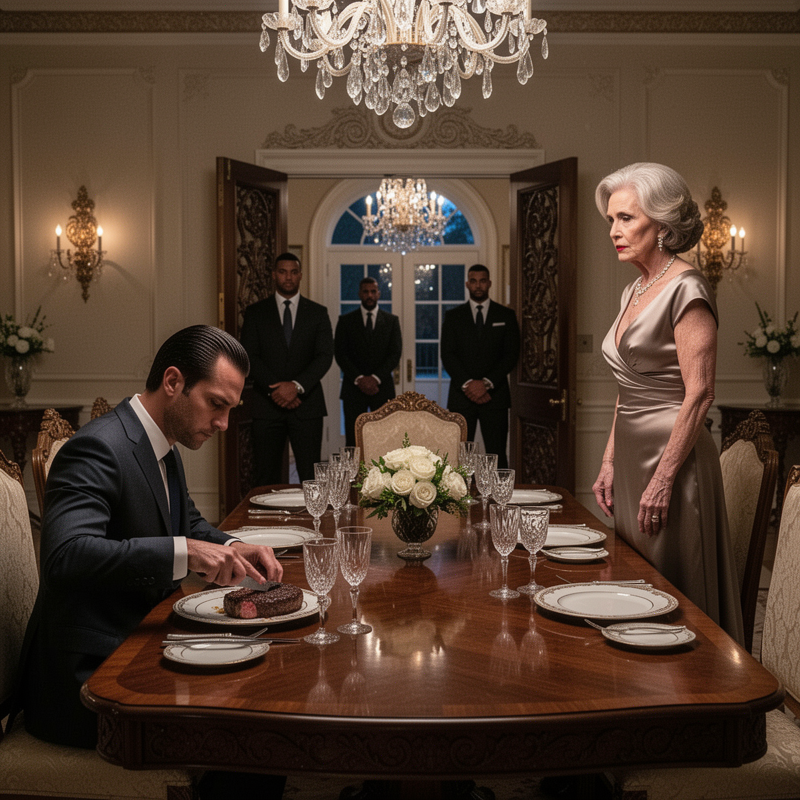
My adult son did not even look up from his ribeye steak. He raised his manicured hand, signaling two armed bodyguards to block the ornate doorway of the estate dining room.
“She doesn’t belong at the head table if she can’t show discipline, Ma,” Dominic said coldly, taking a slow sip of vintage Chianti in front of twenty silent crime captains. “And neither do you if you keep opening your mouth.”
That was the night I realized the monster my son had become—and decided to destroy his grip on the Cassano crime family before he ruined another generation.
The words hung in the air, thick as the smoke from the expensive cigars some of the captains now lit.
No one spoke. Twenty pairs of eyes, hardened by years in the Queens underworld, darted between me and Dominic. They were silent witnesses to my humiliation.
Dominic, my own son, continued to chew his ribeye with infuriating calm. The silverware clinked softly against the bone china, the only sound in the vast dining room.
His words, “And neither do you if you keep opening your mouth,” felt like a physical blow. A threat not just to my status, but to my very presence in the family I had built alongside my late husband, Sal Cassano.
My hand tightened around the stem of my wine glass. The crystal felt fragile, like my hope for Dominic.
I pushed my chair back from the immense mahogany table. The scrape echoed in the sudden quiet, drawing every eye back to me.
“Rosa, Ma,” Uncle Carmine Cassano, a man whose silver hair matched his years of wisdom, started to say, his voice low and concerned. He was three chairs down, but his gaze was urgent.
I met his eye, then shook my head almost imperceptibly. This was not a fight for him to join.
It was my fight.
My legs felt surprisingly steady as I rose. The heavy satin of my dress rustled around me. I walked past the two bodyguards Dominic had stationed at the doorway. They were young, muscle-bound men, their faces blank.
They didn’t move to block me. Not yet.
I paused at the ornate archway. I could feel Dominic’s gaze on my back, cold as a winter wind.
“Sofia is my granddaughter,” I said, my voice cutting through the silence. “She is a Cassano.”
Dominic scoffed, a low, guttural sound that grated on my nerves.
“She is a child who needs to learn her place, Ma,” he replied without looking up. “Just like everyone else.”
I walked out. The heavy double doors of the dining room seemed to close behind me without a sound, sealing me off from the opulent pretense within.
The grand hallway of the Long Island estate felt vast and empty. Tapestries depicting hunting scenes lined the walls, their cheerful colors a jarring contrast to the tension that still thrummed in my veins.
My heart ached for Sofia. Eight years old. Eating alone in that cold, cavernous garage.
I moved quickly through the marble foyer, my heels clicking on the polished stone. The air grew cooler as I approached the service entrance.
A faint light spilled from under the heavy, reinforced door that led to the garage. It was a utilitarian space, meant for storing classic cars and crates of wine, not for a child’s dinner.
My hand trembled slightly as I pushed the door open.
The immediate chill hit me. The garage was unheated, the concrete floor biting cold, the air thick with the scent of motor oil and damp earth.
In the middle of the vast, dimly lit space, a single bare bulb hung from the ceiling. Beneath it, a small folding table stood, stark and isolated.
Sofia was huddled on a metal folding chair, her small frame wrapped in a thin, oversized blazer. Her knees were drawn up to her chest.
A half-eaten plate of pasta sat before her, congealed and cold. Her shoulders shook with silent sobs.
My heart twisted. She looked so small, so utterly alone in that cavernous space.
“Sofia, my cara,” I whispered, rushing forward.
She looked up, her face tear-streaked and blotchy. Her big, brown eyes, so like her mother’s, were wide with fear and relief.
“Nonna,” she choked out, her voice barely a whisper.
I knelt beside her, pulling her into my arms. Her little body was shivering violently.
“Oh, sweet girl,” I murmured, rubbing her back. “You must be freezing.”
I quickly removed the heavy wool shawl from my shoulders, wrapping it around her. It was still warm from the dining room.
“Why did he do this, Nonna?” she asked, her voice muffled against my shoulder. “I just spilled some water.”
“I know, tesoro,” I said, stroking her hair. “Your father can be… unreasonable.”
She pulled back slightly, her gaze fixed on the cold plate of pasta.
“It wasn’t just the water,” she whispered, her eyes darting towards the far wall, as if Dominic might materialize from the shadows.
My brow furrowed. “What do you mean, cara?”
Her voice dropped even lower, almost inaudible.
“I asked him about Mama. Why she doesn’t visit anymore.”
A sudden, sharp pain lanced through my chest. Gina. My beautiful daughter-in-law, banished from the estate years ago. Dominic’s ex-wife.
“And he got angry?” I pressed, my voice hardening despite myself.
Sofia nodded, her chin trembling.
“He said if I mentioned her name again, I wouldn’t eat.”
My breath hitched. Not just a punishment for spilled water. This was calculated cruelty. He was trying to erase Gina from Sofia’s memory, to control every thought, every feeling.
“He locked me out here,” Sofia continued, her voice gaining a fragile courage, “and said I had to think about what happens when I defy him.”
I hugged her tighter, my mind reeling. The spilled water was a mere pretext. A flimsy excuse for a deeper, more insidious form of control.
He was starving his own daughter, not just freezing her, for daring to ask about her mother.
A fierce, cold rage settled in my stomach. It was sharper than the chill in the garage, more consuming than the anger I had felt just moments before in the dining room.
This wasn’t just about discipline or an old tablecloth. This was about erasing a child’s past, manipulating her future, and crushing any flicker of independent thought.
Dominic was not just a ruthless boss. He was a monster who preyed on the innocent.
And in that moment, as I held my shivering granddaughter, inhaling the cold damp air of the garage, I knew with chilling certainty what I had to do. I would dismantle his empire, piece by agonizing piece, until he no longer held power over anyone, especially not my family.
Part 2
That night, sleep did not come easily. I held Sofia close in my own bed, her small body finally still and warm beside me. My mind raced with the promise I had made to myself, a vow colder and harder than any concrete floor.
The next morning, the silence in the estate was different. It wasn’t the usual respectful quiet. It was heavy, watchful. The staff, usually so deferential, avoided my eyes. Even the junior bodyguards who still trailed me through the halls seemed to keep their distance, their whispers dying the moment I drew near.
Dominic made sure his message spread fast.
Word came to me indirectly, through concerned calls from old friends. Friends who suddenly sounded hesitant, their voices laced with thinly veiled pity.
“Rosa, are you feeling alright, cara?” one would ask, then quickly add, “Dominic mentioned… you’ve been a little forgetful lately.”
Another, a wife of a long-time captain, called to express sympathy. “Such a shame, about your memory. Dominic said you were even confusing old safehouse names.”
My blood ran cold. He wasn’t just isolating me; he was discrediting me. Telling everyone I was old, senile, a liability. A woman losing her mind and leaking secrets to the Feds. It was a calculated, vicious campaign, designed to strip me of every ounce of respect and authority I had built over decades.
He wanted to cut me off, to make sure no one would listen when I eventually tried to speak out against him. He was turning my own family against me.
I walked the opulent halls of my home, a prisoner in gilded cages, the whispers following me like shadows. Every door felt heavier, every phone call more guarded. I was alone, truly alone, surrounded by people who now saw me as a senile old woman, a danger to the family.
Days turned into a week. I still went to mass at St. Patrick’s Cathedral, my only escape from the suffocating atmosphere of the estate. My guards always watched, but during communion, they relaxed their vigilance slightly.
I knelt, bowing my head in prayer, my rosary beads cool in my trembling fingers. As the organ music swelled, a small, folded piece of paper slipped from somewhere above, landing softly in my open prayer book.
My heart hammered against my ribs. I picked it up, careful not to draw attention, and tucked it into my sleeve. Back in the car, on the ride home, I unfolded it.
The handwriting was familiar, delicate yet firm. Gina. My banished daughter-in-law.
The note was short, just a few lines. *Meet me. St. Patrick’s. Two days. North entrance, after 10 AM mass. I have the truth about Frankie. About everything. About how Dominic really took power.*
Chapter 2: Whispers in the Cathedral
I adjusted the black lace veil over my head, feeling the heavy gaze of Dominic’s two security men just outside the polished oak doors of St. Patrick’s Cathedral. They watched me enter, but the sacred space was still my one sanctuary.
Inside, the scent of old incense and beeswax calmed my racing heart.
I knelt in a pew near the back, my prayer book open to a worn page. A moment later, a slender shadow fell across the aisle.
“Rosa.”
The whisper was barely audible over the murmur of the morning mass. I looked up.
Gina. Her face was thinner, her eyes holding a fear I remembered well, but she was here. Four years in hiding had not erased the sharp intelligence I always knew she possessed.
“It’s about Frankie,” Gina breathed, pressing herself close enough that her coat brushed mine. “And Dominic. He threatened me when I found the numbers, right after Frankie died.”
A cold knot tightened in my stomach. Dominic had claimed Frankie’s death in 2018 was a rival crew ambush. A street war that led to him taking over the syndicate.
“What numbers?” I asked, my voice barely a rustle.
“Dominic altered the ledgers,” Gina whispered, her eyes darting toward the cathedral entrance. “The crew’s accounts. It happened right after Frankie was killed. He knew I’d find it. He said if I spoke, Sofia would suffer.”
The memory of little Sofia, alone in that cold garage, flashed through my mind. This was deeper than I knew.
Suddenly, a black SUV with tinted windows pulled up sharply at the curb outside, visible through the cathedral’s stained-glass windows. Dominic’s enforcers.
Gina’s eyes widened. “They’re here for me,” she choked, her hand fumbling inside her coat. “Take this.”
She pressed a cold, metal key into my palm, her fingers brushing mine. It was small, old, and unmistakably a locker key.
“74th Street, Queens subway,” Gina said in a rush, standing abruptly. “Locker 14C. The truth is inside. Don’t let them take Sofia, Rosa.”
Then, she was gone, melting into the stream of parishioners heading for the side exit, leaving me clutching the key, its cold metal a stark contrast to the warmth of my coat.
Chapter 3: The Bellevue File
The key felt heavy in my pocket, a constant reminder of Gina’s frantic warning. I couldn’t risk Dominic’s men following me directly from the cathedral. Instead, I spent the rest of the day running mundane errands, buying groceries, and visiting a distant cousin in the Bronx, making sure to circle back and check my tail multiple times.
It was almost dark by the time I finally made it to the 74th Street subway station in Queens. The station hummed with the rumble of trains and the chatter of evening commuters. The air smelled of stale coffee and damp concrete.
My heart pounded as I found the bank of lockers, a forgotten corner near the grimy restrooms. Locker 14C. I fumbled with the key, my fingers trembling slightly. The old lock clicked.
Inside, tucked away in the back, sat a thick, sealed manila folder. The kind government agencies used.
I pulled it out, my breath catching in my throat. I couldn’t open it here. Too public.
I found a quiet diner a few blocks away, ordered a lukewarm coffee I didn’t touch, and slid into a booth at the back. My hands shook as I broke the seal.
The top document was an emergency intake report from Bellevue Hospital, dated 2018. Frankie Cassano’s name was at the top.
I scanned the medical details, my eyes fixing on a single line: “Cause of death: gunshot wound to the chest, point-blank range.”
Point-blank. Not an ambush from a moving vehicle, as Dominic had claimed. Not a distant shot from a rival gang. This was intimate. Personal.
A wave of nausea washed over me. Dominic had lied to everyone.
Attached was a forensic ballistics note. It stated, plainly, “Bullet caliber consistent with .45 ACP, a round commonly fired by military-issue sidearms.”
Dominic’s personal sidearm was a customized .45. He never went anywhere without it.
The report described “powder burns” on Frankie’s skin. Zero-range. My son had stood inches from his own brother, aimed his gun, and pulled the trigger.
My Frankie. My sweet, foolish boy. Murdered by his own brother.
Chapter 4: Locked in the East Wing
The weight of the folder felt immense in my hands, heavier than any cross I’d ever carried. I folded it carefully, tucking it deep inside the lining of my heavy wool winter coat. My son. A murderer.
I made my way back to the estate, the darkness of the evening mirroring the darkness in my soul. The grand foyer was brightly lit, a stark contrast to the grim reality I now carried.
Dominic stood by the fireplace, sipping amber liquid from a crystal glass, an unreadable expression on his face.
“You were gone a long time, Ma,” he said, his voice deceptively calm. “Running errands?”
I tried to keep my face neutral. “Just visiting family. The Bronx.”
His eyes narrowed, flicking to my heavy coat. “Funny. My men reported you took a detour to Queens, then disappeared off-grid for a while.”
My stomach clenched. He’d put a tail on me.
“I needed to clear my head,” I said, trying to sound dismissive. “A woman my age needs her space, Dominic.”
He set down his glass. “Hand me your bag, Ma.”
My heart hammered. He was going to search me. I kept my hands steady as I offered my purse. He emptied it onto a marble side table: tissues, a rosary, my reading glasses, a few dollars. Nothing incriminating.
His gaze lingered on my coat. “Take off that old thing,” he ordered. “You’ll overheat indoors.”
“It’s chilly, Dominic.”
“Take it off.” His voice was sharper now.
I slowly unbuttoned the heavy garment. I knew the Bellevue report was well-hidden, sewn deep into the lining. But the risk was too great. I held the coat, not letting it out of my grasp.
“Give me your phone, Ma,” he said, holding out a hand. “And your medical papers. We need to review your prescriptions. For your safety.”
He wasn’t asking. I handed over my phone, then the small folder with my recent blood work and eye exam results.
“You’ll be confined to your room tonight,” he announced, not looking at me. “And for the foreseeable future. Third floor. For your own good, of course.”
He signaled his bodyguards. They stepped forward, flanking me. I walked, stiff-backed, up the grand staircase.
As the heavy mahogany door of my bedroom clicked shut and the bolt slid home from the outside, I heard Dominic’s voice, muffled but clear, from the hallway.
“Sofia will be leaving for boarding school in Maine by the end of the week. Best for her discipline.”
Chapter 5: The Power Cut at Midnight
The locked door felt like a physical blow. The thought of Sofia, sent away to some cold boarding school, hardened my resolve. Dominic thought he had won, but the Bellevue report was still with me, a burning ember in the lining of my coat.
I paced my room for hours, listening to the rain begin to lash against the windows. Then, just after midnight, the world outside my window plunged into complete darkness. The storm had worsened.
The estate’s electrical grid died with a low hum, followed by an eerie silence. Even the soft glow of the security cameras in the hallway vanished.
A soft scratching sound at my door.
“Rosa,” a voice whispered through the crack. “It’s Gina.”
My heart leaped. How?
The heavy mahogany door swung open. Gina stood there, soaked to the bone, a small flashlight beam dancing in her hand. Sofia, wrapped in a blanket, huddled behind her, her eyes wide with fear.
“I bribed one of the junior gateguards,” Gina explained quickly. “He knew my old access codes. Cut the power to the east wing. Gave us maybe ten minutes before the generators kick in.”
She knew the estate like the back of her hand from her years as Dominic’s wife and crew bookkeeper. Her old knowledge was our lifeline.
“My coat,” I said, grabbing the heavy wool garment from the chair. “The documents are sewn inside.”
“Good,” Gina said, her voice tight. “No time. Follow me.”
She led us not down the grand staircase, but through a hidden servant’s stairwell near the old kitchen, a route Dominic would never expect. The air smelled of stale cooking oil and damp stone.
We moved like ghosts through the darkened halls. Sofia clutched my hand, her small body trembling.
“Where are we going, Grandma?” she whispered, her voice a tiny thread in the dark.
“Somewhere safe, little one,” I murmured, squeezing her hand. “Somewhere warm.”
The kitchen service door, usually locked and alarmed, was unlatched. Gina pushed it open, revealing a torrent of rain and mud. The downpour was relentless, washing out the floodlights that would normally illuminate the rear gardens.
An unmarked black sedan waited at the edge of the property, its engine idling. The driver, a squat man with a grim face, waved us forward.
We scrambled into the back seat, soaked and shivering, the sealed Bellevue report still safe inside my coat. The car pulled away, tires spitting mud and gravel, leaving Dominic’s fortress behind us.
Chapter 6: Safehouse in Brooklyn
The unmarked sedan drove through the torrential rain, the wipers struggling against the deluge. Gina kept checking the rearview mirror until we were deep into the labyrinthine streets of Bay Ridge, Brooklyn.
“He won’t expect us here,” she said, finally relaxing a fraction. “This apartment belonged to Sal Cassano’s old driver. Old school. Nobody knows about it anymore.”
The safehouse was small, sparsely furnished, but warm and dry. Sofia immediately curled up on a worn couch, exhausted, and fell asleep.
Hours later, as dawn broke through the clouds, the news reached us through Gina’s old street contacts. The underground channels hummed with Dominic’s latest pronouncements.
“He’s put a contract out on me,” Gina said, her face pale. “A hundred thousand dollars for my head. He’s telling everyone I kidnapped you, Rosa. That rival crews are trying to extort the Cassano family.”
My blood ran cold. He was twisting the narrative, portraying me as a helpless victim and Gina as a traitorous enemy. This wasn’t just about control; it was about destroying us.
“And Sofia?” I asked, my voice barely a whisper.
“He’s saying she’s at an undisclosed safehouse in New Jersey,” Gina replied, her jaw tight. “He’s trying to make it look like he’s protecting her from me. From us.”
I looked at Sofia, still asleep on the couch, her small chest rising and falling evenly. I had saved her from Dominic’s physical cruelty, but she was still a pawn in his game.
“This hiding won’t last,” I said, my voice firm. “He controls the streets. He controls the information. As long as we hide, he wins.”
Gina looked at me, her eyes questioning. “What do we do, Rosa? He’s untouchable.”
“Not completely,” I replied, pulling the Bellevue report from my coat. Its edges were now soft from the dampness, but the words within were stark. “There are rules. Old rules. Even Dominic has to answer to them.”
“You mean… the council?” Gina asked, a flicker of hope in her eyes. “He’ll never agree.”
“He won’t have a choice,” I stated. “I will demand a formal audience. Under ancestral rules, a matriarch has the right to be heard.”
Chapter 7: The Gathering of the Elders
I found an old flip phone in the safehouse kitchen drawer, ancient but functional. I didn’t dare use my own. With Gina’s help, I remembered the number for an old childhood messenger, a man whose loyalty to the Cassano name stretched back further than Dominic’s reign.
He arrived at the safehouse an hour later, a stoic man named Vinnie, his face etched with concern. I handed him a single, folded sheet of paper with my distinctive handwriting.
“Deliver this to Uncle Carmine,” I instructed, my voice clear. “Only to him. No one else. Tell him it’s about the family. And tell him I have evidence.”
Vinnie nodded once, tucking the note into his inner coat pocket without a word. He understood the unspoken weight of my request.
Within a day, Vinnie returned with Uncle Carmine’s reply. The message was terse: “The council will convene. At the old estate. Tomorrow evening. By ancestral right.”
Dominic, for all his power, could not refuse a matriarch’s summons to a family tribunal. The unwritten laws of the syndicate were older than any boss. Even his own father, my late husband, had respected them. He would be forced to agree, unaware that I held the truth of his deepest treachery in my hands.
“He’ll try to sway them,” Gina warned, pacing the small apartment. “He’s good at manipulating the old men, twisting stories.”
“He can talk all he wants,” I replied, patting the pocket of my coat where the Bellevue file rested. “The evidence speaks for itself. And Carmine is a man of honor, however rigid.”
My mind flashed back to the many family dinners, the hollow pronouncements about Frankie’s “tragic ambush,” the public mourning. Dominic had built his throne on a lie, cemented by his brother’s blood. Now, the truth was about to crack that foundation.
The thought of facing him, alone, in that house, filled me with a quiet dread. But Sofia’s face, her fear, erased any hesitation. For her, I would walk into the lion’s den.
Chapter 8: The Disarming at the Gate
The Long Island estate stood shrouded in a cold, persistent drizzle on the day of the tribunal. The heavy clouds seemed to press down on the grand, imposing structure. I arrived with Gina and Sofia in a nondescript car, leaving them hidden a few blocks away. This was my battle to fight alone.
As the car pulled up to the ornate gates, I saw them. Uncle Carmine, his face grim and unyielding, stood beside Paulie “Nails” Varga, the veteran captain known for his unwavering loyalty to the old ways. Behind them, a dozen other senior captains formed a silent, watchful semi-circle.
Dominic’s personal bodyguards, usually an intimidating phalanx of muscle, stood disarmed, their weapons laid out on a card table next to the gatehouse. Their faces were sullen, but they offered no resistance.
Uncle Carmine was enforcing the strict protocols. No personal security. No distractions.
Dominic himself emerged from the house, his expensive suit impeccable, his face a mask of controlled fury. He saw his men disarmed, his authority publicly challenged, and his jaw tightened.
“Carmine,” Dominic said, his voice clipped, “this is an insult.”
“This is tradition, Dominic,” Uncle Carmine replied, his voice a low rumble. “A matriarch has summoned the council. All men are equal before family law.”
He gestured to Dominic’s remaining bodyguards. “Hand over your pieces. You will wait in the guesthouse.”
Dominic’s eyes flashed with anger, but he knew better than to openly defy the syndicate elders gathered here. He dismissed his men with a curt nod.
“You will proceed alone to your study,” Carmine instructed Dominic. “No audience. The council awaits Rosa’s testimony.”
Dominic shot me a venomous look as he walked past, his shoulders rigid. He knew something was wrong. But he had no idea what storm was about to break.
I watched him enter the house, disappearing behind the massive front door. Paulie “Nails” Varga stepped forward, his expression unreadable.
“The study doors will be locked from the outside,” Paulie said quietly. “No one enters. No one leaves until the resolution.”
He pointed to two burly captains, who took up positions by the heavy oak doors of Dominic’s executive study, their faces stoic. I was to walk into that room, alone, with my son. The air was thick with the silent tension of men anticipating a seismic shift.
Chapter 9: Unmasking the Boss
The heavy oak doors of Dominic’s executive study swung open, and I stepped inside. The room was grand, filled with dark mahogany and leather, a testament to his power. Dominic stood behind his massive desk, his hands clasped, a faint tremor betraying his outward composure. The air was thick, suffocating.
The doors clicked shut behind me, the sound echoing ominously in the silence.
“Well, Ma,” Dominic said, his voice laced with forced bravado. “What is this nonsense? Trying to cause trouble with your ‘dementia’ stories?”
I walked slowly towards the desk, my old bones aching but my resolve firm. I pulled the sealed manila folder from inside my coat, its presence a physical weight in my hands.
“No stories, Dominic,” I said, my voice steady, though my heart pounded against my ribs. “Just the truth.”
I placed the Bellevue Hospital ER record directly onto his polished mahogany desk. The crisp white paper stood out against the dark wood.
Dominic’s eyes flicked to the document. He picked it up, his brow furrowing as he read the hospital’s letterhead, then Frankie’s name. A flicker of something — recognition, fear — crossed his face.
“What is this, a forgery?” he scoffed, but his voice lacked conviction.
I leaned forward, my hands flat on the desk. “Read the coroner’s entry, Dominic. The one about the cause of death. The powder burns on Frankie’s chest. Point-blank range.”
His eyes widened, darting across the page. He stiffened, his carefully constructed composure beginning to crack. The truth, stark and undeniable, was laid bare before him.
“It wasn’t a rival crew, was it?” I continued, my voice gaining strength. “It was your .45. Your own brother. For the throne.”
He slammed the paper down, his face twisting into a mask of rage and desperation. “You think you can come in here, Ma, and accuse me? They’ll laugh you out of here!”
“They’re waiting outside, Dominic,” I reminded him calmly. “Uncle Carmine. Paulie Varga. Every captain who believes in the old ways. They know I have evidence. And they know you’ve been stripped of your guards, alone.”
He looked at the locked doors, then back at me, his eyes filled with a raw, animal panic. He was trapped. Stripped of his power, exposed, with nowhere to run.
“What do you want?” he choked out, his voice hoarse.
“You relinquish your position as boss,” I said, my voice firm. “You sign full custody of Sofia over to Gina. And you accept permanent exile from New York. If you ever return, the syndicate will handle it.”
His shoulders slumped. The monstrous facade crumbled. He was just a coward, exposed and alone.
He stared at the document, then at me. After a long, agonizing moment, he grabbed a pen. “Get the papers ready, Ma.”
Chapter 10: Banishment in the Rain
The moment Dominic finished signing the surrender documents, his hand visibly shaking, a single knock echoed on the study door. I opened it.
Uncle Carmine and Paulie Varga stepped inside, their faces stern, their eyes sweeping over Dominic, then resting on the signed papers. The air in the room, previously thick with tension, now thrummed with cold finality.
“Dominic Cassano,” Uncle Carmine intoned, his voice resonating with ancient authority. “By decree of the family council, you are stripped of your title as boss of the Cassano syndicate. Your claim to the family throne is hereby null and void.”
Dominic stood frozen, his face ashen.
Paulie Varga stepped forward, his movements precise. He reached across the desk and, with a swift, decisive motion, slid the heavy gold syndicate ring from Dominic’s finger. The ring, a symbol of generations of power, now sat cold in Paulie’s palm.
“You will be escorted directly to JFK Airport,” Carmine continued, his gaze unwavering. “Your private jet awaits. If your foot ever touches New York soil again, the consequences will be absolute. You are banished.”
Dominic didn’t speak. He simply turned, a broken man, and walked out of the study, flanked by Paulie and two other captains. The heavy doors closed behind them, sealing his fate. The rain outside continued its relentless drumming.
Hours later, the storm had passed, leaving the estate grounds glistening under a pale moon. Gina and Sofia, their eyes wide with disbelief and relief, returned to the estate. The house felt different now, cleansed of Dominic’s oppressive presence.
Sofia ran through the foyer, her laughter echoing in the now-lighter space. She hugged me tightly. “Grandma, we’re home!”
The senior captains, who had lingered in the grand parlor, offered me quiet nods of respect as I passed. “You preserved the family name, Rosa,” one of them murmured. “Without shedding a drop of street blood.”
It was a strange victory. The tyranny was broken, but the life remained. I looked at Gina, holding Sofia’s hand, a ghost of a smile on her face. A new chapter had begun for them, free from Dominic’s cruelty. But for the Cassano family, the cycle, I knew, was far from over.
Chapter 11: The Echo in the Cold Garage
Twenty-two years later, the Long Island estate still stood, weathering the seasons and the subtle shifts of power. I was 89 now, my steps slower, my cane a constant companion. My memory, thankfully, remained sharp, though some days the past felt as present as yesterday.
One cool evening, I found myself walking slowly across the gravel driveway, towards the quiet, concrete garage. The same room where little Sofia had once been banished for spilling a glass of water. It smelled faintly of oil and cold stone, just as it had then.
I sat on a wooden stool near the workbench, the kind Dominic had forced Sofia to eat her meals on. The room was empty, save for a few forgotten tools and old boxes.
The garage door was open, letting in the fading light of dusk. A figure stood just outside, silhouetted against the amber sky.
It was Sofia. Thirty years old now, her posture confident, her dark hair pulled back in a severe bun. She held an encrypted satellite phone to her ear, her voice low and authoritative.
“Chicago is over-extending,” she said, her voice clear and decisive. “Tell them to pull back from the port authority routes. We’ll hold the western freight until they learn discipline.”
She listened for a moment, then nodded, her jaw set. “Understood. No loose ends. Maintain the silence.”
She ended the call, tucked the phone away, and stepped back into the garage. She saw me there, and a soft smile touched her lips.
“Grandma Rosa,” she said, walking over and placing a warm hand on my shoulder. “Just wrapping up.”
I looked at her, so capable, so strong, running the family business with an iron will Dominic would have envied. She was nothing like the terrified eight-year-old girl I had rescued from his tyranny. She was a boss.
I wrapped my wool shawl tighter around my shoulders, feeling the persistent chill of the concrete.
I thought I saved my bloodline when I broke my son’s crown in that dark room. But sitting here in the cold concrete years later, I realize we never truly escape the cages we build for ourselves—we only pass the keys to those we love.
Leave a Reply