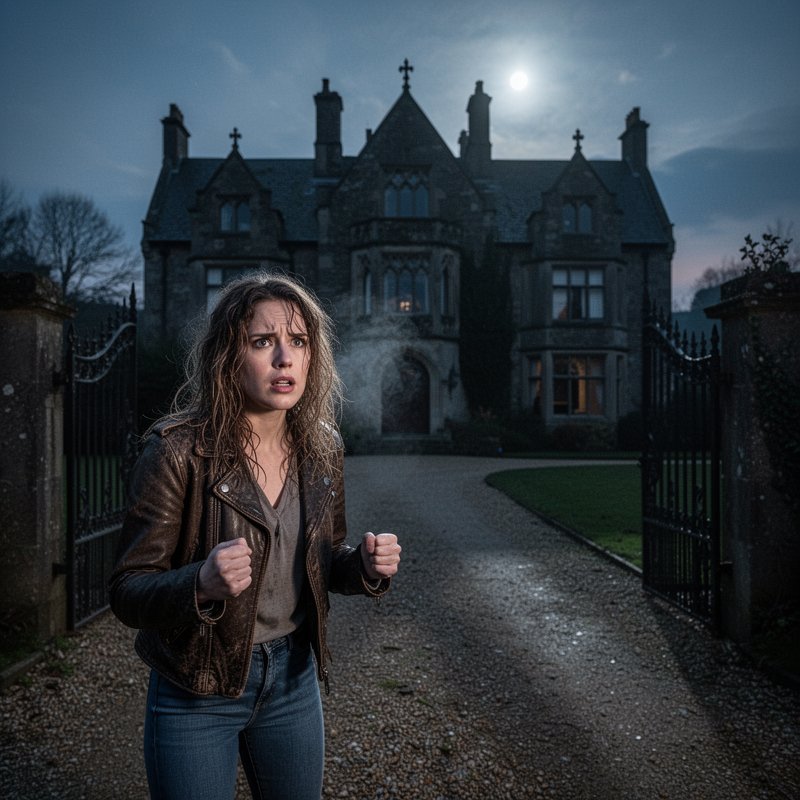
CHAPTER 1: The Call at Three AM
Part 1
At 3:00 AM, my phone rang with a frantic call from my twin sister, Maeve, sobbing that her life was in danger inside her home.
When I arrived, my lifelong best friend and her husband, Julian Danforth, blocked the front door, insisting it was merely a private marital argument.
I forced my way past him into the bedroom and found Maeve lying motionless on the floor, covered in violent contusions and strange, blackened skin scorches.
Although I was stripped of my police badge six months ago following a severe battle with alcoholism, I vowed that Julian would face full prosecution under the law.
As distant sirens began to echo down the road, Maeve’s unconscious body suddenly rigidified, and her lips uttered a chilling warning in a voice that belonged to someone long dead.
The chill of the autumn night seeped into my bones, even through the worn leather of my old patrol jacket. My breath plumed in the cold air as I slammed the door of my ten-year-old sedan, the cheap metal rattling in protest.
Danforth Manor loomed before me, a monstrous silhouette against the bruised pre-dawn sky. Its gothic towers and dark, gabled windows usually exuded an old-money elegance, but tonight, they felt predatory, ancient.
The street was deserted. Not a single porch light flickered on among the neighboring estates, each one set far back behind manicured hedges and iron gates. It was as if the entire world had conspired to leave Maeve and me utterly alone.
My heart hammered against my ribs, a frantic drumbeat against the silence. Maeve’s sobs, her desperate, whispered plea – “He’s going to kill me, Nora!” – still echoed in my ears, making my hands tremble.
I pushed through the ornate iron gates, which groaned on their hinges as if awakening from a long slumber. The gravel crunched loudly under my worn boots as I half-ran, half-stumbled up the curving driveway.
The massive oak front door, usually so welcoming, now looked like the entrance to a crypt. I didn’t bother with the bell. I pounded on the heavy wood with the flat of my hand, a frantic, desperate rhythm.
“Julian! Open up! Maeve!” I yelled, my voice hoarse, raw with adrenaline.
Seconds stretched into an eternity. I pounded again, louder this time, my fists aching. The porch light, usually a soft glow, now seemed to mock me with its pale, unconcerned luminescence.
Then, the heavy door swung inward.
Julian Danforth stood in the doorway, impeccably dressed even at 3:15 AM in a silk robe that looked expensive, his dark hair slicked back perfectly. His face, usually a mask of calm, professional charm, was composed, almost serene.
He was my closest friend, my brother-in-law, a rising star in the District Attorney’s office. Now, he looked like a polished, unyielding stone wall.
“Nora. What a surprise,” he said, his voice level, completely devoid of the panic that should have been tearing through him. He didn’t step aside. He didn’t even acknowledge the urgency in my face.
“Where is she, Julian? I just spoke to Maeve. She’s in trouble,” I snapped, trying to push past him. My suspension from the force had stripped me of my badge, but not my instincts.
He placed a hand firmly on my chest, blocking my path. His touch was cold, authoritative. “Nora, please. You’re overreacting. Maeve is fine. She’s simply having a bit of an episode.”
“An episode? She sounded like she was being murdered!” I retorted, trying to meet his gaze, but his eyes were like chips of dark ice.
He sighed, a measured, exasperated sound. “It’s just one of her anxiety attacks, love. You know how she gets. The stress of… everything. She’s been a little fragile lately.”
He tried to steer me gently back toward the porch steps, his grip surprisingly strong. The faint scent of expensive cologne clung to him, a stark contrast to the visceral terror I felt.
“Fragile? Julian, I heard her! She was crying for help!” I twisted away, adrenaline coursing through me. “Let me see her!”
“This is a private marital matter, Nora,” he said, his tone hardening just perceptibly. “I understand your concern, but you’re no longer on the force. You have no jurisdiction here.”
His words hit me like a physical blow, a cruel jab at my past, at the wreckage of my career. But the image of Maeve’s terrified face flashed in my mind, overriding the sting.
“I don’t need a badge to protect my sister,” I growled, and with a surge of raw, desperate strength, I shoved past him. He stumbled back, momentarily caught off guard.
I burst into the grand foyer, the echoes of my boots loud on the marble floor. The house was quiet, almost eerily so. No sounds of a struggle, no broken glass, just the tick-tock of a grandfather clock in the corner.
“Maeve!” I screamed, my voice cracking.
I ran through the sprawling, opulent living room, past priceless antiques and dark, heavy draperies. The familiar elegance of my sister’s home felt utterly alien tonight.
The master bedroom door was ajar. A faint, sickly sweet smell, like burnt ozone and something metallic, hung in the air.
My heart seized.
I pushed the door open the rest of the way, my gaze sweeping the dimly lit room. Maeve wasn’t in the bed, where the silk sheets were artfully rumpled, as if she’d just gotten up.
She was on the floor.
Her body lay twisted in an unnatural angle beside the intricately carved antique nightstand, her face pale and slack. Her eyes were closed.
“Maeve!” I dropped to my knees, scrambling towards her.
Her usually vibrant red hair was matted and streaked with something dark and crusty. Her beautiful face was marred by vicious, purplish-black contusions that seemed to spiderweb across her delicate skin.
But it was the scorches that truly made my stomach churn. Jagged, blackened patterns, like severe burns, marred her arms and chest, tracing an almost symmetrical, alien design. They looked less like a normal burn and more like the flesh itself had been eaten away, leaving behind charred shadows.
I reached out, my hand trembling, and gently touched her forearm, just above one of the horrifying black patterns. The skin was unnaturally cold.
The moment my fingers made contact, a searing, white-hot agony ripped through my own left arm, precisely mirroring the pattern of the scorch on Maeve’s skin. A phantom burning sensation erupted, so intense it felt like my flesh was being branded by a red-hot iron, twisting and charring me from the inside out.
I gasped, pulling my hand back as if burned, clutching my own arm. The pain was immediate, visceral, and utterly impossible.
Part 2
I gasped, pulling my hand back as if burned, clutching my own arm. The pain was immediate, visceral, and utterly impossible. I looked down at Maeve’s still form, then back at my own tingling forearm, terror chilling me far deeper than the night air.
Just then, Julian appeared in the doorway, his silk robe still perfectly arranged, his face impassive. He surveyed the scene, his gaze lingering on Maeve, then on my clenched fist.
“Nora, what have you done?” he asked, his voice low, but carrying across the silent room.
Before I could answer, the wail of sirens grew louder, then abruptly cut off, replaced by the crunch of boots on the gravel outside. Blue and red lights flashed through the bedroom window, painting the walls with garish, strobing colors.
Detective Marcus Kincaid, a man I’d worked with for years before my fall, strode into the room, followed by two uniformed officers, their bodycams glowing faintly. He took one look at me, kneeling over Maeve, and his expression hardened. His eyes held no sympathy, only a familiar judgment.
“Nora Finch,” he said, his voice flat. “What in God’s name is going on here?”
“It’s Maeve, Marcus!” I cried, pointing to my sister’s still body. “Julian did this to her! Look at her! She’s covered in injuries!”
Kincaid waved his hand, and the uniformed officers moved forward, their flashlights sweeping the floor. One of them knelt where Maeve should have been. Then he looked up, confused.
“Detective? There’s nothing here,” he said, his voice echoing.
My blood ran cold. “What are you talking about? She’s right there!” I insisted, my voice rising in a desperate pitch. “On the floor! She’s unconscious!”
Kincaid pulled a small screen from his belt, reviewing the live feed from the bodycams. His brow furrowed, then he looked at me, a mixture of suspicion and contempt in his eyes. The footage, crystal clear, showed only the empty, patterned rug where I swore Maeve lay.
Julian stepped forward, calm and collected. “Detective Kincaid, I regret to inform you that Nora has been experiencing significant distress. My wife, Maeve, voluntarily admitted herself to St. Jude’s Psychiatric Wing at precisely 1:00 AM this morning. I have the signed admission forms right here.”
He produced a neatly folded document from his robe pocket. Kincaid snatched it, his eyes scanning the timestamp. He looked back at me, his face a mask of certainty.
“Nora, you’re trespassing, you’re off-duty, and you’re clearly unwell,” Kincaid stated, his voice now a threat. “I’m going to have to take you in for questioning. This looks like an alcoholic delusion, Nora.”
The accusation hit me like a physical blow. Just then, a shrill, insistent ringing cut through the silence. It wasn’t my phone, or Kincaid’s. The sound seemed to emanate from the wall beside the fireplace, from behind a small, ornate panel. A panel that covered an old, built-in safe, a relic from the house’s original construction in 1904, long unused.
CHAPTER 2: Scars Beyond the Skin
I rode in silence behind the ambulance, the red and blue strobes painting the wet road ahead. My hands still trembled from touching Maeve’s skin, that phantom burn searing my own forearm.
St. Jude’s Hospital’s emergency room smelled like antiseptic and stale coffee. They wheeled Maeve away quickly.
“I need a full forensic examination,” I told the admitting nurse, my voice tight. “Immediately. Her injuries are… unusual.”
Dr. Evelyn Corliss, a woman with sharp, kind eyes and a lab coat, emerged from Maeve’s bay a few minutes later. She looked tired but focused.
“She’s stable, but the internal damage is significant,” Dr. Corliss said, rubbing her temples. “The scorch patterns on her arms aren’t typical for blunt force trauma.”
I leaned closer. “What do you mean?”
“The tissue damage resembles cellular necrosis, like from internal radiation,” she explained, her brows furrowed. “It’s not an external burn, and it doesn’t match any domestic violence weapon I’ve ever seen.”
The words hit me like a physical blow. Radiation. That wasn’t just a beating.
Julian Danforth strode into the ER, flanked by two lawyers, his face carefully composed. He held a stack of papers.
“Ms. Finch,” he said, his voice cold. “I have a court injunction prohibiting any unauthorized medical procedures, including blood draws, on my wife. Her preexisting medical directive is explicit.”
He handed a document to Dr. Corliss, who read it quickly, her expression hardening. It was dated a month ago.
“I understand,” Dr. Corliss said, her voice strained. She looked at me, a silent apology in her eyes.
Security guards appeared, motioning me toward the exit. Julian watched me, a smirk playing at the corner of his mouth.
As they guided me past Maeve’s bay, I saw a discarded cotton swab on the floor near her gurney. It was stained with a faint trace of fluid from her wrists.
My hand darted out. I snatched it, palming the swab before anyone noticed. The rough cotton felt like a secret.
CHAPTER 3: The Gaslight Strategy
The next morning, the local news channels were full of Julian Danforth. He stood outside the county courthouse, looking somber and composed.
“My wife, Maeve, is currently recovering from a severe anxiety attack,” he told the cameras, his voice resonating with practiced sincerity. “This tragic incident has been compounded by my sister-in-law, Nora Finch, whose well-documented struggles with alcohol addiction led to a violent, forced entry into our home.”
He looked directly into the camera, mentioning my name. “We are deeply concerned for Ms. Finch’s mental health and hope she seeks the help she clearly needs.”
The words were a calculated strike, designed to undermine everything I had seen. My past was a weapon in his hands.
Later that afternoon, Detective Marcus Kincaid knocked on my apartment door. He held a search warrant.
“We have reason to believe you possess unauthorized departmental files, Ms. Finch,” Kincaid said, his eyes avoiding mine. “Specifically related to your suspension.”
He didn’t need to elaborate. Julian had leaked something.
Kincaid’s team systematically searched my apartment, seizing my personal laptop and the physical photo logs I’d kept from my time on the force. These were all materials Julian knew I had.
I watched them pack my life into evidence bags. He was using my own history against me, building a legal defense around my supposed instability. He wanted to make me look like a raving drunk.
He wanted to silence me.
I gripped the small, secret swab hidden in my pocket. If he wanted to fight dirty, I would too.
I drove straight to the county recorder’s office. If Julian wanted to play games with history, I would dig into his.
CHAPTER 4: The Off-Shore Legacy
The county archives were dusty and quiet, smelling of old paper and forgotten time. I found the original 1888 deed for Danforth Manor under a pile of ledgers.
The property tax deposits were unusual. For 135 years, they had been paid by an entity called “The Entity of 1888,” from an off-shore trust.
I scanned the trust documents. An unbroken series of corporate officers were listed, each sharing Julian’s middle name: “Arden.” Each document bore precise bloodline markers I recognized from family history. It was too specific to be coincidence.
This wasn’t just a family estate. This was something deeper, something institutional, hiding behind legal structures.
I tried to photocopy the original land registry page, the one detailing the “Entity.” I placed it on the scanner bed.
The moment the light passed over the ancient paper, the page turned completely black, as if seared by an invisible flame. The scanner whirred, then jammed, spitting out a blank, singed sheet.
My phone buzzed in my pocket, startling me. It was an unlisted number.
“Nora?” Dr. Corliss’s voice was low, urgent. “I need to see you. Now. The diner on Elm. Don’t tell anyone.”
CHAPTER 5: Shared Agony
The diner was almost empty, the smell of grease and coffee hanging heavy in the air. Dr. Corliss sat in a booth in the back, her face grim.
“The skin swab you gave me,” she began, pushing a cup of coffee toward me. “I ran some preliminary microscopic analysis.”
I waited, my heart pounding against my ribs.
“The cells,” she continued, leaning forward. “They have abnormal double-helix structures. They refuse to stabilize under standard laboratory dyes. It’s like nothing I’ve ever observed in human tissue.”
The implications were staggering. “Not human?”
“I can’t say for sure,” she whispered. “But the morphology is alien.”
Suddenly, a searing pain ripped through my left forearm. It felt like hot wires were being twisted under my skin. I gasped, dropping my coffee cup, which shattered on the linoleum floor.
My vision blurred. I looked down, horrified, as dark red lacerations spontaneously erupted across my skin, perfectly mirroring the scorch patterns I’d seen on Maeve in the hospital. The wounds burned, stinging with an impossible agony.
Dr. Corliss stared, her eyes wide with shock. She reached across the table, her hand hovering, not quite daring to touch me.
“Nora,” she breathed, her voice barely a whisper. “What is happening?”
The pain was overwhelming, a phantom agony that left me trembling. This wasn’t a hallucination. She had seen it.
CHAPTER 6: Two Voices on the Line
Detective Kincaid looked out of place, hunched in the shadows behind the precinct. Rain slicked the pavement. He motioned me into his unmarked car.
“I shouldn’t be doing this, Nora,” he said, his voice low. “But something’s not right.”
He pulled out his phone, bypassing departmental channels. “I enhanced the 911 audio from your call that night. Headquarters ordered me to erase it.”
He played the recording. Maeve’s frantic voice filled the small space, but beneath it, a second, deeper sound rumbled. A guttural, archaic cadence. It wasn’t just interference.
“Listen closely,” Kincaid urged.
Two distinct voices. Speaking simultaneously, but through a single vocal track. It sounded like Maeve was struggling to speak, but the other voice was somehow overlaid, controlling her words.
The hair on my neck stood up. “Who was that?”
Kincaid shook his head. “I don’t know. But it’s not normal. It’s why I kept a backup.”
He looked at me, a flicker of professional suspicion in his eyes, but also a dawning realization that I hadn’t been delusional.
My phone buzzed. It was a news alert: “Julian Danforth Files Emergency Petition for Full Legal Guardianship of Wife Maeve.”
Julian was moving to cut me off completely. He knew I was getting too close.
CHAPTER 7: Falsified Records
The probate courtroom was tense. Judge O’Brien, a man known for his rigid adherence to protocol, presided with an unyielding gaze.
Julian sat at the petitioner’s table, calm and collected, his legal team a wall of expensive suits behind him. I sat alone, feeling the weight of their scrutiny.
Julian’s lead attorney stood. “Your Honor, we have evidence that Ms. Nora Finch continues to pose a risk to her sister, Maeve Danforth.”
He presented a state laboratory report. It indicated high levels of alcohol and synthetic hallucinogens in my blood sample, taken during a routine probation check just three days prior.
I stared at the document, my heart sinking. It was a lie. I had been sober for ten months. My last check-up had been clean.
“This is falsified!” I protested, standing up. “My samples were clean.”
Judge O’Brien raised a hand. “Order, Ms. Finch. Do you have proof of tampering?”
I didn’t. The samples had been sent through a private courier service, not directly to the lab. Julian had targeted the weakest link.
He looked at me with cold triumph.
The judge slammed his gavel. “Given the evidence of Ms. Finch’s continued substance abuse, and the concerning nature of her prior actions, I am granting Mr. Danforth temporary full legal guardianship over Maeve Danforth.”
He added, “Furthermore, I am issuing a strict protection order. Ms. Finch is barred from coming within 500 feet of her sister, effective immediately.”
I felt a cold dread settle in my stomach. He had cut me off from Maeve completely.
CHAPTER 8: Unlawful Analysis
Despite the court orders, Dr. Evelyn Corliss refused to be silenced. She worked late, using the state lab equipment after hours, the hum of the machinery filling the empty halls.
She had Maeve’s tissue sample on the gene sequencing machine. The advanced equipment whirred, processing the strange cells.
The screen flickered. An error report flashed: “CRITICAL SYSTEM FAILURE: UNKNOWN BIOLOGICAL ANOMALY.”
Dr. Corliss leaned in closer. The automated sequencing machine generated lines of code, indicating triple-chromosomal pairs and chimeric DNA markers. They simply did not exist in human reference databases.
It was alien. Unnatural.
Before she could archive the bizarre file, the central computer power grid flickered, plunging the lab into momentary darkness. Then the emergency lights hummed on, casting long shadows.
On the main monitor, an unknown IP address appeared, rapidly attempting to remotely wipe the state laboratory’s primary database. Julian knew.
“No, you don’t,” she muttered, her fingers flying across the keyboard.
She rapidly exported the raw data—the impossible DNA sequence—onto an encrypted offline flash drive. She pulled it out just as the system fully crashed.
The lab went silent, save for the rhythmic beeping of the emergency power. She clutched the drive, the only evidence of what she had seen.
CHAPTER 9: The Predecessor’s Fate
My former colleague, a librarian named Ben, looked nervously over his shoulder as he let me into the historical society library’s restricted basement archives. The air was heavy with the smell of mildew and old paper.
“This is strictly against protocol, Nora,” he whispered, flicking on a single bare bulb. “Be quick.”
I found the microfilmed newspaper articles from October 1892. The headlines screamed of tragedy and mystery.
“Clara Danforth Found Dead in Manor Bedroom: Unexplained Burns Reported.”
Julian’s great-grandmother. The date sent a chill down my spine.
I scrolled through the grainy images. The coroner’s report from 1892 described severe scorch marks covering her body. The injuries were identical to Maeve’s.
Then I saw the detail that made my breath catch in my throat: Clara’s twin sister, Eleanor, living five miles away in Boston, had experienced identical phantom agony in the hours leading up to Clara’s death. The article even mentioned Eleanor collapsing with burns that mirrored her sister’s.
It wasn’t just Maeve. It had happened before, over a century ago, in the exact same room, to a Danforth twin. And the agony was shared.
This wasn’t just a family secret. It was a curse, or something far worse, echoing through generations.
CHAPTER 10: The Reinstatement Offer
Julian arranged a private meeting at a neutral downtown legal office, the room sterile and impersonal. He sat opposite me, no lawyers this time, just him and his impenetrable calm.
“Nora, let’s be pragmatic,” he said, sliding a thick envelope across the polished table. “I have a signed agreement here.”
I looked at the document. It detailed full reinstatement of my police badge, a complete clearing of my suspension record, and a $250,000 settlement. The only condition: I was to leave Bristol County permanently.
“Walk away, Nora,” he urged, his voice surprisingly soft. “Let this go.”
“Why?” I asked, my voice flat. “Why now?”
He leaned back, his eyes unreadable. “Maeve’s condition… it is part of a process that human courts cannot comprehend.”
I reached into my pocket, my fingers finding the small, hidden digital recorder I’d brought. I discreetly pressed record.
“A process?” I pushed. “What process, Julian? What did you do to my sister?”
He sighed, a shadow passing over his face. “Some things are beyond the law, Nora. Beyond your understanding. Just take the offer.”
I stood up, pushing the envelope back toward him. “I refuse. Maeve is my sister. I’m not leaving.”
I walked out, clutching the recorder. I had him. I had his admission.
But when I got to my car and played the recording back, there was only static. A low, resonant hum vibrated through the speakers, drowning out everything. My blood ran cold.
CHAPTER 11: The Genetic Anomaly
Dr. Corliss worked around the clock, fueled by caffeine and a fierce sense of moral obligation. She had the impossible task of making sense of Maeve’s DNA.
She’d used Maeve’s fingernail scrapings, recovered from the bedroom carpet, and compared them to historical biological samples. These samples were preserved in county court evidence vaults from an unsolved 1912 homicide at Danforth Manor.
The lab equipment whirred, lights blinking. The results scrolled across the screen.
“Oh, my God,” she whispered, her hands shaking slightly.
The DNA profiles yielded a 99.9% genetic match. The biological material under Maeve’s nails belonged to an individual who had died over a century ago. A Danforth ancestor.
It was impossible. The man buried in 1912 had somehow left his DNA on Maeve, a century later.
This wasn’t just a family secret. It was a biological ghost.
Dr. Corliss immediately picked up the phone. She had to bypass Julian’s protection orders, the threats, everything.
“District Attorney Adler,” she said, her voice firm. “I need to request a grand jury subpoena. I have evidence that will shatter every assumption about the Danforth case.”
CHAPTER 12: Vault Breach
District Attorney Sarah Adler, a no-nonsense prosecutor, moved swiftly. Based on Dr. Corliss’s urgent report, she initiated formal grand jury proceedings. The courthouse buzzed with the impending revelation.
Hours before the evidence was scheduled to be formally presented, the sky turned an ominous green. An unseasonable, violent lightning strike ripped through the municipal courthouse.
The building plunged into darkness. Alarms blared as a localized electrical fire erupted in the basement security vaults.
Firefighters and police converged. Chaos reigned.
I rushed to the scene, my badge still in my pocket, but adrenaline coursing through me. Kincaid, amidst the confusion, found me.
“The vault,” he shouted over the sirens. “The evidence vault. Something hit it directly.”
We pushed our way through the smoke. The sealed physical evidence box, containing Maeve’s tissue samples and the 1912 comparison slides, was gone.
Vanished.
Where the box had rested, a distinct scorch mark blackened the concrete floor. It was identical in pattern and appearance to the unexplainable injuries on Maeve’s skin.
Someone, or something, had taken the evidence. And it left its signature.
CHAPTER 13: Awakening
Maeve briefly regained consciousness in the hospital ICU. She was under round-the-clock police guard, Detective Kincaid having pulled strings after the vault incident.
I knew I couldn’t get in normally. Julian’s protection order was still active.
I found a discarded orderly’s uniform, pulling the scrubs on quickly. My hands were shaking. I adjusted the surgical mask, pushing a cart of fresh linens toward Maeve’s room.
The guard at her door barely glanced at me as I entered.
Maeve’s eyes fluttered open. They were still wide with fear, but a flicker of recognition ignited when she saw me.
“Nora,” she whispered, her voice frail.
I leaned close, my heart hammering against my ribs. “Maeve, what happened? What is Julian doing?”
“He’s not… he’s not acting alone,” she rasped, struggling for breath. “He’s a vessel. For something beneath the estate.”
Her eyes darted nervously to the door. “It dwells in the subterranean chambers. It needs two matching bloodlines to complete its transfer. Every eighty years.”
She looked directly into my eyes, her hand weakly gripping mine. “Nora, you’re the secondary target. You’re next.”
A chill colder than any hospital air seeped into my bones. My twin was telling me I was marked.
CHAPTER 14: The Conscience of a Scientist
The pressure on Dr. Evelyn Corliss was immense. Threats of termination from the state health board, accusations of professional misconduct—all orchestrated by Julian’s lawyers.
But she had Maeve’s face in her mind. She had seen the impossible DNA.
She knew what she had to do.
Defying every court gag order, every professional guideline, she walked directly into the courthouse hallway where the grand jury was deliberating. Her steps were deliberate, firm.
She approached the grand jury foreperson, a stern-faced woman in a navy suit. With a steady hand, Dr. Corliss handed her an encrypted flash drive.
“This is the unredacted chimeric DNA analysis,” she said, her voice clear despite the tremor in her hands. “It bypasses all official channels. It’s the truth.”
The foreperson looked at the drive, then at Dr. Corliss, understanding dawning in her eyes. It was a career-ending move, but a necessary one.
District Attorney Adler received the leaked report minutes later. Her skepticism dissolved under the weight of Corliss’s evidence. She knew Corliss wouldn’t risk everything for a lie.
Within the hour, an emergency arrest warrant was secured for Julian Danforth. The charges were attempted aggravated murder and illegal human experimentation.
It was finally happening.
CHAPTER 15: The Grand Jury Indictment
The grand jury’s decision came down swiftly and decisively. They voted overwhelmingly to return a multi-count felony indictment against Julian Danforth. The courthouse erupted in murmurs.
Judge Raymond O’Brien, looking grim, issued an immediate, no-bail arrest warrant. He then authorized a full state police search of Danforth Manor.
“This is an extraordinary case,” he stated, his gavel echoing. “The evidence presented indicates a pattern of deeply disturbing, premeditated criminal behavior.”
I stood beside Detective Kincaid outside the courthouse, the rain beginning to fall. He looked at me, a grudging respect in his eyes.
“We’re going in,” Kincaid said, handing me a tactical vest. “You coming?”
“Try to stop me,” I replied, pulling the vest over my head. My heart pounded with a mix of dread and determination.
We deployed toward the estate in a convoy of state police tactical units, sirens muted, lights flashing through the gathering storm. The ancient manor loomed in my mind.
I knew Julian wouldn’t simply wait for us. We had to find those subterranean chambers Maeve described, before he could destroy the remaining historical evidence, or worse, disappear completely.
CHAPTER 16: The Breach of Danforth Manor
Dusk settled, thick and heavy, as tactical units surrounded Danforth Manor. A blinding fog rolled in from the Massachusetts Bay, obscuring the ancient trees.
The estate looked like a ghost ship, its dark windows staring out into the encroaching night.
Nora, Kincaid, and six armed officers moved swiftly, breaching the heavy front doors with a single, coordinated strike. The sound of splintering wood echoed in the eerie silence.
The interior was a shock. It was completely stripped of modern furniture. No lamps, no rugs, just bare, dusty floors and walls adorned with crumbling, ancient tapestries. The only light came from flickering tallow candles, their wicks guttering in the still air.
“He knew we were coming,” Kincaid muttered, his hand on his weapon.
The air grew colder as we descended into the cellar beneath the wine pantry. The stone steps were slick with moisture.
Then, a low, rhythmic vibration hummed through the very foundations of the manor. Our electronic communication devices crackled, then failed completely, plunging us into total isolation.
The humming grew louder, resonating in my bones. We were walking into something ancient, something that defied the modern world.
CHAPTER 17: Interrupted Reckoning
The humming led us deeper, into an ancient stone vault beneath the manor. The air was thick with the scent of damp earth and something else, something metallic and old.
Julian stood in the center of the chamber, illuminated by the guttering candlelight. He was beside an iron-bound stone basin, etched with grotesque 19th-century family crests.
“You really shouldn’t have come, Nora,” Julian said, his voice echoing, deeper than I remembered. His eyes gleamed with an unsettling light.
“It’s over, Julian,” I stated, my hand on the pistol Kincaid had lent me. “The grand jury indicted you. You’re coming with us.”
He laughed, a dry, rattling sound. “You think human laws apply here?”
He gestured to his own skin. “My biological structure, Nora, has been completely subsumed. I am merely a host.”
I squinted in the dim light. His skin, exposed at the wrists, bore the same impossibly old genetic markers I’d seen in Dr. Corliss’s reports. Darkened veins pulsed just beneath the surface. He wasn’t just hiding something; he *was* something.
Before I could secure a full confession, before the officers could even move to place handcuffs on him, the estate’s primary power transformers exploded above ground. The entire chamber plunged into pitch blackness.
The rhythmic humming intensified, vibrating through the stone.
Emergency floodlights engaged seconds later, casting harsh, artificial light. Julian was gone.
He had vanished into the thick, swirling fog that billowed from the drainage tunnels at the back of the vault. All that remained was his burnt coat, still smoking faintly on the stone floor, and a pair of empty wrist restraints, untouched.
CHAPTER 18: Aftermath in the Courts
The aftermath at Danforth Manor was a blur of flashing lights and official vehicles. State authorities immediately declared the estate an active crime scene, freezing all assets associated with the enigmatic off-shore trust.
District Attorney Adler addressed the press, her face somber. “Julian Danforth has been indicted in absentia by a grand jury for multiple felony counts, including attempted aggravated murder.”
But the sense of victory was short-lived. Federal agencies swiftly intervened, sealing the underground subterranean vault under classified land preservation orders. No explanation was given. The truth of what lay beneath the manor remained locked away.
Maeve was transferred to an undisclosed rehabilitation facility outside the state, her recovery a long and uncertain path. I was barred from contact, officially for her safety, but I knew it was also to silence any further questions.
Detective Kincaid, however, made good on his word. He officially recommended my full reinstatement to the police force. “Her role in uncovering systemic corruption and a highly unusual criminal conspiracy,” he wrote in his report, “was instrumental.”
My badge, it seemed, might actually be returned. But the questions lingered, cold and unsettling. Julian was gone, but was he truly gone?
CHAPTER 19: The Silent Echoes
A long time later, I drove down the overgrown, cracked driveway of Danforth Manor. The estate stood in total decay, a skeletal silhouette against the bruised sky. Its ornate stone gates were rusted shut, entwined with thorny vines, and surrounded by cautionary state warning signs. No Trespassing.
The air was heavy with the scent of salt and rot from the Massachusetts bay. I walked through the mud toward the blackened foundations, where my sister had almost lost her life. The wind swept through the skeletal remains of the manor, a mournful whisper.
My badge sat inside my jacket pocket. Fully restored. Yet the physical scar on my left forearm, a faint, pale line now, suddenly began to itch with a faint, phantom warmth under my coat.
My phone chimed in my hand. An unlisted incoming call. Timestamped at precisely 3:00 AM. From a dead landline number.
I stared at the glowing screen. The fog rolled in off the tree line, swallowing the distant view of the bay. I knew that some wounds are not written in human law, and some debts are paid in silence long after the courtroom doors are locked.
Leave a Reply