CHAPTER 1: The Drained Account
Part 1
My father took all $22,000 of my college savings that I spent three years working double shifts to earn.
Instead of paying my tuition, he spent every single dollar hiring demolition contractors to gut our family’s historic home.
He told our entire town and church group that I willingly donated my money to build a commercial kitchen for my younger half-brother.
I didn’t yell or call the police; I just stood in the yard for four days and watched the workers sledgehammer the walls into dust.
When the last wall crumbled and the room was a complete ruin, I walked up to my father with an envelope in my hand.
The question I asked him next made his face turn completely pale.
The date was a Tuesday, my nineteenth birthday, and the digital clock on my phone glowed 6:17 AM. My alarm had been set for 5:30, but I’d hit snooze twice, indulging in the rare luxury of a few extra minutes of sleep.
Today was the day I would finally pay the tuition deposit for culinary school.
After three years of early mornings and late nights as an apprentice baker, I had meticulously saved every penny of my $22,000. It represented more than just a college fund; it was my ticket to a future beyond the dusty small town where I’d always felt like an outsider.
I opened the banking app on my phone, my thumb hovering over the transfer button. A small smile touched my lips, a feeling of quiet triumph warming me.
Then my gaze fell to the current balance.
The numbers on the screen were stark, unwavering: $0.00.
My breath hitched. A cold wave washed over me, numbing my fingers. I closed the app and reopened it, convinced it was a glitch.
Still $0.00.
My heart began to pound, a frantic drum against my ribs. I navigated to the transaction history. Page after page of small, hard-earned deposits scrolled by, each one a memory of aching feet and flour-dusted clothes.
Then, a single, enormous withdrawal: $22,000.
The date stamped beside it was only two days prior. My name wasn’t on the transaction. It was simply labeled “Account Transfer – External.”
A metallic taste filled my mouth. This wasn’t right. This wasn’t possible.
I stumbled out of my small bedroom and down the stairs, the old wooden steps groaning under my weight. The smell of charcoal and grilled meat already filled the air, even though it wasn’t yet seven o’clock.
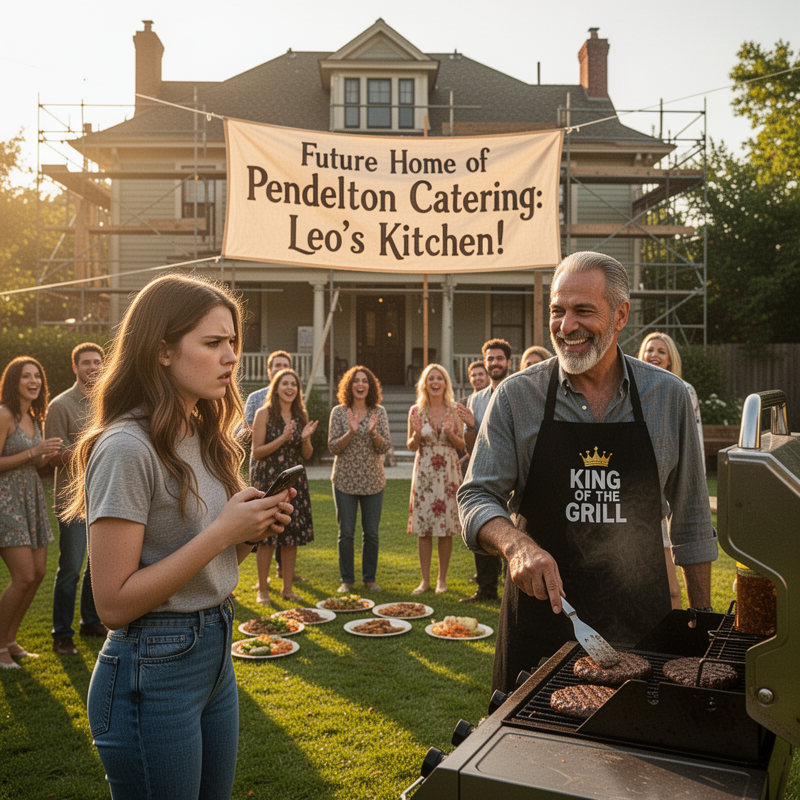
My father, Marcus Pendelton, was in the backyard, beaming. He was wearing his favorite ‘King of the Grill’ apron, flipping burgers over a smoking barbecue pit. A dozen familiar faces from our church and community milled around, laughing and chatting, already holding plates piled high with food.
Leo, my seventeen-year-old half-brother, was showing off a new drone, flying it expertly over the manicured lawn. He grinned, shouting playful instructions to our father.
“Higher, Dad! Get a good shot of the new foundation!”
Marcus waved back, a proud father. He hadn’t seen me yet.
My eyes drifted past him, past the laughing guests, to the back of our historic Oakridge House. Or rather, what was left of it.
The entire back wall of the kitchen, including my late mother’s beloved pantry, was gone. A gaping hole stood in its place, exposing splintered two-by-fours and jagged plaster. Beyond it, a team of workers, led by a burly man with kind eyes—Frank DeLuca, the general contractor—were already measuring and marking new lines. Slabs of concrete lay ready for pouring.
The scene was bustling, celebratory, like a groundbreaking ceremony. A large banner, crudely painted, hung from the side of the house: “Future Home of Pendelton Catering: Leo’s Kitchen!”
I felt like I was walking through a dream, or rather, a nightmare. The sounds of laughter and sizzling meat felt distant, muffled, as if I were underwater.
I walked directly toward Marcus, holding my phone out. My voice, when it came, was a raspy whisper.
“Dad. My college fund. It’s… it’s all gone.”
Marcus turned, his smile still wide, but a flicker of something unreadable passed through his eyes. He quickly composed himself, gesturing broadly toward the chaos behind him.
“Ah, Maya! Happy birthday, sweetheart! Perfect timing!” he boomed, his voice carrying over the festive din. He wrapped an arm around my shoulder, pulling me close. The smell of charcoal and his expensive cologne was overwhelming.
He addressed the small crowd, his voice projecting.
“Friends, family, thank you for coming to celebrate this special day and this exciting new chapter for the Pendelton family!”
He squeezed my shoulder, a little too tight.
“As many of you know, our Maya here, she’s always been so selfless, so dedicated to her family. And on her nineteenth birthday, she made a truly wonderful gesture.”
A few people murmured their approval. Leo looked up from his drone, a curious expression on his face.
“She’s generously gifted her entire savings,” Marcus continued, his voice ringing with false pride, “all twenty-two thousand dollars, to help us build this state-of-the-art commercial kitchen for her brother, Leo. A true sacrifice for the family business!”
He turned his beaming smile to me. The raw, open wound in my chest felt like it was tearing me apart.
“Isn’t that right, Maya?” he asked, his eyes suddenly hard, daring me to contradict him. “You wanted to do this for your family, didn’t you?”
Part 2
Marcus’s eyes bore into mine, a clear warning. Every fiber of my being screamed to expose his lie, to tell these people the truth. But the words caught in my throat. I looked at Leo, who was now watching me expectantly, a hopeful light in his eyes, already imagining his “Pendelton Catering” dream kitchen. The thought of shattering his innocent excitement, even if it meant exposing Marcus, felt impossible in that moment. I couldn’t do it. Not yet.
I simply nodded, a tiny, almost imperceptible movement. A forced, fragile smile touched my lips. “Yes, Dad,” I whispered, my voice barely audible. “For the family.”
Marcus beamed, his grip on my shoulder loosening. “See? A truly remarkable girl!” he announced to the crowd, pulling me into a quick, performative hug. The tension in his eyes softened, replaced by a smug satisfaction. The guests murmured approvingly, some patting my arm, praising my “generosity.”
Over the next few days, Marcus worked tirelessly to solidify this narrative. At church, during Sunday service, he spoke emotionally about “family unity” and “selfless sacrifice,” subtly hinting that I was struggling with the “burdens of adult responsibility” and needed their prayers. He confided in neighbors that I was “going through a difficult phase,” prone to “emotional outbursts” and “misunderstandings,” especially when Leo’s dreams took center stage.
Suddenly, sympathetic glances followed me. People offered gentle, pitying smiles, asking if I was “feeling better.” Some even suggested I “take a break” from my baking apprenticeship, saying I looked “stressed.” Their words, meant to be kind, felt like invisible walls closing in around me. Marcus had successfully painted me as unstable, ungrateful, and hostile towards my brother.
I didn’t argue. I didn’t defend myself. I stopped trying to explain.
Instead, I took up residence on the old porch swing, watching. Frank DeLuca and his crew returned each morning, their heavy machinery rumbling to life. The first day, they tore down the remaining kitchen cabinets. The second, the ancient tile floor. Then came the true destruction.
I sat there, hour after hour, a silent witness. The rhythmic *THWACK* of sledgehammers against plaster filled the air. Dust motes danced in the sunlight as chunks of the 120-year-old walls, steeped in generations of family history, crumbled to the ground. Each blow was a physical ache in my chest, a pulverizing of not just the house, but of my future, my identity, everything I thought I had built for myself.
I watched as Frank’s crew ripped out the last vestiges of the historic 120-year-old plaster walls, turning what was once the heart of our home into a raw, exposed shell.
Chapter 2: The Sound of Sledgehammers
The noise from the backyard carried even into the cool silence of the bank lobby. Sledgehammers crashed, metal groaned, and the roar of a small excavator occasionally pierced the air.
I sat at a polished desk across from a teller, her smile thin and tired.
“The withdrawal was fully authorized,” she said, tapping her screen. “There’s a signed release form.”
My throat felt tight. “Authorized by whom?”
She turned her monitor slightly, and I leaned closer. There it was: a digital image of a signature, scrawled across a bank withdrawal slip for $22,000. Underneath, a notary’s stamp pressed into the digital paper.
The name below the stamp was Gideon Croft, a local appraiser who sometimes handled documents for Dad’s property management business.
My own signature. Or rather, a sloppy imitation of it.
I knew my own handwriting. This was close, but not mine. Not the loops, not the specific angle of the ‘M’.
My heart hammered against my ribs. “When was this processed?”
“Last Tuesday,” the teller replied. “Around ten in the morning.”
Last Tuesday, ten AM. I was at the bakery, elbow-deep in flour, kneading dough for morning pastries. There was no way I could have been here.
A cold dread spread through my chest. Dad hadn’t just taken the money. He’d gone a step further. He’d used Gideon Croft to forge my name.
Chapter 3: A Wall of Silence
Two days later, the yard was a chaos of splintered wood and broken plaster. The air hung thick with dust. Inside, the noise was duller, but still a constant thudding.
My father, Marcus, stood beaming in the living room, shaking hands with three men in dark suits. They were members of the local church council, men he played golf with, men he had advised on property investments.
“Such a generous act of family loyalty,” one of them boomed, clapping Marcus on the shoulder. “Leo’s commercial kitchen will be a beacon for our youth programs.”
They completely ignored me, sitting quietly on the antique settee, a cloud of dust settling on my jeans. They clapped Leo on the back, offering congratulations. Leo preened, his face flushed with pride.
Later, as the council members finally left, their voices echoing with praise for my father, Marcus stepped close to me in the narrow hallway. He smelled of sweat and sawdust.
“Don’t you dare,” he hissed, his voice low, “say a single word to anyone about this.”
I kept my gaze fixed on the peeling wallpaper behind him.
“You understand me, Maya?” he pressed, his hand gripping my arm. “You utter one complaint, one accusation, and you’re out. No college, no inheritance, no home. Not a dime, not a place to live. You’ll have nothing.”
He let go of my arm. His eyes narrowed, searching for a reaction. I gave him nothing, just a blank stare.
Chapter 4: Unseen Foundations
The kitchen was now a hollow shell. Dust motes danced in the shafts of light streaming through where walls used to be. Frank DeLuca, the general contractor, stood with Marcus, pointing to an exposed section of the subfloor where old pipes had been ripped out.
Frank tapped a thick, folded blueprint against the timber joists. “Marcus, I’ve been looking over the original land deed from your late wife, my wife, Maya’s mother. It’s… specific.”
Marcus shifted his weight. “Specific about what?”
“About the biological trust conditions,” Frank said, his voice flat. “It states that the property’s title structure changes. Upon Maya’s nineteenth birthday, certain rights transfer. Especially regarding substantial modifications.”
He looked at the gaping hole where the kitchen once was. “This isn’t just a renovation. You’re gutting the main structural support. I need to see verified title documents, clear and undisputed. Otherwise, I can’t proceed.”
Marcus’s face darkened. “You worry about the demolition, Frank. Not the legal paperwork. I own this house. My wife left it to me. Now get your crew digging out that subfloor. I want this done.”
He waved a dismissive hand, turning his back on Frank and striding towards the back door. Frank watched him go, a muscle ticking in his jaw, then slowly refolded the old blueprints. He ran a hand over the rough wood of the exposed studs.
Chapter 5: The Certified Envelope
A week later, a priority mail envelope sat on the kitchen counter when I arrived home from the bakery. It was thick, stiff, and bore the insignia of an independent laboratory in Arizona. The return address stated “Certified Genetic Paternity Testing.”
My fingers trembled as I picked it up. A month ago, after Marcus first started talking about Leo’s commercial kitchen, I’d mailed a sample of my hair and some old family photos with loose hairs from Marcus and Leo to a lab I found online. Just a desperate, quiet inquiry. A wild guess at something I’d always felt, a flicker of doubt I couldn’t name.
I took the envelope into my bedroom, the sounds of ongoing demolition from the back of the house rumbling faintly beneath my feet. I tore open the seal, the paper rasping.
Inside was a single, official-looking document. My name was at the top. Below it, in bold print, were the results.
“Maya Pendelton,” it read, “is biologically related to Marcus Pendelton as his daughter.” My breath caught.
Then I read the next line.
“Leo Pendelton is NOT biologically related to Marcus Pendelton.”
The world tilted. Leo wasn’t Marcus’s son. Everything Marcus had ever done, everything he had built his life around, the entire structure of our family, was a lie. The property, his supposed inheritance plans for Leo, his entire motivation for this renovation.
It shattered everything.
Chapter 6: Recorded In the Dust
The smell of plaster dust and freshly cut lumber was constant now. Frank DeLuca paused his work, leaning against a half-demolished wall, wiping sweat from his forehead. He heard Marcus’s voice from the backyard, loud and confident on the phone.
“Yeah, that’s right,” Marcus boasted into his phone, his voice carrying clearly over the muted sounds of a radio. “She thinks she’s going off to some fancy culinary school. Not a chance now, not with her college fund gone.”
Frank froze.
“I needed her to stay here, under my thumb,” Marcus continued, a nasty chuckle in his voice. “Couldn’t have her getting any big ideas. It was worth every penny, keeping her trapped.”
Frank’s hand automatically went to his pocket, fumbling for his phone. His thumb slid across the screen, activating the audio recorder. He kept his posture casual, pretending to examine a beam.
“And Croft?” Marcus asked into the phone. “That notary was easy. Just reminded him of those gambling debts he owed me. A few thousand dollars. He’d sign anything for that kind of leverage. Not like Maya was ever going to check.”
Frank felt a cold surge of disgust. This wasn’t just about a greedy father. This was malice. This was about control, about intentionally crippling his own daughter. The recorder light blinked silently in his pocket.
Chapter 7: Point of No Return
The next morning, the crew arrived earlier, their faces grim. Marcus stood over them, barking orders, his eyes scanning the property, almost frantic.
“Faster!” he yelled. “I want the main joists out! Down to the foundation! Get it done!”
The powerful impact driver whined, followed by the deep groan of stressed wood. Plaster dust exploded outward as a load-bearing joist was severed, sending ancient lath and debris raining down. The entire house seemed to sigh.
Another joist cracked, then another. The historic kitchen, once the warm heart of the 120-year-old house, was rapidly becoming a gaping, raw wound. Jagged teeth of wood and broken pipes jutted from the walls. Crushed stone and pulverized plaster created a rising mound in the center of what used to be a polished floor.
I stood at the edge of the ruined foundation, a small, still figure amidst the chaos. My sealed document folder, stiff and heavy, was clutched in my hand. The vibrations from the heavy machinery thrummed through the soles of my shoes.
A piece of debris, a chunk of old brick, bounced near my feet. I didn’t flinch. I just watched the destruction, my posture completely still, every crash of wood and stone echoing Marcus’s frantic rush. He wanted a point of no return. He wanted it all gone before anyone could stop him.
Chapter 8: The Public Stage
The familiar white van with the local news logo pulled up the driveway, followed by a smaller car. Sarah Jenkins, the independent digital reporter, stepped out, microphone in hand, trailed by a video crew.
Marcus smoothed his shirt, a wide, practiced smile plastered on his face. He waved them towards the wreckage.
“This is Marcus Pendelton,” Sarah said into her microphone, “a prominent local property manager, live from his historic Oakridge House, where he’s spearheading a remarkable community project.”
Marcus stepped forward, placing a hand on Leo’s shoulder. Leo beamed, clearly thrilled by the cameras.
“We’re rebuilding,” Marcus announced, gesturing grandly at the gaping hole of the kitchen, “creating a state-of-the-art commercial kitchen for my son, Leo, and his new catering venture. It’s a true family effort.”
He paused, then turned to me, standing silently at the edge of the frame. “And I want to publicly thank my daughter, Maya, for her incredible selflessness. She willingly sacrificed her college ambitions, generously donating her entire savings to make this dream a reality for her brother and our community.”
The camera panned to me. The dust was thick on my clothes. My face was impassive. Leo smiled proudly, utterly unaware of the lie. Marcus looked directly into the camera, a picture of benevolent fatherhood, while the remains of the house crumbled behind him.
Chapter 9: The Ruin and the Question
Sarah Jenkins continued her live stream, Marcus still holding court in front of the debris. “A truly inspiring tale of family support…” she began.
Suddenly, Frank DeLuca stepped directly into the camera’s frame, his work boots kicking up dust. He held his phone aloft. “Excuse me, ma’am,” he said to Sarah, his voice steady. “I think the public needs to hear the *real* story behind this ‘generosity’.”
He pressed play. Over the livestream’s audio feed, Marcus’s voice boomed, clear and unmistakable. “*She thinks she’s going off to some fancy culinary school. Not a chance now, not with her college fund gone. I needed her to stay here, under my thumb.*”
A gasp went through the small crowd of neighbors and media. Marcus’s face went from confident to ashen.
“*And Croft? That notary was easy. Just reminded him of those gambling debts he owed me. He’d sign anything for that kind of leverage.*”
As the recording finished, I walked calmly into the center of the dust-covered yard, directly between Marcus and Leo. Two sheriff’s deputies, who had arrived quietly with Sarah Jenkins, moved towards me. I handed them my sealed document folder.
“This,” I said, my voice clear, “is a certified DNA paternity test. It proves Marcus Pendelton is my biological father.” I paused, looking at Leo. “But it also proves Leo is NOT Marcus’s son.”
The deputies quickly scanned the paper. I then handed them a copy of the property deed. “Under my late mother’s biological trust clause, the entire estate, including this house, legally defaulted to me the moment I turned nineteen.”
I turned to my father, his face completely pale, his eyes wide with a dawning horror. The camera zoomed in.
“Dad,” I asked, my voice quiet in the suddenly silent yard, “why did you spend $22,000 gutting a house you don’t own?”
Chapter 10: The Fallen House
The silence that followed my question was deafening, broken only by the distant hum of the camera’s lens. Marcus Pendelton stood frozen, his face a mask of disbelief and betrayal.
The sheriff’s deputies moved swiftly. “Marcus Pendelton,” one stated, “you’re under arrest for bank fraud, identity theft, and grand larceny.”
They cuffed him, his struggles weak and ineffectual. A second pair of deputies went to Gideon Croft, who had been standing nearby, silently watching. He too was arrested, his face collapsing in on itself.
The community members, many of whom had praised Marcus just moments before, now stood in a stunned, murmuring silence. Sarah Jenkins kept her microphone pointed at the scene, her eyes wide.
Leo, however, was no longer watching his father. He was staring at me, his face streaked with tears and dirt, his eyes wide with horror and a raw, shattering grief.
“This isn’t true,” he whispered, shaking his head. “You… you destroyed everything! You ruined him! You ruined *my* life!”
He shoved past the deputies, stumbling towards his car. “I never want to see you again, Maya!” he screamed, his voice cracking. “Never!”
He tore out of the driveway, tires squealing. I watched him go, the sting of his words a fresh wound on top of the old ones. The house stood in ruins behind me.
Chapter 11: The Quiet Terrace
Twenty-five years later, the morning sun warmed my face on the quiet, stone terrace. Below, rows of apple trees in my coastal orchard stretched towards the glistening Pacific. The scent of fresh-baked sourdough and lavender drifted from the open doors of “Oakridge Bakery & Cafe,” a renowned establishment rebuilt, stone by stone, on the very foundation Marcus had sought to destroy.
My daughter, Elara, now a young woman, sat across from me, sipping her coffee. “Mom, this shortbread is perfect,” she said, her smile bright.
I reached for a faded, creased photograph I kept in my old recipe box. It showed a younger me, barely a teenager, laughing with Leo, his arm slung around my shoulder. His smile was innocent, unburdened.
I traced the edge of the photo with my thumb. Frank DeLuca, now retired, sometimes visited. He’d shown me how to pour the new foundation, how to mill the salvaged timber. He’d taught me resilience. Marcus Pendelton had served his time, emerging bankrupt and alone, a pariah in the town he once dominated. Gideon Croft lost everything, too.
I had built my dream. I had secured my mother’s legacy. I was free, fiercely independent, and profoundly content. Yet, there remained a space in my heart, a quiet ache that time had softened but never truly healed.
“I saved the house my mother built, stone by stone,” I murmured, my gaze drifting across the peaceful orchard. “But standing in the quiet sun today, I know that some broken bonds can never be rebuilt.”
Leave a Reply