CHAPTER 1: The Shadow on the Ultrasound
Part 1
“You are sixty-six years old, Mrs. Albright, and this pregnancy is not in your uterus.”
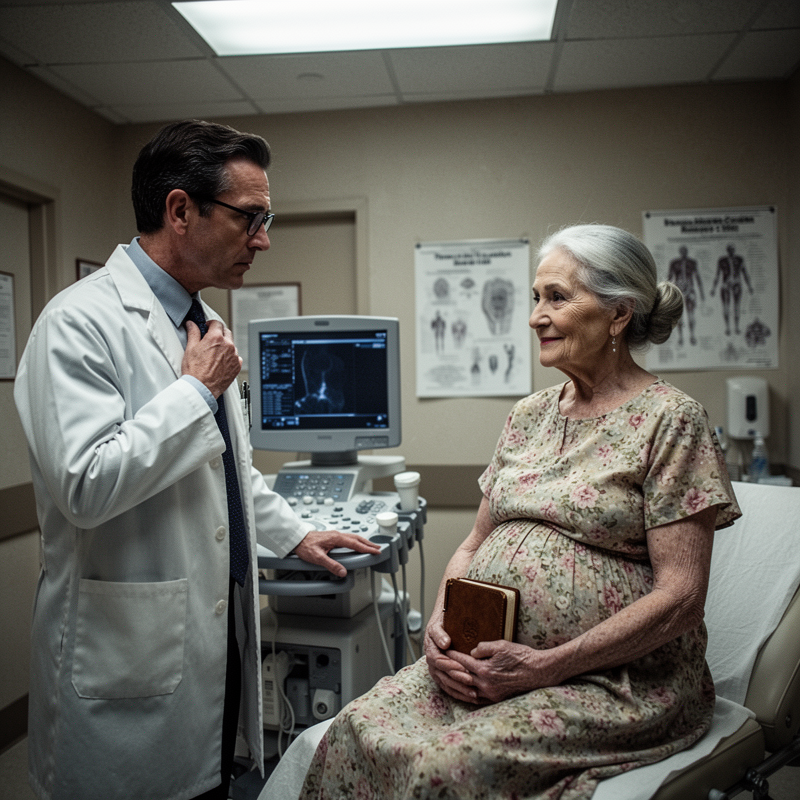
When Dr. Samuel Kincaid read the ultrasound scan at the Philadelphia Military Health Clinic, sixty-six-year-old widow Evelyn Albright insisted she was seven months pregnant with her late husband’s embryo after a secret overseas procedure.
The scan showed a life-threatening ectopic mass leaking toxic fluid into her abdominal cavity, requiring immediate surgery before sepsis killed her.
Evelyn refused to sign the consent form, clutching a battered leather journal from the Vietnam War.
Seconds later, her daughter Clara burst through the examination room doors, shouting that her mother had spent her entire $120,000 life savings on a dangerous lie.
What Dr. Kincaid did not know was that the danger in that room had started fifteen years ago in a classified military laboratory.
Dr. Samuel Kincaid adjusted the knot of his tie, the crisp white of his lab coat a stark contrast to the muted beige walls of Examination Room 4. The air in the Philadelphia Military Health Clinic smelled of antiseptic and old paper.
He carried a light folder, expecting another routine consultation, perhaps a follow-up, or a new referral.
His gaze fell upon the woman already seated on the examination table. Mrs. Evelyn Albright, a war widow, according to her chart.
She was sixty-six, but carried herself with a quiet dignity, her silver hair pulled back in a neat bun. A distinct, rounded swell was visible beneath her floral dress.
Evelyn offered a small, polite smile. In her lap, she clutched a worn, leather-bound journal.
“Good morning, Mrs. Albright,” Dr. Kincaid said, his voice even and professional. “I’m Dr. Kincaid. I understand you’re here regarding a… a pregnancy?”
Evelyn nodded, her smile unwavering.
“Seven months, Doctor,” she replied, her voice soft but firm. “With Captain Albright’s child.”
Captain Thomas Albright, Kincaid recalled, was her late husband, a decorated officer who had passed away just six months prior. The timeline felt impossibly tight.
“And you mentioned this procedure was performed overseas?” he probed gently, trying to mask the flicker of concern in his eyes. Cases of pseudocyesis, or phantom pregnancy, were not unheard of, especially in patients dealing with profound grief.
“Yes,” Evelyn confirmed, her hand resting protectively over her abdomen. “A private clinic. Very discreet.”
Kincaid maintained his professional facade. His duty was to the patient, regardless of how unconventional their story might seem.
“Alright, Mrs. Albright,” he said, moving towards the ultrasound machine. “Let’s take a look, shall we?”
He pulled on thin, latex gloves and squeezed a generous amount of cool, clear gel onto her lower abdomen. The contrast against her warm skin made her flinch almost imperceptibly.
He pressed the transducer to her skin, guiding it slowly, methodically. The machine whirred to life, its monitor glowing with the grainy black and white images of her internal anatomy.
Kincaid’s eyes scanned the screen, searching for the familiar contours of a gestational sac, a fetal pole, a beating heart. He moved the probe, tilting it, pressing slightly harder.
His brow furrowed.
No uterus. No sign of a developing life within its walls.
He adjusted the settings, zoomed in, but the screen stubbornly refused to show what he expected. Instead, a dense, irregular shadow emerged, deep within her abdominal cavity, outside the uterine walls. It was calcified, with an ominous, jagged perimeter.
A slow, sickening dread began to coil in his gut.
He saw fluid, dark and murky, surrounding the mass, indicating leakage. He recognized the shape, the texture.
It was not a pregnancy. Not in any viable sense.
Kincaid inhaled sharply, a silent gasp escaping him. This was not pseudocyesis. This was far, far more dangerous.
He recognized the signs of a lithopedion – a calcified ectopic mass. A stone baby, as it was grimly known in medical circles. But this one was leaking, threatening her with a severe, potentially fatal infection. Sepsis would set in quickly.
His mind raced, calculating the immediate need for emergency surgery. He had to act now.
He pulled the transducer away, wiping the gel from her skin with a practiced hand, his movements suddenly urgent. Evelyn watched him, her expression still serene, as if unaware of the storm brewing within him.
Before he could form the words, before he could explain the dire reality, the examination room doors burst open with a violent swing.
“Mother! What are you doing?” a woman shrieked, her voice shrill with hysteria.
Clara Albright, Evelyn’s daughter, stood framed in the doorway, her face contorted in a mask of panic and fury. She looked disheveled, her blonde hair askew, her clothes rumpled.
“You’re insane!” Clara screamed, her eyes wide and wild. “You’ve spent every last dime! Every single penny of your $120,000 life savings on this dangerous lie!”
Part 2
Clara lunged forward, a crumpled stack of papers flying from her hand and skidding across Dr. Kincaid’s sterile desk. They were foreign wire transfer receipts, emblazoned with unfamiliar bank logos and currency symbols. “Proof! Look at these, Doctor! She’s been sending everything, *everything*, to these fake clinics overseas!”
Dr. Kincaid barely registered the financial chaos unfolding. His attention was still fixed on the ultrasound screen, on the dark, irregular shadow that pulsed menacingly. He leaned closer, inspecting the edges of the calcified mass. That’s when he saw it—a tiny, metallic glint, deep within the tissue. He zoomed in, adjusting the focus.
It was a surgical clip, unmistakable in its form. And etched onto its surface, barely visible but undeniably there, was a serial stamp: a small, precise emblem of the United States Army Medical Department, followed by the year 1968.
Kincaid’s gaze snapped from the monitor to Evelyn, then back to the frantic Clara. Evelyn, however, remained unnervingly still, her hand tightening around the worn leather journal in her lap. Her eyes met Dr. Kincaid’s, a flicker of something he couldn’t quite decipher passing between them.
“The money… yes, it went overseas,” Evelyn said, her voice a hushed counterpoint to Clara’s frantic panting. “But the mass, Doctor… this isn’t from a recent procedure.”
Dr. Kincaid felt a chill run down his spine. “Then where did it come from, Mrs. Albright?” he pressed, his voice barely a whisper.
Evelyn’s grip on her journal tightened further, her knuckles white. “It was created fifteen years ago,” she confessed, her voice strained. “Inside a secret military facility. Under Dr. Harrison Finch.”
The name hit Kincaid with the force of a blow. Harrison Finch, a legendary, if controversial, figure in military medical research. A man whose career was shrouded in whispers of classified projects and unusual experiments during the Vietnam War era.
The implications were staggering. This wasn’t just a medical emergency; it was a military secret, a historical anomaly.
Kincaid wasted no time. He reached for the heavy black telephone on his desk, his fingers fumbling slightly as he dialed the direct line to the Department of Defense Medical Board. He needed answers, and he needed them now.
The phone rang once, twice… then the line went dead.
The silence in the room was absolute, broken only by Clara’s ragged breathing. Kincaid pressed the receiver to his ear again. Nothing. Not a dial tone, not a click. Just an unnerving, complete silence.
CHAPTER 2: Shadows of the 1968 Ward
The sharp pain in my abdomen tightened with every step I took away from the Philadelphia Military Health Clinic. It wasn’t just a physical ache. It felt like a cold, iron hand squeezing my insides, pulling at the thread that connected my present agony to a shadowed past. Dr. Kincaid’s words, the image of that 1968 surgical clip on the ultrasound, echoed in my mind. This mass, the one they said could kill me, was a direct ghost of Dr. Harrison Finch’s classified trials from the Vietnam War. I had been an unwitting subject, a lab rat.
I clutched my battered leather journal, the one Thomas had given me, as I stumbled up the familiar steps of my Philadelphia townhouse. The street was quiet, the afternoon light fading.
Then I saw them. Two uniformed process servers, grim-faced, were taping a bright yellow notice to my front door.
“Mrs. Albright?” one of them asked, his voice flat.
I stared at the paper. It was a foreclosure notice. Immediate.
“What is this?” I whispered, my voice thin.
The man handed me another document. “Administrative lien, Mrs. Albright. Federal matter.”
My fingers trembled as I took the paper. My name, Clara’s name, Captain Thomas Albright’s service number. It was all there. My $2,200 monthly widow pension, frozen. My bank accounts, locked. Harrison Finch. He had struck already.
The phone in my purse vibrated. I answered, my heart pounding a frantic rhythm.
“Evelyn,” a cold, familiar voice said. Dr. Harrison Finch.
“You animal,” I spat, ignoring the pain. “What have you done?”
“A necessary measure, my dear,” Finch replied, his tone chillingly calm. “A courtesy, to remind you of certain… allegiances.”
He paused, letting the silence hang heavy.
“Captain Albright’s service records, Evelyn,” he continued. “They remain under my departmental control.”
I could feel his sneer through the telephone line. He was reminding me that he held Thomas’s legacy in his hand.
“I require your 1968 personal nursing logs,” Finch said. “Deliver them to my office by morning.”
“Or what?” I challenged, though I already knew.
“Or you’ll find yourself and your daughter on the street before nightfall,” he said, his voice dropping. “Consider this your final notice, Evelyn.”
The line clicked dead. I leaned against my front door, the foreclosure notice a bright, mocking yellow against the dark wood. The pain in my abdomen flared, a cruel reminder of the secret Finch had buried in me.
CHAPTER 3: The Price of Silence
The Navy Yard Medical Depot loomed under a gray Philadelphia sky, a hulking relic of wartime urgency. My appointment with Dr. Harrison Finch was in his private office, a place I hadn’t seen in fifteen years. The scent of antiseptic and old paper hung heavy in the air.
Finch rose from behind his large mahogany desk, his posture still ramrod straight, a faint smile playing on his lips. “Evelyn, my dear. It’s been too long.”
He walked around the desk, extending a hand, acting with a practiced paternal warmth that felt like ice.
“I heard about your… condition,” he said, his gaze flicking to my abdomen. “A difficult situation, I understand. I’d be willing to arrange for your emergency surgery at a private facility. No military hassle. All expenses covered.”
My hands tightened on the strap of my purse. “What’s the catch, Harrison?”
He retrieved a document from a folder on his desk, sliding it across to me. “A simple non-disclosure agreement, Evelyn. Regarding the 1968 trials. A mutual understanding, for old times’ sake.”
My eyes scanned the dense legal text. It would bind me to silence, bury his crimes, and leave me to carry his secret, even if it killed me.
I pushed the document back across the desk. “No.”
The warmth evaporated from Finch’s face, replaced by a cold, hard look I remembered from the war. He sat back down, picking up another file.
“A pity,” he said, his voice devoid of emotion. “Then we move to less… amicable terms.”
He opened the file. “Captain Thomas Albright’s military death benefit. After a comprehensive review, it has been reclassified as an overpayment.”
My breath hitched. “Overpayment? That’s impossible.”
“The figures were… adjusted,” Finch stated. “A retroactive reclassification, effective immediately. The sum of $45,000 is due. In full. By end of week.”
My head snapped up. “You’re trying to bankrupt me. So I can’t talk. So I can’t show Kincaid the proof.”
He leaned forward, his eyes glinting. “Consider it a proactive measure. You’d be surprised how quickly federal investigations can stall when a widow’s finances are, shall we say, indisposed.”
I shoved my chair back, the scrape echoing in the silent office. He was trying to cripple me, to make me choose between my husband’s honor and my very survival.
I walked out, the air heavy with the metallic tang of his cruelty. When I arrived home, the evening darkness had fallen. My porch light was shattered, glass glinting on the steps. The front door hung ajar, splintered. My heart hammered against my ribs.
Inside, my small living room was a whirlwind of chaos. Papers ripped, furniture overturned. My private research notes, the few scraps I’d collected on Finch’s career, were strewn across the floor, some torn beyond recognition. He had ransacked my home. He was warning me.
CHAPTER 4: The Registrar’s Remorse
The rain hammered against the windows of my ransacked townhouse. I was trying to sort through the chaos, every ache in my abdomen a stark reminder of Finch’s control. A soft, hesitant knock sounded at my back door.
I peered through the peephole. A frail woman, her hair a wispy silver, stood on my porch, soaked to the bone. It was Miriam Adler, Finch’s ex-wife. She looked older, smaller than I remembered from the Navy Yard, her face etched with a quiet sadness.
I opened the door, a rush of cold, damp air entering the house.
“Evelyn,” she whispered, her voice raspy. “I heard what Finch is doing.”
She stepped inside, her movements slow and deliberate. Her eyes darted around my messy living room, resting on the scattered papers.
“He’s still a monster,” she murmured, a flicker of old fear in her eyes.
Miriam opened her worn leather handbag. Her hands trembled slightly as she pulled out a thick envelope, its contents rustling.
“I was the registrar for his classified experiments in ’68,” she said, her voice barely audible. “I kept copies. Carbon copies.”
She laid them on my kitchen table. My eyes widened. Original patient logs. My name was on one. My procedure date. And next to it, a handwritten notation: “Experimental hormonal compounds administered – Subject unaware.”
My stomach lurched, not just from the pain, but from the cold certainty settling in my bones. Finch hadn’t just experimented on me; he’d done it without my knowledge, during a routine surgical procedure. He had used me.
“I should have come forward years ago,” Miriam said, her gaze fixed on the rain streaming down the window. “Fifteen years, I kept silent. Out of fear. Of him. Of what he could do to me.”
She turned to me, her eyes clouded with guilt. “But I can’t let him kill you, Evelyn. Not for his secrets.”
“This is proof,” I said, my voice shaking as I touched the aged paper. “Proof he injected me. Proof he buried the truth about his failures.”
“He intentionally buried the 1968 clinical failure reports,” Miriam confirmed, her voice stronger now. “To secure a $1.5 million government research grant. His legacy was more important than anything.”
My mind raced. With these logs, with Miriam’s testimony, Kincaid could finally get the federal review he needed.
I grabbed the phone. “Miriam, thank you.”
“Be careful, Evelyn,” she warned, her hand resting briefly on my arm. “Harrison won’t stop.”
I called Dr. Kincaid, my voice filled with a new resolve. “I have the proof, Doctor. The original logs. Finch’s experiments.”
“Bring them,” Kincaid said, his voice grave. “I’ll arrange an independent federal review of the tissue. Immediately.”
CHAPTER 5: Financial Siege
The federal review Dr. Kincaid was organizing became a race against Finch’s escalating attacks. I was still sorting through Miriam’s documents when Clara burst through my front door, her face pale and streaked with tears.
“Mom! What did you do?” she shrieked, her voice high-pitched and frantic.
She threw her bank passbook onto the coffee table. “They just froze my accounts! At work! Bank officials. They said ‘shared family asset liability.’ Under your damn military lien!”
My heart sank. Finch had found a way to reach Clara, to hurt her through me.
“It’s Finch, Clara,” I explained, trying to keep my voice calm. “He’s trying to cut us off. To silence me.”
Clara shook her head violently, her eyes wide with panic. “You don’t understand, Mom! They’re threatening me! I owe people money. A lot of money.”
She paced the small living room, her hands tearing through her hair. “I owe $85,000, Mom. To illegal loan sharks. They’ll break my legs. Or worse.”
The number hit me like a physical blow. $85,000. Where could she have gotten that kind of debt?
Just then, the doorbell chimed. A man in a dark suit stood on my porch, holding a sealed envelope.
“Message from Dr. Finch,” he said, handing it to me. “A proposal.”
I ripped it open. Inside, a formal letter outlined Finch’s offer: a full financial settlement, cancellation of all debts—including Clara’s—if I turned over my hidden 1968 medical logs. My personal journal. The carbon copies Miriam had given me. Everything.
Clara snatched the letter from my hand, reading it quickly. Her eyes, red and swollen from crying, darted to my locked wooden desk drawer where I kept Miriam’s copies. A flicker of something I didn’t recognize crossed her face. Greed. Hope. Desperation.
“He’ll clear everything, Mom,” she whispered, looking from the letter to the drawer. “All the debt. My life could go back to normal.”
I saw the internal battle raging in her eyes. Finch was twisting the knife, using Clara’s desperation against me. The stakes were rising, not just for me, but for my daughter.
CHAPTER 6: The Calcified Truth
Dr. Kincaid moved fast. The covert biopsy of the calcified tissue was done at a private lab, far from Finch’s reach. The wait for the results was agonizing, each passing hour a test of my resolve.
When Kincaid called, his voice was somber. “Evelyn, the pathology report is in.”
My hand instinctively went to my abdomen. “And?”
“The tissue,” he began, his voice hesitant. “It was never a viable embryo, Evelyn. Not even close.”
A cold dread washed over me. “What are you saying?”
“It’s an artificial biological matrix,” Kincaid explained. “Tested by Finch’s team in 1968. It calcified over fifteen years, a slow, inert process.”
My world tilted. The hope I had clung to, the belief that I was carrying Thomas’s legacy, preserving a part of him—it was all a lie. An elaborate, cruel fiction maintained by Finch. He had orchestrated this psychological torment to monitor the long-term cellular effects of his sick experiment. My husband’s memory, my grief, twisted into his research.
The phone slipped from my numb fingers. I stared at the wall, the image of that ultrasound, the calcified mass, replaying in my mind. It wasn’t a baby. It was a scar. A monument to Finch’s deceit.
Clara walked in from the kitchen, holding a stack of the foreign wire transfer receipts she’d shown Dr. Kincaid. “Mom, are you okay? You look like you’ve seen a ghost.”
“A ghost of a lie,” I muttered, picking up one of the slips. “A lie Finch built around me.”
I held the receipt closer. “$120,000, Clara. You said you sent this to an overseas clinic.”
She nodded, looking away. “Yes. All of it, for the procedure.”
My eyes narrowed. The signature on the receipt. It was distinctly Clara’s handwriting. But something was off. The fluid, looping lines that should have been foreign clinic details looked oddly… forced.
I grabbed another receipt, then another. All in Clara’s hand, but the clinic names, the addresses—they were barely legible, almost like someone had tried to disguise them. A critical discrepancy, a hairline fracture in Clara’s story.
“Clara,” I said, my voice dangerously quiet. “Did you really send this money to an overseas clinic?”
She froze, her back to me. The air in the kitchen grew thick, suddenly charged with an unspoken secret.
CHAPTER 7: Web of Deception
“Clara, look at me.”
She turned slowly, her face pale, her eyes wide. I held up the overseas wire transfer receipts, my finger pointing to her distinctive looping signature.
“This is your handwriting,” I stated, my voice devoid of accusation, just cold, hard fact. “Not a clinic registrar. Your handwriting.”
She opened her mouth, then closed it. Her gaze darted to the floor, to the ceiling, anywhere but my eyes.
“The clinic names,” I continued, pushing. “The addresses. They’re smudged. Like you tried to make them unreadable.”
Clara’s composure crumbled. She slumped onto a kitchen chair, burying her face in her hands. Her shoulders shook.
“I’m sorry, Mom,” she sobbed, her words muffled. “I’m so, so sorry.”
She finally looked up, tears streaming down her face. “I forged them. All of them. The overseas clinic documents. The visas.”
My breath caught in my throat. “$120,000, Clara? You tricked me? To release my inheritance?”
She nodded frantically. “I had to, Mom! They were going to kill me! The loan sharks.”
Her story spilled out, a torrent of fear and desperation. “They found me. After I lost everything at the tracks. $85,000. They said they’d hurt me. They said they’d hurt you.”
She gripped her hair, pulling at the strands. “I saw how much you wanted to believe it, Mom. The baby. Thomas. It was the only way I could think of to get the money without you questioning it.”
The pain in my chest was sharper than any physical ache. My own daughter. Using my grief. Using Thomas’s memory.
“But the clinical failures,” I said, my mind racing. “Finch’s experiments. You knew I was going to Kincaid with that story.”
Clara avoided my gaze. “I… I thought it would just be a scan. A check-up. Not this.”
My eyes scanned her messy desk. Among the scattered papers, a small phone ledger lay open. My gaze snagged on a recent entry. Dozens of outgoing calls. To Dr. Harrison Finch’s private residence.
And the dates. They went back six months. Before Thomas had even died.
A chill snaked up my spine. This wasn’t just desperation. This was deeper. A cold, calculated betrayal.
CHAPTER 8: The Reversal
The revelation of Clara’s debt and the forged documents had left me reeling. But the phone ledger, with its insistent calls to Finch dating back months, gnawed at me. My daughter, in league with the man who had ruined my life? It was too monstrous to comprehend.
Late that night, as Clara finally succumbed to a fitful sleep on the living room couch, I moved quietly. My abdominal pain was a constant dull throb, but a cold determination propelled me. I needed to know.
I found her purse on the floor, tucked beside a cushion. My fingers trembled slightly as I searched through it. Cosmetics, a crumpled tissue, loose change. Then, a folded piece of paper, stiff and formal.
It was a signed agreement. Between Clara Albright and Dr. Harrison Finch. Dated three months prior.
My eyes scanned the lines, the words blurring, then sharpening into agonizing clarity. It wasn’t a simple deal. It was a contract.
Clara had approached Finch first. She had threatened to reveal his secret 1968 trials. She had demanded $50,000 for her silence.
Finch had refused.
Instead, the agreement detailed a counter-proposal. Clara would help Finch orchestrate the fake overseas embryo scheme. She would drain my $120,000 savings. She would split the money with Finch. And in return, she would ensure I remained quiet, deluded by maternal grief, while they both profited.
The paper slipped from my numb fingers. It wasn’t just a betrayal. It was a conspiracy. My daughter. My own flesh and blood. She wasn’t manipulated. She was the architect. She had traded my life, my sanity, my husband’s memory for her gambling debts.
The world spun. My vision blurred. A searing, white-hot pain tore through my abdomen, worse than anything I’d felt before. My legs gave out.
I crumpled to the floor, the signed agreement lying beside me like a venomous snake. The betrayal was complete, the pain absolute.
CHAPTER 9: The Key to the Vault
The sharp, sudden pain from the night before had landed me back in Dr. Kincaid’s care. He had sneaked me into the clinic’s emergency wing under an assumed name, shielding me from Finch’s prying eyes. The infection was spreading, a silent, deadly enemy.
My daughter’s face, cold and calculating on that signed agreement, haunted me more than the pain. How could I have been so blind?
Miriam Adler arrived late that afternoon, her expression solemn. She looked around the small, sterile room, her gaze resting on my pale face.
“Evelyn,” she said, her voice soft, “you need this.”
She reached into her coat pocket, pulling out a heavy, tarnished brass key. It was old, intricately cut, clearly a relic of another time.
“This is the key to the decommissioned 1968 archive vault,” Miriam explained, placing it in my hand. “In the basement of the old Navy Yard hospital. Where Finch worked. Where you worked.”
My fingers closed around the cold metal. “What’s in there?”
“The original master reel-to-reel audio recordings,” she revealed, her eyes meeting mine. “Finch explicitly detailed his illegal trials. His experiments.”
My breath hitched. “And Thomas?”
“He forged Captain Thomas Albright’s consent waiver,” Miriam confessed, her voice thick with renewed guilt. “He signed Thomas’s name on the experimental paperwork. I saw it. I copied it. It’s in the vault, with the tapes.”
The weight of the key in my hand suddenly felt immense, charged with unbearable power. This single tape. It could destroy Finch. It could expose his crimes, clear Thomas’s name, save countless others from his dark legacy.
But a cold wave of dread washed over me. If Finch’s conspiracy with Clara was laid bare by those tapes, by that forged signature, it wouldn’t just be Finch who fell. Clara would be implicated. Extortion. Fraud. Federal arrest. Prison.
The key felt heavy, a choice between justice and my daughter’s ruin. The spreading infection in my body was nothing compared to the agony in my soul.
CHAPTER 10: The Ultimatums (Build-up)
My body screamed for rest, for healing, but my mind was a whirlwind of choices. Justice for Thomas, for myself, against my daughter’s freedom. The brass key felt like a branding iron in my pocket.
Under the cover of midnight, I slipped out of the clinic, a ghost in the shadows. The rain had begun, a cold, relentless downpour, as I drove to the abandoned Navy Yard. Rusting military structures loomed against the stormy sky, monuments to a forgotten past.
Miriam’s directions led me to a discreet service entrance, then down a flight of crumbling concrete stairs. The air in the basement archive room was damp, heavy with the smell of decay and forgotten paper. I pushed aside cobwebs, my flashlight beam cutting through the gloom.
The vault door was a massive, rusted iron beast, but Miriam’s key slid into the lock with a surprising click. It groaned open, revealing rows of metal file cabinets, shrouded in dust. I found the one marked “ALBRIGHT, T.” and, with a surge of adrenaline, forced open the rusted drawer.
Inside, nestled amongst yellowed files, sat a small, battered metal box. I opened it. A reel-to-reel audio tape, its label faded but legible: “Project Nightingale – Finch – 1968.” And beneath it, a brittle, official-looking document. Captain Thomas Albright’s consent waiver, his signature undeniably forged.
As I retrieved the tape and the waiver, the heavy iron vault door swung shut behind me with a sickening thud. The darkness was absolute for a moment, then a harsh beam of light cut through.
Dr. Harrison Finch stepped out from the shadows, a smug, triumphant smile on his face. He held a flash drive in one hand and a stack of legal documents in the other.
“Looking for something, Evelyn?” he purred, his voice echoing eerily in the confined space.
My heart pounded. I gripped the master tape tightly. “You can’t hide anymore, Harrison.”
He chuckled, a dry, rattling sound. “I can hide plenty, my dear. What you hold there… it’s just a relic. Unless you want your daughter to suffer the consequences.”
He stepped closer, holding out the documents. “My final ultimatum, Evelyn. Hand over that tape, and everything ends. I will permanently clear Clara’s criminal file. The $45,000 estate debt, extinguished.”
He paused, letting his words sink in. “But if you refuse… I will turn Clara over to federal authorities tonight. For extortion. For fraud. For conspiring to drain your savings.”
The rain intensified, hammering on the roof above. In the damp, silent vault, the choice lay before me.
CHAPTER 11: The Fractured Reckoning (Climax)
The beam from Finch’s flashlight danced across the dusty shelves of the archive vault, illuminating the cruel twist in his smile. I kept the small audio recorder pressed tight against my chest, the master tape secure in my pocket.
“You ruined me, Harrison,” I said, my voice steady despite the tremor in my hands. “You used Thomas’s memory, my grief, for your twisted experiments.”
He scoffed. “Necessary sacrifices, Evelyn. For national defense. For progress.” He began to pace the narrow aisle, a restless predator. “You think you can expose me with that little toy? You think one tape changes anything?”
He stopped, his eyes glinting in the dim light. “I already destroyed the secondary archive backups years ago. Your standalone audio recording is legally useless without my written confession.”
My stomach dropped. He had thought of everything. My recording, a powerful moral weapon, but legally inadmissible without proof he acknowledged its contents.
“You’ll sign it,” I stated, my voice firm. “You’ll admit your crimes.”
I pulled a pen from my pocket, uncapped it, and extended it to him. Then, with my free hand, I unfurled Captain Thomas Albright’s forged consent waiver, placing it on a nearby crate.
“This is your confession,” I pressed, pushing the pen against his chest. “Sign it, Harrison. For Thomas. For all your unwitting subjects.”
His face contorted, a mixture of rage and fear. He snatched the pen, staring at the waiver. He hated being cornered. He hated being seen for what he was.
With a heavy sigh, a sound of utter defeat, he bent over the crate. The fountain pen scratched against the paper. He signed his name, the first few letters scrawled unevenly.
Just as he was about to complete the signature, a piercing, deafening security alarm blared through the corridors. A high-pitched, insistent wail. The building vibrated.
“Lockdown!” a harsh voice echoed from somewhere above. “Facility sweep initiated!”
Finch’s head snapped up, his eyes wide with panic. The pen clattered to the floor, his signature incomplete.
Suddenly, with a pneumatic hiss and a grinding roar, a heavy iron gate slammed down, not ten feet in front of us, between me and Finch. It separated us, cutting off the aisle. Dust exploded from the old machinery.
Through the gaps in the iron bars, I saw military police officers breaching the upper floor, their flashlights sweeping the space. They were coming for him.
Finch, trapped behind the gate, recovered his composure with chilling speed. He smiled, a cold, triumphant twist of his lips. He was safe. The written confession lay on the floor, half-signed, incomplete. The confrontation fractured, unresolved. Guards were already dragging him away.
CHAPTER 12: The Price paid in Full (Immediate Aftermath)
Twenty-four hours later, the world outside the clinic faded to a dull hum. Dr. Kincaid, true to his word, had performed the emergency surgery. The calcified mass, the fifteen-year burden of Finch’s lie, was finally gone. I was alive.
But the real battle was just beginning.
Federal prosecutors arrived at my hospital room, their faces grim, their folders thick with accusations. Clara stood beside them, her hands handcuffed behind her back, her face tear-streaked and swollen. She looked small, terrified.
“Mrs. Albright,” the lead prosecutor began, his voice devoid of emotion, “your daughter, Clara Albright, is being charged with felony wire fraud and military pension extortion. We have substantial evidence, including her own admission of fabricating documents and a corroborated financial arrangement with Dr. Harrison Finch.”
Clara looked at me, her eyes pleading, raw with terror. This was it. The moment of truth. My ultimate choice.
I thought of Thomas, of his unwavering loyalty, his sacrifice. I thought of Lily, my granddaughter, innocent and unaware. And I looked at Clara, my daughter, broken and ruined, caught in the web of her own making, yet still my child.
“I wish to make a sworn statement,” I said, my voice raspy from disuse, but firm.
The prosecutors exchanged glances. They set up their recording equipment.
“I take full personal blame for fabricating all foreign medical records,” I stated, looking directly at the lead prosecutor. “I manipulated my daughter, Clara, into transferring the funds. I was suffering from severe psychological delusion, believing I was pregnant with my deceased husband’s child. My grief had driven me to extreme lengths.”
Clara gasped, a choked sound of disbelief and relief.
“I accept complete responsibility for the fraudulent scheme,” I continued, my heart aching with every word. “Clara was merely following my instructions, misguided by my deteriorating mental state.”
A wave of exhaustion washed over me. By signing that affidavit, I knowingly forfeited my husband’s military pension. I surrendered my own professional standing as a former army nurse. I accepted complete financial bankruptcy. I would have nothing left. But Clara would walk free.
The prosecutors, though skeptical, had no choice but to accept my sworn statement, backed by my documented history of recent medical crisis. They uncuffed Clara, her eyes still wide with shock. She looked at me, a complex mixture of gratitude and shame warring on her face.
It was done. The price was paid. In full.
CHAPTER 13: The Silent Horizon (Resolution / Epilogue)
Twenty-eight years later, the autumn of 2011 painted the Oregon coastline in hues of muted gold and deep green. The wind, carrying the scent of salt and pine, swept across the rugged cliffs, whipping strands of my silver hair around my face. I sat alone on a solitary wooden bench, overlooking the vast, restless expanse of the Pacific Ocean. Eighty-four years old now, my faded linen coat offered little warmth against the chill.
My granddaughter, Lily, was a medical researcher now, a brilliant, compassionate woman of thirty. She had grown up without ever knowing the full truth of the 1983 scandal. She knew her grandmother had faced hardship, had made difficult choices, but the true sacrifice, the one that kept her mother Clara out of federal prison, remained a silent, unspoken history. Clara herself rarely spoke of those years, burdened by a past she couldn’t outrun.
I reached into my pocket, my fingers, gnarled with age, closing around a rusted 1968 military dog tag. Thomas’s. I ran my thumb over his name, the metal cool against my skin. The ocean roared below, its rhythm a constant, unchanging lament.
I sat there, in complete, quiet solitude, watching the sea foam break against the ancient rocks. The sun began its slow descent, painting the horizon in shades of fire and deep purple.
Some victories are written in medals and news headlines, but the deepest sacrifices are carried silently into the salt air, known only to the hearts that bore them.
Leave a Reply