CHAPTER 1: Roots in the Red Dirt
Part 1
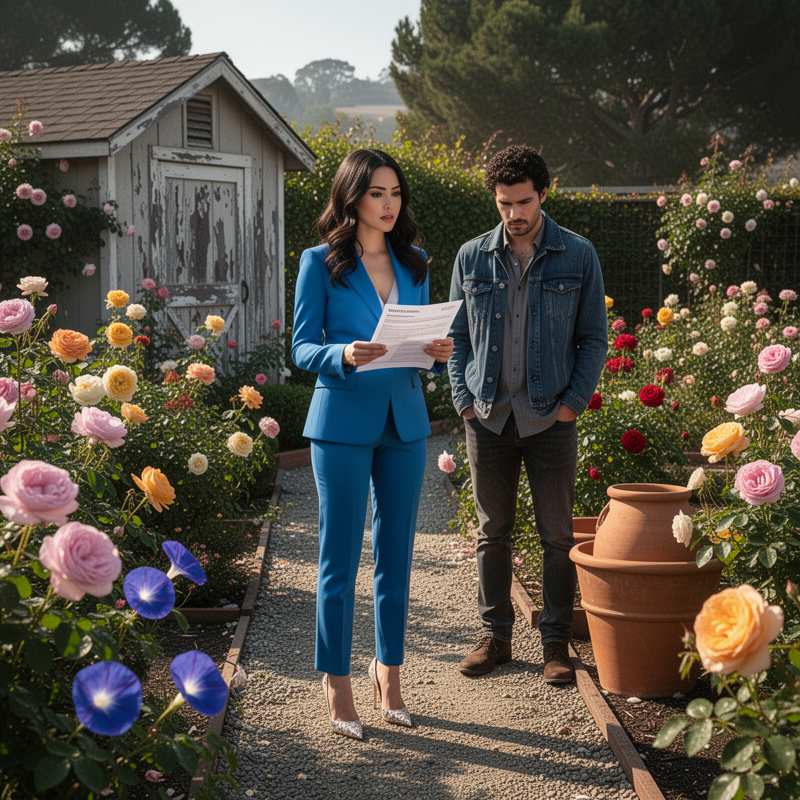
“Your father’s will leaves this entire lot to Julian, so you need to clear out your dirty little garden tools by Friday,” Chloe said, stepping onto the gravel path in her $800 designer heels.
My husband Julian stood right behind his mistress, refusing to make eye contact as she produced a stamped property transfer document.
“Your brother David already signed off as the co-executor,” she added with a smug smile. “We’re knocking down these hideous old bushes to build a modern two-story guest house.”
I didn’t scream or break down.
Instead, I looked down at the root soil of the 1988 heirloom Taiwanese tea roses my late father had spent thirty years cultivating.
They had no idea what my father had hidden beneath the roots before he died.
The sharp scent of blooming roses hung heavy in the warm San Francisco air, a stark contrast to the metallic tang of betrayal that suddenly filled the afternoon. My fingers, still stained with rich, dark compost, tightened around the polished wooden handles of my pruning shears. The shears themselves were an antique, passed down from my father, Master Chen Wei-Ming, worn smooth from decades of use.
Chloe Bennet’s $800 designer heels crunched again on the gravel path. Each step seemed to announce her presence, loud and imperious, in a garden that had always whispered. Her tailored suit, a vibrant cerulean, shimmered under the afternoon sun, a color entirely alien to the muted greens and deep reds of my father’s meticulously cared-for Taiwanese tea roses.
Julian Kross, my husband, or rather, my soon-to-be estranged husband, remained silent behind her. His shadow stretched long and distorted over the dew-kissed petals of a ‘Morning Glory’ bloom. He stared fixedly at the terracotta pots lining the old potting shed, anywhere but at me.
“Did you hear me, Mae?” Chloe’s voice, though pitched to sound pleasant, carried a razor’s edge. Her manicured hand, adorned with a diamond ring Julian had never bought for me, waved a document. It was a crisp, official-looking paper, folded into neat thirds.
I watched her for a moment, letting the silence hang. The buzzing of a bumblebee around a particularly fragrant ‘Crimson Glory’ was the only sound.
“This is a certified property transfer deed,” Chloe announced, unfolding the document with a flourish. “It legally transfers ownership of this entire lot, including the house and… this overgrown patch, to Julian’s development firm.”
She held it out, not for me to take, but to display. The official seals and stamps were unmistakable. My gaze drifted from the document to Julian. He remained motionless, a statue carved from complicity. Not a flicker of emotion crossed his face.
“Your brother, David,” Chloe continued, her smile widening into a predatory grin, “already signed off as the co-executor.”
My brother. David. The name echoed, a cold, hollow sound in the peaceful sanctuary of the garden. The realization settled over me, not as a shockwave, but as a slow, painful ache. It was a wound I hadn’t known I had, deeper than Julian’s betrayal.
David, my older brother, the one who always claimed to be the pragmatic one, the one who looked out for our family’s “best interests.”
He had sold me out. Sold *our father* out.
“We’re knocking down these hideous old bushes,” Chloe declared, gesturing vaguely at the dense, thirty-year-old rose bushes that formed a vibrant, living wall around the property. “To build a modern two-story guest house.”
Her words were a direct assault on my father’s legacy, a desecration. These weren’t just “bushes.” They were the heart of Master Chen Wei-Ming’s life work, the culmination of decades of careful cross-breeding and cultivation. Each plant was a testament to his patience, his artistry, his profound connection to our Taiwanese heritage. The 1988 heirloom Taiwanese tea roses, the very first strain he had brought over from Taiwan, formed the foundation.
I remained still, my face, I hoped, a placid mask. Inside, a quiet resolve began to harden.
“Friday, Mae,” Chloe reiterated, tapping the document impatiently. “That’s three days from now. We have crews scheduled to start clearing the perimeter. This garden will be gone before the weekend.”
She looked at Julian then, a brief, triumphant glance that he returned with a faint nod. They were a united front, arrogant and confident in their victory.
My eyes swept over the garden, a place I had called home my entire life. Every leaf, every bloom, every patch of soil held a memory of my father. The low hum of a distant lawnmower, the playful chatter of children from the park next door — the ordinary world continued, oblivious to the quiet devastation unfolding here.
“Don’t worry,” Chloe added, a faux-sympathetic lilt in her voice. “You won’t have to watch. You’ll be long gone.”
The unspoken threat was clear. My father’s garden, the very essence of his spirit, would be bulldozed. His legacy erased.
Slowly, deliberately, I lowered the pruning shears to the ground. They landed with a soft, almost imperceptible clink against a loose stone. I turned away from Julian and Chloe, moving with an unhurried grace that I knew would infuriate Chloe.
I walked towards the old potting shed, its peeling green paint and rusty hinges a familiar comfort. The wooden door groaned softly as I pushed it open. Inside, the air was cool and earthy, smelling of damp soil, dried leaves, and my father’s pipe tobacco. Tools hung neatly on pegs, terracotta pots were stacked by size, and bags of peat moss sat in a corner.
Chloe’s voice drifted from the garden, sharp and impatient. “Where is she going? Don’t tell me she’s calling a lawyer, Julian.”
Julian mumbled something inaudible.
I ignored them. My gaze fell upon the rough-hewn wooden bench where my father had spent countless hours. A faded photograph of him, younger, vibrant, tending to a sapling, was tacked to the wall above it.
“The root, Mae,” his voice echoed in my memory, a faint whisper from his deathbed, just weeks ago. “Under the mother bush. Remember the root.”
He had been frail, his breath shallow, his eyes clouded with pain. But there had been a flicker of something, a knowing glint, as he squeezed my hand. A secret shared, a final instruction.
The mother bush. He had always called the central 1988 Taiwanese tea rose, the very first one he planted when we moved into this San Francisco house, the “mother bush.” Its roots were the oldest, the deepest, the most sacred.
I reached for a small, sturdy trowel hanging by the door. Its handle felt warm in my grip, as if imbued with his quiet strength. I walked back out into the bright afternoon, my steps purposeful, heading directly for the colossal, sprawling Damascus rose plant in the very center of the garden. Its ancient, gnarled branches reached towards the sky, laden with blossoms.
Chloe watched me, a frown creasing her perfect brow. “What is she doing now?”
I knelt beside the enormous base of the mother bush, the rich, red dirt cool beneath my fingertips. The soil here was always damp, nourished by the intricate network of roots that spread beneath it. I inserted the trowel into the earth, just beside the thickest part of the trunk.
The blade bit into the compacted soil, pushing through the intertwined tendrils of roots. I dug deeper, the familiar resistance of the earth yielding slowly. The aroma of rich, damp earth filled my senses, grounding me.
I worked methodically, carefully, mindful of the fragile root system that had sustained this majestic plant for over three decades. The sun beat down on my back, but I didn’t feel the heat. My focus was entirely on the task, on my father’s final message. My father, who had known, somehow, that this day would come.
The trowel struck something hard, something unyielding, not a rock. It made a dull, metallic thud deep within the earth.
Part 2
I scraped away more soil, revealing a glint of dull, aged metal. It was a brass container, rectangular and surprisingly heavy, nestled deep among the thick, fibrous roots of the mother rose. It was completely waterproof, sealed tightly, and wrapped in what felt like oiled silk, protecting it from decades of damp earth.
My heart quickened, but my hands remained steady. I carefully dislodged it, pulling it free from its earthen cradle. Chloe and Julian were still talking, their voices a distant, irritating drone. They had no idea what I had found.
I knelt there for a moment, holding the cool, heavy box, feeling the weight of my father’s foresight in my hands. I ran my fingers over the smooth, slightly tarnished brass, a silent connection to the man who had been gone for only weeks, yet felt so present.
I unwrapped the oiled silk. Beneath it, the brass box clicked open with a faint, almost inaudible sound. Inside, tucked neatly, lay a small, leather-bound journal. Its pages were filled with my father’s familiar, elegant Taiwanese script. Even before I could read a word, I knew it was his.
Beside the journal, there was a crisp, official-looking document. It was a formal receipt from the San Francisco Municipal Land Archives, dated several years prior. It looked like a record of some sort of registration or filing.
My father had planned this. He had hidden this.
As I gently lifted the journal and the receipt, a small, folded note fell from between their pages. It was written in English, in my father’s hand, clear and concise. It pointed to a confidential medical file, stored at St. Jude’s Clinic, under the care of a Dr. Arthur Hwang.
My gaze was still fixed on the note, the implications slowly dawning on me – a medical file, specifically mentioned, and connected to the land archives. What had he been planning?
Suddenly, a loud, distinct crunch of heavy boots on the gravel driveway broke the silence. Not Chloe’s designer heels, but something heavier, more deliberate. Then, a sharp, authoritative rap on the front door, followed by another.
From the corner of my eye, I saw a flash of bright yellow from the path leading to the house. It was a notice, tacked to the doorpost, stark against the dark wood.
Chapter 2: The Seventy-Two Hour Notice
Heavy boots crunched on the gravel driveway, pulling me from the quiet satisfaction of the brass box. I had barely registered the city official’s yellow notice, crumpled in Chloe’s hand, when Julian stepped forward, a smug smile plastered across his face.
“Mae,” he began, his voice surprisingly formal, “allow me to introduce Gareth Croft.”
A man with a slicked-back haircut and a too-tight suit offered a curt nod. He held a clipboard, its edges worn, and extended a folded document with a red stamp.
“This property is structurally unsound,” Croft announced, his voice flat. “Condemned. You have seventy-two hours to vacate.”
The words hung in the humid air, absurd and clinical next to the scent of the tea roses. He pointed to a small, official-looking seal near the bottom.
Julian’s eyes, usually so quick to meet mine, now darted past my shoulder to the greenhouse. “It’s a pity, really. All this overgrowth. A definite environmental hazard.”
Croft let out a small, dismissive laugh. “She thinks she can just keep digging in the dirt. Doesn’t understand authority.”
Julian stepped closer, pulling a thick envelope from his inner jacket pocket. “Look, Mae, I can be reasonable. We’re offering you ten thousand dollars cash right now. Just sign a simple tenant waiver, and this whole mess goes away quietly.”
The stack of bills was visible through the clear window of the envelope. Crisp, new American dollars.
I looked at the house, solid and familiar, then back at Croft’s sneering face. “No,” I said, my voice barely a whisper, but firm enough to make Julian’s hand freeze mid-air.
I stepped around them, the red dirt still clinging to my gardening gloves. My fingers fumbled with the old padlock on the garden gate.
“Seventy-two hours, Mae,” Croft called out, his tone edged with impatience. “Don’t say we didn’t warn you.”
I clicked the lock shut, severing the space between their world and mine. Inside, with the brass box tucked safely under my arm, I pulled out my phone and dialed St. Jude’s Clinic.
“I need to request my father’s archived medical files,” I told the receptionist. “Specifically, a cognitive assessment from June fourteenth.”
Chapter 3: The June Fourteenth File
The waiting room at Dr. Hwang’s office was quiet, smelling faintly of antiseptic and old magazines. He had been my father’s physician for decades, a kind man with tired eyes.
“Mae,” Dr. Hwang said, ushering me into his consultation room. “I was so sorry to hear about your father.”
I nodded, my hands clasped tightly in my lap. “Dr. Hwang, I need to see the cognitive assessment from June fourteenth.”
He opened a file on his desk, pulling out a single, heavily stamped document. “Yes, I remember that day clearly. Your father insisted on a full work-up, said he wanted everything ‘in perfect order.’”
He slid the report across the polished wood. The date, June 14th, was circled in red. Underneath, a series of complex medical terms culminated in a clear declaration: “Patient Master Chen Wei-Ming, 100% cognitively intact, fully lucid, and capable of understanding and making personal and financial decisions.”
My breath hitched. Julian had claimed my father was in severe dementia on that exact date, using it to justify his forged Power of Attorney.
“He was completely himself,” Dr. Hwang confirmed, his voice soft. “Sharp as a tack, as always.”
I traced the words with my finger. This was the proof I needed.
“One detail, Mae,” Dr. Hwang added, leaning back in his chair. “I feel you should know. Your brother, David, was present for that examination.”
My head snapped up.
“He sat right there,” Dr. Hwang continued, gesturing to a chair by the wall. “He heard me explain to your father, and to him, that there was absolutely no sign of mental impairment. Your father specifically articulated his wishes regarding the property. David was witness to it all.”
The document felt heavier in my hands. David had known. He had stood by while Julian fabricated a lie about our father’s mind, a lie that would have stripped me of everything.
Chapter 4: The Unwitting Instrument
Two days later, the sound of a city vehicle pulling into the driveway brought me to the front porch. Inspector Raymond Sutter, a man in a crisp uniform with a serious face, stepped out.
He carried a clipboard, similar to Croft’s, but his demeanor was different. Less arrogant, more procedural.
“Ms. Chen?” he asked, adjusting his hat. “Inspector Sutter, City Zoning Department. We received a report of an immediate environmental hazard on this property. Overgrown vegetation, structural concerns around the greenhouse.”
He consulted his notes, his brow furrowed. “Mr. Kross filed the complaint himself. Claimed it was a public safety risk.”
“Of course,” I said, stepping aside. “Please, inspect anything you need.”
I walked him through the garden, the scent of fresh earth and roses filling the air. He examined the greenhouse, ran his hand along the sturdy wooden beams, and peered at the perfectly pruned bushes.
“These are heritage roses, Inspector,” I explained, my voice calm. “My father, Master Chen, cultivated them for thirty years.”
I showed him the original city agricultural permits, neatly laminated, tucked into a waterproof folder I’d found in the brass box. They were dated 1988, detailing every plant, every structure, approved and compliant.
Sutter’s expression shifted. He looked from the permits to the thriving garden, then back to his clipboard, a faint flush creeping up his neck.
“This report,” he mumbled, tapping the paper. “It stated a serious biohazard.”
“There is no hazard,” I said simply. “Only a well-maintained garden.”
He cleared his throat, avoiding my gaze. “Mr. Kross was very insistent on expediting this. Pressured the department to bypass the standard thirty-day inspection notice period.”
He looked genuinely uncomfortable, realizing he had been used. “This isn’t what I expected. Not at all.”
Sutter took a deep breath, then clipped the permits back onto his board. “I’ll need to submit my own findings, Ms. Chen. This complaint… it’s baseless.”
He turned to leave, his face grim. Julian had thought he could use the city against me, but he had only exposed his own deceit to an honest official.
Chapter 5: The Wire Transfer
With the city’s immediate threat neutralized, I turned my attention to the brass box’s most damning contents: my father’s meticulous financial ledger. The small, worn book contained cryptic codes and figures, but a handwritten note inside the front cover provided the key: my father’s online banking login credentials.
I sat at my father’s old mahogany desk, the one Julian had always called “dusty,” and typed in the numbers. The screen sprang to life, displaying years of transactions.
I navigated to the corporate accounts, cross-referencing Julian’s name with the dates around my father’s last months. My eyes scanned the entries. Three months ago.
A single line jumped out: “$150,000.00 – Wire Transfer. Destination: David Chen Personal Account. Origin: Kross Development LLC – Offshore.”
A cold knot tightened in my stomach. David. My brother.
I picked up the phone, my fingers trembling slightly as I dialed his number. It rang several times before he answered, his voice breathless.
“Mae? Everything alright?” he asked, a nervous edge to his tone.
“David,” I said, trying to keep my voice steady. “I just looked at Father’s bank records.”
A beat of silence stretched between us. “What about them?” he finally asked, too quickly.
“The one hundred and fifty thousand dollars,” I stated, directly. “From Julian’s offshore account to yours. Three months ago.”
He stammered, a shaky cough escaping him. “Look, Mae, it’s not what you think. This old house, the garden… it’s a money pit. Father was obsessed with those roses. Julian offered me a way out, a fair deal.”
“A fair deal?” I echoed. “To sell out your own family, David? To lie about Father’s will?”
“It’s for the best, Mae! The family needed to modernize, liquidate. It was a business decision!” he insisted, his voice rising. “You just don’t understand business. You always just live in the past, with your archives and your dirt.”
My grip tightened on the phone. “Father trusted us.”
“And I made a practical choice,” David shot back, his voice hardening. “You should do the same. This isn’t worth fighting for.”
He hung up, leaving a hollow echo in the quiet room. The betrayal, sharp and personal, cut deeper than any legal document.
Chapter 6: The Unseverable Trust
The municipal archive receipt from the brass box felt fragile in my hand as I presented it to Ms. Lin, a quiet, bespectacled legal researcher at a small firm downtown. She specialized in historical property deeds for immigrant families, her office cluttered with stacks of ancient scrolls and legal texts.
“Master Chen was very meticulous,” she observed, her finger tracing the faded script on the receipt. “This looks like a registration from 1994.”
She disappeared into a back room, emerging a few minutes later with a large, bound volume. Flipping through its yellowed pages, she stopped at a specific entry.
“Here it is,” she announced, sliding the book across the table. “The Chen Family Cultural Trust. Established December 12th, 1994.”
My eyes scanned the document. It clearly stated that Master Chen Wei-Ming had legally registered the entire property, including the house and the garden, into an irrevocable trust.
“What does ‘irrevocable’ mean?” I asked, my voice barely a whisper.
“It means it cannot be undone,” Ms. Lin explained. “The land, once placed into this trust, is legally distinct from personal assets. It is held in perpetuity for its cultural purpose, as defined by the trust itself.”
She pointed to another section. “And here. Upon the death of Master Chen Wei-Ming, the sole trustee is designated as… Mae Chen.”
A wave of understanding washed over me. My father, in his quiet wisdom, had protected his legacy long before Julian had ever entered my life. The trust predated my marriage by years.
“So Julian’s claim,” I started, “that it’s joint marital property?”
Ms. Lin shook her head gently. “Completely void. The land was never solely your father’s personal property to bequeath after 1994. It belonged to the trust, and the trust named you as its guardian.”
Julian’s entire scheme, built on the premise of my father’s personal assets and his “senility,” was legally dead before it even began. My father had truly planned for everything.
Chapter 7: Falsified Seals
The revelation of the trust fueled a new resolve. I remembered Gareth Croft’s sneer and the official-looking condemnation notice. It was time to look into his credentials.
At my desk, I opened the California Secretary of State’s online registry for notaries public. I typed in “Gareth Croft,” and a profile appeared, complete with his commission number and active dates.
Then I saw it. A small, red banner across the top of his profile.
“Notary Commission: REVOKED.”
The revocation date was listed as June 2nd. My heart hammered against my ribs.
Julian’s property transfer forms, the ones Chloe had mockingly waved in my face, were dated June 16th. Two weeks *after* Croft’s commission had been officially rescinded. The reason for revocation: “Multiple instances of real estate fraud and falsification of documents.”
Croft had no legal authority to notarize anything. Every stamp, every signature he had applied for Julian, was completely invalid, void from the moment he pressed his seal to the paper. The entire edifice of Julian’s deception was crumbling.
I felt a quiet thrill of power. Julian, Chloe, and David believed I was simply yielding. They had no idea I was preparing my final move, piece by quiet piece.
The game was almost over.
Chapter 8: The Sealed Envelope
A knock on the garden gate brought me out of my thoughts. A uniformed municipal courier stood there, holding a large, stiff envelope.
“Mae Chen?” he asked, checking his manifest. “Certified delivery, pre-scheduled by Master Chen Wei-Ming.”
My father. Even in death, he was still protecting me.
I signed for the packet, my hands trembling slightly as I took the heavy envelope. The courier tipped his hat and walked back to his vehicle.
Back inside, I broke the wax seal. The packet contained several official documents: an audit report from the city planning department, a loan application summary, and a detailed property line survey map.
My eyes landed on the loan document first. “Julian Kross, Kross Development LLC,” it read, “secured against 1988 Chen Estate property value. Loan amount: $320,000. Interest rate: 18%.”
He had taken out a massive, high-interest loan, believing the property was his. It listed the invalid Power of Attorney documents as collateral.
Then I unrolled the large, intricate survey map. It showed the property boundaries, drawn with precise lines. But what caught my eye were the faint, dotted lines marking a historical preservation buffer. And right on top of that buffer line, spilling over its exact edge, were tiny, hand-drawn circles.
The heirloom rose garden.
My father hadn’t just planted his favorite roses. He had meticulously planted them along the exact municipal heritage buffer line, legally preventing any modern construction from ever being built there under San Francisco’s stringent historic preservation statutes. The roots were literally the boundary.
A small, handwritten note was tucked into the map. It was my father’s familiar script. “Remember, Mei-Mei,” it read. “The roots are stronger than the concrete.”
The final piece of the puzzle slid into place. Master Chen had not only created the trust, secured his lucidity with Dr. Hwang, and recorded the fraudulent notary, but he had also physically engineered the garden itself as an impenetrable legal defense. Julian’s grand development plan was not just void; it was impossible.
Chapter 9: The Potting Shed
The text from Julian was smug: “Ready to move on, Mae? Chloe says she’s found a great condo downtown for you. Meet me in the potting shed in ten minutes. I’ll pick up the keys.”
I nodded to myself. The potting shed, small and earthy, felt like the perfect arena.
Ten minutes later, I heard his footsteps on the gravel path. Julian entered, his expensive suit looking out of place amidst the gardening tools and sacks of compost. He offered a strained smile, a false confidence radiating from him.
“Alright, Mae. Let’s make this quick. I have meetings.” He held out his hand, expecting the keys.
Instead, I reached for three items I had placed on the worn wooden workbench. I laid them out, one by one, beneath the single bare bulb hanging from the ceiling.
First, the certified cognitive assessment from Dr. Arthur Hwang, dated June 14th, proclaiming my father’s 100% lucidity.
Next, the printout from the California Secretary of State registry, clearly showing Gareth Croft’s notary commission had been revoked two weeks before he’d stamped Julian’s fraudulent documents.
Finally, the original, official 1994 irrevocable trust deed, naming me as the sole trustee of the Chen Family Cultural Trust.
Julian’s eyes darted from one document to the next. The confident smirk slowly drained from his face, replaced by a pallor. He stood frozen, his hand still extended in the empty air, staring at the evidence of his ruin.
Chapter 10: The Quiet Reckoning
The silence in the potting shed was heavy, broken only by the distant hum of city traffic. Julian’s eyes, wide and disbelieving, fixed on the documents.
“What is this?” he finally stammered, his voice thin.
“This is the truth,” I said, my voice calm, almost detached. “My father was never senile. Your Power of Attorney was a fraud. Gareth Croft was not a licensed notary, rendering every document he stamped for you illegal.”
I paused, allowing the words to sink in. “And the property was never solely my father’s to bequeath to you, or anyone else. It was placed into an irrevocable trust in 1994, with me as the sole trustee.”
His face went ashen as he registered the full implications. The $320,000 loan he’d secured against the property, the development plans, Chloe’s guest house—all of it was gone. Defaulted. Non-existent.
“I’ve also already filed a criminal fraud complaint with the district attorney’s office,” I added, picking up a final, sealed envelope and sliding it across the bench. “For loan fraud, forgery, and notarization fraud.”
Julian stared at the envelope, his shoulders slumping. He looked deflated, suddenly much older. He collapsed onto an overturned bucket, burying his face in his hands.
“Mae, please,” he pleaded, his voice muffled. “Don’t do this. Think of our marriage, our years together. I can make this right. Just… drop the charges. We can work something out.”
His voice was desperate, a man stripped bare of all his arrogance. He looked up, his eyes pleading, stained with unshed tears.
I walked to the shed door, unlatching it and pulling it open, letting the cool evening air flow in. I didn’t say a word. I simply pointed out.
Julian looked at the open door, then back at me. He slowly rose, his movements stiff, a ghost of the man who had walked in minutes ago. Without another word, he walked out of the potting shed, leaving the faint scent of his expensive cologne to mix with the rich, earthy smell of the soil. He closed the garden gate behind him, forever.
Chapter 11: The Fractured Lineage
A week later, the quiet of the house was broken by a frantic knocking late at night. I found David on the porch, his face haggard, his clothes disheveled. He clutched a thick envelope.
“Julian’s firm collapsed,” he choked out, thrusting the envelope at me. “He’s facing charges. Chloe left him. This… this is the money. The one hundred and fifty thousand.”
He tossed the envelope onto the small table in the hallway. It landed with a soft thump, the crisp bills visible inside.
“Mae, what have you done?” he accused, his voice rising, thick with shame and anger. “You destroyed everything! My future, our family’s chance to finally move forward. This traditional stuff, it’s a burden! You just refuse to adapt, to be practical.”
He gestured wildly around the hallway, at the ancestral scrolls and the old photographs. “You always cling to the past, Mae. Always.”
My heart ached, not for Julian, but for my brother. “David, Father wanted this garden, this house, to endure. He wanted to preserve our heritage.”
“Heritage?” he scoffed. “It’s a liability! A money pit!”
“I would have forgiven you,” I said softly, looking directly into his eyes. “For everything. You are my brother.”
He flinched, then his face hardened. “No. You’re not my sister. Not anymore.”
He turned abruptly, leaving the money on the table. He marched out into the night, climbed into his packed car, and drove away, the roar of his engine fading into the distance. He didn’t even look back.
The last blood connection, severed.
Chapter 12: Three Days Later
Three days later, the house was quieter than ever. I stood in the hallway, surrounded by unpacked archive boxes, the echoes of my father’s life. The phone rang, startling me.
It was a brief, forty-five-second call from the district attorney’s investigator. Julian Kross had been formally processed for felony indictment. Gareth Croft’s appraiser license had been permanently seized, his legal career ending in disgrace.
I hung up the phone. No triumph, no celebration. Only a profound sense of emptiness.
I walked outside, into the quiet evening air, the familiar scent of earth and roses filling my lungs. I picked up my father’s old, iron shears from their hook beside the potting shed door. The metal felt cool and solid in my hand.
The roses survived the concrete they tried to pour over them, but the garden feels much quieter now that I am the last one left to tend it.
Leave a Reply