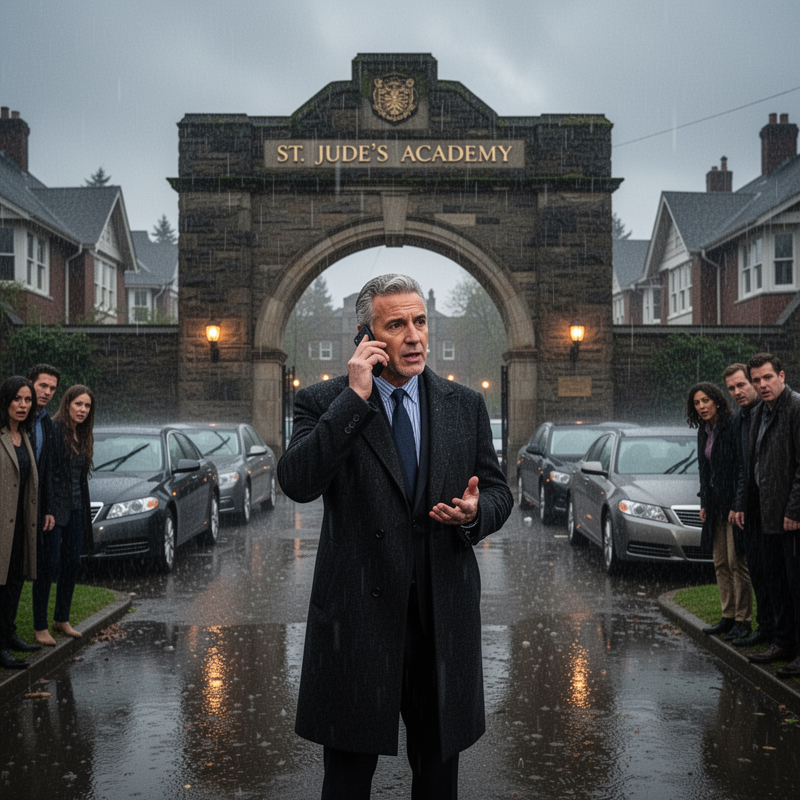
CHAPTER 1: The Cold Rain at St. Jude’s
Part 1
“There was no room in the Escalade for Maya, so we told her to wait under the awning,” my father-in-law, Frank Moretti, told me calmly over the phone.
I drove through the torrent rain to St. Jude’s Academy and found my six-year-old daughter shivering alone on the curb, her shoes soaked through and her hands blue.
Frank had comfortably loaded his daughter Bianca’s three children into his armored SUV, leaving my daughter behind in mob-controlled territory during an active weather emergency.
When I got home, I logged into my encrypted logistics portal and pulled up the hidden ledger.
Over six years, I had secretly funneled $374,000 of my personal military retirement savings and specialized security consulting earnings to keep Frank’s dockside shipping front solvent.
The windshield wipers on my custom-armored Range Rover thrashed against the deluge, fighting a losing battle against the sheets of water cascading down the glass. The city streets were a blur of red taillights and blinding white headlights, each one a stark, fleeting reflection in the deep puddles that swallowed the cracked asphalt.
My knuckles were white on the steering wheel, the phone still warm in the cup holder beside me. Frank’s words, so casual and dismissive, echoed in my mind. No room. Under the awning.
It was almost 4:30 PM, and the weather channel had been screaming “active weather emergency” for the last two hours. Flash flood warnings were everywhere. And my six-year-old daughter, Maya, was standing somewhere in it.
A knot tightened in my chest, a cold, hard stone of dread and fury. St. Jude’s Academy was usually a beehive of activity at dismissal, but today, with the storm, it would be chaotic. I pushed the Rover faster, the powerful engine roaring in protest.
I pulled up to the school’s main entrance, the grand stone archway of St. Jude’s disappearing and reappearing through the rain. The usual line of parents’ cars was gone, just a few lingering sedans, their drivers looking anxious. My eyes scanned frantically.
There. A tiny, hunched figure huddled under the small, tattered canvas awning by the side door. She was barely visible against the dark brick, a splash of bright pink backpack a shocking contrast to the grey misery surrounding her.
Maya.
My breath caught in my throat. I slammed the gear selector into park and threw open the door, not caring about the rain that instantly plastered my hair to my face.
“Maya!” I screamed, my voice raw against the wind and the downpour.
She looked up, her small face pale and drawn. Her eyes, wide and startled, found mine, and a flicker of relief, so profound it was heartbreaking, crossed them. She started to run, a clumsy, waterlogged dash, her little legs churning.
I met her halfway, sweeping her into my arms. Her clothes were soaked, heavy with rain, and she was trembling. Her hands, when they touched my neck, were ice cold, tinged with blue. Her school shoes, those bright pink ones she loved, squelched with every step.
“Mama,” she whispered, her voice barely audible, burying her face into my shoulder. “It’s so cold.”
I pulled her tighter against me, my own body shielding her as I rushed back to the Rover. The leather seats were cool against her wet clothes, but the heater was blasting. I stripped off my jacket and wrapped it around her.
“What happened, baby?” I asked, my voice a forced calm. “Where was Grandpa Frank?”
Maya shivered, her teeth chattering. She looked up at me, her innocent eyes still a little red-rimmed from the cold.
“Grandpa Frank picked up Aunt Bianca’s kids first,” she murmured, clutching my jacket tighter.
My heart seized. “He did? What about you?”
“Aunt Bianca told me I was supposed to wait until a little later,” Maya said, her voice small. “She said he would come back for me after he dropped off Lucas and Emily and David.”
My blood ran cold. Bianca. My sister-in-law. Frank’s favorite child.
I gripped the steering wheel so hard my knuckles popped. Frank hadn’t just ‘run out of room.’ Bianca had deliberately told Maya a different pickup time. She had orchestrated this. She had ensured Frank would pick up her own children, leaving mine behind, knowing full well the storm was closing in.
The implications hit me like a physical blow. This wasn’t an oversight. This was malicious.
The drive home was silent, except for the rhythmic thud of the wipers and Maya’s quiet sniffles as she slowly warmed up. I kept glancing in the rearview mirror, watching her small reflection, the anger building in a slow, steady burn inside me. This wasn’t just about Frank’s neglect. This was about Bianca’s calculated cruelty.
Once we were home, I quickly got Maya out of her wet clothes, wrapped her in a thick, warm blanket, and made her a cup of hot cocoa. I settled her on the sofa with her favorite cartoon, watching her until her shivering finally stopped and a faint flush returned to her cheeks.
Then, I walked into my study, my movements deliberate, each step precise. The room was dark, the only light from the monitors glowing in the corner. I sat down at my desk, the rain still lashing against the windowpane.
My hands moved over the custom keyboard, typing a complex sequence of alphanumeric characters. The screen flickered, then an access prompt appeared. I input my biometric data, a quick scan of my thumbprint, and then the portal opened.
This was my world, my hidden infrastructure, built from years of Special Operations Signals experience. My secure, military-grade financial ledger.
I navigated through a series of encrypted directories, each layer peeling back to reveal more granular data. Then, I pulled up the hidden ledger, the one that detailed my six years of undeclared contributions to Frank Moretti’s legitimate dockside shipping front.
The figures swam into focus, stark white text on a black background.
$374,000.
Every dime of my personal military retirement savings, every penny from my specialized security consulting earnings. Funneled silently, meticulously, into Frank’s enterprise, keeping it afloat, keeping the books clean enough for federal eyes, expanding his operations without his crew ever knowing where the extra capital came from.
My generosity. My loyalty. My years of quiet, unspoken support for Leo’s family, for *my* family.
And it had been met with absolute contempt. With the deliberate abandonment of my child in a storm, orchestrated by Frank’s own favored daughter.
The cold truth of it hit me with the force of a physical blow. It wasn’t an accident. It was a cold, calculated slight, a statement.
And Maya’s innocent words, “Aunt Bianca told me I was supposed to wait until a little later,” now resonated with a chilling clarity.
Part 2
The ledger on my screen, a testament to my misguided loyalty, now glowed like a betrayal. I stared at the numbers, the sum so immense, and felt a cold fury settle in my gut. This wasn’t just about Maya being left in the rain. This was a pattern. Bianca’s calculated lie, Frank’s dismissive tone. They treated my contributions, my sacrifices, as a given. As something they were *entitled* to.
I clicked on the sub-accounts linked to the main enterprise. My military training had taught me to look for anomalies, for the hidden pathways. Frank’s books always had a certain… creative flair. He’d always claimed my funds were patching up aging equipment, ensuring the docks met modern safety standards, keeping the whole operation above board. Essential investments, he’d called them.
But as I drilled down, following the digital breadcrumbs through layers of shell corporations and offshore transfers, a different picture emerged. A very deliberate one.
The $374,000 wasn’t going into new cranes, or facility upgrades, or even securing new contracts. It wasn’t buying parts for the old dockside machinery he always complained about needing repair.
It was being siphoned. Systematically. Directly into an unlisted, private trust account. An education fund, specifically, for ‘Bianca Moretti’s children.’ Lucas. Emily. David. The same three kids who had ridden comfortably in Frank’s Escalade while Maya shivered on the curb.
My stomach twisted. Not a single cent of it had gone to the business directly. It was a personal slush fund, a secret endowment for Bianca’s kids, built on *my* retirement, *my* earnings, *my* loyalty. Frank hadn’t just allowed Bianca’s cruelty; he had enabled it, profited from it. And my husband, Leo, a man who worked tirelessly for his father, was completely unaware. He believed, as I had, that the money was shoring up the family business. He was just as much in the dark, another pawn in their game.
A slow, deliberate calm settled over me. This was no longer just anger. This was war. Not with guns or violence, but with the language I knew best: data, networks, and the invisible threads that held their entire world together.
My fingers flew across the keyboard, a blur of motion. I navigated to the network infrastructure section, the heart of Frank’s legitimate operations. I located the system protocols for inbound international cargo manifests. The specific cryptographic keys that verified and cleared Frank’s shipping containers through customs at the Brooklyn pier.
With a few precise commands, I revoked them all. Every single digital signature. Every access token. The entire digital handshake that allowed his ships to unload. I locked them down. The docks were about to become very, very quiet. This would crippling his immediate logistics.
Chapter 2: The Lock on the Pier
The next morning, the docks at Red Hook were quiet under a pale, gray sky. But it was a deceptive calm.
My phone rang at 6:04 AM. The caller ID flashed “Frank Moretti.” I let it ring.
It rang again. Then a third time. I imagined him staring at the three freight haulers idling at the terminal, their $2 million in imported Italian goods held hostage.
I picked up on the fourth ring.
“Elena, what the hell is going on?” His voice was tight, a low growl I knew well. “My ships can’t clear. The manifests are encrypted.”
“The system is functioning exactly as it’s been paid for,” I said, my voice flat.
There was a silence on the other end, long and sharp. I could hear the wind whipping off the water in the background of his call.
“This is a glitch,” Frank insisted, his voice rising. “Fix it. Now.”
“There’s no glitch, Frank,” I told him. “Just a change in service.”
He exhaled slowly, a sound like grinding gravel. “What does that mean?”
“It means my financial contributions to the dock’s operating expenses have ended,” I explained. “And with them, my technical maintenance. That security framework? It was part of my services.”
“You want to play games?” Frank spat. “With my business?”
“This isn’t a game, Frank,” I said. “This is a consequence.”
He slammed the phone down. I held mine for a moment, the silence feeling heavier than his rage. Three ships, $2 million. It was a good start.
Chapter 3: The Tribunal at the Warehouse
Two hours later, Leo found me in the kitchen. He knew.
“My father wants us at the warehouse,” he said, his voice soft, almost a plea. “He’s called a meeting.”
The warehouse office, tucked behind stacks of plywood and dormant forklifts, always smelled of damp concrete and old coffee. Frank sat at the head of a long, scarred oak table. Bianca was at his right, her face tight with a familiar sneer. My husband, Leo, sat across from me, his shoulders slumped.
Frank gestured sharply at a tablet on the table. “The Genoa shipment is stalled. Two million dollars, held up by some ‘technical issue’ you engineered, Elena.”
Bianca leaned forward, her eyes narrowed. “This isn’t about some security system, Papa. This is about jealousy.”
She turned to me. “Because I got my kids picked up first. You’re trying to steal from the family out of spite for a missed carpool.”
I felt a coldness settle in my stomach. “Steal? Bianca, I’ve poured nearly four hundred thousand dollars of my own money into this operation.”
“Which we have no record of!” Bianca shot back. “Unless you have a ledger. Oh, wait, you run a secret ledger, don’t you?”
Frank tapped his fingers on the table. “Elena, you will unlock the system. The family’s business cannot be jeopardized by this… personal matter.”
“It’s not personal,” I countered. “It’s business. And I won’t unlock anything until a full audit of the last five years of dock accounts is conducted. Transparently. In front of this entire inner circle.”
Bianca gasped, a theatrical sound. Frank’s face hardened, his jaw clenching.
“An audit?” he repeated slowly. “You question my books?”
“I question where $374,000 of my money went,” I replied. “And until I get answers, those ships stay put.”
Chapter 4: Digital Footprints
Later that evening, the doorbell rang. It was Marcus, my younger brother, his usually quiet eyes alight with a focused intensity. He held a slim, encrypted drive in his hand.
He didn’t say much, just nodded toward the kitchen table. I brewed coffee.
“I’ve been poking around,” he stated, plugging the drive into my secure laptop. “Since you mentioned the issues.”
A terminal window opened, then a web browser displaying a defunct forum. The interface was crude, dark. It was a place for people in… certain circles to exchange information.
“This is an archived copy from 2019,” Marcus explained, scrolling. “An obscure underworld tech forum. It’s been shut down for years.”
He pointed to a username, a string of seemingly random letters and numbers. “I cross-referenced IP logs from old Moretti network traffic. This handle belongs to Bianca.”
My breath hitched as I read the screen. The posts were a chilling roadmap. Bianca, under that handle, had been asking for advice.
“How to structure an off-book trust for minors,” Marcus read aloud, his voice devoid of emotion. “Preferably one that can absorb substantial, untraceable ‘donations’ from an unwitting source.”
Another post detailed “methods to gradually diminish a rival’s standing within a traditional family enterprise, particularly if they possess assets perceived as external.”
My vision blurred for a moment. “She was planning this for years.”
“Looks like it,” Marcus confirmed, his finger tracing a line of text. “She laid out a step-by-step strategy. Right down to how to exploit your military pension savings. And how to sideline you and Maya.”
The air went cold around me. It wasn’t just about Frank’s callousness. It was Bianca’s calculated, insidious cruelty, openly discussed on a dark corner of the internet.
Chapter 5: Retaliatory Strikes
The next morning, Leo walked into his auto repair shop to find three of his mechanics staring at their pay stubs.
“The bank rejected my transfer for parts,” Leo told me over the phone, his voice tight with frustration. “Said our operating account is frozen. All of them.”
Frank’s retaliation was swift and brutal. My own primary bank lines for my security consulting business were also suddenly inaccessible. He wasn’t just hitting me; he was hitting our household, our lifeblood.
I found Leo an hour later, standing in his office at the shop, a blank expression on his face.
“He called me,” Leo said, looking out the grime-streaked window. “My father. He told me to control my wife.”
“What did you say?” I asked, my heart hammering.
“I didn’t say anything,” Leo admitted, his shoulders slumping. “He just told me that a son who cannot control his wife does not deserve the family’s protection.”
He turned, his eyes red. “He thinks you’re just being difficult. He thinks you’re trying to take what’s ours.”
“Ours?” I echoed, the word tasting bitter. “He let Bianca take my money. My daughter was left in the rain. And he calls me difficult?”
Leo just shook his head slowly. He picked up a wrench from his desk, weighing it in his hand. The weight of his father’s words was clearly crushing him.
“What are we going to do, Elena?” he asked, his voice barely a whisper.
I looked at him, then at the frozen bank statements scattered across his desk. “We fight back,” I said. “On my terms.”
Chapter 6: International Waters
Frank wanted to play financial games. I knew the rules better than he did.
I logged into my secure terminal. Frank’s dock operations relied on a complex web of international clearances. His most valuable, time-sensitive shipments moved through a single partner in Genoa, Italy. Their liquid clearing reserves, critical for quick customs processing, were their Achilles’ heel.
Using a sequence of specialized electronic warfare protocols, I triggered an automated security flag. It wasn’t illegal, not technically. It simply highlighted anomalies in Frank’s partner’s transaction history—anomalies that were easy to create if you knew the right channels.
A few clicks, a series of encrypted commands, and the system was activated.
Within the hour, the news started to ripple through the network. A frantic call from Frank’s lead broker in New York, then another from the partner in Genoa. Their liquid clearing reserves, over $800,000, were frozen pending an “international audit.”
The entire Moretti syndicate enterprise felt it. High-stakes shipments meant for urgent delivery sat stranded. Contracts breached. Penalties looming.
I watched the digital indicators on my screen. The red alerts, the flashing error messages on Frank’s shipping dashboards, all confirmed it. The gears of the Moretti operation had ground to a sudden, painful halt.
Let him control his wife, I thought. I controlled the ports.
Chapter 7: The Fractured Line
The next day, Marcus arrived again, his face grim. He had printed out the forum threads, thick stacks of paper now, to protect the digital trail.
I handed them to Leo. He sat at our kitchen table, the early morning light cutting across his weary face, and started to read.
Page after page, the cold, calculating words of his sister Bianca detailed her plans. His eyes scanned the dates, the specific strategies for diverting funds, the casual mentions of “unwitting sources.”
Then he saw the proof that Frank knew. Small details, easily missed, but now undeniable. Frank’s own network logs showing access to an internal financial projection that factored in “anticipated non-repayable infusions.” The exact value of my contributions.
Leo stopped at a specific paragraph, a discussion about how to minimize “external influences” on family decisions, targeting me and Maya directly. His hands began to tremble.
He didn’t speak. He simply pushed back his chair, the sound scraping against the linoleum. He stood, grabbed his car keys from the hook by the door, and walked out without a word.
I watched him go, knowing where he was headed.
Less than an hour later, my phone rang. It was one of Frank’s junior capos, frantic.
“Mr. Leo just walked into the office,” the capo stammered. “He laid his keys on Mr. Moretti’s desk. Said nothing. Just turned around and left.”
“And Frank?” I asked, my voice barely audible.
“He just sat there,” the capo whispered. “Didn’t say a word. Didn’t move.”
For the first time in his life, Leo Moretti had publicly broken ranks.
Chapter 8: The Red Hook Surge
A late-season storm descended on Brooklyn like a fist. The sky turned an ugly bruise-purple, and the wind shrieked. News channels showed images of surging tides in Red Hook.
Frank, stubborn as always, refused to abandon the docks. Un-cleared cargo, held up by my actions, was a priority for him. He and a skeleton crew were out there, trying to secure an unstable crane stack.
I was monitoring my old military channels, a habit from my Special Operations days. The static was heavy, but I picked up snippets. Port Authority calls, Coast Guard chatter about the worsening conditions.
Then, a sudden burst of frantic voices.
“Crane four… unstable! Electri—” The signal broke up.
“Transformer exploded! Main grid down at Red Hook terminal!”
A new voice, distorted but urgent: “Frank Moretti… trapped! Under the hoist! Crane four collapsed!”
My blood ran cold. Frank. Trapped.
I grabbed my tactical bag, already packed with emergency comms gear and medical supplies. Leo was in the garage, staring at a weather report on his phone, his face pale.
“Frank’s trapped at the docks,” I told him, already heading for the door. “Crane four. Transformer exploded.”
Leo looked up, his eyes wide. “The storm… you can’t go out there!”
“Someone has to,” I said, pulling on my heavy-duty rain jacket. “He’s still Maya’s grandfather.”
The wind howled, rattling the windows. I started the engine, the wipers fighting a losing battle against the torrent.
Chapter 9: The Fate at Crane Four
The docks were a scene from a disaster movie. Rain lashed down, mingling with steam from ruptured pipes. Sparks shot from downed power lines, arcing against the darkening sky. Everywhere, the smell of ozone and burning metal hung heavy.
I navigated the flooded paths, my tactical training kicking in. Live wires snaked across the ground, debris from collapsed structures littered the landscape. I moved, low and fast, towards Crane Four.
It was a mangled wreck. Twisted steel beams, some still smoldering, lay everywhere. Underneath a massive section of collapsed hoist, half-buried in water, I saw Frank. He was pinned, conscious, but his face was chalky white.
“Elena?” he croaked, his voice barely audible above the storm.
“Don’t move,” I ordered, assessing the situation. The hoist was too heavy to lift manually. Its weight pressed against his chest. I could see the rebar from the collapsed concrete.
I pulled out my compact hydraulic spreader, a piece of kit from my days in a combat recovery unit. It was designed for vehicle extraction, not this. I jammed it into a crevice, straining against the immense weight. Sweat poured down my face, mixing with the rain.
Then, a blinding flash. A deafening crack that seemed to split the sky.
A bolt of lightning, sharp and impossibly bright, struck a nearby grounding rod. The surge, instead of hitting us, arced. It ripped through the steel girder pinning Frank, vibrating it with an impossible force. With a loud shriek of metal, the section shifted, then blew clear, flung yards away.
Frank coughed, gasping for air as the pressure released. I scrambled to his side, checking him for injuries.
Lying uncharred on his chest, amidst the wet, smoking debris, was a small, tarnished silver religious medal. It was the one I’d seen in old photos, belonging to his late wife. His eyes, wide with shock, fixed on it.
He looked up at me then. His gaze was no longer sharp or angry. It held stunned awe. He knew. He knew I had the codes, the technical ability to let him burn, to let the storm erase his problems. But I hadn’t. I had risked my life to pull him out.
His lips moved, but no sound came out. He just stared, holding the medal in his hand, then at me.
Chapter 10: Unspoken Restitution
The next morning, Frank returned from the hospital. He had a few cracked ribs, a deep gash on his arm, and a newly acquired quietness. He said nothing about the rescue. No thanks, no apologies.
But actions spoke louder.
My phone chimed, signaling a new deposit. I pulled it up. My personal account showed a wire transfer. The exact amount: $374,000. It was dated from one of Frank’s personal offshore accounts. No message, no memo. Just the money.
Moments later, Leo’s phone rang. He walked into the living room, a bewildered look on his face.
“My bank,” he murmured. “They just unfroze the shop accounts. All of them. Said it was a ‘system error’ and the hold was removed.”
Later that day, Frank sat at his desk in the Moretti family office. He had a bandage on his arm, but his movements were steady. He was working through administrative terminals, his fingers moving across the keyboard with purpose.
He methodically revoked Bianca’s high-level access to the enterprise’s financial ledgers. Then he downgraded her security credentials. A quiet re-prioritization, done without a word.
The air in the house, in the family, was still thick with the aftermath of the storm, both literal and metaphorical. But something fundamental had shifted. Frank’s silence wasn’t a punishment anymore. It was a new language.
Chapter 11: Reconfiguration
The following Monday, Bianca arrived at the dock office, an expensive leather bag slung over her shoulder, a forced smile on her face. She stopped dead at her desk.
It was cleared. Not just tidy, but empty. Her personal effects were gone.
She looked around, her smile faltering. A junior associate, usually deferential, avoided her gaze.
“What is this?” Bianca demanded, her voice sharp. “Where are my files?”
She stormed towards Frank’s office, her heels clicking angrily on the concrete floor. Frank was inside, reviewing shipping logs on his screen, a cup of coffee steaming beside him.
“Papa, what is going on?” she burst out, throwing her hands up. “My desk is empty! My credentials aren’t working!”
Frank continued to stare at his monitor. He didn’t flinch. He didn’t even turn his head.
“I need my access back,” Bianca insisted, her voice rising. “I have responsibilities here!”
He slowly reached for his coffee cup, took a sip, and then placed it back down. Then, with deliberate slowness, he swiveled his chair to face the window, his back to her.
It was a complete, silent dismissal.
Bianca stood there for a long moment, her face draining of color. The message was clear. Her administrative access was gone. Her power was stripped. Her new role, a single email confirmation later, was basic paper archiving in a back office, under strict supervision. No more influence. No more control.
Just the silent, unyielding consequence of her actions.
Chapter 12: Two Weeks Later
Two weeks later, the smell of freshly baked cannoli and strong espresso filled a neutral Italian bakery in South Brooklyn. The sun streamed through the window, but the atmosphere inside remained tense, almost fragile. A few men in dark suits stood casually outside, their presence a silent reminder of the world we moved in.
Frank sat across from me and Maya, his expression unreadable. Leo was beside me, his hand resting lightly on my arm. The conversation around us was quiet, measured tones, small talk.
Frank didn’t offer a dramatic apology. There were no grand declarations. Instead, he reached into his jacket pocket and slid a small, elegantly wrapped box across the table.
Leo looked at me, then at the box. Inside, nestled on velvet, was a classic gold watch, heavy and traditional. He picked it up, a surprised intake of breath.
Then Frank pushed a second, smaller box across the table, along with a set of keys. “For you, Elena,” he said, his voice low.
The keys were for a brand-new, top-safety-rated SUV. Registered directly in my name. A tangible acknowledgment of Maya’s safety, of my position.
Frank looked at me then, his eyes holding mine. A single, slow nod of genuine respect passed between us. He then reached for the espresso pot. Instead of pouring his own, or even Leo’s, he filled my small cup first.
It was a quiet acknowledgment. The balance of power, of respect in our family, had been permanently restored.
Respect in our world was never built on fear or money. It was built in the silence after the storm, when you finally choose who you’re going to be.
Leave a Reply