CHAPTER 1: The Blood on the Deed
Part 1
“Elena, your grandmother, mother, and son didn’t die in a random house fire—they were destroyed because they refused to sign over the family chapel.”
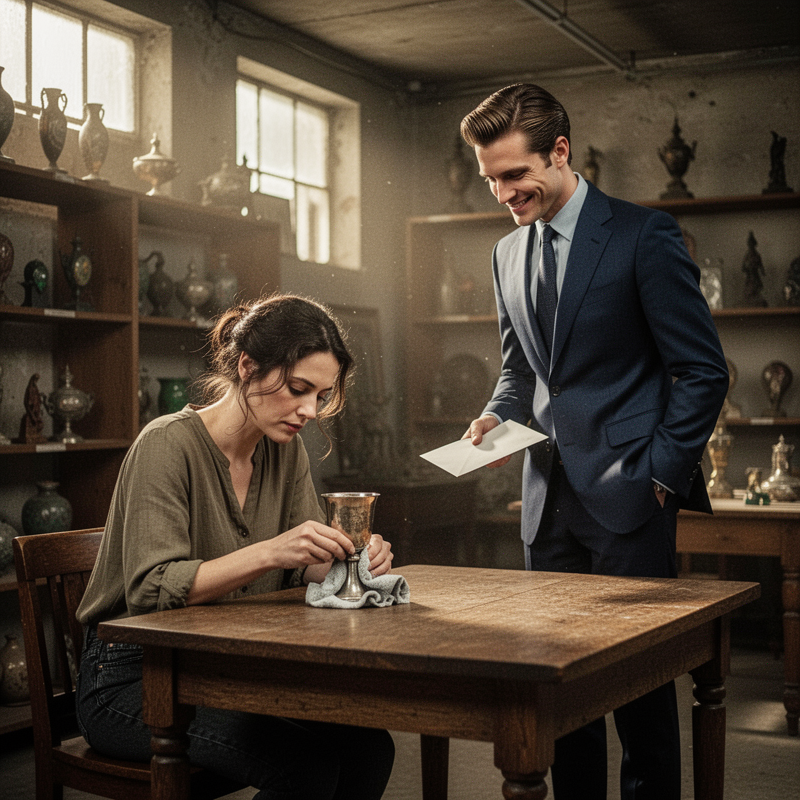
My employer, Julian Kincaid, said those words with a smooth, untroubled smile while handing me my bi-weekly paycheck of $2,400.
One year ago, five members of my family perished overnight in what police called a tragic, unexplained massacre and fire after they fiercely rejected a routine land acquisition offer.
I had spent twelve months grieving them while cataloging artifacts in Julian’s private gallery, completely unaware that my boss held the blood-stained deed to our sanctuary all along.
The air in the Kincaid Antiquities basement hung heavy, thick with the scent of aged paper, beeswax, and the faint, sweet decay of centuries-old wood. Dust motes danced in the sparse beams of light filtering down from the grimy street-level windows, illuminating the endless shelves of 18th-century curiosities.
I sat hunched over a heavy oak table, meticulously cleaning a tarnished silver chalice that once belonged to a forgotten Savannah merchant. It was a monotonous task, the kind of quiet, repetitive work that suited my grief-numbed state. Each polished surface reflected a small, distorted piece of my own quiet misery.
A shadow fell over my work.
I didn’t need to look up to know it was Julian Kincaid. The faint, expensive scent of his cologne always preceded him, cutting through the musty antique aroma.
His shoes clicked softly on the rough concrete floor as he approached my table.
“Elena,” he said, his voice as smooth and polished as the ancient mahogany he collected. “A moment of your time, please.”
I set down the chalice and the polishing cloth, my movements slow and deliberate. My heart gave a tiny, unwelcome lurch. Julian rarely ventured into the basement.
He produced a crisp, cream-colored envelope from the inner pocket of his tailored jacket. It was my bi-weekly paycheck, exactly $2,400, a sum that felt both enormous and utterly insufficient in the face of my empty life.
He held it out, his fingers long and elegant.
“Your wages,” he announced, a polite, almost paternal smile playing on his lips. “Always on time, as promised.”
I reached for it, our fingers brushing for a fleeting second. His felt cool, indifferent.
But then, instead of withdrawing his hand, he slid another item across the tabletop toward me. It was a thin, rectangular packet, wrapped in faded yellow parchment tied with a brittle, fraying ribbon. It looked ancient, another one of his endless acquisitions.
“And this,” he added, his smile widening almost imperceptibly, “is a little something extra. A deed, actually. Found it tucked away in an old collection I acquired last month.”
He watched me, his gaze unblinking. There was an unnerving stillness about him, as if he were enjoying a private joke.
I untied the ribbon, my fingers fumbling slightly. The parchment crackled under my touch. It was stiff with age, the edges browned and delicate.
The script inside was elegant, flowing. My eyes scanned the words, trying to make sense of the archaic legal jargon. My gaze snagged on a familiar name.
Ross.
My breath hitched. It was the deed to our family chapel, the one that had stood on our land for generations. My grandmother, Rose, had cherished it.
My eyes darted down the document. There, near the bottom, was a signature. A signature I knew intimately from countless birthday cards and school notes.
My mother’s.
It was bold, distinctive, yet somehow…off. The slant was wrong, the flourish at the end of the ‘s’ too exaggerated. It was a forgery. A clumsy, obvious forgery, yet one I might not have noticed if I hadn’t spent a lifetime staring at her actual handwriting.
A cold dread began to coil in my stomach.
Julian leaned closer, his voice dropping to a low, conspiratorial murmur. He gestled toward the document with a dismissive wave of his hand.
“They really put up quite a fight, didn’t they?” he mused, his tone light, conversational. “Your grandmother especially. Stubborn woman. Said she’d rather die than part with that land.”
My head snapped up. My eyes, still stinging from the dust of ages, locked onto his.
He chuckled softly, a dry, humorless sound.
“And look what happened,” he continued, gesturing vaguely around the dusty basement as if to encompass the entire tragedy. “A year ago, wasn’t it? Such a shame. All that unpleasantness could have been avoided.”
His words hit me like a physical blow. They echoed the very first lines of his casual confession. Unpleasantness? This wasn’t just about land. This was about their deaths.
I looked back at the deed, my hands trembling now. The parchment felt suddenly heavy, radiating a chilling cold. My gaze fell to an attached annex document, a small, separate paper stapled clumsily to the main deed.
It was a list of occupants. A roster, perhaps, of those residing on the property.
My grandmother’s name. My mother’s name. My aunt’s. My uncle’s. All there, stark and clear in the dated script.
And then, impossibly, at the very bottom, after my mother’s name, was another entry.
Leo Ross. Age 7.
My son. My beautiful, sweet, seven-year-old Leo.
His name, typed onto that official document, confirming his presence on the property that night, stared up at me from the page. It was a final, undeniable proof. A final twist of the knife.
My employer, the man who paid my wages, the man who had hired me a month after the fire, had just handed me the forged deed that stole my family’s land.
Hours before they died.
Part 2
My employer, the man who paid my wages, the man who had hired me a month after the fire, had just handed me the forged deed that stole my family’s land.
Hours before they died.
My voice was a strangled whisper, barely audible over the thumping in my ears. “You… you did this?”
Julian’s smile remained fixed, untroubled. He didn’t deny it. He simply tilted his head, a gesture of casual amusement.
“Your family’s chapel,” he began, his tone almost instructional, “was not merely a building. It sat upon a very old, very powerful ward. A boundary, if you will, that sealed something away.”
He paused, letting the words hang in the air, watching my face. His eyes held a chilling, distant intelligence, completely devoid of empathy.
“Your grandmother, Rose, was offered a generous sum, you know. Five hundred thousand dollars for the property. A more than fair price.” He shrugged, as if discussing a trivial market transaction. “But she refused. Stubborn, as I said.”
The tremor in my hands intensified, rattling the ancient parchment. “What are you talking about? A ward? What does that have to do with…”
“Everything,” he interjected smoothly. “When negotiations failed, my team had to… persuade the land to be available. We simply severed the old iron boundary stakes that had been driven deep into the soil centuries ago.”
His voice was almost clinical, like a historian describing a forgotten ritual.
“It wasn’t a gas leak, Elena. There was no faulty wiring. The moment those stakes were removed, the ward broke. It unleashed something ancient. Something that had been trapped beneath your family’s chapel for generations.”
My mind reeled, struggling to grasp his words. The police reports, the fire investigator’s theories, the endless, agonizing questions. All of it shattered into a million pieces.
“It corrupted the house,” Julian continued, his gaze drifting to the shadows in the far corners of the basement. “It turned everything inside to madness. It didn’t just burn. It unmade them.”
The horrifying truth descended on me with the weight of a thousand gravestones. My family hadn’t died in a tragic accident, or even a simple fire.
They had been slaughtered. In an unearthly nightmare, orchestrated by the man who now stood before me, casually explaining how he had unleashed a malevolent entity that drove my loved ones to destroy each other.
Chapter 2: A Child’s Memory
I walked the familiar cracked pavement of our old neighborhood, the air heavy with the scent of damp earth and distant woodsmoke. My chest felt hollow, a constant ache. Ahead, the scorched iron gates of our family chapel stood like skeletal fingers against the grey sky.
A small figure was kicking at a loose stone near the fence line. It was Toby Albright, the neighbor’s boy, still only seven years old. He looked up, his face smudged with dirt.
“Hi, Elena,” he said, his voice bright and unaffected by the ruins around him.
“Hi, Toby,” I managed, a lump forming in my throat.
He pointed a small finger at the rusted gates. “Did the dark gentleman come back to the chapel last night?”
My breath hitched. “What dark gentleman, Toby?”
“The one with the shiny black Mercedes,” he said, skipping a stone into a puddle. “He was here right before the smoke started last year. He kept looking at the gate.”
My eyes darted to the twisted metal. Julian Kincaid’s sedan was distinct, sleek, and black as a raven.
Toby tilted his head. “He dropped something in the drain, too. It was big and silver, like a fancy key.” He shrugged. “Then he just drove away really fast.”
He pointed to the storm drain near the curb, a dark grate partially clogged with leaves. A wave of ice washed over me. Julian had been here. He had been here the night they died.
Chapter 3: The Price of Paper
The city property office buzzed with the low hum of photocopiers and hushed conversations. I felt out of place amidst the stacks of mundane blueprints and land deeds. My search for “land alteration permits” for the Ross family property yielded nothing.
“Looking for something specific, or just admiring the bureaucracy?” a voice rumbled from beside me.
I turned to see a man with sharp eyes and a neatly trimmed beard, leaning against a towering stack of old boundary maps. His trench coat looked too heavy for the Savannah heat. This was Gabriel Croft, the independent antiquarian investigator I’d heard whispers about.
“Elena Ross,” I said, offering a weak nod. “My family’s chapel. I’m trying to find records.”
Gabriel slid a faded document across the counter. “You won’t find anything related to true alterations. Not legally, anyway.” He tapped a specific entry. “But you might find this interesting.”
It was a public record, a re-zoning document from eleven months ago, declaring our ancestral chapel “abandoned and structurally unsound.” The signature at the bottom belonged to Arthur Pendelton, the city appraiser.
“Pendelton fudged the boundary lines,” Gabriel explained, his voice low. “Declared the land unrestricted, allowing Julian’s crew access to the soil, the wards.”
“Why?” I whispered.
Gabriel’s lips thinned. “$45,000. Wired directly into Pendelton’s offshore account. Not hard to trace if you know where to look.” He watched my face. “Julian Kincaid likes to cut corners, even sacred ones.”
Chapter 4: The Iron Circle
Gabriel’s workshop on River Street was a chaos of antique maps, ancient texts, and exotic artifacts. Dust motes danced in the single shaft of sunlight cutting through a grimy window. He poured me a glass of amber tea, the scent of ginger sharp in the air.
“Julian isn’t just some rich antique dealer, Elena,” Gabriel began, setting the glass before me. “He’s a lieutenant in something called the Iron Circle.”
I frowned. “The police can’t help with Kincaid. What’s a… Circle?”
“An organization,” Gabriel clarified, picking up a dull, iron-bound book. “An underground syndicate that deals in things no one should touch. Forbidden artifacts, ward-bound relics, dark entities.”
He explained how they operated across the East Coast, maintaining a tight, invisible grip on various illicit trades. Savannah, with its deep, hidden history, was a key hub.
“They’ve got their fingers in city hall, the courts, even some federal agencies,” he continued. “That’s why Pendelton’s bribe went unnoticed. That’s why you got no legal answers about the chapel.”
My stomach clenched. “So, what? I just give up?”
“No,” Gabriel said, his gaze intense. “The Iron Circle has rules. Strict ones. They tolerate a lot, but unsanctioned dark rituals, especially ones that draw public attention and leave a mess? That’s punishable by total erasure. They value secrecy above all else.”
Chapter 5: Sealed Archives
My phone buzzed constantly as I left Gabriel’s workshop. News travels fast in Savannah, especially the bad kind. Julian Kincaid had clearly heard about my visit to the city registry.
By the time I reached the municipal archives, a chain was wrapped around the double doors, a brightly colored “CONDEMNED” sign dangling from it. A burly security guard stood at attention.
“Structural hazard,” he said gruffly when I tried to ask questions. “Closed indefinitely.”
It was Julian. He’d paid off two city council members, bribing them to lock away the historical records, erasing any trace of Arthur Pendelton’s fraudulent documents. He was closing every door.
I numbly walked back to my small apartment. The hallway smelled faintly of stale cigarettes and disinfectant. As I unlocked my door, I noticed the frame was slightly splintered.
Inside, cushions were tossed from the sofa, and drawers lay open, their contents spilled across the floor. My few personal photos, the ones of Leo, were scattered face down.
A formal eviction notice was taped to my refrigerator. “Immediate Vacate” was stamped across the top in angry red ink. Beside it, a single, black feather—a subtle, chilling message from Kincaid—lay on the pristine white porcelain. It was a warning: stay quiet, or share my family’s fate.
Chapter 6: The Vault on Bull Street
The Bull Street gallery was dark, its grand entrance gate locked. Rain slicked the cobblestones as Gabriel picked the heavy iron lock with practiced ease. The air inside smelled of dust and ancient wood polish.
We descended into the private vault, a massive steel door groaning open on well-oiled hinges. Rows of meticulously organized shelves held rare, priceless artifacts.
“He keeps his most prized possessions down here,” Gabriel whispered, shining a narrow beam of light into the gloom.
In the center of the room stood a large, iron box, secured with a complex series of tumbling locks. Gabriel worked quickly, his fingers flying. The tumblers clicked, and the heavy lid creaked open.
Inside, nestled on a bed of faded velvet, was a tarnished silver pendant. My breath caught. It was Leo’s. The small, oval charm he’d worn every day, a guardian angel from his grandmother.
My fingers trembled as I picked it up. It was caked with a fine, black dust—ritual ash. Not from a simple house fire. This was from the very entity Kincaid had unleashed.
Julian had been inside the chapel that night. He had walked through the chaos, through the inferno that consumed my family, just to retrieve this relic. My son’s pendant, found here, was proof.
Chapter 7: Broken Pledges
Back in his workshop, Gabriel spread out Julian’s recovered relic logs on a large wooden table. The scrawled entries were chilling, detailing every acquisition, every transaction. I stood beside him, still clutching Leo’s pendant.
Gabriel traced a finger down a column of dates. “Here it is,” he murmured. “The Ross Chapel acquisition. Date of entry: one day after the fire.”
The log described the artifact retrieved as “worthless stone fragments, minimal arcane resonance.” Julian had reported it as a failed operation, a dead end.
“He lied,” I said, the words barely a whisper.
Gabriel nodded grimly. “The genuine article was a black obsidian mirror. He kept it for himself. It’s an unsealed conduit, tremendously powerful. He reported it as useless, so the Iron Circle wouldn’t demand it.”
My blood ran cold. “He betrayed them.”
“He traded the lives of your family for it,” Gabriel corrected, his voice flat. “And then he broke every internal covenant the syndicate holds sacred by pocketing the prize.” He looked up at me, a strange glint in his eye. “Julian’s greed didn’t just expose your family to a monster, Elena. It exposed him to his own.”
Chapter 8: The Shadow Tribunal
The air in the damp brick cellar beneath Savannah’s historic district hung heavy with the smell of mildew and old secrets. Gabriel and I waited in silence, the stolen ledgers tucked securely into a leather satchel. Aboveground, the city slept, unaware of the clandestine meeting unfolding below.
A heavy oak door creaked open. Silas Drake entered, his presence filling the small space. He was a man carved from granite, with eyes that saw everything and betrayed nothing. Four silent, unsmiling enforcers fanned out behind him.
Gabriel stepped forward, placing the satchel on a makeshift table. “Silas. We have a problem. Julian Kincaid.”
Silas offered no greeting, no sign of recognition. His gaze flickered to me, then back to Gabriel. “Speak plainly.”
Gabriel unclasped the satchel, revealing Julian’s meticulously kept, incriminating ledgers. “Kincaid violated the Code of Secrecy. He orchestrated an unsanctioned ritual. Caused public attention. And worse—he stole the primary artifact, the black obsidian mirror, from the organization itself.”
Silas reached out a hand. Gabriel handed him a ledger. The Iron Circle boss flipped through the pages, his expression unreadable. He paused on a series of dates, his thumb stroking a particular entry.
“A tribunal,” Silas announced, his voice like stones grinding together. “It will convene immediately.”
Chapter 9: The Reading of the Ledger
Julian Kincaid stood in the center of his dimly lit gallery, surrounded by priceless relics and shadow-streaked tapestries. He had been brought here, not by choice, but by the silent, unyielding presence of Silas Drake and four Iron Circle enforcers.
“Silas,” Julian began, a forced calm in his voice. “This is a misunderstanding. I can explain the Ross Chapel incident. The artifact was…”
Silas cut him off with a raised hand. There was no negotiation, no defense to be mounted here. He held Julian’s own personal ledger, its leather cover smooth beneath his fingers.
“On the fifth day of the eleventh month,” Silas read aloud, his voice echoing through the silent gallery, “transfer of 45,000 USD to Arthur Pendelton. Forged land alteration permits, Ross Chapel.”
Julian’s face went white. He opened his mouth, but no sound came out.
Silas continued, his tone devoid of emotion, reading from Julian’s own hand. “Acquisition of unsealed entity. Ross property. Ritual conducted without board authorization. Family purged for resistance.”
Each word, each fraudulent transaction and unsanctioned blood ritual entry, echoed Julian’s own damning confession. The records laid bare his greed, his deceit, his absolute violation of every syndicate law. Julian, caught in the web of his own meticulous accounting, crumbled.
Chapter 10: Darkness Claims Its Own
The enforcers moved with chilling efficiency. Two of them seized Julian, pinning his arms behind his back. He thrashed, a guttural sound escaping his throat, but they were implacable.
Silas Drake stepped forward, his eyes fixed on Julian. With a precise motion, he reached out and stripped the heavy signet ring from Julian’s finger. It was the symbol of his authority, his membership in the Iron Circle.
“All gallery assets,” Silas declared, his voice cold and final, “all properties, all accounts, are forfeit.”
He then turned to the iron box, the one Gabriel and I had found in the vault. Silas unlocked it, revealing the black obsidian mirror, its surface reflecting only the oppressive darkness of the room. A tangible chill emanated from it.
Silas held the mirror up, its polished surface briefly catching the ambient light before plunging into shadow. Julian let out a choked cry, his eyes wide with terror as the residual force of the trapped dark entity seemed to reach out, latching onto his mind.
“You unleashed it,” Silas intoned, his voice resonating with ancient judgment. “Now you will be bound to it.”
Julian screamed, a high, desperate sound, as the enforcers dragged him backward, into the depths of the underground vault system. His fortune was dissolved, his existence wiped clean from Savannah’s high society, swallowed by the very shadow he had sought to control.
Chapter 11: The Quiet Aftermath
The Kincaid Antiquities gallery stood empty, its windows boarded over, a “For Sale” sign flapping forlornly in the breeze. The Iron Circle had moved swiftly, discreetly, leaving no trace of their presence, only absence. Elena found herself with no job, no legal recourse, and a profound silence that echoed in her small apartment.
A week later, on a cold, overcast morning, she walked through the municipal cemetery. The grey skies matched the quiet ache in her chest. Five silent granite markers stood in a neat row: Rose, Leo, her mother, her aunt, her uncle. She knelt, placing a small bouquet of fresh, white lilies on each stone.
No one had been charged. No arrests made. Arthur Pendelton, the corrupt appraiser, had fled the state the day after Kincaid’s disappearance. His house was empty, a ghost in the humid Savannah air.
The city archives, still under the guise of a “structural hazard,” remained locked. The intricate paper trail of lies, bribes, and false declarations was buried beneath layers of bureaucratic silence. The official story of her family’s death remained an unsolved tragedy, a mystery wrapped in fire and unanswered questions.
The truth, stark and brutal, lived only in Elena’s memory, and in the dark corners where the Iron Circle still operated.
Chapter 12: A Year in Gray
Exactly one year after the nightmare began, on the anniversary of the chapel fire, Elena sat at a Formica table. The dreary breakroom of a downtown temp agency hummed with the fluorescent lights overhead. She stared at a cracked mug of lukewarm instant coffee, steam rising thinly in the stale air.
Julian was gone, his empire a forgotten whisper in the city. The gallery was an empty shell, a hollow monument to a power that had once seemed unassailable. But the silence in her tiny apartment, the absence at her dinner table, remained absolute.
She quietly touched Leo’s tarnished silver pendant under her collar. It was cold against her skin.
She had found a kind of justice, an underworld reckoning that had consumed the monster who took her family. Yet, it had changed nothing about the emptiness that now defined her world. The seats remained vacant. The laughter remained unheard.
Revenge removes the monster from the room, but it leaves the empty chairs exactly where they were.
Leave a Reply