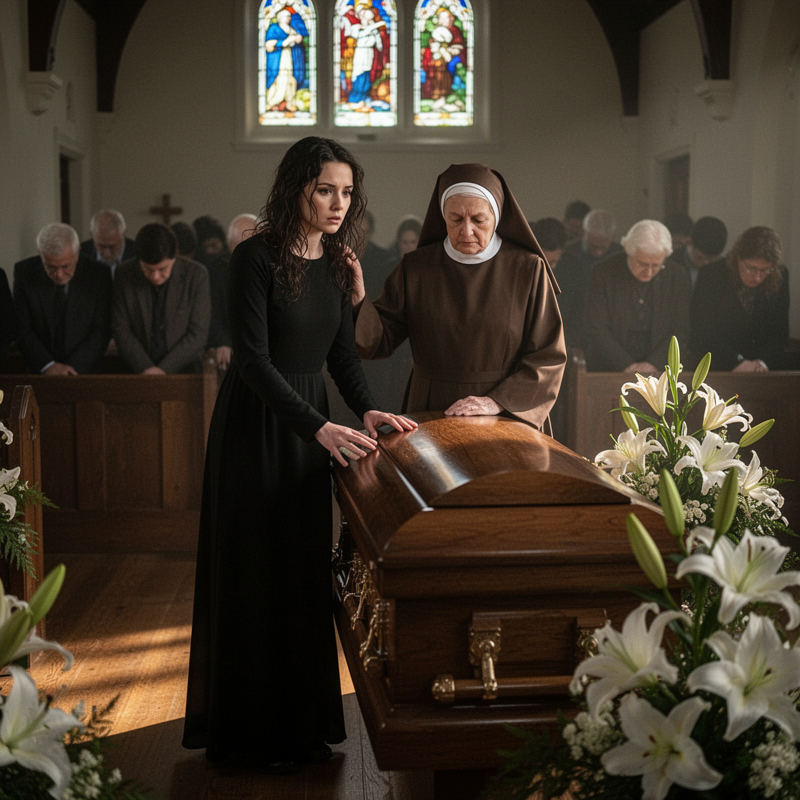
CHAPTER 1: The Funeral That Wasn’t
Part 1
My business partner in our religious trust told three hundred followers that my father had died of natural heart failure.
Two hours after the funeral service, a community nurse led me into an abandoned timber mill at the edge of our sanctuary compound.
My father was sitting inside on a wooden stool, breathing with the help of an oxygen tank.
He told me he had faked his death to survive being poisoned by the man now taking over our church.
I had no idea the counter-trap my father set was about to demand every single thing I owned.
The drone of Silas Croft’s voice filled the chapel.
It echoed off the rough-hewn timber beams, a familiar comfort to the three hundred members of the New Covenant Sanctuary gathered around me.
His words wove a tapestry of grief and scripture, eulogizing my father, Thomas Albright, the man who had founded this community decades ago.
I stood beside the closed casket, my fingers tracing the smooth, polished wood.
The scent of lilies and beeswax hung heavy in the air, mixing with the damp earth smell that always clung to the chapel after a spring rain.
My eyes drifted across the faces of my community, my family. They were somber, heads bowed, their sorrow a palpable weight in the room.
Silas continued, his voice resonating with practiced solemnity.
He spoke of my father’s quiet devotion, his unwavering faith, and the sudden, peaceful passing from natural heart failure that had claimed him two days prior.
It was all a lie.
But the congregation believed every word, their faces reflecting the truth Silas had carefully crafted.
A low murmur rippled through the pews as the final hymn faded.
Then, a wave of rustling fabric and soft footsteps as people began to rise.
They moved slowly, some pausing to offer a silent nod or a gentle hand on my shoulder before filing out into the late afternoon light.
I watched them go, each face a blur of muted colors, a testament to the quiet order of our sanctuary.
The last few congregants drifted out, leaving only the hushed echoes of their departure.
The chapel door clicked shut, plunging the room into a deeper quiet.
A hand, light but firm, touched my arm.
It was Sister Mary Holbrook, the community nurse, her face usually a picture of serene composure, now etched with an unfamiliar urgency.
Her eyes, normally kind and placid, darted around the empty chapel.
“Hannah,” she whispered, her voice barely audible.
Her grip tightened on my arm.
“We need to leave. Now.”
My head snapped towards her, confusion clouding my grief.
“Leave? Sister Mary, what are you talking about? The elders will be-”
“No time,” she cut me off, her voice hushed but insistent. “There are people watching. We must go unnoticed.”
Before I could form another question, she was pulling me towards a small door at the rear of the chapel, typically used for storing altar linens and hymnals.
The air in the storage room was stale, thick with the smell of old paper and dust.
Sister Mary moved with a briskness I’d never seen from her, her long habit swishing as she opened a back exit that led directly into the dense woods behind the sanctuary compound.
The late afternoon sun was already dipping below the tree line, casting long, distorted shadows through the pines.
A cold breeze rustled the needles overhead.
“Follow me closely,” Sister Mary instructed, her voice still a whisper, as she stepped out onto the damp earth.
I hesitated, looking back at the chapel.
The funeral, the casket, my father’s supposed death – it all felt like a dream, a blurred memory in the face of Sister Mary’s strange, demanding urgency.
But her gaze was unwavering, compelling.
I pushed my own questions down and followed her.
The woods were a labyrinth of thick underbrush and winding game trails.
Sister Mary moved with surprising agility for her age, her path unerring.
I stumbled behind her, my funeral shoes slipping on loose pine needles and hidden roots.
My black dress, meant for solemnity, felt heavy and restrictive, snagging on low-hanging branches.
Two miles, she had said, though it felt like ten.
The light faded rapidly, the trees growing denser, their branches interwoven overhead to form a dark canopy.
Only faint slivers of the moon broke through, illuminating brief patches of the forest floor.
The air grew colder, biting at my exposed skin.
My breath came in ragged gasps, not just from the physical exertion, but from the knot of dread coiling in my stomach.
What could possibly be so important, so secret, that it demanded this clandestine escape from my own father’s funeral?
After what felt like an eternity, Sister Mary finally slowed, pulling me to a halt.
“Here,” she murmured, pointing through a gap in the trees.
Through the twilight gloom, I saw it: the silhouette of an old, abandoned timber mill, its skeletal frame half-swallowed by vines and neglect.
Its weathered wooden walls sagged, and the roof was pockmarked with holes, like a gaping mouth.
A forgotten relic from a different era, it had stood empty for as long as I could remember.
A faint, sickly-sweet odor, like decaying wood and something metallic, drifted from its direction.
Sister Mary pushed open a creaking door that hung precariously on one hinge.
Darkness pooled inside, thick and oppressive, broken only by a single, battery-powered lantern casting a weak, flickering glow.
The air was stagnant, heavy with the dust of years.
My eyes adjusted, scanning the cavernous space.
Rotting timbers lay scattered on the dirt floor, alongside rusted tools and discarded machinery.
Then I saw him.
In the center of the mill, illuminated by the lantern’s dim glow, sat a man on a crude wooden stool.
His back was to me, his shoulders thin and stooped.
A clear plastic tube ran from his nose, connecting to a small, whirring machine beside him – an oxygen concentrator, its hum a steady counterpoint to the silence of the mill.
My heart seized in my chest.
A choked gasp escaped my lips.
The man turned his head slowly, his eyes, so familiar and yet so distant, meeting mine.
It was my father, Thomas Albright.
He was alive.
Part 2
“Father?” My voice was a raw whisper, barely audible above the quiet hum of the oxygen machine. Tears welled in my eyes, blurring his face. I rushed forward, dropping to my knees beside him. “How… how is this possible?”
He reached out a trembling hand, his skin papery and cool, and gently touched my cheek. “Hannah, my dear girl. I knew you’d understand.” His voice was weak, raspy, a shadow of the booming sermon voice I remembered.
Sister Mary stepped forward, placing a comforting hand on my shoulder. “We had to act quickly, Hannah. Silas… he was killing your father.”
“Killing me slowly,” Thomas interjected, his gaze hardening slightly as he looked at me. “It started about three months ago. I began to feel weak, my heart racing, my vision blurring. Silas had started bringing me a special ‘tonic tea,’ he called it, to help with my ‘stress.’”
He coughed, a dry, rattling sound that shook his frail frame. “I thought nothing of it at first. But the symptoms grew worse. Sister Mary, bless her medical training, recognized the signs. Digitalis poisoning. Foxglove extract. Enough to cause organ failure, but slow enough to look like natural causes.”
My mind reeled. Silas. My father’s partner. The man who had just eulogized him, pretending grief. He had been poisoning him?
“When the organ failure became undeniable,” Thomas continued, his breath catching, “we knew we had to make a move. Silas was planning to have me transferred to an outside hospital, which would have given him the perfect opportunity to finish the job.”
“Deputy Marcus Garza helped us,” Sister Mary added softly. “He arranged for a body to be discreetly swapped during the medical transfer. A Jane Doe, recently deceased, with a similar build. It was the only way to make it convincing.”
Thomas squeezed my hand. “It worked. Silas believes I’m dead, Hannah. He thinks he’s free to do what he wants.”
He paused, taking a shallow breath from the oxygen tube. “But I have a counter-plan. A way to expose him. We’ve been working on it here, with Mary and the Deputy. But Silas… he won’t stop. He’s after something far more valuable than just control of the church. He wants the sanctuary’s real estate trust. All fourteen million dollars of it.”
Chapter 2: The Whispers of Madness
The crisp morning air bit at my exposed hands as I walked back toward the main compound. My father’s words echoed in my ears: *Silas will stop at nothing.* I needed proof, concrete files that could expose his greed.
I pushed open the heavy oak door of the administrative office, the familiar smell of old paper and dust filling my lungs. Three senior elders sat around the large conference table, their faces grave. Silas Croft stood beside them, a somber expression on his face.
He didn’t look up from the tablet in his hands.
“Hannah, my dear,” he said, his voice soft, almost sympathetic. He finally met my gaze, his eyes betraying nothing. “We’ve been very concerned.”
“Concerned about what, Silas?” I asked, a tremor in my voice despite myself. I scanned the room for a sign of the financial ledgers I’d hoped to access.
He sighed, placing the tablet on the table with a gentle tap. “Your father’s passing, it has been a profound shock for all of us. But especially for you.”
Elder Thorne, a woman with tight grey braids, nodded slowly. Elder Jenkins clucked his tongue.
“Your grief, Hannah,” Silas continued, stepping closer, “it seems to be manifesting in some… troubling ways. Sister Mary mentioned you reported hearing Thomas’s voice.”
My breath hitched. He was twisting Mary’s actions, painting me as unstable. This was his first move.
“That’s not what happened,” I retorted, my voice rising. “I was told my father faked his death to expose your-”
Silas held up a hand, silencing me. “You see?” he murmured to the elders, shaking his head sadly. “Such intense spiritual delusions. It pains me deeply to witness this.”
He turned back to me, his expression hardening slightly. “Given your current distress, and for the spiritual well-being of the New Covenant Sanctuary, I must, regretfully, revoke your administrative clearance.”
His fingers flew across the keyboard of the communal computer. A red error message flashed on the screen as he disabled my user account.
“You can’t do that,” I said, stepping forward. “Those files are mine. This is my father’s work.”
“It’s a temporary measure,” Elder Thorne interjected, her eyes full of pity. “Until your spirit finds peace, dear.”
Silas then removed my key card from the wall hook, tucking it into his pocket. “Your access to all church office systems is now suspended, Hannah. Please, take this time to rest and pray.”
The three elders watched me, their faces a mixture of concern and solemn understanding. They believed him. I was already locked out, cast as the grieving daughter losing her mind.
Chapter 3: The Secret Wire Transfer
The administrative office doors clicked shut behind me, echoing the finality of Silas’s pronouncement. I retreated to my small cabin at the edge of the compound, the weight of his gaslighting pressing down. My phone, confiscated the day of my father’s “funeral,” was still gone. I was isolated.
That night, a soft tap at my cabin window startled me from my restless sleep. I peered through the glass to see a silhouette. It was Ruth Croft, Silas’s ex-wife. She had left the compound five years ago, disappearing without a word.
My heart pounded. Ruth never came back.
I unlatched the door, and she slipped inside, her face etched with a decade of worry lines. The night air, still cool, swirled around her.
“Hannah,” she whispered, her voice hoarse. “I heard what Silas is doing. The stories he’s spreading about you.”
She pulled a folded piece of paper from her worn jacket pocket, her hand trembling slightly. “I couldn’t stay silent anymore. Not when he’s doing this to you, too.”
She unfolded the paper, pressing it into my hand. It was a bank record. My eyes scanned the details, instantly focusing on a transaction entry: a wire transfer for $500,000.
“Look at the recipient,” Ruth urged.
“Julian Kincaid,” I read aloud, my brow furrowing. Kincaid was a local real estate appraiser, also a notary public. Why would the church building fund pay him half a million dollars?
Ruth’s eyes met mine, full of a guilt I recognized. “Silas has been siphoning funds for years. Kincaid helps him undervalue properties, move money. I saw it happening before I left.”
“Why now, Ruth?” I asked, my voice barely audible. “Why come back now?”
She looked away, toward the small, flickering lamp on my bedside table. “I was afraid. He threatened me, my family. But seeing you, seeing the way he uses God’s name to take everything… I can’t live with it anymore.”
“This isn’t just a suspicious payment, is it?” I asked, clutching the document. “This is proof.”
Ruth nodded, tears welling in her eyes. “He’s trying to get full control of the land. He needs Kincaid to forge the papers, to make it look legitimate.”
A cold dread settled in my stomach. Silas wasn’t just gaslighting me; he was preparing to steal the entire sanctuary, backed by a corrupt notary. This wire transfer was the first piece of real evidence.
Chapter 4: The Deed of 2019
I barely slept after Ruth’s visit, the bank record clutched in my hand like a lifeline. The sun had just begun to paint the sky when I slipped out of my cabin, heading for the compound fence line. Deputy Marcus Garza was waiting, just as Sister Mary had arranged. He leaned against his county vehicle, a thermos in his hand.
“Deputy,” I greeted him, handing him the crumpled bank record. “Ruth Croft brought me this last night.”
He whistled softly as he examined the $500,000 wire transfer to Julian Kincaid. “This is exactly what we needed to tie Kincaid to Silas. My office has been looking at Kincaid for a while now.”
“Ruth said Silas is having Kincaid forge papers,” I explained, “to give him sole control of the sanctuary land.”
Garza nodded, pulling a thick folder from his passenger seat. “That’s why I brought these. Church incorporation filings, land trust documents. Your father was very meticulous about keeping them up to date.”
We spread the documents across the hood of his cruiser. My finger traced the legal jargon, looking for anything related to succession.
“This is it,” Garza said, pointing to a specific clause. “An irrevocable trust modification, filed five years ago. Look at the date: November 14, 2019.”
My eyes widened as I read it. The document stated that upon the death or incapacitation of Thomas Albright, the sole legal control of the New Covenant Sanctuary land trust would transfer to… Hannah Albright. Me.
“My father transferred the land to me?” I whispered, staring at the notarized signature. Five years ago. He had done this in secret, a quiet safeguard.
Garza leaned back, a grim look on his face. “Silas’s newly notarized papers, the ones he’s waving around? They’re garbage. Kincaid must have forged them, knowing this deed existed.”
“So, the land is legally mine,” I said, a strange mix of shock and resolve washing over me. “All fourteen million dollars of it.”
“According to this, yes,” Garza confirmed. “Your father knew Silas was a snake. He protected you, and the community, from beyond the grave.”
But the understanding brought a new, chilling realization. If Silas knew about this deed, or even suspected it, my life was in far greater danger than before. I held the very thing he desperately wanted.
Chapter 5: Trapped in the Cellar
The irrevocable deed was both a shield and a target. I knew I couldn’t just walk into the elders’ meeting with it; Silas would twist it, accuse me of theft, of betraying my father’s legacy. I needed to present it properly, with Deputy Garza’s backing, to expose Silas’s forgery.
I hurried back to my cabin, planning to call Garza to coordinate. As I approached, I saw two of Silas’s security guards standing by my door, their faces stern. My heart sank.
Before I could turn away, Silas emerged from inside my cabin, holding a small, heavy satchel. He stood in the doorway, blocking my entry.
“Hannah,” he said, his voice devoid of its usual false sympathy, replaced by a cold edge. “I’m afraid we’ve uncovered something deeply disturbing.”
He gestured to the satchel. “Forty thousand dollars. Missing from the church’s operational funds.”
My stomach dropped. “What are you talking about?”
He stepped aside, revealing my desk inside the cabin. A stack of crisp hundred-dollar bills sat on top of my Bible, clearly visible. It hadn’t been there when I left.
“It was found, Hannah,” he said, his eyes narrowed. “Neatly hidden. In your desk. Quite a sum for someone trying to fund their exit from the sanctuary, wouldn’t you say?”
One of the guards stepped inside, his hand resting on a heavy flashlight at his hip.
“This is a lie,” I protested, my voice cracking. “You planted that! You’re trying to frame me!”
Silas simply shook his head, a feigned look of disappointment on his face. “The evidence speaks for itself, Hannah. Embezzlement from the Lord’s treasury. It’s a grave sin.”
“I have proof against you, Silas!” I shouted, desperation rising. “A half-million-dollar wire transfer to Julian Kincaid!”
Silas merely scoffed. “More of your delusions, dear. We cannot have such a troubled spirit sow discord in our flock.”
He snapped his fingers at the guards. “Take her. She’ll be detained in the chapel cellar until an emergency congregation council can vote on her formal expulsion.”
The two guards moved swiftly, one grabbing my arm. I struggled, but their grip was firm. The deed, still folded in my pocket, felt useless now. They dragged me, kicking and pleading, past the startled faces of a few passing members, toward the old chapel. The heavy wooden door to the cellar groaned open, revealing darkness and the smell of damp earth.
Chapter 6: The Notary’s Flight
The chapel cellar was cold and damp, the air thick with the smell of mildew. I sat on an overturned crate, listening to the muffled sounds of the compound above. Every creak of the floorboards above made me jump, expecting Silas or his guards.
Then, a soft scrape. The rear storm door, usually padlocked from the outside, opened slowly. Deputy Garza slipped in, followed by Sister Mary. A wave of relief, cold and dizzying, washed over me.
“Hannah, are you alright?” Mary whispered, rushing to me. She immediately checked my pulse, her nurse’s instincts kicking in.
“I am now,” I breathed, standing on shaky legs. “How did you get in?”
“Silas isn’t as careful as he thinks,” Garza said, his voice low. “He was in a hurry to lock you away.”
He quickly explained. “State troopers executed a search warrant on Julian Kincaid’s office. We tracked that $500,000 wire straight to his accounts. Kincaid fled the state about an hour ago.”
A surge of triumph mixed with dread. “He ran? So Silas’s forgery is exposed?”
“Kincaid’s flight confirms a lot,” Garza admitted. “But it also leaves Silas desperate. He’s moving fast.”
“What do you mean?” I asked.
“We heard whispers,” Mary interjected, her voice hushed. “An emergency assembly. Tonight. Silas is going to force a vote to formally expel you and sign over the communal land rights to him. He thinks if he can get the congregation to vote, it’s irreversible.”
My blood ran cold. He wasn’t just removing me; he was taking everything, using the community’s trust to legitimize his theft.
“He can’t do that,” I said, “I have the real deed! The land is legally mine!”
Garza ran a hand through his hair. “I know, Hannah. But if he gets the community to vote, if they believe you’re a fraud, it becomes a much harder fight. Public opinion here is everything. And Silas controls that.”
“We need to stop him,” I said, a fierce resolve burning through my fear. “Before he steals everything my father built.”
Garza nodded, a serious glint in his eyes. “That’s exactly what we’re going to do.”
Chapter 7: The Gathering Storm
The air crackled with tension, mirrored by the brewing storm outside. The sky overhead grew bruised and purple as I, flanked by Sister Mary and Deputy Garza, emerged from the chapel cellar into the gathering dusk. Rain began to spatter, large, cold drops hitting the ground.
Silas had wasted no time. All three hundred sanctuary members were already gathered in the main open-air tabernacle, huddled together against the biting wind. Their faces, usually serene, were a mixture of unease and solemn expectation.
Silas stood behind the historic carved oak pulpit, his figure illuminated by the flickering lanterns. He clutched a stack of documents, which I knew must be Kincaid’s forged papers.
“Beloved brothers and sisters,” he boomed, his voice unnaturally loud over the rising wind. “We face a crisis of faith and stewardship. Tonight, we must make a difficult but righteous decision.”
A low rumble of thunder echoed across the valley. The wind whipped through the timber supports of the tabernacle, making the canvas roof flap violently.
“Sister Hannah Albright, once a cherished member, has fallen prey to spiritual corruption,” Silas declared, his eyes sweeping over the crowd. “She has attempted to defraud this sanctuary, to steal the very land God entrusted to us.”
He brandished the forged documents, waving them for all to see. “These papers confirm that I, Silas Croft, am the rightful steward of this sacred ground, as willed by Thomas Albright.”
A shiver went down my spine. He was using my father’s name, twisting his legacy.
“I call for a unanimous vote,” Silas commanded, his voice rising above the storm, “to strip Hannah Albright of her membership, to cleanse our community of this deceit, and to seal the land title under my name forever!”
I stood at the back of the pavilion, under the watchful eyes of two of Silas’s guards. The rain began to fall in earnest, lashing through the open sides of the tabernacle. The congregation murmured, their gazes shifting between Silas and me. The elders, seated near the pulpit, looked on with grim determination.
The air was heavy, charged with both Silas’s fervor and the raw energy of the storm. I clutched the true deed in my pocket, knowing this was my last, desperate chance.
Chapter 8: The Strike on the Altar
Silas raised his hands high above his head, the forged documents rustling in the wind. Rain poured down, blurring the faces of the three hundred members. He looked like an ancient prophet, powerful and unyielding.
“All those who seek to preserve the sanctity of this community,” he thundered, his voice almost swallowed by the storm, “raise your hands in agreement! Let us banish this corruption!”
A collective gasp swept through the tabernacle. Just as a few hesitant hands began to rise, the sky ripped open with a blinding flash.
A deafening crack split the air directly above us. A freak bolt of lightning, impossibly precise, struck the metal weather vane atop the chapel steeple. The sheer electrical force traveled down, through the very heart of the building.
The historic carved oak pulpit, where Silas stood, exploded.
Wood shrieked, splintered, and tore apart. The heavy structure didn’t just break; it shattered, blowing open a hidden interior compartment. Dust, splinters, and—most crucially—a cascade of papers rained down across the rain-soaked stage. Real estate ledgers and offshore bank statements, bound with rubber bands, scattered across the floor at Silas’s feet.
The congregation screamed, a wave of terror and disbelief. Silas stood frozen, utterly exposed, staring at the scattered documents that were never meant to see the light of day.
Then, from the shadows at the side of the tabernacle, a figure stepped forward.
The rain plastered his thinning hair to his forehead, but there was no mistaking him. Thomas Albright. My father. Alive.
He walked slowly, deliberately, into the center of the stage, Deputy Garza right behind him. His eyes, though weary, were filled with a fierce resolve. The three hundred followers gasped again, this time in stunned silence. Their presumed dead founder stood before them, bathed in the driving rain, amidst the ruins of Silas’s lies.
Chapter 9: The Fall of the Shepherd
The silence that followed my father’s appearance was absolute, broken only by the continued roar of the storm and the creak of the damaged tabernacle. Silas, his face ashen, finally snapped out of his trance. His eyes darted from the scattered ledgers to my father, then to Deputy Garza.
He scrambled, attempting to gather the incriminating bank statements and real estate documents. His hands fumbled, but he managed to scoop up a few.
“This is a trick!” Silas shouted, his voice cracking with desperation. “A demonic illusion!”
He lunged toward his waiting vehicle, parked just outside the tabernacle, but Deputy Garza was faster. With a swift movement, Garza intercepted Silas, grabbing his arm.
“Silas Croft,” Garza announced, his voice clear and authoritative, “you’re under arrest.”
He produced a pair of handcuffs, snapping them shut around Silas’s wrists right there, in front of the entire stunned congregation. Silas struggled, his face contorted with rage, but it was useless.
Then, Ruth Croft, Silas’s ex-wife, stepped forward onto the stage. She picked up one of the fallen bank records, her hand trembling.
“This is it,” she declared, her voice ringing out. “Proof that Silas paid Julian Kincaid five hundred thousand dollars to forge land transfers. He was stealing from all of us.”
A ripple of murmurs spread through the crowd. Their shepherd, their trusted leader, was a thief.
My father walked toward me, his steps slow, deliberate. He reached out, pulling me into a tight embrace. The smell of rain and damp wood clung to him.
“You did it, Hannah,” he murmured, his voice hoarse against my hair.
As he pulled back, his hand gripped my arm, his expression shifting. He leaned in close, his voice dropping to a near whisper, meant only for me. “The digitalis… the poisoning. It left me with permanent heart damage.”
My stomach clenched. “What?”
“I don’t have much time left, my daughter,” he confided, his eyes filled with a deep sadness. “But at least Silas won’t destroy everything.”
The weight of his words, of his sacrifice, hit me harder than any of the revelations that night.
Chapter 10: The Price of Redemption
Two days after Silas’s arrest, the New Covenant Sanctuary was a whirlwind of activity. County deputies secured the property, and state officials arrived to unravel the complex web of financial fraud. My father, frail but resolute, gave his statement, his voice weakening with each passing hour.
I sat at a large, temporary table set up in the now-damaged tabernacle, facing a panel of local state officials and community representatives. The true deed was before me, a document that legally made me the sole owner of fourteen million dollars in prime upstate New York real estate.
“Ms. Albright,” one of the officials began, “with Silas Croft facing federal charges for attempted murder, wire fraud, and grand larceny, and Kincaid now a fugitive, the sanctuary’s land trust defaults entirely to your control, as per your father’s wishes.”
Fourteen million dollars. My home, my inheritance, my entire future. I could rebuild the sanctuary, become its new leader, consolidate my power. But as I looked at the anxious faces of the community members gathered, I saw the fear, the dependence, the echoes of the toxic hierarchy that had trapped my family for so long.
This was not about what I could gain. It was about what I was willing to surrender.
I took a deep breath. “I have made my decision.”
I informed the officials that I would not be retaining ownership. With a stroke of a pen, I legally dissolved the religious trust, surrendering my entire fourteen-million-dollar inheritance. I would receive zero financial compensation. My childhood home, my birthright, would no longer be mine.
Instead, the compound land would be converted into a public nature preserve, ensuring its natural beauty would be protected for everyone. A significant portion would be designated for an affordable housing community, open to anyone, including the former sanctuary members, allowing them to build independent lives, free from manipulative leadership.
The room fell silent. The officials looked surprised, but the faces of the community members slowly began to change. A few tears, a few nods of understanding. It was over. I had given up everything to set them free.
Chapter 11: A Sunday in the Valley
On the following Sunday, the valley was bathed in the golden light of autumn. I sat on a scenic mountain overlook, the crisp air carrying the scent of pine and damp earth. My father was gone, passing peacefully the day after Silas’s arrest, his final act of love ensuring the community’s freedom.
Below me, nestled among the turning leaves, I could see the former sanctuary grounds. But it was different now. Instead of rigid rows of people marching to morning service, I saw small groups, scattered and free. Children ran through the fields, their laughter echoing up the hillside. Families worked on individual gardens, not communal plots.
I watched a pickup truck drive away, laden with furniture. A young couple, members since their childhood, waved to someone still on the grounds, then drove off into the wider world. They were choosing their own path.
My hands rested on my knees, feeling the rough texture of the autumn leaves scattered around me. I had walked away from fourteen million dollars and the only home I ever knew, but as I looked down at the peaceful valley, I knew freedom was the only inheritance worth giving.
Leave a Reply