CHAPTER 1: Whispers in the Conservatory
Part 1
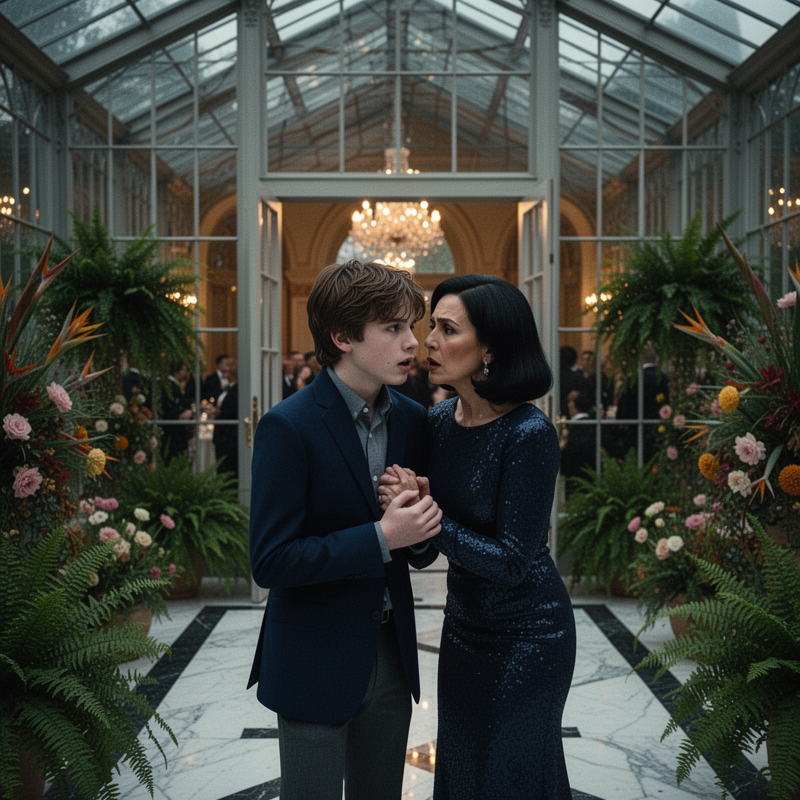
“I know where my mother is, Aunt Nora,” sixteen-year-old Leo whispered, pulling me into the shadows of the estate conservatory during our autumn gala.
“She didn’t die in the storm twelve years ago, and Julian has been paying to keep her hidden.”
My blood ran cold as I looked across the marble ballroom at my eldest adopted son, Julian, holding court with Boston’s elite.
Twelve years ago, after my sister Julia vanished in a coastal car wreck during a hurricane, I took in her nine orphaned children and built a high-society real estate empire from nothing.
Now, the boy I raised as my own son was holding a key that could burn our family name to the ground.
The hushed elegance of the Oakridge Estate’s annual autumn gala felt suddenly suffocating. Laughter and the clink of champagne flutes drifted in from the ballroom, a stark contrast to the urgent tension radiating from Leo.
He had dragged me behind a sprawling fern in the conservatory, where the scent of damp earth and exotic blooms mingled uncomfortably with my Chanel No. 5. The air was heavy, charged.
“Leo, what are you talking about?” I managed, my voice barely a breath.
His young face, usually so open and bright, was pale and tight with a mixture of fear and conviction. His eyes darted toward the ballroom’s arched entrance, where the lights of a crystal chandelier shimmered.
“I’m serious, Aunt Nora.”
He reached into the inner pocket of his tailored blazer, his hand trembling slightly. From it, he pulled out a small, worn leather wallet.
My gaze flickered back to Julian, who was deep in conversation with Senator Albright, a practiced, confident smile on his face. He looked every inch the successful scion, completely unaware of the bomb ticking in the shadows of his own house.
Leo fumbled with the wallet, his fingers struggling with the clasp.
“I found these,” he whispered, pressing five old postcards into my hand.
They were flimsy, their edges softened by time and touch. The images on the front varied: a foggy lighthouse, a windswept beach, a quaint seaside cottage, a bustling harbor, a lone sailboat against a sunset. All coastal scenes, evocative of the very place Julia had disappeared.
My fingers tightened around the faded cardboard.
“These are from different places,” I noted, my voice catching.
“Look at the back,” Leo urged, his voice barely audible above the distant string quartet.
I turned the first card over. The handwriting was neat, elegant, yet unmistakably familiar. A simple message was penned, timeless and vague. It wasn’t the words that made my heart leap, though.
It was the signature.
Beneath the brief greeting, written in a small, looping flourish, was a single word: *Willowisp*.
My breath hitched. The blood drained from my face, leaving a cold ache in my jaw.
Willowisp.
That was it. Julia’s secret childhood nickname, given to her by our mother. A name only a handful of people had ever known, and one she had forbidden anyone outside our immediate family from using. Especially after she became “Julia Oakridge” and married into society.
A faint tremor ran through my hand, threatening to drop the evidence.
I flipped through the other four cards, my eyes scanning each one. Every single one bore the same, unmistakable signature at the bottom: *Willowisp*.
My mind raced. Twelve years. Twelve years of grief, of building a new life for these children, of believing my sister was gone, lost to the Atlantic’s fury.
And here, in my hand, was proof that Julia had been alive, sending these quiet, clandestine messages.
The dates on the postmarks, though smudged, spanned the last three years. This wasn’t a one-off. This was a pattern.
A pattern of survival. A pattern of secrecy.
“Aunt Nora,” Leo pleaded, his voice cracking, “you have to help me find her. Before Julian finds out I know.”
Part 2
My gaze snapped from the postcards back to Leo’s desperate eyes. The string quartet music now felt like a mocking serenade. Find her. Yes, but first, I needed to understand *why* she was hidden, and *how* Julian was involved. My sister’s death had been a closed case, a tragic accident during a storm. Or so I believed.
I quickly excused myself from the gala, my mind a whirl of disbelief and dawning horror. I mumbled something about a sudden headache to a few inquiring guests, managing a tight, practiced smile that hid the chaos brewing inside. My feet moved almost on their own, guiding me away from the opulence and toward the quiet, deserted wing of the estate.
I bypassed my private study and went straight to the old Oakridge vault, a relic from Julian’s grandfather, hidden behind a false bookshelf. The heavy steel door creaked open, revealing stacks of old ledgers, property deeds, and family papers. I lit the small lamp, its glow casting long, dancing shadows on the dusty shelves.
My fingers trembled as I searched for Julia’s file. I expected to find a city coroner’s report, perhaps a police statement, confirming the accident, the recovery—something official and final. Instead, my hand brushed against a thicker, cream-colored envelope, much newer than the others from that time. It was marked simply: “Julia Oakridge – Casualty Claim.”
I pulled it out, my heart hammering against my ribs. Inside, nestled amongst legal jargon, was a single, shocking document. It wasn’t a death certificate from the city. It was a casualty payout claim, for the staggering sum of $15,000,000. My vision blurred for a moment, the numbers swimming before my eyes.
The claim had been processed by an insurance adjuster named Richard Delacroix. And beneath his florid signature, in the space for “Beneficiary Representative,” was Julian’s name, written in his precise, confident hand. The date above it read, “October 22nd” – just two weeks after the storm that supposedly took Julia’s life.
Chapter 2: The Price of Marble
The Oakridge gala was still in full swing when I left Leo, a hushed promise of answers hanging between us. My mind raced past the glittering chandeliers and the polite hum of conversation. The $15,000,000 payout. Julian. Richard Delacroix.
The next morning, the polished oak doors of the Beacon Hill Club felt heavy in my hand. Delacroix’s usual table, by the bay window overlooking the harbor, was empty. I found him in the members-only lounge, a cigar cradled between his fingers, the morning news propped open beside him.
His eyes, sharp and calculating, met mine. “Eleanor. To what do I owe this distinct pleasure?”
I didn’t waste time with pleasantries. “The casualty payout for Julia. That $15,000,000. It listed Julian as the beneficiary representative.”
Delacroix took a slow drag from his cigar, a wisp of smoke curling above his head. “Ah, yes. A messy business, that storm. Very tragic.”
“You processed it,” I pressed. “Twelve years ago. Why wasn’t I contacted?”
He set the cigar down, his smile thin. “You were. You’d just lost your sister. And you had nine children to think of. Julian, he stepped up.”
A cold dread began to settle in my stomach. “Stepped up how?”
“He was only sixteen,” I said, the words feeling hollow. “He signed off on a payout that huge?”
Delacroix chuckled, a dry, rustling sound. “Well, he was a very bright boy. And he had a good advisor. Me.”
He leaned forward, his voice dropping slightly. “That initial capital, Eleanor. For your little real estate venture. The one that bought you the Oakridge name and this club membership.”
My breath hitched. “What about it?”
“It came directly from that payout.”
The lounge felt suddenly airless. My vision blurred around the edges.
“The seed money for Oakridge Properties,” he continued, watching my face. “Your first major acquisition, the Holbrook building. All of it. Straight from the casualty claim. Julian made sure you had the resources to start fresh.”
My empire. My hard-won prestige. The foundation I had built, stone by painful stone, to lift my family from ruin.
It was all a lie. A glorious, beautiful fraud.
Chapter 3: The Archivist’s Risk
The world outside Delacroix’s club seemed muted, a drab canvas against the vibrant shock that now colored my thoughts. My phone buzzed hours later, a number I didn’t recognize.
“Eleanor Oakridge?” a cautious voice asked. “My name is Clara Hensley. I’m a senior archivist at St. Jude’s Private Care Center.”
My heart pounded. “St. Jude’s?”
“I… I saw an inquiry on Julia Gentry’s file. Your sister.”
A flicker of hope, dangerous and fragile, ignited within me. “Is she…?”
“I can’t talk over the phone,” Clara said quickly. “Meet me. Garage Level B, Boston Public Library. One hour. I have something you need to see.”
The sky was a bruised purple, and a steady, cold rain had begun to fall by the time I pulled into the dim, echoing parking garage. I found Clara Hensley, a woman with kind, weary eyes, huddled in a sensible raincoat beside a silver sedan. She looked nervous, glancing around like she expected to be followed.
“This is risking my career, Mrs. Oakridge,” she whispered, her voice tight. “Julian Oakridge has deep pockets. He’s very careful.”
“Julian?” I asked, a fresh wave of dread washing over me.
She nodded, then fumbled inside her bag, pulling out a single, laminated sheet. “I remembered the case. The car crash, the storm. It was all over the news.”
She pushed the paper into my hand. It was an intake medical record.
“Julia Anne Gentry,” I read aloud, my voice trembling. “Admitted… October 17th. Four days after the storm.”
My sister, Julia, had officially died on October 13th, the day the hurricane hit.
Clara kept her voice low. “The official police report listed her as a casualty, car found submerged. But she arrived at our facility by ambulance. Alive.”
The paper crinkled in my grip. Julia. Not dead. Not then.
Clara’s eyes were earnest. “I knew it was wrong. Kept a copy. They wanted it all purged, but…conscience.”
“Thank you, Clara,” I managed, my throat tight. “Thank you.”
She gave a quick, fearful nod. “Just…be careful, Mrs. Oakridge. Julian. He controls everything there.”
Chapter 4: The Mud on the Silk
The intake form burned a hole in my bag. Julia was alive. Julia was alive for at least four days after the storm. I spent the next few hours in a daze, clutching the record, trying to reconcile the impossible. My sister. My family’s entire tragic history.
The first call came from Marcus Vance, a long-time board member and the patriarch of a rival real estate firm. His tone was clipped, laced with feigned sympathy.
“Eleanor,” he began. “Are you quite alright, my dear? I’ve been hearing… troubling things.”
“Troubling things?” My grip tightened on the phone.
“Yes. Concerning your… recent memory. And a growing confusion, perhaps?”
My blood ran cold. The next call was from Cynthia Hayes, a grande dame of the Boston Social Registry. Her voice was pure velvet, dripping with concern.
“Nora, darling. I just read the most dreadful piece. A leaked psychiatric evaluation.”
My stomach clenched. “What are you talking about, Cynthia?”
“It suggested early-onset dementia. That you’re… losing your grip. It’s so utterly scandalous! But everyone’s talking.”
I hung up, my hand shaking. Julian. He had struck. Not at Julia’s truth, but at mine.
Within an hour, emails poured in. “Thinking of you.” “Hope you’re taking care of yourself.” “Perhaps a break from the firm, dear?”
My personal assistant, Brenda, burst into my office. Her face was pale.
“Mrs. Oakridge, have you seen the Boston Social Register’s private newsletter? It’s… it’s atrocious.”
She held out a tablet. The headline blared, “Oakridge Matriarch’s Mental Decline Raises Succession Questions.” Beneath it, a blurry photo of me from a recent charity event.
The article quoted anonymous sources, “close to the family,” suggesting erratic behavior, forgotten meetings, and “moments of profound disorientation.”
It even referenced forged medical documents. A psychiatric report, complete with official-looking letterhead, diagnosing me with “severe cognitive impairment.”
Julian wasn’t just hiding a secret. He was trying to bury me.
Chapter 5: The Gala of Whispers
The Beacon Hill Symphony Guild dinner was usually an event I relished, a chance to mingle and reinforce the Oakridge name. Tonight, it felt like walking into a viper’s nest. Every glance was a judgment, every hushed conversation a dagger.
As I entered the grand ballroom, the glittering chandeliers seemed to cast a harsh, unforgiving light. Faces that normally beamed with polite smiles now turned away, or offered tight, pitying looks.
“Eleanor, dear,” Mrs. Albright from the Historic Preservation League murmured, her eyes wide. “So brave of you to attend.”
I forced a smile, the muscles in my face aching. “Why wouldn’t I, Agnes?”
“Well, with everything,” she said, waving a hand vaguely. “All these rumors. So awful.”
Julian, impeccably dressed in a custom tuxedo, caught my eye from across the room. He offered a commiserating smile that didn’t reach his eyes. It was a victory dance, performed in plain sight.
Later, after the main course had been cleared, the room quieted. Julian walked to the podium, tapping the microphone lightly.
“Good evening, everyone,” he began, his voice smooth and confident. “As many of you know, my mother, Eleanor, has dedicated her life to this city and to the Oakridge Foundation.”
A ripple of murmurs went through the crowd. My hands clenched beneath the table.
“Her passion and tireless efforts have been truly remarkable,” Julian continued, his gaze briefly meeting mine, a hint of steel in his blue eyes. “However, recent events… and her declining health… have necessitated a temporary adjustment.”
My jaw tightened. This was it.
“Effective immediately,” he announced, his voice ringing with authority, “I will be stepping in to manage the day-to-day operations of the Oakridge Foundation.”
A few polite claps, then a wave of whispers. I could feel every eye on me. My face felt frozen in a polite, if slightly strained, smile. To react, to challenge him here, would only confirm their suspicions. It would be seen as further proof of my instability.
I sat there, watching my eldest son usurp my authority, surrounded by the elite of Boston. The symphony orchestra began to play a delicate allegro, the music providing an ironic backdrop to my public humiliation.
Chapter 6: Following the Paper Trail
The humiliation of the symphony gala fueled a cold fury. I couldn’t fight Julian publicly without destroying everything. But I could fight him in the shadows, where he operated.
Late that night, under the cover of a moonless sky, I met Beatrice and Carter in the estate’s west wing. Julian’s private office, usually off-limits, was our target.
“He keeps everything locked down,” Beatrice whispered, expertly picking the antique lock on the office door. She’d always had a knack for puzzles. “He’s paranoid about his privacy.”
The office was meticulously organized, a monument to Julian’s control. Dust motes danced in the beam of Carter’s flashlight as we searched.
“Anything,” I urged them. “Bank statements, ledgers, anything that links him to St. Jude’s.”
Carter grunted, prying open a drawer in Julian’s heavy mahogany desk. “He’s got a whole section on ‘Offshore Investments’.”
He pulled out a stack of documents. My eyes scanned them rapidly. Bank statements from the Cayman Islands. Accounts under shell corporations I’d never heard of.
“Here,” Beatrice breathed, pointing. “Monthly transfers. To ‘St. Jude’s Care Services, Inc.’ Thirty-five thousand dollars. Every single month.”
I felt a fresh wave of nausea. Julia. Hidden away for twelve years, at a cost of $35,000 a month, just to keep the fraud alive.
“And look at these,” Carter said, his voice tight with anger. He held up a series of account summaries. “Millions. Transferred from the Oakridge Trust to these offshore accounts. Since when?”
“Almost from the beginning,” Beatrice murmured, her finger tracing a line. “He’s been skimming. Systematically.”
The numbers swam before my eyes. Julian had funneled at least $4,200,000 from the trust into his personal, hidden accounts over the years. Not just the initial $15,000,000 fraud, but a continuous stream of theft.
“He’s not just protecting the secret,” I said, my voice barely a whisper. “He’s enriching himself. Off Julia. Off all of us.”
Then, tucked away in a file marked “Legal Precedents,” Beatrice found something else. Documents detailing the process for establishing conservatorship. And beneath them, a printout from a website, titled “Signs of Geriatric Mental Decline.”
My heart pounded. He wasn’t just trying to discredit me. He was planning to institutionalize me next.
Chapter 7: The Brother’s Betrayal
The discovery of Julian’s sinister plans for me sent a fresh shiver down my spine. But Leo’s quiet confession hit me harder, a raw wound in the midst of financial machinations. He found me in the kitchen that morning, long after Beatrice and Carter had slipped away.
“Aunt Nora,” he began, his voice small. He looked tired, shadows under his young eyes.
I motioned for him to sit. “What is it, Leo?”
He fiddled with the edge of the tablecloth. “Julian… he found out about the postcards.”
My breath caught. “When?”
“A few months ago. He caught me mailing one.” Leo’s voice was barely audible. “He was so angry. He said… he said if I ever spoke about Mom again, he’d send me away.”
“Send you where?” I asked, my voice soft.
“A boarding school in Switzerland. He said it would be ‘for my own good,’ to focus on my studies, but…”
He looked up, his eyes wide and vulnerable. “He meant to keep me quiet. To separate me from everyone.”
The pieces clicked into place with a horrifying clarity. Julian hadn’t just used Julia’s continued existence to fund his lavish lifestyle. He had actively suppressed any attempt to find her, any spark of hope for her children.
“He said Mom didn’t want to be found anyway,” Leo continued, a tear tracing a path down his cheek. “That she left us. I didn’t believe him, but… he made it sound so convincing.”
“Oh, Leo,” I murmured, pulling him into a hug. My heart ached for this boy, carrying such a heavy burden alone.
Julian’s motive wasn’t just greed; it was absolute control. He had kept Julia hidden, trapped in that facility, for over a decade. Not because she was escaping debt, as I’d initially considered, but because her death had secured his fortune. If the truth about her survival got out, the insurance company would demand their $15,000,000 back. And Julian’s empire, built on that fraud, would crumble. He had used fear to silence Leo, to perpetuate the lie, to protect his ill-gotten gains.
He had betrayed his own brother.
Chapter 8: The Sibling Alliance
The betrayal burned, a hot coal in my gut. I couldn’t confront Julian alone. Not with the public smear campaign and his conservatorship plans. I needed my children. All of them, united.
The next evening, seven of my nine adopted children gathered at Beatrice’s townhome. We deliberately excluded Julian, and even Leo, knowing the weight of the secret was already too much for him. Carter stood guard by the door, ensuring privacy.
The room was tense, filled with wary faces. Beatrice sat beside me, her hand resting on my arm.
“Thank you all for coming,” I began, my voice steady despite the tremor in my hands. “I have something important to tell you. Something that will change everything you thought you knew about our family.”
I laid out the story, piece by agonizing piece. The $15,000,000 insurance payout. Richard Delacroix’s complicity. The fact that Julia, their mother, had survived the storm. The intake record from St. Jude’s.
A gasp went around the room. Disbelief warred with dawning horror on their faces.
“Julian has known all along,” I explained, “and he’s been paying St. Jude’s to keep Julia hidden for twelve years. All to protect the insurance money and his own wealth.”
I showed them the offshore bank statements, the transfers of $35,000 a month to the care center, the millions skimmed into his private accounts. I showed them the conservatorship documents he had gathered for me.
The room erupted in a furious murmur.
“He tried to have me declared incompetent,” I said, looking into each of their faces. “He’s stolen from the trust, and he’s hidden the truth about your mother. He threatened Leo.”
Carter slammed his fist on a nearby table. “That manipulative snake!”
“We have to stop him,” Beatrice declared, her voice firm. “Before he does more damage.”
I then presented them with the proxy revocation forms, meticulously prepared by my legal team. “Julian holds significant control over the Oakridge Trust. To remove him, we need a united front. Each of your signatures will revoke his executive proxy.”
One by one, they signed. Seven signatures, deliberate and firm, severing Julian’s power. It was a silent, powerful vote of no confidence. My children, my family, were united against him.
Chapter 9: The Gathering Storm
The signed proxy revocation forms felt like armor, giving me strength for the battle ahead. I knew Julian would not surrender easily, but with my children united, I finally had leverage.
Just as I was preparing my strategy, my phone rang. It was Clara Hensley. Her voice was thin, strained, as if she was speaking from a great distance.
“Mrs. Oakridge,” she whispered. “I’m so sorry. I… I have more information.”
My heart began to pound. “What is it, Clara?”
“I found a death certificate. For Julia.”
A sudden, sharp pain seized my chest. “When?”
“Six months ago. Natural causes. At St. Jude’s.”
The phone almost slipped from my grasp. Julia. My sister. Alive all these years, just out of reach, and now… now truly gone. The hope I had nurtured, fragile and fierce, shattered.
“Julian,” Clara continued, her voice filled with a desperate urgency, “he kept paying the facility. To maintain the cover-up. Even after she passed. He was so insistent. I just… I had to tell you.”
The truth hit me with the force of a physical blow. I had been chasing a ghost, a living phantom kept alive by Julian’s greed. He hadn’t just hidden her; he had profited from her life and then her death. The $35,000 a month. It had continued even after she was gone.
The storm outside mirrored the tempest within me. Rain lashed against the windows of the estate, thunder rattling the grand old house. Julian was in the library, I knew. He liked to be there during storms, listening to the rain, pretending to be a man of letters.
I clutched the signed proxy forms. Julia was gone. But Julian’s reign of deceit was not. I headed towards the library, the scent of old leather and damp earth filling the air. It was time to face my son. Alone.
Chapter 10: The Sealed Library
The library doors were closed, the heavy oak muffling the storm’s fury. I pushed them open, stepping into the dim, cavernous room. Julian sat in his usual armchair, a book unread in his lap, the glow of the fire casting dancing shadows across his face. He looked up, his expression unreadable.
“Nora,” he said, his voice calm, betraying nothing. “Joining me for the storm?”
I walked to the center of the room, the signed proxy revocations clutched in my hand. The rage, the grief, the years of hidden truth, simmered beneath my skin.
“It’s over, Julian,” I stated, my voice steady. “I know everything.”
His gaze sharpened, but he didn’t flinch. “Everything?”
“Julia. St. Jude’s. The $15,000,000. Your offshore accounts. The conservatorship papers you had drawn up for me.”
I threw the proxy forms onto his lap. The parchment rustled.
Julian picked them up, his eyes scanning the signatures. A faint smirk touched his lips. “So, the family has spoken.”
“Julia died six months ago,” I said, my voice breaking slightly. “You kept paying. You kept her hidden even after her death.”
He leaned back, a sigh escaping his lips. “A small detail. Her passing was… peaceful. I spared you the news, Mother. You had enough on your plate.”
My fists clenched. “You used her. You used her life, her absence, her death, for your own gain.”
Julian set the proxy forms on the small table beside him. “Perhaps. But I secured our future. Your future. The Oakridge name. Do you think you would have built this empire without that initial capital?”
He reached into a hidden compartment in the arm of his chair, pulling out a yellowed document. It was another intake form from St. Jude’s, identical to Clara’s copy, but with one crucial difference.
“And speaking of securing futures,” he said, pushing it towards me. “I believe this also has your signature.”
My eyes widened. Below Julia’s name, below the admission date of October 17th, 12 years ago, was my own signature. Faded, but undeniably mine.
“You were heavily sedated, Mother,” Julian explained, watching my face. “After the crash. You barely knew your own name. But you signed it. Authorizing her admission. Authorizing her privacy. Unknowingly, of course.”
My head spun. I had signed it. Unwittingly, in a haze of grief and painkillers, I had authorized Julia’s isolation. I was complicit in the very lie that had founded my life.
“So, here is my offer,” Julian said, his voice devoid of emotion. “I will resign from the trust. I will transfer all my executive control to you and Beatrice. No police. No public scandal. Our name remains untarnished. But,” he paused, his eyes piercing mine, “you maintain the public fiction. Julia died in the original car crash, twelve years ago. The insurance payout was legitimate. Forever.”
The storm raged outside, mirroring the turmoil in my soul. To expose him would be to destroy everything—the Oakridge name, the children’s inheritance, the fragile peace I had built. To protect them, I had to accept. I had to live the lie, forever bound to the secret that had built my life.
Chapter 11: The Quiet Exile
The morning after the storm, the estate felt unnaturally quiet. The air was thick with unspoken words, a palpable tension that hummed beneath the surface of polite silence. The drawing room, usually a vibrant hub of family activity, was somber.
Julian stood by the fireplace, as impeccably dressed as ever, but a subtle change in his posture spoke of defeat. The other children were present, quiet, watchful. Leo sat beside me, his hand resting lightly on my arm.
The legal transfer documents lay on the antique mahogany table. Julian, without a word, signed them. His executive proxy over the Oakridge Trust was officially transferred to Beatrice and me. No dramatics, no grand pronouncements. Just the scratch of his pen.
There were no police. No sirens. No reporters. Just a cold, calculated dismantling of power, conducted within the gilded cage of the Oakridge Estate. Our high-society standing, more precious than any jail sentence, remained intact.
Julian picked up a small, leather travel bag. He looked at each of us, a strange, unreadable expression on his face, a mix of resentment and something that might have been regret.
“I’ve made arrangements,” he announced, his voice flat. “I’ll be leaving for London this afternoon. Permanently.”
He paused, his gaze lingering on Leo. “My monthly allowance will be deposited into a private account. Adequate for my needs, I assure you.”
A limited stipend. Exiled. No criminal prosecution, no public shame, but a lifetime of quiet disgrace. It was the only way to preserve the family’s name, the only way to shield the other children from the fallout of his fraud.
He turned, walked to the grand double doors, and exited without looking back. The sound of his departure was just a muted click, absorbed by the thick carpets and heavy drapes. The Oakridge family, fractured but intact, breathed a collective, if shaky, sigh of relief.
Chapter 12: Echoes in the Grand Hall
Exactly nine days after Julian’s quiet exile, the Oakridge Estate’s grand hall buzzed with the carefully modulated voices of Boston’s elite. The annual Oakridge Charity Tea was in full swing. Sunlight streamed through the towering windows, illuminating the crystal and silver.
It was a performance, a meticulously choreographed ballet of smiles and veiled curiosity. Everyone knew Julian was “traveling abroad indefinitely,” a convenient euphemism for banishment. Everyone knew the whispers about my “declining health” had vanished as quickly as they appeared.
“Eleanor, darling, you look simply radiant,” Mrs. Hayes gushed, clutching my hand. “Such strength. Such resilience. We were all so concerned.”
I offered a gracious smile, the muscles of my face aching from the effort. “Just a passing seasonal bug, Cynthia. Nothing a good cup of tea can’t fix.”
They praised my leadership, my unwavering spirit, my ability to navigate “difficult family matters” with such “grace.” They were entirely unaware of the rot beneath the polished surface, the truth of a sister hidden and a son exiled.
As tradition demanded, I approached the small, elevated podium. A hush fell over the room. I cleared my throat, my gaze sweeping over the sea of familiar, smiling faces.
“Thank you all for joining us today,” I began, my voice clear and steady. “The Oakridge Foundation continues its vital work, thanks to your generosity and the tireless dedication of my family.”
My eyes flickered to Beatrice, who gave me a small, encouraging nod. Then to Carter, his jaw set, watchful. And finally, to Leo, who stood quietly near the conservatory doors, his young face unreadable.
I made a short, gracious speech, keeping my words light, focused on philanthropy and community. Beneath the perfectly modulated tones, beneath the carefully chosen words, lay a grief that felt too vast for this glittering room. A sister lost twice over, a son gone, and a lifetime of secrets stretching before me. I held it all back, maintaining the illusion, protecting the fortress.
Chapter 13: Rain on the Conservatory Glass
Nine days after the showdown with Julian, the Oakridge Estate was once again bathed in the familiar gray light of an autumn thunderstorm. The charity tea had concluded, the last limousine sweeping down the drive, leaving behind a silence heavier than usual. I sat alone in the estate library, a cup of untouched Earl Grey cooling on the polished surface of the antique desk.
Rain lashed against the conservatory glass, a steady, rhythmic drumming that seemed to echo the beating of my own heart. Julia. Gone. Julian. Exiled. The fortune. Secured. But at what cost?
The library doors opened softly. Leo stepped in, his silhouette framed against the muted light of the hallway. He didn’t speak, just walked across the Persian rug and sat in the armchair opposite me, his gaze fixed on the storm outside.
The air between us was thick with unspoken understanding. He knew. He knew his mother was gone, not just in a storm twelve years ago, but now, truly. He knew Julian’s treachery, and he knew the silent pact we had all made to keep the lie alive.
We watched the rain together, the world outside blurred by the deluge. He was sixteen, and he carried the weight of a secret that could shatter the very foundation of his life. I was forty-eight, and I carried the guilt of building that foundation on a carefully constructed lie.
The marble and gold of the library, the quiet grandeur of the estate, felt less like a sanctuary and more like a gilded cage. We had survived the storm, both the literal and the metaphorical. The family wealth was preserved, our social standing untarnished. But redemption felt like a distant, impossible dream.
We spent twelve years building a fortress of marble and social grace, only to realize the walls were made to keep our own ghosts inside.
Leave a Reply