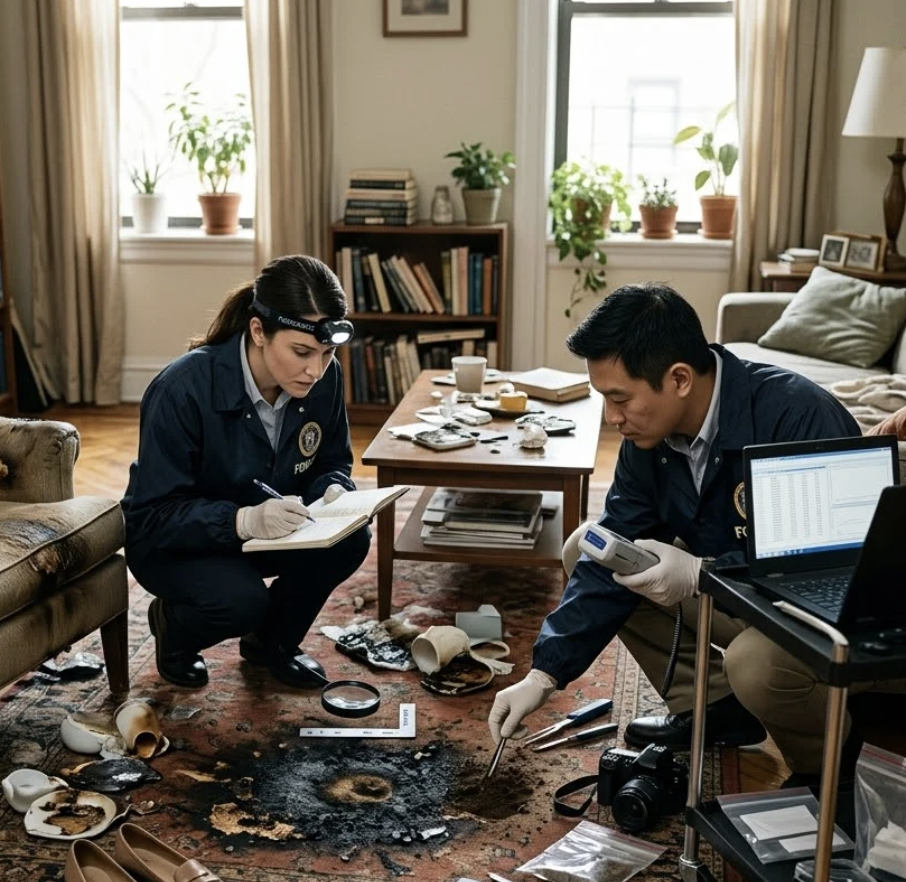
Imagine firefighters arriving at a scene unlike anything they have ever seen.
A room remains mostly intact.
Furniture nearby is only lightly damaged.
Walls show little sign of a major fire.
Yet in the center of the room lies evidence that a human body has been almost completely consumed by flames.
No obvious source of ignition.
No sign of a large house fire.
No clear explanation.
For centuries, cases like these have fueled one of the strangest mysteries in the world:
Can people spontaneously burst into flames?
Or is something else happening?
The Birth of a Terrifying Mystery
Stories of so-called “spontaneous human combustion” have circulated for hundreds of years.
Newspapers, books, and later television programs described cases in which individuals appeared to catch fire without warning.
The reports often shared similar details.
The victim was found severely burned.
The surrounding room showed surprisingly limited damage.
Nearby objects sometimes remained untouched.
To many observers, the scene seemed impossible.
How could a body burn so extensively without setting the entire room ablaze?
The mystery captured public imagination.
Some blamed supernatural forces.
Others suggested unknown chemical reactions inside the body.
A few even believed humans might somehow ignite from within.
The stories sounded more like horror fiction than science.
Yet real investigations continued.
And eventually, researchers began uncovering a far more plausible explanation.
Why the Scenes Look So Strange
One reason these cases seem mysterious is that fire does not always behave the way people expect.
Most people imagine a large blaze spreading rapidly through an entire room.
But under certain conditions, a fire can remain surprisingly localized.
This is especially important when examining alleged cases of spontaneous human combustion.
Investigators noticed that many victims were found near potential ignition sources.
A cigarette.
A fireplace.
A candle.
A heater.
Some small source of flame or heat.
Often the initial ignition could have gone unnoticed.
Particularly if the person was asleep, unconscious, intoxicated, or unable to react quickly.
The fire might begin as something small.
Yet the final scene would look dramatically different.
The “Wick Effect”
One of the most widely accepted explanations involves a process known as the wick effect.
To understand it, think about how a candle works.
A candle does not burn because the wax itself instantly erupts into flames.
Instead, the wick draws melted wax upward, where it feeds the flame gradually.
Researchers believe a similar process can sometimes occur in the human body under tragic circumstances.
Clothing acts like the wick.
Body fat acts as fuel.
Once clothing ignites, heat can melt nearby fat beneath the skin.
That fat may then soak into clothing and continue feeding the fire.
The result is a slow, sustained burn.
Not a sudden explosion.
Not spontaneous ignition.
A long-lasting process that can continue for hours.
Because the fire burns slowly and remains concentrated around the body, surrounding areas may suffer surprisingly little damage.
This helps explain why some scenes appear so unusual.
Why Nearby Objects Sometimes Survive
One of the biggest reasons people suspect something supernatural is the condition of the room afterward.
If a body burned, shouldn’t the entire house burn too?
Not necessarily.
The wick effect produces a relatively localized fire.
The heat remains concentrated.
Furniture several feet away may experience limited damage.
Walls may become discolored without fully igniting.
Objects nearby might survive.
To someone unfamiliar with fire behavior, the scene can look impossible.
Yet fire investigators have repeatedly demonstrated that such outcomes are physically possible.
What appears mysterious at first glance may actually reflect how a slow-burning fire behaves.
Famous Cases
Throughout history, numerous cases have been cited as examples of spontaneous human combustion.
Many became famous because investigators initially struggled to explain them.
Media coverage often emphasized the unusual aspects.
Missing details were filled with speculation.
Legends grew.
Over time, however, advances in forensic science helped provide more grounded explanations.
While some cases remain partially unresolved due to limited evidence, none have produced convincing proof that the human body can suddenly ignite without an external source.
That distinction is important.
A mystery is not automatically evidence of something supernatural.
Sometimes it simply means investigators lack complete information.
Could the Human Body Ignite Itself?
From a scientific perspective, the answer appears highly unlikely.
The human body contains a large amount of water.
Water does not burn.
For spontaneous combustion to occur, enough heat would need to build internally to ignite tissue without any external ignition source.
Researchers have found no known biological mechanism capable of producing that effect.
Human metabolism generates heat.
But not remotely enough to cause spontaneous ignition.
The body simply isn’t designed in a way that supports such a process.
This is why most scientists reject the idea of spontaneous human combustion as a literal phenomenon.
Why People Still Believe It
Even with scientific explanations available, the mystery remains popular.
Part of the reason is psychological.
Humans are naturally drawn to unexplained events.
When a scene looks unusual, the mind searches for extraordinary answers.
A room that remains mostly intact while a body burns extensively feels wrong.
It violates our expectations.
That discomfort creates curiosity.
Curiosity creates stories.
And stories often survive longer than explanations.
The concept of spontaneous human combustion combines two powerful elements:
Fire.
And mystery.
Together, they create a narrative people find difficult to forget.
The Real Danger
The truly frightening lesson is not that people suddenly ignite without cause.
It is that ordinary hazards can sometimes produce extraordinary outcomes.
A cigarette left unattended.
A spark from a heater.
A small flame near clothing.
These seem minor compared to the dramatic stories told afterward.
Yet investigators repeatedly find that seemingly insignificant ignition sources can trigger devastating fires.
The danger often begins with something so small that it hardly attracts attention.
Until it’s too late.
The Scientific Twist
The most unsettling truth is not that humans spontaneously burst into flames.
It is that a tiny, ordinary fire can create a scene so strange that it appears supernatural.
A small spark.
A forgotten cigarette.
A brief moment of bad luck.
Those things may not sound mysterious.
Yet under the right circumstances, they can produce outcomes that leave even experienced investigators searching for answers.
And perhaps that is why stories of spontaneous human combustion continue to fascinate people.
Because the real explanation is not about magic.
Not about curses.
Not about paranormal forces.
It’s about how a simple flame can create a mystery that looks far more impossible than it truly is.
Sometimes the scariest explanations are not the supernatural ones.
They’re the ordinary ones hiding in plain sight.
Leave a Reply