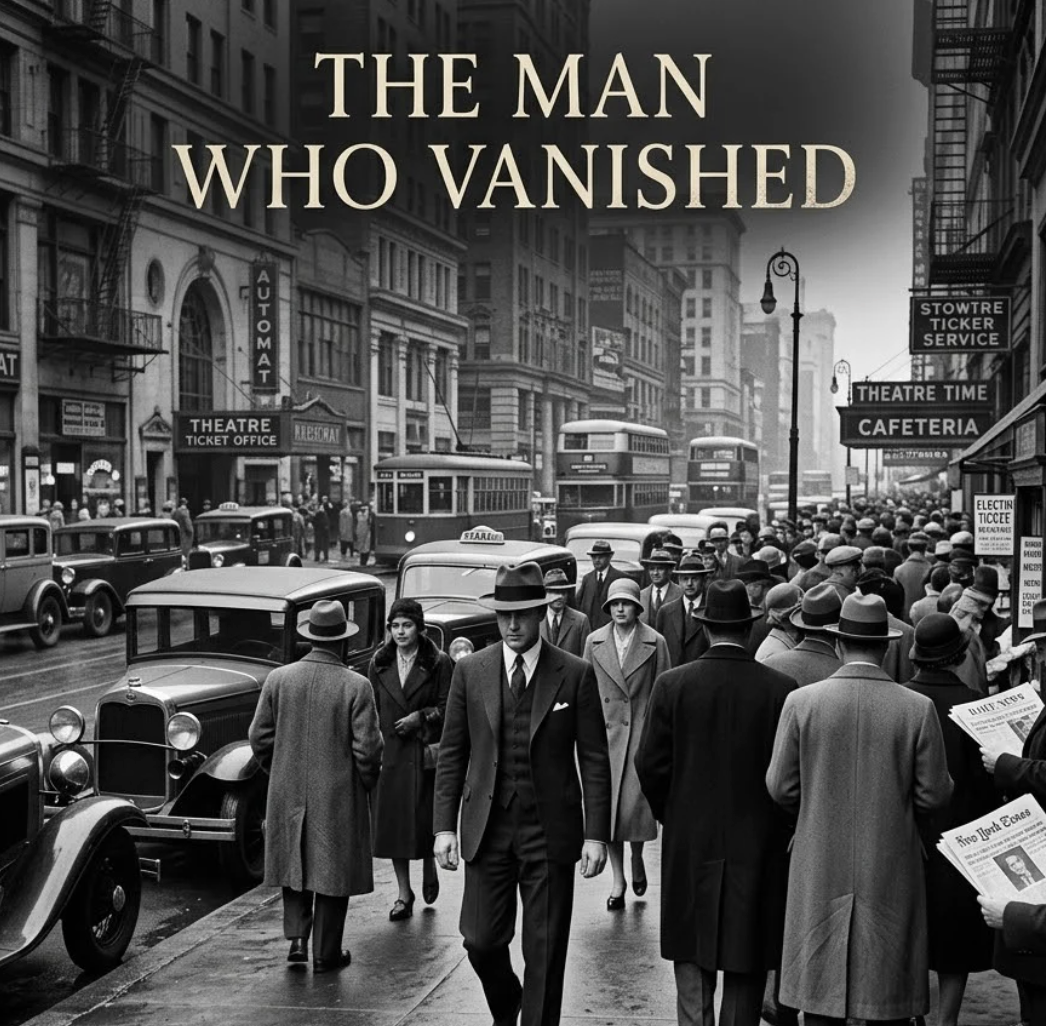
A powerful judge walked into the crowded streets of New York and disappeared.
No body was ever found.
No confirmed farewell was left behind.
No witness could explain what happened after a certain point.
Nearly a century later, the disappearance of Judge Joseph Force Crater remains one of the most famous unsolved mysteries in American history.
And at the center of the mystery is a question that has never completely disappeared:
What was he carrying in the final days before he vanished?
A Rising Star in New York
In 1930, Judge Joseph Force Crater appeared to have everything.
Influence.
Prestige.
Political connections.
A respected position within New York’s legal system.
To the public, he looked like a successful man enjoying the rewards of a remarkable career.
But New York politics during that era was a complicated world.
Behind elegant dinners and official meetings existed networks of favors, alliances, rivalries, and secrets.
People often knew far more than they said publicly.
And those who possessed sensitive information sometimes found themselves navigating dangerous territory.
Judge Crater operated within that environment.
He knew politicians.
Business figures.
Lawyers.
Influential power brokers.
The kinds of people whose names appeared in newspapers and behind closed doors alike.
No one could have predicted that he would soon become one of the most famous missing persons in American history.
The Day Everything Changed
During the summer of 1930, Crater traveled to New York City from Maine, where he had been vacationing.
At first, nothing seemed unusual.
He met colleagues.
Handled legal matters.
Attended meetings.
Went about his business.
Then several strange events occurred in rapid succession.
He reportedly reviewed personal files.
Requested documents.
Handled financial matters.
And withdrew a significant amount of money.
At the time, these actions did not immediately alarm anyone.
But after his disappearance, investigators would revisit every detail.
Every conversation.
Every receipt.
Every meeting.
Every document.
Because those ordinary actions suddenly looked very different.
The Last Confirmed Sighting
On the evening of August 6, 1930, Judge Crater spent time with friends in Manhattan.
The evening appeared normal.
Dinner.
Conversation.
Nothing that suggested he was about to vanish forever.
At some point later that night, he left.
That is where certainty ends.
No verified sighting ever conclusively established what happened next.
He simply disappeared.
Days passed.
Then weeks.
Then months.
The absence became impossible to ignore.
A statewide search began.
Police investigated.
Journalists followed leads.
Witnesses came forward.
Rumors multiplied.
But the mystery only deepened.
Theories Begin to Spread
The public became fascinated by the case.
People proposed countless explanations.
Some believed Crater had fled voluntarily.
Perhaps he was escaping scandal.
Perhaps financial problems existed that had not yet become public.
Others believed something far more sinister had occurred.
Maybe he knew too much.
Maybe he possessed information powerful individuals wanted hidden.
Maybe his disappearance was connected to political corruption.
The lack of evidence allowed every possibility to survive.
And because no body was ever found, no theory could be completely ruled out.
That uncertainty transformed the case into a legend.
Missing Papers and Missing Answers
One detail particularly intrigued investigators.
Before disappearing, Crater had reportedly handled personal records and documents.
Questions arose regarding what those files contained.
Had important information vanished alongside him?
Had sensitive materials been destroyed?
Had someone else gained access to them?
These questions fueled speculation for decades.
Many researchers later noted that the disappearance occurred during an era when political influence, organized crime, and government power often intersected in complicated ways.
Whether those factors played a role remains unknown.
But they added another layer of intrigue to an already baffling case.
Why the Case Became Famous
Over time, Judge Crater’s name became synonymous with unexplained disappearances.
His case entered popular culture.
Newspaper headlines.
Books.
Documentaries.
Historical investigations.
For generations, Americans used the phrase “pulling a Crater” to describe someone who vanished without explanation.
Very few missing-person cases have had that kind of cultural impact.
The reason is simple.
Most mysteries eventually produce answers.
This one never did.
The Search That Never Ended
Decades passed.
Witnesses died.
Records disappeared.
Memories faded.
Yet occasional discoveries continued to revive interest.
Old documents surfaced.
Researchers revisited evidence.
Families uncovered forgotten papers.
Each new clue generated excitement.
Each new lead seemed promising.
Yet none provided a definitive solution.
The mystery remained.
The Twist Behind the Legend
What makes the Judge Crater case so compelling is not merely that a man disappeared.
It is the possibility that he vanished while navigating a world built on secrets.
Whether those secrets involved politics, money, personal relationships, corruption, or something entirely different remains uncertain.
History offers no final answer.
No confession.
No proven culprit.
No universally accepted explanation.
Instead, the case leaves behind a haunting possibility.
Perhaps Judge Crater believed information could protect him.
Perhaps he thought knowledge gave him leverage.
Perhaps he assumed that knowing powerful secrets made him safer.
If so, history suggests the opposite may have been true.
Because nearly a century later, investigators still debate what happened after he stepped into the New York night.
The most unsettling aspect of the mystery is not that Judge Crater disappeared.
It is that despite decades of investigation, nobody can say with certainty whether he was running from danger, hiding from scandal, or walking directly toward the people who had the most to gain from his silence.
And that uncertainty is what keeps the mystery alive.
Leave a Reply