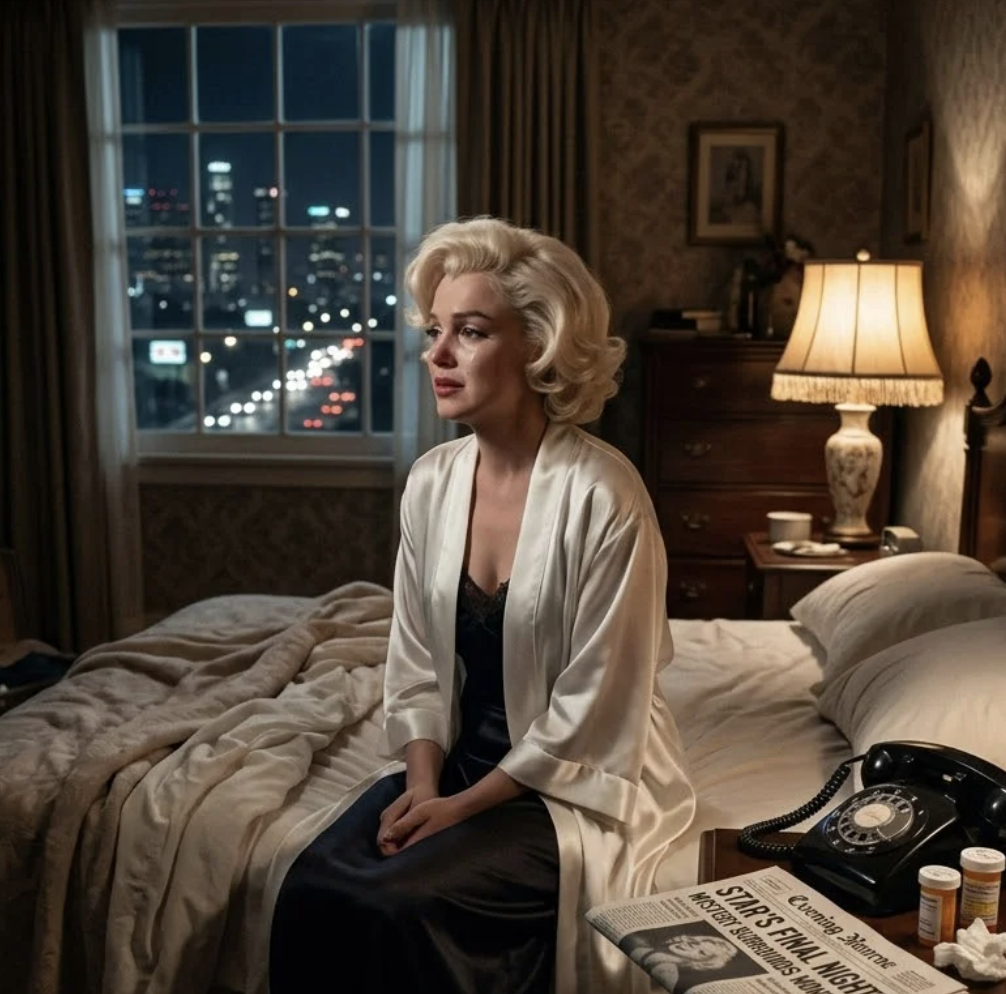
On August 5, 1962, the world woke up to shocking news.
Hollywood icon Marilyn Monroe had been found dead in her bedroom.
She was only 36 years old.
The official ruling would eventually classify her death as a probable suicide caused by an overdose of barbiturates.
For many people, the story ended there.
A tragic ending to the life of one of the most famous women in history.
But more than sixty years later, questions still surround her final hours.
And among the countless theories, one mystery continues to fascinate people:
What really happened during the last phone calls of Marilyn Monroe’s life?
A Star Known Around the World
By the early 1960s, Marilyn Monroe was far more than a movie star.
She had become a cultural phenomenon.
Her image appeared everywhere.
Movies, magazines, advertisements, television screens.
To millions of fans, she represented beauty, glamour, and success.
Yet behind the public image was a woman struggling with enormous pressure.
She battled insomnia.
Anxiety.
Depression.
Dependence on prescription medications.
And the constant scrutiny that came with worldwide fame.
Friends and colleagues often described two versions of Marilyn.
The radiant star the world saw.
And the vulnerable woman who frequently felt isolated and misunderstood.
Those close to her knew that her personal life was often far more complicated than the headlines suggested.
The Night Everything Changed
According to official accounts, Marilyn spent the evening of August 4, 1962, at her home in Los Angeles.
Several people later reported speaking with her by telephone that night.
Others claimed to have visited or communicated with her in the hours before her death.
The challenge is that not all accounts matched.
Over the years, researchers, journalists, and authors have pointed out inconsistencies in witness statements regarding the timeline.
Different people remembered events differently.
Phone calls were reported at different times.
Descriptions of who was present varied.
As a result, the final hours of Marilyn Monroe’s life became one of Hollywood’s most discussed mysteries.
Not necessarily because there is proof of a conspiracy.
But because uncertainty often creates questions that never completely disappear.
The Stories About Missing Recordings
Among the many rumors surrounding Marilyn’s death are stories about missing notes, missing documents, and alleged recordings of conversations from her final days.
Some researchers have claimed that Marilyn kept personal notes about her relationships, career, and private concerns.
Others have speculated that important materials disappeared shortly after her death.
Over the decades, numerous books and documentaries have explored these claims.
Some suggest that key evidence was lost.
Others argue there is no reliable proof that such materials ever contained anything extraordinary.
One recurring theme involves alleged phone conversations from her final hours.
Did she make calls seeking help?
Did she fear someone?
Did she know something she wanted to reveal?
Or were these stories created later as speculation grew?
The truth is that many of these claims remain difficult to verify.
Why the Mystery Refuses to Disappear
Most celebrity deaths eventually fade into history.
Marilyn Monroe’s never did.
Part of the reason is her unique place in popular culture.
Another reason is that unanswered questions continue to exist.
Human beings are naturally drawn to mysteries.
When timelines don’t perfectly align.
When witness statements conflict.
When evidence seems incomplete.
People search for explanations.
This has led to decades of theories ranging from reasonable questions to highly dramatic claims.
Some believe the official explanation remains the most likely.
Others suspect there were events that were never fully documented.
Still others believe the truth may lie somewhere between those extremes.
The Notebook Mystery
One of the most enduring stories involves claims that Marilyn kept personal notes during the final period of her life.
According to various accounts, she often wrote down appointments, thoughts, conversations, and concerns.
Whether any missing notebook contained major secrets remains unknown.
No publicly verified document has ever conclusively solved the mystery.
Yet the idea continues to capture public imagination.
A notebook.
A final phone call.
A missing piece of information.
A clue that never surfaced.
These are the ingredients that keep historical mysteries alive for generations.
The Most Human Part of the Story
The most haunting aspect of Marilyn Monroe’s death may not be the theories.
It may be something much simpler.
Many people looking back at her final years see a woman surrounded by fame but struggling with loneliness.
Someone admired by millions yet often feeling isolated.
Someone whose image became larger than the person herself.
That reality is perhaps more tragic than any conspiracy theory.
Because regardless of how people interpret the unanswered questions, one fact remains certain:
A real person stood behind the legend.
A woman with fears, hopes, relationships, disappointments, and dreams.
The Twist That Keeps People Talking
The mystery surrounding Marilyn Monroe continues not because anyone has definitively proven a hidden explanation.
It survives because some questions never received answers everyone accepted.
Who did she speak to last?
Were all events of that night documented accurately?
Did every witness remember things correctly?
History may never provide complete certainty.
And perhaps that is why the story remains so compelling.
The most intriguing possibility is not that Marilyn knew exactly what was about to happen.
It is that somewhere among the conflicting memories, missing details, and unanswered questions, there may still be pieces of her final story that the world has never fully understood.
More than six decades later, the death of Marilyn Monroe remains one of Hollywood’s most enduring mysteries—not because we know what happened, but because people are still debating what might have happened in those final hours.
Leave a Reply