Chapter 1:
Part 1
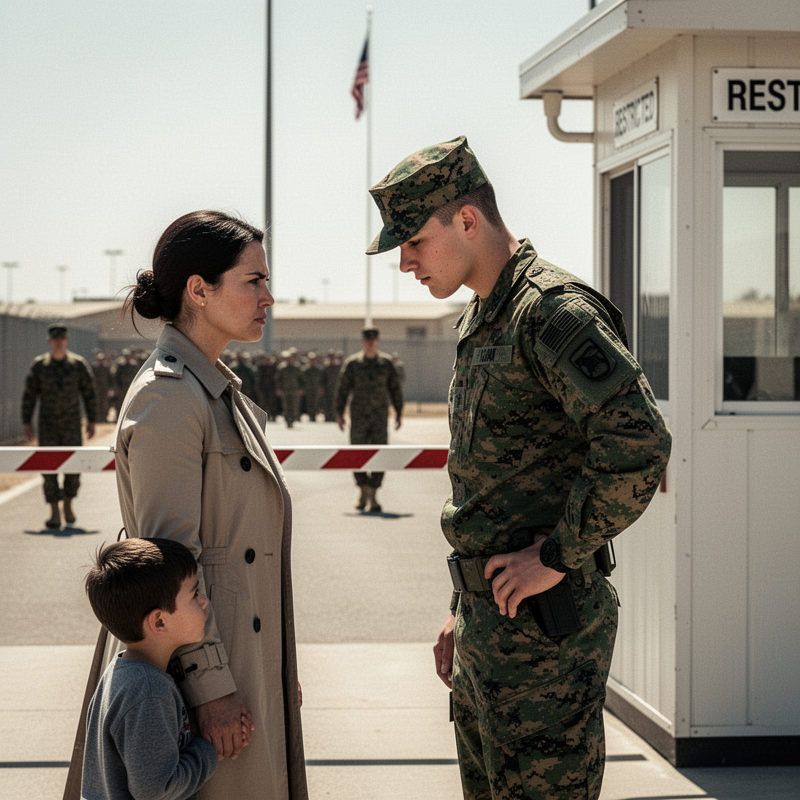
I was denied entry to the military base with my 4-year-old son, and the guard whispered, “The Colonel requests privacy.”
The North Carolina humidity clung to Sarah Davies’s skin, a familiar weight as she gripped the steering wheel of her sensible sedan. Four-year-old Leo, buckled securely in his car seat, hummed a tuneless song, oblivious to the momentous drive they were making to Fort Bragg. For years, Sarah had written letters, made calls, and sent emails, each one detailing Leo’s milestones, his first words, his favorite dinosaur, all in the hope that Colonel Maxwell Vance, his biological father, would acknowledge his son. Every attempt had been met with silence. Today, she was tired of the silence.
She took a deep breath, pushing down the nervous flutter in her stomach. This was it. No more intermediaries, no more unanswered pleas. She would introduce Leo to his father face-to-face. It was time for Vance to see the boy he had helped create, the vibrant, curious little person who deserved to know both of his parents.
The imposing sign for Fort Bragg rose into view, an emblem of power and order against the clear morning sky. She felt a surge of resolve. This place, a bastion of discipline and duty, should be where accountability finally found Vance.
As she pulled up to the main gate, a line of cars already snaked ahead. The checkpoint looked formidable: stern-faced military police, concrete barriers, and a large booth manned by a young guard. Leo pointed to a passing helicopter, his eyes wide.
“Look, Mama! A helicopter!” he chirped, his small voice cutting through the hum of the engine.
Sarah smiled faintly, a practiced, reassuring gesture. “It is, sweetie. Very big.”
She waited patiently for twenty minutes, inching forward. Each passing minute felt like an hour, her heart thudding a nervous rhythm against her ribs. She rehearsed her words, trying to strike the perfect balance between firmness and politeness. She imagined Vance’s reaction, a mixture of apprehension and, perhaps, a flicker of paternal recognition. That flicker was all she hoped for.
Finally, it was their turn. She pulled the sedan up to the guard booth. Private Kevin Miller, a young man with a neatly trimmed haircut and eyes that seemed a little too wide for his uniform, peered down at her from behind his dark sunglasses.
“Good morning, ma’am,” he said, his voice surprisingly soft. “May I see your ID and vehicle registration, please?”
Sarah handed them over, her hands slightly damp. “Good morning, Private. My name is Sarah Davies. I’m here to see Colonel Maxwell Vance.”
She glanced in the rearview mirror, making sure Leo was still content. He was absorbed in his toy car, making quiet racing noises.
Private Miller typed something into his computer, his brow furrowing slightly. His fingers moved quickly across the keyboard, then paused. He looked up at her, then back at the screen.
“I’m sorry, ma’am,” he stated, his voice now flat and official. “Your name isn’t on the approved visitor list for Colonel Vance.”
Sarah’s carefully constructed composure wavered. This was the same bureaucratic wall she’d hit for years. She pushed down the rising panic.
“There must be a mistake,” she insisted, leaning slightly towards the booth. “I’ve tried to contact him for a very long time. It’s urgent. I need to speak with him about our son.”
She gestured vaguely towards Leo in the back seat. The words “our son” hung in the air, heavier than she intended.
Private Miller stiffened visibly. His shoulders pulled back, and his gaze flickered from Sarah to Leo, then back to her. The previous flatness in his voice was replaced by a strained formality.
He leaned closer to the open window, his voice dropping to a near whisper, barely audible over the idling engine. “Ma’am, the Colonel requests privacy.”
The words felt like a physical blow. Privacy. Not a mistake, not a misunderstanding. A direct request. A deliberate denial. It was a rejection cloaked in military protocol. Sarah’s frustration boiled, hot and bitter. Her eyes burned, but she refused to let tears fall. Not here. Not in front of Leo.
She forced a tight smile, grabbing her ID and registration back from his outstretched hand. “Understood,” she managed, her voice clipped.
She put the car into reverse, the crunch of gravel beneath her tires loud in her ears. The hope she’d carried for so long felt suddenly crushed, replaced by a cold knot of anger. She was about to turn the wheel, to concede defeat and drive away, when something caught her eye inside the guard booth.
On the corner of Private Miller’s small, cluttered desk, amidst a stack of forms and a half-eaten sandwich, sat a framed photograph. It was a casual shot, not a formal portrait. A younger Colonel Vance, his smile wide and relaxed, stood with his arm around a small child. The boy in the photo, no older than three or four, had a mop of sandy-blond hair and bright, curious eyes that mirrored Leo’s own. The resemblance was uncanny, unmistakable.
Sarah’s breath hitched. Her heart began to pound, not just with anger, but with a sudden, icy shock. This wasn’t just about “privacy” in some vague, official sense. Vance wasn’t just avoiding an awkward meeting with a past acquaintance. The photo on that desk confirmed a deeper, personal connection, a bond he was actively trying to conceal.
This wasn’t a bureaucratic denial; it was a deeply personal rejection, an active erasure. The true nature of Vance’s secrecy hit her with the force of a physical blow. She realized, with a sickening certainty, that he knew exactly who Leo was, and he wanted absolutely nothing to do with him.
What happened after that is in the first comment, because that’s when the truth started leaking out.
Part 2
I stood frozen, my hand still on the gear shift. The guard’s booth, the uniform, the entire imposing gate seemed to blur around the edges. All I could see was that photo, that undeniable proof, searing itself into my memory.
My heart hammered against my ribs, a frantic, angry beat. The cold certainty of Vance’s deceit wrapped around me, a sickening truth.
Private Miller shifted in his seat, his gaze flicking to Leo in the backseat, then back to my face. His young eyes, previously flat, now held a flicker of something unreadable – perhaps unease, perhaps a shared understanding of the injustice.
He fumbled with a stack of papers on his desk, his movements suddenly jerky. It was a quick, almost imperceptible gesture, but I caught it.
I finally snapped out of my stupor, jamming the car into drive. The sedan lurched forward. I needed to get away, to breathe, to process this new, horrifying layer of deception.
As I slowly pulled away from the gate, turning onto the road that led out of the base, Private Miller stepped out of his booth. He pretended to adjust one of the orange traffic cones, bending down, his back mostly to me.
But as my front tire passed, something small and white fluttered to the ground, landing just inches from my rear wheel. It was a folded paper napkin.
My eyes narrowed in the rearview mirror. It looked like an accident, a casual drop. But something in Miller’s posture, his quick glance in my direction, told me otherwise.
A horn blared behind me. I reached the first traffic light outside the base, the red glow a command. My mind raced. Was it nothing? Or was it… a message?
Without thinking, I quickly pulled over to the shoulder, throwing the car into park. Leo stirred in his seat, wondering why we’d stopped.
“Just a second, sweetie,” I murmured, my voice tight.
I unbuckled my seatbelt, opened the door, and walked quickly back to where the napkin lay. My hands trembled slightly as I picked it up, folded small and tight.
Back in the car, I unfolded it carefully. Inside, scrawled in hurried, blocky handwriting, were two short lines.
“October 20th.”
“Bldg 47A.”
A date. A building number. My breath hitched. What did it mean? What was Private Miller trying to tell me?
Chapter 2: The Hidden Daycare
The crumpled napkin, now smoothed on my kitchen table, felt like a burning ember in my palm. “Bldg 47A” and “October 20th” were the only anchors in a sea of confusion. I pushed aside Leo’s half-finished drawing of a rocket ship and pulled my laptop closer, starting my deep dive into the labyrinthine world of Fort Bragg.
The date, October 20th, remained an enigma. It didn’t correspond to Leo’s birthday, nor any other significant date I could recall from my brief history with Maxwell. Building 47A, however, yielded results after hours of scouring old military forums and archived base maps. It was listed as a long-decommissioned storage facility, tucked away on the outer perimeter, far from any active operations. That detail struck me as odd, almost deliberately obscured.
For three days, I researched, my phone pressed to my ear, navigating the polite but unhelpful bureaucracy of the base. No one seemed to know anything about Building 47A, or if they did, they weren’t saying. I finally found an out-of-date civilian map that marked its location with a faint “X” near a forgotten service road.
Leaving Leo with a trusted friend, I drove to the outskirts of Fort Bragg, parking my car a discrete distance from the chain-link fence. The air hung heavy with the scent of pine and damp earth. Building 47A stood exactly as described: dilapidated, its windows boarded up with rough plywood, vines creeping up its faded green walls. It looked abandoned, forgotten by time.
A loose panel on the side of the building, rusted hinges barely holding, offered a potential entry point. I wedged my fingers into the gap and pulled, the wood groaning in protest. It gave way, revealing a sliver of darkness within. Taking a deep breath, I squeezed through the opening.
Inside, the air was thick with dust and the smell of mildew. My flashlight beam cut through the gloom, revealing not storage shelves, but small, brightly painted murals peeling from the walls. Faded paper stars dangled from the ceiling. A miniature plastic slide lay on its side, covered in grime. This wasn’t a storage facility at all. It was a disused, forgotten daycare center.
My heart began to pound with a frantic rhythm. This unexpected discovery felt significant, yet its meaning was shrouded in mystery. I moved cautiously through the silent room, my footsteps muffled by years of dust. In a back office, a filing cabinet stood ajar. Its contents were mostly moldy papers, but one drawer, surprisingly dry, held stacks of old attendance sheets.
I began to sift through them, my breath catching in my throat. My fingers trembled as I found it: an attendance sheet from four years prior, dated entries consistent with Leo’s age. And there it was, meticulously written in faded blue ink: “Leo Vance.” My son’s name, but with Maxwell’s surname.
Below it, “Captain Maxwell Vance” was listed as the parent. My eyes raced to the next line, expecting to see my own name. Instead, a different name jumped out at me, cold and stark: “Eleanor Vance” listed as the primary contact and emergency pick-up.
A profound shock coursed through me, a chilling realization that settled deep in my bones. Maxwell had listed his new wife, Eleanor, as Leo’s mother figure, while he was still a Captain, actively attempting to erase my very existence from Leo’s life. The extent of his deception, his calculated manipulation of the past, left me reeling, questioning everything I thought I knew about him.
Chapter 3: Echoes of the Past
The daycare records became my grim trophy. I clutched them tightly, the paper brittle and thin, as I sat across from David Chen in his Fayetteville office. David, sharp-eyed and impeccably dressed, listened intently, his pen hovering over a legal pad.
“This is compelling, Sarah,” David said, a thoughtful frown creasing his brow. “But we need more. Vance is a Colonel; he’ll have resources. These records are old, from a decommissioned facility. His legal team will try to dismiss them.” He advised caution, explaining the complexities of family law against a high-ranking military officer.
He began drafting the initial paternity filings, a necessary first step. Meanwhile, I took his advice to seek out anyone connected to the old daycare. It was a long shot, but I had to try. Base personnel had been a dead end.
My search led me to Agnes Peterson, a retired administrative clerk who had worked at Fort Bragg for decades. Her name appeared on a few of the daycare’s archaic payroll documents. I found her address in a quiet retirement community near Asheville, a few hours drive from Fayetteville. Agnes, now 78, answered my hesitant phone call with a frail but surprisingly firm voice. She was initially wary, her words clipped, but after I explained my predicament and mentioned the old daycare, a flicker of something, perhaps nostalgia or concern, softened her tone. She agreed to meet me.
The drive was long, filled with apprehension. When I arrived, Agnes greeted me at her front door, a wisp of a woman with bright, knowing eyes. Over sweet tea and pastries, in a living room filled with crocheted blankets and faded photographs, I laid out the daycare records. Agnes peered at them through thick spectacles.
“Ah, the Vance situation,” she murmured, a sigh escaping her lips. She traced a finger over “Captain Maxwell Vance.” “That was quite the talk of the base, briefly.” She paused, stirring her tea. “Maxwell Vance was a Captain then, yes. Very ambitious. Always careful about his image.”
She recounted how Captain Vance had hastily married Eleanor, a well-connected socialite, not long after Leo’s birth. “It was quite sudden,” Agnes reminisced, her eyes distant. “He’d just made Major, I believe. Everyone thought it was a whirlwind romance, but it happened *after* the little one appeared in those daycare records.” She had initially seen Eleanor as a kind stepmother, a woman embracing a child, but now, a new suspicion crept into her voice. “Now I wonder… if it was just to keep things tidy for his career. To legitimize his image.”
Then, almost as an afterthought, Agnes lowered her voice. “And there was something else, years before. When he was a Lieutenant. A… similar situation. Another young woman. Hush-hush, of course. I remember whispers of a quick settlement. Paternity was denied, then acknowledged, then settled out of court. Very clean. The military likes things clean.”
The air in the quiet room grew heavy. This revelation painted a chillingly clear picture of Vance’s calculated cunning, a disturbing pattern of using marriage and payoffs to cover his tracks. The misunderstanding I held about Eleanor’s initial role shattered. Agnes’s words cast a new, disturbing light on Eleanor’s involvement, making her not just a primary contact, but potentially a crucial piece in Vance’s long-standing game of deception.
Chapter 4: The Paper Trail
David Chen wasted no time after my meeting with Agnes. He officially filed the paternity suit in Cumberland County district court. The response from Colonel Vance’s legal team was immediate and aggressive. A thick envelope arrived at David’s office, addressed to me: a cease and desist letter, a threat of defamation, and thinly veiled accusations of opportunism.
“This is standard procedure for someone like Vance,” David calmly explained, holding the letter. “They want to intimidate you. Don’t respond directly. Let us handle it.” His advice was to maintain a dignified silence, but I could feel the invisible tendrils of Vance’s influence reaching out, attempting to strangle my resolve.
David suggested hiring a private investigator. “Vance has too much to hide. We need someone who can dig where legal channels can’t easily reach.” He recommended Frank Rossi, a gruff, no-nonsense PI with a reputation for tenacity. Frank, with his perpetually wrinkled suit and cynical gaze, agreed to take the case, for a hefty fee.
A week later, Frank Rossi delivered his initial findings, a stack of documents tied with a string. He laid them out on David’s conference table, pushing his spectacles up his nose. “He’s a careful man, your Colonel,” Frank grunted, pointing to a labyrinthine chart of financial transactions. “But not careful enough.”
He had uncovered a complex financial paper trail. Colonel Vance, a high-ranking officer, wasn’t sending child support payments directly to me, or even to a designated account in my name. Instead, the paltry sum of $500 per month was being routed through a shell corporation registered in Delaware. A ghost entity designed to obscure.
“This here,” Frank tapped a line item, “is the ‘payment.’ Fifty-six hundred dollars a year. For a Colonel. With his known assets and income, that’s ludicrously low.” He produced a document detailing Vance’s substantial military salary and various investment properties, estimates of which put his net worth significantly higher than a typical officer of his rank. “He’s deliberately underreporting his income, or at least, making it appear he’s paying the bare minimum through a convoluted channel to avoid detection.”
The shock was visceral. Five hundred dollars a month. It wasn’t just insufficient; it was an insult, a calculated maneuver to appear as if he was providing some support while actively concealing his true wealth and responsibility. This wasn’t just evasion; it was systematic fraud. Vance hadn’t just denied Leo’s existence; he had built an elaborate financial smokescreen to hide it.
I felt a cold rage blossom in my chest. The depth of his calculated deception was astounding. How many more layers of lies had Colonel Vance meticulously constructed to protect his flawless image, and how many more would we have to peel away? The fight had just begun.
Chapter 5: An Unexpected Ally
The paternity suit continued to gather momentum, but so did Colonel Vance’s retaliatory efforts. His legal team, unrelenting, escalated their attacks. Rumors began circulating through Fayetteville’s social circles, whispered behind hands at school functions and community events. I was painted as an unstable, opportunistic gold-digger, a woman with a history of similar “schemes.” It was a smear campaign designed to isolate and discredit me.
“Just breathe, Sarah,” David Chen advised, sensing my growing frustration. “Don’t engage. Any reaction from you will fuel their fire. We let the legal process speak. Our evidence will counter their lies.” His words were calm, but the pressure felt immense, a constant, gnawing anxiety.
Then, out of the blue, an unexpected development. David received an anonymous email. The sender’s address was a jumble of random letters and numbers, untraceable. The subject line was blank. Attached was a single PDF: a heavily redacted financial statement from a military charity fund, seemingly innocuous. My heart hammered as David opened it.
“Look closely,” David instructed, zooming in on the document. A few numbers, almost imperceptibly, were circled in faint red. We cross-referenced them with Vance’s publicly available financial disclosures, a painstaking process that took hours. The discrepancy, once we found it, was glaring. Vance’s reported charitable contributions didn’t match the actual payouts from the fund.
“This is a classic maneuver,” David explained, his voice low. “Inflate contributions on one ledger, underreport on another, then siphon off the difference. It’s a way to funnel off-the-books funds, to hide income or assets without drawing too much attention.” It was further evidence of Vance’s intricate financial deception.
But the most shocking detail came next. As David meticulously examined the PDF, he found a subtle watermark embedded in the corner of the document, barely visible to the naked eye. He used a digital tool to enhance it, and there it was, stark and clear: “E.V.”
Eleanor Vance.
My jaw dropped. The realization hit me like a physical blow. Colonel Vance’s elegant wife, the woman he had hastily married, the one listed as Leo’s primary contact in the daycare records, was secretly providing us with crucial intelligence. She wasn’t just a loyal, supportive spouse; she was a covert informant, disillusioned and striking out against her husband from the shadows.
“She’s seen enough,” David murmured, a slow smile spreading across his face. “This changes everything, Sarah. We have an ally, however anonymous. This confirms not everyone in Vance’s inner circle is loyal.” The discovery was a jolt of renewed hope, a powerful piece of ammunition for the upcoming hearing. But her true motives remained shrouded in mystery, leaving me to wonder what other secrets Eleanor Vance harbored.
Chapter 6: The Forged Truth
The air in the Cumberland County District Court on the day of the paternity hearing was thick with tension. Colonel Vance, impeccable in his dress uniform, exuded an aura of calm confidence, his gaze unwavering as he occasionally glanced towards me. His lawyer, a formidable figure with a booming voice, launched into a powerful defense, attempting to dismantle my character and paint Leo’s birth as a youthful indiscretion that Vance had generously, if anonymously, addressed.
“My client has always acted with discretion and generosity,” Vance’s lawyer declared, his voice echoing. “He simply wishes to protect his privacy and his family from unwarranted allegations.” He produced bank statements showing the $500 monthly payments through the shell corporation, attempting to frame them as altruistic support, despite our evidence of their inadequacy.
Then, in a move designed to deliver a crushing blow, Vance’s lawyer approached the bench. “Your Honor,” he announced, “we present a document that proves Ms. Davies willingly relinquished all claims.” He held up a single sheet of paper. “A signed affidavit from Ms. Sarah Davies herself, dated five years ago, explicitly relinquishing all parental claims to Leo in exchange for a one-time settlement of ten thousand dollars.”
I gasped, my breath catching in my throat. My blood ran cold. I had never seen that document in my life. I vehemently denied it, my voice trembling with indignation. “That’s not my signature! I never signed anything like that!”
David Chen, ever composed, requested an immediate recess to examine the document. The judge, his expression grave, granted it. In the quiet chaos of the hallway, Frank Rossi’s forensic expert, a quiet woman with sharp eyes, quickly set to work. She compared the signature on the affidavit to various authenticated documents of mine.
Within minutes, she looked up, her face grim. “It’s a precise replica,” she stated, handing David a magnified image. “It was lifted, likely from a visitor’s pass application Ms. Davies filled out for a base visit several years ago. An application she ultimately didn’t use, but still signed.” The meticulous forgery, expertly crafted, sent a wave of shock through our small team. Vance hadn’t just lied; he had fabricated my consent.
As the court reconvened, the judge’s gaze swept over the courtroom. David was about to present the forensic expert’s findings when a stir broke out near the back. Eleanor Vance, looking pale but resolute, rose from her seat and approached the bench. Her sudden appearance silenced the room.
“Your Honor,” Eleanor’s voice was clear, though a tremor ran through it. “I have vital evidence concerning this… document.” She held up a document identical in appearance to the one Vance’s lawyer had presented. “This is from my own previous divorce, years ago. My ex-husband presented a similarly forged relinquishment affidavit, supposedly from me.” Her eyes met Vance’s across the courtroom, a silent, damning accusation. “His legal team at the time included one of the associates now working with Colonel Vance’s current counsel.”
A collective gasp rippled through the courtroom. Eleanor’s testimony established a clear, horrifying pattern of legal fraud, directly linking the forgery to Vance’s sphere of influence. The magnitude of Vance’s ongoing deception, his willingness to use such desperate measures, was fully revealed, leaving the courtroom in stunned silence as his carefully constructed facade crumbled.
Chapter 7: Reckoning and Resolution
The judge, a man known for his unflappable demeanor, was visibly disturbed. The forensic evidence, coupled with Eleanor Vance’s unexpected and damning testimony, shattered any remaining semblance of Vance’s credibility. He immediately ordered an investigation into Vance’s legal team for complicity in the forgery.
He then turned his attention to the core matter of paternity. “Based on the overwhelming evidence, including the daycare records, the confirmed financial discrepancies, and the proven fraudulent activity of Colonel Vance,” the judge declared, his voice ringing with authority, “this court finds Colonel Maxwell Vance to be the legal father of Leo Davies.”
A wave of relief washed over me so profound it nearly buckled my knees. The judge then ordered retroactive child support payments of $1,800 per month for the past 48 months, totaling $86,400, and ongoing payments until Leo turned 18. This was a clear victory, a lifeline for Leo’s future.
But the judge wasn’t finished. “Furthermore,” he continued, his gaze fixed directly on Colonel Vance, “given Colonel Vance’s egregious conduct unbecoming an officer, his documented fraudulent activity, and clear obstruction of justice in this court, I am referring Colonel Maxwell Vance to the Secretary of the Army for an immediate, full internal military investigation.”
The words hung in the air, cold and definitive. Vance’s carefully constructed life, his immaculate career, his reputation—all were crumbling, not just in civil court, but within the very institution he had used to hide his deceit. This wasn’t just a civil judgment; it was a career-ending pronouncement, jeopardizing his rank, his entire pension, and his future. He would face a dishonorable discharge, his lifetime earnings decimated, fines and legal fees piling high.
As the gavel slammed, a hush fell over the courtroom. Vance sat motionless, his face etched with a look of stunned disbelief. Eleanor, who had provided the crucial, final piece of the puzzle, quietly slipped out a side door, her eyes meeting mine for a fleeting moment – a silent acknowledgment, perhaps of shared burdens, perhaps of a future finally free.
Outside the courthouse, a small crowd of media had gathered, their cameras flashing, microphones thrust forward. They clamored for a statement, eager to sensationalize the downfall of a high-ranking officer. But I simply clutched Leo’s hand, his small fingers warm and secure in mine. We walked past them, not needing to speak. The truth, hard-won and exposed, had already spoken for us. I looked towards the future, a future where justice, though delayed and fought for every step of the way, had finally prevailed, promising a secure and honest path for my son.
Leave a Reply