Chapter 1:
Part 1
My brother, who runs a hotel in Miami, called me and asked: ‘Where is it?’ – Messages from the heart.
The fluorescent glow of my New York City apartment did little to dispel the gloom that had settled over me. Another Monday night, another late dinner, and another missed call from David. My thumb hovered over his contact, a familiar mix of annoyance and something akin to dread tightening my chest. Our conversations had been fractured ever since I’d left Miami five years ago, a jagged break from the carefully constructed peace of our childhood home.
He called again, his name flashing insistently. I sighed, picked it up, and braced myself.
“Sarah! Finally!” His voice, usually smooth and charismatic, was ragged, frantic. “Where is it? Mom left a note, but I can’t find it anywhere!”
I leaned against my kitchen counter, clutching the phone. My mother, Eleanor, had passed just a few weeks ago, leaving behind a silence that was still too loud. David’s usual self-centeredness, however, seemed to have amplified in the wake of her death.
“David, what are you talking about?” I kept my voice even, though a tremor tried to escape. “What note? What ‘it’?”
“The will, Sarah! Frank Henderson, the lawyer, just read it. Mom left a ‘final message’ for us, hidden somewhere.” He paused, a harsh breath rattling through the line. “He said it was meant for both of us to find.”
A final message. Eleanor, always one for grand gestures and intricate puzzles, even in death. It sounded exactly like her. But the idea of flying back to Miami, of sifting through her things with David, filled me with a weary resignation. Our relationship had always been fraught, a delicate dance around unspoken resentments. He’d always seen me as abandoning the family, leaving him with the sole burden of “The Miami Breeze,” our mother’s boutique hotel in South Beach. I’d always felt he prioritized the hotel over everything else, including my own aspirations.
“I’m busy, David,” I tried, half-heartedly. “Can’t Maria handle it? Or Aunt Clara?”
“No, Sarah, you don’t understand! This is important. More important than your… whatever you’re doing in New York.” His tone, sharp with stress, cut through me. “It has to be *both* of us. It’s what Mom wanted.”
He rarely pleaded. The urgency in his voice was undeniable, a raw edge of desperation that chipped away at my resolve. Despite our history, the thought of Eleanor’s last wish going unfulfilled, of David struggling alone, gnawed at me.
“Fine,” I said, rubbing my temples. “I’ll book a flight for tomorrow morning. Text me the details.”
“Thank you, Sarah. Just… thank you.” The relief in his voice was palpable, a fragile wave that almost made me forget my irritation.
The next morning, the humid embrace of Miami hit me the moment I stepped off the plane. The familiar scent of salt and tropical flowers mingled with the bittersweet aroma of grief. David met me at baggage claim, his usually immaculate hair slightly dishevelled, dark circles under his eyes. He looked thinner, more strained than I remembered.
He pulled me into a quick, awkward hug.
“Thanks for coming,” he mumbled, stepping back quickly. “I know this isn’t easy.”
We drove in silence, the familiar streets of Coral Gables a blur outside the window. Memories of Eleanor, of our childhood, flashed through my mind like old photographs. Her laughter, her quiet strength, her meticulous attention to detail in everything she did. The house loomed ahead, a stately, Spanish-style home draped in bougainvillea, an anchor in a turbulent sea.
Eleanor’s study, always her sanctuary, was exactly as she’d left it. Every book aligned, every pen in its holder, a silent testament to her organized mind. A faint scent of lavender and old paper hung in the air, stirring a fresh wave of grief. David walked directly to her grand mahogany desk, running his hand over its polished surface.
“It was right here,” he said, his voice low, pointing to an empty space between a vintage globe and a silver letter opener. “A small wooden box, carved with little intricate patterns. I remember seeing it for years, just sitting there. Now it’s gone.”
He looked around frantically, his eyes darting from shelf to shelf, cabinet to cabinet.
“I’ve searched everywhere, Sarah. Every single drawer, every nook and cranny. It’s not here. And there’s no note, just what Frank said about a ‘final message.’” He ran a hand through his hair. “I think someone took it. Maybe… maybe Aunt Clara?”
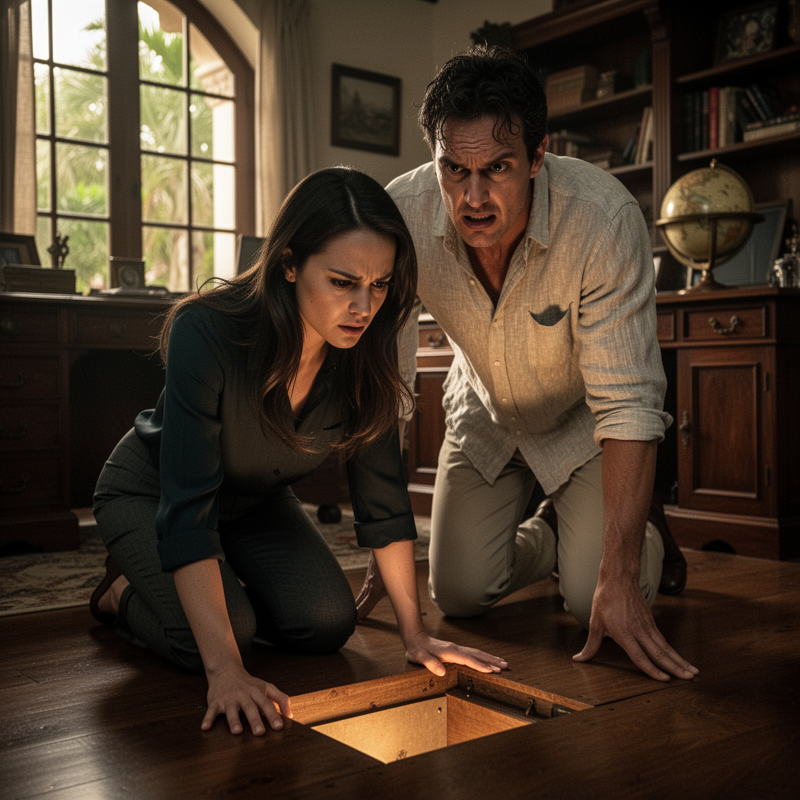
My mother had a deep love for puzzles, for hidden messages and elaborate games. I remembered her setting up scavenger hunts for our birthdays, each clue leading to the next with delightful complexity. She would never just leave something out in the open, especially not something so important. My gaze dropped to the desk itself, then to the floorboards beneath it, where she sometimes hid small trinkets when we were children, thinking they were safe.
A slight, almost imperceptible groove caught my eye, a faint discolouration on the polished wood. My fingers traced the line, feeling a subtle unevenness. I knelt down, pressing lightly.
With a soft groan of protest, a section of the floorboard, perfectly disguised, gave way, revealing a shallow compartment. My breath hitched.
Inside, nestled on a velvet lining, was the very box David had described: small, ornate, made of dark, carved wood. It was exactly as he’d remembered, untouched. But what it held was not a single object, or a pile of money, as David likely hoped.
I carefully lifted the lid. Inside lay a neatly folded, crisp piece of parchment, aged to a cream colour, secured with a thin, faded blue ribbon. Next to it, glinting softly in the dim light of the study, was a tiny, intricate silver key.
David leaned over my shoulder, his frantic energy momentarily stilled. “The box! You found it! What’s inside? The inheritance? Is it a stack of cash? Or deeds to some property?” He reached for it, but I gently pulled it back.
I untied the ribbon, my fingers trembling slightly, and unfolded the parchment. Eleanor’s familiar, elegant handwriting filled the page. It wasn’t a direct message, nor was it a simple instruction. It was a riddle.
The note read, clear and precise: “Where we first dreamed, there you shall find the seed of what was lost.”
David snatched the note from my hand, scanning it quickly. “Where we first dreamed?” He scoffed, his initial relief quickly replaced by a fresh wave of frustration. “What is this, a game? This has to be about money, Sarah. It just has to be! ‘Seed of what was lost’ – probably some investment, something she put away for the hotel.” He paced, running his hands through his hair. “She must’ve hidden money, enough to stabilize ‘The Miami Breeze’ after all these years.”
I looked from the cryptic note to the small silver key, then back to the empty, meticulously kept study. My mother, Eleanor, had never been straightforward, especially when it came to matters of the heart. This wasn’t about money, I realized with a sudden, chilling certainty. This was just the beginning. The “it” David sought wasn’t what he thought. It was a treasure hunt, a final, elaborate message from our mother.
But what could this “seed of what was lost” possibly be?
What happened after that is in the first comment, because that’s when the truth started leaking out.
Part 2
“Where we first dreamed,” David repeated, his voice laced with the kind of certainty that always grated on my nerves. “It has to be the hotel, Sarah. The Miami Breeze was her life’s work, her biggest dream.”
He gestured vaguely towards the window, as if the hotel’s neon sign were visible from Coral Gables.
“Her dreams weren’t always about grand gestures, David,” I countered, tracing the delicate carvings on the wooden box. “Mom found solace in quiet places. In the soil, in her plants.”
My thoughts drifted to Eleanor’s small potting shed, tucked away behind the main house. It was a space she retreated to when the hotel’s demands, or life’s pressures, became too much.
David grumbled, but he followed me. We walked through the lush backyard, the air heavy with the scent of jasmine, towards the modest wooden structure. It looked surprisingly neat, almost staged, I noticed, pushing open the creaking door.
Inside, beneath a stack of terra cotta pots and a watering can, I spotted it. A weathered, leather-bound journal, its pages thick with years of use.
“This is it,” I said, a strange certainty settling over me.
David snatched it from my hand, flipping through the pages eagerly. His face, initially alight with anticipation, sagged. He let out a frustrated sigh, running a hand over his tired eyes.
“Gardening entries? Sarah, seriously? Prize-winning orchids, soil compositions… this is what we’re looking for?” He scoffed, tossing the journal back onto the potting bench. “This is a waste of time. I need to find something real, something that will help the hotel.”
I picked up the journal, my fingers brushing against the rough leather. David was looking for a fortune, a tangible asset. But I felt a subtle pull, a deeper layer to my mother’s riddle.
Turning to a random page, I saw a pressed, dried hibiscus flower, its vibrant red now faded to a gentle rust, marking the spot. The entries on that page were mundane, a simple list of planting dates and watering schedules. Nothing remarkable.
David paced in the cramped shed, muttering about pointless sentimental journeys. He kicked a loose bag of fertilizer.
I ran my thumb over the fragile petals of the hibiscus, feeling a peculiar warmth. The journal held no grand revelation, no hidden deeds, no stacks of cash. It was just a gardening diary, yet it was precisely what Eleanor’s note described: “the seed of what was lost.”
This discovery left us utterly perplexed. Was this entire “treasure hunt” merely a sentimental wild goose chase, a final, elaborate joke from our mother?
Chapter 2: The Eavesdropper
David, still convinced their mother had hidden a financial windfall, spent his evenings hunched over Eleanor’s old ledgers in the study. He muttered about market fluctuations and bank interest, the numbers doing little to calm his agitation. I, on the other hand, found myself drawn back to the simple beauty of the pressed hibiscus in Eleanor’s gardening journal.
I spent hours on my laptop, researching the specific variety. My search results returned vibrant images and botanical details. A memory surfaced then: Eleanor, her hands smudged with paint, once sketching a hibiscus bloom in an old notebook, talking about a quiet art studio she used to visit.
“She had a whole secret life, didn’t she?” I murmured, half to myself, half to David’s preoccupied form.
He grunted, not looking up. “She certainly kept her finances secret if she thought this was a good way to secure them.”
The faint click of the front door opening and closing barely registered above David’s frustrated sighs. Moments later, a figure appeared in the doorway of the living room, startling us both. Aunt Clara stood there, a small, non-descript photo frame clutched in her hand.
“Clara?” David asked, his voice tight.
Her eyes darted between us, her expression unreadable. “Just checking on things.”
She didn’t elaborate, simply pivoted and walked towards the front door. We heard it close softly behind her. A knot tightened in my stomach. Her presence felt… off.
“What was that about?” I asked, pushing myself up from the armchair.
David shrugged, still absorbed. “Probably just trying to snoop for whatever Mom left her. You know how she always thought she was Mom’s favorite.”
I walked over to the armchair where Clara had been standing. My gaze fell to the polished wood of the side table. A faint smudge, the shape of a photo frame, lingered on the dust-free surface. It was slightly larger than the one Clara had carried out.
Curiosity overriding caution, I retraced Clara’s path, eventually finding the discarded frame tucked away in the recycling bin by the kitchen. The photo inside was a generic landscape, a tranquil beach scene. But when I flipped it over, my fingers brushed against something.
A slight, almost invisible indent marked the cardboard backing. It was the impression of a smaller, different-sized photo, once tucked inside, now clearly removed. Clara hadn’t just been “checking on things.” She had been searching, and she had found something specific.
“David,” I called, my voice sharp.
He appeared, his brow furrowed. I held out the frame.
“She swapped photos,” I stated, pointing to the faint outline. “Or she was looking for a specific one, removed it, and left this one instead.”
He took the frame, turning it over in his hands. His eyes widened. “She’s trying to cut us out, isn’t she? Trying to get to Mom’s real inheritance before we do.”
A cold certainty settled in my chest. Clara wasn’t just observing; she was actively involved. But if she wasn’t looking for the clues, what exactly was she after? The image of her terse face and quick exit played over in my mind. We were clearly looking for different things.
“We can’t trust her,” I said, looking at the empty impression on the photo backing. “Not at all.”
Chapter 3: A Hidden Map
The discovery of Aunt Clara’s subtle interference ignited a new kind of resolve within me. Her secretive actions convinced me that Eleanor’s treasure hunt wasn’t just a sentimental journey; there was a genuine secret at its core, and Clara was desperate to keep it buried. I returned to the gardening journal, no longer just admiring the pressed hibiscus, but scrutinizing every detail.
“Any luck deciphering the flower?” Daniel asked, his face appearing on my laptop screen. He had called from New York, a comforting presence amidst the family chaos.
“Not yet,” I admitted, swirling my coffee. “But I have a feeling the answer isn’t in the botanical facts.”
“Maybe it’s not the words or the flower itself,” he suggested, ever pragmatic. “Sometimes secrets are hidden in plain sight. What about the journal’s physical structure?”
His words struck a chord. I ran my fingers over the worn leather binding, the stiff pages. David, meanwhile, had returned to the Miami Breeze. He’d called earlier, his voice strained.
“Maria just reminded me about the bank loan,” he’d said, the stress palpable. “Thirty thousand dollars, Sarah. By the end of the month. This whole ‘treasure hunt’ better lead to something real, and fast.”
His financial pressures were immense, making his skepticism understandable. I, however, felt a growing conviction that Eleanor’s clues were leading to something far more profound than money.
I held the journal up to the light, peering at the spine. Nothing obvious. I pressed along the edges of the pages, then ran my thumb along the inside of the back cover, near the binding. There, a faint ridge, barely perceptible, caught my attention. It felt almost like a seam.
My heart began to pound. I remembered the small silver key we’d found with the first note. Could it be for this?
I carefully inserted the key into the faint seam. There was a soft click, almost imperceptible. With a gentle tug, a section of the back cover hinged open. It wasn’t a solid cover at all, but a cleverly disguised compartment.
My breath hitched. Inside, nestled deep within the false bottom, was a small, tightly folded piece of paper. It felt old, brittle. I carefully unfolded it.
It was a miniature, hand-drawn map. My eyes widened as I recognized the familiar, winding streets of our childhood neighborhood in Coral Gables. But instead of an X marking our own house, a distinct, faded ‘X’ highlighted a property several blocks away. It was on Elm Street, number 210.
“Elm Street?” I whispered. We’d never lived on Elm Street.
Beside the ‘X,’ a single word was scrawled in Eleanor’s elegant cursive, faded with time: “Esperanza.”
“What is it?” David’s voice boomed from the doorway. He must have returned from the hotel.
I looked up, my hands trembling slightly as I held out the map. “It’s not here, David. The next clue isn’t in any of our houses.”
He strode over, snatched the map, and his gaze fixed on the address. “Elm Street? What’s on Elm Street?”
“An old, dilapidated house, I think,” I mused. “I vaguely remember Mom mentioning it. She called it her ‘old art project’.”
The map, the strange address, and the single word “Esperanza” spun in my head. This wasn’t about our immediate family property. This was leading us somewhere entirely unexpected, somewhere outside our known history. What could “Esperanza” mean?
“We need to go there,” David declared, his voice firm, the financial stress momentarily forgotten, replaced by a new urgency. “First thing tomorrow.”
Chapter 4: The House of Hope
The next morning, armed with the map and a growing sense of urgency, David and I drove to Aunt Clara’s house. She answered the door, her usual stern expression firmly in place.
“Good morning, Aunt Clara,” I began, trying to keep my voice neutral. “We have some questions about a house on Elm Street.”
Her body stiffened. Her eyes, usually direct, darted away. “What about it?” she asked, her voice clipped.
David didn’t mince words. “Mom drew a map. Number 210, Elm Street. With the word ‘Esperanza’ next to it.”
The color drained from Clara’s face. Her knuckles turned white as she gripped the doorframe. “Leave that house alone!” she exclaimed, her voice suddenly shrill, completely unlike her usual composed self. “Your mother wanted it forgotten.”
“Forgotten?” I challenged. “Why? What’s so important about it that you’re acting like this?”
“It’s nothing,” she insisted, turning to retreat into the house. “Just an old, abandoned property. There’s nothing there for you.”
“Nothing for us?” David’s voice rose. “Or nothing you want us to find? You were looking for something in Mom’s study, weren’t you? What is it, Aunt Clara? Are you trying to cut us out?”
Clara froze, her back to us. She stood there for a long moment, her shoulders tight. Then, without another word, she closed the door with a soft click, leaving us standing on the porch, confused and frustrated. Her intense reaction only deepened our suspicions. She was definitely hiding something, and it felt like it concerned more than just money.
“She’s up to something,” David fumed, marching back to the car. “I knew it. She wants whatever it is all to herself.”
The pressure of the hotel’s loan repayment gnawed at him. He checked his phone constantly, grimacing at emails from Maria. “I don’t have time for these games, Sarah. Thirty thousand dollars is a lot of money to lose if this ‘Esperanza’ is just another dead end.”
Despite Clara’s warnings and David’s mounting frustration, we drove towards Elm Street. The neighborhood gradually shifted, the manicured lawns of Coral Gables giving way to older, less maintained homes. Number 210 stood out, a derelict, boarded-up property, its paint peeling like sunburned skin. A rusted “For Sale” sign, decades old, leaned against a collapsing porch pillar, its faded lettering barely legible.
“This is it,” I said, a shiver running down my spine. The house felt like it held its breath.
We circled the property, looking for an entry point. The front door was barred shut. Most windows were boarded. Eventually, David found a loose board on a back window, hidden behind an overgrown jasmine bush. With a grunt and a few splintered curses, he managed to pry it open enough for us to squeeze through.
Inside, the air was thick with dust and the silence of abandonment. Cobwebs draped from every corner, catching the few shafts of light that pierced the gloom. Plaster flaked from the ceilings, and the floorboards groaned under our weight. It smelled of decay, of damp wood, and something else… something strangely familiar.
“Do you smell that?” I asked, inhaling deeply.
David sniffed the air. “Musty old house. What of it?”
“No,” I insisted, moving further into what looked like a living room. “It’s fainter now, but it’s there. Hibiscus.”
The familiar, sweet scent of hibiscus, distinct and almost impossibly persistent, lingered in the musty air, a ghost of Eleanor’s presence in this forgotten house. It was a faint but undeniable clue, drawing us deeper into its secrets.
Chapter 5: The Locket of Secrets
The lingering scent of hibiscus spurred us onward, a guiding thread through the derelict “Esperanza” house. We moved from room to room, our footsteps echoing in the oppressive silence. In what might have once been a sunroom, now choked with dust, we found them. Stacked haphazardly against a damp wall were old canvases, many faded, some covered with mold.
I pulled one forward, wiping away the grime. It was a vibrant, almost lifelike painting of a hibiscus flower, its petals a riot of crimson. Another canvas depicted a cluster of them, intertwined with lush green leaves. Eleanor’s signature was clearly visible in the corner of each.
“This was her secret art space,” I murmured, a profound sense of connection washing over me. “The one she mentioned.”
David ran his hand over a frame, feeling the rough texture of the wood. “She spent a lot of time here.” His voice was softer now, the urgency of the hotel loan momentarily forgotten.
As I examined another canvas, my fingers brushed against the frame. There was a slight give. I pushed, and a section of the wooden frame pivoted inward, revealing a shallow, narrow compartment. My heart leaped.
Inside, carefully folded and brittle with age, was a faded newspaper clipping. The Miami Herald, 1972. The headline spoke of Cuban refugee families arriving in Miami. My eyes scanned the blurry text until I found it: a small section underlined in Eleanor’s familiar hand, referencing a young woman with artistic talent named “Elena Martinez.”
“Elena Martinez?” David whispered, peering over my shoulder. “Who’s that?”
Before I could answer, I found another hidden compartment in a different frame. This one held a letter, stained with age and water damage, but still legible. It was from a Miami adoption agency, dated 1973. It confirmed Eleanor Miller had been adopted as a baby. Her birth name: Elena Martinez.
A gasp escaped me. David stood frozen, his face ashen. Our mother, adopted? It was an unbelievable truth, shattering every assumption we had ever held about our family history.
“Mom… she was adopted,” David finally managed, his voice barely a whisper. “All these years, and we never knew.”
The revelation left us reeling. We sat in silence for a long moment, absorbing the shock. Then, a new determination set in. There had to be more.
We continued our search, systematically tapping along walls and feeling for loose floorboards. The scent of hibiscus seemed to guide me towards the old, crumbling fireplace in the main living area. I ran my hand over the soot-stained bricks. One felt slightly loose. I tugged.
With a soft scraping sound, a brick came free, revealing a small, dark recess within the fireplace wall. Inside, nestled on a bed of dried, fragrant hibiscus petals, was a small, intricately carved wooden locket. It was warm to the touch, and from it emanated the unmistakable, sweet aroma of hibiscus, concentrated and powerful. This was the source of the lingering scent in the house.
I carefully lifted it out. It was a beautiful piece, smooth and polished, carved with delicate floral patterns. David reached for it, his fingers tracing the contours.
“This… this is it, isn’t it?” he asked, his voice thick with emotion. “The inheritance.”
It wasn’t money. It wasn’t property. It was this locket, radiating a profound, intimate warmth, connecting us to a secret chapter of Eleanor’s life. The hidden past of Elena Martinez, the adopted Cuban immigrant. My fingers tightened around the locket, a chilling thought blooming in my mind. What other secrets did it hold?
Chapter 6: True Inheritance
Overwhelmed by the discovery of our mother’s adoption, David and I stared at the wooden locket. Its warmth in my palm felt like a direct link to Eleanor’s hidden past. With trembling fingers, I found a tiny clasp on the side and carefully opened it.
Inside, nestled opposite a pressed hibiscus petal, was a tiny, faded black-and-white photograph. It depicted a young woman, strikingly beautiful, with eyes that were unmistakably Eleanor’s. She held a hibiscus flower, a ghost of a smile playing on her lips. On the back of the photo, almost invisible, was a minute, handwritten inscription: “Mi Esperanza – 1972.” My hope.
“It’s her,” I breathed, tears pricking my eyes. “Mom’s birth mother.”
David’s breath hitched. He reached out, his finger gently tracing the image. “Our grandmother.”
Just then, a commotion from the front of the house startled us. The creak of the door, hurried footsteps. Aunt Clara burst into the room, her face stained with tears, her chest heaving. She stopped dead, her eyes fixed on the locket in my hand. Her shoulders sagged, defeat etched onto her features.
“No,” she whispered, her voice raw. “You found it.”
“Aunt Clara,” David began, his voice laced with accusation. “You knew about all of this, didn’t you? You knew Mom was Elena Martinez.”
Clara sank to the dusty floor, burying her face in her hands. Her body shook with silent sobs. “Yes,” she choked out, finally. “I knew.”
She lifted her head, her eyes red-rimmed and filled with a pain that mirrored our own. “Elena Martinez was Eleanor’s birth name. And the woman in that photograph… that was your grandmother. My sister’s birth mother. She died shortly after arriving in Miami, in 1972. This locket was her only possession, the last thing she ever held from her family in Cuba.”
A fresh wave of shock washed over us. David leaned against the crumbling wall, a hand covering his mouth.
“Eleanor… she always kept it a secret,” Clara continued, her voice trembling. “She was so afraid. Afraid of judgment, of feeling like an outsider. She worried you would see her differently, that her ‘true’ family would overshadow the love she had for all of us, for being a Miller.”
“But why didn’t you tell us?” I asked, my voice cracking. “Why try to hide it now?”
Clara looked at us, her gaze pleading. “Eleanor confided in me, years ago. She deeply regretted never telling you. She feared rejection, feared causing you pain. When she set up this… this treasure hunt… I saw it as her final, painful act. I thought she was making a mistake. I wanted to protect you from this heartbreak. I believed it would only cause distress, digging up a past she’d wished to remain buried.”
The pieces clicked into place. Clara’s “antagonism” wasn’t about greed; it was misguided, desperate protectiveness. Her evasiveness, her warnings – they were born of fierce loyalty to Eleanor and a desire to spare us what she perceived as unnecessary grief. All the while, she carried the weight of Eleanor’s secret alone. The accusations, the coldness she’d endured from us, the isolation – it all washed over me, a bitter pang of regret.
“Mom… she wanted us to find this, didn’t she?” David said, his voice thick. “She wanted us to know her whole story.”
Clara nodded, wiping her eyes. “She wanted you to find your way back to each other. She worried about how distant you two had become.”
Suddenly, the true brilliance of Eleanor’s plan became clear. The elaborate treasure hunt, the cryptic clues, the shared frustration, the combined efforts to piece together a complex identity – it wasn’t just about revealing her adoption. It was a carefully designed journey, a final act of profound love, intended to force David and me, her estranged children, to work together, communicate, and confront our own resentments. The shared discovery, the piecing together of our mother’s complete story, and our combined processing of this profound grief was the true “message from the heart.”
David, tears streaming down his face, pushed himself off the wall and strode over to me, wrapping me in a tight embrace. “I’m so sorry, Sarah,” he choked out. “For everything. For being so dismissive. For letting the hotel blind me.”
I hugged him back, fiercely, my own tears flowing freely. “Me too, David. I should have tried harder to understand.” My stubbornness, my own past resentments, had built walls between us. Eleanor’s legacy wasn’t just the struggling hotel, or a hidden past. It was the family she nurtured, the bond she fought to mend, even from beyond the grave.
We turned to Aunt Clara, still weeping softly on the floor. I extended my hand. David knelt beside her.
“Thank you, Aunt Clara,” I said, my voice thick. “Thank you for protecting Mom, and for trying to protect us.”
Clara looked up, her face etched with relief, and took my hand. In that moment, the years of unspoken resentments, the miscommunications, and the deep-seated misunderstandings between us began to dissolve. We had found our way back to each other, united in our grief and newfound understanding.
Together, the Miller siblings, now bonded more deeply than ever, decided to integrate Eleanor’s full, rich story – her Cuban heritage, her artistic passion, her brave secret – into their family narrative. They would share it with their children, ensuring Eleanor’s complete identity lived on. And the “Esperanza” house, far from being forgotten, would be preserved, a monument to a hidden past and to the enduring power of love and reconciliation – the greatest inheritance of all.
Leave a Reply