Chapter 1:
Part 1
My wife and daughter swore to stand by me in my fight against cancer, but they abandoned me when I needed them most. Six months later, they returned, smiling, to hear my will read, unaware that the deceased still had one last trick up his sleeve for them.
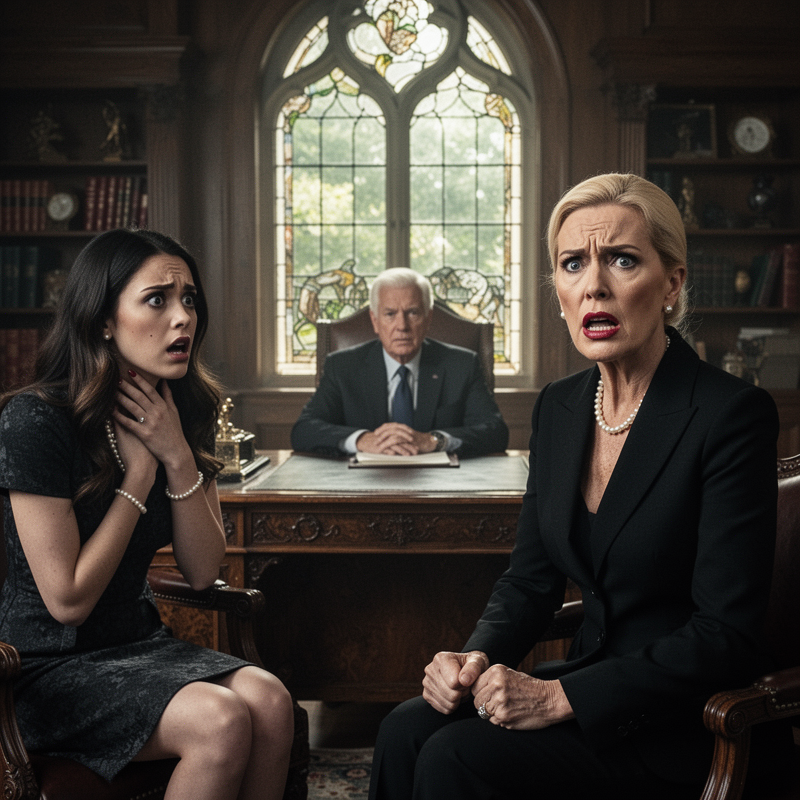
The heavy mahogany door of the Miller family mansion’s study creaked open, then swung silently shut, sealing the room in a hush that felt more like anticipation than grief. Sunlight, filtered through the leaded glass windows, cast a muted glow on the opulent space. Every surface gleamed, reflecting the quiet wealth that permeated the Greenwich, Connecticut estate.
Richard Sterling, John Miller’s long-time estate lawyer, sat behind a sprawling antique desk. He cleared his throat, his gaze sweeping over the two women seated opposite him.
Sarah Miller, John’s wife, was immaculate in a tailored black suit, her pearl necklace catching the light. Beside her, their daughter, Emily Miller, echoed her mother’s elegance in a similar, though more fashion-forward, dark ensemble. Both women carried themselves with an air of composure, their faces carefully neutral, yet a faint, almost imperceptible smirk played at the corners of their lips.
Six months had passed since John Miller’s supposed death from an aggressive form of pancreatic cancer. Six months since the frantic calls, the urgent pleas for support during his illness, had given way to silence. Six months since they had effectively abandoned him, leaving him to face his grim diagnosis alone. Now, they were back, radiating a thinly veiled eagerness.
Richard Sterling held up a thick manila envelope. The crisp paper rustled softly as he drew out several sheets, bound with a red ribbon.
“We are here today for the reading of John Miller’s last will and testament,” he stated, his voice devoid of emotion. “This document was executed on October 15th, just two weeks prior to Mr. Miller’s passing.”
Sarah shifted in her seat, a tiny, expectant sigh escaping her lips. Emily’s eyes, bright with an unspoken avarice, flickered towards her mother, then back to the lawyer. They envisioned the grand Miller mansion, the multi-million dollar investment portfolios, the vast fortune accumulated over John’s successful career. They imagined their lives, now unshackled from John’s declining health and increasing demands, free to blossom into a new era of opulent independence.
Richard Sterling adjusted his spectacles. He began to read.
He recited the preamble, the formal declarations, the customary acknowledgments. He listed a series of minor bequests: a distant cousin in Arizona, a long-serving gardener, a retired housekeeper. Each mention drew a subtle, impatient twitch from Sarah. Her gaze sharpened, ready for the core of the document, the part that mattered most.
Then, Sterling paused, taking a slow, deliberate breath.
“And to my wife, Sarah Miller,” he read, his voice clear and unwavering, “I bequeath the sum of ten thousand United States Dollars.”
A sharp intake of breath filled the room. Sarah’s eyes widened, her posture stiffening. Emily, initially confused, echoed her mother’s sudden rigidity.
Sterling continued, his eyes meeting theirs briefly, then returning to the page. “And to my beloved daughter, Emily Miller, I bequeath the sum of ten thousand United States Dollars.”
The words hung in the air, impossibly small, ludicrously meager. Ten thousand dollars? It was barely a weekend trip for Sarah, a single designer handbag for Emily. Their tight, confident smiles wavered, then cracked.
“Additionally,” Sterling went on, seemingly oblivious to the seismic shift in the room’s atmosphere, “to Sarah Miller and Emily Miller, jointly, I leave the sole inheritance of one specific property.”
Sarah’s expression flickered, a sliver of hope rekindling in her eyes. Perhaps a hidden villa, a secret offshore account, something John had squirrelled away beyond the main estate. Emily leaned forward, her earlier disdain for the paltry sum momentarily forgotten, replaced by renewed anticipation.
“The property located at 142 Elm Street,” Richard Sterling enunciated, his voice cutting through the rising tension, “in Bridgeport, Connecticut.”
The name of the street landed like a physical blow. 142 Elm Street. The address was instantly recognizable, notorious in local circles. It was a rundown row house in one of Bridgeport’s most derelict neighborhoods, a property long condemned by the city for severe structural issues. It was a known haven for squatters, a decaying monument to urban neglect.
The room fell into a stunned, absolute silence. The only sound was the soft tick of the grandfather clock in the corner, marking the passage of moments that felt like an eternity.
Sarah’s mouth, which had been poised to demand clarification, hung slightly agape. Her carefully constructed smile, polished and perfect just moments before, shattered into a mask of pure, unadulterated fury. Her breath hitched, an almost inaudible gasp of disbelief and simmering rage. Emily’s hand flew to her throat, her eyes wide with horror, fixed on the lawyer as if he had just pronounced a curse. The air in the elegant study thickened, heavy with the stench of shattered expectations and festering betrayal.
What happened after that is in the first comment, because that’s when the truth started leaking out.
Part 2
Sarah shot to her feet, her chair scraping harshly against the polished hardwood. Her voice, usually composed, now trembled with indignation.
“Is this some kind of sick joke, Richard?” she demanded, her eyes blazing. “Ten thousand dollars and a condemned shack? My husband’s will cannot possibly be legitimate.”
Emily’s hand, still clutching her pearl necklace at her throat, trembled visibly. Her mouth hung open, her gaze fixed on the lawyer, her horror mirroring her mother’s fury. The slum property was an insult beyond comprehension.
Richard Sterling, however, remained unmoved. He calmly removed his spectacles and placed them on the desk, his expression unreadable.
“Paragraph seven of Mr. Miller’s will clearly states these provisions,” he replied, his voice even. “And it outlines the conditions for a further allocation of funds.”
Sarah’s head snapped up. Emily leaned forward, a flicker of desperate hope momentarily overriding her shock.
Sterling picked up a second, thinner document. “To receive an *additional* fifty thousand United States Dollars each, from a specially designated trust fund established in Mr. Miller’s memory, both Sarah Miller and Emily Miller must comply with a specific clause.”
He paused, letting the implication sink in. Fifty thousand dollars. It was still a pittance compared to their expectations, yet it was a substantial increase from the initial ten thousand.
“You must personally reside at 142 Elm Street for a continuous period of one full year,” Sterling continued, his gaze sweeping over their incredulous faces.
Sarah scoffed, but he held up a hand, preventing her interjection.
“During this period,” he went on, “you are solely responsible for all maintenance, repairs, and expenses incurred at the property.”
Emily’s jaw dropped. Maintain that hovel? At their own cost?
“Regular inspections will be conducted by an independent estate trustee to verify compliance,” Sterling added, his words methodical and precise. “Failure to meet these conditions, at any point within the year, will result in the immediate forfeiture of the additional fifty thousand dollars.”
He looked at them directly. “Furthermore, the property at 142 Elm Street will then immediately revert to the city of Bridgeport.”
Sterling reached into his briefcase. He pulled out a large, heavy ring of keys, tarnished and dull, clearly old and well-used. He placed them deliberately on the polished mahogany desk with a faint clink.
The keys lay there, silent and heavy. Sarah and Emily stared at them, their dreams of inherited millions crumbling into a nightmare of poverty and forced dereliction.
Chapter 2: The Deceased Observes
Two weeks later, the stench of mildew and neglect from 142 Elm Street almost reached me across the street. My wife, Sarah, and my daughter, Emily, begrudgingly moved into the squalid house, their initial outrage from the will reading replaced by a grim resignation. I watched through the concealed cameras, a hidden smirk playing on my lips.
Leaky pipes, rat traps, boarded-up windows – it was a stark contrast to their usual opulent lives. From my stylishly renovated, soundproofed apartment, I saw Emily recoil from a scuttling cockroach, a gasp catching in her throat. Sarah, meanwhile, wrestled with a broken faucet, her manicured hands ill-suited for the task.
David Chen, my loyal lawyer and friend, sat beside me. He held a stack of forged medical records and a meticulously crafted death certificate, confirming our deception. He nodded, a subtle approval in his gaze as he watched the live feeds.
“They’re settling in,” David observed, his voice low.
“Settling into their new reality,” I corrected, a cold satisfaction spreading through me. I felt healthier and more vibrant than I had in years, the weight of my ‘illness’ lifted.
I turned to David, a cold glint in my eyes. “The performance has just begun, my friend. Let’s see how well they handle the second act.”
Chapter 3: A Preservation Order
Sarah, true to form, soon grew desperate to escape the Elm Street nightmare. I watched her pacing the cramped living room, cell phone pressed to her ear. Her sister, Brenda Hayes, suggested selling the property quickly to cut their losses, a predictable move.
But the real estate market was less accommodating than Brenda imagined. For a week, I saw Sarah grow increasingly frustrated with unanswered calls from agents who wouldn’t touch a condemned house. Finally, she found one willing to meet.
The agent, a jaded local, inspected the property. I watched his face on the monitor, impassive as he pointed out structural issues. Sarah listened, a forced politeness etched on her features. Then came the bombshell.
“142 Elm Street is part of a newly designated ‘Historic Urban Redevelopment Zone’,” the agent stated. “Specifically, it’s under a strict historical preservation order.”
Sarah’s face went rigid. I knew that news would hit hard. This order, which I had secretly lobbied for years ago, meant the house could not be demolished, extensively renovated, or sold without specific city council approval. The process would take years and require immense financial investment to bring it up to code.
It was effectively unsellable. A monumental money pit. I saw Sarah slam the phone down against the peeling paint of the kitchen wall, her body language screaming silent fury. The house wasn’t just a punishment; it was a cage, tightening around them.
Chapter 4: Empty Promises, Empty House
Weeks bled into two miserable months within those dilapidated walls. Emily, finding the grim reality unbearable, frequently called her boyfriend, Marcus Thorne. I heard her through the hidden mics, her voice strained, promising him a grand future once they “fixed” my “mistake.” Marcus, initially supportive, became increasingly distant, always finding excuses to avoid visiting the squalid house.
Meanwhile, Sarah’s attempts to find legal loopholes in the will proved fruitless. I saw her frustration mounting with each call. Her previous lawyer, Mr. Sterling, flatly refused to entertain the idea of a challenge, citing the iron-clad clauses I had so carefully crafted.
One evening, in a fit of despair, Sarah accidentally left her ledger open on the kitchen counter. My cameras zoomed in. There, visible for anyone to see, were several past-due notices for her boutique’s suppliers. A summary showed over $800,000 in accumulated business debt—a secret she had diligently kept from everyone, including me.
Emily, passing through the kitchen, paused. Her eyes, wide and searching, fixated on the alarming numbers. I saw a flicker of doubt about her mother’s financial acumen spark in her eyes, a fleeting moment of realization. But she quickly dismissed it, shaking her head as if to dislodge the troubling thought, clinging to the belief it was just a temporary setback.
Chapter 5: Fair-Weather Love
Emily, tired of Marcus’s constant excuses, finally demanded he visit her at 142 Elm Street for her 25th birthday. I overheard her desperate plea, promising him a romantic, if rustic, evening. Marcus, hoping for a grand gesture of a hidden inheritance, reluctantly arrived.
His initial hope quickly dissipated. I watched his carefully constructed façade crumble as he witnessed the squalor firsthand – the peeling paint, the lack of internet, Emily’s visibly deteriorating appearance and mood. They sat on milk crates around a wobbly table, eating takeout pizza.
Emily desperately tried to convince him that the “real” money was coming, her voice cracking. But her conviction was clearly faltering. Marcus, realizing there was no immediate payoff, no glamorous life awaiting him, abruptly cut her off.
“Look, Emily,” he said, standing up from his crate. “I like you, but this… this isn’t my scene. I need someone who’s going places, not someone stuck in a condemned house fighting rats.”
He turned and walked out, the door slamming behind him. I saw Emily’s shoulders slump, her face buried in her hands. She was left alone amidst the peeling paint and her shattered dreams, confirming her greatest fears about his superficiality.
Chapter 6: Desperate Measures
Marcus’s abandonment shattered Emily, pushing her deeper into despair and resentment. I watched Sarah exploit this vulnerability, further demonizing me, her ‘deceased’ husband. She painted me as an unpredictable tyrant, sowing seeds of victimhood.
Desperate, Sarah contacted Brenda again. This time, she wanted obscure property laws researched, potential heirs unearthed, anything to invalidate my will. Brenda, ever eager for a slice of the action, unearths an old, nearly forgotten local ordinance concerning property occupancy for wills. It was a long shot, but Sarah clung to it.
Simultaneously, Sarah made a bolder move. She decided to approach Detective Elena Rodriguez, a local private investigator known for her tenacity. Sarah initially hired her to investigate potential foul play in my ‘death’. She secretly hoped to prove I was incompetent when I made the will, or that someone else manipulated me.
What Sarah didn’t know was that David Chen had already anticipated this. He was quietly feeding carefully curated, misleading information to Detective Rodriguez. It ensured her findings would only deepen Sarah’s quagmire and gather more evidence for my eventual reveal.
Chapter 7: Leaked Secrets
Detective Rodriguez’s initial investigation into my ‘death’ yielded no evidence of foul play. I watched Sarah’s frustration grow through my monitors, her grand plans for invalidating the will crumbling. However, following David Chen’s subtle guidance, the detective delved deeper into Sarah’s financial background.
She inadvertently uncovered the full extent of Sarah’s $800,000+ business debts and a history of risky, almost fraudulent, investments. David then anonymously tipped off Jessica Davies, a sharp investigative reporter at the local daily, ‘The Bridgeport Sentinel’. He provided her with redacted but damning documents concerning Sarah’s financial misdealings and the strange circumstances surrounding my ‘will’.
Jessica, sensing a major story, began her own investigation. She delved into my life, my business, and the conspicuous timing of my death and unusual will. Sarah, still at 142 Elm Street, opened the morning paper a few days later. Her eyes fixated on the front-page headline: “MILLER WIDOW’S SECRET DEBTS: WAS INHERITANCE A DESPERATE GAMBLE?”
I watched her face crumple, the carefully constructed facade she’d maintained for years finally cracking under the weight of public exposure.
Chapter 8: The Trap Tightens
The newspaper article unleashed a torrent of public scrutiny on Sarah. It devastated her social standing, shredding her reputation in the affluent circles she so desperately clung to. Emily, caught in the wake, found herself completely ostracized, abandoned by her superficial friends.
Sarah’s boutique faced immediate bankruptcy. Creditors began aggressive collection efforts, their patience worn thin. Feeling utterly cornered and humiliated, Sarah made a desperate, public statement to the press. She painted herself as a victim of my erratic behavior, hinting at mental instability in my final months. Her attempt was clear: undermine my will’s validity through public opinion.
I watched from my hidden sanctuary with David and Dr. Reed, calmly reviewing a detailed dossier compiled by Detective Rodriguez. It contained further evidence of Sarah’s financial malfeasance and, more damningly, Emily’s callous remarks during my ‘illness’. The file grew thicker, providing irrefutable proof of their betrayal.
I then greenlit the final phase of my plan. It was a public town hall meeting, ostensibly to discuss historical preservation and local charity initiatives. But in truth, it was designed as the perfect stage for my dramatic return, the culmination of my long-laid trap.
Chapter 9: The Living Testament
The town hall meeting, held in the community center, was packed. Jessica Davies and her camera crew were present, drawn by the ongoing Miller family drama. Sarah and Emily were there too, hoping to gain sympathy and deflect blame for the newspaper allegations, their faces a carefully crafted mask of aggrieved innocence.
As the meeting concluded, a familiar, clear voice cut through the murmurs: “If I may have a moment, I have something important to add to this discussion about community and truth.” All heads turned as I, John Miller, looking remarkably healthy and impeccably dressed, stepped forward from a side door, a microphone in my hand.
Sarah and Emily gasped, their faces draining of color. They stared, slack-jawed, at the man they believed was dead. I watched their eyes, wide with disbelief and horror.
I then calmly, methodically, presented a meticulously edited video compilation on the large screen. It showed their deliberate neglect during my ‘illness,’ their celebratory remarks about my ‘death,’ and recorded phone calls of Sarah discussing her debts and plans to liquidate my assets. The murmur in the room grew to a roar.
I explained that my ‘cancer’ and ‘death’ were a deliberate, necessary test of their character. A test, I stated, which they failed utterly. Finally, I projected my *true*, legal will onto the screen. It detailed the precise allocation of my $12 million estate: 95% to various local charities.
And for Sarah and Emily? A conditional $100,000 trust fund each, contingent upon five years of public hospice volunteering and mandatory family counseling. I concluded by announcing that the Miller mansion, their opulent dream home, had been donated to a homeless veterans’ charity. They stood publicly exposed, financially ruined, and now faced a choice between public penance or utter destitution.
Leave a Reply