CHAPTER 1: The Floor of St. Jude
Part 1
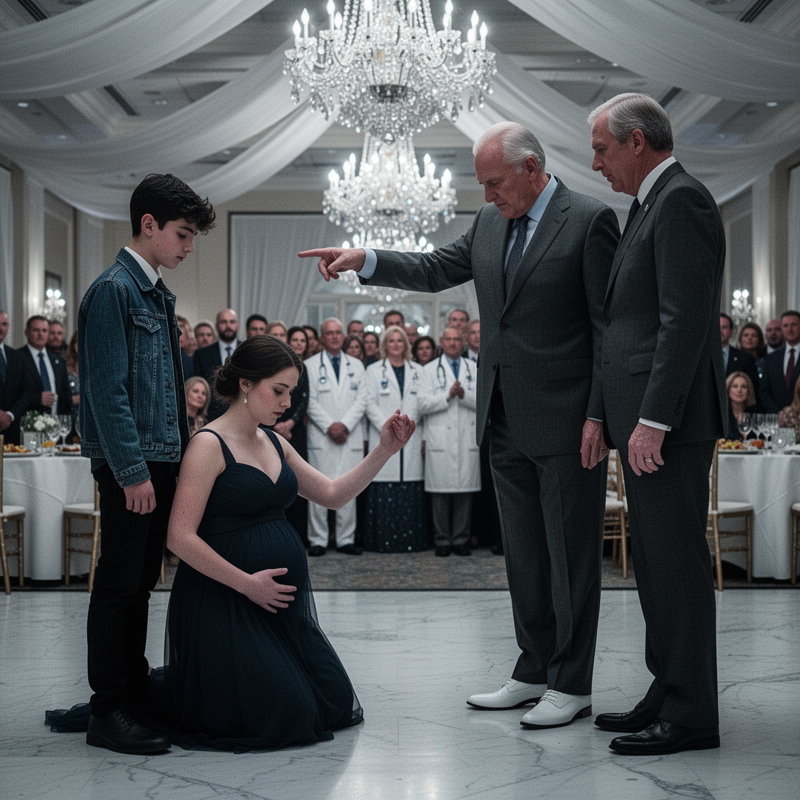
“Clean it off right now, or you and your teenage sister are on the street tonight,” Victor Kincaid demanded, pointing down at a wine stain on a board member’s shoe.
My eight-month pregnant sister Clara lowered herself onto her knees on the cold marble floor of the medical housing banquet hall, fighting back tears while dozens of doctors watched in silence.
I was sixteen years old, standing frozen beside her, holding her trembling hand as our landlord towered over us.
The air in the grand ballroom of St. Jude Medical Center usually hummed with polite chatter and the clinking of champagne flutes. Tonight, it was a tomb. The high ceilings, draped with white fabric for the annual donor gala, seemed to press down on us, amplifying the silence.
Crystal chandeliers glittered, casting a cold, indifferent light on the scene.
Clara, heavy with the weight of her unborn child, moved slowly, her body trembling with a mix of shame and suppressed anger. Her fingers fumbled with the tiny cocktail napkin Kincaid had flung.
The wine stain, a deep, angry red, was a brutal contrast against the pristine white shoe of Dr. Robert Holbrook, St. Jude’s Chief of Cardiology. He stood rigid beside Kincaid, his face a mask of discomfort, eyes darting from Clara to the silent crowd. He wouldn’t intervene. None of them would.
Victor Kincaid, immaculate in his charcoal suit, smirked. He looked like a predator, sleek and utterly confident in his dominion. He owned Kincaid Medical Housing, the complex where our apartment was. He owned the loyalty of these doctors, whose careers often depended on his influence.
He believed he owned us.
“Honestly, Clara,” he drawled, his voice pitched just loud enough for the closest tables to hear. “Such carelessness. This isn’t some cheap diner. This is St. Jude.”
A few murmurs rippled through the onlookers, quickly dying down. Most averted their gazes, pretending to be deeply absorbed in their half-eaten hors d’oeuvres or the intricate patterns on the ceiling. Their discomfort was palpable, but their inaction was a heavier weight.
My stomach churned with a desperate, burning helplessness. We had already lost so much. My father, Dr. Julian Lin, had been Chief Pathologist here, respected, brilliant. Then, two months ago, he was gone, suddenly, unexpectedly.
And just like that, everything changed.
Kincaid had swooped in, claiming my father owed $180,000 in back rent on our apartment, a sum that felt impossible, monstrous. Without my father’s salary, we had no way to pay.
Clara’s hand, still in mine, felt cold and damp. I could feel the tremors running through her. She gasped softly again, a quick, shallow breath, and her hand pressed instinctively against the curve of her belly.
The baby. My niece or nephew.
I imagined us, Clara, her baby, and me, out on the street tonight, just as Kincaid had threatened. The thought was a physical blow, stealing the air from my lungs.
My grip tightened on Clara’s hand, a silent promise I didn’t know how to keep. My sixteen years felt utterly inadequate against Kincaid’s cold, calculated power.
Clara took a deep, shaky breath, her eyes closed for a moment. She looked up at Kincaid, a fragile plea in her gaze.
“Please, Mr. Kincaid,” she whispered, her voice barely audible. “I’m trying. It’s… it’s difficult to bend.”
“Oh, it’s difficult now?” Kincaid chuckled, a harsh, humorless sound. He leaned closer, his voice dropping to a theatrical whisper that still carried. “Then perhaps you should have thought about that before your deceased father decided to default on his lease for over a year.”
The lie hung in the air, thick and nauseating. My father had never missed a payment in his life. He was meticulous with finances, almost to a fault. Kincaid was fabricating this, twisting reality, crushing us under the weight of his false narrative.
A few doctors exchanged glances, uncertainty flickering in their eyes. Kincaid had been circulating rumors, whispers about my father’s supposed financial recklessness. He was poisoning my father’s memory, eroding his reputation.
My whole body tensed, a desperate protest forming in my throat, but it died before I could utter a sound. What could I say? Who would believe me?
Clara dabbed at the shoe again, her movements becoming slower, more labored. Another tremor ran through her, deeper this time, a full-body shudder. Her face was pale, almost translucent in the bright hall lights.
Suddenly, my late father’s emergency satellite phone vibrated inside my denim jacket pocket.
The buzzing was a jolt, an unexpected intrusion into the suffocating tableau. My father had kept it with him always, an old habit from his international research trips. It was heavy, strangely comforting in my pocket. I hadn’t even thought to remove it.
My hand instinctively dove into the pocket, fingers fumbling around the cold metal. My heart hammered against my ribs, a frantic drum against the silence. Why was it buzzing now? It was never active.
I pulled it out, my eyes squinting at the sudden brightness as the screen flared to life. It was a model from years ago, clunky and thick, but the display was surprisingly sharp.
A automated notification from St. Jude Medical Center bio-vault flashed across the screen: “Dr. Julian Lin’s Confidential Estate & Pathology Archive: Unlocked.”
My mind, still reeling from Kincaid’s cruelty, struggled to process the words. “Estate.” It wasn’t just “pathology.” Estate meant assets, property. A sudden, cold shock of realization spread through me, chilling me to the bone, then igniting a furious heat.
The medical housing. The land trust. Kincaid had always treated it like his sole possession, his birthright. But my father… his estate…
The truth hit me with the force of a physical blow. My father hadn’t owed Kincaid a dime. He *co-owned* the building trust that governed this very medical housing. He had built it, invested in it, not defaulted on it. Kincaid had been lying. All of it. The back rent, the threats, the public humiliation. It was all a calculated, monstrous lie.
The icy dread that had gripped me for weeks evaporated, replaced by a surge of pure, incandescent rage. It coursed through my veins, electrifying every nerve ending. My father was not a debtor. He was an owner. And Kincaid had tried to erase him, to erase us.
My grip on Clara’s arm tightened, no longer out of shared fear, but with a fierce, protective strength that surprised even me. Her eyes fluttered open, wide and startled, meeting mine. She saw the change in me, the sudden, unyielding resolve.
I pulled Clara up by her arms.
She stumbled, her pregnant body swaying, but she found her footing beside me, leaning heavily. Her eyes darted from Kincaid to me, confusion warring with a fragile hope.
I turned to Victor Kincaid. His smug expression had faltered, a flicker of irritation crossing his face at my sudden movement. But then he saw my eyes, and the irritation morphed into something else: surprise, then a dawning unease.
My voice, usually quiet and hesitant, cut through the hushed hall, each word deliberate, sharp, and laced with an anger I didn’t know I possessed.
“You,” I said, my gaze locking onto his, refusing to flinch.
“You have five seconds to step back,” I continued, feeling the tremors in my own body, but forcing the words out. “Before the truth about your late daughter’s death tears your medical empire apart.”
Part 2
My words hung in the air, sharp and defiant. A collective gasp rippled through the room.
Kincaid’s face, usually so composed, contorted with a mixture of shock and pure, venomous rage. His eyes burned with an inferno.
He took a menacing step toward me. “You insolent child!” he spat, his voice raw with fury. “How dare you spread such vile fabrications?”
He quickly regained his composure, a condescending smirk replacing his rage. He turned to the stunned crowd, his voice dropping to a theatrical, regretful tone. “I apologize for this… outburst. Grief can lead to delusion, especially when compounded by a history of mental instability.”
He paused, letting the words sink in. He scanned the faces, ensuring his narrative was taking root.
“It truly pains me to reveal this,” he continued, pulling a folded document from his inner jacket pocket with a flourish. “But Dr. Julian Lin, while a once-respected pathologist, was unfortunately suffering from severe paranoid delusions in his final years.”
He unfolded the document, displaying it quickly. It looked official, a hospital letterhead, signatures. A monstrous, calculated lie.
“We were forced to let him go, for his own good, for patient safety,” Kincaid announced, his voice laced with false sympathy. “These are his psychiatric discharge papers from St. Jude, detailing his severe mental decline. It’s a tragic truth, but one we must acknowledge.”
The murmurs returned, louder, tinged with pity for my “delusional” father. Kincaid had turned the tables, painting my father as unstable, me as an unreliable accuser. My rage turned cold, replaced by dawning horror.
Clara gasped, her hand flying to her mouth. She looked at me, then at the document, her eyes wide with disbelief, her face draining of color.
“Nurse Drake!” Kincaid barked, his eyes narrowing on me. Sarah Drake, the property manager, flinched. She was standing by the entrance, her face pale.
“Escort these two out immediately,” Kincaid commanded, his voice like ice. “And make sure their unit is locked and secured by morning. No exceptions.”
Sarah hesitated, her gaze flicking between Kincaid and us. With a tight nod, she moved toward us, her expression unreadable as she took Clara’s arm gently.
“Come on, girls,” she said, her voice low, pulling us away from the stunned silence of the banquet hall. We walked past the staring faces, the whispers, the shattered fragments of my father’s reputation.
My mind raced. How could he have these papers? How could he lie so easily? He was twisting everything.
As we reached the corridor, just outside the main doors, Sarah’s hand subtly brushed against mine. She didn’t look at me, her gaze fixed straight ahead, but in that fleeting moment, something small and cold was pressed into my palm.
My fingers instinctively closed around it. It was a brass keycard, smooth and worn, with a single, small numeral “B” engraved on its surface.
CHAPTER 2: The Sub-Basement Locker
The heavy steel doors of St. Jude’s sub-basement B3 swung shut with a muffled thud, cutting off the distant hum of the hospital lobby.
The corridor smelled of industrial floor cleaner and damp cold concrete.
I pulled Sarah Drake’s brass keycard from my denim jacket pocket, my fingers brushing against my late father’s satellite phone.
Locker 114 sat at the end of a dimly lit storage alcove, tucked beneath a network of frost-coated cooling pipes.
I swiped the keycard. A small LED light flashed green, and the heavy magnetic latch disengaged with a metallic clack.
Inside the temperature-controlled metal vault sat a single velvet-lined box.
I lifted the lid. Resting inside was my father’s physical silver engraved stethoscope, its surface polished and cold against my palms.
I turned the heavy chest-piece over, noticing a micro-seam running along the brass rim that had never been there before.
I twisted the metal rim counter-clockwise until it unthreaded, revealing a tiny silver micro-drive embedded inside the casing.
A piece of folded waterproof paper slipped out behind it, covered in my father’s sharp, familiar handwriting.
“If you are reading this, Victor has already tried to erase us,” the note read. “Do not let him bury the data.”
CHAPTER 3: Darkness in Unit 4B
By midnight, the temperature outside dropped to fifteen degrees, sending frost crawling up the inside of our living room window pane.
I walked into Unit 4B to find Clara shivering under three wool blankets, her hands cradling her eight-month pregnant stomach.
Our breath billowed in thick white clouds inside our own kitchen.
The electric radiator in the corner was dead, and every light switch on the wall clicked uselessly.
I wrapped my heavy winter coat around Clara’s shoulders and marched straight down to the residential building lobby.
Victor Kincaid stood near the main office entrance, holding a clipboard alongside a building technician.
“The heating unit in 4B is off, Mr. Kincaid,” I said, my voice echoing in the marble entryway. “My sister is eight months pregnant.”
Kincaid didn’t look up from his papers.
“Your late father tampered with the main breaker box years ago, Maya,” he said calmly. “It’s an uncertified fire hazard.”
“It worked fine yesterday,” I said, stepping into his line of sight.
Kincaid leaned down, his eyes cold and unwavering.
“If you bring an infant into a freezing apartment with illegal wiring, I will have Child Protective Services remove the child at birth,” he whispered. “You have until morning to clear out.”
CHAPTER 4: The Brugada File
The public library across from the hospital was empty at seven in the morning.
I plugged the silver micro-drive into a corner workstation computer and waited for the encrypted files to open.
A series of high-resolution pathology scans and genetic sequencing logs filled the screen.
The file heading read: *Kincaid, Victor – Genetic Panel & Arrhythmia Tracking.*
My eyes scanned down the clinical rows until I reached a bolded red warning label near the center of the page.
Victor Kincaid carried Brugada Syndrome, a rare and fatal genetic cardiac defect that caused sudden bio-electric heart failure.
Attached to the file was an eight-year-old pediatric autopsy report for Chloe Kincaid, age twelve.
She had died instantly in her sleep from the exact same un-diagnosed heart condition.
My father hadn’t been stealing money or hiding back rent from Kincaid.
He had been running unauthorized cellular synthesis trials in the sub-basement to create a targeted therapy before Kincaid’s own heart gave out.
CHAPTER 5: The Psychiatric Slander
When I walked back through the residential building front doors, three medical tenants were standing near the mailboxes, whispering.
Bright white legal notices had been stapled onto every communal bulletin board on all four floors.
I walked over and ripped one off the cork wall.
It was an official-looking hospital document bearing my father’s name and photo across the top.
*Notice of Posthumous Discharges: Dr. Julian Lin.*
The text below detailed a series of fabricated psychological evaluations, claiming my father suffered from late-stage delusional paranoia and financial fraud.
It claimed his medical license had been quietly flagged for severe cognitive decline before his death.
“He’s destroying my dad’s entire life,” I muttered, squeezing the paper into a tight ball in my fist.
A second-year surgical resident turned away from me, grabbing her mail and hurrying up the stairs without meeting my gaze.
Kincaid wasn’t just trying to evict us. He was making sure that if I ever spoke the truth about his records, everyone in the medical system would think I was as unhinged as he claimed my father was.
CHAPTER 6: Confessions in the Cafeteria
The hospital cafeteria smelled of burnt coffee and fried hash browns.
Nurse Sarah Drake sat in a back booth away from the overhead security cameras, her hands wrapped tightly around a styrofoam cup.
I slid into the vinyl seat across from her and placed my father’s silver stethoscope on the laminate table.
Sarah looked at the engraved metal and let out a long, ragged breath.
“He thinks Julian let Chloe die,” Sarah said, her voice barely audible over the hum of the ice machine.
“What are you talking about?” I asked.
“Eight years ago, when Chloe collapsed, your dad was the attending pathologist on call,” Sarah explained. “Victor begged him to run experimental drugs, but Julian refused because the data wasn’t verified.”
She looked down at her hands.
“Chloe died three hours later. Victor spent every day since believing Julian was a coward who let his daughter die out of spite.”
“My dad spent his last six months in a basement lab trying to save Victor’s life!” I said.
Sarah looked at me, tears brimming in her eyes.
“I signed off on those utility notices because Victor promised to terminate my contract if I didn’t,” she whispered. “I was terrified, Maya. But I won’t let him freeze your sister.”
CHAPTER 7: Pre-Term Emergency
By five o’clock that evening, a severe winter thunderstorm slammed into the city, rattling the window panes of Unit 4B with sleet and ice.
Heavy boots pounded against the hallway carpet outside our apartment door.
The door burst open without a knock.
Victor Kincaid stood in the doorway, backed by two uniformed private security officers.
“Emergency lockout order for severe code violations,” Kincaid announced, holding up an orange paper. “You have sixty minutes to step outside.”
Clara stood up from the sofa, her face instantly turning pale.
“We have nowhere to go in this storm, Mr. Kincaid,” Clara pleaded, reaching out for the doorframe.
Suddenly, Clara gasped, doubling over as her hands clutched her lower abdomen.
A sharp, audible groan escaped her lips as her knees buckled under her weight.
“Maya…” Clara gasped, sweating despite the freezing room. “The baby… it’s happening now.”
“Get out of the way!” I screamed, shoving past the security guards to catch Clara before she hit the floor.
Pre-term labor contractions were hitting her every two minutes as I dragged her down the freezing concrete stairwell toward the street level.
CHAPTER 8: The Sub-Basement Standoff
I got Clara through the sliding glass doors of the Emergency Room, where two nurses immediately loaded her onto a gurney and wheeled her into triage.
Once I knew she was surrounded by monitors, I turned around and ran straight toward the sub-basement stairs.
I needed the original physical tissue logs from Locker 114 to prove to Dr. Holbrook that the genetic research was real.
I reached the bottom of the B3 stairwell, my sneakers squeaking against the polished linoleum.
As I grabbed the handle to the storage clinic, a heavy hand slammed against the metal doorframe above my head.
I spun around. Victor Kincaid stood inches from me, his chest heaving, his face flushed red with rage.
“Give me the stethoscope, Maya,” Kincaid growled, blocking the narrow hallway. “And hand over that drive.”
“My father gave his life trying to fix your broken genetics!” I yelled, pulling the silver stethoscope tight against my chest.
“Your father was a fraud who ruined my family!” Kincaid shouted, stepping closer and backing me against the cold wall.
“Hand it over now, or I swear your sister gets discharged onto the sidewalk tonight.”
CHAPTER 9: The Lightning Strike
Before I could answer, a blinding flash of blue-white light illuminated the small frosted window at the top of the stairwell.
A deafening boom shook the concrete walls of the sub-basement, rattling the metal pipes overhead.
The overhead fluorescent lights flickered violently once, twice, and then went completely dark.
The loud hum of the main ventilation system died instantly, leaving the sub-basement in heavy, suffocating silence.
The emergency generator backup click echoed down the hallway, but the red ceiling lights failed to turn on in the storage wing.
We were trapped in absolute, impenetrable darkness.
“Kincaid?” I called out, taking a cautious step back.
Instead of an answer, a harsh, violent gasp tore through the dark corridor.
A loud thud echoed against the linoleum as something heavy slammed against the concrete wall and slid to the floor.
“I… I can’t…” Kincaid choked out, his breath coming in rapid, unnatural rattles.
He was clutching his chest in the pitch-black hallway, his heart slipping into the lethal arrhythmia my father had spent years trying to prevent.
CHAPTER 10: Pacing in the Dark
I dropped to my knees in the dark, my hands sweeping across the cold floor until my fingers hit Kincaid’s heavy wool coat.
His body was violently shaking, his pulse fluttering beneath his neck like a dying bird.
“Brugada event,” I murmured, my heart pounding in my ears.
I remembered the exact diagram from my father’s pathology log: *Manual precordial pacing protocol for acute sodium channel blockages.*
I placed the heel of my right hand directly over the lower third of Kincaid’s sternum, placing my left hand firmly over my knuckles.
I delivered a sharp, controlled closed-fist precordial strike straight down into his chest wall.
Kincaid gasped violently, his throat making a wet, choked sound.
“Listen to me!” I shouted in the dark, placing my thumb firmly against his carotid artery to check the rhythm. “My father didn’t hate you!”
I delivered two more steady, synchronized chest compressions, keeping the rhythm in my head.
“He spent his last days down here dying of exhaustion because he wanted to make sure you didn’t die the same way Chloe did!” I cried out into the blackness.
“He loved your daughter, Victor! He was trying to save you for her!”
Underneath my fingers, the irregular fluttering pulse suddenly surged, stabilizing into a strong, rhythmic beat.
Kincaid drew in a deep, desperate breath of air, his fingers clutching tightly to the sleeve of my jacket in the dark.
CHAPTER 11: The Waking Remorse
A sharp buzzing noise sounded from the end of the hallway as the secondary circuit breaker finally kicked in.
Emergency white floodlights flickered to life, bathing the concrete corridor in bright, stark light.
Footsteps thundered down the stairwell as Dr. Holbrook and three ER nurses rounded the corner carrying an emergency crash cart.
“Over here!” I yelled, waving my arm.
Kincaid lay on his back, his eyes open, staring up at the concrete ceiling as the medical team rushed to his side.
Tears were streaming down his face, cutting clean lines through the dust on his cheeks.
He looked down at my hands, which were still covered in black rubber dust from the storage floor.
Dr. Holbrook reached down to attach defibrillator pads, but Kincaid weakly raised his left hand, waving the doctor off.
He reached into his inner coat pocket with trembling fingers, pulled out the signed orange eviction notice for Unit 4B, and slowly tore it into shreds.
The paper scraps drifted down onto the linoleum floor.
“Admit me,” Kincaid choked out, his voice broken and hollow as he looked up at Dr. Holbrook. “Admit me to cardiology… under Julian Lin’s protocol.”
CHAPTER 12: A Message from Unit 4B
Four weeks later, the afternoon sun spilled across the freshly painted living room wall of Unit 4B.
The apartment was warm, the new digital thermostat on the hallway wall reading a steady seventy-two degrees.
I stood by the bright window, gently rocking my newborn baby niece, Lily, in my arms while Clara slept peacefully on the sofa nearby.
The quiet of the apartment was broken by a soft chime from my denim jacket pocket.
I pulled out my father’s old phone and clicked open the single incoming text message.
It was from an unlisted number linked to St. Jude’s cardiology recovery wing.
“Procedure complete. Genetic therapy successful,” the message read. “Building trust deed signed over to the Lin Family Foundation today. I am sorry, Maya. For everything.”
I looked at the screen for a moment, letting the words sink into the warm air of the room.
I typed back five short words: “Get well soon, Mr. Kincaid.”
I closed the phone, placed it quietly on the side table, and leaned down to touch my niece’s soft forehead.
My father spent his last days trying to fix a heart that was broken in more ways than one. In the end, saving it was the only real justice.
Leave a Reply