CHAPTER 1: The Silicon Scalpel
Part 1
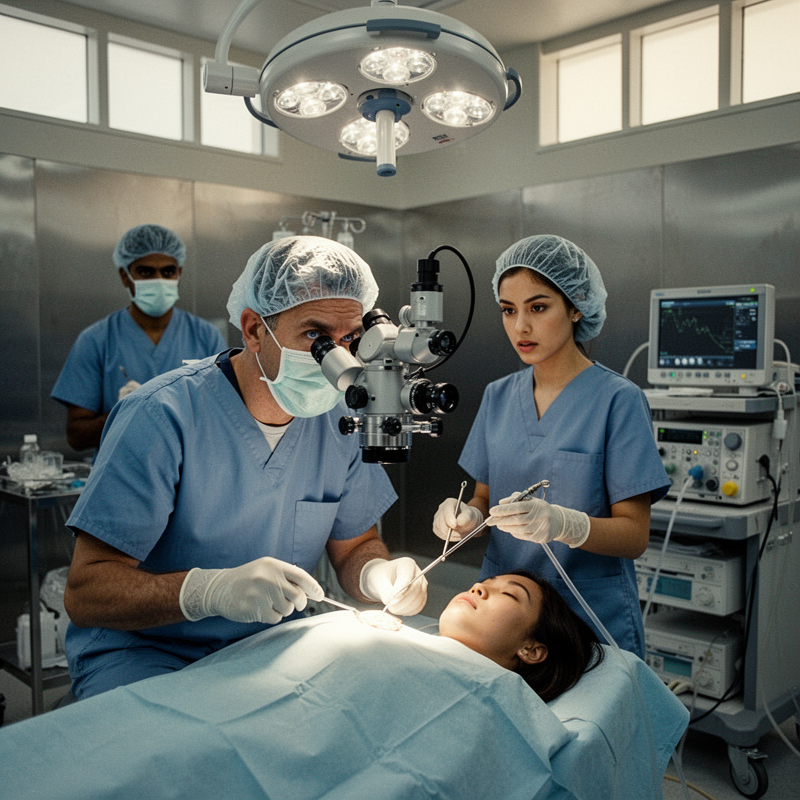
“Dr. Vance, look at the cortical margin—that isn’t tumor tissue,” senior surgical resident Dr. Chloe Bennett whispered, her suction tip frozen inside the open craniotomy of 28-year-old software engineer Sarah Lin. I leaned over the surgical microscope at 6:40 PM inside OR-4 at UCSF Medical Center, expecting a standard high-grade glioblastoma, but my titanium forceps clinked against a solid, rectangular piece of micro-etched silicon embedded deep within her left parietal lobe. Before I could process why a military-grade microchip was wired directly into her central nervous system, the standard telemetry monitor chimed three sharp high-pitched beeps, wiped Sarah’s vitals from the glass screen, and replaced them with a flashing red text box: ‘KILL-SWITCH ACTIVATED: 00:30.’ As the timer began ticking down toward zero, the magnetic lock on the operating room doors clicked shut from the outside.
The heavy steel doors of OR-4 sealed with a thick pneumatic hiss and a metallic thud.
I stepped back from the surgical microscope, my gloved hands dripping with warm saline.
“What did you just hit?” Dr. Gautam Patel asked, leaning over the top of his anesthesia cart.
“It’s solid,” I said.
“Is that… metal?” Dr. Chloe Bennett whispered, her hands trembling around the suction retractor.
“It’s silicon,” I replied, keeping my voice dead even. “Micro-etched silicon, wired straight into her parietal cortex.”
A sharp electronic beep echoed off the sterile stainless steel walls.
00:28.
00:27.
00:26.
“Dr. Vance, look at the door!” Chloe shouted, her gloved finger pointing wildly toward the double entry doors.
“Gautam, hit the manual override pad,” I ordered.
Dr. Patel rushed past the stainless steel mayo stands and slammed his palm against the yellow emergency door release on the wall.
Nothing happened.
The green access indicator light above the door mechanism flickered once and died completely.
“It’s dead,” Patel said, his voice dropping an octave as he tugged hard on the handles. “The magnetic relay completely lost signal. We’re sealed in.”
“That’s impossible,” Chloe said, her voice rising into panic. “The emergency doors are on a completely independent hardwired circuit!”
“Not anymore,” Patel muttered.
I leaned back over the microscope eyepiece.
The rectangular piece of silicon was no larger than four millimeters long, but micro-fine copper filaments ran out from its edges like spiderweb threads.
They weren’t merely resting on the gray matter.
They were woven directly into Sarah Lin’s central nervous system, anchoring themselves deep along her primary motor pathways.
00:22.
00:21.
“The vitals,” Chloe gasped, stepping back from the operating table. “Where are her vitals?”
The primary wall monitor was no longer displaying her blood pressure, oxygen saturation, or intracranial pressure readings.
clear yellow and green telemetry lines had been violently erased.
In their place, massive glowing red text filled the dark glass display.
`KILL-SWITCH ACTIVATED: 00:19.`
“The monitor didn’t lose its connection,” I said, staring at the screen. “It was overridden from an external signal.”
“Overridden by who?” Chloe asked, her eyes wide above her surgical mask. “We’re in the middle of a live brain surgery!”
“00:17,” Patel read aloud from his secondary cart monitor. “Marcus, whatever that thing is, it’s taking over the room’s master distribution board.”
“Look at the saline inside her brain,” Chloe whispered.
Inside the open cranial window, tiny silver bubbles were forming rapidly along the cortical margins surrounding the microchip.
A rogue electrical micro-current was flowing directly through the copper leads.
The chip wasn’t drawing power from our surgical equipment or our wall outlets.
It was drawing power directly from Sarah Lin’s own bio-electric nervous system.
“She came through the emergency department two hours ago,” I said, my mind reviewing her chart in real time. “28 years old. Lead cybersecurity engineer. Presented with acute focal seizures. Her transfer CT scans showed a high-grade space-occupying lesion.”
“A glioblastoma,” Chloe stammered, her brow slick with sweat. “That’s what the chief radiologist signed off on.”
“It was never a tumor,” I said.
00:14.
00:13.
00:12.
“Marcus, look at her left pupil,” Patel called out, shining his penlight directly into Sarah’s exposed eye. “It’s completely blown. She’s suffering an acute neuro-electrical surge!”
“What happens when that clock hits zero?” Chloe asked, backing away until her shoulders hit the stainless steel instrument cabinet.
“The chip isn’t sending diagnostic telemetry anymore,” I said, watching the tiny copper wires vibrate against her brain tissue under the bright surgical light. “It’s preparing to dump a lethal voltage discharge straight down her brainstem.”
The warning chimed again, louder and higher in pitch, echoing inside the locked, windowless operating room.
We were sealed inside OR-4.
Our patient was wide open on the table.
And in less than ten seconds, an illegal military-grade microchip was going to trigger a fatal cardiac arrest and fry Sarah Lin’s brain from the inside out.
Part 2
“Ten seconds,” Patel shouted, his hands clamped on Sarah’s pulse point. “Marcus, her sinus rhythm is breaking down!”
I didn’t answer. My eyes dropped to the heavy industrial suction pump standing beside the primary sterile field. It was plugged directly into the wall’s high-voltage isolation transformer, linked straight to the building’s grounded copper structural frame.
“Hand me the heavy utility shears,” I said, reaching across the tray.
“What are you doing?” Chloe cried out.
I grabbed the thick, insulated power cable running to the suction pump and drove the hardened steel blades right through the outer sheath, cutting clean through the live conductors.
Sparks erupted in a brilliant white flash against the tile floor.
00:06.
00:05.
00:04.
Before the room’s central circuit breakers could trip, I slammed the bare, frayed copper wires directly against the solid stainless steel rail of the operating table.
A sharp electrical crack echoed off the walls. A sudden localized current surge flooded through the grounded frame, bypassing the digital control board entirely and short-circuiting the local switch.
The telemetry monitor shrieked a high-pitched digital whine. The bright red screen glitched violently, lines of distorted code tearing across the glass before freezing completely in place.
`KILL-SWITCH ACTIVATED: 00:03.`
The clock stopped cold.
Chloe fell back against the wall, her chest heaving as the room settled into a heavy, suffocating silence.
“Did… did you stop it?” Patel asked, leaning over the manual console, his voice shaking.
“I grounded the digital interface,” I said, wiping cold sweat from my forehead with the shoulder of my gown. “The local trigger lost its path.”
“Her heart is still beating,” Patel whispered, staring at his mechanical pressure gauge. “Sinus rhythm is stabilizing.”
I leaned back down over the surgical microscope to inspect the cortical tissue around the chip.
Then I froze.
Deep inside Sarah’s left parietal lobe, a tiny pinprick light on the corner of the micro-etched silicon began to flash.
It was a sharp, brilliant crimson diode embedded within the chip’s casing, pulsing steadily at exactly 120 beats per minute.
“Marcus,” Patel called out, staring at his backup frequency monitor as a secondary light flickered back on. “It’s transmitting.”
Across the glass screen, a single line of raw system telemetry re-established itself over an automated bypass frequency:
`UPLINK ESTABLISHED. DIRECTORY STREAMING TO EXTERNAL HOST: PALO ALTO NETWORK SERVER 09.`
CHAPTER 2: The Toxic Scan
The Palo Alto uplink light on the monitor continued its steady, crimson pulse.
I stepped back from the open cranial field and signaled for anesthesiologist Dr. Gautam Patel to step closer.
“Gautam, bring up her pre-operative MRI series on the secondary display,” I said, my voice barely carrying over the hum of the air scrubbers. “Look at the T2-weighted sequence around the parietal margin.”
Dr. Patel tapped the glass interface, zooming in on the dense tissue surrounding the metallic housing inside Sarah Lin’s skull.
Instead of the ragged, infiltrating edges of a glioblastoma, fine dark specks radiated outward like iron filings drawn to a magnet.
“That isn’t tumor necrosis,” Patel whispered, his fingers pausing over the console. “Those are heavy metal deposits. Cadmium and lead.”
“She was never dying of a natural brain cancer,” I said. “Someone micro-dosed her over eight months to induce localized cerebral edema.”
“An artificial swelling,” Patel replied, his eyes widening behind his surgical mask. “It mimicked an aggressive glioblastoma on standard scans.”
“It was designed to force an emergency craniotomy,” I said. “It put her directly on the surgical schedule of Dr. Arthur Pendelton.”
I turned to resident Dr. Chloe Bennett, who stood rigidly by the instrument tray. Her hands trembled inside her sterile blue gloves.
“Chloe, hand me a twenty-milliliter syringe of neutral saline flush,” I ordered. “We need to irrigate the surgical pocket.”
Chloe did not move for three full seconds. Her eyes darted from the pulsing red light on the telemetry monitor to the door of OR-4.
“Dr. Vance,” Chloe stammered, her voice shaking. “The Palo Alto connection… it’s gaining bandwidth. It’s writing to our local network.”
“Prepare the saline flush, Chloe,” I repeated. “Now.”
She reached for the tray, her silver forceps clattering against the stainless steel surface.
CHAPTER 3: Forty-Seven Shadows
I reached into the emergency diagnostic kit and pulled out a handheld surgical optical scanner.
Plugging the cable directly into the chip’s exposed diagnostic port, I pulled up the raw, unencrypted telemetry stream on my sterile hand tablet.
Lines of hex code flooded the screen, bypassing the hospital’s firewall completely.
“What are you looking at, Marcus?” Patel asked, stepping around the IV pole.
“The chip’s active registry,” I said.
A regional network log opened, displaying a live directory of hardware identification serial numbers.
I scrolled through the list. Forty-seven distinct serial entries sat on the glass screen, each assigned to a different patient file across three major teaching hospitals in California.
Every single entry was tagged with a terminal glioblastoma diagnosis.
“They aren’t testing medical devices,” I whispered. “They’re using terminal brain cases as live, off-grid processing nodes for Apex Neurosystems.”
“Forty-seven people,” Patel said, his jaw tightening under his mask. “They’ve wired human brains together into a remote network.”
Before I could export the directory to a flash drive, a sharp mechanical hiss echoed from the ceiling utility panel.
The digital panel on the wall flashed amber. The surgical suite’s oxygen line pressure dropped from fifty psi down to twelve in five seconds.
“The main gas manifold,” Patel said, lunging for the manual pressure valve. “Someone just altered the oxygen flow controls from the central administrative desk.”
CHAPTER 4: Scalpel in the Dark
Patel grabbed a manual oxygen bag and began compressing it rhythmically over Sarah’s endotracheal tube.
I stepped away from the table to inspect the emergency wall-mounted oxygen tanks behind the anesthesia cart.
As I turned, I saw Chloe Bennett reach into her lab coat pocket and pull out a pre-filled twenty-milliliter syringe.
She moved toward Sarah’s central IV line, her thumb pressing hard against the plunger.
I lunged forward, grabbing Chloe’s wrist inches from the injection port.
The syringe fell from her fingers, shattering on the tile floor and releasing a clear liquid that smelled faintly of salt and rubber.
“Potassium chloride,” I said, reading the label on the broken glass. “Fifty milliequivalents. That would have stopped her heart in under ten seconds.”
“I didn’t have a choice, Dr. Vance,” Chloe sobbed, her body shaking as I pinned her arm against the wall.
I pulled a flat, encrypted mobile terminal out of her coat pocket.
The screen lit up instantly, displaying a wire transfer confirmation from an offshore account in the Cayman Islands for $150,000.
“Pendelton,” I said.
“Dr. Pendelton said she couldn’t leave this room alive,” Chloe whispered. “He said if the chip touched open air, she had to die on the table.”
Before I could respond, the overhead surgical lamps sputtered twice and died.
The digital monitors went completely dark, dropping OR-4 into absolute, pitch-black silence.
CHAPTER 5: Blackout Protocol
“Total power failure,” Patel said from the dark. “The emergency generators should have kicked on in three seconds.”
“They were bypassed,” I said, unclipping my surgical headlamp and snapping the LED light on. “Apex is cutting the grid.”
The harsh white beam illuminated Sarah’s open skull and the still-pulsing microchip.
“They know we stopped the kill-switch,” I said. “Corporate security will be at those doors in under two minutes.”
“Where do we go?” Patel asked, holding the manual ventilator bag firm. “The whole building is locked down.”
“The service corridors,” I said.
We rapidly unhooked Sarah from the ceiling gantries and transferred her onto a manual transport gurney.
Patel kept squeezing the manual bag while I pushed the heavy gurney toward the rear utility exit of OR-4.
I pulled a brass master key from my neck lanyard and unlocked the heavy gray door leading to the service stairwell.
We wheeled the gurney into the concrete corridor just as the heavy front doors of OR-4 were smashed open by boots above us.
“Down,” I whispered. “To the sub-basement.”
We maneuvered the gurney into an abandoned 1970s freight elevator that bypassed the hospital’s modern digital card readers.
I pulled the manual iron lever down. The ancient lift groaned, lowering us deep into the concrete foundation beneath the building.
CHAPTER 6: Highway 80 Telemetry
The freight elevator rattled to a stop in the decommissioned sub-basement radiology suite.
Dust covered the disused film racks and heavy Lead-lined walls built fifty years ago.
I pushed the gurney into an old darkroom, placing Sarah under the glow of a single battery-powered work lamp.
I pulled an old analog oscilloscope off an iron shelf and connected its copper probes to the diagnostic pins on Sarah’s neural chip.
Green wave traces flickered across the rounded cathoderay tube.
“This chip stores local event logs,” I said, fine-tuning the frequency dial. “It records motor-control override events.”
A file directory decoded into raw text on the small display screen.
“Look at this timestamp,” I said, pointing to an entry dated fourteen days prior. “Command code: Executive Override. Sector: Interstate 80.”
Patel leaned down, his forehead slick with sweat. “The twelve-car pile-up on the Bay Bridge two weeks ago?”
“Apex tested a remote motor hijacking command on a test subject driving fifty miles an hour,” I said. “They wiped out a highway to test their signal range.”
“Sarah found this file on their servers,” Patel said. “That’s why they poisoned her.”
A heavy metallic boom vibrated through the floorboards above us.
CHAPTER 7: Iron Gate in the Basement
The sound echoed again—a heavy, pneumatic clanging that sealed the darkroom’s outer corridor.
An old wall-mounted intercom box crackled to life with static.
“Dr. Vance,” Chief Raymond Torres’s voice boomed through the small speaker. “You are in a restricted hazmat zone.”
“Torres,” I shouted toward the box. “Pendelton poisoned this patient. He’s running illegal experiments on hospital ground.”
“I don’t care about your medical disputes, Doctor,” Torres replied, his voice completely flat. “Apex Neurosystems just transferred two hundred and fifty thousand dollars into my corporate account.”
“You sealed the sub-basement blast doors,” I said.
“You and the girl stay down there until CEO Sterling’s recovery team arrives,” Torres said. “The air scrubbers in that basement were decommissioned an hour ago.”
A loud click signaled the end of the transmission.
Above our heads, the ventilation ducts whined to a complete stop.
I looked down at the portable battery display attached to Sarah’s temporary monitor.
The green battery icon flickered, dropping to eighteen percent.
“We have less than twenty minutes of air,” Patel said, checking his wrist watch. “And her ventilator battery is dying.”
CHAPTER 8: The Hacker’s Sacrifice
A cold hand tightened around my right wrist.
I spun around. Sarah Lin’s eyes were open, cloudy from the lingering anesthesia, but sharp with focus.
“Marcus,” she gasped, her throat dry and raspy from the breathing tube.
“Don’t talk, Sarah,” I said, leaning down. “You’re in the basement. We stopped the kill-switch.”
“I… I let them do it,” she whispered, her fingers digging into my surgical sleeve.
“What do you mean?” I asked.
“The water,” she wheezed. “I knew they were micro-dosing my apartment water supply with cadmium.”
“You knew you were being poisoned?” Patel asked, stepping closer in disbelief.
“It was the only way,” Sarah said, coughing weakly. “Apex’s main network in Palo Alto is completely air-gapped. No digital signal can get in or out.”
She touched the edge of her head bandage.
“I downloaded their master source code onto this chip,” she said. “I needed to get operated on at UCSF so the hardware could be removed and read.”
“You turned your own brain into a physical flash drive,” I said, stunned.
“The root access code is six-four-nine-two-zero-eight,” Sarah whispered. “Pendelton will burn this entire building before he lets that key reach the light.”
CHAPTER 9: Code Red Frame
Sarah’s head fell back against the gurney pillow as her eyes drifted shut again under the stress of hypoxia.
“I need a fresh oxygen cylinder,” Patel said, pointing toward the dark hallway leading to the mechanical plant. “There are old emergency tanks stored near the boilers.”
“I’ll go with you,” I said.
“No,” Patel replied firmly. “Stay with her. Keep that root password ready.”
Patel slipped through the doorway into the unlit pipe corridor.
I checked the ventilator battery. Seventeen percent.
Thirty seconds later, a muffled gunshot echoed through the concrete walls, followed immediately by the dull thud of a body hitting the floor.
“Gautam!” I yelled, reaching for a heavy steel bone-lever off the tray.
I rushed out into the corridor. Dr. Gautam Patel lay beside the iron steam pipes, a single bullet wound in his chest.
Standing over him was Dr. Arthur Pendelton, holding a silenced nine-millimeter pistol.
Pendelton unclipped a wall-mounted radio from his belt and pressed the push-to-talk button.
“All units, this is Dr. Pendelton,” his voice echoed loudly through the hospital’s overhead PA speakers above. “Code Red in the lower levels. Dr. Marcus Vance has gone psychotic. He has executed Dr. Patel and is holding patient Sarah Lin hostage.”
Outside the high basement windows, red and blue police strobe lights began painting the concrete walls.
CHAPTER 10: Signal Above the Bay
Sirens screamed across the UCSF campus above as San Francisco Police Department SWAT units surrounded the perimeter.
I pulled back into the darkroom, grabbing Sarah’s gurney and pushing it toward the service stairwell behind the elevator shaft.
“Marcus,” Sarah’s voice was barely a whisper. “The police… they don’t know.”
“They think I’m an active shooter,” I said, hauling the heavy metal frame of the gurney up the concrete steps. “We can’t go out the ground floor.”
I dragged the gurney up six flights of emergency stairs, my lungs burning in the hot, unventilated air.
At 11:10 PM, I kicked open the heavy red door leading out onto the main hospital roof.
The cold San Francisco night air hit my face, smelling of salt fog and diesel exhaust.
In the center of the rooftop stood the hospital’s legacy analog paging broadcast antenna—a thirty-foot steel tower built in 1982.
I dragged a tool kit out of the rooftop maintenance shed and pulled two long strands of thick copper surgical wire from my coat.
I stripped the insulation with my teeth, clamping one end to the diagnostic pins on Sarah’s exposed scalp chip.
I climbed three rungs of the tower and twisted the other end directly into the high-voltage transmission lead of the analog antenna.
I pulled up my hand tablet, opened the chip interface, and typed the root password: 6-4-9-2-0-8.
“11:15 PM,” I whispered, slamming the transmit button.
A massive radio pulse surged through the copper wire, bypassing the local cell towers.
Across the Bay Area, television broadcasts flickered, radio frequencies squealed, and federal monitoring screens in the FBI Cyber Crime Division lit up with raw biometric data, forty-seven live patient coordinates, and encrypted corporate wire transfers.
CHAPTER 11: The Echo of the Heart
Two twin-engine helicopters cut through the fog, their searchlights blinding me as they hovered over the helipad.
The first chopper landed, dropping armed FBI SWAT agents who fanned out across the gravel roof with rifles raised.
The second helicopter touched down, and CEO Victoria Sterling stepped onto the roof, flanked by four private corporate guards in dark suits.
Sterling marched toward the FBI tactical commander, waving a thick leather folder.
“Stand down, Agent Miller!” Sterling shouted over the roar of the rotor blades. “This patient and all attached hardware fall under Title 50 Department of Defense national security jurisdiction!”
Agent David Miller hesitated, lowering his rifle slightly as he examined the forged federal security order in her hand.
“She’s lying, Miller!” I shouted, holding up my hand tablet. “Check your regional server logs right now!”
Miller reached into his tactical vest and pulled out his mobile terminal.
His eyes widened as megabytes of open-source raw data flooded the federal network—$14.5 million in offshore Cayman transfers, forty-seven precise hospital bed numbers, and the complete source code for the remote motor hijackings.
“The DoD order is fraudulent, Agent,” Miller declared, raising his weapon toward Sterling.
Dr. Pendelton burst through the rooftop door, holding a wireless corporate wiped-disk transmitter in his right hand.
“I’m purging the master chip right now!” Pendelton screamed, pressing a red trigger on his phone.
I smiled cold through my surgical mask.
“I re-routed Sarah’s short-range neural bridge frequency ten minutes ago, Arthur,” I said. “It’s paired directly to your short-range wireless pacemaker receiver.”
Pendelton’s face went white.
The corporate wipe signal bounced off his phone, hitting his own chest.
His digital cardiac pacemaker shorted out, pulsing at two hundred beats per minute.
Pendelton dropped his phone, clutched his chest, and fell to his knees on the gravel roof.
CHAPTER 12: Fall of the Syndicate
Agent Miller stepped forward, slamming Victoria Sterling against the side of the helicopter and snapping steel handcuffs over her wrists.
“Victoria Sterling, you are under arrest for treason, high-tech racketeering, and corporate homicide,” Miller announced.
FBI agents moved quickly across the roof, disarming Sterling’s four private guards and arresting Security Chief Raymond Torres as he stepped off the service stairs.
Two paramedics rushed to Pendelton, who lay writhing on the roof, his shorted pacemaker causing violent cardiac arrhythmia.
“Get him to the ER under armed guard,” Miller ordered. “He has a murder charge waiting for him if he survives.”
At the same me, federal agents in Palo Alto executed a simultaneous raid on Apex Neurosystems headquarters, seizing dark-budget servers and freezing $14.5 million in corporate accounts.
I knelt beside Sarah’s gurney, immediately disconnecting the surgical copper wiring from the rooftop antenna.
“We need to get her into a clean operating room right now,” I told Miller.
Twenty minutes later, I stood inside OR-1 under proper lighting, with fresh oxygen supplies and a loyal surgical team behind me.
For four agonizing hours, my titanium forceps worked with microscopic precision around her parietal lobe.
At 3:45 AM, I lifted the small, rectangular silicon chip out of Sarah Lin’s skull and dropped it into a glass specimen jar.
Her intracranial pressure stabilized instantly, her vital signs smoothing into a healthy, rhythmic line.
CHAPTER 13: Unseen Frequencies
Three weeks later, the afternoon sun streamed through the blinds of my Chief of Neurosurgery office at UCSF.
The internal hospital investigation had fully cleared my name, reinstating my surgical privileges and scrubbing the false Code Red from my record.
Resident Dr. Chloe Bennett faced twenty-five years to life for attempted murder and bribery.
Sarah Lin sat across from my desk, wearing a light blue scarf over her healing surgical scar.
Her cheeks had regained their color, and her hands were steady as she held a cup of tea.
“The Congressional committee called this morning,” Sarah said, a soft smile appearing for the first time. “I testify in Washington on Tuesday.”
“They need to hear everything you found,” I said, leaning back. “You exposed a network that would have turned thousands of patients into living microprocessors.”
“Thank you, Marcus,” she said softly, standing up and reaching across the desk to shake my hand. “You saved my life.”
“I just kept my oath,” I replied.
After Sarah left the office, I turned back to my desktop terminal to review the overnight emergency surgical logs.
An encrypted alert flashed red in the bottom corner of my screen—a background intercept tool I had left running on the hospital’s high-frequency antenna.
I clicked the notification.
Three faint, high-frequency signal bursts appeared on the map, completely outside the seized Apex network in Palo Alto.
The signatures matched the exact hardware serial formatting of the microchips.
The telemetry lines did not trace to California. They bounced directly off a military satellite array, terminating at an undisclosed underground research facility deep inside the Nevada desert.
I looked at the jar on my desk, the tiny piece of silicon sitting silent under the desk light.
A surgeon’s hands are bound by an oath written thousands of years ago, but as long as men trade human souls for silicon and copper, our fight will never be confined to the operating room.
Leave a Reply