CHAPTER 1: The Voice Beneath the Floorboards
Part 1
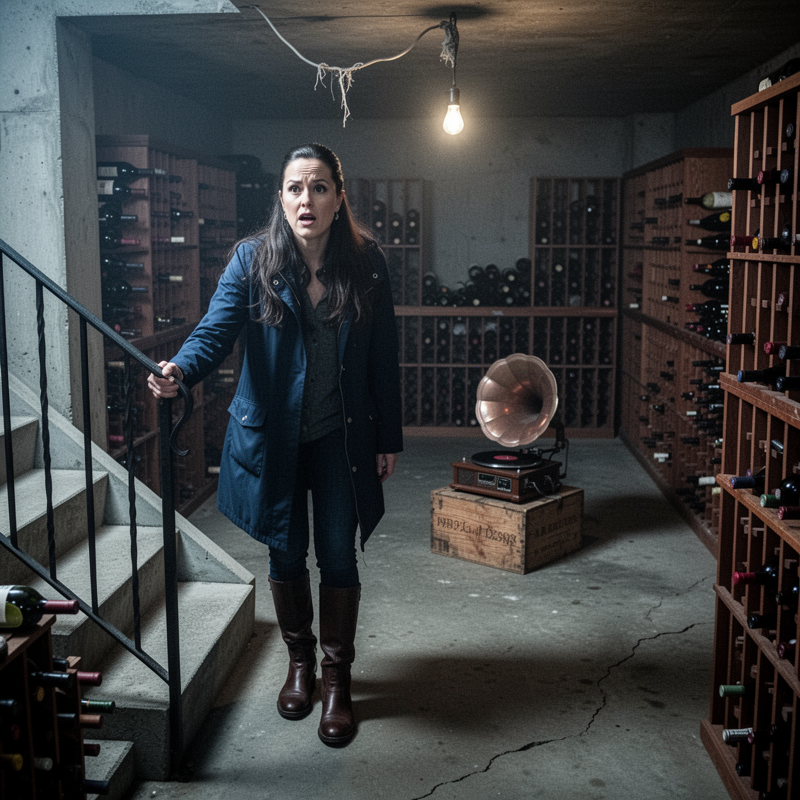
“Elena, don’t ask questions—just get down to the wine cellar right now, there’s a baby screaming under the floorboards,” her gardener Mateo gasped over the phone at 2:14 PM, his voice shaking so hard he could barely pronounce the words. Elena Vance dropped her tea cup, left her six-year-old daughter Phoebe with the nanny, and sprinted down the narrow concrete steps into the humid darkness beneath her late father’s Tacoma home. But when she reached the lowest storage room, there was no child in the dark. Sitting on an overturned wooden crate was an ancient 1970s record player, its needle spinning inside a black vinyl groove, blaring a high-pitched, rhythmic sob through a single horn speaker. Elena froze as a sharp hiccup broke the crying audio—a distinct, double-gasp habit she knew better than anyone because it was the exact sound recorded on her own mother’s old home cassette tapes: it was her own five-year-old voice crying from thirty years ago.
The damp, chilly air of the subterranean storage room clung to Elena’s skin like wet wool.
A single 40-watt bulb hung from a frayed cord overhead, casting long shadows across dusty rows of oak wine racks.
The high-pitched sobbing continued to burst from the single horn speaker.
A sharp hiccup broke the static. Then a double gasp. Then a long, trembling sob.
It was the exact, unmistakable cadence of her own childhood distress.
Elena lifted her hands to her head, her fingers brushing against the faint scar hidden near her hairline.
She pulled her phone from her coat pocket with numb fingers and dialed Mateo back.
The call connected on the second ring.
“Mateo?”
Her voice was barely a whisper over the raspy vinyl static.
“Where are you right now?”
“Elena! Did you find it?”
Mateo’s voice cracked through the phone speaker, heavy with panic.
“Is the child okay?”
“Mateo, listen to me.”
She leaned her shoulder against a cold concrete pillar.
“There is no baby down here.”
Silence stretched on the other end of the line.
“What do you mean?”
His breathing sounded ragged.
“I heard it from the edge of the north garden wall. It sounded like it was coming right through the iron floor vents.”
“It’s an old record player.”
Elena kept her eyes locked on the spinning black disc.
“Sitting right on top of my father’s old apple crate.”
“That’s impossible.”
Mateo stammered over the line.
“I swept the cellar foundation at noon. That crate was completely empty.”
“Did anyone enter the house after lunch?”
“No one.”
He answered instantly.
“Only the utility contractor who checked the water meter by the side alley around 1:30 PM. But he never came inside.”
“Stay upstairs with Phoebe and the nanny.”
She kept her tone slow and deliberate.
“Lock the back kitchen door. Do not let anyone near the main entrance.”
“Elena, please come back up—”
She ended the call before he could finish.
The cellar returned to the eerie isolation of the spinning record.
Pop. Crackle. Hiccup. Gasp.
Elena stepped slowly toward the crate, her leather boots scraping against the uneven concrete floor.
The machine was a vintage 1974 Dual 1229 turntable, housed in a polished walnut cabinet.
A heavy copper horn speaker was wired directly into the output jack, amplifying every scratch in raw clarity.
The record spinning on the platter was a small, custom-cut seven-inch black vinyl disc with a blank white paper center label.
No artist name. No song title. No record label logo.
Only the rhythmic, agonizing sound of a five-year-old girl crying in an echoey room.
Elena reached a hand toward the tone arm, intending to lift the stylus from the groove.
Her father, Dr. Harold Vance, had died just three weeks ago from a sudden cardiac arrest.
He was a retired neuroscientist who had spent forty years working for private medical research foundations across Washington State.
Why would her father keep a vinyl recording of her childhood distress hidden beneath his estate?
Why play it now?
Her hand hovered two inches above the spinning record.
As the needle tracked toward the middle of the disc, the dim overhead light reflected off the inner run-out groove—the smooth, unrecorded band of vinyl near the center label.
Something was stamped into the black lacquer.
Elena leaned down, her face inches from the moving turntable.
Engraved directly into the master vinyl matrix was a series of sharp, factory-punched metallic capital letters:
CLINICAL TRIAL 1995 – SUBJECT 4A
A cold wave of nausea hit Elena’s stomach.
1995.
She was exactly five years old in the summer of 1995.
Her childhood memories prior to age six had always been a total blank—a gap her father had always blamed on a severe childhood fever.
“Subject 4A,” she whispered into the dark room.
She reached out to grab the edge of the vinyl disc to flip it over.
Suddenly, a heavy thud rattled the ceiling directly overhead.
Fast, heavy footsteps hurried across the hardwood floorboards of the hallway right above the cellar.
Elena froze.
“Mateo?”
She called out toward the wooden rafters.
“Is that you?”
There was no answer.
The footsteps moved with terrifying speed toward the heavy oak door at the top of the cellar stairs.
“Who’s up there?”
Elena shouted, her voice bouncing off the concrete foundation.
The spinning record issued another sharp, double-gasp sob into the heavy air.
Elena turned and lunged toward the narrow concrete staircase.
She reached the third step, extending her right hand toward the iron banister.
SLAM!
The massive wooden cellar door violently shut at the top of the flight.
The force of the impact shook the frame, sending a cascade of dust down onto the steps.
“Hey! Stop!”
Elena screamed, taking two steps at a time.
“Open the door!”
She reached the top landing and grabbed the brass doorknob.
She twisted it with all her strength.
The handle spun completely loose, disconnected from the inner latch.
CLACK.
A heavy metallic thud echoed through the frame from the outside.
The heavy brass deadbolt clicked firmly into place.
Part 2
I slammed my fists against the hard oak paneling.
“Mateo! Open the door!”
The deadbolt didn’t budge. Up on the ground floor, total silence replaced the heavy footsteps.
I pulled out my phone and switched on the flashlight beam, piercing the dense darkness of the stairwell.
I turned back toward the turntable.
The vintage record player was still spinning, emitting that unsettling childhood sob into the humid cellar.
I aimed the flashlight beam down at the wooden cabinet, following the power cord back toward the wall outlet.
Spliced directly into the thick black wire was a small, black cellular relay box with a tiny, flickering red LED light.
It wasn’t just an old turntable. It was a remote-activated receiver.
A sudden heavy thud echoed from the garden hatch near the back wall.
“Elena!” Mateo’s frantic voice filtered down through the iron ventilation frame. “Are you down there?”
“Mateo! Unlock the door! I’m trapped inside!”
“I can’t!” he shouted back, his voice shaking. “The lock jammed! I got an automated text from your mobile number at 2:18 PM telling me an intruder was in the garden and to lock all cellar doors for safety!”
My blood ran cold.
“I never sent you a text, Mateo.”
Silence fell over the vent for two long seconds.
Whoever installed the relay device inside the record player had remote-spoofed my phone number, manipulating Mateo into trapping me in the dark.
“Hold on!” Mateo shouted. “I’m getting the bolt cutters from the tool shed!”
A minute later, the heavy iron lock snapped outside with a sharp metallic crack.
The cellar door swung open, letting the bright afternoon light stream down the concrete steps.
Mateo stood at the top, breathing hard, holding heavy steel cutters in his hands.
I didn’t waste a second. I stepped back to the crate and switched off the motor.
The needle slid off the vinyl groove with a loud scratch, plunging the room into absolute silence.
I carefully lifted the small black disc off the spindle and flipped it over.
Taped directly to the paper center label on the back was a tiny, tarnished brass key.
Engraved clearly into the metal surface were six small words:
“Vault 414 – Pacific First Bank.”
CHAPTER 2: Vault 414 and the Twin in the Photograph
The brass key felt cold against my palm as I stepped out of the cellar and handed Phoebe over to Mateo.
“Keep her in the kitchen,” I told him, my fingers trembling against the steering wheel seconds later. “Don’t let anyone near the front gate.”
I drove twenty-two miles south down Interstate 5 toward downtown Seattle, pushing my sedan through the afternoon rain.
The clock on the dashboard read 4:28 PM when I pulled into the underground garage of Pacific First Bank.
The vault manager led me down a carpeted basement hallway lined with rows of dull steel doors.
He inserted his master key into box 414, turned it once, and stepped back with a silent nod.
I pulled the heavy metal drawer out and carried it to a small private viewing booth.
There was no cash inside, no jewelry, and no stock certificates.
Instead, a single yellowed manila folder lay on the cold steel floor of the box, stamped with the red emblem of the Sterling Health Institute and dated July 14, 1995.
Inside the folder rested a black-and-white clinical Polaroid photograph.
Two five-year-old girls sat side by side on a stainless-steel bench, wearing matching white hospital gowns.
They had identical dark curls, identical narrow chins, and identical faint dimples beside their lips.
Across the bottom margin, someone had written two labels in neat blue fountain pen: *Subject 4A* and *Subject 4B*.
My breathing stopped as my finger traced the face of Subject 4A—the face I saw in the mirror every morning.
Subject 4B sat next to me, staring directly into the camera lens with wide, startled eyes.
I had grown up believing I was an only child, raised in a silent house where the past began on my sixth birthday.
There were no family photos before 1995 in my father’s house, no baby books, and no birthday cards.
I turned the Polaroid over.
Handwritten notes covered the back in faded ink: *Subject 4B showing high resistance to auditory suppression protocol. Separation required before official trust audit.*
I pressed the edge of the photograph against my chest, the concrete walls of the vault suddenly feeling like they were closing in around me.
I had a twin sister.
And someone had systematically erased her from existence thirty years ago.
CHAPTER 3: The Voice in the Static
Rain hammered against the corrugated tin roof of an industrial warehouse in South Seattle at 6:15 PM.
Julian Croft adjusted his wire-rimmed glasses, leaning over a customized laser turntable that cast a sharp red beam across the black vinyl record.
“The grooves are cut deep,” Julian said, his voice barely louder than a whisper as audio spectral lines danced across his computer monitor. “This wasn’t pressed in a commercial plant. It was cut directly onto a master lathe in a lab.”
He clicked a mouse, isolating a dynamic sound wave on the display screen.
“I’m running a digital comb filter to pull away the thirty-cycle electrical hum from the vintage motor,” he added.
My own child voice filled the room, high and hysterical, echoing off the concrete walls of Julian’s studio.
“Listen right here,” Julian whispered, pointing a pencil at a dense cluster of purple frequency bars on the screen. “At minute 2:14, the child stops screaming for a split second to breathe. Look at the secondary audio track underneath.”
He boosted the gain by twelve decibels and stripped the higher frequencies.
The crying faded into a low background hiss, exposing two distinct adult voices speaking in a tiled room.
“The baseline neural dampening is holding,” a deep, rigid voice said through the speakers—a voice I recognized instantly as my late father, Dr. Harold Vance. “She doesn’t remember the facility or the accident.”
“It’s not clean enough, Harold,” a second voice cut in, cold, clinical, and sharp.
My spine went rigid. It was my uncle, Dr. Arthur Sterling.
“Subject 4A’s memory wipe is stable at eighty-five percent,” Arthur’s voice continued on the isolated recording. “But if 4B survives the fever, we must separate them permanently before the trust audit in 2025. The foundation cannot risk a dual claimant.”
Julian stopped the playback, the room falling dead silent except for the rain overhead.
“They weren’t just recording a crying child, Elena,” Julian said, turning his chair toward me. “They were documenting a medical procedure.”
“My father did this to me?” I whispered, my voice breaking in the dark room.
“Your father was holding the microphone,” Julian said, zooming in on the matrix code at the center of the screen. “But Arthur Sterling was running the room.”
Before I could answer, my phone buzzed violently on the workbench.
It was an automated security alert from my house in Tacoma.
The motion sensors in the main entryway had just been bypassed from the inside.
CHAPTER 4: The Involuntary Commitment Order
I slammed the front door of my Tacoma home open at 8:30 PM, my shoes slick with rain.
Two uniformed Tacoma police officers stood in my entryway, their arms crossed over their yellow hi-vis vests.
Stepmother Vivienne sat on the velvet settee near the fireplace, dabbing her eyes with a lace handkerchief while Dr. Arthur Sterling stood behind her in a charcoal wool coat.
“Elena, thank God you’re back,” Arthur said smoothly, stepping forward with his hands open in a gesture of fake concern. “We were worried you might do something drastic.”
“Get out of my house,” I said, stepping past the officers toward the stairs. “Mateo, where is Phoebe?”
“Phoebe is upstairs with her nanny, ma’am,” the older police officer said, stepping into my path. “Ma’am, we need you to remain calm and sit down.”
Vivienne rose from the couch, holding a folded sheet of blue paper stamped with a county seal.
“She’s been hearing things, Officer,” Vivienne sobbed, her voice trembling with practiced grief. “Ever since Harold died three weeks ago, she talks to empty rooms. She spent three hours trapped in the cellar today, screaming that there was a baby under the floorboards.”
“That is a lie!” I shouted, reaching into my coat for my phone. “There was a machine hidden in the cellar! Arthur put it there!”
Arthur sighed, shaking his head with a look of deep professional pity.
“This is the third acute episode this week,” Arthur told the officers, pulling a small silver voice recorder from his coat pocket. “Listen to how erratic she was earlier today.”
He pressed play.
My own voice blasted through the small speaker—frantic, screaming, and disjointed: *”There’s a voice down here! It’s playing over and over! Get me out! I can hear her!”*
The recording had been sliced and edited, cutting out every reference to the record player and leaving only raw panic.
“This is an emergency seventy-two-hour involuntary psychiatric hold order,” Arthur said, handing the blue paper to the lead officer. “Signed by Magistrate Miller at 7:45 PM. I am taking clinical custody of my niece for her own safety.”
“You touched that record!” I yelled, pointing directly at Arthur’s leather briefcase sitting on the entryway table.
I saw the corner of the vintage vinyl record sleeve sticking out from the top zip.
“Officer, look in his bag!” I demanded, taking a step toward the table.
The second officer grabbed my wrist, twisting my arm behind my back with a swift, practiced motion.
Metal handcuffs clicked cold against my skin.
“Mommy!” Phoebe screamed from the top landing of the stairs, clutching the wooden banister as her nanny tried to pull her back. “Mommy, don’t let them take you!”
Arthur reached over to the table, slowly zipped his briefcase shut, and looked me in the eye with a cold, triumphant smile.
“Take her to Ward 3 at Saint Jude,” Arthur instructed the officers calmly. “I will handle her intake personally.”
CHAPTER 5: The Escape from Ward 3
The fluorescent light overhead hummed at a constant, sickening pitch inside Room 314 of Saint Jude Hospital.
The reinforced window looked out over a dark courtyard four floors down, sealed shut with heavy steel security screens.
I sat on the edge of the vinyl-covered bed, my arms tight across my chest, watching the digital clock on the wall count up to 3:12 AM.
If Arthur held me here for seventy-two hours, he would call a private guardianship panel before I could contest it.
He would take control of my father’s $4.8 million estate trust and seal the clinical archives forever.
A key scraped softly inside the heavy door lock.
The latch clicked, and the door swung open three inches.
A middle-aged night nurse stepped inside, her rubber-soled shoes silent on the linoleum floor.
Her name tag read *Clara*.
“Keep your voice off,” Clara whispered, looking back down the empty hallway before closing the door behind her. “The night supervisor is on break for another twelve minutes.”
She reached into her scrubs pocket and pulled out my personal items—my car keys, my driver’s license, and my mobile phone.
“Why are you doing this?” I asked, rising slowly from the bed.
“I worked in pediatric intake here in 1995,” Clara said, her voice shaking with quiet anger. “I knew your father, Dr. Vance. He wasn’t a cruel man, but Arthur Sterling was a monster who owned half the hospital board.”
She pulled a folded, yellowed document from her clipboard and pressed it into my hands.
“This was in the shredder box in the basement archive,” Clara said. “It’s the original patient transfer log from August 12, 1995.”
My eyes scanned the faded grid lines.
Line 14 listed *Subject 4B — Declared Deceased following facility fire at 02:15 AM.*
“Look at the bottom line, Elena,” Clara whispered.
I looked down.
The lines for *Attending Physician Signature* and *Coroner Seal* were completely blank.
“There was no body,” Clara said, taking a step toward the door. “Arthur filed a false death report to close the clinical file. The other little girl didn’t die in that fire.”
“Where did she go?” I demanded, grasping her sleeve.
“She was taken out through the service tunnel before the fire brigade arrived,” Clara said, unlocking the side exit door that led to the fire staircase. “Go down to the basement, take the linen chute exit to the alley. There is someone waiting for you at the dock.”
“Who?” I asked.
“Someone who has been looking for you for thirty years,” Clara said, pushing me through the doorway into the cold concrete stairwell.
CHAPTER 6: The Sister in the Shadows
Fog rolled off the waters of Bainbridge Island at 6:45 AM, blowing past the neon sign of an isolated twenty-four-hour diner near the ferry terminal.
I sat in the back corner booth of the empty restaurant, my coffee cup untouched as my hands shook over my phone screen.
The door chimes jingled.
A woman in a dark canvas jacket and heavy boots walked past the counter, pulling off a damp woolen cap.
She turned toward my booth, and my coffee cup spilled across the Formica table.
I stared into my own face.
She had my exact cheekbones, my dark hair, my precise height, and the same narrow nose.
Just above her left eyebrow sat a tiny, crescent-shaped scar—identical to the line I had carried on my forehead for as long as I could remember.
She walked straight to the table, pulled out the vinyl chair across from me, and sat down without saying a word.
“Elena,” she said softly. Her voice had the exact tone and cadence as mine.
“Nora?” I whispered, my voice caught in my throat.
She pulled a battered tablet from her bag, swiped the screen twice, and turned it toward me.
It was a printout from a private DNA matching service, dated four weeks ago.
*Match Confidence: 99.9% — Monozygotic Twin Relationship Identified.*
“My name is Nora Vance,” she said, her dark eyes locking onto mine with fierce intensity. “I’ve run an investigative podcast on private medical corruption for three years. I thought I was an orphan from a state foster home until this match hit the server.”
“Arthur told everyone you died in a fire,” I said, my hands trembling as I reached across the table to touch her fingers.
They were warm, solid, and real.
“Arthur set that fire to burn the paper trail,” Nora said, her jaw tightening. “A nurse named Clara smuggled me out in a laundry basket and left me at a fire station three miles away. My memories before age six were completely gone.”
“He used sound,” I realized out loud, remembering the vinyl record. “He used tone frequencies to wipe our early memories.”
“He didn’t just wipe them to hide his experiment,” Nora said, leaning closer across the table. “Our biological parents were researchers who owned the original patent for a targeted neuro-pharmaceutical compound. It’s worth twelve million dollars today.”
“Our parents?” I asked, my heart pounding against my ribs. “Harold Vance wasn’t my biological father?”
“Harold Vance was Arthur’s research partner,” Nora revealed, her voice dropping to a harsh whisper. “Our real parents died in a double fatal car crash on Interstate 90 in July 1995.”
She pulled out a printout of an old newspaper clipping showing a crumpled black sedan near Snoqualmie Pass.
“Two days after that crash,” Nora said, “Arthur and Harold signed illegal adoption papers, locked us in that subterranean facility beneath your house, and began testing auditory suppression to make us forget who we were.”
“They split us up so neither of us could ever claim our parents’ patent or the trust,” I said, the terror of thirty years suddenly crystallizing into sharp, icy clarity.
“Arthur thinks you’re trapped in Ward 3,” Nora said, a grim smile spreading across her face. “He has no idea I’m here. And he has no idea what we’re about to do to his foundation.”
“Phoebe,” I suddenly said, jumping up from the table as my phone buzzed with an urgent text message from Mateo. “Nora, he’s going after my daughter!”
CHAPTER 7: The Midnight CPS Raid
At 11:30 PM, heavy rain swept across the manicured lawn of my Tacoma estate.
Two police cruisers and a dark state vehicle sat idling in the driveway with their headlights shining directly into the front windows.
Inside Julian’s mobile surveillance van parked two hundred yards down the street, Nora and I watched the high-definition thermal camera feed mounted on the roof.
“That’s Sandra Gable,” Nora said, pointing to a sharp-featured woman in a navy trench coat exiting the state car. “Senior CPS investigator. She’s been on the Sterling Foundation payroll for six years.”
On the screen, Mateo stepped onto the front porch, spreading his arms wide to block the front doorway.
“You can’t enter this house without a signed warrant from a county judge!” Mateo shouted through the wind, his voice picked up by our directional shotgun microphone.
Sandra Gable didn’t even slow down. She held up a white paper folder and pushed past him, flanked by two uniformed officers.
“We have an emergency child welfare removal order,” Gable barked cold-heartedly. “Reports of illegal pharmaceutical storage and dangerous audio hardware deployed around a minor.”
Through the ground-floor thermal feed, we watched Gable walk straight up the stairs to Phoebe’s bedroom.
Less than ninety seconds later, Gable walked out holding a clear plastic evidence bag containing three unlabelled pill bottles and a small wireless transmitter.
“She planted those,” I gasped, my fingernails digging into the van’s leather console. “Vivienne was in the house yesterday!”
Gable dragged Phoebe down the front steps.
Phoebe’s red raincoat flapped in the storm as she fought against Gable’s grip, her little boots sliding across the wet concrete.
“Mommy! Mateo, help me!” Phoebe screamed, her tears visible under the driveway light.
Mateo stepped forward to grab Gable’s arm, but one of the police officers shoved him hard onto the lawn, pointing a taser at his chest.
Gable slammed Phoebe into the back seat of the unmarked sedan and shut the heavy door.
“Wait,” Nora said, zooming the long-range optical lens on Gable’s car. “Look at the silver Mercedes parked across the street.”
Vivienne sat in the driver’s seat of the Mercedes, her window rolled down two inches against the rain.
Sandra Gable walked directly past the police cars, stepped up to Vivienne’s window, and slipped a manila folder inside.
In return, Vivienne reached down and handed Gable a thick, heavy white envelope stuffed with cash.
Julian’s camera captured every frame in crisp, four-kilobyte digital clarity—the exact moment the bribe changed hands under the streetlamp at 11:48 PM.
“Got you, you miserable parasite,” Nora whispered, hitting the save button on the recording system.
“We have to get Phoebe back right now,” I pleaded, turning to my sister.
“We get her back tomorrow morning,” Nora said, her face cold and resolute. “When we destroy Arthur Sterling in front of his entire board.”
CHAPTER 8: The Subterranean Chamber
The air inside the wine cellar smelled of ancient rot, damp stone, and forgotten dust at 2:00 AM.
Mateo shone a high-lumen tactical flashlight against the exposed brick of the north wall while Nora unrolled a blue paper architectural schematic dated November 12, 1928.
“The original blueprint shows a twelve-hundred-square-foot root cellar extending under the north lawn,” Mateo said, tapping a brass tape measure against the floor. “But when my father helped Dr. Harold build this stone wall in 1996, they sealed off thirty feet of depth.”
“Look at the mortar lines right here,” Nora pointed out, sweeping a handheld thermal scanner across the concrete surface. “The ambient temp drops four degrees behind this wine rack.”
Mateo grabbed a heavy iron crowbar and wedged it behind the third row of oak shelves.
With a loud crack of splintering wood, the heavy rack swung forward on concealed floor hinges, revealing a solid steel security door flush with the concrete wall.
Beside the brass door handle sat a commercial-grade digital keypad with a red LED light blinking twice every five seconds.
“It requires a six-digit access code,” Mateo said, frustration clear in his voice.
“Try father’s birthdate,” I said suddenly, stepping up to the panel. “April 12, 1952.”
Nora punched in the numbers: **0 – 4 – 1 – 2 – 5 – 2**.
The electronic lock clicked loudly, and a pneumatic seal hissed as thirty years of trapped air rushed out into the cellar.
Mateo pulled the steel door open.
We stepped down three concrete steps into a fully preserved 1995 clinical observation suite.
Flickering fluorescent tubes overhead buzzed to life, casting a harsh green light over two small metal-framed child beds fitted with leather restraint straps.
A double-paned soundproof observation window looked into an acoustic testing booth filled with oversized speaker horns, reel-to-reel tape decks, and stainless-steel control consoles.
“My God,” Nora whispered, walking slowly toward the center of the room.
On a metal desk beside the main console sat a dusty reel-to-reel magnetic tape deck, its ten-inch aluminum spools still loaded with brown magnetic tape.
A white strip of masking tape across the top of the machine read: *Master Trial Log — Subjects 4A & 4B — July 1995.*
I approached the desk and clicked the mechanical power switch on the deck.
The heavy machine hummed to life, its needle meters bouncing softly in amber light.
Beside the tape deck lay a leather-bound notebook written in my father’s precise cursive handwriting.
I opened to the final entry, dated August 10, 1995:
*Arthur has gone too far. The frequency sweeps are causing permanent neural damage to both girls. He plans to stage a fire to clear the clinical liabilities and take sole control of the pharmaceutical patent. If anything happens to me, I have hidden the mechanical fail-safe in the cellar turntable. Elena’s thirty-fifth birthday is the trigger date. The truth must come out.*
“He wasn’t trying to hurt us,” I whispered, tears filling my eyes as I read my father’s desperate final words. “He was trying to build a delayed fail-safe to protect us from Arthur.”
“And tomorrow is your thirty-fifth birthday,” Nora said, placing her hand gently on my shoulder. “Let me grab these master reels. It’s time to play this tape for Arthur’s board.”
CHAPTER 9: The $4.8 Million Boardroom Ambush
The fiftieth-floor boardroom of the Columbia Center in downtown Seattle commanded a panoramic view of the misty harbor at 10:00 AM.
Dr. Arthur Sterling sat at the head of a twenty-foot mahogany conference table, flanked by four corporate attorneys and stepmother Vivienne, who wore a grey silk suit.
Fourteen members of the Vance-Sterling Foundation Board sat along the sides, reviewing bound leather folders.
“As acting chairman,” Arthur said, his voice echoing smoothly across the room, “I am calling for an immediate voice vote to declare my niece, Elena Vance, permanently incapacitated under Section 4 of the foundation charter.”
“The medical reports from Saint Jude are conclusive,” Vivienne added, dabbing her cheek with a tissue. “Her breakdown is severe. Her father’s four-point-eight million dollar trust must be transferred into the foundation’s research fund immediately to preserve its tax-exempt status.”
The board chairman lifted a heavy gold pen over the signature line of the authorization decree.
“Is there any objection from the legal trustees?” the chairman asked.
Before anyone could speak, the room’s primary seventy-five-inch high-definition presentation monitors flickered violently.
The slides detailing the financial transfer disappeared, replaced by a crystal-clear, high-definition live video broadcast.
“What is the meaning of this?” Arthur barked, standing up so fast his leather chair rolled back against the window. “IT, get in here and shut this down!”
On the screens, Nora and I stood side-by-side inside the subterranean laboratory beneath the Tacoma estate, lit by the harsh green fluorescent lights.
“Good morning, gentlemen of the board,” I said through the room’s surround-sound audio system. “My name is Elena Vance. And standing next to me is my twin sister, Nora Vance—Subject 4B.”
Gasps erupted around the table.
Two board members stood up in shock, staring back and forth between our identical faces on the screens.
“That is a deepfake illusion!” Vivienne shrieked, her knuckles turning white against the edge of the table. “Shut it off!”
“Look at the master clinical reels from July 1995,” Nora’s voice boomed through the speakers as she held up the physical aluminum tape spool in front of the camera lens.
Nora pressed play on the console behind her.
Arthur Sterling’s voice from 1995 filled the executive boardroom, cold, clear, and unedited:
*”If Harold hesitates, burn the facility. We report Subject 4B dead, place 4A under memory ablation protocols, and secure ninety percent of the patent rights before the trust audit in 2025. Harold will comply if he wants to keep the girl.”*
The room went dead silent.
The board chairman dropped his gold pen onto the mahogany table.
Arthur Sterling stood frozen, his face drained of all color, staring at the screen as the recording played his own voice damning him to thirty years of criminal exposure.
CHAPTER 10: The Climax of Shadows and Truth
Heavy glass double doors burst open at the back of the boardroom as four Tacoma police officers and three federal marshals swarmed into the room, led by Detective Ray Mercer.
“Arthur Sterling, you are under arrest for federal trust fraud, child endangerment, and illegal medical conspiracy!” Detective Mercer announced, unholstering his handcuffs.
Arthur collapsed back into his chair without making a sound, his mouth working silently as officers pulled his arms behind his back.
Across the room, Vivienne snatched her heavy leather briefcase from the floor and bolted toward the private service exit near the catering kitchen.
She slammed through the door and sprinted down the narrow carpeted service hallway toward the express elevators.
I was waiting for her in the main ground-floor marble lobby when the elevator doors slid open thirty seconds later.
Vivienne ran straight out, her high heels clicking frantically on the polished granite floor, before she froze in place as federal agents blocked every exit.
Reporters and camera crews from three local news networks flooded through the revolving front doors, flashing lights illuminating the lobby as Nora walked up beside me.
“Get away from me!” Vivienne screamed, clutching her briefcase against her chest like a shield. “You’re supposed to be locked away! Both of you!”
“It’s over, Vivienne,” I said, stepping right up to her until I could see the sweat breaking out along her hairline. “We know about the offshore accounts. We know about the $1.4 million you stole four days before my father died.”
Vivienne dropped her briefcase, the metal latch springing open as thick stacks of bearer bonds and stolen financial deeds spilled across the bright white floorboards.
She dropped to her knees, weeping hysterically in front of the flashing television cameras.
“Your father was a coward!” Vivienne shrieked, pointing a shaking finger at me. “Harold Vance was never your real biological father! He was just a spineless researcher who rescued you from that burning room because he couldn’t live with the guilt!”
The lobby went dead silent as news microphones leaned closer to capture her frantic words.
“He built that stupid record player system in the cellar because he was dying of cancer!” Vivienne sobbed, her face contorted in bitter fury. “He set it on a mechanical timer to trigger on your thirty-fifth birthday! He knew Arthur would take everything if you didn’t remember before the legal cutoff!”
I stood still under the bright lobby lights, processing the final piece of my life’s puzzle.
My late father had not been my tormentor.
He had spent his final months on earth building an unbreakable mechanical alarm clock—a sound wave buried in a vinyl groove—waiting thirty years to awaken his daughter and save her life.
“Take her away,” Detective Mercer commanded, and two federal marshals lifted Vivienne off the floor and led her out into the waiting police cars.
CHAPTER 11: The Fall of the Sterling Empire
Eleven days after the boardroom ambush, rain washed clean the concrete front steps of the Tacoma estate under a pale morning sky.
A black government SUV pulled into the driveway and came to a stop beside Mateo’s pickup truck.
The rear passenger door opened, and Phoebe scrambled out carrying her yellow backpack, her little coat unzipped in the cool air.
“Mommy!” she screamed, running across the wet grass as fast as her legs could carry her.
I dropped to my knees on the lawn, catching her in my arms and pulling her tight against my chest as tears hit her dark hair.
“I’m here, sweetie,” I sobbed, kissing her cold forehead again and again. “You’re home. You’re never going away again.”
Mateo stood on the porch, wiping his eyes with the back of his sleeve, while Nora walked out to take my hand.
The federal judge had signed an emergency court order returning full custody of Phoebe to me within three hours of Sandra Gable’s arrest.
The news on my phone carried non-stop updates regarding the collapse of the Sterling Health Institute:
Dr. Arthur Sterling was held without bail at the Federal Detention Center in SeaTac, facing twelve felony counts including kidnapping, medical malpractice, and trust fraud, with his personal assets of $3.6 million frozen solid.
Vivienne Vance had been formally indicted for grand larceny, conspiracy, and evidence tampering, facing a mandatory twelve-year sentence in state prison.
Sandra Gable’s CPS license was permanently revoked, and she was awaiting trial on federal corruption charges after video footage of her midnight bribe went viral across every social network in the country.
The $4.8 million Vance estate trust had been fully restored to Nora and me as equal joint heirs, alongside the $12 million pharmaceutical patent created by our real parents.
“Is she staying with us?” Phoebe asked softly, pulling back from my shoulder to point her small finger at Nora.
Nora knelt beside us on the damp grass, offering a small, warm smile that mirrored my own exactly.
“I am, kiddo,” Nora said gently. “If it’s okay with your mom.”
“She’s your aunt Nora,” I told Phoebe, wrapping my arm around my sister’s shoulders. “And she’s never leaving us again.”
CHAPTER 12: Sound Waves in the Light
Three weeks later, warm spring sunlight streamed through the tall Victorian windows of my Tacoma estate.
A demolition crew’s truck was parked in the driveway, hauling away crushed concrete and twisted steel framing from the subterranean laboratory beneath the wine cellar.
Nora stepped up the basement stairs into the sunlit living room, carrying a small metal security box she had extracted from a hidden wall safe discovered behind the lab’s observation console.
“Look what was inside,” Nora said, sitting beside me on the plush sofa while Phoebe drew pictures on the floor nearby.
She opened the box and set a single vintage cassette tape onto the wooden coffee table.
The clear plastic casing was slightly yellowed around the edges, labeled with blue fountain pen in elegant, flowing handwriting: *Lullabies for Elena and Nora — May 1994.*
It was our biological mother’s handwriting.
Nora pulled a portable tape player from her coat pocket, inserted the cassette, and pressed the mechanical play button.
A soft, warm hiss of magnetic tape filled the quiet living room.
Then, a clear, sweet voice began to sing—a woman’s voice, devoid of clinical noise, echo chambers, or static frequencies.
She sang a quiet, gentle lullaby, calling our names softly between the verses, her voice filled with unmistakable love and warmth.
I leaned my head against Nora’s shoulder, my hand holding hers as we listened together in the bright morning sunlight.
Phoebe stopped drawing, looking up at us with wide, curious eyes as the music filled the house.
For thirty years, they had tried to turn my identity into a weapon of silence and madness.
They had used frequencies and concrete walls to erase every trace of where I came from.
But sitting here beside my sister and my daughter, listening to our mother’s true voice fill the light, I finally knew who I was.
They stripped away my childhood memories to build a prison of silence, but they forgot that sound always leaves a groove behind.
Leave a Reply