CHAPTER 1: The Locket in the Yard
Part 1
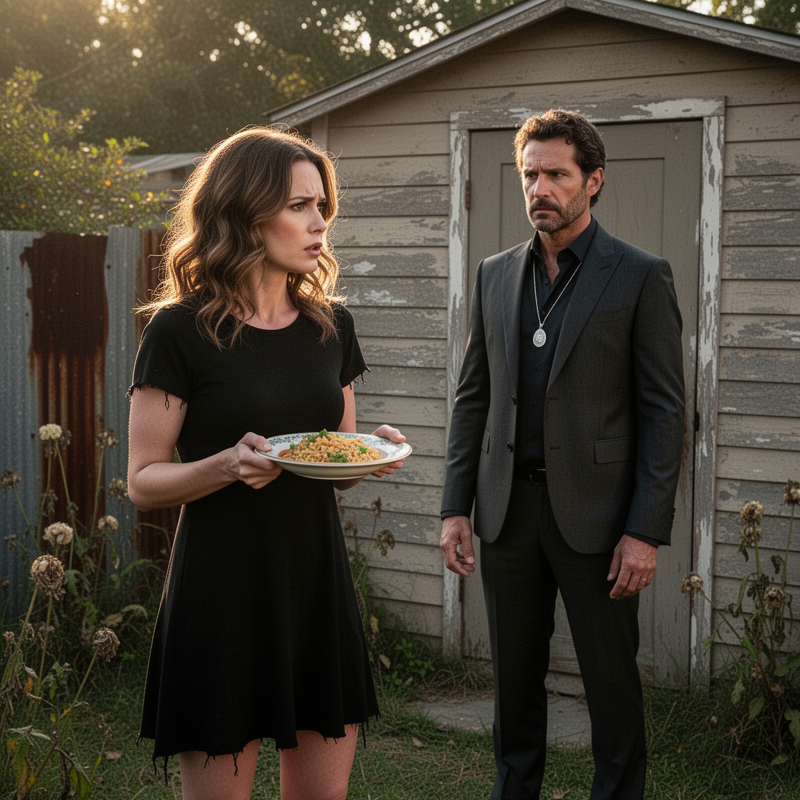
For twenty years, my mother gave three hot meals a day to a filthy vagrant living in our backyard shed while we survived on canned beans.
When my mother Fiona died of liver failure at Wollongong Hospital, her final words were a strict order to keep delivering those meals.
Two hours after her funeral, I walked to the backyard shed with a plate of food, only to find the ragged shelter cleared out.
Standing in the shadows was a man in a $3,000 Italian suit, wearing my mother’s long-lost silver locket.
He looked me dead in the eye and said, “Your mother spent twenty years keeping me hidden from the syndicate that killed your father.”
The raw smell of cut grass and wilting lilies still clung to the air, a cruel mockery of peace. I could still feel the press of the rough tweed suit on my skin from the funeral, a borrowed outfit that scratched more than it comforted.
It had been a short service. Not many people knew Fiona anymore, not really.
The few relatives who came had left, their forced condolences ringing hollow in the empty fibro home. The silence that settled in the house felt heavier than any grief. It was the silence of questions unanswered, of sacrifices unexplained.
I walked to the kitchen, the linoleum cold beneath my feet. On the counter, a plate of lukewarm food sat waiting: a piece of grilled barramundi, some steamed greens, and a scoop of mashed potato.
My mother’s final, unwavering command echoed in my ears: “Keep feeding him, Chloe. Promise me.”
I picked up the plate, the ceramic surprisingly heavy. Twenty years. Twenty years she’d fed him, this nameless man, while I grew up on baked beans and stale bread. The bitterness was a physical knot in my stomach.
Every single day, three times a day, without fail. Rain or shine, no matter how little money we had, his meals were sacrosanct. The family had always come second to the silent, ungrateful stranger in the backyard.
I pushed open the back door, the wood groaning in protest. The familiar, overgrown yard stretched out, bordered by the rusty corrugated iron fence. The old shed, leaning precariously to one side, looked just as neglected as it always had.
My heart hammered with a strange mix of dread and a perverse sense of duty. I hated this ritual, this man, but I’d promised Fiona.
One step, then another. The gravel crunched under my worn trainers. The afternoon sun, bright and relentless, cast long shadows from the gum trees.
I reached the shed door, pulling at the loose rope that served as a handle. The rusty hinges shrieked, making me flinch.
Inside, the shed was empty.
My breath hitched. The usual squalor, the layers of rags, the stale smell of unwashed humanity—all gone. Only dust motes danced in the slivers of light filtering through gaps in the tin.
The dirt floor was swept clean. A single, dark patch marked where his bedroll must have been. Nothing else. Just emptiness.
I stared, baffled. Where was he? Had he just… left?
A slight movement in the deepest corner of the shed, where the shadows pooled thickest, made me jump. My heart leaped into my throat.
I instinctively recoiled, nearly dropping the plate.
A figure stepped forward, emerging from the gloom. Not the hunched, ragged man I expected. This man stood tall, his posture almost military.
He wore a dark suit, the fabric clearly expensive, tailored perfectly to his broad shoulders. It was Italian, I recognised the cut from my corporate auditing days. At least three thousand dollars, easily. His shoes gleamed.
His face was weathered, with sharp, intelligent eyes that seemed to hold endless weariness. But it was not his face that froze me.
Around his neck, on a thin silver chain, hung my mother’s locket.
The ornate silver locket, engraved with Fiona’s initials, that had vanished from her dresser a decade ago. The one she’d cried over, the last piece of jewellery from my grandmother.
He saw my gaze lock onto it. There was no flicker of shame or surprise in his eyes, only a deep, unsettling calm.
He raised a hand, his fingers brushing the silver.
“Chloe Callahan,” he said, his voice a low rumble, surprisingly clear. No trace of the vagrant I’d imagined.
“Who are you?” I managed to stammer, my voice thin and reedy. The plate of food suddenly felt impossibly heavy in my shaking hands.
His gaze was unwavering, fixed on mine. There was something in his eyes, an ancient knowledge, a profound sadness.
“Your mother spent twenty years keeping me hidden from the syndicate that killed your father.”
Part 2
My knees felt weak. “Killed my father?” I repeated, the words barely a whisper. “What are you talking about? He… he died in an accident.”
Julian shook his head slowly. “No accident, Chloe. Your father was a good man, but he saw too much. Sean MacIntyre decided he had to go.”
My mind raced, trying to grasp what he was saying. Sean MacIntyre. A name I’d heard, vaguely, from hushed conversations around the docks when I was a kid. A powerful shipping magnate. A *syndicate*. This was madness.
“And you… you were part of this syndicate?” The question choked out of me.
He met my gaze without flinching. “I was. MacIntyre’s underboss. When your father was… eliminated, MacIntyre gave me a second order. To clean up. To make sure there were no loose ends. No family left behind to ask questions.”
A cold dread seeped into my bones, a chill far deeper than the evening air. “Loose ends?”
Julian’s eyes, though tired, held a flicker of the past. “You were just a baby, Chloe. A few months old. MacIntyre’s instruction was clear: remove the family.”
He paused, a heavy silence hanging between us, thick with unspoken horrors. My hands were trembling so violently, the plate rattled.
“I couldn’t do it,” he finally said, his voice raw. “I couldn’t harm a child. So I ran. Fiona… your mother… she found me.”
My mother. Fiona. The pieces clicked, terrifyingly. The twenty years of meals. The absolute secrecy. The poverty she willingly embraced.
“She brought me here,” Julian continued, gesturing around the bare shed. “She hid me from MacIntyre. For two decades, I lived in this shed, fed and protected by your mother, while the syndicate believed I was dead, and that your family had vanished entirely.”
His gaze sharpened, locking onto mine once more. “She kept me alive, Chloe, to keep you safe. As long as MacIntyre believed I was dead, and his orders had been carried out, he stopped looking for any trace of your family.”
Chapter 2: Shadows of the Freight Line
The smell of stale coffee and printer toner hung heavy in the air of my office at Port Logistics in Botany Bay. I stared at the data on my screen, a glowing matrix of freight manifests, offshore accounts, and the $14.2 million anomaly I’d flagged. Before Fiona’s funeral, it had just been a massive discrepancy. Now, a cold dread snaked through me.
I clicked through the shell company’s registration details. Horizon Maritime Holdings. Based in a legal grey zone in the Marshall Islands.
My fingers flew across the keyboard, cross-referencing names, dates, and account numbers with the limited information Julian had given me about my father’s death. It was a long shot, a desperate reach.
Then it hit me. A single, distinct transaction.
A payout from Horizon Maritime Holdings, dated March 2004. Exactly the month my father died. The amount was small, almost insignificant in the larger scheme of the $14.2 million, but the recipient was a numbered account linked to a defunct Wollongong legal firm – a firm Julian had mentioned MacIntyre used for ‘special disbursements’.
My stomach clenched. This wasn’t just corporate fraud. The millions I’d flagged, the money I was about to expose, wasn’t just missing freight revenue. It was directly tied to the same shadowy fund that had paid for my father’s assassination two decades ago.
My audit wasn’t random at all. It was a ghost reaching out from the past.
Chapter 3: Paperwork Siege
I was still reeling from the discovery, pacing my small living room, when the sharp knock came. Too formal for a neighbour, too deliberate for a delivery. Through the peephole, I saw a man in a crisp navy suit, flanked by two solemn-faced civil court officers in their official uniforms.
The man introduced himself as Charles Dempsey. His voice was smooth, almost bored.
“Ms. Callahan? We have some papers for you.”
He handed me a thick stack of documents. The top page was a summons. A $2.5 million lawsuit against me personally, filed by a subsidiary of MacIntyre Shipping. Another document was a statutory gag order, forbidding me from discussing my Port Logistics audit findings with anyone outside the company, especially federal authorities.
“Failure to comply,” Dempsey said, his eyes scanning the room, “will result in an immediate court injunction. That includes seizure of all Callahan family assets.”
He paused, letting the words hang in the air. The court officers stood silently, impassive.
“Including your mother’s estate, if it comes to that.”
His gaze lingered for a moment on a framed photo of Fiona on the mantelpiece, then he turned and left, his footsteps echoing ominously down the path. The papers felt like lead in my hands. This wasn’t just a legal threat; it was a declaration of war.
Chapter 4: The Floor Beneath the Dirt
I staggered back to the backyard shed, the legal papers clutched in my hand, my heart hammering. Julian was inside, observing the quiet street from the shadows. He saw the distress on my face.
“Dempsey,” I choked out, holding up the documents. “He just… he’s suing me. He wants to seize everything.”
Julian’s face hardened. He walked to the center of the shed, where Fiona’s old cot used to be. The space was eerily clean now, swept bare.
He knelt, his expensive suit wrinkling on the dusty floor, and ran his fingers along a faint line in the concrete.
“Your mother always said this shed was the safest place,” he murmured.
With a grunt, he tugged at a corroded steel ring, lifting a section of the floorboards. Beneath them, embedded in the earth, was a heavy steel safe, its surface grimy with two decades of damp.
He spun the dial, the tumblers clicking softly in the sudden silence. The heavy door swung open.
Inside, stacked neatly, were dozens of leather-bound ledgers, their pages filled with precise, elegant handwriting. Dates, names, specific dollar amounts.
“Twenty years of MacIntyre’s operations,” Julian said, his voice quiet. “Every dockland deal. Every shell company. Every transaction. Fiona’s price for my hiding place wasn’t just a hot meal, Chloe. It was my promise to record everything.”
Chapter 5: The Civil Raid
The next morning, the legal siege escalated. I heard the crunch of tyres on our gravel driveway and looked out to see a procession of dark cars. This time, it wasn’t just Dempsey. A team of stern-faced men, led by a stocky man with cold, intelligent eyes, fanned out across the property.
“Leo Harris, Ms. Callahan,” the man introduced himself, his voice flat. “Executing a civil asset search warrant.”
They swarmed into the house, methodical and efficient. Drawers were pulled open, boxes emptied, every corner of Fiona’s modest home systematically dismantled. I stood frozen in the doorway, watching them violate everything that was left of my mother.
Harris moved through the living room, his gaze sharp, assessing. He picked up a dusty photo frame from a side table. It was an old picture: a younger Fiona, her arm around my small, smiling self, taken on a rare sunny day at Wollongong Beach.
He looked at the photo, then at me. His expression, for a fleeting moment, softened.
“MacIntyre doesn’t play games, Ms. Callahan,” he said, his voice low enough only for me to hear. “This is just the start. He’ll go further than any court order if you push him.”
Then, as quickly as it appeared, the look vanished. He replaced the frame and moved on, leaving me with the chilling implication of his words.
Chapter 6: The Price of Pension
I sat on the shed floor, surrounded by Julian’s meticulously kept ledgers. The numbers swam before my eyes, cold and precise. I still couldn’t reconcile this methodical man with the image of the destitute vagrant I’d despised for so long.
“Why, Julian?” I finally asked, my voice raw. “Why did my mother live like that? Why did she starve us?”
Julian’s gaze drifted past me, out to the overgrown backyard. “She didn’t starve you, Chloe. She protected you. And me.”
He explained how Fiona, with her meager pension, had carved out a hidden network. It wasn’t just food and a roof. Every month, for twenty years, she’d allocated a portion of her tiny income.
“Fourteen thousand dollars, over two decades,” he revealed. “She paid the local dock scouts. The blokes who sat nursing beers, watching traffic near Port Kembla. She made sure they’d call her if any vehicle that didn’t belong showed up in the neighbourhood.”
He looked at me, his eyes solemn. “She didn’t want MacIntyre’s people sniffing around. Every dollar she spent on those meals, on those warnings, bought you another day of safety. Kept you out of their sights.”
My mother hadn’t been neglecting us. She’d been running a silent, desperate security operation, turning her poverty into a shield.
Chapter 7: The Emergency Record
The revelation about Fiona’s silent sacrifices spurred me. I had to know the full truth about my father. I took a day off, driving to the Wollongong Hospital archives, a dusty, dimly lit room heavy with the scent of old paper and disinfectant.
After navigating layers of bureaucracy, an archivist placed a thick, yellowed file in front of me: my father’s emergency admission record from March 2004. My hands trembled as I opened it.
The official police report had stated a drunk-driving accident, a tragic rollover car crash. I remembered the funeral, the hushed whispers.
But the hospital record told a different story.
Under ‘Cause of Death’, clearly written in a doctor’s hurried script, were the words: “Massive internal trauma, consistent with gunshot wounds to the chest. Multiple entry and exit wounds.”
My breath hitched. Not a car crash. Not drunk driving. My father had been murdered. The police report was a lie, a cover-up. The syndicate hadn’t just eliminated him; they had erased the truth of his death, leaving us to believe a manufactured tragedy.
Chapter 8: Eight Hundred Milliliters
I stared at the record, the words swimming before my eyes. Gunshot wounds. A deliberate murder, not a tragic accident. The sheer, cold brutality of it settled in my bones. I scrolled through the pages, every detail now taking on a horrifying significance.
Then I saw it. A section detailing blood transfusions and donor information.
My father had lost a massive amount of blood. But there was a notation for an emergency, on-site blood donation, listed under “Unidentified Male, DOB unknown.”
Below that, scrawled in a different hand, was a brief addendum. “Donor later identified by attending nurse as ‘Julian D.’. Four hours spent in trauma bay, 800ml whole blood donated. Patient remained unstable.”
Julian. He hadn’t just gone into hiding to save me. After MacIntyre’s men shot my father, Julian had pulled him from the scene, taken him to the very hospital that would record his murder, and then tried to save his life. He had spent four hours, giving his own blood, desperately fighting for the man he was supposed to have killed.
The homeless man I’d resented for two decades had been with my father in his final moments, risking everything to defy MacIntyre’s order.
Chapter 9: Frozen Estate
The next morning, the phone rang, startling me. It was Sam Mercer, my childhood friend and a paralegal. Her voice was tight, barely above a whisper.
“Chloe, listen,” she said. “Dempsey just moved again. He’s placed an administrative hold on Fiona’s estate.”
My mother’s modest bank account, holding her entire life savings of $18,000, was now frozen. Just days after her death, they were trying to seize everything.
“And it’s not just that,” Sam continued, her voice trembling. “They served my firm with a formal threat. Alleging professional misconduct. Conspiracy. He’s trying to get me disbarred if I help you.”
My heart sank. They were closing in, cutting off every lifeline. My mother’s last legacy, wiped out. My only legal contact, silenced. Dempsey wasn’t just aggressive; he was aiming to isolate me completely, severing every connection I had. The sheer ruthlessness of it left me speechless.
Chapter 10: Cracks in the Armor
I knew I had to push back. I found Leo Harris at the Port Kembla docks, watching containers being unloaded, a solitary figure amidst the noise. His cold, calculating demeanour had chilled me during the raid, but now I had a new weapon.
I walked straight up to him, holding my father’s medical record. “You told me MacIntyre would go beyond court orders,” I said, my voice steady despite the tremor in my hands. “I think you should see what he went beyond in 2004.”
Leo took the aged document from me, his expression unreadable. His eyes scanned the details, the cause of death, the donor log. His jaw tightened.
He looked up at me, a flicker of something raw in his eyes. “This signature,” he said, tapping a section of the report. “This is Frank Moretti. He was with the syndicate back then. He told me… he told me my own brother, David, died in a drunken bar brawl in 2005.”
Leo’s brother had disappeared, presumed dead, years ago. I remembered the whispers in the neighbourhood.
“Moretti was MacIntyre’s top enforcer,” Leo continued, his voice low, “and my brother was trying to leave the syndicate. MacIntyre said David was a loose end, a liability. But he swore to me, on his family, that he wasn’t involved.”
Leo crushed the paper in his hand. MacIntyre had lied, not just about my father, but about his own brother’s murder. The man Leo had served, whose family honor he upheld, had betrayed a core syndicate code. A crack, small but significant, had appeared in Leo Harris’s armor.
Chapter 11: The Dockers Gate
The threats against Sam and the frozen estate didn’t stop Dempsey. Days later, a gleaming black sedan pulled up our driveway, two process servers stepping out, clipboard in hand. They were here for my personal computer, the hub of all my audit files.
Just as they reached the front gate, a beat-up ute rumbled to a stop behind their car. Then another. And another. Eight old, weathered men, faces etched with years of sun and hard work, climbed out. My Uncle Mark Callahan, Fiona’s estranged brother, stood at the head of them.
“Got a problem, fellas?” Uncle Mark’s voice was gruff, but his eyes were sharp.
The process servers, suddenly outnumbered and out of their element, exchanged nervous glances.
“We have a warrant for Ms. Callahan’s property,” one stammered.
Uncle Mark folded his arms across his chest. “This street,” he declared, gesturing to the dockers, “is Port Kembla land. These men here worked this port for forty years. They know what’s fair, and they know what’s not.”
The dockers, silent but formidable, took a step forward, forming a solid wall between the servers and my gate. One of them, a man with a booming laugh, quietly revved the engine of his old Ford, making the sedan quiver.
After a tense minute, the process servers, defeated, mumbled their apologies, turned around, and drove away. Uncle Mark, weathered and strong, had just rallied the old guard.
Chapter 12: The Truce Offer
Julian knew MacIntyre wouldn’t back down easily. He also knew he held the ultimate leverage. He found a secure payphone near Wollongong Station, the kind that didn’t trace calls. I stood a discreet distance away, watching him.
He dialled, the coins clanking into the slot. His posture was rigid, his voice low and precise, devoid of emotion.
“MacIntyre,” he said into the receiver. “Julian De Luca. I hear you’re causing trouble for Fiona’s daughter.”
A pause. I imagined MacIntyre’s shock on the other end.
“I have something you want,” Julian continued, glancing at me. “Twenty years of ledgers. Every dollar, every transaction, every dirty deal. Hidden beneath the shed.”
Another pause.
“In exchange,” Julian stated, his voice unwavering, “you’ll sign a full legal covenant. All lawsuits, all gag orders, all freezes against Chloe Callahan. Dropped. Permanently. No future harassment. You leave her alone, and you get your ledgers.”
The line was quiet for a long moment. Julian’s face gave nothing away. Finally, he nodded slowly.
“Good. We’ll arrange the exchange.”
He hung up, his eyes meeting mine. “He accepted. But don’t trust him, Chloe. Not for a second.”
Chapter 13: Financial Isolation
We held our breath, waiting for MacIntyre’s next move. Julian’s truce offer felt like a fragile peace. For a brief moment, I allowed myself to hope.
That hope was shattered within twenty-four hours.
Uncle Mark received a terse notice in the mail. Dempsey, acting on MacIntyre’s orders, had filed retaliatory corporate liens against the union’s distribution account. Not against Uncle Mark directly, but against the fund itself. This wasn’t just harassment; it was a targeted strike against his ability to rally support.
“They’re trying to cut us off,” Uncle Mark growled over the phone, his voice laced with fury. “Freezing my pension fund is one thing. But threatening the entire union’s payouts? It’s a message. No one helps Chloe.”
MacIntyre wasn’t just fighting me; he was trying to starve my entire family support structure into submission. The message was clear: defy him, and you lose everything. Our small, community-based defense was now under a direct financial assault.
Chapter 14: The Insider Ledger
The night after Uncle Mark’s pension was threatened, a shadow moved across my backyard. I opened the shed door to see Leo Harris standing there, his face grim in the moonlight. He wasn’t here to search.
“MacIntyre’s gone too far,” he said, his voice flat. “Julian’s a dead man walking, and he’s freezing an old man’s pension. My brother, your father… it’s the same pattern.”
He held out a small, encrypted flash drive.
“This is Dempsey’s personal firm ledgers,” Leo revealed. “Everything he’s been funnelling for MacIntyre. $4.1 million, through offshore accounts in his own name. Tax evasion, money laundering… it’s all there.”
He pushed the drive into my hand. It was cold, hard, and contained enough evidence to bring down MacIntyre’s entire operation, and Dempsey with it.
“He won’t stop at Julian,” Leo warned, his eyes holding mine. “MacIntyre’s cleaning house. Use this. Burn them all down.”
Then, as silently as he appeared, Leo melted back into the darkness. I stood there, the small flash drive a powerful, terrifying weapon in my palm.
Chapter 15: The Timber Yard Strategy
Julian knew this was it. He cleaned the shed meticulously, placing Fiona’s locket on the small, scarred table. He moved with a quiet resignation, packing only the essentials, a change of clothes, some water.
“Stay here, Chloe,” he instructed, his voice firm, his gaze meeting mine. “Do not follow me. Do not interfere. Your safety is the only thing that matters.”
He knew MacIntyre would try to eliminate him. He accepted it.
But I couldn’t accept it. I watched him walk away, his figure fading into the twilight along the old dock tracks leading towards Port Kembla. The image of Julian giving his blood for my father, of Fiona’s endless sacrifice, burned in my mind. I couldn’t let another person die for me.
I waited five minutes, then pulled on a dark jacket, grabbed the flash drive Leo had given me, and slipped out the back gate. I followed his path, keeping to the shadows, my heart pounding a frantic rhythm against my ribs. I wouldn’t be left alone, wondering, again.
Chapter 16: Paper Defense
While Julian walked towards his fate, Uncle Mark and Sam were moving on another front. Armed with Leo’s flash drive, they stormed the offices of the New South Wales Law Society, demanding an immediate investigation into Charles Dempsey.
They laid out the unredacted digital ledgers, detailing every shell company, every offshore transfer, every instance of the $4.1 million in personally managed mob money laundering.
Sam, terrified but resolute, provided her own testimony, exposing Dempsey’s threats and the statutory freezes.
Concurrently, another set of files, mirroring the financial fraud, landed on the desk of a federal tax investigator. The sheer volume and specificity of the evidence, coupled with Dempsey’s personal involvement, was undeniable.
Dempsey, suddenly facing federal indictments and immediate disbarment proceedings, was caught. His legal shield shattered, his loyalty to MacIntyre evaporated. The mob lawyer, cornered and facing personal ruin, abandoned MacIntyre’s defense, leaving the crime boss exposed and vulnerable.
Chapter 17: Cold Iron at the Shed
I found a vantage point behind a stack of rotting timber in the abandoned Port Kembla shed, my heart hammering against my ribs. The air was thick with the smell of salt and decay.
Julian stood in the center of the vast, empty space, a briefcase containing the ledgers in his hand. MacIntyre entered, flanked by two silent men, his face a mask of cold anticipation.
“The ledgers, Julian,” MacIntyre commanded, his voice echoing.
Julian placed the briefcase on a rusted oil drum. “The release papers, Sean.”
MacIntyre’s man produced a folder. Julian opened it, scanning the pages. A genuine smile, fleeting and full of quiet triumph, touched his lips as he saw the signed legal covenant, dropping all claims against me.
He took the papers, folding them carefully. MacIntyre gestured, and Julian pushed the briefcase towards him. As MacIntyre reached for it, a suppressed pistol appeared in his other hand, a dark, silent extension of his will.
He didn’t hesitate. A soft *thwip* broke the silence.
Julian gasped, clutching the signed release papers to his chest. A dark stain bloomed on his expensive suit. He staggered, his eyes wide with surprise, then crumpled to the dirt floor, the papers still clutched tight.
MacIntyre stared at the dying man for a moment, then turned and fled into the twilight. I watched in horror, frozen, as Julian’s last breath escaped, the signed release papers pressed to his still chest.
Chapter 18: Underworld Reckoning
The silence after the shot was deafening. I rushed to Julian, collapsing beside him. His eyes were glazed, fixed on the rusting roof. He was gone.
Moments later, Leo Harris appeared, his face grim. He took in the scene – Julian’s lifeless body, the signed papers, the abandoned briefcase. His eyes narrowed, a cold fury replacing his usual detachment.
He carefully retrieved the blood-stained release documents from Julian’s hand. He then secured the ledgers from the briefcase.
“He broke protocol,” Leo stated, his voice devoid of emotion, but with an underlying steel. “Killed an unarmed man during a negotiated exchange. And a former underboss, no less.”
Leo moved swiftly. He called paramedics, who confirmed Julian De Luca was dead at the scene. But Leo’s work was just beginning. He presented the murder evidence, along with the detailed ledger logs and the signed release, to the syndicate’s governing board that same night.
MacIntyre’s violation of underworld code, his betrayal of a blood compact, sealed his fate. The board, adhering to ancient, ruthless protocols, stripped MacIntyre of his leadership, his assets, and his protection. He was exiled, forced to vanish into the shadows he once commanded. Justice, in its brutal, underworld form, had been delivered. But Julian was still dead.
Chapter 19: Nine Days Later
Nine days after the shooting, the world outside returned to a semblance of order. The legal injunctions against me were formally dismissed by the court. My mother’s small estate, along with Uncle Mark’s pension fund, was fully unfrozen. Charles Dempsey was disbarred, facing federal charges. The syndicate’s power was broken.
I sat alone in the empty backyard shed in Port Kembla, the late afternoon sun filtering through the gaps in the corrugated iron walls. The air was still, quiet. No one knew Julian had died for me. The police report would simply state he was found, a victim of an unknown assailant. MacIntyre was gone, erased by his own kind, but Julian’s death remained a silent, private wound.
I held my mother’s long-lost silver locket in my palm, its cool metal a tangible link to two decades of unspoken sacrifice. The shed, once a place of resentment, was now a sanctuary of grief. It was quiet. It was safe. But the silence felt heavy, a void where two lives had been given for mine.
Safety earned through another person’s blood doesn’t feel like peace; it feels like holding a debt you can never pay back.
Leave a Reply