CHAPTER 1: The Shadow on the Porch
Part 1
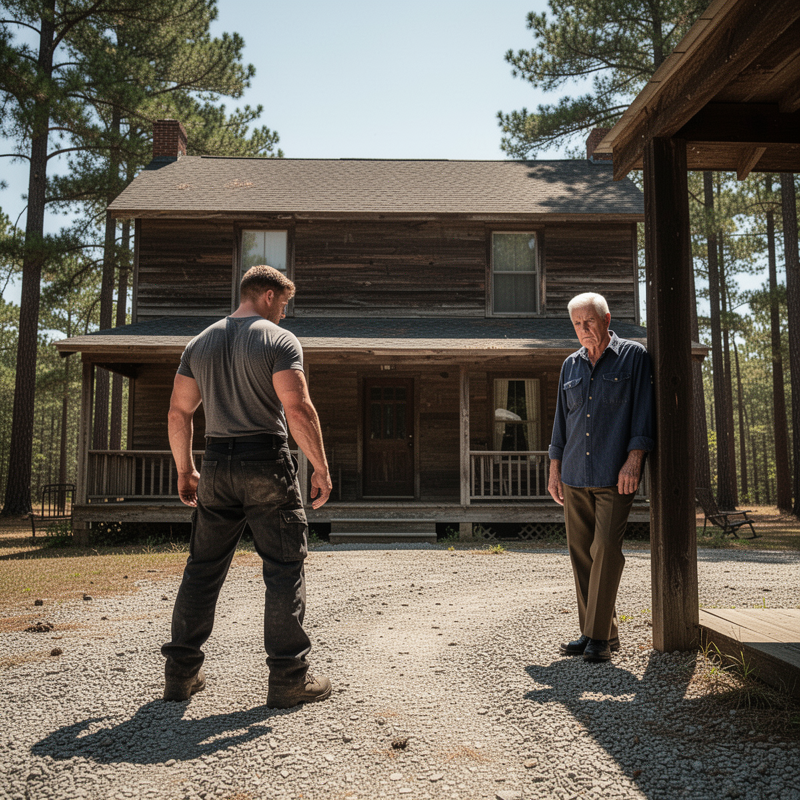
“If you ever set foot on this property again, I will have the sheriff arrest you for extortion,” my stepfather barked across the porch.
Six years ago, on my eighteenth birthday, Frank Holloway threw a duffel bag at my chest and gave me twenty-four hours to enlist in the Marines or get out of his house forever.
I ran away that night, fell into heavy drug addiction, and spent three years in state prison for burglary before finally getting clean.
Now, at twenty-four, I stood on his gravel driveway with a rebuilt body and a hardened face, demanding he tell my mother the truth about why he drove me out.
Instead of confessing, he picked up his phone and launched a public smear campaign across our entire town to destroy the fragile new life I was trying to rebuild.
The afternoon sun, bright and unforgiving, beat down on the gravel driveway of Frank Holloway’s house. The scent of pine needles and damp earth clung to the air, unchanged in six years. Every crunch of a loose stone under my boots felt amplified in the quiet Oakhaven air.
I moved slowly, deliberately, my gaze fixed on the familiar, weathered porch. The house looked exactly as I remembered it – stern, uninviting, a reflection of the man who owned it.
My chest felt tight, not from nerves, but from the raw, simmering anger that had fueled me for years. It had been six years since I’d last stood here, a terrified kid. Now, I was twenty-four, my body a testament to countless hours of iron and discipline. The scrawny, gentle boy was gone, replaced by a frame hardened by prison workouts and a will forged in recovery.
Every muscle in my shoulders felt coiled, ready. This wasn’t just a visit; it was a reckoning.
Frank Holloway stood on the porch, leaning against a rough-hewn wooden pillar. He hadn’t changed much either. His back was ramrod straight, a retired Marine sergeant who still carried himself with the rigid discipline of a drill instructor. His silver hair was thinner, his face a little more lined, but his eyes held the same cold, unyielding stare.
He hadn’t moved an inch as I walked up the driveway, a silent, unblinking sentinel.
My jaw tightened. This was it.
I stopped at the edge of the porch, the small gap between us feeling like an uncrossable chasm.
“Frank,” I said, my voice rougher than I intended, a deliberate challenge in the way I spoke his first name, not ‘stepfather.’
He didn’t acknowledge the greeting. His gaze swept over my frame, taking in the broader shoulders, the scars barely visible beneath my t-shirt. There was no flicker of recognition, no hint of a welcome. Only scrutiny.
“What do you want, Leo?” he finally grunted, his voice a low rumble, devoid of any warmth.
The casual cruelty of it, the absolute lack of emotion, hit me like a physical blow. Six years, all the pain, all the rebuilding, and this was his response.
“You know what I want,” I shot back, my voice rising. “I want you to tell Mom the truth.”
He didn’t blink. A faint, almost imperceptible scoff escaped his lips.
“The truth?” he repeated, his tone laced with a sarcasm that made my blood boil. “The truth about what, exactly?”
My hands clenched at my sides. I could feel the old rage building, the one I’d worked so hard in therapy to manage. It threatened to consume me.
“The truth about why you threw me out,” I spat, the words heavy with six years of resentment. “Why you forced me out, ruined my life, and made me a criminal.”
Frank pushed himself off the pillar, taking one slow step toward the edge of the porch. His eyes, the color of cold steel, never left mine.
“You made yourself a criminal, Leo,” he said, his voice flat. “No one forced you to do anything.”
“You did!” I roared, pointing a finger at him. “You gave me an ultimatum on my eighteenth birthday! Enlist or get out! What kind of father does that?”
“A father who saw a spoiled boy wasting his life,” Frank countered, his voice steady, emotionless. “A boy who needed a dose of reality.”
My breath hitched. He truly believed it. He truly thought he was justified.
“You stripped me of everything,” I whispered, the anger momentarily giving way to a profound ache. “You took away my home, my family, everything.”
“You chose your path,” Frank said, dismissing my pain with a wave of his hand. He glanced at his wrist, though he wore no watch. A subtle gesture, meant to convey utter disinterest.
“I tried to find my way back,” I pressed, desperation creeping into my voice. “I went to prison. I got clean. I rebuilt myself. And now I’m here. I deserve an explanation.”
“You deserve nothing from me,” he stated, his voice chillingly devoid of emotion. “And you have no right to be here.”
He reached into his pocket and pulled out his phone. The black rectangle felt like a weapon in his hand.
“This is private property,” he continued, his thumb hovering over the screen. “You are trespassing. And I’ve already contacted the authorities about your threats.”
My stomach dropped. Threats? What threats?
“What are you talking about?” I demanded, my mind racing. “I haven’t threatened anyone.”
“Your presence here is a threat,” Frank said, his eyes hard. “You’ve returned, visibly agitated, after years of silence. You are on my property, demanding explanations and making accusations.”
He brought the phone to his ear, never breaking eye contact.
“I’m reporting you for harassment,” he said, his voice loud enough for me to hear over the low dial tone. “And for attempting to extort money from an elderly, ailing woman. My wife, Evelyn Holloway.”
He paused, listening, then spoke into the receiver with a tone of grave concern.
“Yes, my stepson, Leo Gratton. He’s a convicted felon, recently released from state prison, on parole. And he is currently standing on my porch, refusing to leave.”
My jaw dropped. Extortion? Ailing woman? He was twisting everything. He was calling my probation officer. Right now.HOOK: “If you ever set foot on this property again, I will have the sheriff arrest you for extortion,” my stepfather barked across the porch.
Six years ago, on my eighteenth birthday, Frank Holloway threw a duffel bag at my chest and gave me twenty-four hours to enlist in the Marines or get out of his house forever.
I ran away that night, fell into heavy drug addiction, and spent three years in state prison for burglary before finally getting clean.
Now, at twenty-four, I stood on his gravel driveway with a rebuilt body and a hardened face, demanding he tell my mother the truth about why he drove me out.
Instead of confessing, he picked up his phone and launched a public smear campaign across our entire town to destroy the fragile new life I was trying to rebuild.
The afternoon sun, bright and unforgiving, beat down on the gravel driveway of Frank Holloway’s house. The scent of pine needles and damp earth clung to the air, unchanged in six years. Every crunch of a loose stone under my boots felt amplified in the quiet Oakhaven air.
I moved slowly, deliberately, my gaze fixed on the familiar, weathered porch. The house looked exactly as I remembered it – stern, uninviting, a reflection of the man who owned it.
My chest felt tight, not from nerves, but from the raw, simmering anger that had fueled me for years. It had been six years since I’d last stood here, a terrified kid. Now, I was twenty-four, my body a testament to countless hours of iron and discipline. The scrawny, gentle boy was gone, replaced by a frame hardened by prison workouts and a will forged in recovery.
Every muscle in my shoulders felt coiled, ready. This wasn’t just a visit; it was a reckoning.
Frank Holloway stood on the porch, leaning against a rough-hewn wooden pillar. He hadn’t changed much either. His back was ramrod straight, a retired Marine sergeant who still carried himself with the rigid discipline of a drill instructor. His silver hair was thinner, his face a little more lined, but his eyes held the same cold, unyielding stare.
He hadn’t moved an inch as I walked up the driveway, a silent, unblinking sentinel.
My jaw tightened. This was it.
I stopped at the edge of the porch, the small gap between us feeling like an uncrossable chasm.
“Frank,” I said, my voice rougher than I intended, a deliberate challenge in the way I spoke his first name, not ‘stepfather.’
He didn’t acknowledge the greeting. His gaze swept over my frame, taking in the broader shoulders, the scars barely visible beneath my t-shirt. There was no flicker of recognition, no hint of a welcome. Only scrutiny.
“What do you want, Leo?” he finally grunted, his voice a low rumble, devoid of any warmth.
The casual cruelty of it, the absolute lack of emotion, hit me like a physical blow. Six years, all the pain, all the rebuilding, and this was his response.
“You know what I want,” I shot back, my voice rising. “I want you to tell Mom the truth.”
He didn’t blink. A faint, almost imperceptible scoff escaped his lips.
“The truth?” he repeated, his tone laced with a sarcasm that made my blood boil. “The truth about what, exactly?”
My hands clenched at my sides. I could feel the old rage building, the one I’d worked so hard in therapy to manage. It threatened to consume me.
“The truth about why you threw me out,” I spat, the words heavy with six years of resentment. “Why you forced me out, ruined my life, and made me a criminal.”
Frank pushed himself off the pillar, taking one slow step toward the edge of the porch. His eyes, the color of cold steel, never left mine.
“You made yourself a criminal, Leo,” he said, his voice flat. “No one forced you to do anything.”
“You did!” I roared, pointing a finger at him. “You gave me an ultimatum on my eighteenth birthday! Enlist or get out! What kind of father does that?”
“A father who saw a spoiled boy wasting his life,” Frank countered, his voice steady, emotionless. “A boy who needed a dose of reality.”
My breath hitched. He truly believed it. He truly thought he was justified.
“You stripped me of everything,” I whispered, the anger momentarily giving way to a profound ache. “You took away my home, my family, everything.”
“You chose your path,” Frank said, dismissing my pain with a wave of his hand. He glanced at his wrist, though he wore no watch. A subtle gesture, meant to convey utter disinterest.
“I tried to find my way back,” I pressed, desperation creeping into my voice. “I went to prison. I got clean. I rebuilt myself. And now I’m here. I deserve an explanation.”
“You deserve nothing from me,” he stated, his voice chillingly devoid of emotion. “And you have no right to be here.”
He reached into his pocket and pulled out his phone. The black rectangle felt like a weapon in his hand.
“This is private property,” he continued, his thumb hovering over the screen. “You’ve returned, visibly agitated, after years of silence. You are on my property, demanding explanations and making accusations.”
My stomach dropped. Accusations?
“I haven’t accused you of anything,” I said, confusion mixing with the rage.
“You’ve implied I ruined your life,” Frank corrected, his voice sharp. “That’s an accusation of malice. And it won’t stand.”
He brought the phone to his ear, never breaking eye contact.
“I’m reporting you for harassment,” he said, his voice loud enough for me to hear over the low dial tone. “And for attempting to extort money from an elderly, ailing woman. My wife, Evelyn Holloway.”
He paused, listening, then spoke into the receiver with a tone of grave concern.
“Yes, my stepson, Leo Gratton. He’s a convicted felon, recently released from state prison, on parole. And he is currently standing on my porch, refusing to leave. I want to ensure his probation officer is aware of his threatening behavior.”
Part 2
My jaw clenched so hard I thought my teeth might crack. He was actually doing it. He was weaponizing my past, my struggles, everything I’d fought to overcome. He hung up the phone, his eyes still fixed on me, a cold, triumphant glint in them.
“You’ve been warned,” he said, his voice flat, final. “Now get off my property.”
I wanted to rush him, to scream, to make him feel a fraction of the betrayal and rage churning inside me. But years of therapy, of learning to control the volatile temper that had landed me in so much trouble, held me back. I was on parole. One wrong move, and everything I’d rebuilt would crumble.
I turned slowly, my back stiff, and walked away from the porch. Every step down the gravel driveway felt like a retreat, a defeat. The sun still beat down, but now it felt oppressive, pressing down on my shoulders. I got into my beat-up car, the engine rattling to life, and drove away, leaving Oakhaven’s quiet main street in my rearview mirror.
My rental room above the old hardware store was small, just a bed and a shaky dresser. I unlocked the door, ready to collapse and try to process the raw injustice of it all. But someone was already there.
Officer Miller, my probation officer, sat at the tiny, scarred table, looking grim. He looked up as I entered, his expression unreadable.
“Gratton,” he said, his voice clipped. “We need to talk.”
My stomach dropped again. Frank hadn’t wasted any time.
“It’s about the call I just received,” Officer Miller continued, tapping a manila folder on the table. “And the official report filed by Frank Holloway this afternoon. Along with a few… other things.”
He pushed a stack of papers across the table toward me. They were flyers, printed clearly, with my name and a mugshot-like photo of me from my arrest record. The text was bold, accusing.
“He’s been distributing these,” Miller said, nodding at the flyers. “To every business owner, every diner, every gas station in town. Claims you’ve returned solely to extort money from his frail mother.”
CHAPTER 2: The Auditor’s Ledger
The laminated menu at the Oakhaven Diner smelled of stale grease and lemon cleaner.
I set my olive-drab duffel bag against the base of the vinyl booth, making sure the stamped military stencil faced the floor. My probation check-in folder sat open on the formica table next to a black mug of coffee.
Across the aisle, an older man with wire-rimmed glasses and a ironed plaid shirt pushed his pie plate aside. His fingers were stained with dark blue ink.
“That’s a Department of Corrections release form, isn’t it?” the man said.
His voice was thin, but pitched with absolute calm.
“Mind your own business, old man,” I said, sliding the white folder under my napkin.
“I retired after thirty-four years as a senior auditor for the Veterans Administration,” he said, extending a hand over the wooden booth divider. “Arthur Pendelton. I know a government stamp when I see one.”
I stared at his outstretched palm before taking it. My knuckles were scarred from three years of prison yard pull-ups; his were soft and spotted with age.
“Leo Gratton,” I said.
Arthur gestured toward the county courthouse visible through the rain-streaked diner window.
“I came down here to clear up a missing military pension record for a friend,” Arthur said. “Spent four hours digging through the public terminal in the county clerk’s basement. You look like you’re carrying a heavy load, son.”
“My stepfather spent six years trying to destroy me,” I said, my jaw tightening. “Now he’s got the sheriff looking for me.”
Arthur adjusted his glasses and pulled a yellow legal pad from a leather briefcase.
“Frank Holloway?” Arthur asked.
I stiffened in the booth.
“How do you know that name?”
“Oakhaven is small,” Arthur said, turning a sheet of lined paper. “When I was running county real-estate title cross-checks this morning, I noticed something strange on the public ledger under the Holloway parcel.”
He turned the legal pad around and slid it across the table.
“Six years ago, on August 14th—the date you turned eighteen—Frank Holloway opened a restricted third-party escrow account at First National Bank,” Arthur said. “Every month on the fifteenth, like clockwork, forty-three dollars was transferred into it from his military pension.”
“Forty-three dollars?” I scoffed. “That’s insulting.”
“Look closer at the line item,” Arthur said, pointing a trimmed fingernail at a column of figures. “Not forty-three dollars. Four hundred and thirty dollars every month. For seventy-two months.”
The total at the bottom of the ledger was stamped in crisp, black ink: $43,260.00.
“The beneficiary listed on the custodial deed isn’t his wife,” Arthur said softly. “It’s Leo Gratton. The account has never been accessed. Not once.”
CHAPTER 3: The Missing Name
Rain rattled against the glass of the glass-enclosed bulletin board outside the Oakhaven Municipal Center.
A fresh sheet of bright orange paper was stapled directly over a flyers for the local high school car wash.
I pulled my jacket hood over my head and stepped closer.
WARNING TO OAKHAVEN BUSINESS OWNERS, the black block lettering screamed.
Below the heading was my mugshot from three years ago—shaven head, sunken cheeks, eyes hollow from withdrawal. The text listed my conviction for third-degree burglary and described me as a unstable, aggressive ex-con attempting to extort funds from local residents.
Arthur stood beside me, his canvas coat buttoned to his chin. He pulled a small magnifying glass from his coat pocket and leaned toward the paper.
“Notice anything missing, Leo?” Arthur asked.
“My whole life is printed right there,” I said, my chest tight with rage. “He made sure everyone in town knows I spent three years in Stateville.”
“Read the second paragraph aloud,” Arthur instructed.
“The individual has engaged in harassment against the Holloway household, targeting senior property owners,” I read, tracing the words with a calloused thumb.
Arthur shook his head.
“Look at the phrasing. It mentions ‘the Holloway property’ four times. It lists ‘Frank Holloway, USMC Retired’ as the reporting party. But look at the list of protected family members at the bottom.”
I scanned the fine print near the bottom margin.
My mother’s name was nowhere on the sheet. Evelyn Holloway did not appear once in the entire text.
“If Frank wanted to paint you as a threat to your mother, her name would be front and center to drum up sympathy,” Arthur said quietly. “A smear campaign designed to destroy a man’s credibility always uses the most vulnerable victim as a shield.”
“Frank is hiding her,” I muttered.
“Or shielding her from the record,” Arthur corrected. “He put his own name on the line as the sole target. He left her completely out of the paper trail.”
CHAPTER 4: The Deputy’s Silence
A rusted Ford F-150 sat under a decaying car port behind the gravel pit on the edge of town.
Roy Henderson sat on a wooden folding chair on his screened porch, cleaning a double-barreled shotgun with an oiled rag. His right leg was stiff, extended straight out on a wooden crate.
“I told the sheriff I wasn’t taking any more calls,” Roy said without looking up as my boots crunched on the gravel.
“I’m not the sheriff, Deputy Henderson,” I said.
Roy froze. The rag stopped moving over the blue steel barrel. He slowly set the gun down across his lap and looked up, his faded blue eyes taking in my shoulders, my jawline, and the dark tattoo peaking above my collar.
“You grew up, Leo,” Roy said.
“Six years late,” I replied. “Frank told me you were the one who signed the runaway report when I left on my eighteenth birthday.”
Roy spat a dark line of tobacco juice into a coffee can beside his chair.
“Frank lied to you.”
I stepped onto the first wooden porch stair. The wood groaned under my weight.
“He showed me the paper, Roy. He said if I didn’t get on the bus or join the Marines, you’d haul me to juvenile detention.”
Roy reached into a dented metal filing cabinet resting on the porch floor beside his chair. He pulled out a faded manila folder tied with a cloth ribbon and tossed it onto the glass table between us.
“Open it,” Roy said.
I pulled the ribbon. Inside were five carbon-copy receipts from a private investigator agency in Chicago.
“Frank didn’t file a delinquent report,” Roy said, his voice dropping an octave. “He paid $12,000 out of his own pocket over two years to track you across three states. Every time you moved to a new squat or a new trap house, those investigators sent him a photo.”
I looked at the top photo in the pile. It showed me sitting on a curb in East St. Louis, wearing a filthy oversized jacket, my hands clutching a paper bag.
“Why didn’t he come get me?” I whispered.
“Because he couldn’t,” Roy said, his eyes hard as flint. “He told me if he brought you back here, you’d die.”
CHAPTER 5: Forged Paperwork
The Oakhaven Town Council meeting room smelled of damp plaster and old floor wax.
Silas Finch stood at the wooden podium near the front of the room, smoothing his slicked-back gray hair with a manicured hand. He wore a crisp beige suit that cost more than my monthly probation allowance.
“Members of the council, ladies and gentlemen of Oakhaven,” Silas announced, tapping a stack of legal-sized papers against the lectern. “As the court-appointed real-estate appraiser and notary for the Holloway estate, I am duty-bound to bring this emergency matter to the floor.”
I stood at the back of the room, my arms crossed over my chest. Arthur sat three chairs down, taking notes in his small leather journal.
Silas held up a sheet bearing a blue notary stamp.
“Three days ago, a quitclaim deed was filed with the county register,” Silas said, his voice echoing through the microphone. “This document purports to transfer full title of Evelyn Holloway’s residential property to her son, Leo Gratton, effectively stripping a frail, elderly woman of her living quarters.”
A collective gasp swept through the forty townspeople sitting on the wooden folding chairs.
“That’s a lie!” I shouted, taking a heavy step down the center aisle.
Two off-duty county deputies immediately shifted their positions near the side doors, their hands resting near their belts.
“Mr. Gratton,” Silas said, a cold smile touching his lips. “Your signature is right here, witnessed and notarized. The document attempts to liquidate the property for immediate cash sale. It is a clear case of attempted elder fraud by a convicted felon.”
Evelyn sat in the front row, wrapped in a thick wool shawl despite the humid evening air. She buried her face in a white handkerchief, her shoulders shaking violently.
Frank sat beside her in a wheelchair, his posture rigid, his face completely expressionless as he stared straight ahead at the blank wall behind the podium.
CHAPTER 6: The Money Trail
Rain was pounding against the high windows of the county library basement as Arthur plugged a yellow USB drive into the public terminal.
“Silas Finch is a notary,” Arthur said, his fingers flying across the mechanical keyboard. “In this state, every notarized transaction must be logged in an official journal with a corresponding sequential receipt number.”
I leaned over his shoulder, watching lines of green data scroll across the black monitor.
“There it is,” Arthur muttered, pointing at line 408. “Deed Transfer Filing Fee: $150. Notary Commission: $50.”
“Where’s the forgery?” I asked.
Arthur clicked a secondary field on the database overlay.
“Look at the electronic transfer reference code attached to the notary journal entry. Silas Finch didn’t just collect his fifty-dollar notary fee. He received a secondary electronic wire transfer of $15,000 into his personal LLC account two hours before the filing.”
“Frank paid him off to frame me,” I said, my knuckles turning white against the back of Arthur’s chair.
“Look at the originating routing number, Leo,” Arthur said softly.
He brought up a secondary window showing a wire clearinghouse verification form.
“Routing Number 071900093. Account holder: Evelyn M. Holloway. Personal Savings Account ending in 4012.”
I stared at the screen as the room seemed to tilt beneath my feet.
“My mother paid him?”
“Frank’s name isn’t on that account,” Arthur said, looking up at me through his spectacles. “It’s a single-signature account opened under her maiden name twenty years ago. Evelyn paid Silas Finch $15,000 to fabricate that property transfer paper.”
CHAPTER 7: Toxic Care
The rain had turned into a torrential downpour by the time Roy Henderson met us in the rear parking lot of the abandoned train depot.
He slid into the back seat of Arthur’s sedan, dripping water onto the vinyl floorboards. He carried a heavy manila envelope wrapped in clear plastic.
“I kept these in my gun safe for seven years,” Roy said, handing the plastic package over the front seat to me. “Frank made me swear on my Marine Corps ring that I’d burn them if he died before you came back.”
I tore the plastic with my pocket knife and pulled out a thick stack of medical laboratory reports stamped with the seal of the St. Jude Regional Hospital toxicology department.
“Read the red stamp on page three,” Roy instructed.
My eyes scanned down the clinical rows of figures:
*Phenobarbital Level: 28 mcg/mL (Toxic threshold: 15 mcg/mL)*
*Clonazepam Level: 42 ng/mL (Severe elevation)*
“These aren’t my medical records,” I said, confused. “I never took heart medications or heavy sedatives when I was seventeen. I was just tired all the time. I thought I had chronic fatigue syndrome.”
“You didn’t have fatigue syndrome, Leo,” Roy said, his voice flat and heavy. “You were being dosed. Every night in your soup, in your tea, in your morning orange juice.”
I dropped the paper onto my lap.
“My mother made every meal I ate until the day I left.”
“Frank suspected something was wrong when you started slurring your words during your high school track season,” Roy said. “He secretly took a sample of your blood from a routine sports physical to a lab two counties over. That report came back on August 13th—the night before your eighteenth birthday.”
CHAPTER 8: The Ultimatums of 18
“When Frank got those results back,” Roy continued, leaning forward between the front seats, “he lost his mind. He went straight to the house to arrest her himself.”
“Why didn’t he?” I demanded, my hands shaking on the steering wheel. “Why didn’t he call the state police?”
“Because of what Evelyn said when he confronted her,” Roy said. “I was standing in the kitchen, Leo. I was the duty deputy who responded to the silent distress alarm Frank tripped.”
Roy took a deep breath, his chest rising and falling heavily under his wet jacket.
“Evelyn looked Frank right in the eye and told him that if he called the police, she would tell the court that you were the one stealing her prescriptions to get high. She had already planted half a dozen empty pill bottles under your mattress.”
“I was seventeen,” I whispered.
“With a record of juvenile delinquency and a mother who had spent ten years telling every doctor in the county that her son was unstable,” Roy said. “In a legal battle, her word against yours, you would have gone straight to a state youth reformatory for five years. Frank knew your body couldn’t survive another six months of that poison, and your mind couldn’t survive being locked in a cell at seventeen.”
“So he gave me the duffel bag,” I said, the memory crashing over me like cold water.
“He gave you twelve hours to get out of that house,” Roy said. “He told you he hated you. He acted like a sadistic bastard so you would run as far and as fast as you could, far away from that kitchen table.”
CHAPTER 9: The Armor of Misunderstanding
The interior of the car was dead silent except for the rhythmic sweep of the windshield wipers against the glass.
I looked at my scarred knuckles, then at the envelope of medical records resting on my knees.
For six years, every time I did a push-up on the cold concrete of a jail cell, every time I bit my lip to fight off the urge to buy a bag of dope, I had pictured Frank Holloway’s cold, sneering face on the front porch.
I had built my whole identity around my hatred for him. I had lifted weights until my shoulders swelled, grew my jaw out, hardened my eyes—all so I could stand on his driveway one day and show him he hadn’t broken me.
“He let me think he was a monster,” I said, my voice breaking.
“He knew that if you knew the truth back then,” Arthur said softly from the driver’s seat, “you would have come back to fight her. You were angry, damaged, and reckless. You would have ended up in prison for violent assault before you turned nineteen.”
“He took the hits for her,” I said.
“He made himself the villain so you’d have something clear to run away from,” Roy said. “And every month, he put four hundred and thirty dollars into that escrow account so you’d have something waiting for you if you ever got clean.”
A sharp crack of lightning illuminated the dark parking lot, followed instantly by a deafening roar of thunder that shook the car frame.
“The storm’s hitting early,” Arthur said, checking the dashboard clock. “The barometric pressure is plummeting.”
CHAPTER 10: The Gathering Storm
By seven o’clock, the wind speed reached sixty miles per hour.
Sirens began to wail across Oakhaven as tree branches snapped and fell onto power lines along Main Street. Emergency weather broadcasts hummed through Arthur’s car radio, warning of an unprecedented microburst system locking over the valley.
“ALL RESIDENTS IN THE DOWNTOWN DISTRICT ARE INSTRUCTED TO TAKE IMMEDIATE SHELTER IN THE CIVIC HALL BASEMENT,” the radio announcer crackled through static.
Arthur pulled the car into the flooded parking lot of the historic Oakhaven Civic Hall. Emergency vehicles were already lined up near the side entrance, their red and blue lights flashing against the torrential sheets of rain.
Inside the civic hall’s reinforced concrete basement, forty townspeople were huddled on green cots and metal folding chairs. High-powered emergency lighting strips cast long, sharp shadows across the concrete walls.
Near the back pillar sat Evelyn Holloway, wrapped in three wool blankets, clutching a thermos of hot tea. Silas Finch stood beside her, frantically trying to get a cell phone signal against the reinforced wall.
In the corner, sitting in his heavy manual wheelchair, was Frank. His eyes were closed, his breathing shallow and rattling in his chest.
I walked straight across the basement floor, my boots echoing off the damp concrete.
Silas stepped forward, blocking my path with an outstretched hand.
“You need to stay away from her, Gratton,” Silas snapped. “The sheriff was called before the lines went down.”
“Get out of my way, Silas,” I said, my voice low and steady.
“He’s dangerous!” Evelyn shrieked, cowering back against the concrete wall. “Keep him away from me! He’s come back to finish what he started!”
Frank opened his eyes slowly. He looked at me, then at the manila folder clutched in Arthur Pendelton’s hands right behind me.
Frank’s chest heaved once, a long, tired sigh escaping his pale lips.
CHAPTER 11: The Reckoning in Darkness
A blinding flash of white light exploded through the high basement transom windows, followed instantly by a strike that vibrated through the floorboards.
The emergency generators roared, sputtered, and died with a sickening metallic whine.
Pitch darkness swallowed the room.
Shouts and cries of panic echoed through the enclosed basement. Women screamed, and metal chairs scraped violently across the floor.
“Everyone stay calm!” a deputy yelled from the front stairwell. “Stay where you are!”
A sharp, brilliant beam of light cut through the blackness.
Arthur Pendelton stood near the central support pillar, holding a heavy halogen audit lantern. He aimed the beam straight at the center of the room, lighting up Silas Finch, Evelyn, and Frank.
“Silence!” Arthur’s voice boomed through the cellar, surprisingly powerful for an old man. “Everyone sit down and listen!”
“Who the hell are you?” Silas shouted, shielding his eyes from the glare.
“I am Arthur Pendelton, former Chief Auditor for the United States Department of Veterans Affairs,” Arthur said, pulling a bundle of papers from his coat. “And I am exercising my authority under state public disclosure laws to read an emergency evidence affidavit into the record.”
“Turn that light off!” Evelyn screamed, her voice cracking into a high pitch.
Arthur didn’t pause. He clicked a secondary switch on the lantern, flooding the back wall with bright white illumination, and began reading in a clear, measured cadence.
“Document One: St. Jude Regional Hospital Lab Analysis, Case File 8802. Patient: Leo Gratton, Age 17. Blood serum reveals lethal concentrations of Phenobarbital and Clonazepam, administered orally over an estimated eighteen-month period.”
Murmurs rippled through the dark room.
“Document Two,” Arthur continued, his voice cutting through the static of the emergency radios. “Bank Wire Verification Code 4012. Silas Finch received a sum of $15,000 from the personal account of Evelyn Holloway on October 12th to notarize a fraudulent deed transfer.”
“That’s a lie! It’s a conspiracy!” Silas yelled, taking a step toward Arthur.
Roy Henderson stepped out from the shadows beside the pillar, his retired deputy badge gleaming in the lantern beam, his shotgun held securely across his chest.
“Sit down, Silas,” Roy said softly. “You’re done.”
CHAPTER 12: The Shattered Facade
Evelyn dropped her thermos. It hit the concrete floor with a loud metallic clatter, spilling hot liquid across her shoes.
“He made me do it!” she shrieked, pointing a trembling, thin finger at Frank’s wheelchair. “Frank forced me! He controlled everything! He’s a sick, abusive man!”
“Shut up, Evelyn,” Frank said.
His voice was hardly more than a whisper, but the entire room fell dead quiet.
Frank slowly turned his wheelchair to face the townspeople gathered in the shadows. In the harsh glare of Arthur’s lantern, his face was gaunt, his skin yellowed under the cheekbones.
He unbuttoned the top two buttons of his flannel shirt, revealing a dark, purplish surgical port taped over his collarbone.
“Stage IV lung cancer,” Frank said, his breathing raspy. “Spread to the bone three months ago. I have about four weeks left.”
A gasp ran through the room.
Frank looked directly at me. His eyes were clear, dark, and steady—the same eyes that had stared down at me six years ago on that rain-soaked porch.
“I didn’t tell him,” Frank said, his voice trembling slightly for the first time. “I let him hate me. Because as long as he hated me, he was fighting to live. He was building muscle. He was getting clean. He had a target.”
Evelyn sank to her knees on the cold floor, sobbing hysterically as two county deputies stepped out of the darkness and stood over her, pulling out pair of stainless-steel handcuffs.
“Silas Finch,” Deputy Roy Henderson said, leaning against his cane. “You’re coming with us too. Real-estate fraud and falsifying legal records.”
Frank reached out a weathered, trembling hand toward me.
I stepped forward, dropped to one knee beside his wheelchair, and took his hand in mine. His skin was cold, but his grip was still firm.
“You made it, son,” Frank whispered. “You grew up.”
“I’m sorry,” I choked out, the tears finally breaking past six years of hardened anger. “I’m so sorry, Frank.”
Frank shook his head slowly.
“Don’t be,” he said. “You survived.”
CHAPTER 13: The Ridge at Twenty-Five
The morning sun rose over the valley, painting the pine forest below High Ridge in brilliant shades of gold and amber.
The air was crisp and cool, smelling of rain, damp earth, and pine needles.
Eight months had passed since the night of the storm.
I stood alone on the rocky ledge, my hands resting in the pockets of my canvas work jacket. Below me, the small town of Oakhaven looked quiet and peaceful, the red brick chimneys blowing thin wisps of smoke into the clear autumn air.
I pulled my right hand out of my pocket and looked at what I was holding.
Two heavy silver dog tags hung from a tarnished steel chain, clinking softly in the cold mountain wind. Stamped into the metal were the words: *HOLLOWAY, FRANK E. – USMC – 581-09-44*.
Frank had passed away peacefully four months ago in a hospice bed in County General.
The $43,260 in the escrow account had been fully released to me on my twenty-fifth birthday—today. I hadn’t spent a single cent of it on myself; instead, it sat in a clean corporate trust, funding a local outreach center for troubled young men coming out of state custody.
Evelyn was currently serving a six-year sentence at the State Correctional Institution for women following her conviction for reckless endangerment and financial fraud. Silas Finch had lost his license and was serving eighteen months in county jail.
I ran my thumb over the raised letters of Frank’s dog tags, feeling the weight of the metal against my palm.
I didn’t feel rage anymore. I didn’t feel the burning need to prove my strength to anyone. The muscles in my arms and the scars on my knuckles were no longer weapons built for revenge; they were just tools to build a life.
I spent six years building armor to fight the man who kicked me out, only to realize he was the only soldier standing between me and the dark.
Leave a Reply