CHAPTER 1: The Weight of Rusted Iron
Part 1
When I was eight years old, my teacher asked what my father did, and the classroom erupted in laughter when I whispered that he collected scrap metal.
Twenty-four years later, my landlord Victor Croft handed me a $68,000 retroactive fee notice, threatening to seize our home and the salvage yard my father built.
To save my disabled father and Richie—the boy who stood up for me back then and now runs the yard—I had to stop playing the silent caretaker and finally stand my ground.
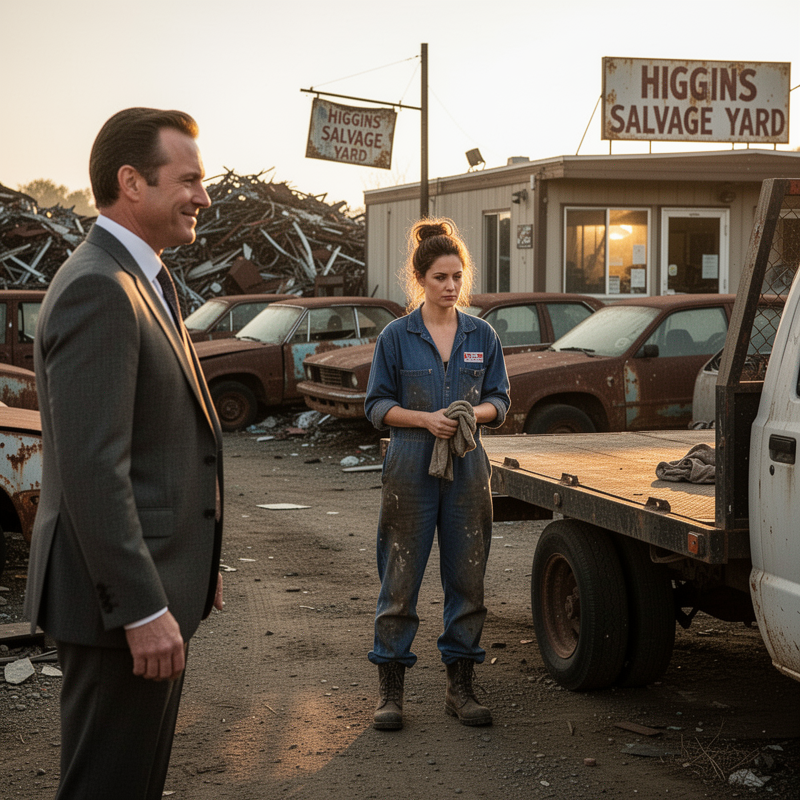
The late afternoon sun, usually a welcome golden hue across the Higgins Salvage Yard, felt like a spotlight fixed on my chest. Dust motes danced in the air, swirling around the rusty skeletons of forgotten cars and the towering stacks of crushed metal that formed the familiar landscape of my life.
I was wiping grease from my hands with a rag, just having helped Richie Holloway hoist a particularly stubborn engine block, when the black Cadillac pulled up to the office trailer. It wasn’t a customer. No one drove a car that pristine to the yard.
Victor Croft stepped out. His suit was tailored, a sharp contrast to the grime and grit of our world. A thin, almost predatory smile played on his lips as he approached.
Richie, sensing something was off, paused his work. He leaned against a flatbed truck, his arms crossed over his grease-stained shirt, watching Croft with a wary gaze.
“Clara Higgins,” Croft’s voice was smooth, too smooth, cutting through the usual clang and hum of the yard.
He didn’t wait for me to respond. He held out a thick envelope. The paper was crisp, expensive. It felt heavy in my hand.
“A little something for your attention.”
My fingers fumbled with the seal. Even before I pulled out the document, a cold dread began to curl in my stomach. Legal-sized paper. Lots of small print.
The first few lines blurred. My eyes scanned for a name, a date, a number.
Then I saw it.
“Retroactive Ground Lease Assessment.” The words jumped out, stark and unforgiving.
A sum, underlined in red, practically screamed off the page: “$68,000.00.”
My breath hitched. Sixty-eight thousand dollars. It was an astronomical figure for us.
“What is that?” Richie’s voice was low, concerned. He moved closer, his shoulder brushing mine.
I couldn’t speak. My gaze was locked on the document. It cited a clause from a 2009 ground lease amendment, one I barely remembered, something about “underutilization fees” and “market value adjustments.”
But it was the next paragraph that truly stole the air from my lungs.
“Failure to remit the full amount of sixty-eight thousand dollars ($68,000.00) within fourteen (14) calendar days of the date of this notice will result in immediate commencement of eviction proceedings and foreclosure on the improvements situated upon the property.”
Fourteen days. Eviction. Foreclosure.
My father, Arthur, was just inside the office trailer, probably dozing in his worn armchair, the afternoon sun warming his face. He’d built this yard with his own hands, collected every piece of scrap that formed its foundation.
He wouldn’t survive losing it.
“What’s he talking about, Clara?” Richie’s voice was sharper now, sensing the gravity in my silence.
Croft’s smile widened, a glint of triumph in his eyes.
“It’s all perfectly legal, Mr. Holloway. An obscure clause, perhaps, but binding nonetheless. Your improvements, the structures, the very trailer you call an office – they’re all subject to seizure under the terms of the ground lease.”
He was enjoying this. The power, the shock on my face.
I looked down at the paper again, my hands trembling slightly. My vision swam. Everything we had, everything my father had worked for, was being threatened by a piece of paper, a hidden clause, and a landlord’s greed.
Richie reached for the document, but I instinctively clutched it tighter.
“This can’t be right,” I whispered, though the words felt hollow.
Croft chuckled softly. “Oh, it’s very right, Miss Higgins. Enjoy your next two weeks. They’ll be memorable.”
He turned, got back into his gleaming Cadillac, and drove away, leaving a plume of dust and a silence that felt heavier than any engine block.
The silence was broken only by the distant squawking of gulls flying over the river and the gentle creak of the old metal gate in the breeze.
I stood there, the paper a burning weight in my hand, the words “eviction” and “foreclosure” echoing in my mind. Sixty-eight thousand dollars in fourteen days. It was impossible.
My gaze drifted to the window of the office trailer, where I could just make out the silhouette of my father. He was innocent of this, of all of it. He deserved to live out his days in peace, surrounded by the organized chaos he’d created.
Richie put a hand on my shoulder, his touch firm and grounding. His eyes scanned the notice, then met mine.
“Clara,” he said, his voice unusually strained. “What are we going to do?”
He paused, then added, his voice barely a whisper, “We don’t have that kind of money. Not even close. And I… I just paid off Arthur’s old medical bills a few months ago. Had to take out a personal loan for it.”
The world tilted. My breath caught in my throat. Richie had taken out a loan? For Arthur’s bills? He hadn’t told me a thing. My father’s old chronic pain, his deteriorating mobility, the endless prescriptions, the physical therapy sessions…
Richie had been quietly shouldering that burden.
And now this. Sixty-eight thousand dollars in fourteen days, threatening to take away everything, including the very ground beneath Richie’s feet.
The weight of the paper in my hand grew heavier, impossibly so. It wasn’t just the yard anymore. It was Richie too.
Part 2
The shock of Richie’s words hit me harder than Croft’s demand. Richie, always so quiet about his own struggles, had taken on this burden for my father. For *us*.
My gaze snapped from the paper to him. His face was grim, a streak of grease across his cheekbone. “It’s fine, Clara,” he said, trying to dismiss it, but his eyes wouldn’t meet mine. “Arthur needed it. No way he could go without the treatments.”
My throat felt tight. He hadn’t just stayed at the yard to keep it running. He’d stayed, it seemed, to keep my father alive. And he’d put himself in debt to do it.
“Richie,” I started, but the words choked in my throat. This wasn’t just a business problem anymore. This was personal. This was *him*.
“We need to find that lease,” I finally managed, my voice hoarse. “The 2009 ground lease amendment he mentioned. There has to be something in it, some way to fight this.”
We walked into the small office trailer. Arthur was indeed dozing in his armchair, a half-finished crossword puzzle on his lap. He looked so frail, so innocent of the storm brewing around us. We moved quietly, not wanting to disturb him.
Richie pulled out the old metal filing cabinet from behind Arthur’s desk. It was crammed with decades of invoices, permits, and faded receipts. Dust motes danced in the sliver of sunlight cutting through the grimy window.
“He kept everything,” Richie murmured, pulling open drawers. “Arthur never threw a piece of paper away.”
I started sifting through folders, my fingers brushing against yellowed documents. The air was thick with the smell of old paper and rust. After what felt like an hour, buried under old tax returns, I found it. A thick packet, labeled “Croft Commercial Lease Amendment – 2009.”
My hands trembled as I opened it. Page after page of legal jargon. But then, on the last page, there it was: Arthur’s signature. Or what was supposed to be Arthur’s signature.
I pulled out an old checkbook from the desk drawer. Arthur’s real signature was a familiar, spidery scrawl. I held the lease document next to it.
My heart began to pound. It wasn’t the same. Not even close. The signature on the lease was too neat, too forced.
Then, a memory flashed through my mind, cold and clear. 2009. That was the year Arthur had his major spinal surgery. He’d been in the county hospital, recovering for weeks, barely able to lift his head, let alone sign his name with such a steady hand. The lease had been notarized. But he couldn’t have been there.
CHAPTER 2: The Paper Trail of 2009
The air in Dad’s old study was thick with dust and the smell of forgotten paper. I knelt beside the filing cabinet, the same one that had been there since I was a little girl, sifting through rusted metal and faded manila folders. My fingers traced the labels: ‘Utilities,’ ‘Yard Maintenance,’ ‘Medical.’
I found the ‘Lease Agreements’ folder tucked behind a stack of old tax returns. Inside, nestled amongst boilerplate legal language, was the 2009 lease extension.
Victor Croft’s name was typed neatly at the top. Beneath it, a series of clauses about ground rent and property use.
Then I saw it. The signature line for Arthur Higgins, my father.
It was a neat, flowing script. Almost elegant.
My dad’s actual signature was a series of jagged, hurried loops, a practical man’s scrawl. It never looked like this. Not once.
My breath hitched. I pulled out a medical bill from the ‘Medical’ folder, dated September 2009. Spinal surgery, county hospital. I remembered it clearly, the long days in the waiting room, the fear.
Dad had been in recovery, barely able to lift his head, much less sign legal documents. His hand had been shaking for weeks.
A cold dread spread through me. This signature, so precise and clean, had been notarized while my father was lying in a hospital bed.
Someone had signed for him. Someone had notarized it. This entire document, the foundation for Croft’s $68,000 demand, was a lie.
CHAPTER 3: Uninvited Headlines
The next morning, the bell above the yard office door jingled, pulling me from a frantic spreadsheet. I expected Richie, but a woman with sharp, intelligent eyes stood in the doorway, a camera bag slung over her shoulder.
“Clara Higgins?” she asked, her voice calm but direct. “I’m Maya Lin, from the regional paper.”
I blinked, confused. My hands, still grimy from fixing a carburetor, tightened around a wrench. “What can I do for you, Ms. Lin?”
“I’m investigating Victor Croft’s recent commercial land acquisitions,” she said, stepping inside. “Specifically, the sudden wave of retroactive fees and environmental citations hitting small businesses in this district.”
My jaw tightened. She already knew.
“I hear your family’s salvage yard is one of the targets,” Maya continued, her gaze sweeping over the cluttered space. “And I’m particularly interested in a real-estate appraiser named Julian Marsh.”
That name hit me like a physical blow. Marsh. He was the one who signed off on the original 2009 property assessment that Croft had used to justify the new fees.
“Marsh has been involved in three other cases,” Maya said, her voice dropping slightly. “Small, family-owned businesses like yours. Craft shops, an auto repair garage.”
She leaned against a metal drum, her expression serious. “They all received identical legal paperwork. The same disputed ground lease clauses, the same aggressive retroactive fee demands, all within the last six months. Two of them are already gone.”
My stomach clenched. This wasn’t just about my dad’s yard. Croft was systematically clearing out entire blocks, using the same playbook. Julian Marsh was his instrument.
CHAPTER 4: Quiet Confessions over Rusted Gears
Richie was hunched over an engine block, his brow furrowed in concentration. The shop smelled of oil and hot metal. I walked in, carrying two lukewarm sodas.
“Maya Lin was here,” I said, handing him a can.
He straightened up, wiping grease from his hands with a rag. “The reporter? What did she want?”
“She’s investigating Croft,” I explained. “And Julian Marsh. Apparently, we’re not the only ones being hit with these ‘retroactive fees.’ She thinks Marsh is working with Croft to push out small businesses.”
Richie’s knuckles, already scarred from years of work, turned white as he gripped the soda can. “That doesn’t surprise me. Croft’s always been a shark.”
He looked at me, a flicker of something raw in his eyes. “You know, when we were kids, after that day in third grade… the one where those jerks laughed at your dad?”
My chest tightened. I remembered it perfectly: the hot shame, the whispered word “garbage man” echoing in the classroom.
“I found them after school,” Richie said quietly, looking down at his worn boots. “Behind the gym. I put Tommy Davies in a headlock until he cried. Told him if he ever disrespected your dad again, he’d regret it.”
A warmth spread through me, cutting through the anxiety. I had never known.
Richie still didn’t look up. “I loved you then, Clara. Loved your dad, loved this place. I fought them because they were hurting something precious.” He finally met my gaze, his eyes shining with an unspoken truth. “Those feelings… they never changed.”
CHAPTER 5: The Red-Ink Citation
The smell of freshly cut steel hung in the air, a familiar comfort. Richie was loading scrap, and I was on the phone trying to trace the notary for Dad’s 2009 lease when a sleek black car pulled up.
Julian Marsh stepped out, impeccably dressed, clutching a clipboard. He looked completely out of place against the backdrop of rusted machinery and piled metal.
“Ms. Higgins,” Marsh said, his voice flat, devoid of any warmth. He didn’t even make eye contact. “I’m here to deliver this.”
He held out a thick envelope. It was marked with bold, red lettering: “ENVIRONMENTAL COMPLIANCE CITATION.”
My heart hammered against my ribs. “What is this?”
“Routine inspection,” Marsh answered, as if discussing the weather. “The property has been cited for heavy metal runoff into the adjacent storm drains. Significant violations.”
Richie walked over, his eyes narrowed. “That’s impossible. We just had our annual inspection. Everything passed clean.”
Marsh didn’t even acknowledge Richie. He handed me the envelope. “The citation demands $15,000 in immediate remediation efforts. Failure to comply within 48 hours will result in a cease-and-desist order and complete site closure.”
Forty-eight hours. My mind reeled. They were moving faster, hitting us with another impossible demand, designed to break us. This wasn’t about compliance; it was about outright closure.
Marsh turned and walked back to his car, leaving a chilling silence in his wake.
CHAPTER 6: A Voice from the Past
I sat at the kitchen table, the environmental citation spread out, its red ink screaming. Dad was napping, and Richie was out trying to find someone, anyone, who could help us with the impossible 48-hour deadline.
A knock at the back door made me jump. Through the window, I saw an elderly man with thin white hair and a stoop, leaning heavily on a cane.
“Clara Higgins?” he asked when I opened the door. His voice was frail. “My name is Donald Gable. I used to be a notary public in town.”
My eyes widened. A notary. The same word that had been burning in my mind since I found the forged signature.
He shuffled inside, slowly settling into a chair across from me. “I saw that reporter, Maya Lin, asking about Victor Croft and Julian Marsh. It brought back some old memories.”
He took a shaky breath. “Fifteen years ago, Clara, Marsh came to me. He had a stack of documents, lease amendments. Said he needed them stamped urgently, a client was out of town, couldn’t sign in person.”
Gable’s hands trembled as he gripped the edge of the table. “He laid out a stack of crisp hundred-dollar bills. Said it was a rush fee. My wife was sick, and we needed the money.”
His gaze met mine, filled with a profound regret. “He made me stamp forged documents. Your father’s lease extension was one of them. He told me it was just a formality, nothing important.”
A wave of relief and fury washed over me. The truth, finally. It hit me harder than any of Croft’s legal threats. “You stamped my dad’s signature as legitimate when he was in the hospital?”
Donald Gable nodded, tears welling in his eyes. “I know. It was wrong. I’ve lived with that guilt every day since. But I’m moving away next month, to live with my daughter. I couldn’t leave without clearing my conscience.”
CHAPTER 7: The Landlord’s Bargain
The next afternoon, just as the 48-hour environmental deadline loomed, Victor Croft’s black Cadillac pulled up to the yard office. He didn’t come inside. He just sat there, waiting.
I walked out to his car, my heart thumping. The sunlight glinted off the polished chrome. Croft lowered the passenger window. The air conditioning inside blasted cold.
“Ms. Higgins,” he said, his voice smooth, almost paternal, a stark contrast to his earlier threats. “This is getting complicated. Unnecessary, really.”
He leaned back in his leather seat. “I understand your loyalty to your father. And to young Richie Holloway.”
My spine stiffened. He knew about Richie. He knew about the loan.
“Let’s be pragmatic,” Croft continued, watching my face. “You sign a voluntary surrender agreement for the property. All environmental fines will be dropped. And,” he paused, letting the words hang in the air, “Richie Holloway’s personal loan? The $22,000 debt for your father’s medical bills?”
He offered a small, predatory smile. “Consider it erased. A clean slate for him. All you have to do is walk away. You have 24 hours to decide.”
He was trying to buy me. To separate me from Richie, from my father, from everything I was fighting for. The temptation, the relief of Richie’s debt disappearing, was a sharp, painful ache.
“Think about it, Clara,” Croft said, his eyes drilling into mine. “It’s a generous offer. Don’t let sentimentality ruin a young man’s future.”
CHAPTER 8: Unyielding Metal
I stared at Croft, the words about Richie’s debt echoing in my head. For a moment, the silence stretched, heavy with the weight of his offer. My father’s tired face, Richie’s determined eyes, flashed in my mind.
“No,” I said, the word coming out firmer than I expected. “I won’t sign it.”
Croft’s polite veneer cracked. His eyes narrowed. “That’s a mistake, Ms. Higgins. A very costly one.”
“It’s not for sale,” I retorted, stepping back from his car. “Neither is this yard. Neither are we.”
He slammed the window up, the expensive glass sealing him off. The Cadillac peeled away, leaving me standing in a cloud of dust. My hands were shaking, but a strange sense of resolve settled in my chest.
Later that evening, after the environmental deadline passed with no further word from Marsh (a small miracle I attributed to Maya’s quiet inquiries), Richie looked at me, his face etched with worry.
“What did Croft say?” he asked.
I told him about the offer, the wiped debt. Richie ran a hand through his hair, a pained expression on his face.
“He tried that with me first,” Richie admitted, his voice barely a whisper. “He came to the yard a few days ago. Said he’d pay off my loan if I convinced you to sign. Said if you didn’t, he’d sue me personally for the site restoration costs after eviction.”
My jaw dropped. “What did you say?”
“I told him no,” Richie replied, his eyes meeting mine. “And then I went to see a legal aid lawyer. I was going to offer to take full legal responsibility for everything. The fines, the cleanup, whatever he threw at us. So you and your dad could keep the house.”
A wave of overwhelming emotion washed over me. He was willing to sacrifice everything for us. He loved us that much.
CHAPTER 9: The Ledger in the Attic
The next morning, Donald Gable was back at my kitchen table, looking a little stronger. He carried a dusty, leather-bound book.
“I’ve been doing some more thinking,” he said, pushing the book across the table. “About Marsh, about that day in 2009.”
He opened the ledger. It was a notary’s logbook, filled with neat entries in fading blue ink. Dates, names, types of documents notarized.
“This is my official log,” Gable explained. “Every document I ever stamped, every person I signed for.”
He pointed to an entry dated September 14, 2009. “This is the day Marsh said he needed your father’s lease amendment stamped. He claimed Arthur had just stepped out of his office.”
Gable’s finger moved to the next line. “But look here, Clara. On September 14th, 2009, I was at the County Annex building, notarizing property deeds for the city. From 9 AM to 3 PM.”
My eyes scanned the entries. His location was clearly listed: “County Annex – City Re-zoning.” He had meticulous notes.
A cold certainty settled in. Donald Gable was miles away at another signing when my father’s lease amendment was allegedly notarized in Croft’s office. There was no way he could have been in two places at once.
“This proves it,” I breathed, tracing the faded ink. “This proves he lied. Marsh forged the signature and pressured you into stamping it, knowing you weren’t even there.”
Gable nodded, a shadow of relief crossing his face. “It’s all in there. Every alibi. Every lie.”
This was more than just his word. This was irrefutable, undeniable proof.
CHAPTER 10: The Front-Page Storm
The regional paper usually arrived on our porch with a gentle thud. This morning, it landed with the force of a thunderclap.
The front page was impossible to miss. “CROFT CORRUPTION? Landlord Accused of Predatory Land Grabs.”
Maya Lin’s article dominated the entire front spread. It detailed Victor Croft’s tactics, Julian Marsh’s involvement, and the stories of the other small businesses pushed out. It cited my father’s forged lease amendment, the environmental citation, and even mentioned Donald Gable’s coming forward.
My phone started ringing before I even finished my first cup of coffee. Tess Banning, the diner owner, called, practically shouting with outrage and support. Then a local councilman’s office. Then two more reporters from smaller local papers.
By noon, a small crowd had gathered outside the yard, holding signs that read “HANDS OFF OUR NEIGHBORHOOD” and “SAVE CEDAR STREET.” Maya Lin’s exposé had gone viral.
Richie stood beside me, his arm brushing mine as we watched the impromptu protest. “It worked, Clara,” he murmured, a disbelief in his voice. “People are listening.”
The biggest news came later that afternoon. Maya called me directly. “Clara, I just got off the phone with City Hall. The city council has officially paused Croft’s commercial zoning vote.”
She paused, letting that sink in. “They’ve ordered a full investigation into his property acquisition practices. Your fight, all of it, just froze his entire project in its tracks.”
CHAPTER 11: Silence in the High-Rise
Victor Croft’s office was on the top floor of the tallest building downtown, all polished marble and silent, thick carpet. The receptionist, usually a formidable gatekeeper, seemed almost deferential as she ushered me through to his inner sanctum.
Croft was alone, seated behind a massive mahogany desk, the city skyline spread out behind him. The room felt unnaturally quiet, devoid of the usual office bustle.
I clutched Donald Gable’s notary logbook, its worn leather a comforting weight in my hands. I didn’t sit in the plush leather chair he gestured towards. I stood directly opposite his desk.
“Ms. Higgins,” Croft said, his voice clipped, his composure strained. He tapped a manicured finger on a stack of legal papers. “I understand you have some… concerns.”
“I have proof,” I corrected, my voice steady despite the tremor in my hands. I slid Gable’s logbook across the desk. It landed with a soft thud. “This is Donald Gable’s notary logbook from 2009.”
Croft’s eyes flickered to the open page, his expression unreadable.
“It shows he was miles away, at the County Annex, notarizing city documents, at the exact time Julian Marsh claimed he notarized my father’s lease amendment in your office,” I explained. “My father, who was in spinal surgery recovery at the county hospital.”
Croft picked up the book, his fingers brushing the faded ink. The silence stretched, thick and suffocating. No bluster. No threats. Just the ticking of a grandfather clock in the corner.
Finally, he looked up, his gaze cold and calculating. “What do you want, Ms. Higgins?”
“A formal standstill agreement,” I said, my voice unwavering. “Signed by you. Halting all eviction proceedings, all fines, effective immediately. And a written apology to my father, for the fraud.”
Croft stared at me for another long moment, weighing his options. His grand project was on hold, his name splattered across the papers. He was cornered. He reached for a pen.
“Get my lawyer on the line,” he said into his intercom, not taking his eyes off me. “Draft a standstill agreement. And an apology.”
CHAPTER 12: Echoes in the Aftermath
The news of Croft’s signed standstill agreement spread like wildfire through our community. The small protest outside the yard turned into a celebration. Neighbors brought food, offering hugs and congratulations. For a glorious few days, it felt like a complete victory.
Richie and I stood by the rusty gate, watching the last of the news vans pull away. He took my hand, his thumb tracing patterns on my skin.
“We did it, Clara,” he said, his voice thick with emotion. “We actually did it.”
The reprieve was sweet, but short-lived. A week later, a formal letter arrived from Croft’s corporate lawyers. It outlined a series of new civil appeals. They weren’t fighting the standstill agreement itself, but rather challenging the underlying jurisdiction, the validity of certain historical property easements, and even the original terms of the ground lease, hoping to drag the case out for years.
“They’re not giving up,” I told Richie, holding the new stack of legal paperwork. “They’re just changing tactics. Trying to bleed us dry with legal fees.”
Richie picked up a discarded spark plug, turning it in his fingers. “It means we’re not truly safe, not yet.”
The public outrage had put Croft’s development project on ice, but his legal team was persistent. The yard, our home, remained in an ambiguous limbo. We had won the battle, but the war, it seemed, was far from over. The property’s long-term ownership was still unsettled, hanging precariously in the balance of ongoing court dates and endless appeals.
CHAPTER 13: One Year on Cedar Street
One year later. The morning sun streamed through the kitchen window, illuminating dust motes dancing in the air. The kitchen table, still worn and cluttered, held two mugs of coffee. My father was pottering in the small garden outside, a little slower, but still insistent on his morning routine.
Richie sat across from me, a serious expression on his face, holding a printout. The initial shock of the court battles had faded into a dull, persistent ache, the appeals still grinding slowly through the system. We had found a pro-bono lawyer through Maya Lin’s contacts, which helped, but the legal uncertainty remained.
“I got an offer yesterday,” Richie said, pushing the paper across the table. “From a company in Texas. A multi-state salvage expansion project.”
I picked up the document. It was a partnership proposal, significant. Enough to finally put us on solid financial ground, to secure Dad’s care, to clear Richie’s name from Croft’s legal threats, and then some.
“It’s a huge opportunity, Clara,” he continued, watching me intently. “It would mean a fresh start. Far away from Croft, from all this.”
My eyes scanned the numbers. It was more than we could have dreamed of just a year ago. It meant stability, security, a future free from the shadow of eviction. But it also meant leaving Cedar Street. Leaving the scrap yard. The place we had fought so desperately to save.
“It would mean moving,” I said, my voice barely a whisper. “Starting over, somewhere new.”
Richie reached across the table, taking my hand. His calloused fingers intertwined with mine. “With you. Wherever you want to go. Whatever you want to build.”
The lawsuit lingered, a ghost in the background. But here, in this ordinary kitchen, on this ordinary morning, a new path was opening up, forged not from rusted metal, but from something far more precious.
For years I thought my father’s rusted metal was something to hide, but it taught me that the strongest things in life are forged under pressure.
Leave a Reply