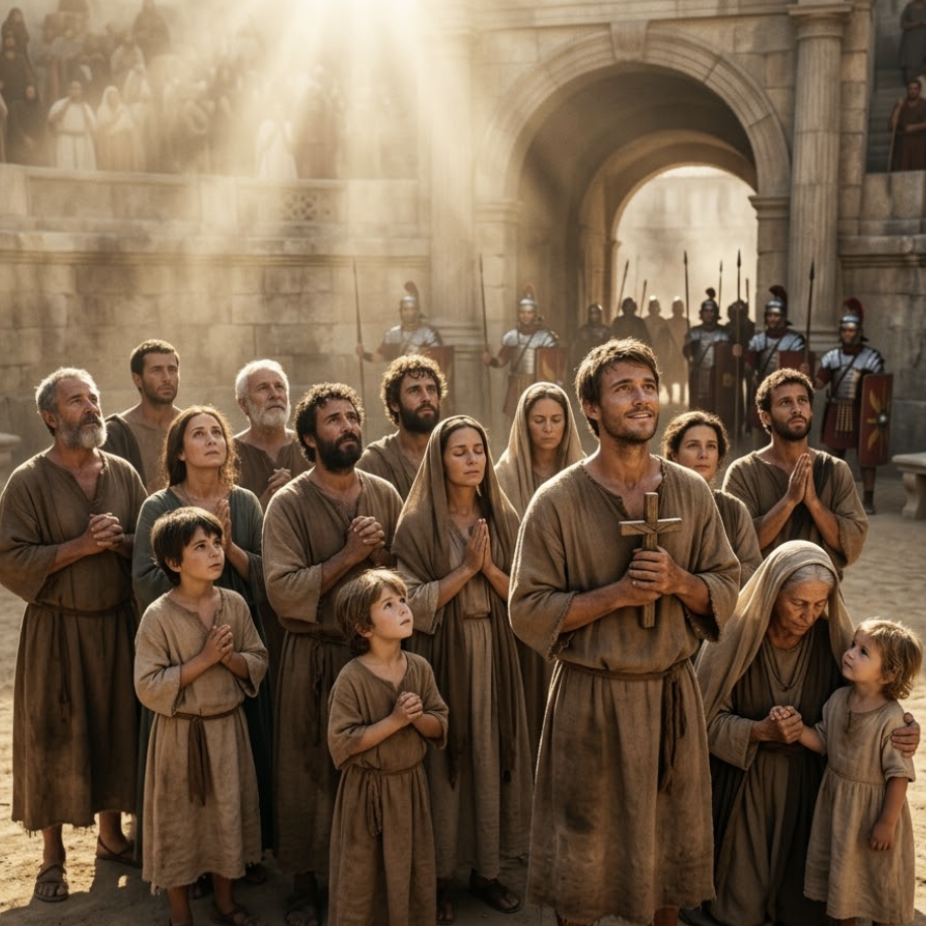
The Holy Martyrs did not choose death because they wanted to be remembered.
They chose faithfulness because they believed there was a life greater than fear.
For more than 2,000 years, Christianity has carried the memory of men, women, children, priests, religious, parents, workers, servants, nobles, farmers, and ordinary believers who faced one terrible choice: deny Christ and live, or remain faithful and die.
Many of them did not seek suffering.
They did not wake up hoping to become heroes.
They were not people without fear.
They were human beings with families, dreams, memories, weaknesses, and trembling hearts.
But when the moment came, they believed that losing Christ would be a greater tragedy than losing their own lives.
Some stood in Roman arenas while crowds shouted for blood.
Some were imprisoned in dark cells.
Some were tortured in public squares.
Some were tied to crosses, burned, beheaded, or executed in front of their own families.
Some were persecuted in Japan, Korea, Vietnam, Mexico, Africa, Europe, and countless other places where confessing Christ became dangerous.
In many cases, they were offered a way out.
Just say one sentence.
Just burn one pinch of incense.
Just step on a sacred image.
Just sign one paper.
Just pretend you no longer believe.
Just deny Christ once, and you can go home.
But they would not.
Not because they hated life.
Not because they wanted pain.
Not because they were stronger than everyone else.
But because they loved Christ more than they feared death.
And that is why the story of the martyrs still asks every believer a quiet question:
How strong is my faith when it costs me something?
Throughout the history of Christianity, the martyrs have never been remembered merely because of the way they died.
They are remembered because of the way they believed.
Death came to them in many forms. Some died in public. Some died forgotten. Some left behind written testimonies. Others left behind only a name, a place, or a memory passed on by the Church. Some were young. Some were old. Some had studied theology. Others could barely read. Some were priests and bishops. Others were mothers, fathers, catechists, workers, farmers, children, and servants.
But beneath all those different lives was one same witness:
Christ was worth everything.
That is what makes the martyrs so powerful.
They were not simply victims of cruelty. They were witnesses. The word “martyr” itself means witness. Their blood did not merely tell the world that they had died. It told the world what they lived for.
A person may die for many reasons.
But the martyr dies while testifying that God is real, that Christ is Lord, that eternal life is not an empty promise, and that the human soul is worth more than comfort, safety, approval, or even physical survival.
This does not mean Christians should seek suffering.
The Church has never taught that death itself is the goal.
Life is sacred.
The body is sacred.
Family, love, work, friendship, laughter, and earthly joys are gifts from God.
The martyrs did not despise life. Many of them loved life deeply. That is why their choice is so moving. They did not throw life away because it meant nothing. They offered it because Christ meant more.
When a martyr refuses to deny Christ, he or she is not saying, “My life has no value.”
The martyr is saying, “My life belongs to God.”
There is a difference.
A person who despises life may be reckless.
But a martyr who loves God is faithful.
That faithfulness has echoed from the earliest centuries of Christianity.
In ancient Rome, Christians were often viewed with suspicion. They refused to worship the emperor as a god. They refused to abandon the worship of the one true God. They gathered for prayer, shared the Eucharist, cared for the poor, rescued abandoned children, and lived by a kingdom the Roman Empire could not fully control.
To the world around them, they often looked weak.
They had no army.
No political power.
No throne.
No wealth comparable to the empire.
And yet the empire feared them.
Because there is something deeply dangerous about people who cannot be bought by comfort or broken by fear.
When believers were dragged into arenas, mocked by crowds, and threatened with death, the authorities often expected them to collapse. Surely, they thought, these ordinary men and women would choose survival. Surely, once they saw the beasts, the swords, the fire, the chains, they would deny Christ.
But many did not.
Some prayed.
Some sang.
Some forgave their executioners.
Some encouraged one another to remain faithful.
Some walked toward death with a peace that confused those watching.
That peace was not natural.
It was not the peace of people who felt no pain.
It was the peace of people who believed death did not have the final word.
This is what unsettled the world.
The martyrs showed that the Christian faith was not merely an idea.
It was not just a set of teachings.
It was not just a weekly gathering or a private comfort.
It was a truth worth dying for.
And if something is worth dying for, then it must also be worth living for.
That is why the witness of the martyrs still matters today.
Most believers will never be dragged into an arena.
Most will never face a judge demanding that they deny Christ.
Most will never be asked to choose between execution and faith.
But every Christian still faces smaller forms of pressure.
The pressure to stay silent when truth is mocked.
The pressure to hide one’s faith to avoid embarrassment.
The pressure to compromise values in order to gain success.
The pressure to follow the crowd even when the crowd walks away from God.
The pressure to make comfort the highest good.
The pressure to live as if Christ is only one part of life, not the center of life.
The martyrs ask us:
If I cannot be faithful in small trials, how would I be faithful in great ones?
This question is not meant to shame us.
It is meant to awaken us.
Because martyrdom is not only about the final moment of death. It is the fruit of a life already surrendered to God.
No one becomes courageous by accident in the final second.
The courage of the martyrs was formed through prayer, sacrifice, repentance, humility, the Eucharist, Scripture, community, and daily choices to put God first.
Before a martyr says yes to Christ at the moment of death, he or she has often said yes to Christ in countless hidden moments.
Yes, when forgiving someone felt impossible.
Yes, when prayer felt dry.
Yes, when obedience was difficult.
Yes, when the world laughed.
Yes, when temptation looked attractive.
Yes, when faith brought suffering.
Yes, when there was no applause.
The final yes of martyrdom is built upon many smaller yeses.
That is why the lives of the martyrs are not distant from us.
They are not only stories from ancient books.
They are mirrors.
They show us what the human heart can become when it belongs fully to God.
The martyrs of the early Church witnessed in the face of pagan power.
The martyrs of Japan witnessed in silence, endurance, and hidden faith. Many Japanese Christians suffered brutal persecution. Some were forced to step on sacred images to prove they had abandoned the faith. Some refused. Others fell under pressure and later repented with tears. The history of those persecutions reminds us that martyrdom is not romantic. It is terrifying. It tears families apart. It exposes human weakness. It shows both the cruelty of persecutors and the fragile courage of believers.
Yet in that darkness, the light of faith remained.
In Korea, many Catholics were persecuted because the faith challenged social and political structures. Lay believers played a major role in spreading Christianity, often before priests could freely minister among them. Many Korean martyrs were ordinary laypeople who held fast to Christ despite imprisonment, torture, and death. Their witness showed that holiness is not reserved for clergy or religious. A father, a mother, a student, a servant, a scholar, a young person, a widow — all can become witnesses.
In Vietnam, generations of Catholics endured severe persecution. Some were imprisoned. Some were tortured. Some were executed. Some were forced to step on the cross or publicly renounce the faith. Many refused. The Vietnamese martyrs remain a powerful witness of courage, patience, and fidelity. They show that faith can survive not only in cathedrals, but also in prisons, villages, fields, and families who whisper prayers in fear yet refuse to abandon Christ.
Across the world, the same pattern appears again and again.
The persecutors say:
“Deny Christ, and you may live.”
The martyrs answer:
“To deny Him would be a worse death.”
This does not mean they felt no fear.
We often imagine saints as if they were made of stone.
But the martyrs were not stone.
They had beating hearts.
They loved their families.
They felt pain.
They may have trembled.
They may have cried.
They may have begged God for strength.
Their courage was not the absence of fear.
Their courage was faithfulness in the presence of fear.
That is important for us to remember.
Because many people think courage means never being afraid. But Christian courage is different. It means trusting God even while afraid. It means saying, “Lord, I am weak, but I belong to You.” It means standing firm not because we feel powerful, but because we believe God is faithful.
Some martyrs prayed for those who killed them.
This may be the most difficult part to understand.
It is already extraordinary to remain faithful under threat.
But to forgive the people causing that suffering seems almost impossible.
Yet this is one of the clearest signs that martyrdom is not hatred in religious clothing.
True martyrdom is united to Christ.
And Christ, from the cross, prayed for those who crucified Him.
So when martyrs forgive their persecutors, they do not merely show human kindness. They reveal the life of Christ within them.
They refuse to let evil turn them into hatred.
They refuse to let violence steal their mercy.
They refuse to let the cruelty of others define their final act.
That kind of witness is more powerful than revenge.
Revenge says, “You hurt me, so I will hurt you.”
Martyrdom says, “You may take my life, but you cannot take Christ from me. You cannot make me hate. You cannot make me deny love.”
This is why the martyrs disturb the conscience of the world.
They expose the emptiness of power without truth.
A tyrant can kill the body.
But he cannot force the soul to betray God if the soul refuses.
A crowd can mock.
A prison can isolate.
A sword can threaten.
Fire can burn.
But none of those things can separate a faithful soul from Christ.
This is why the memory of the martyrs has always strengthened the Church.
When Christians are comfortable, the martyrs remind them not to become lazy.
When Christians are afraid, the martyrs remind them not to despair.
When Christians are tempted to compromise, the martyrs remind them that Christ is worth more.
When Christians suffer, the martyrs remind them that suffering can be united to God.
When Christians feel alone, the martyrs remind them that they are surrounded by a great cloud of witnesses.
The martyrs are not dead memories.
They are living witnesses in the communion of saints.
Their lives continue to speak.
And their message is not complicated:
Do not trade Christ for safety.
Do not trade truth for approval.
Do not trade eternal life for temporary comfort.
Do not trade your soul for the world.
This message can sound severe, but it is actually filled with hope.
Because the martyrs prove that grace is stronger than human weakness.
No one is born ready for martyrdom.
Grace makes saints.
Grace strengthens the fearful.
Grace gives words to the silent.
Grace gives peace in the hour of trial.
Grace allows ordinary people to do what would otherwise be impossible.
A young girl can stand firm before threats.
An old man can refuse to betray Christ.
A mother can entrust her children to God.
A priest can bless his executioners.
A lay catechist can continue teaching the faith despite danger.
A prisoner can pray in chains.
A dying believer can smile, not because death is beautiful, but because Christ is near.
The martyrs reveal what grace can do in a human heart.
That is why their stories should not only make us emotional.
They should make us examine ourselves.
What do I fear more than losing Christ?
Whose opinion controls me?
What comfort am I unwilling to surrender?
Where have I already denied Christ in small ways?
Have I hidden my faith because I was embarrassed?
Have I chosen sin because it was easier?
Have I stayed silent when I should have defended truth?
Have I treated faith as decoration rather than the center of life?
These questions are uncomfortable.
But the martyrs did not give their lives so that we could admire them from a safe distance and change nothing.
Their witness calls us to conversion.
Not everyone is called to shed blood for Christ.
But every Christian is called to die to something.
To pride.
To selfishness.
To cowardice.
To sin.
To the desire to be accepted at any cost.
To the habit of choosing comfort over holiness.
There is a kind of daily martyrdom hidden in ordinary life.
A mother who sacrifices sleep to care for a sick child.
A father who works honestly when dishonesty would bring more money.
A young person who refuses to join friends in sin.
A spouse who remains faithful when tempted.
A believer who forgives an enemy.
A worker who tells the truth at personal cost.
A Christian who keeps praying when faith feels dry.
These are not the same as bloody martyrdom.
But they belong to the same logic of love.
They say: Christ first.
Not my pride first.
Not my comfort first.
Not my image first.
Not my fear first.
Christ first.
The martyrs teach us that faith is not proven only by words.
Anyone can say, “I believe,” when belief costs nothing.
The question is what happens when belief costs reputation, success, comfort, relationships, freedom, or life itself.
This is why the title of this story is so piercing:
They only had to deny Christ once to stay alive.
Just once.
One sentence.
One gesture.
One public denial.
And yet many refused.
Because for them, Christ was not an idea to be adjusted for survival.
He was Lord.
He was Savior.
He was the One who had conquered death.
He was the One who had promised eternal life.
He was the One who had loved them first.
To deny Him would be to deny the deepest truth of their existence.
That does not mean they wanted to die.
It means they knew death was not the end.
This belief in eternal life is central to the witness of the martyrs.
Without eternal life, martyrdom can look like tragedy only.
But with eternal life, martyrdom becomes testimony.
The martyr loses earthly life, but not life itself.
The martyr is defeated in the eyes of the world, but victorious in Christ.
The martyr may appear powerless, but reveals a power greater than violence.
That is why the Church honors martyrs.
Not because suffering is good in itself.
Not because violence is holy.
Not because death is desirable.
But because love stronger than death is holy.
Faith stronger than fear is holy.
Hope stronger than persecution is holy.
The martyrs are honored because they show us what it means to belong completely to Christ.
Today, many Christians live in places where they can practice their faith freely. They can attend Mass, wear a cross, own a Bible, speak about God, teach their children to pray.
That freedom is a gift.
But freedom can also become dangerous if it leads to indifference.
When faith costs nothing, people can begin to treat it as nothing.
They stop praying.
They skip worship.
They forget Scripture.
They compromise little by little.
They let the world form their values more than the Gospel.
They say they believe in Christ, but live as if He is optional.
The martyrs shake us awake.
They remind us that the faith we sometimes neglect was preserved by the blood of others.
The Gospel reached us because someone before us was faithful.
The Church endured because someone refused to deny Christ.
Our freedom to believe was often purchased through the suffering of those who had no freedom at all.
That should humble us.
It should also inspire us.
Because the martyrs are not only examples of suffering. They are examples of love.
Their lives say:
Love Christ when it is easy.
Love Him when it is difficult.
Love Him when others understand.
Love Him when others mock.
Love Him when you feel close to Him.
Love Him when you feel nothing.
Love Him in public.
Love Him in secret.
Love Him in life.
Love Him in death.
And if we are honest, most of us are not yet ready to say that perfectly.
But we can begin.
We can begin with a prayer.
“Lord, make my faith stronger than my fear.”
We can begin with confession.
“Lord, forgive me for the times I denied You by my choices.”
We can begin with courage.
“Lord, help me stand for truth when it costs me.”
We can begin with small acts of fidelity.
A morning prayer.
A decision to forgive.
A refusal to lie.
A return to Mass.
A quiet act of charity.
A conversation about faith with someone we love.
A choice to live differently from the world.
This is how courage grows.
Not all at once.
But step by step.
The martyrs did not become faithful in the final moment only.
They had already learned to belong to Christ.
That is the lesson for us.
Do not wait until a great trial comes to decide who you are.
Choose Christ now.
In the small moments.
In the hidden choices.
In the ordinary pressures.
In the daily temptations.
In the quiet places where no one applauds.
Because the faith that stands in public is formed in secret.
The martyrs also teach us not to be ashamed of the cross.
Modern life often tells us to avoid suffering at all costs. Comfort becomes the highest goal. Pain becomes meaningless. Sacrifice seems foolish. But Christianity sees the cross differently.
The cross is not the end of love.
The cross is where love is revealed most fully.
The martyrs understood this.
They united their suffering to Christ’s suffering.
They did not suffer alone.
They died with Christ, trusting they would live with Him.
This does not make their pain less real.
But it gives their pain meaning.
And many people today need that hope.
People suffering illness.
People grieving loved ones.
People facing injustice.
People rejected for their faith.
People carrying hidden crosses.
The martyrs whisper to them:
Your suffering is not unseen.
Your tears are not wasted.
Your faithfulness matters.
Christ is near.
Hold on.
The world may forget many things.
But the Church remembers her martyrs.
She remembers them at altars.
In feast days.
In litanies.
In churches named after them.
In stories told to children.
In prayers whispered by the suffering.
In the courage of believers who come after them.
Their blood became seed.
Their witness became light.
Their death became proclamation.
And their silence before persecutors became one of the loudest sermons in history.
They only had to deny Christ once to stay alive.
But they chose Him.
And because they chose Him, millions after them have found courage to choose Him too.
CONCLUSION
The Holy Martyrs are not remembered because they loved death.
They are remembered because they loved Christ more than death.
They did not choose suffering for its own sake.
They chose faithfulness.
They believed there was a life greater than fear, a truth greater than pressure, a kingdom greater than any empire, and a love stronger than the grave.
Their stories still speak to every generation.
To the fearful, they say: do not be afraid.
To the comfortable, they say: do not fall asleep.
To the tempted, they say: do not trade Christ for anything.
To the suffering, they say: Christ is near.
To all believers, they ask:
How strong is your faith when it is tested?
Most of us may never face the same choice they faced.
But every day, in smaller ways, we are asked to choose.
Christ or comfort.
Truth or approval.
Holiness or compromise.
Faithfulness or fear.
May the witness of the Holy Martyrs teach us to live with courage, pray with sincerity, love with sacrifice, and hold fast to Christ in every trial.
Because the world may remember how they died.
But Heaven remembers why they stayed faithful.