Saint Thérèse did not do great things in the way the world usually understands greatness.
She did not found a religious order.
She did not travel across oceans as a missionary.
She did not preach to crowds in public squares.
She did not build great churches, lead movements, or perform famous miracles during her lifetime.
To many people looking from the outside, her life seemed hidden, ordinary, and almost too small to be remembered.
She entered a cloistered Carmelite monastery.
She lived behind convent walls.
She prayed, worked, suffered, obeyed, and offered small sacrifices to God.
She washed, swept, smiled, forgave, endured misunderstandings, and tried to love Jesus in the smallest moments of each day.
And yet, this young woman became one of the most beloved saints in Catholic history.
After her death, her spiritual memoir, Story of a Soul, spread across the world. Millions of people discovered in her words a path they could actually follow: not a path of worldly greatness, but a “little way” of trust, humility, and love.
Saint Thérèse showed that holiness is not only found in extraordinary achievements.
It can be found in hidden sacrifices.
In quiet patience.
In simple love.
In doing small things with great love for God.
And that is why a young nun who seemed unknown in life would one day be declared a Doctor of the Church.
When Saint Thérèse of Lisieux was alive, there was almost nothing about her life that looked impressive by worldly standards.
She was not famous.
She did not hold an important position.
She did not travel the world.
She did not speak before large crowds.
She did not leave behind a long list of public achievements.
She lived most of her religious life inside the walls of a Carmelite monastery in Lisieux, France. Her days were marked by prayer, silence, community life, work, obedience, illness, and hidden sacrifices. To someone who values only visible success, her life could have seemed small.
Too small, perhaps, to change the world.
But God often hides His greatest works inside the smallest places.
The world measures greatness by attention.
God measures greatness by love.
The world asks, “How many people saw you?”
God asks, “How much love did you place into what no one saw?”
This is the key to understanding Saint Thérèse.
Her life was not outwardly dramatic, but inwardly it burned with love. She believed that holiness did not require doing spectacular things. It required doing ordinary things with extraordinary love.
This became known as her “little way.”
The little way was not a childish spirituality.
It was not laziness.
It was not an excuse for doing less.
It was a path of deep trust in God, complete surrender, humility, and hidden love.
Saint Thérèse understood that not everyone is called to accomplish great visible works. Not everyone can become a missionary in a distant land. Not everyone can preach, teach, write theology, build institutions, or lead great causes.
But everyone can love.
Everyone can offer a small sacrifice.
Everyone can be patient when misunderstood.
Everyone can forgive a small offense.
Everyone can smile when tired.
Everyone can do an ordinary duty for God.
Everyone can trust God like a child trusts a loving father.
This is why her message touched so many people.
She made holiness feel possible.
Not easy, but possible.
For a mother washing dishes.
For a father working long hours.
For a sick person lying in bed.
For a student struggling quietly.
For a nun in a cloister.
For a worker doing the same task every day.
For an elderly person who feels forgotten.
For anyone who thinks, “My life is too ordinary to matter.”
Saint Thérèse answers:
No life is too ordinary when it is filled with love.
Her spiritual memoir, Story of a Soul, became the window through which the world discovered her. She did not write it to become famous. She wrote in obedience, simply telling the story of what God had done in her soul.
And that is what made it powerful.
It was not a book of pride.
It was not a book of self-display.
It was the honest testimony of a young woman who knew her weakness and trusted completely in God’s mercy.
In those pages, readers found a saint who did not pretend to be strong by herself. Thérèse did not present herself as someone who climbed to Heaven by her own power. She saw herself as little, weak, dependent, and deeply loved by God.
This is one of the reasons she became so beloved.
Many people feel weak.
Many people feel spiritually small.
Many people begin the Christian life with hope, then become discouraged by their failures.
They think holiness is only for heroic souls, for people who never struggle, never doubt, never fall, never feel tired, never feel dry in prayer.
But Saint Thérèse shows another way.
She teaches that weakness does not have to keep us away from God.
Weakness can become the very place where we learn to trust Him.
She did not deny her smallness.
She offered it.
She did not pretend to be great.
She let God be great in her.
The little way is built on this truth: we do not become holy because we are powerful. We become holy because we allow God’s love to transform our smallness.
That is why Thérèse’s spirituality is both gentle and demanding.
It is gentle because it tells the weak not to despair.
It is demanding because it asks us to love in the exact place where we are.
Not tomorrow.
Not when life is easier.
Not when everyone understands us.
Not when we finally feel holy.
But today.
In this house.
In this duty.
In this illness.
In this misunderstanding.
In this ordinary moment.
For Saint Thérèse, the monastery was not a prison that limited her mission. It became the place where her mission was purified. She wanted to be a missionary. She wanted to go to distant lands and bring souls to Christ. But she was not sent across the world.
Instead, she became a missionary through prayer and sacrifice.
She offered her hidden life for priests, missionaries, sinners, and souls far from God. She believed that love could travel farther than her feet ever could.
This is one of the beautiful paradoxes of her life.
She never went on a foreign mission, yet she became a patroness of missions.
She lived hidden in a cloister, yet her influence spread across continents.
She died young, yet her voice still speaks to millions.
She did not perform public miracles during her lifetime, yet after her death many graces and miracles were attributed to her intercession.
She seemed small, yet the Church recognized the depth of her wisdom.
Eventually, Saint Thérèse was declared a Doctor of the Church.
This title is not given lightly.
A Doctor of the Church is a saint whose teaching has special importance for the whole Church. The title recognizes not only personal holiness, but also the spiritual depth and lasting value of the saint’s doctrine.
And this is what makes Thérèse’s story so striking.
She was not a university professor.
She was not a bishop.
She was not an ancient theologian writing complex treatises.
She was a young Carmelite nun who died at only 24.
Yet the Church saw in her little way a teaching so profound, so pure, and so necessary that it belonged not only to one convent, one country, or one century, but to the entire Church.
Her doctrine was simple, but not shallow.
Trust God.
Remain little.
Do small things with great love.
Offer everything.
Do not despair over weakness.
Believe in mercy.
Let love be the heart of holiness.
This message continues to speak because the modern world is exhausted by the pressure to be impressive.
People are constantly told to achieve more, show more, prove more, own more, become more visible, more successful, more admired.
Even spiritual life can become infected by that pressure.
People may begin to think that unless they are doing something big, their faith is not meaningful.
Unless they are seen, they are not useful.
Unless they are praised, their sacrifice does not matter.
Saint Thérèse quietly destroys that lie.
She reminds us that God sees what the world ignores.
God sees the tired mother who still speaks gently.
God sees the father who works honestly without recognition.
God sees the caregiver who serves day after day.
God sees the sick person who offers pain in silence.
God sees the lonely person who still prays.
God sees the hidden act of kindness.
God sees the small sacrifice no one thanks you for.
God sees the love.
And love is what matters.
This is why Saint Thérèse’s life is so comforting to ordinary people.
She did not make holiness unreachable.
She brought it close.
She showed that sanctity can grow in ordinary soil.
In laundry.
In silence.
In headaches.
In community tensions.
In disappointments.
In obedience.
In small acts of self-denial.
In choosing not to complain.
In choosing to love someone difficult.
In choosing to trust God when prayer feels dry.
Her life teaches that the smallest act, if done for God, can have eternal weight.
A hidden sacrifice can help save souls.
A quiet prayer can support a missionary.
A moment of patience can become an offering.
A small act of love can become great in Heaven.
This is not how the world thinks.
The world often honors what is loud.
God often blesses what is hidden.
The world rewards visibility.
God rewards fidelity.
The world asks for results.
God asks for love.
That is why Thérèse’s story is so revolutionary.
She did not compete with the world’s idea of greatness.
She revealed a different greatness altogether.
The greatness of being little before God.
The greatness of trusting completely.
The greatness of love hidden beneath ordinary duties.
The greatness of becoming like a child in the arms of the Father.
Her life was also marked by suffering.
The little way was not a sentimental path free from pain. Thérèse suffered physically and spiritually. She endured illness, weakness, misunderstandings, and deep interior trials. Near the end of her life, tuberculosis consumed her body. She experienced darkness in faith, feeling the weight of spiritual dryness and temptation.
Yet she remained faithful.
This is important.
The little way does not mean life becomes easy.
It means that even when life is hard, we can still love.
Even when we do not feel strong, we can still trust.
Even when God seems silent, we can still offer ourselves.
Even when our suffering is hidden, it can still be united to Christ.
Saint Thérèse did not teach from a place of comfort. She taught from the cross.
That is why her words carry weight.
She knew what it meant to love without consolation.
She knew what it meant to believe in darkness.
She knew what it meant to be physically weak but spiritually surrendered.
Her holiness was not made of beautiful thoughts only.
It was lived in real suffering.
And after her death, the world began to understand what had been hidden.
Story of a Soul spread widely. People from different countries, cultures, and states of life read her words and felt that she was speaking directly to them. Her message crossed boundaries because the human heart everywhere understands the desire to be loved by God despite weakness.
Many graces and miracles were reported through her intercession.
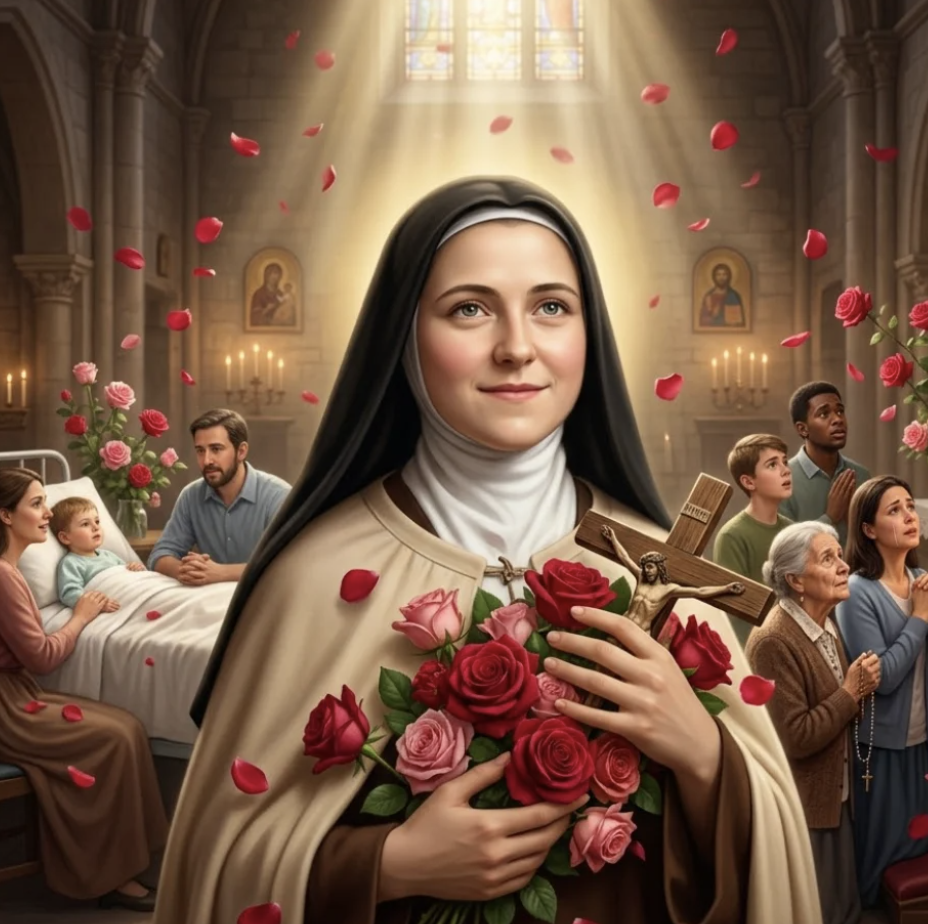
People prayed to her in illness, confusion, family struggles, spiritual dryness, and desperate need. Many testified that they received help, healing, peace, or signs of her intercession. The image of the “shower of roses” became closely associated with her, recalling her desire to spend Heaven doing good on earth.
Roses became a symbol of her gentle heavenly mission.
But the roses are not the center.
Christ is the center.
Thérèse does not lead people to herself.
She leads them to Jesus.
Her whole life was a movement toward Him.
Her whole teaching points to His mercy.
Her whole little way is possible only because God is a loving Father.
That is why devotion to Saint Thérèse remains so fruitful. It is not merely admiration for a sweet young saint. It is an invitation to live differently.
To stop despising small duties.
To stop waiting for perfect circumstances.
To stop thinking weakness disqualifies us from holiness.
To stop chasing worldly greatness at the cost of interior peace.
To begin again with trust.
To love today.
To offer today.
To forgive today.
To pray today.
To do the small thing in front of us with love.
This is the genius of Saint Thérèse.
She teaches that the path to holiness is not always far away.
Sometimes it is right under our feet.
In the next act of patience.
The next duty.
The next prayer.
The next hidden sacrifice.
The next moment when we choose love over self.
For some people, holiness looks like preaching to thousands.
For others, holiness looks like caring for one sick family member.
For some, holiness looks like crossing oceans.
For others, holiness looks like remaining faithful in one small room.
For some, holiness looks like public courage.
For others, holiness looks like silent endurance.
Saint Thérèse reminds us that both can be holy if filled with love.
Her life is a rebuke to the pride of the world.
But it is also a comfort to the wounded.
It says:
You do not have to be famous to be precious to God.
You do not have to be powerful to be useful to the Church.
You do not have to be perfect to begin loving.
You do not have to do great things to become holy.
You only have to give God your little things with great love.
This is why a young woman who seemed hidden became known around the world.
This is why a short life became a lasting light.
This is why a cloistered nun became a Doctor of the Church.
This is why millions still call her beloved.
Saint Thérèse did not conquer the world by force.
She conquered hearts by trust.
She did not build an empire.
She showed a way.
She did not speak loudly in life.
But after death, her little voice traveled everywhere.
And that voice still says:
Be little.
Trust God.
Do not be afraid of your weakness.
Love in small things.
Heaven sees.
CONCLUSION
Saint Thérèse did not do great things according to the standards of the world.
She did something deeper.
She loved greatly in small things.
She chose hidden sacrifices, simple trust, quiet obedience, and childlike confidence in God. She believed that holiness was possible not only in extraordinary missions, but in ordinary moments offered with love.
After her death, Story of a Soul carried her little way across the world. Millions found hope in her message. Many graces and miracles were attributed to her intercession. And the Church eventually recognized the depth of her wisdom by declaring her a Doctor of the Church.
From an unknown young nun in a cloister, Saint Thérèse became one of the most beloved saints in Catholic history.
Her life still reminds us that God does not measure greatness the way the world does.
The world may overlook hidden love.
But Heaven never does.