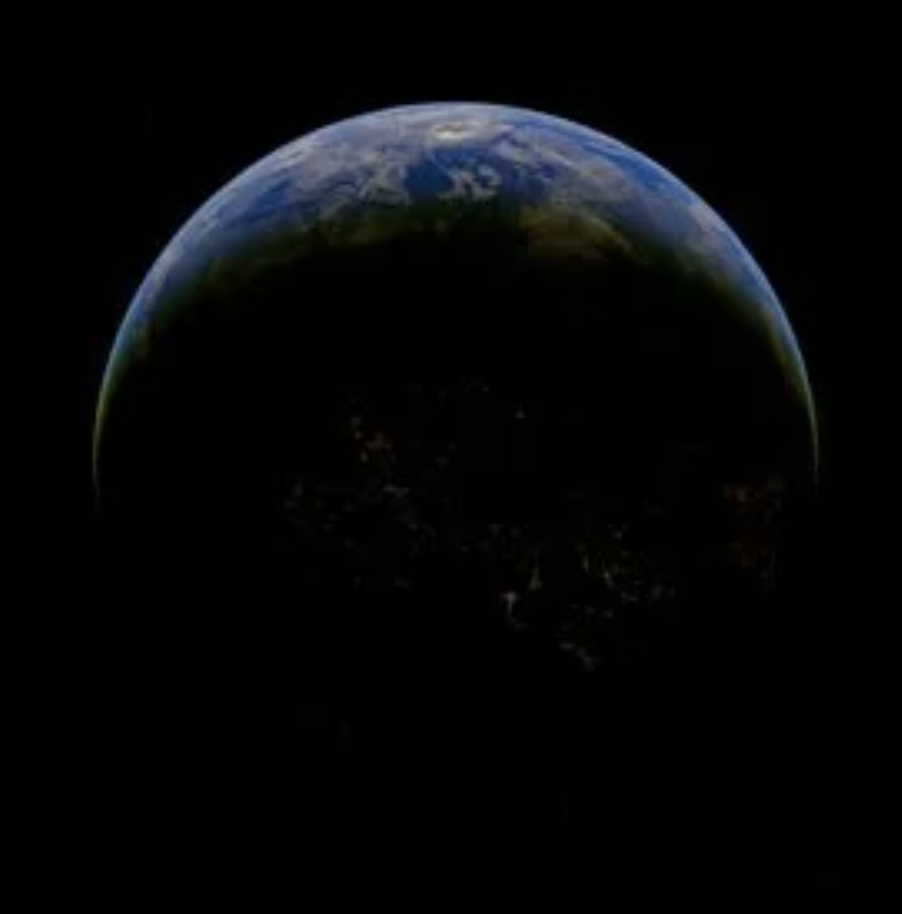
Imagine waking up one morning and hearing the most shocking news in human history.
The Sun is gone.
Not hidden behind clouds.
Not blocked by an eclipse.
Gone.
Completely vanished.
At first, surprisingly, nothing would seem different.
Birds would still sing.
Cars would still move.
People would still go about their day.
For a few brief moments, Earth would appear perfectly normal.
Then reality would begin to unravel.
The First 8 Minutes
One of the strangest facts about our universe is that we never see the Sun exactly as it is right now.
Sunlight takes time to travel.
The light leaving the Sun today requires approximately 8 minutes and 20 seconds to reach Earth.
That means if the Sun somehow vanished instantly, nobody on Earth would know immediately.
For more than eight minutes, daylight would continue.
The sky would remain bright.
The world would look completely normal.
Then, without warning, everything would change.
The sunlight would stop arriving.
The sky would turn black.
Every location experiencing daytime would suddenly be plunged into darkness.
It would not resemble sunset.
It would resemble a light switch being turned off across half the planet.
Stars would become visible.
Planets would appear overhead.
And billions of people would realize something unimaginable had happened.
The Loss of Gravity
The disappearance of sunlight would not be the only shock.
Gravity would vanish too.
Just like light, the Sun’s gravitational influence travels at the speed of light.
For those same eight minutes, Earth would continue orbiting normally.
Then the Sun’s gravitational pull would disappear.
At that exact moment, Earth would stop following its curved orbit around the Sun.
Many people imagine Earth would suddenly fly outward violently.
That isn’t quite what would happen.
Instead, Earth would continue moving in the direction it was already traveling.
Think of swinging a ball on a string.
If the string suddenly breaks, the ball doesn’t stop.
It moves forward in a straight line.
Earth would do something similar.
For billions of years, the Sun has continually pulled Earth into a curved path.
Remove that pull, and Earth would simply continue straight ahead into deep space.
The planet would become a cosmic wanderer.
A world drifting alone through the darkness.
The First Few Hours
Contrary to popular belief, Earth would not instantly freeze.
Our planet stores enormous amounts of heat.
The oceans.
The atmosphere.
The land itself.
All act as giant thermal reservoirs.
Even after sunlight disappeared, they would continue releasing stored energy.
For the first several hours, temperatures would drop only slightly.
Most people would be frightened by the darkness.
But freezing would not yet be the main threat.
Power grids would struggle under unprecedented demand.
Cities would illuminate every available light source.
Governments would attempt to explain the situation.
Air traffic would face chaos.
Navigation systems dependent on solar conditions would become increasingly unreliable.
The world would enter a state of confusion unlike anything in history.
After One Day
Twenty-four hours later, the planet would still be alive.
Human civilization would not have ended.
But warning signs would appear everywhere.
Global temperatures would begin declining.
Plants would stop photosynthesis.
Many animals would become disoriented.
Bird migrations would be disrupted.
Insects dependent on daylight cycles would behave unpredictably.
Marine ecosystems would begin experiencing unusual changes.
Humans rely on sunlight for far more than illumination.
The Sun regulates countless biological rhythms.
Sleep cycles.
Hormone production.
Animal behavior.
Seasonal patterns.
Without sunlight, these systems would begin breaking down.
The Psychological Impact
Perhaps the most immediate effect would be psychological.
Human beings evolved under the daily rhythm of sunrise and sunset.
Darkness has always signaled caution.
Night has always represented uncertainty.
Now imagine a world where dawn never arrives.
One day without sunrise would be enough to create widespread fear.
People would constantly check the horizon.
Waiting.
Hoping.
Expecting the light to return.
Children would ask questions no parent could answer.
Scientists would work desperately to understand what happened.
Religious interpretations would emerge.
Conspiracy theories would spread.
For the first time in modern history, every person on Earth would share the same terrifying question:
Will the Sun come back?
The Oceans Keep Us Alive
One reason humanity would survive the first day is Earth’s oceans.
Water stores heat exceptionally well.
Even after sunlight disappeared, the oceans would continue releasing thermal energy.
This stored heat would slow the cooling process dramatically.
Without that enormous reservoir, temperatures would plummet far faster.
The atmosphere would also help distribute remaining warmth around the globe.
Earth would not become an ice planet overnight.
The process would take much longer.
But the first signs would already be underway.
What Astronomers Would See
Meanwhile, astronomers would witness something extraordinary.
The night sky would become visible everywhere.
Even locations normally flooded with daylight would reveal stars.
The Milky Way would stretch across the heavens continuously.
Planets would shine brightly.
Deep-space objects normally hidden by sunlight would become visible.
The beauty would be breathtaking.
And horrifying.
Because it would remind everyone of a terrible reality.
The brightest object in our sky was gone.
If the Sun Returned
Suppose the impossible happened.
After exactly 24 hours, the Sun suddenly reappeared.
The consequences would still be enormous.
Global confusion.
Economic disruption.
Environmental effects.
Psychological trauma.
But civilization would survive.
Plants would resume photosynthesis.
Temperatures would stabilize.
Earth would return to orbit if the Sun’s gravity reappeared simultaneously.
The event would become the most significant moment in human history.
Every culture.
Every nation.
Every person would remember where they were when the Sun disappeared.
The Scientific Twist
Most people assume the scariest part would be the darkness.
But darkness is only a symptom.
The truly frightening reality is orbital mechanics.
The Sun does more than provide light.
It anchors the entire Solar System.
It keeps Earth moving along a stable path.
It governs seasons, climate, and the energy that powers nearly all life.
Without it, Earth would not simply become dark.
It would become lost.
A lonely world drifting through interstellar space.
And perhaps that is the most unsettling thought of all.
The thing that keeps us warm, feeds our ecosystems, guides our calendars, and lights every sunrise is doing something even more important.
It is quietly holding our entire world in place.
Most of us never notice.
Until we imagine what happens when it isn’t there.
Leave a Reply