CHAPTER 1: The Voice in the Storm
Part 1
For fifteen years, my extended family treated me as an unemployed failure who ran away to Columbus, Ohio.
Only my eighty-two-year-old grandmother, Evelyn, knew that she had quietly appointed me as the sole legal trustee of her entire property estate to shield it from my aunt Deirdre.
Evelyn and I established a secret emergency text phrase if she was ever trapped: “The blue bird stopped singing.”
Yesterday at 9:15 PM, that exact phrase landed on my phone screen while I was at my desk.
I drove three hours through a downpour to the family homestead, stepping through the front door to find my aunt holding a pen to my grandmother’s trembling hand over an asset transfer document.
The smell of old wood and something vaguely metallic, like dust and damp earth, hit me first. It was the familiar scent of the Sanger homestead, a smell I hadn’t realized I missed.
Rain lashed against the windows, a relentless drumbeat against the silence of the house. Each gust of wind seemed to sigh through the ancient eaves, carrying a chill through the old structure.
My shoes tracked mud across the pristine entryway rug, but I didn’t care. My eyes were already scanning the dim hallway for any sign of life, my heart pounding a frantic rhythm.
A faint light spilled from the dining room, just ahead. Sounds, too. A low murmur, then a sharper, more impatient tone. It was Deirdre.
My heart hammered against my ribs, an urgent echo of the storm outside. The three-hour drive from Columbus, through sheets of rain that made the highway a blur, had only sharpened my dread.
I pushed open the heavy oak door to the dining room. The sight inside froze me instantly.
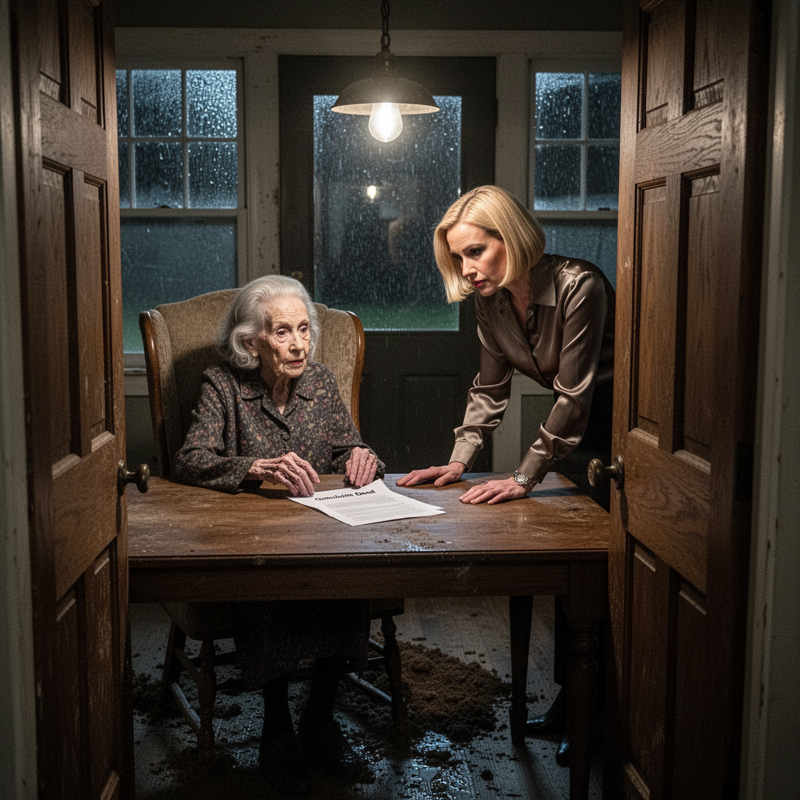
Evelyn, my eighty-two-year-old grandmother, was slumped in her high-backed chair at the polished mahogany table. Her silver hair, usually meticulously styled, was slightly disheveled.
Her hand, gnarled with age, trembled visibly as my Aunt Deirdre Sanger’s fingers wrapped tightly around her wrist. Deirdre was guiding a pen toward a line on a large, official-looking document spread across the table.
The document’s title, “Quitclaim Deed,” flashed into focus. My blood ran cold.
Deirdre didn’t look up immediately. Her brow was furrowed in concentration, her blonde bob perfectly still as she leaned over Evelyn. She wore one of her expensive silk blouses, completely out of place in the old, drafty dining room.
“Just sign here, Mama,” Deirdre said, her voice strained but falsely sweet. “It’s just to simplify things. You know, less for Maya to worry about when she eventually comes back for a handout.”
Evelyn’s eyes darted past Deirdre, wide and frightened. They locked onto mine for a split second. A flicker of relief, then a wave of pure terror, crossed her face.
Deirdre finally registered my presence. Her head snapped up, her eyes narrowing into slits. The pen hovered just above the paper, its tip almost touching Evelyn’s signature line.
Deirdre’s grip on Evelyn’s wrist tightened, pulling the frail hand closer to the document.
“Maya?” Deirdre’s voice was sharp, cutting through the drumming rain and the tense silence in the room. “What in God’s name are you doing here?”
She released Evelyn’s hand abruptly, the pen clattering against the table. Evelyn flinched, pulling her hand back as if burned.
“I didn’t think you ever ventured back to this side of the state,” Deirdre continued, her tone dripping with disdain. “Unless you’ve finally run out of money in that ‘big city’ of yours.”
Her gaze swept over my rain-soaked clothes, lingering on the mud on my shoes. A familiar look of judgment settled on her face, the same one I’d seen for years.
“Don’t tell me you’re here to beg for a place to stay now that your grand experiments have failed.”
Evelyn coughed weakly, her eyes still on me, trying to communicate something beyond Deirdre’s watchful gaze. A silent plea.
“I’m here because Evelyn needs me,” I said, my voice steady despite the tremor in my hands. The old house suddenly felt colder, despite the heat of my anger.
Deirdre barked a laugh. It was a harsh, humorless sound that scraped against the quiet.
“Needs you? She needs a competent adult to manage her affairs, not some twenty-something dropout who thinks she can disappear for fifteen years and waltz back in like she owns the place.”
“I’m thirty-seven, Deirdre,” I corrected her, my gaze firm, refusing to waver. “And I’m not a dropout.”
“Oh, right,” she sneered, waving a dismissive hand. “Always so high and mighty. Well, I’m sorry, darling, but Mama’s affairs are none of your concern. This is family business. Real family.”
She emphasized “real family,” a barb meant to cut deep, just as it always had.
My eyes drifted to the document again. The words “Sanger Homestead” were visible beneath the bold “Quitclaim Deed.” This wasn’t just about Evelyn’s personal savings; it was about the land, the house, our history.
The house had been in the Sanger family for generations. Forty acres of prime Ohio farmland.
“Actually, Deirdre,” I said, my voice dropping, “it is very much my concern.”
Deirdre scoffed, picking up the pen she had dropped. She tapped it impatiently against the document.
“Don’t be ridiculous. Mama just needs a little push to get these papers signed. It’s all perfectly legal.”
“I wouldn’t be so sure about that,” I replied, reaching into the inner pocket of my damp jacket.
Her eyes followed my hand, curiosity warring with suspicion.
I pulled out a thick envelope, sealed and official-looking, with a court stamp emblazoned on the front. It felt heavy in my hand, substantial.
“What is that?” Deirdre demanded, her voice losing its edge of dismissive amusement. A flicker of genuine, unsettling concern crossed her face.
I pulled out a stack of papers, folded neatly. The top page was headed with the distinct seal of the Franklin County Probate Court.
“This,” I said, unfolding them slowly, deliberately, “is a certified copy of Evelyn Sanger’s Declaration of Trust.”
Deirdre stared, her mouth slightly agape. Evelyn watched me, a small, knowing smile beginning to form at the corner of her lips.
“And this,” I continued, my voice clear and unwavering, “states that fifteen years ago, Evelyn appointed me, Maya Garrison, as the sole legal trustee of the Sanger Estate.”
I laid the documents flat on the table, pushing them slightly toward Deirdre.
The color drained from her face. Her hand, still clutching the pen, began to tremble. Her gaze flickered from the court seal to my face, then back to the name “Maya Garrison” clearly printed on the document.
A sharp gasp escaped her lips, swallowed almost immediately by the relentless roar of the rain outside.
Part 2
Deirdre’s eyes, wide with disbelief, finally narrowed into a dangerous glare. The initial shock quickly morphed into a familiar, chilling fury. She snatched the trust documents from the table, crumpling them slightly before tossing them back.
“This is impossible,” she hissed, her voice low and tight. “Mama would never—” She cut herself off, taking a deep, ragged breath. Her gaze hardened. “You think you’re so clever, don’t you, Maya? Always the schemer.”
Evelyn watched from her chair, her expression a mix of apprehension and faint defiance. The small smile had vanished.
“It’s not cleverness, Deirdre,” I replied, trying to keep my voice even, though my pulse still hammered. “It’s simply the truth. Evelyn protected her assets.”
A bitter laugh escaped Deirdre. “Protected her assets? Oh, she protected them alright. Right into a massive hole.”
She reached into her expensive leather handbag, which had been slung over the back of an empty chair. She pulled out another document, this one thinner, printed on a single sheet of stark white paper.
“You think a piece of paper from fifteen years ago can stop me?” she sneered, her eyes glittering with malice. “Think again, Miss Trustee.”
She slapped the paper onto the table, right next to Evelyn’s trembling hand. The harsh fluorescent light of the dining room lamp glinted off the crisp edges.
My eyes scanned the header. “Demand Note.” Below it, a sum: “$85,000.00.”
My breath hitched. Evelyn had signed this, too. Three years ago, the date indicated.
“This is a private loan, Maya,” Deirdre said, a triumphant smirk twisting her lips. “Against the property. Mama took it out three years ago when she needed cash for some… unforeseen expenses.” She paused, her gaze flicking to Evelyn, who winced.
“And now,” Deirdre continued, “the lender is calling it in. All of it. Eighty-five thousand dollars, due immediately.”
I stared at the paper, then at Deirdre, then at Evelyn, who looked away, her face etched with shame.
“A private lender?” I managed to ask, my voice barely a whisper. This was a completely new angle.
“An aggressive one,” Deirdre confirmed, enjoying my sudden distress. “They’ve been very patient. But their patience, unlike yours, has run out.”
She leaned forward, her voice dropping to a theatrical whisper, but loud enough for Evelyn to hear every word. “You have forty-eight hours, Maya. Forty-eight hours to come up with eighty-five thousand dollars. Or an aggressive private lender will initiate immediate tax foreclosure proceedings.”
Chapter 2: The Drained Accounts
The air in Evelyn’s study felt heavy, thick with the scent of old paper and dust motes dancing in the single beam of moonlight cutting through the window. I closed the door softly, hearing my grandmother’s gentle snores from upstairs. Deirdre’s frantic energy from earlier still prickled in my skin.
I pulled the box of Evelyn’s personal bank statements from under the antique desk, a box Deirdre had overlooked in her rush. My grandmother had always been meticulous. Every ledger, every receipt, neatly organized by date.
I started flipping through the monthly statements. My eyes landed on a series of recurring withdrawals. Not large sums, not initially.
A check for $2,500. Another for $3,000. All made out to “Cash,” and each signed by Evelyn and Deirdre.
They happened like clockwork. Almost every month for the last two years.
My stomach twisted. Evelyn, with her arthritic hands, hadn’t written a check in years, let alone withdrawn cash from her personal account so frequently.
I added up the amounts. $4,000 in January. $5,500 in February. The numbers kept climbing. My fingers traced the neat columns.
The total leapt out at me: over $120,000. Drained from Evelyn’s personal savings.
I walked into the living room, the stack of statements clutched in my hand. My father, Dennis, sat on the sofa, scrolling aimlessly through his phone. My mother, Nora, was tidying cushions that didn’t need tidying.
“Dad,” I said, my voice sharper than I intended. “Mom.”
They both looked up, a flicker of annoyance crossing their faces.
“What is it, Maya?” my mother asked, her tone dismissive. “Can’t you see we’re trying to relax?”
I held up the bank statements. “This isn’t just about Evelyn’s estate anymore. This is about her personal money.”
“What are you talking about?” my father mumbled, not quite meeting my gaze.
“Deirdre has taken over $120,000 from Grandma’s personal savings account,” I stated flatly. “Over the last twenty-four months, through joint checks.”
My mother let out a small, incredulous laugh.
“Maya, don’t be so dramatic,” she said, waving a hand. “Those are just household expenses. Deirdre helps Evelyn with everything.”
My father nodded slowly. “Your aunt takes care of Evelyn. She deserves to be compensated for her time, doesn’t she?”
“Compensated for $120,000?” I asked, a bitter taste in my mouth. “That’s not compensation, that’s theft. And these checks are all signed jointly, but Evelyn hasn’t been able to write her name clearly in years.”
“She’s family, Maya,” my mother said, her eyes narrowing. “She’s not a stranger you met in Columbus. You’re just trying to make trouble.”
My father sighed, shrinking into the cushions. “It’s all above board, Maya. It has to be. You’re just seeing things from an outsider’s perspective.”
The accusation stung. I stood there, the evidence heavy in my hands, but their faces were closed off, unwilling to see the truth. The understanding settled in: they were either blind, or complicit.
Chapter 3: Frozen Assets
The next morning, the first thing I did was call the bank. I needed to move funds from the estate’s trust account to cover the immediate $85,000 demand note Deirdre had brought up. Evelyn’s home was hanging by a thread.
The bank representative, a polite young woman named Sarah, confirmed the trust account existed.
“Yes, Ms. Garrison,” she said. “The Sanger Family Irrevocable Trust. Balance is sufficient.”
“Great,” I said, my voice tight with a hope I hadn’t realized I was holding. “I need to initiate a wire transfer for $85,000 to cover a property lien. Under my authority as sole trustee.”
There was a pause on the line. A long, uncomfortable silence.
“Ms. Garrison, I apologize,” Sarah said, her voice dropping. “I’m showing a hold on that account.”
My heart plummeted. “A hold? What kind of hold?”
“An emergency civil injunction,” she explained carefully. “Filed by a Deirdre Sanger. It alleges…”
She paused again.
“…that you, Maya Garrison, have embezzled funds from the trust and are attempting to defraud the beneficiaries.”
My hand tightened around the phone. Embezzled? I hadn’t even accessed the account.
“That’s impossible,” I snapped. “I just became aware of this account’s existence yesterday. I’ve been living out of state.”
“I understand,” Sarah said, but her voice was stiff. “However, the court order is in place. Funds are frozen pending an investigation.”
The line went dead in my hand. I stood there, the receiver pressed against my ear, the silence deafening.
Just then, a loud, insistent knock rattled the front door. It wasn’t the tentative knock of a delivery person, but something more demanding.
I walked to the door, my mind reeling. Through the frosted glass, I saw a burly man in work boots, his face grim. He held a clipboard.
I opened the door, just a crack. “Can I help you?”
“Maya Garrison?” he asked, his voice gruff. “I’m here to serve notice.”
He pushed a stapled document through the gap in the door, his gaze unwavering.
“Foreman from United Roofing,” he said, gesturing to the logo on his jacket. “We’ve got a $45,000 lien for unperformed roof repairs on this property.”
He pointed to a section of the document. “Filed by Deirdre Sanger herself. Said we were contracted last month. We haven’t even broken ground.”
“A lien for unperformed work?” I stared at the paper in my hand, my fingers trembling. “This is a new roof, right?”
“Yup. She signed off on the contract herself, then said you were supposed to pay,” he said, shaking his head. “Told us if we didn’t get paid, to slap a lien on the deed, pronto. Said you were trying to skip out on the bill.”
He gave me a hard, suspicious look. “It’s all on there. Unless we see payment in forty-eight hours, this property officially enters pre-foreclosure proceedings. Good luck.”
He turned and walked back to his pickup truck, leaving me standing in the doorway, the fraudulent lien notice fluttering in my hand. The house felt like it was shrinking around me, each new piece of paper a tightening band.
Chapter 4: Cold Realities
That night, the temperature outside dropped like a stone. Inside the old homestead, the chill began to seep into the walls. I noticed it first when I went to turn up the thermostat. Nothing happened. The display was dark.
I flicked a light switch. Darkness.
“The power’s out,” I called out, my voice echoing in the sudden quiet.
My father emerged from the living room, rubbing his arms. “Well, that’s just typical. Happens all the time in these old places.”
He tried the living room lights, then the kitchen. Nothing.
I grabbed my phone and called the electric company. After several minutes on hold, a customer service representative confirmed a service interruption.
“It says here a municipal hazard complaint was filed for the address,” she informed me. “Defective wiring. We’ve had to suspend service until an inspection is cleared.”
A municipal hazard complaint. My mind instantly went to Deirdre. It had to be her.
As if on cue, a deep rumbling sound came from the basement. I ran down the stairs. The propane furnace, which powered the heating, was also silent.
Another call. Another suspension. “Safety inspection required for the fuel lines,” the gas company representative said. “Citing fire risk due to a recent report.”
I slammed the phone down. Deirdre was trying to freeze us out. Literally.
I bundled Evelyn into an extra blanket and sat with her by the fireplace. My grandmother, usually so resilient, shivered. Her face was pale.
“It’s getting cold, Maya,” she whispered, her voice frail. “So very cold.”
The next morning, I drove into town. I bought two portable generators, lugging them back to the house. Then I found every kerosene heater I could, along with five-gallon cans of fuel. The car smelled like a gas station.
I set up the generators, the constant drone filling the usually quiet house. The kerosene heaters gave off a faint, acrid smell, but they warmed the rooms enough to keep Evelyn comfortable.
My father watched me, huddled in a thick sweater.
“You’re working so hard, Maya,” he said, his voice laced with pity. “But for what? This is endless.”
He gestured around the dim, generator-powered house. “Look at this misery. It’s not worth it. Just give Deirdre what she wants. Let her take the house.”
“And let her sell it to a developer?” I asked, looking at the flickering lights. “Let her tear down Grandma’s home? No.”
My mother appeared, a scarf wrapped tightly around her neck. “Dennis is right, Maya. You’ve been gone for so long, you don’t understand how things work here. Deirdre knows best.”
“Deirdre just wants the land,” I countered, the words tasting like ash. “She doesn’t care about Evelyn or this house.”
“It’s a losing battle, honey,” my father insisted, his face drawn. “Just hand over control. End the suffering for all of us.”
His words hung in the frigid air, the hum of the generators a constant reminder of the cold reality we were now living in. The thought of giving up, of walking away from this fight, was a powerful pull. But Evelyn was upstairs, relying on me.
Chapter 5: The Ledger in the Dark
The old barn, with its creaking timbers and resident owl, was the only place I felt safe from my parents’ constant pleas and Deirdre’s unseen assaults. I was stacking firewood by the light of a portable lantern when a shadow moved in the doorway.
My heart leaped into my throat.
“Maya?” a hushed voice called out. It was Julian. My cousin, Deirdre’s son.
He looked pale, his usually tidy hair disheveled. He clutched a worn leather folder to his chest.
“Julian,” I said, surprised. “What are you doing here?”
He glanced nervously over his shoulder, even though the homestead was miles from any close neighbors. The only sound was the distant drone of my generators.
“I… I couldn’t stand it anymore,” he whispered, stepping further into the barn. “Mom’s gone too far.”
He looked at the folder in his hands, his knuckles white.
“She’s been planning this for months, Maya. Years, maybe. She thinks you don’t belong here, that you abandoned the family.”
“I know,” I said, bitterness rising. “Everyone thinks that.”
“She said you just came back for money,” he continued, avoiding my eyes. “But I heard her on the phone. Things she said. And then I found these.”
He extended the folder. His hand trembled slightly as I took it.
“What are these?” I asked, flipping it open. Inside were printouts of emails, neatly organized.
“Her private emails,” Julian said, his voice barely audible. “Between her and a commercial land developer. A company called ‘Midwest Holdings’.”
My eyes scanned the first email. It was a proposal. Deirdre discussing the “prime location” of the Sanger 40-acre homestead. Mentioning the “potential for a lucrative strip mall.”
“A strip mall?” I gasped, looking up at Julian. My grandmother’s land, her beloved home, turned into a concrete shopping center?
“She wants to demolish the house,” Julian confirmed, his voice thick with shame. “The whole thing. Says it’s ‘obsolete.’”
I read further. The emails detailed a proposed payout. A “finder’s fee” for Deirdre. A “commission” for a local contact who could smooth over zoning.
“She’s planning on a $600,000 payout,” Julian murmured, watching my face. “Split with Lyle Higgins.”
Lyle Higgins. The sleazy real estate appraiser who had certified the dodgy land assessment for Deirdre’s demand note.
“Lyle’s involved?” I asked, a new layer of disgust settling in. “How?”
Julian nodded, his gaze fixed on the floor. “He’s the appraiser who’s going to make it all look legitimate. He owes my mom money, a lot of money, from some old business deal with my dad. My dad passed away with some shady debts, and Lyle got caught in the crossfire.”
“She’s leveraging his debt to force him to do this,” I realized aloud. The pieces clicked into place.
Julian shifted his weight. “He’s supposed to inflate the property value for the commercial sale and help fast-track the permits. He’s afraid of Mom.”
He wrung his hands. “Please, Maya. You have to do something. Grandma would never want this. This land… it’s everything to her.”
He looked utterly miserable, a rare glimpse of integrity breaking through his fear. I nodded slowly, the weight of the new information pressing down on me. Julian had just handed me a weapon.
Chapter 6: The Sworn Statement
Lyle Higgins’ office was tucked away above a pawn shop on Main Street. The bell above the door jingled as I walked in, kicking up dust from the faded carpet. The air smelled of stale coffee and desperation.
Higgins sat behind a cluttered desk, his thinning hair slicked back. He looked up, his eyes widening when he saw me. He recognized me from the notary statement Deirdre had filed.
“Ms. Garrison,” he said, his voice a little shaky. “What can I do for you?”
I didn’t waste any time. I pulled out the folder Julian had given me, placing it on his desk. The emails were clearly visible.
“This is what you’ve been doing with Deirdre Sanger,” I stated, my voice low and steady. “Planning to demolish my grandmother’s house, turn her land into a strip mall, and split a $600,000 payout.”
His eyes darted to the emails, then to me, then back to the emails. His face drained of color.
“I don’t know what you’re talking about,” he stammered, his hand going to his tie.
“Don’t you?” I leaned forward. “Because I’m also holding copies of the land assessment papers you ‘notarized.’ The ones where you claim Evelyn Sanger authorized the property evaluation for the $85,000 demand note.”
I pushed the copies of Evelyn’s signatures toward him. Her actual signature, and the wobbly, clearly forged one on his documents.
“Evelyn hasn’t been able to sign her name legibly for years,” I said, watching him closely. “But you attested that she did.”
He swallowed hard, his Adam’s apple bobbing. “Deirdre… she pressured me. She said it was just a formality.”
“She blackmailed you, didn’t she?” I pressed. “Over those old debts of her late husband’s. The ones you owe money on.”
His shoulders slumped. He ran a hand over his face. “Look, I just did what she told me. I didn’t think it would go this far.”
“It’s gone far enough to jeopardize your state notary license, Mr. Higgins,” I said, my voice hardening. “And expose you to a civil fraud suit that will cost you everything.”
He looked around his dingy office, as if realizing the precariousness of his position. The thought of losing his livelihood, everything, seemed to hit him.
“What do you want?” he whispered, defeated.
“I want the truth,” I said, pushing a blank document and a pen across the desk. “A sworn affidavit. Admitting that Deirdre Sanger forged Evelyn’s authorization signatures on those land assessment forms. Every single one.”
He hesitated for a long moment, staring at the paper. Then, with a shaky breath, he picked up the pen.
“This will ruin me with Deirdre,” he mumbled, beginning to write.
“It will save you from prison, Mr. Higgins,” I countered. “And save my grandmother’s home.”
He signed the document, his hand still trembling. I watched him closely, confirming every detail. The words “I, Lyle Higgins, hereby swear under penalty of perjury” stood out in his messy script.
It was done. A real turning point. The first concrete piece of evidence against Deirdre that wasn’t just my word against hers.
Chapter 7: The Emergency Hearing
The informal probate conference was held in a small, windowless room at the county courthouse. The air was thick with tension. My parents sat silently on one side of the room, looking uncomfortable. Deirdre sat opposite me, her face set in a hard, defiant mask, her attorney by her side.
I laid out my case calmly, detailing the fraudulent liens, the utility cutoffs, and the clear pattern of financial sabotage.
Then, I produced the sworn affidavit from Lyle Higgins.
“This document,” I said, holding it up for the magistrate to see, “attests that Ms. Sanger forged my grandmother’s signature on critical land assessment forms.”
The magistrate, a stern woman in a sensible suit, took the affidavit and read it carefully. Her gaze shifted to Deirdre, who bristled under her scrutiny.
“Ms. Sanger,” the magistrate said, “this is a very serious allegation.”
Deirdre’s attorney leaned in, whispering furiously. Deirdre herself simply smirked.
“Perhaps,” Deirdre said, her voice dripping with condescension, “but it’s irrelevant. Maya is no longer the trustee, Your Honor.”
A collective gasp went around the small room. My parents shifted uneasily.
Deirdre’s attorney stood, a smug look on his face. “We would like to introduce a secondary document, dated July 14, 2018.”
He handed a folded paper to the magistrate. “This is a legal codicil to Evelyn Sanger’s original trust documents. It explicitly revokes Maya Garrison’s authority as trustee and appoints Deirdre Sanger as the sole successor trustee.”
My blood ran cold. A codicil? Evelyn had told me I was the *sole* trustee. This couldn’t be real.
The magistrate took the document, her expression unreadable, and began to read it. The silence in the room stretched, punctuated only by the nervous tapping of my fingers on my knee.
“This document appears to be properly executed,” the magistrate finally stated, her voice devoid of emotion. “Signed by Evelyn Sanger and duly witnessed.”
Deirdre’s grin widened. She shot me a triumphant look, a silent “I told you so.”
“Furthermore,” Deirdre announced, rising from her seat and addressing the magistrate directly, “I am filing for temporary emergency guardianship over my mother, Evelyn. Maya has demonstrated financial abandonment and extreme negligence by allowing the utilities to be cut off and the property to fall into disrepair.”
Her eyes blazed with a manic certainty. “I will take physical custody of Evelyn by nightfall. The house, Maya, is as good as mine.”
My mind raced. How could Evelyn have signed something like this? The room seemed to tilt. The weight of the world pressed down on me. I had proof of Deirdre’s fraud, but she had a paper that undermined my entire position.
Chapter 8: The Standoff at the Homestead
The rain was relentless. It had started as a drizzle and now hammered down, turning the long gravel driveway into a muddy creek. Headlights cut through the gloom, illuminating the familiar silhouette of Deirdre’s SUV, followed closely by a large moving truck.
“She’s here,” my father whispered, his voice cracking. He stood on the porch with Julian and me, all of us braced.
Evelyn was upstairs, mercifully asleep, shielded from the immediate storm.
Deirdre emerged from her SUV, wrapped in a bright yellow raincoat that seemed to mock the grim situation. Her attorney followed, holding a briefcase over his head.
“Maya!” Deirdre shouted, her voice cutting through the downpour. “Move out of my way. I’m here to collect my mother. And to secure *my* property.”
The movers, two burly men, started toward the porch.
“Stop!” I yelled, stepping forward, my arm outstretched. “You’re not taking Evelyn anywhere.”
My father, usually so passive, planted his feet firmly beside me. Julian, though trembling slightly, stood his ground on my other side.
“This is my grandmother’s home,” Julian said, his voice surprisingly firm. “You can’t just take her like this.”
Deirdre laughed, a harsh, humorless sound. She pulled the folded codicil from her pocket, shaking it in my face. Water dripped from the paper.
“This document says otherwise, Maya,” she sneered. “I am the appointed trustee. I have full authority over Evelyn’s care. And over this property. The magistrate was very clear.”
“You forged that signature, Deirdre,” I shot back, though a seed of doubt had planted itself in my mind. The magistrate *had* said it appeared valid.
“Nonsense,” she scoffed. “And even if I did, you have no proof. Lyle Higgins is a desperate, discredited man. No one will believe him over a legal document.”
The movers paused, looking from Deirdre to us, unsure of how to proceed.
“You’re not coming in,” I said, my voice unwavering despite the cold and the fear. “Not without a proper court order specifying temporary guardianship, which you don’t have yet.”
Deirdre’s face contorted in rage. “This is my mother! And my family’s legacy! You’ve ruined everything, you ungrateful little tramp!”
She took a step forward, trying to push past me. My father, surprisingly, moved to block her.
“Deirdre, please,” he pleaded, his voice cracking. “Let’s not make a scene.”
“Get out of my way, Dennis!” she shrieked, shoving him. He stumbled back, bumping into Julian.
The rain beat down, plastering my hair to my face. Deirdre stood there, fuming, waving the soaking codicil. The moving truck idled behind her, its engine rumbling like a predator. We were at an impasse, but the weight of Deirdre’s purported legal authority hung heavy in the air.
Chapter 9: The Unsealed Desk
The standoff had ended with Deirdre retreating, promising to return with law enforcement and a formal court order by morning. The moving truck idled away, leaving behind silence and the steady drumming of rain on the roof.
Inside, the generator hummed, casting flickering shadows across the parlor walls. We sat in the dim light, exhausted and defeated. Evelyn was still asleep, oblivious.
Julian stared at Evelyn’s antique roll-top desk in the corner. It was a beautiful piece, dark wood with intricate carvings.
“My grandma always kept that desk locked,” Julian said softly, almost to himself. “Said it held her most important papers.”
I looked at the desk. I’d seen it countless times, but never paid it much mind. It had a small, ornate lock.
“She kept a spare key hidden,” Julian mused. “But Mom could never find it. She spent hours searching.”
“Why didn’t you say anything before?” I asked, my voice flat.
“I don’t know,” he admitted, shrugging his shoulders. “I just… I never thought it would come to this. And I always just assumed Mom would get the desk when Grandma was gone.”
He walked over to it, running his hand over the polished surface. “There’s a secret compartment in the back panel. She showed me once, years ago.”
My mind sparked. A secret compartment. Evelyn was always so careful, so deliberate.
“Help me,” I said, getting up.
Julian and I worked together, our heads close in the flickering light. We felt along the back panel, searching for a seam, a hidden button.
“Here!” Julian exclaimed, his finger pressing into a tiny knot in the wood.
With a faint click, a small drawer popped open, barely visible. It was only a few inches deep.
Inside, nestled on a velvet lining, was a tarnished brass key. And a thick, sealed envelope.
My name, “Maya Garrison,” was written on the front in Evelyn’s elegant, if shaky, script. Below it, in bolder letters, were the words: “To be opened when Deirdre comes.”
My heart pounded. Evelyn had planned this. She had known.
Julian looked at the envelope, then at me. His face was a mixture of awe and fear.
“Grandma knew,” he repeated, his voice hushed. “She knew exactly what Mom would do.”
I held the envelope carefully, feeling the weight of Evelyn’s foresight, her quiet defiance. The rain outside had finally begun to ease, replaced by an eerie stillness. But the storm inside the house was about to break.
Chapter 10: The Unread Confession
The family stood gathered in the dimly lit hallway, the hum of the generator providing the only background noise. My father looked grim, my mother agitated. Deirdre, having returned, stood with her attorney, a triumphant smirk on her face. She was about to announce her next move, a final attempt to leverage the codicil.
I held Evelyn’s sealed letter in my hands.
“Before anyone speaks,” I announced, my voice cutting through the tension, “I think you all need to hear this.”
Deirdre snorted. “More of your fabricated stories, Maya? You can’t just make things up to get your way.”
I ignored her. “This is a letter from Evelyn. Addressed to me. It says, ‘To be opened when Deirdre comes.’”
I broke the wax seal. The paper crackled as I unfolded it. Evelyn’s familiar handwriting filled the page, but the words were sharp, clear, and utterly devastating.
I began to read aloud, my voice steady despite the tremor in my hands.
“My Dearest Maya,” I read. “If you are reading this, Deirdre has finally made her move.”
Deirdre’s attorney shifted uncomfortably. My parents exchanged confused glances.
“Fifteen years ago, I made you trustee to protect this land. I saw the greed in Deirdre’s eyes even then.”
“Lies!” Deirdre shrieked. “She’s just making it up!”
I continued, not pausing. “Five years ago, I discovered Deirdre had begun siphoning funds from my personal savings. Not for my care, but for her own extravagant spending. I specifically disinherited her from any claim to my estate at that time.”
The air left Deirdre’s lungs with a choked sound. She staggered back, bumping into her attorney.
“As for the so-called ‘2018 codicil’ she may produce,” I read, Evelyn’s words like ice, “be aware that I explicitly revoked it in writing, on August 1st, 2019, through a signed and notarized statement held in the safety deposit box at First National Bank. I did this after discovering she was attempting to manipulate my finances further.”
Deirdre made a desperate noise, her face turning ashen. Her attorney’s jaw dropped.
Then came the final blow, the twist Evelyn had meticulously prepared for.
“And finally,” I read, my voice ringing in the stunned silence, “the matter of the $85,000 demand note against the property. This debt was not mine. It was incurred by Deirdre’s late husband, who, a decade ago, secretly embezzled funds from my investment accounts. He forged my signature on a loan application to cover his losses, leaving me responsible for his crimes after his passing. I kept this secret to protect Deirdre’s reputation, but it must now be revealed.”
The hallway was utterly silent, save for the generator’s hum. Deirdre stared at me, her eyes wide with shock and pure hatred. Every accusation, every maneuver she had made, had just been systematically dismantled by the very woman she sought to exploit. The truth, hidden for so long, had finally shattered the pretense.
Chapter 11: The Bitter Truce
Deirdre’s face crumpled. The furious mask she’d worn for days shattered into a weeping, distorted mess. She sank to the floor, oblivious to the damp and cold. Her attorney quickly knelt beside her, whispering urgently, his earlier confidence completely gone.
My father stared at the crumpled letter in my hand, then at Deirdre on the floor. His face was a roadmap of shock and belated understanding. My mother, usually so composed, looked utterly horrified.
“He… he stole from you?” my father stammered, his voice barely a whisper. “Deirdre’s husband?”
I nodded, the full weight of Evelyn’s sacrifice hitting me. She had carried that secret for years, protecting her daughter, only to be betrayed again.
Deirdre suddenly lunged up, her eyes red-rimmed and wild. She pointed a trembling finger at me.
“You,” she spat, her voice raw with fury. “You destroyed everything! You always hated me!”
“I only protected Grandma,” I said, my voice tired. “And her home.”
“This isn’t over!” she shrieked, ignoring her attorney’s calming hand. “You think you’ve won? You haven’t won anything, Maya!”
Her attorney finally managed to pull her aside, ushering her toward the front door. He paused, turning back to me.
“Ms. Garrison,” he said, his tone professional, resigned. “Given the new evidence, particularly the existence of the safety deposit box document, Ms. Sanger will withdraw all civil injunctions, including the guardianship petition.”
He cleared his throat. “She will also abandon her claim to the property. However, she will not be apologizing. And she will dispute all repayment demands for the funds she… managed.”
Deirdre, standing by the door, glared at me. “You think I’m just going to let you have a clean slate?” she sneered. “I’ll make your life a living hell! I’ll file municipal tax appeals until I’m in my grave! I’ll make sure this house costs you every penny you ever thought you had!”
She stomped out into the still-drizzling night, followed by her defeated attorney. Her SUV roared to life and sped down the driveway.
My parents remained frozen, speechless. The revelations had shattered their carefully constructed reality, their belief in Deirdre’s righteousness. The house was safe, for now. The trust was secure. But Deirdre’s rage hung in the air like a poisonous fog, a promise of ongoing warfare. The relief I felt was fleeting, overshadowed by the stark reality of what Evelyn’s letter truly meant: the battle had been won, but the war, it seemed, would never truly end.
Chapter 12: Epilogue — One Year Later
Exactly one year after the text message “The blue bird stopped singing” landed on my phone, I sat at the cluttered kitchen table of the Sanger homestead. The house was quiet now, mostly. Evelyn was upstairs, sleeping peacefully, her eighty-third birthday just passed. She had good days and bad, but she was safe, and still here.
I took a sip of lukewarm, cold coffee. The mug had been sitting there since before dawn. The table was covered in papers: an old newspaper, a grocery list, and a fresh stack of certified mail.
I picked up the top envelope. The return address was familiar: Deirdre’s attorney. Inside, a new legal challenge notice. Another petition to the county tax appeals board, claiming an improper property valuation. It was the third one this month.
Since that night, the house had regained its power and heat. The fraudulent liens had been removed. The $120,000 Deirdre had siphoned from Evelyn’s personal accounts was subject to ongoing civil repayment demands, which Deirdre was fighting tooth and nail, paying just enough to avoid deeper legal trouble but never truly settling.
Julian visited often, a welcome presence, helping with chores and offering quiet support. My parents, after the initial shock, had slowly come around, though they rarely mentioned Deirdre. The silence where her name used to be spoken was almost as loud as her accusations had been.
I had tried to go back to my life in Columbus. But every time I packed, every time I considered leaving, another legal notice would arrive, another utility bill would be inexplicably suspended, another rumor would circulate through town. Deirdre was relentless. She didn’t want the property anymore, not truly. She just wanted to bind me to it, to ensure I would never escape the family drama, to make my victory as hollow as possible.
So here I was, a year later. The homestead, Evelyn’s legacy, was protected. But I was still here, permanently tied to this kitchen table, sifting through an endless tide of legal paperwork, making sure the old house didn’t crumble under the weight of ceaseless conflict.
Victory in a divided family isn’t a celebratory horizon—it is simply holding the door closed against a storm that never truly stops blowing.
Leave a Reply