Three Lines That Changed Everything
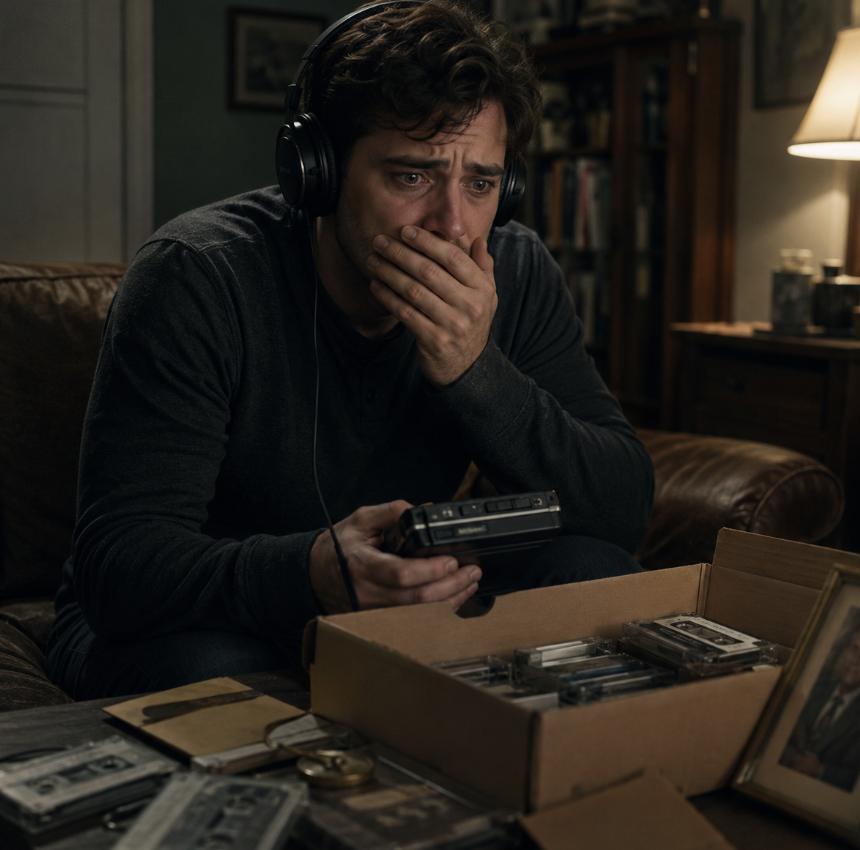
After my father died, he left me a box of cassette tapes numbered by year.
I thought they were messages meant for me.
Then I heard a little boy’s voice asking, “Dad, when are you coming home?”
My father left me forty-two cassette tapes.
One for every year of my life.
At least that’s what I believed.
The box arrived three days after the funeral.
No explanation.
No letter.
No instructions.
Just a heavy cardboard box sealed with old packing tape.
My name was written across the top in my father’s unmistakable handwriting.
Daniel Carter.
For several minutes I simply stared at it.
My father had been dead less than a week.
The house still smelled like funeral flowers.
Family members were still calling every day.
The grief still felt fresh.
Raw.
Unfinished.
And now there was this box.
Waiting.
I carried it into the kitchen and opened it carefully.
Inside sat dozens of cassette tapes.
Each one labeled with a year.
All the way through the year before he died.
Every tape had a handwritten note.
Small observations.
Tiny memories.
Fragments of a life.
The first one read:
“For Daniel. Age one.”
The next:
“For Daniel. Age two.”
Then:
“For Daniel. Age three.”
I smiled despite myself.
That sounded exactly like my father.
Methodical.
Sentimental.
The kind of man who saved birthday cards for decades.
The kind who kept every school drawing I ever made.
The kind who recorded family vacations using cameras that should have been thrown away years earlier.
I assumed the tapes contained memories.
Stories.
Advice.
The sort of thing people leave behind when they know they’re running out of time.
My father had battled cancer for nearly two years.
By the end, we all knew what was coming.
Apparently he knew too.
The first recording began with static.
Then his voice.
Younger than I remembered.
Stronger.
Healthier.
“Daniel, today you turned one.”
I immediately felt tears forming.
For the next twenty minutes he described my first birthday.
The cake.
The presents.
The way I cried when everyone sang.
Tiny moments nobody else would have remembered.
When the recording ended, I sat quietly for several minutes.
Then I played another.
And another.
And another.
Each tape captured a different year.
A different version of my father.
A different version of me.
It felt like traveling through time.
Listening to him age.
Listening to myself grow up.
Listening to memories I didn’t know existed.
For three nights, I did almost nothing else.
I worked during the day.
Then came home and listened.
Year after year.
Memory after memory.
Until I reached the tape labeled:
1991
My ninth birthday.
I inserted it into the player.
Pressed play.
And everything changed.
At first, nothing seemed unusual.
My father’s voice filled the room.
“Daniel, you’re nine today.”
A pause.
Then static.
More static than usual.
As though something had been recorded over an older tape.
I almost stopped listening.
Then I heard another voice.
A child.
Not me.
Definitely not me.
The boy sounded younger.
Maybe six or seven.
His accent wasn’t American.
His voice trembled slightly.
“Dad?”
I froze.
The tape continued.
“Dad, can you hear me?”
Silence followed.
Then my father’s voice responded.
But not the version speaking to me.
A different recording.
A different conversation.
Real.
Unscripted.
“I’m here, buddy.”
My heart stopped.
I replayed it immediately.
Again.
Then again.
Same result.
A strange child.
Calling my father “Dad.”
I sat motionless.
Trying to convince myself there had to be another explanation.
Maybe it was a family friend.
Maybe a nephew.
Maybe someone joking.
Then the boy spoke again.
“When are you coming back?”
My father didn’t answer immediately.
When he finally did, his voice sounded broken.
“I don’t know.”
The room suddenly felt smaller.
I listened to the rest of the recording in complete silence.
The conversation lasted only four minutes.
Yet it shattered everything.
The child clearly knew my father.
Loved him.
Missed him.
And most importantly…
Called him Dad.
After the tape ended, I searched the box.
Maybe it was a mistake.
Maybe someone else’s recording became mixed in.
But the next tape contained the same voice.
And the next.
And the next.
The further I listened, the clearer the truth became.
This wasn’t random.
My father intentionally included these recordings.
Which meant he wanted me to hear them.
The question was why.
The boy’s name appeared three tapes later.
Miguel.
I first heard it during a conversation recorded in 1994.
“Dad, my teacher says I need a father for the school meeting.”
A pause.
Then:
“Can you come this year?”
My father’s silence lasted several seconds.
Long enough to hurt.
Finally he whispered:
“I’m sorry, Miguel.”
The boy didn’t cry.
Didn’t complain.
That somehow made it worse.
Because disappointment sounded normal to him.
Familiar.
Practiced.
I spent the next week obsessed.
Who was Miguel?
Why had my father hidden him?
Why include these recordings now?
And why had nobody in the family ever mentioned another child?
I searched old documents.
Photographs.
Military records.
Anything.
Nothing.
No Miguel.
No clues.
No evidence.
Then I discovered an envelope taped beneath the bottom of the box.
The handwriting belonged to my father.
And across the front he had written:
“Open only after listening to the tapes.”
My hands shook.
Inside sat a twenty-page letter.
The first sentence changed everything.
“Daniel, before you judge me, you need to know what happened during the war.”
I immediately sat down.
The letter described events that occurred before I was born.
Before my parents met.
Before the life I knew existed.
My father had served overseas during the final years of a conflict rarely discussed anymore.
According to the letter, he spent nearly two years stationed near a small village.
A dangerous assignment.
Long stretches away from home.
Long stretches away from safety.
And during that time, he fell in love.
Not casually.
Not briefly.
Deeply.
Her name was Elena.
The letter described her with heartbreaking detail.
The way she laughed.
The way she argued.
The way she believed every war eventually ended.
Then came the sentence that made my stomach drop.
“By the time I was ordered home, Elena was pregnant.”
I stopped reading.
My pulse thundered in my ears.
Pregnant.
Miguel.
Suddenly everything made sense.
And nothing made sense.
My father continued.
He promised to return.
Promised to bring them to America.
Promised they would become a family.
Then politics intervened.
Borders changed.
Governments changed.
Military orders changed.
Communication became difficult.
Then nearly impossible.
Months passed.
Then years.
Yet somehow my father maintained contact.
Letters.
Phone calls.
Recordings.
Anything he could manage.
Every conversation was preserved on cassette tapes.
Because he feared losing them.
Feared forgetting.
Feared that one day both sons might believe the same terrible thing.
That he had abandoned them.
The final page of the letter contained one devastating confession.
“You grew up believing you were my only son.”
“Miguel grew up believing I chose another family over him.”
“The truth is I spent my life failing both of you in different ways.”
I lowered the letter.
Unable to continue.
Because suddenly the story wasn’t about betrayal.
It wasn’t about a secret family.
It wasn’t about infidelity.
It was about a man trying to hold together two lives separated by an ocean.
A man who loved two sons.
And never felt he had done enough for either.
Then I noticed one final item hidden inside the envelope.
A photograph.
Recent.
Not old.
Not faded.
Recent.
Taken only three years before my father’s death.
Two elderly men stood together outside a small house.
One of them was my father.
The other looked exactly like him.
The caption on the back contained only four words.
“You finally met.”
And beneath that:
“Now it’s your turn.”
PART 2
For a long time, I simply stared at the photograph.
My father.
An older man standing beside someone who looked enough like him to be family.
The resemblance wasn’t subtle.
It was undeniable.
The same eyes.
The same nose.
The same stubborn expression I saw every morning in my own mirror.
The man in the photograph had to be Miguel.
My half-brother.
The son I never knew existed.
The son my father spent decades trying not to lose.
I turned the photograph over.
There was more writing beneath the first message.
Small.
Almost rushed.
As if my father had added it at the last moment.
“His address is in the blue notebook.”
“Please don’t wait as long as I did.”
I found the notebook at the bottom of the box.
Inside were names.
Dates.
Phone numbers.
Addresses.
Dozens of entries spanning nearly forty years.
A complete history of my father’s attempts to stay connected with Miguel.
Letters returned unopened.
Money transfers.
Phone calls.
Visits.
Cancelled trips.
Missed opportunities.
Promises made.
Promises broken.
Not because he didn’t care.
Because life kept getting in the way.
Because governments changed.
Because paperwork disappeared.
Because oceans are larger than people realize.
Because time is cruel.
And because every year that passed made it harder to explain why he wasn’t there.
The final page contained a single address in Chile.
Written only four years earlier.
Underneath it my father had written:
“I think he finally forgives me.”
I booked a flight three weeks later.
The decision terrified me.
Part of me felt angry.
Part of me felt guilty for being angry.
Part of me wondered if I even had the right to enter this man’s life.
After all, I had spent my childhood with our father.
Miguel hadn’t.
I got birthdays.
Christmases.
Baseball games.
School graduations.
Miguel got cassette tapes and long-distance phone calls.
Who was I to show up now?
Yet I couldn’t ignore the feeling growing inside me.
Because somewhere in another country lived a man who shared my blood.
A man who had spent his entire life wondering about the family his father built somewhere else.
The address led to a small coastal town.
Quiet.
Beautiful.
The kind of place people retire to after difficult lives.
I almost turned around twice before knocking on the door.
Almost.
Then the door opened.
And there he was.
Older than the photograph.
Grayer.
Thinner.
But unmistakably my father’s son.
For several seconds neither of us spoke.
Then his eyes moved to the photograph in my hand.
The photograph of him and my father.
And everything changed.
His expression softened immediately.
“You must be Daniel.”
Not who are you.
Not what do you want.
Not confusion.
Recognition.
As though he had been expecting this moment for years.
I nodded.
Unable to speak.
Then he smiled sadly.
“He always thought you’d come someday.”
That sentence nearly broke me.
Inside his home, photographs covered entire walls.
Not just of his family.
Of our father.
Hundreds of them.
Young father.
Middle-aged father.
Old father.
Pictures spanning decades.
Some I had never seen before.
Some I recognized immediately.
The realization hit me hard.
My father hadn’t hidden Miguel from his life.
He had hidden him from mine.
There was a difference.
A painful difference.
Miguel made coffee.
We sat at a kitchen table overlooking the ocean.
For nearly an hour we simply talked.
About ordinary things.
Families.
Careers.
Children.
Life.
Neither of us knew how to approach the bigger conversation.
Eventually Miguel stood and disappeared into another room.
When he returned, he carried a box.
Almost identical to mine.
Cassette tapes.
Dozens of them.
Numbered.
Dated.
Preserved.
My throat tightened.
“He made one set for you,” Miguel said softly.
“And one set for me.”
The room suddenly felt very quiet.
Because in that moment I finally understood what my father had been trying to do.
For decades he had been terrified of the same thing.
That one son would believe he was loved more.
And the other would believe he was loved less.
So he recorded everything.
Everything.
Not because he was choosing between us.
Because he refused to.
Miguel handed me a tape.
The label read:
“For Both Boys.”
I frowned.
“There are tapes for both of us?”
He nodded.
“Only a few.”
We played it immediately.
The recording began with static.
Then our father’s voice.
Older.
Tired.
Emotional.
“If you’re listening to this together…”
A pause.
“…then something finally went right.”
Miguel laughed softly.
I swallowed hard.
Our father continued.
“I spent most of my life trying to explain the impossible.”
Another pause.
“I loved two sons who lived thousands of miles apart.”
I looked at Miguel.
He looked at me.
Neither of us spoke.
The recording continued.
“Daniel got the father who came home.”
“Miguel got the father who kept promising he would.”
His voice cracked.
The sound hurt.
Because for the first time, I heard the guilt he carried.
Not just for one life.
For both.
Then came the sentence that neither of us expected.
“I don’t know which one of you suffered more.”
The tape fell silent for several seconds.
Then he added:
“And that’s what breaks my heart.”
Miguel looked away.
I noticed tears in his eyes.
Truthfully, I had my own.
The recording lasted nearly forty minutes.
Stories.
Apologies.
Memories.
Regrets.
And finally one request.
A simple request.
Perhaps the last thing our father ever wanted.
“Don’t make each other pay for my mistakes.”
I don’t think either of us spoke for several minutes after the tape ended.
Because suddenly the situation looked different.
This wasn’t a story about betrayal.
It wasn’t about a secret family.
It wasn’t about a man living two separate lives.
It was about a father trapped by circumstances he spent forty years trying to fix.
A father who failed repeatedly.
But never stopped trying.
That evening Miguel showed me something else.
A wooden chest.
Inside were every letter my father ever sent.
Hundreds of them.
Some yellow with age.
Some barely readable.
Others covered in notes and corrections.
Evidence of a lifetime spent reaching across an ocean.
Then Miguel opened a drawer.
Inside sat a baseball glove.
Old.
Worn.
Cracked with age.
I recognized it instantly.
My father’s glove.
The one I used as a child.
The one I thought had disappeared decades ago.
I stared at him.
“How did you get that?”
Miguel smiled.
“He mailed it to me when I was twelve.”
The answer hit me unexpectedly hard.
Because suddenly I understood something.
The glove wasn’t just a gift.
It was our father’s way of sharing part of one son’s life with the other.
Trying to connect two worlds.
Trying to make sure neither boy felt forgotten.
Neither boy felt less loved.
Neither boy felt abandoned.
The next morning, before I left, Miguel walked me to my rental car.
For a moment we stood in silence.
Two old men.
Brothers.
Strangers.
Family.
All at the same time.
Then he handed me one final cassette.
“No label?”
I asked.
He smiled.
“It was the last one.”
I played it on the flight home.
The recording was short.
Only three minutes.
My father’s voice sounded weak.
Much weaker than before.
Near the end.
Near death.
Yet peaceful.
“If you’re hearing this…”
A pause.
“…then you found each other.”
I stared out the airplane window.
Clouds stretched endlessly below.
The recording continued.
“I used to worry that discovering the truth would make you hate me.”
His laugh sounded tired.
“Maybe you should.”
Another pause.
Then his final words.
The words I still think about years later.
“I never divided my love.”
“I multiplied it.”
The tape clicked.
Ended.
And for the first time since his funeral, I cried.
Not because I discovered my father had another son.
Not because he kept a secret.
Not because part of my life had been built on something I never knew.
I cried because after listening to forty-two years of recordings, I finally understood the one thing he had spent a lifetime trying to tell both of us.
Neither of us had been abandoned.
Neither of us had been forgotten.
Neither of us had been loved less.
We were simply two sons living on opposite sides of the world.
And one imperfect father spent his entire life trying to make sure we eventually found our way back to each other.
Leave a Reply