SCRIPT INTRO: WHEN THE REFRIGERATOR IS NO LONGER DEEPLY COLD
Check your refrigerator right now. You open the freezer and see that ice takes a very long time to freeze, or the ice cream inside is melting and becoming soft. You open the fresh food compartment and see vegetables wilting quickly, milk souring quickly, even though you have turned the temperature control knob to the highest setting. You stand next to the refrigerator and hear the motor running continuously, roaring without ever stopping, while the side shell of the fridge feels as hot as a heater.
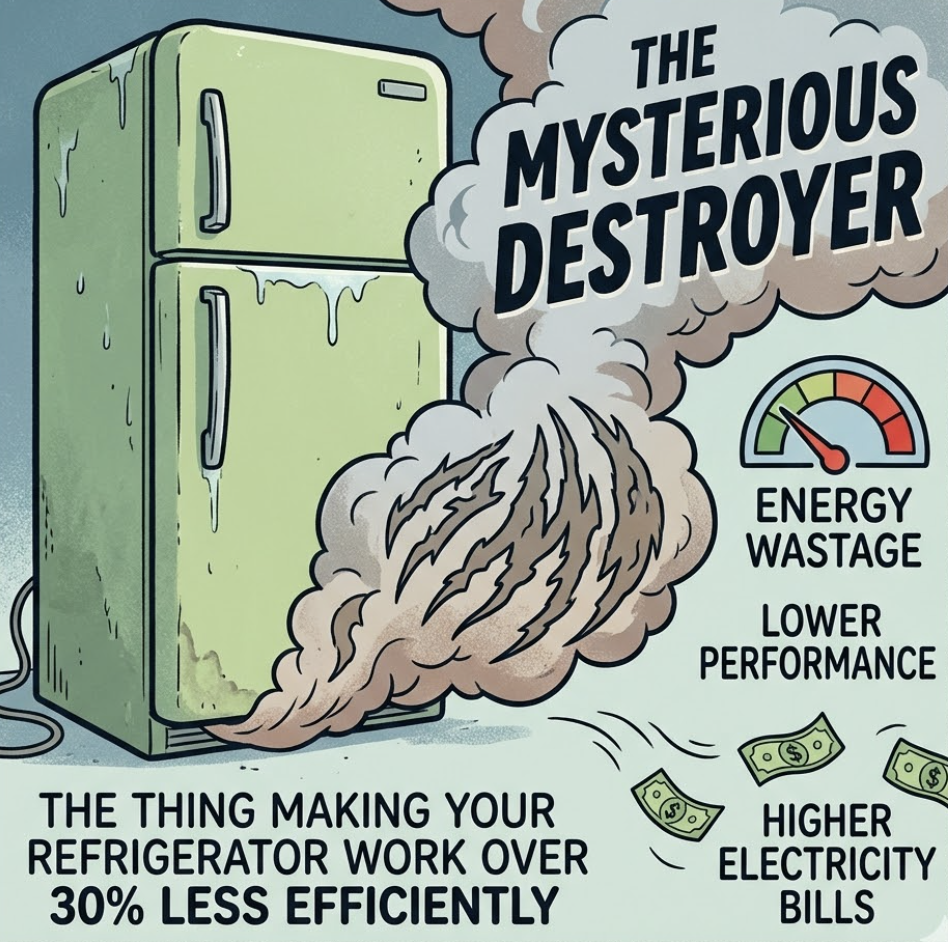
Many people immediately panic and call a refrigerator repair technician because they think the fridge is out of gas or the compressor is broken. As a result, you can easily get overcharged millions of dong by dishonest technicians for problems that do not even exist. In reality, 30% of your refrigerator’s energy efficiency has been destroyed by an extremely tiny factor, a silent destroyer clinging to the back of the fridge that you have ignored for years.
DETAILED CONTENT: THE HIDDEN CULPRIT AND ITS DESTRUCTIVE MECHANISM
- A Wall of Dust on the Condenser Coils
A refrigerator works based on the principle of the thermodynamic cycle: it does not create cold air by itself. Instead, it pulls warm heat from inside the refrigerator and releases that heat into the outside environment through the condenser coil system attached to the back of the fridge or underneath it.
Because the refrigerator is always placed in a fixed corner of the kitchen close to the wall, where air circulation is poor and cleaning is very difficult, over time, a layer of dust, cobwebs, combined with grease from cooking, sticks thickly to this condenser coil system.
This dust layer acts like a giant insulating wall. It completely blocks the cooling process of the refrigerant from releasing heat into the surrounding air. When heat cannot escape, the internal cooling system becomes stalled. The refrigerator falls into a state of “heat suffocation,” causing the cooling level inside to drop seriously even though the compressor is still operating at full power.
- Double Consequences: Electric Bill Skyrockets and Compressor Lifespan Drops Sharply
When the condenser coils are covered in dust, two serious consequences immediately happen to your household:
The electric bill skyrockets: As explained, when the refrigerator cannot release heat, the temperature inside the compartments cannot reach the standard level needed to trigger the power-off sensor. The compressor will run continuously 24/7 without rest. This increases electricity consumption by up to 30–40%, turning the refrigerator into the most expensive appliance in the house.
The compressor gets destroyed: A refrigerator motor is designed to run intermittently. Being forced to run continuously in a high-temperature environment causes the lubricating oil inside the compressor to dry out and the pistons to wear down quickly. After only a short time, the compressor can burn out completely. The cost of replacing a new compressor today ranges from 2 to 4 million dong—a huge amount of money for a problem caused by not cleaning.
- The “Expert Standard” Refrigerator Maintenance Process in 10 Minutes at Home
You can completely rescue your refrigerator yourself and save millions of dong in repair costs with this simple 3-step process:
Step 1: Safely disconnect the power: Unplug the refrigerator from the outlet. Move the refrigerator at least 50 cm away from the kitchen wall to expose the entire back of the fridge.
Step 2: Vacuum and sweep away cobwebs: Use the brush attachment on your vacuum cleaner to remove the thick dust layer stuck to the metal coils behind or underneath the fridge. If the dust is stuck with kitchen grease, use a soft paintbrush dipped in a little diluted dish soap to wipe gently. Avoid using sharp objects because they can puncture the gas pipe.
Step 3: Create open space for airflow: When placing the refrigerator back in its old position, make sure the distance between the back of the fridge and the wall is at least 10 cm, and both sides of the fridge are at least 5 cm away from the wall. This distance creates an air convection corridor, helping the fridge release heat as quickly as possible and optimize electricity consumption.
CONCLUSION & CTA
A refrigerator working poorly is not always caused by complex technical damage. Sometimes, it only needs a little attention and a vacuum cleaner. Clean the back of your refrigerator at least once every 6 months to protect your appliance and your wallet.
CTA: When was the last time you pulled out your refrigerator to clean the back? Share honestly in the comments below! If you find this article helpful, give me a like and follow so you don’t miss more amazing household knowledge!