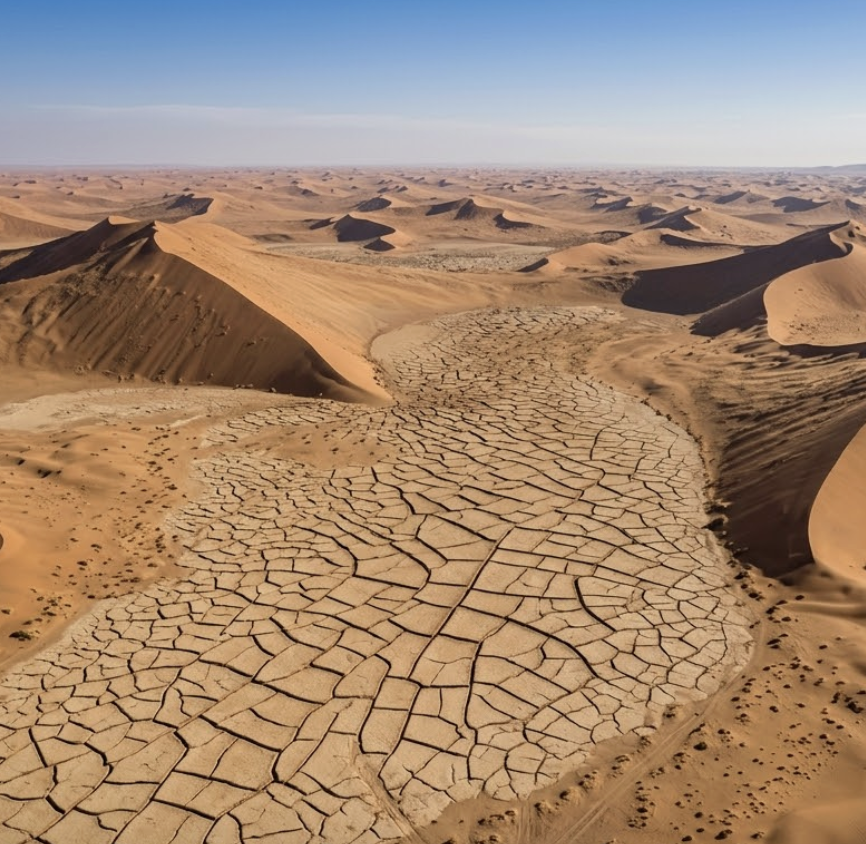
Imagine living in a place where a rainfall is so rare that people remember it for years.
A place where the ground is cracked, the landscape appears lifeless, and the horizon looks more like another planet than Earth.
These places are real.
And some of them are so dry that measurable rainfall may not occur for years at a time.
To many people, that sounds impossible.
After all, rain is one of the most common parts of weather.
Yet there are regions on Earth where water from the sky is almost absent.
The question is why.
Why do some places receive abundant rainfall while others seem forgotten by the clouds?
The answer lies in a fascinating combination of geography, atmosphere, oceans, and climate.
What Actually Makes a Desert?
When most people think of deserts, they imagine endless dunes under a blazing sun.
But heat alone does not create a desert.
In fact, some deserts are surprisingly cold.
The defining characteristic of a desert is not temperature.
It is the lack of precipitation.
A region is generally considered a desert when it receives very little rainfall each year.
Some deserts receive less than 10 centimeters of rain annually.
Others receive only a few millimeters.
To put that into perspective, some cities receive more rain in a single afternoon thunderstorm than certain deserts receive in an entire year.
The Atacama Desert: One of the Driest Places on Earth
One of the most famous examples is the Atacama Desert in northern Chile.
Scientists consider parts of the Atacama among the driest places on Earth.
Certain weather stations there have recorded years, and in some cases decades, with almost no significant rainfall.
The landscape is so dry that it has often been compared to Mars.
Researchers even use the Atacama to test equipment designed for future missions to the Red Planet.
Standing in parts of the desert feels surreal.
The ground appears frozen in time.
Vegetation is sparse.
Some areas look as though rain has never touched them.
Yet despite the harsh conditions, life still exists.
Tiny organisms, specialized plants, and remarkably adaptable animals have found ways to survive where water is almost nonexistent.
The Rain Shadow Effect
One major reason some places become extremely dry is a phenomenon known as the rain shadow effect.
Imagine moist air traveling inland from an ocean.
When that air encounters a mountain range, it begins to rise.
As it rises, it cools.
Cooler air cannot hold as much moisture, so clouds form and rain falls on the side of the mountain facing the ocean.
By the time the air reaches the other side, much of its moisture is gone.
The descending air becomes warmer and drier.
As a result, the region behind the mountains receives very little rainfall.
This creates a dry zone known as a rain shadow.
Many of the world’s deserts owe their existence, at least in part, to this process.
The mountains essentially block the rain before it can reach the land beyond.
The Role of Ocean Currents
Another surprising factor is the ocean itself.
You might assume that areas near the sea would always be wet.
In reality, certain cold ocean currents can contribute to extreme dryness.
Cold water cools the air directly above it.
Cool air holds less moisture than warm air.
Because there is less moisture available, cloud formation becomes more difficult.
With fewer clouds, rainfall decreases dramatically.
This is one of the reasons why several major deserts exist close to coastlines.
The Atacama Desert, for example, is strongly influenced by the cold Humboldt Current flowing along South America’s Pacific coast.
The nearby ocean helps create one of the driest environments on Earth.
High-Pressure Systems and Permanent Dryness
Some deserts exist because of large-scale atmospheric circulation.
Around thirty degrees north and south of the equator, air that rose near the equator begins descending back toward the surface.
As the air sinks, it becomes warmer and drier.
Dry air suppresses cloud formation.
Without clouds, rainfall becomes rare.
This pattern creates broad desert belts around the planet.
Many famous deserts—including the Sahara, Arabian Desert, and parts of Australia’s interior—exist largely because of these persistent high-pressure systems.
The atmosphere itself acts as a barrier against rain.
Life Finds a Way
Despite their harsh appearance, deserts are not lifeless.
In fact, some of the most remarkable survival strategies in nature evolved in dry environments.
Certain plants remain dormant for years, waiting for a rare rainfall.
When rain finally arrives, they bloom rapidly, produce seeds, and complete their life cycle before the water disappears again.
Animals have adapted as well.
Some obtain most of their water from food.
Others are active only during cooler nighttime hours.
A few can survive with almost no direct water intake at all.
Human communities living in deserts have developed equally impressive solutions.
Ancient civilizations built irrigation systems.
Modern cities rely on reservoirs, pipelines, and advanced water conservation technologies.
Where water is scarce, innovation often becomes essential.
The Surprising Truth About Deserts
Many people associate deserts exclusively with heat.
Yet some of the world’s coldest regions also qualify as deserts.
Parts of Antarctica receive so little precipitation that they are technically considered desert environments.
Snowfall is extremely limited in certain areas.
The air is simply too cold to hold much moisture.
This reveals an important scientific truth.
Deserts are not defined by temperature.
They are defined by dryness.
A frozen landscape can be a desert.
A scorching landscape can be a desert.
What matters is how little water falls from the sky.
A World Shaped by Water’s Absence
Rain shapes rivers, forests, farms, and ecosystems.
But the absence of rain shapes landscapes too.
The world’s driest regions remind us how powerful water truly is.
Without it, mountains erode differently.
Plants evolve differently.
Animals behave differently.
Entire ecosystems follow different rules.
And perhaps the most remarkable thing about Earth’s driest places is not how barren they appear.
It is that life continues to exist there at all.
Because even in places where the sky seems to have forgotten how to make rain, nature still finds a way to endure.
The next time you see a rainstorm pass overhead, it may be worth remembering that somewhere on Earth, there are people living in places where such a sight would be considered extraordinary.
Places where a single rainfall can become a story remembered for years.
Leave a Reply